

Enterprise Sales Negotiations: Frameworks, Talk Tracks, and Tactics That Protect Your Margin
You're three months into a $250K deal. The champion loves you. The technical evaluation went clean. Then procurement sends a 47-page redline and asks for 25% off - and suddenly you're negotiating against a professional whose entire job is to extract concessions from people like you.
Enterprise sales negotiations aren't a conversation about price. They're a structured, multi-party chess match where 80% of the outcome gets decided before you sit down at the table. RED BEAR research found that every $1 invested in negotiation training returns $54 in value. Yet most AEs wing it.
Why Enterprise Deals Require a Different Approach
Selling to a 50-person startup and selling to a Fortune 500 are fundamentally different disciplines. The enterprise buying process often involves around 13 stakeholders across multiple departments - IT, finance, legal, compliance, the business unit, and often a dedicated procurement team measured on savings and commercial outcomes.
The numbers reflect this complexity. Enterprise deals typically run $100K+ in ACV, with sales cycles stretching 6-24 months. The enterprise software market is projected to hit $280.5B in 2026, growing at 12.1% CAGR. Every percentage point of discount you concede compounds across renewals.
Here's what makes these negotiations stacked against you: by the time you're in the negotiation phase, you've invested months of selling effort. Procurement knows this. They know your sunk cost makes you psychologically reluctant to walk away, and they'll use that asymmetry - through time pressure, competitive threats, and scope unbundling - unless you've prepared for it. Meanwhile, 61% of B2B buyers now prefer a rep-free buying experience. That means when buyers do engage with you, the stakes are higher and the scrutiny is sharper. You're not educating anymore - you're defending value against people who've already done their homework.
One stat we keep coming back to: deals closed within 50 days have a 47% win rate. Beyond that, win rates drop to 20% or lower. Speed matters, but not at the expense of margin.
What You Need (Quick Version)
- Three frameworks to internalize: BATNA/ZOPA for positioning, the Concession Matrix for trade planning, and the 12 Non-Price Levers for protecting margin without saying "no."
- The contrarian thesis: Preparation beats persuasion. The best negotiators aren't smooth talkers - they're the ones who've mapped every stakeholder, modeled every concession, and rehearsed every objection before the call starts.
- The #1 leverage mistake: Being single-threaded. If your only relationship is with the champion, procurement controls the deal. Multi-thread into finance, the executive sponsor, and the end-user team.
- The math that matters: On a $500K deal, a 15% discount costs you $75K/year. Non-price levers can recoup more than that over the contract term.
- The timeline: Expect the negotiation phase to run 4-12 weeks once procurement engages. Plan accordingly.
Building a Data-Driven Negotiation Plan
The best enterprise AEs we've worked with spend more time preparing for negotiations than they spend in them. That's what separates reps who protect margin from reps who give away the farm.
BATNA, ZOPA, and Anchoring
BATNA (Best Alternative to a Negotiated Agreement) isn't just an acronym from your MBA program. In enterprise deals, your BATNA is the concrete fallback if this deal dies - another opportunity in your pipeline, a smaller scope deal with the same buyer, or walking away entirely. The buyer has a BATNA too: a competitor's proposal at a lower rate, their incumbent vendor, or building in-house. Don't assume they're bluffing. They might actually have one.
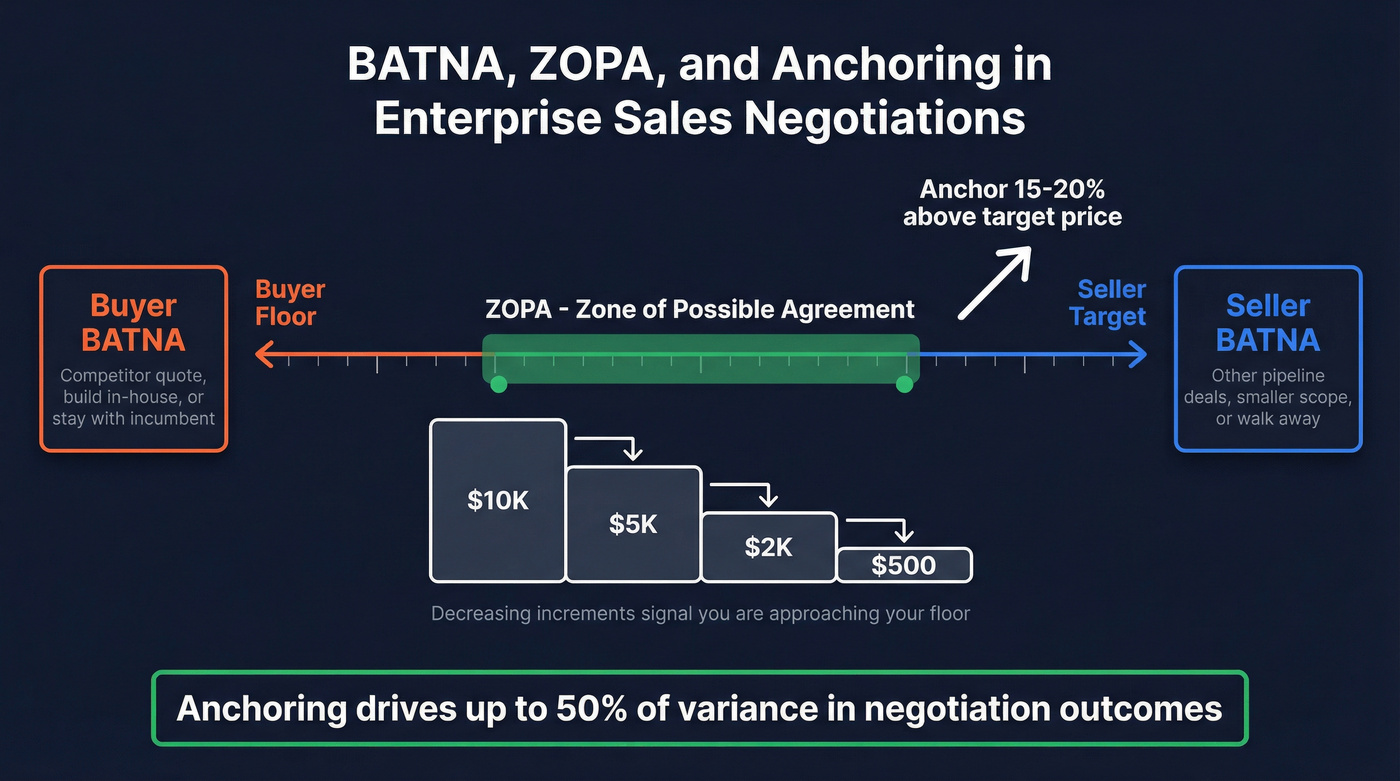
ZOPA (Zone of Possible Agreement) is the overlap between your minimum acceptable terms and the buyer's maximum willingness to pay. Your job in preparation is to estimate both boundaries as precisely as possible.
Anchoring can drive up to 50% of the variance in negotiation outcomes, which is a staggering number when you think about it. The first number on the table shapes everything that follows. Anchor 15-20% above your target price. When a buyer drops an extreme low anchor, don't inch toward it - re-anchor entirely and reset the frame. (If you want a deeper breakdown of anchoring mechanics, see our guide on Anchoring.)
Plan your concession pattern in decreasing increments: $10K, then $5K, then $2K, then $500. This signals you're approaching your floor, which psychologically discourages the buyer from pushing further.
The Power Assessment Score
Before any negotiation, score your position using Simon-Kucher's framework: importance of the deal to both sides, competitive environment, your differentiation, and the strength of the relationship. This tells you whether you're negotiating from strength or desperation.
Pair this with the MOCA framework (Matrix of Competitive Advantages) to make your value drivers explicit. Don't assume the buyer remembers why they chose you. Document every differentiator, quantify the business impact, and have those numbers ready when procurement tries to commoditize you. Problem solving and negotiation skills are inseparable in this context - the rep who diagnoses the buyer's real constraints earns more trust than the rep who simply defends a price. (This is also where data-driven selling pays off.)
Multi-Threading as Leverage
Deals with 3+ contacts engaged close 2.4x faster than single-threaded ones. That's not just a pipeline velocity stat. It's a negotiation leverage stat.
Engaging multiple stakeholders before procurement enters the process yields 12-17% better pricing outcomes. On a $300K deal, that's the difference between a 20% discount and a 5% discount. When you have relationships across the buying committee, procurement can't isolate you.
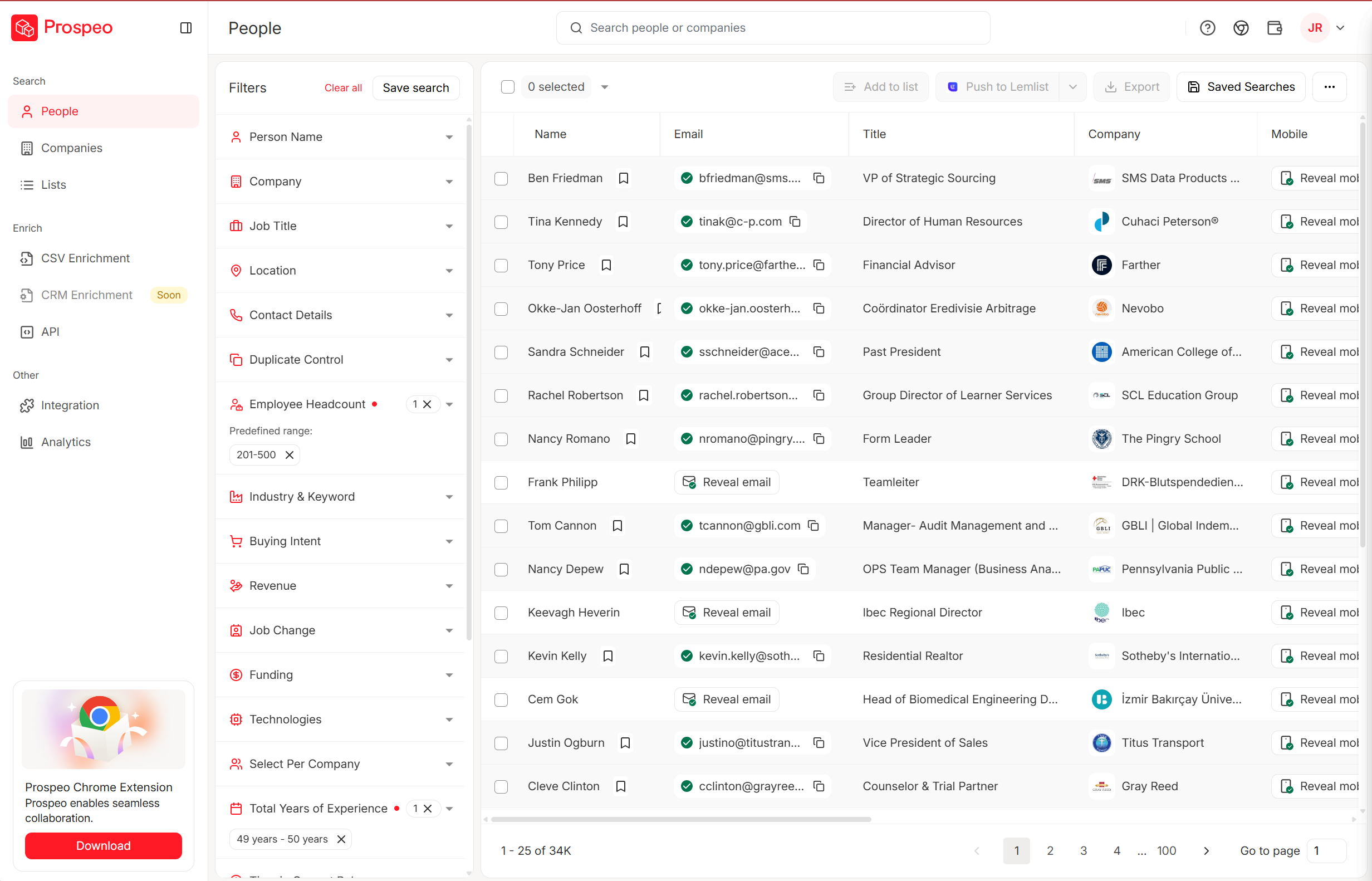
To multi-thread effectively, you need verified contact data for every stakeholder on the buying committee. We use Prospeo's B2B database - 300M+ professional profiles with 98% email accuracy and 125M+ verified mobile numbers - to build stakeholder maps before the first negotiation meeting, not after procurement sends the redline. Walking into negotiation with five relationships instead of one shifts the power dynamic fundamentally. (If you're building this motion, start with account-based selling best practices.)
Non-Price Levers That Protect Margin
On a $500K annual SaaS deal, a 15% discount costs you $75K per year. Over a three-year term, that's $225K in lost revenue. But restructuring the deal - multi-year commitment, annual escalators, expanded scope, adjusted payment terms - can recoup more than the discount over the contract term. These trades let you move on value instead of price, giving both sides something to celebrate.
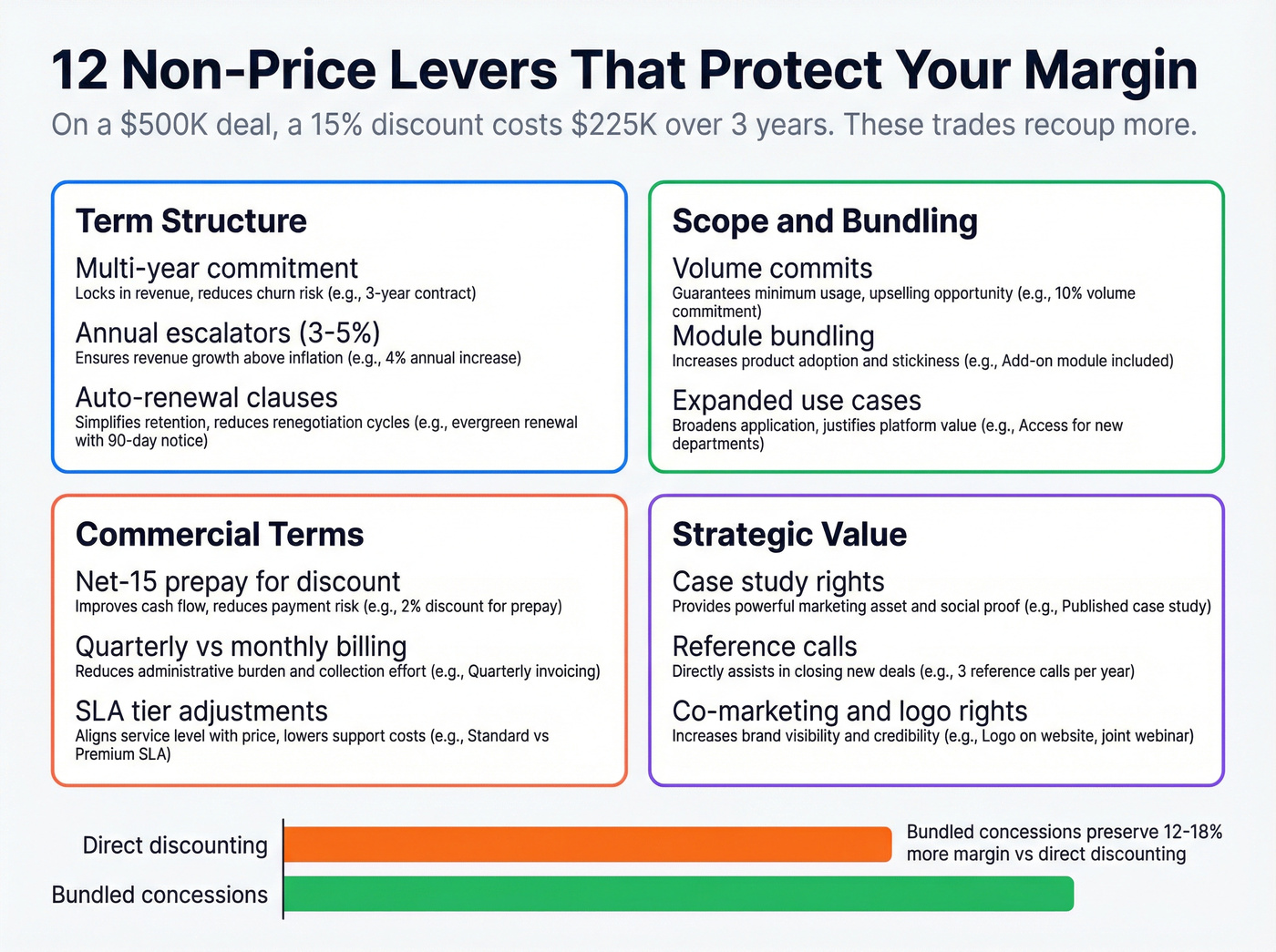
Bundled concessions preserve 12-18% more margin compared to direct discounting. The key is having a structured menu of non-price trades ready before you sit down.
| Category | Levers | Example Trade ($500K Deal) |
|---|---|---|
| Term Structure | Multi-year, escalators, auto-renewal | 3yr commit -> 8% discount + 4% escalator |
| Scope | Volume commits, module bundling | Bundle analytics -> $40K value, offset 5% |
| Commercial | Payment terms, billing, SLA tiers | Net-15 prepay -> 3% discount |
| Strategic | Case study, references, co-marketing | Logo rights + 2 refs -> 2% discount |
The concession matrix breaks trades into four tiers: sacrifices (low cost to you, high value to buyer - give these freely), bargaining chips (moderate cost, moderate value - trade for something), battlefield concessions (high cost, high value - fight hard), and walk-away concessions (deal-breakers you won't cross). Every concession you make should earn something in return. (Related: how to define your walk-away point.)
A Deal Where This Actually Worked
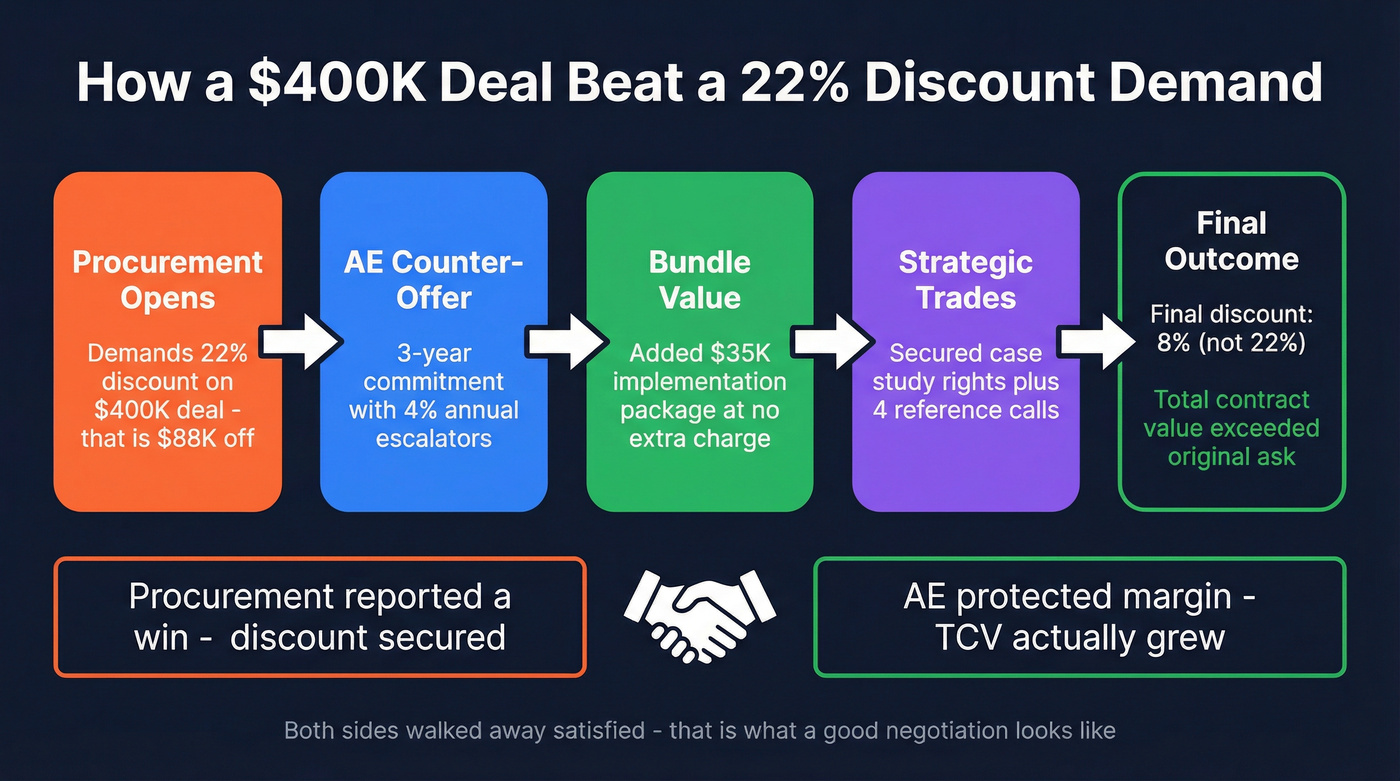
A mid-market SaaS company was negotiating a $400K platform deal with a Fortune 1000 retailer. Procurement opened with a 22% discount demand. Instead of caving, the AE offered a three-year commitment with 4% annual escalators, bundled an implementation package worth $35K, and secured case study rights plus four reference calls. The final discount landed at 8% - but the escalators and expanded scope meant the deal's total contract value actually exceeded the original ask. Procurement got to report a "win." The AE protected margin. Everyone walked away satisfied.
Annual escalators of 3-5% are standard in enterprise SaaS. If procurement pushes back on escalators, that's a concession you can trade - but know what you're getting in return. Never concede without a reciprocal ask.
Five Talk Tracks for Pricing Objections
Every enterprise deal hits at least one of these moments. Having a rehearsed response - not a scripted one, but a practiced one - prevents reactive concessions. Reframing competitive pricing conversations yields 23% higher margins on average. Here's how top performers handle the pressure without flinching.
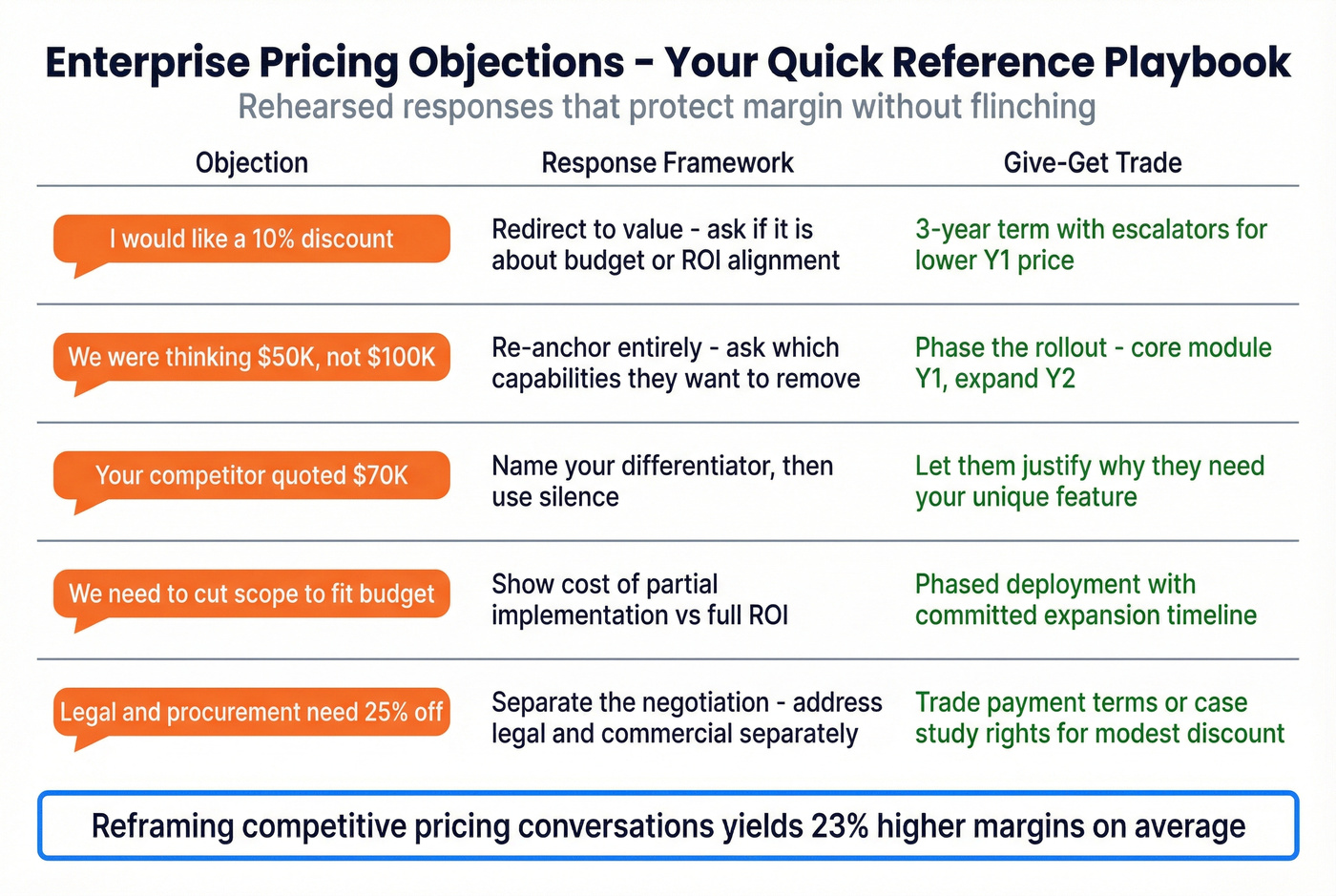
"I'd Like a 10% Discount"
Most reps hear "discount" and start calculating. Instead, redirect to value.
Start with a pattern-interrupt: "I appreciate you being direct. Help me understand - is this about budget constraints, or about making sure the value lines up with the investment? Because if it's value, let's walk through the ROI model together."
If the buyer can't articulate why the price is wrong - only that they want it lower - you have leverage. The give-get: "I can look at adjusting the price if we extend to a three-year term with annual escalators. That gives you a lower year-one number and gives us predictability."
"We Were Thinking $50K, Not $100K"
Don't inch. Re-anchor entirely.
"That's a significant gap from what we've scoped. Let me ask - at $50K, which capabilities are you comfortable removing? Because the solution we've designed delivers [specific outcome], and that's what drives the investment."
Frame the conversation as gains versus status quo, not as a loss from their target. Harvard's Program on Negotiation research shows buyers perceive movement away from their anchor as a loss. Reframe: "This solution saves you $200K annually in [specific cost]. We're offering a $100K solution for a $200K return." The give-get: "If budget is truly capped at $50K, we can phase the rollout - start with the core module this year and expand in year two."
"Your Competitor Quoted $70K"
"That's good to know. Feel free to go with them - but could you really live without [specific differentiator]? Because that's the gap between their offer and ours."
Then use silence. Let the buyer sit with the question. In our experience, about 60% of the time they'll start justifying why they actually need your differentiator. They talk themselves out of the competitor. The give-get: "If you can share the competing proposal's scope, I'll show you exactly where the value gap is - and we can discuss whether a phased approach gets you closer to that number."
"Just Close for X and Move On"
This is the bazaar-style dynamic that r/sales practitioners describe - the buyer trying to force-close at a lower number through sheer repetition and pressure.
The psychology here matters more than the script. You need to be genuinely willing to walk away. Buyers can sense desperation, and it costs you margin every time. A confident response: "You seemed okay with the price when we were discussing the solution last week - what changed?" This forces the buyer to either reveal new information or admit they're simply testing you. The give-get: "I can't move on price alone, but I can restructure the payment schedule to ease the cash flow impact this quarter."
"We Need to Run This by Procurement"
This isn't an objection - it's a transition. But it's the most dangerous moment in the deal if you're not prepared.
"Absolutely - that's standard. Before we loop them in, let's align on the business case and the terms you're comfortable with. That way, when procurement asks about value, you can speak to it directly."
The goal is to anchor pricing with your champion before procurement enters. Pre-procurement anchoring is the single most effective tactic for protecting margin in enterprise deals. The give-get: "Let's also identify who on your side will be in the procurement meetings - I want to make sure we have the right technical and business context in the room."

Multi-threading wins enterprise negotiations - but only if you have verified contacts for every stakeholder. Prospeo gives you 300M+ profiles, 125M+ verified mobiles, and 98% email accuracy so you walk into procurement calls with five relationships, not one.
Stop negotiating single-threaded. Build your buying committee map now.
How to Handle Procurement
Procurement professionals have three primary weapons: information, supplier pressure, and time.
Information control is their strongest play. They'll ask for your cost structure, your discount history, your internal timeline. Every piece of information you share gets used against you. The RED BEAR framework puts it simply: once shared, information can't be unshared. Never reveal your internal deadline, your pipeline pressure, or your discount authority level.
Supplier pressure comes as competitive bids - real or manufactured. Counter with early anchoring using credible data: third-party benchmarks, prior agreement terms, or projected ROI.
Time pressure is procurement's favorite closing tactic. They'll slow-roll the process, then create artificial urgency near quarter-end. Don't reveal your internal deadlines. Instead, redirect to their constraints: "Assuming we're aligned on value and terms, what's your capacity for implementation in Q3?" When procurement meetings happen over video, you lose body-language cues, so ask more explicit discovery questions and confirm alignment in writing after every call.
Use Stage 2 questioning to uncover procurement's own pressures: "What milestones are critical for your team in the next 60 days?" and "How does this deal impact your broader business goals?" These questions shift the power dynamic. Suddenly you're not the only one with constraints. One r/sales thread put it well: procurement's job is to make you feel like you're losing the deal so you'll discount preemptively. Knowing that is half the battle.
MSA Clauses That Become Battlegrounds
Legal review is where deals go to die slowly. Knowing the standard positions - and your fallback ranges - prevents weeks of unnecessary redlining. Your job as the AE during this phase is internal quarterback: coordinating comments from legal, finance, and security so procurement gets one clean response, not three conflicting redlines.
| Clause | Vendor Position | Buyer's Ask | Recommended Fallback |
|---|---|---|---|
| Liability Cap | 12 months of fees | Unlimited / 24+ months | 18-24 months of fees |
| SLA Uptime | 99.9% | 99.95%+ with credits | 99.9% with tiered credits |
| Indemnity | IP infringement only | Broad indemnity | IP + data breach, capped |
| Termination | 90-day notice, for cause | 30-day, for convenience | 60-day notice, mutual |
| Payment Terms | Net 30 | Net 60-90 | Net 45 |
| DPA/Security | Standard addendum | Custom security review | SOC 2 + standard DPA |
| Auto-Renewal | 12-month auto-renew | No auto-renewal | Auto-renew, 60-day opt-out |
| IP Ownership | Vendor retains all IP | Customer owns customs | Vendor IP, customer data |
| Force Majeure | Standard clause | Expanded scope | Standard with notification |
| Governing Law | Vendor's jurisdiction | Buyer's jurisdiction | Neutral or vendor state |
Most of these clauses have well-established norms in enterprise SaaS. The liability cap fight is the most common - buyers want unlimited liability, vendors want 12 months of fees. Landing at 18-24 months is standard. Know your company's red lines before you enter legal review, and involve outside counsel early for larger deals.
Five Mistakes That Kill Deal Margins
Teams using negotiation psychology principles achieve 32% higher close rates. The MESO approach - presenting Multiple Equivalent Simultaneous Offers - can increase close rates by up to 34%. Here's what the losing side gets wrong.
The endowment effect. You overvalue your own product and assume the buyer sees the same worth. They don't. They see a line item on a budget. Counter this by quantifying value in the buyer's terms - cost savings, revenue impact, risk reduction - not your feature list. (More on value framing: how to add value in sales.)
Single-issue focus. When the entire negotiation collapses to price, you've already lost. Expand the conversation to include implementation timeline, scope, payment terms, and strategic value. More issues on the table means more room to trade.
Poor framing. Buyers perceive movement away from their anchor as a loss. If they anchored at $50K and you're at $100K, don't negotiate down from $100K - reframe as gains versus their status quo. "You're spending $150K annually on the problem this solves. We're offering a $100K solution for a $200K return."
Reactive concessions. You give something without getting something back. Every concession should be paired with a reciprocal ask. "I can adjust the payment terms to net-60 if we can lock in a three-year commitment." Never concede unilaterally - it trains the buyer to keep pushing.
Wrong authority in the room. If the person across the table can't say yes, you're negotiating with a messenger. Messengers lose nuance. Always confirm decision-making authority before entering substantive negotiation - qualifying authority early saves you from hours of conversation that'll just get re-litigated with the actual decision-maker. (If you're formalizing qualification, see MEDDPICC economic buyer.)
Let's be honest about one thing: if your deal size is under $50K, you probably don't need a formal negotiation playbook. You need faster deal velocity and fewer concession conversations. The frameworks in this article are built for deals where the margin impact of a bad negotiation exceeds the cost of preparing for a good one. Below that threshold, standardize your pricing, hold the line, and move on.
Tools That Shift Negotiation Leverage
56% of sales professionals now use AI daily, up from 24% in 2023. Three categories of tools are reshaping how enterprise deals get closed.
Conversation intelligence platforms like Gong and Jiminny record, transcribe, and analyze negotiation calls. Outreach's Kaia assistant closes deals 11 days faster on average, with up to +10 percentage points win-rate lift on deals over $50K. Reviewing call recordings is one of the fastest ways to improve how your reps talk pricing - you'll spot patterns in your own language that either build or erode confidence. (If you're tightening your process end-to-end, see sales process optimization.)
B2B data platforms enable the multi-threading that drives negotiation leverage. When you need to reach the CFO, the CISO, and the VP of Operations before procurement locks you out, verified contact data is the foundation. Prospeo covers 300M+ profiles with 98% email accuracy and 125M+ verified mobiles, starting at roughly $0.01/email with a free tier - no contracts, no "talk to sales" gates. (Related: best sales prospecting databases.)
CLM tools like Ironclad and DocuSign CLM accelerate the legal phase by automating redlines, clause libraries, and approval workflows. Enterprise deployments typically run $30K-$100K+/year, but when the MSA review drags for six weeks, the ROI is obvious.
For reps looking to deepen their craft, Getting to Yes by Fisher and Ury and Never Split the Difference by Chris Voss remain essential reading. The principles of interest-based bargaining and tactical empathy translate directly to enterprise deal work.
Every 1% discount you concede on a $500K deal costs $15K over three years. The reps who protect margin are the ones who reach the CFO, the executive sponsor, and end-users before procurement isolates them. Prospeo's 30+ filters and 7-day data refresh ensure you're contacting the right people with current, verified data.
Protect your margin by reaching every decision-maker first.
Post-Signature Pricing Best Practices
The deal is signed. The celebration lasts about 30 minutes. Then the real work starts.
Document every concession you made and why. Your VP will ask why average discount crept from 12% to 19% this quarter - you need an answer that isn't "procurement was tough." Build a concession log that tracks what you traded, what you got in return, and whether the trade was worth it. Think of it as a pricing cheat sheet your team can reference for every future deal in the same vertical.
Establish discount governance frameworks with clear approval tiers: reps can approve up to 10%, managers up to 20%, VP sign-off above that. Guardrails prevent the slow margin erosion that kills SaaS economics over time. (If you want to quantify the downstream impact, see what is a sales margin.)
Run win/loss analysis on your concession patterns quarterly. Which non-price levers actually moved deals? Which concessions did buyers value most? This data compounds - by the third quarter, your team negotiates from pattern recognition, not instinct.
Start renewal preparation at signature, not 90 days before expiry. The seeds of your next negotiation - usage data, expansion opportunities, champion changes - are planted the day the contract starts. The best negotiators don't win at the table. They win in the weeks before it. (Related: improving renewal rate.)
FAQ
How long do enterprise deal negotiations typically take?
Expect 4-12 weeks depending on deal complexity, legal review scope, and procurement involvement. Deals closed within 50 days have a 47% win rate; beyond that, odds drop to 20% or lower. Plan for the procurement and legal phases explicitly in your deal timeline - they're where most time gets lost.
What's a reasonable discount range for enterprise SaaS?
Industry norms run 10-15% on deals under $100K, 15-25% on $100K-$500K, and 20-35% on $500K+. Non-price levers - term length, scope adjustments, payment terms, strategic trades - often deliver more value to the buyer than straight discounts while preserving your margin.
How do you negotiate against procurement teams?
Engage business stakeholders before procurement enters the process - this yields 12-17% better pricing outcomes. Anchor pricing early with credible data, never reveal internal deadlines or budget constraints, and use Stage 2 questioning to uncover procurement's own pressures. Preparation outweighs persuasion every time.
What tools help with multi-threading in enterprise deals?
Conversation intelligence platforms like Gong and Outreach Kaia provide real-time coaching and post-call analysis. B2B data platforms like Prospeo enable multi-threading across the buying committee with verified emails and direct dials - 300M+ profiles at 98% accuracy. CLM tools accelerate the contract review phase that often stalls deals for weeks.
Does humor have a place in enterprise negotiations?
Used carefully, humor can defuse tension and build rapport - especially during tense procurement calls. A well-timed, self-deprecating comment can reset the emotional temperature of a stalled conversation. But it needs to be genuine and situationally appropriate; forced humor reads as deflection and undermines credibility.