

Enterprise SaaS Sales: Benchmarks, Frameworks, and Hard Numbers Other Guides Won't Tell You
You've read five enterprise sales guides this week that all say "build relationships" and "align with stakeholders." None gave you a single number you could use in a forecast model. This field guide covers the actual benchmarks, frameworks, and comp figures for enterprise SaaS sales - the stuff that matters when you're closing six-figure deals or deciding whether moving upmarket is worth the pain.
The Short Version
Enterprise SaaS sales means $100K+ ACV, 6-18 month cycles, and 7-10 stakeholders (11-20 in large enterprise) who can all block the deal. The realistic win rate for $100K+ ACV enterprise motions is 15-20%. Only 40.9% of enterprise AEs hit quota. Three things separate closers from everyone else: MEDDPICC qualification rigor, multi-threading across the buying committee (34% win-rate lift), and verified contact data for every stakeholder on that committee. If a third of your emails bounce, you're single-threading by default - and single-threaded enterprise deals die.
What Enterprise SaaS Sales Actually Looks Like
This motion is the process of selling software at $100K+ ACV to organizations with 6-10+ decision-makers and evaluation cycles stretching 6-18 months. The deals are consultative, relationship-driven, and gated by security, legal, and procurement reviews that simply don't exist in SMB.
Here's the contrarian reframe most guides miss: your buyer doesn't see your nine-stage sales process. They see three questions. "Is this worth my time?" "Can I get this approved internally?" "Will this make me look good?" Every stage in your CRM maps to one of those three buyer questions. If you can't answer all three with data - not slides - you'll lose to the status quo, not a competitor.
Enterprise deals don't die because of price objections. They die in procurement, in security review, and in the gap between your champion saying "we want this" and their CFO actually signing.
| Metric | Enterprise | SMB |
|---|---|---|
| ACV | $100K-$500K+ | $5K-$50K |
| Cycle length | 6-18 months | 1-3 months |
| Decision-makers | 6-10+ | 1-3 |
| Security/compliance | SOC 2, GDPR, CCPA | Minimal / self-attested |
| Sales motion | Consultative | Transactional/self-serve |
Cycle length gets more specific by deal size. Focus Digital's benchmarks show a $50K-$100K deal averages 120 days, while $100K-$250K stretches to 170 days. At $250K-$500K you're looking at 220 days. And $500K+ deals average 270 days - nearly nine months. Company size matters too: selling into a 1,001-5,000 employee org averages 135 days, while 10,001+ employees means 185 days. If your pipeline model assumes 90-day cycles for six-figure deals, your forecast is fiction.
Key Benchmarks for 2026
These are the numbers we wish someone had given us before building our first enterprise forecast.
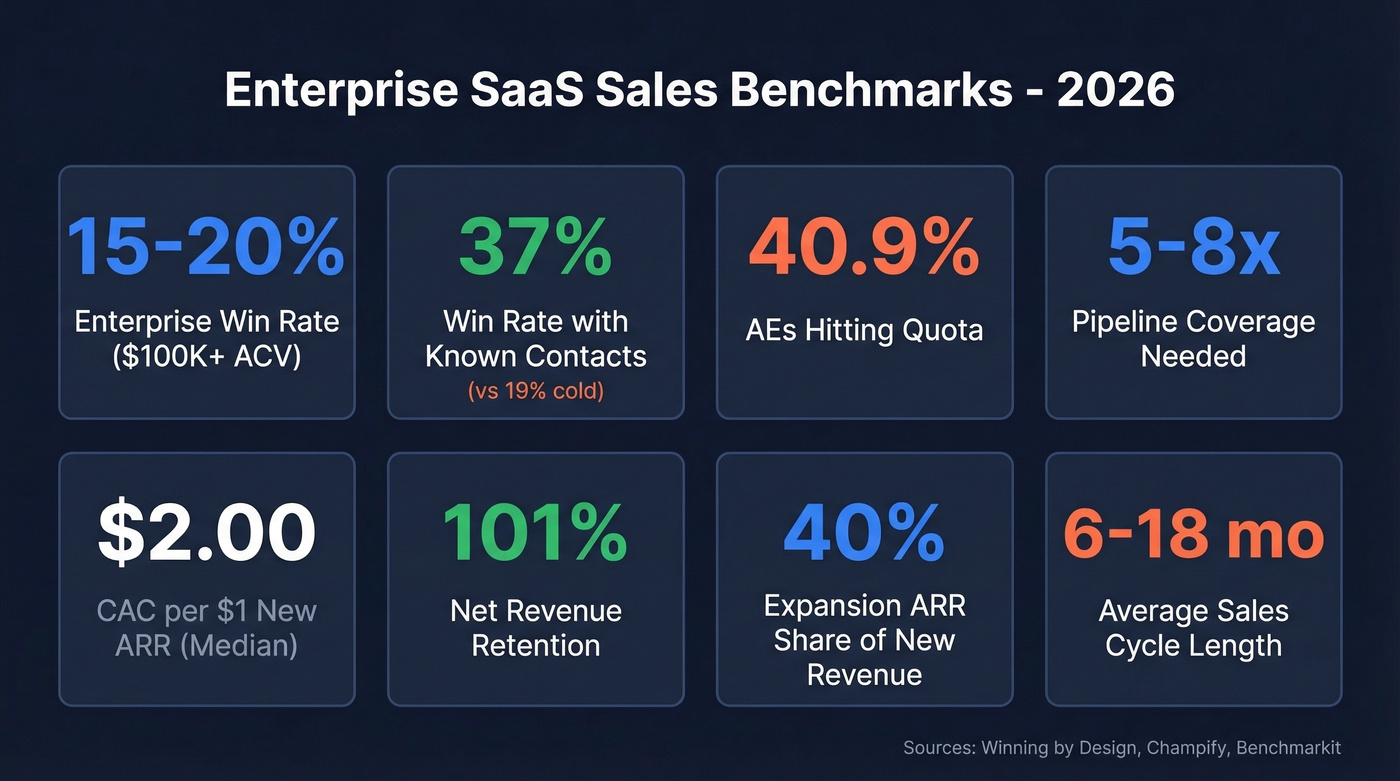
| Metric | Benchmark |
|---|---|
| Average B2B win rate | ~21% |
| Enterprise ($100K+ ACV) win rate | 15-20% |
| "Known contact" deal win rate | 37% vs 19% cold |
| Enterprise AE quota attainment | 40.9% |
| Pipeline coverage needed | 5-8x |
| New CAC ratio (median) | $2.00 per $1 new ARR |
| Net revenue retention | 101% |
| Expansion ARR share | 40% of total new ARR |
The win-rate decline is real. Winning by Design tracked enterprise win rates falling from ~26% to ~17% between late 2022 and early 2023, and the 15-20% range remains the planning benchmark heading into 2026. The Champify Impact Report found that deals sourced through known contacts close at 37% - nearly double the 19% rate for cold outreach. That's the strongest argument for multi-threading and warm introductions you'll find anywhere.
Pipeline coverage of 5-8x is the standard for enterprise motions. At a 17% win rate, you need 6x pipeline to hit target. Most teams run closer to 4x and wonder why they miss. The math doesn't lie.
Here's the formula you should tape to your monitor: Sales Velocity = (# Opportunities x Average Deal Size x Win Rate) / Cycle Length. For enterprise: (50 x $150K x 0.17) / 180 = $7,083/day. If that number doesn't cover your quarterly target, you have a pipeline problem, a win-rate problem, or both.
The silver lining: Benchmarkit's benchmark data shows enterprise deals carry a lower CAC ratio at scale. The median is $2.00 in S&M spend per $1.00 of new customer ARR, and larger ACV bands actually perform better. Combine that with 101% NRR and expansion ARR accounting for 40% of total new revenue, and the unit economics improve dramatically over time - if you can survive the ramp.
The 7-Stage Sales Process
Every enterprise deal moves through seven stages, even when your CRM shows twelve.
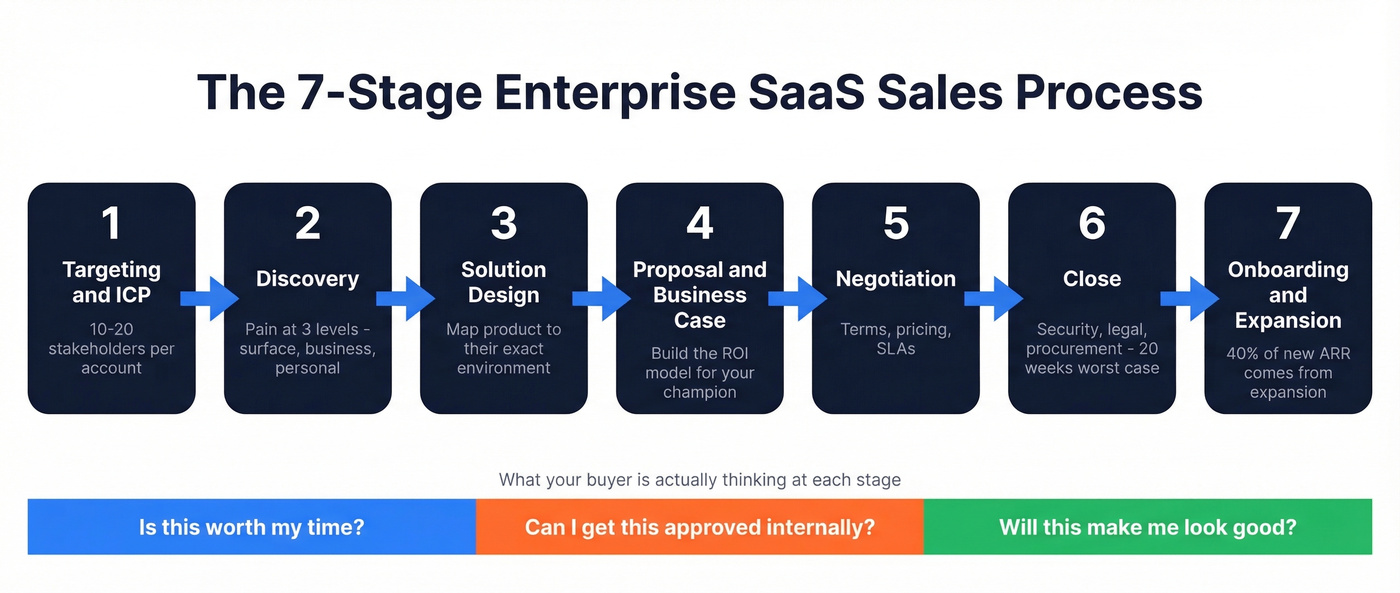
1. Targeting and ICP definition. You're building account lists, identifying 10-20 stakeholders per target account, and layering intent signals to prioritize who's actually in-market. This is where data quality makes or breaks everything downstream. Your SDR team sent 2,000 emails last week. If 680 bounced, you didn't just waste credits - you burned domain reputation and missed half the buying committee. Snyk's 50 AEs faced exactly this problem: bounce rates of 35-40%. After switching to a verified data platform with a 7-day refresh cycle and 98% email accuracy, bounces dropped below 5% and AE-sourced pipeline jumped 180%. If you're tightening list quality, start with email bounce rate benchmarks and fixes.

2. Discovery. Understand the buyer's pain at three levels: surface symptoms, business impact, and personal implications for your champion. Bad discovery is the #1 reason enterprise deals stall at proposal. If you want a tighter structure, use a set of proven discovery questions in every first call.
3. Solution design. Enterprise buyers don't want a demo. They want proof your platform solves their exact problem in their exact environment. Map your product to their specific requirements, not your feature list. A simple product demo checklist helps keep this stage from turning into a feature tour.
4. Proposal and business case. Build the ROI model your champion will carry into the CFO meeting. Buyers spend only 5-6% of their buying time with sales reps. Your champion sells for you the other 94%. Give them ammunition, not brochures.
5. Negotiation. Terms, pricing, SLAs, and the beginning of the procurement gauntlet. If you want a cleaner approach to pricing pressure, use an anchor in negotiation strategy that’s defensible.
6. Close. Security review, legal redlines, procurement approval. Most CRMs collapse these into one stage. That's a mistake - each has its own timeline and blockers.
7. Onboarding and expansion. The deal isn't done at signature. Expansion ARR is 40% of total new revenue. Treat onboarding as the first step of the next sale. If you’re building the post-sale motion, align it to upsell vs cross-sell in SaaS so expansion isn’t random.

You need 5-8x pipeline coverage to hit enterprise quota. That means reaching 10-20 stakeholders per account with emails that actually land. Prospeo's 300M+ profiles, 30+ search filters (buyer intent, technographics, headcount growth), and 98% email accuracy give your AEs the same edge that helped Snyk's 50-rep team cut bounce rates from 35% to under 5% and grow AE-sourced pipeline 180%.
Stop single-threading enterprise deals because half your contacts bounce.
The Procurement Gauntlet
Enterprise deals don't die in negotiation. They die in procurement. Most sales guides pretend this stage doesn't exist.
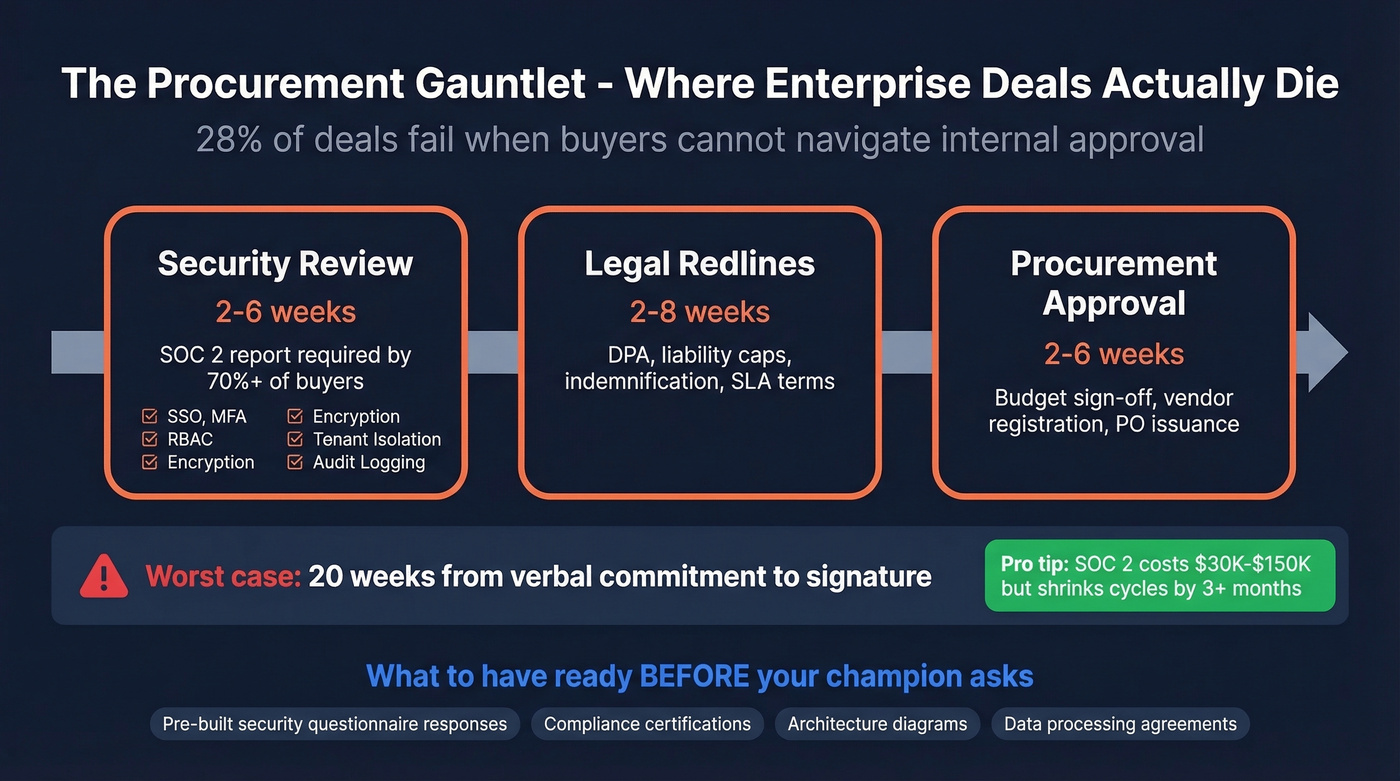
Over 70% of enterprise SaaS deals require a SOC 2 report before contracts get signed. Without one, your deal stalls for months while security sends you a 300-question assessment. SOC 2 certification costs $30K-$150K, but it shrinks sales cycles by 3+ months. That's a no-brainer ROI calculation.
The timeline for a typical enterprise procurement process: security review runs 2-6 weeks, legal redlines take 2-8 weeks, and procurement approval adds another 2-6 weeks. Worst case, you're looking at 20 weeks between verbal commitment and signature. Twenty weeks.
28% of deals fail when buyers can't navigate internal approval. That isn't your product failing - it's your champion failing to sell internally, often because you didn't arm them with pre-built security questionnaire responses, compliance certifications, architecture diagrams, and data processing agreements. Have these ready to ship before your champion asks.
Common table-stakes security for enterprise buyers: SSO, MFA, role-based access control, encryption at rest and in transit, tenant isolation, and audit logging. Missing any of these means you aren't enterprise-ready. Average breach costs hit $4.88M, and US breach costs hit $10.22M. Enterprise buyers aren't being paranoid. They're being rational.
MEDDPICC - The Only Qualification Framework That Matters
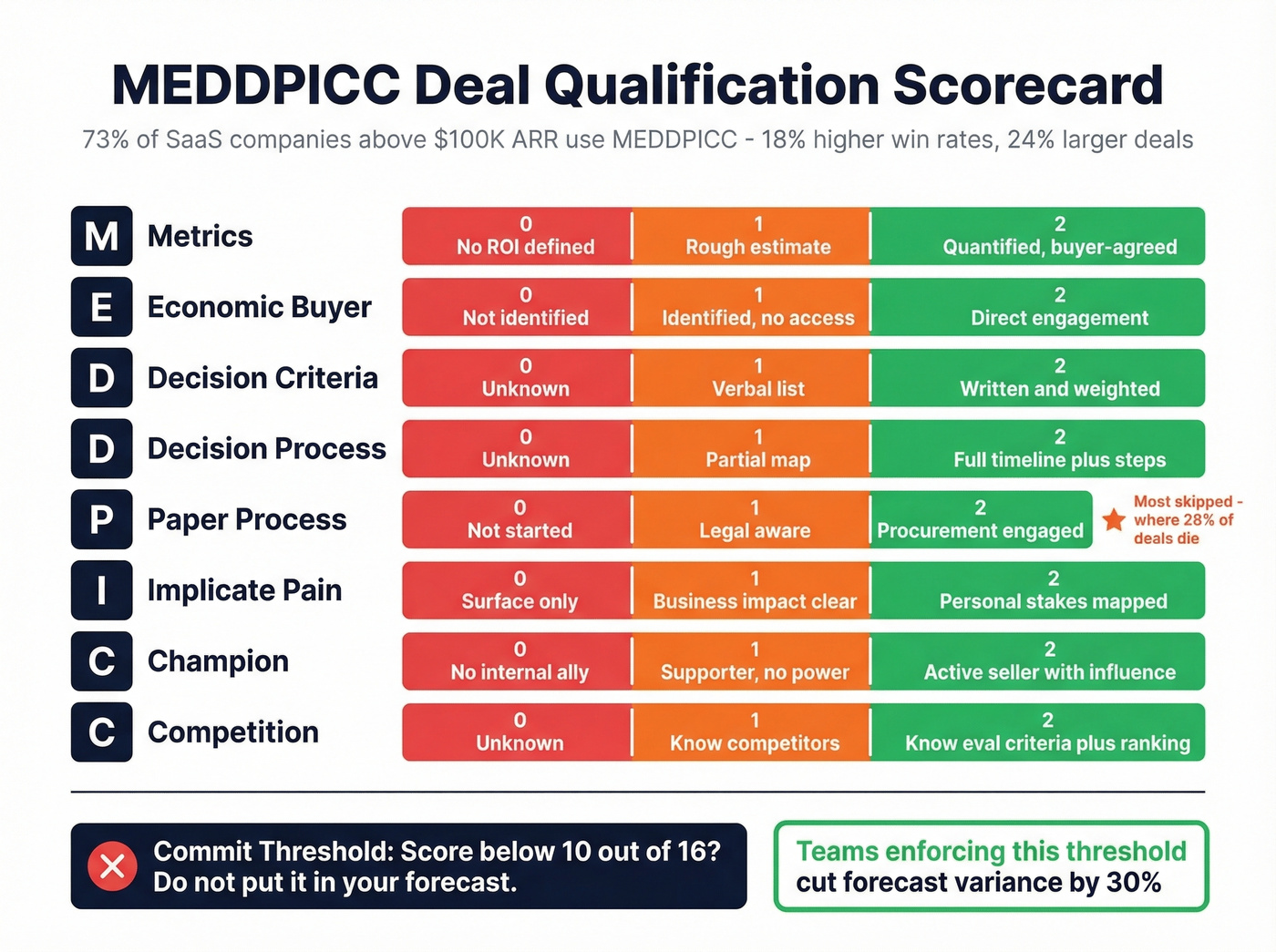
73% of SaaS companies selling above $100K ARR use some version of MEDDPICC. Full adoption correlates with 18% higher win rates and 24% larger deal sizes. Above $100K ACV, MEDDPICC isn't optional. BANT is for SMB.
You'll hear arguments for Challenger, SPIN, or Gap Selling. Those are selling styles, not qualification frameworks. Use whatever conversational approach works for your market - but qualify every deal with MEDDPICC. If you want a deeper implementation, start with MEDDIC sales qualification and then map it to your enterprise stages.
Let's break this down into something you can actually implement this week. Copy this rubric into your CRM's deal review template.
| Element | 0 (Unknown) | 1 (Partial) | 2 (Confirmed) |
|---|---|---|---|
| Metrics | No ROI defined | Rough estimate | Quantified, buyer-agreed |
| Economic Buyer | Not identified | Identified, no access | Direct engagement |
| Decision Criteria | Unknown | Verbal list | Written, weighted |
| Decision Process | Unknown | Partial map | Full timeline + steps |
| Paper Process | Not started | Legal aware | Procurement engaged |
| Implicate Pain | Surface only | Business impact clear | Personal stakes mapped |
| Champion | No internal ally | Supporter, no power | Active seller with influence |
| Competition | Unknown | Know competitors | Know eval criteria + ranking |
A deal scoring below 10 out of 16 shouldn't be in your commit forecast. We've seen teams cut their forecast variance by 30% just by enforcing this threshold in weekly deal reviews. The "Paper Process" element is the one most teams skip - and it's exactly where 28% of deals die. If you’re trying to reduce forecast whiplash, pair this with a tighter pipeline health review.
Multi-Threading and Land-and-Expand
Why Multi-Threading Wins Deals
It's month 7 of a $250K deal. Your champion just got promoted to a different division. The VP who was nodding along in every meeting? She left for a competitor last Friday. Your single thread just snapped - and with it, seven months of work.
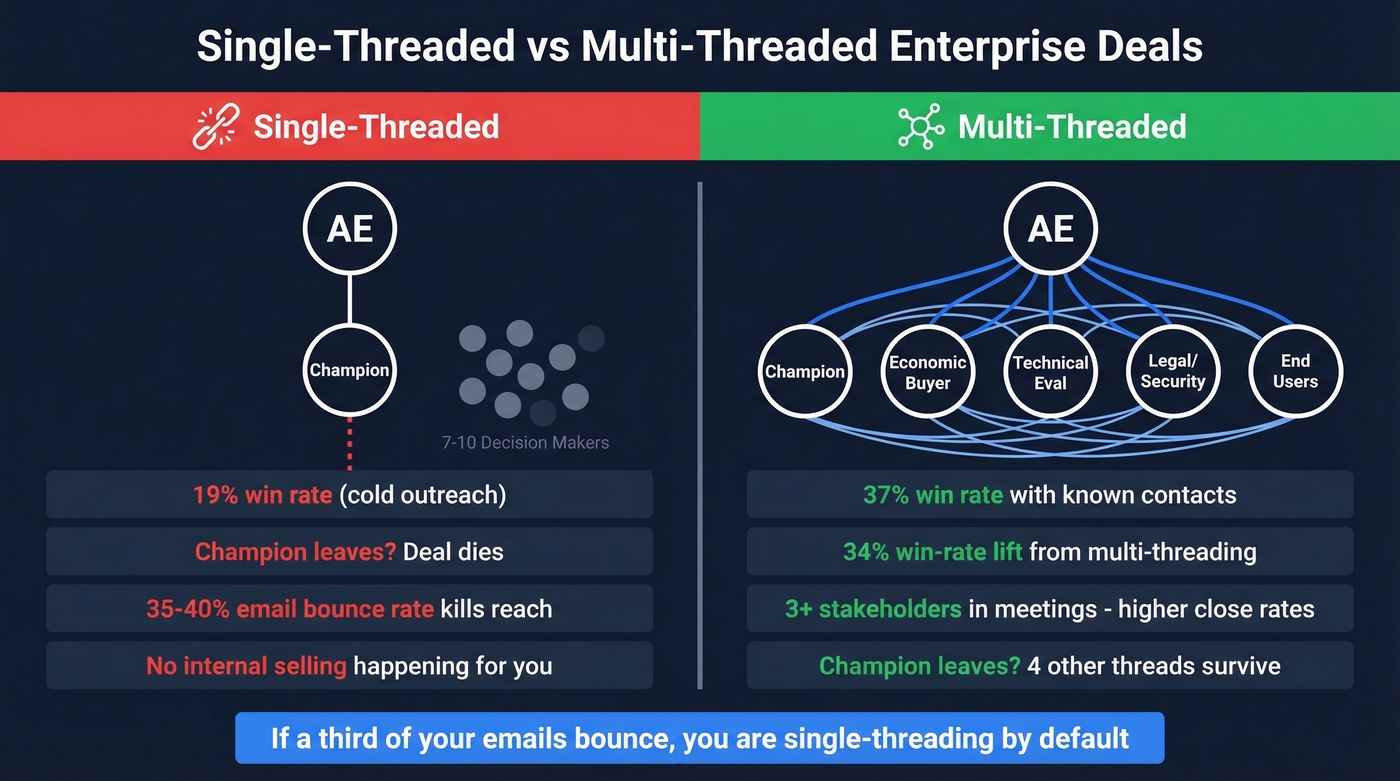
This is the nightmare scenario enterprise AEs trade war stories about in Slack communities and on r/sales. The consensus is always the same: multi-thread early or die single-threaded.
The average B2B deal involves 7-10 decision-makers. In large enterprise, that climbs to 11-20. Deals with at least three stakeholders in meetings close at higher rates, and multi-threading delivers a 34% lift in win rates. Referral-sourced high-complexity deals close in about 60 days - nearly half the time of cold outreach at 110 days.
The tactics that work: map the influence hierarchy before your first meeting. Keep outreach 1:1 - group emails signal laziness. Start multi-threading before the first call, not after your single thread goes dark. Align every stakeholder to a shared outcome, and summarize every call with a TL;DR plus next steps so your champion can forward it internally. If you need more ways to create meetings in the first place, borrow from these sales prospecting techniques.
Multi-threading requires reaching the right people with accurate data. If a third of your emails bounce, you're single-threading by default. Prospeo's 7-day data refresh cycle and 98% email accuracy mean you're working with current contacts, not stale records from six weeks ago. At ~$0.01 per email, the cost of verifying every contact on a 15-person buying committee is negligible compared to losing a six-figure deal because you couldn't reach the VP of Security.
Land and Expand
Here's the thing: if your initial deal size is under $75K, you probably shouldn't be running a full enterprise motion. Land-and-expand is the smarter path. Instead of asking for a $300K commitment upfront, land a $50K department deal and expand from there. The procurement and security approval you already cleared carries over - you're in the system.
Expansion ARR accounts for 40% of total new ARR at the median SaaS company, and over 50% for companies above $50M ARR. Arm your champion with usage data, ROI metrics, and expansion business cases. They sell for you the other 94% of the time. Make it easy for them.
Deals sourced through known contacts close at 37% vs 19% cold. But you can't multi-thread a 10-person buying committee with stale data. Prospeo refreshes 300M+ profiles every 7 days - not the 6-week industry average - so your champion's CFO, CISO, and procurement lead all have verified emails and direct dials when you need them. At $0.01 per email, covering the full committee costs less than a single wasted discovery call.
Map the entire buying committee with verified data for under a dollar.
Enterprise AE Compensation
Let's be honest about the money, because comp is half the reason people move into enterprise sales. RepVue's salary data breaks down across segments like this:
| Segment | Median OTE | Quota Attainment |
|---|---|---|
| SMB AE | $130K | 44.8% |
| Mid-Market AE | $175K | 43.9% |
| Enterprise AE | $265K | 40.9% |
| Enterprise AE (top) | $627K | - |
Enterprise AE base salary sits at a median of $135K, with OTE at $265K and a typical 50/50 base-to-variable split. Strategic enterprise AEs running $500K+ deals with 12-month cycles see 10-15% higher comp than standard enterprise reps. Standard SaaS commission rates run around 10%. If you’re comparing roles, it helps to understand OTE in sales and how it maps to quota reality.
Real talk: 76.6% of all sellers missed quota last year. Enterprise quota attainment at 40.9% means fewer than half of enterprise AEs hit target. The comp ceiling is high, but the probability-weighted expected earnings are lower than the OTE suggests. If you're evaluating an enterprise AE role, ask about quota attainment rates for the existing team - not just the OTE number on the offer letter.
Moving Upmarket - The Readiness Checklist
Before you chase enterprise logos, make sure your product and organization can support them. Skip this section if you're already selling $100K+ deals and have SOC 2 in hand - it's aimed at teams making the jump from mid-market.
Security certifications come first. SOC 2 Type II, ISO 27001, GDPR compliance. Non-negotiable. Budget $30K-$150K and 3-6 months for SOC 2 alone.
Access controls are table stakes: SSO, MFA, role-based access, encryption at rest and in transit, tenant isolation. Expect 300-question security assessments that probe every one of these.
Operational infrastructure means SLAs with teeth, 24/7 support, and dedicated CSMs. Enterprise customers expect a named human, not a chatbot. If your support team clocks out at 6pm Pacific, you aren't ready.
Financial readiness is the one that catches most teams off guard. Higher CAC, longer payback periods, custom feature pressure. The CAC ratio improves at scale, but the initial investment is real - and you'll burn cash for 12-18 months before the unit economics start compounding. If you’re modeling the investment, start with cost to acquire customer so your CAC math is consistent.
Moving upmarket is worth it. The numbers prove that. But going in unprepared will burn your team, your reputation, and your first enterprise reference accounts.
FAQ
How long does an enterprise SaaS sales cycle take?
Enterprise SaaS cycles run 120-270 days depending on ACV. Deals at $50K-$100K average 120 days, while $500K+ deals average 270 days. Add 2-4 months if you don't have SOC 2 certification, since security review alone can take 6+ weeks.
What's a realistic win rate for $100K+ deals?
Enterprise deals above $100K ACV close at 15-20%, compared to the average B2B win rate of ~21%. Deals sourced through known contacts close at 37% - nearly double the 19% cold outreach rate. Multi-threading and warm introductions are the highest-leverage tactics for improving close rates.
Is moving upmarket worth the investment?
Yes, if you can sustain the longer payback. Enterprise deals show lower CAC ratios at scale ($2.00 median), 101% net revenue retention, and expansion ARR accounting for 40% of new revenue. The unit economics compound over time as expansion revenue kicks in.
What tools do enterprise sales teams need?
At minimum: a CRM like Salesforce or HubSpot, a verified contact data platform like Prospeo for multi-threading across buying committees, a conversation intelligence tool like Gong or Chorus, and a buyer enablement workspace like Dock. MEDDPICC tracking built into your CRM deal stages is non-negotiable above $100K ACV.
The enterprise game rewards patience, rigor, and preparation. The teams that win aren't the ones with the best pitch decks - they're the ones who mapped the buying committee, armed their champion, and had their SOC 2 report ready before anyone asked.