

Event Follow-Up Email Subject Lines That Actually Get Opened
It's the Monday after the conference. You've got 200 contacts in a spreadsheet, a stack of badge scans, and exactly zero follow-up emails drafted. Meanwhile, 81% of those contacts will open your email on mobile - where they'll see roughly 33-50 characters of your event follow-up email subject line before deciding whether to tap or scroll past.
That tiny sliver of text is the entire game. We've seen teams meaningfully increase reply rates just by segmenting badge scans from real conversations and writing different subject lines for each. Here's how to do it.
The Quick Version
- Front-load value in the first 35 characters. Mobile truncation is brutal - your hook needs to land before the cutoff.
- Segment by event type AND recipient type. An attendee who asked a question during your demo isn't the same as a badge scan who wandered past your booth.
- Verify your contact list before sending. A perfect subject line to a bounced email is wasted effort and damages your sender reputation.
How Long Should Your Subject Line Be?
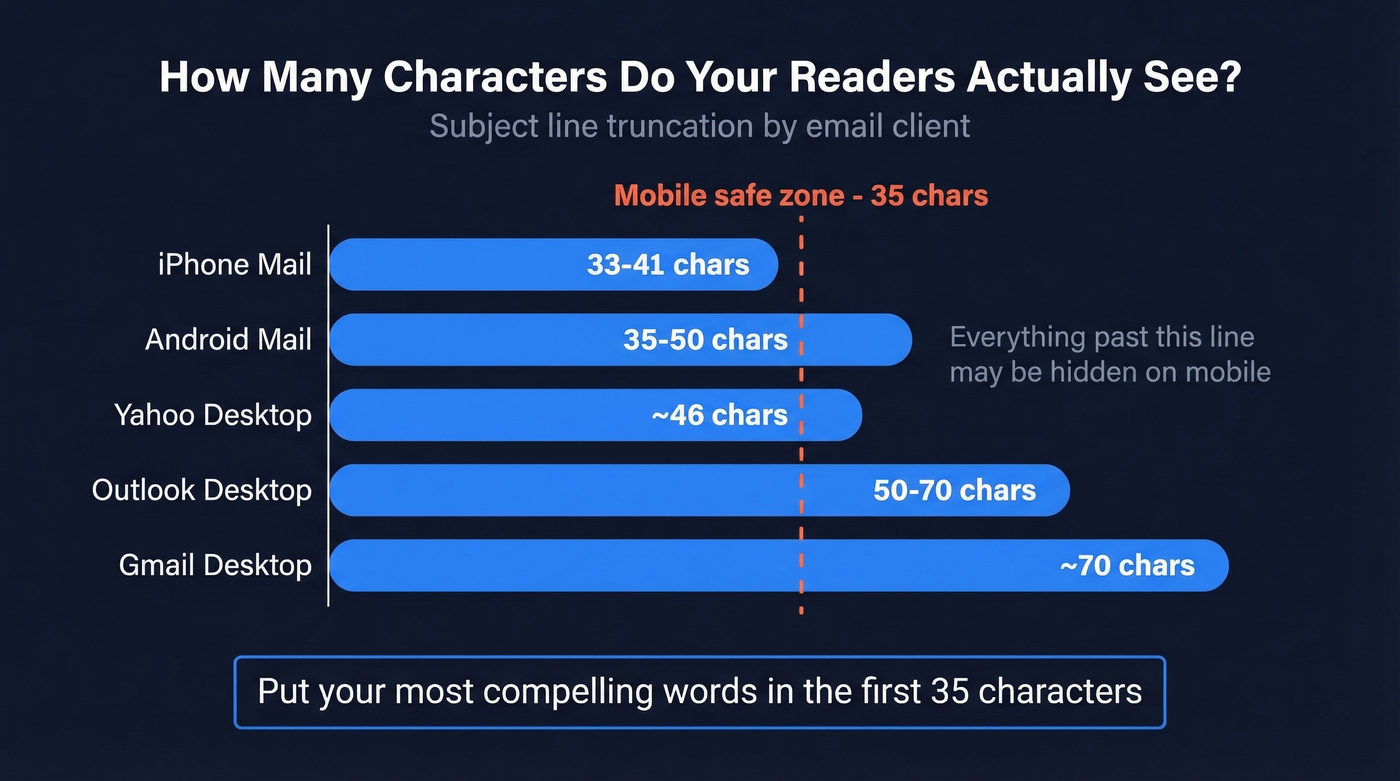
It depends on where it's read. Here's what each client actually displays, per Twilio's truncation data:
| Email Client | Visible Characters |
|---|---|
| iPhone Mail | 33-41 |
| Android Mail | 35-50 |
| Gmail (desktop) | ~70 |
| Outlook (desktop) | 50-70 |
| Yahoo (desktop) | ~46 |
So "shorter is always better," right? Not exactly. A BuzzStream study of 6 million subject lines found that 9-13 word subject lines hit roughly 40% open rates - and lines over 71 characters edged them out by about half a percentage point. The catch: that study covered PR outreach with desktop-heavy audiences, not event follow-ups.
Here's a counterpoint: Twilio's Cyber Week data found 2-4 word subject lines outperformed longer ones, though that's B2C promotional context. The takeaway isn't a magic character count. Put your most compelling words in the first 35 characters. If the rest gets truncated, the reader should still know why they should open.
If you want more inspiration beyond event follow-ups, pull from these email subject line examples and adapt them to your event context.

A great subject line means nothing if it bounces. Before you send a single event follow-up, run your badge scans and contact lists through Prospeo's 5-step email verification - 98% accuracy, spam-trap removal, and catch-all handling included.
Stop wasting perfect subject lines on dead email addresses.
Subject Lines by Event Type
Trade Show & Conference
Here's the thing about trade show contacts: only 5-15% are actually sales-ready. The rest need nurture. Your subject line should match where each contact actually sits, not blast the same "Great meeting you!" to everyone. Segmented trade show emails consistently hit 5%+ CTR versus 1-3% for generic promos, and in our experience, the difference between a segmented and unsegmented send is the difference between pipeline and noise.
If you're building a repeatable post-event motion, treat this like targeted email campaigns, not a one-off blast.
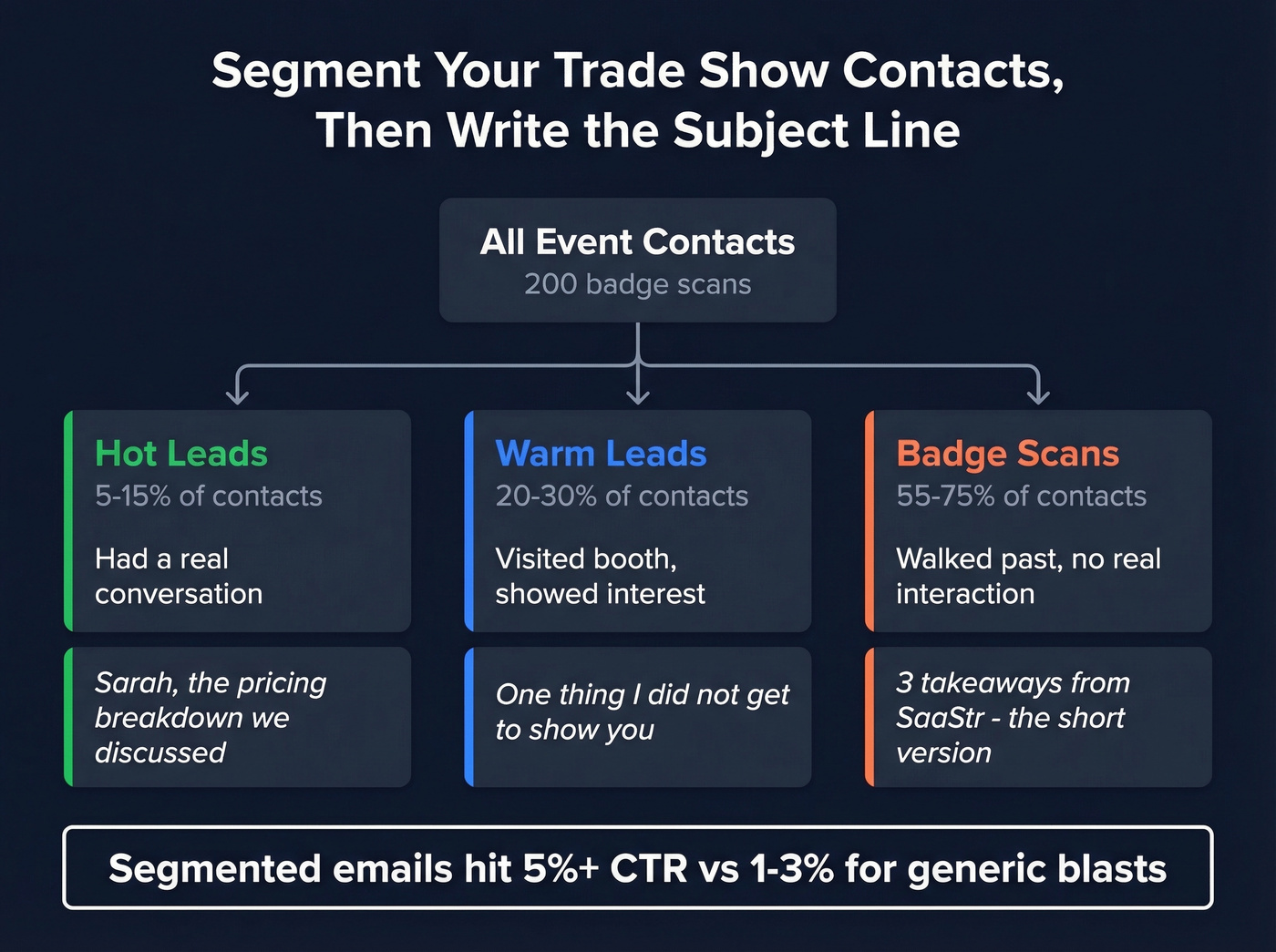
Hot leads (had a real conversation):
- "[First name], the pricing breakdown we discussed"
- "Following up on your [specific pain point] question"
- "[First name], let's pick up where we left off at [Event]"
Warm leads (visited booth, showed interest):
- "[Event] recap + the [resource] you grabbed"
- "[First name], one thing I didn't get to show you"
Badge scans (cold/nurture):
- "[Event] attendee? Here's what you missed at booth [#]"
- "3 takeaways from [Event] - the short version"
Specificity beats pleasantries every time.
Webinar Follow-Ups
Webinar follow-ups are a different animal. ActiveCampaign reports 58% open rates on webinar follow-up emails - far above the ~42% industry average. But here's the math most teams miss: with a 46% average attendance rate, more than half your registrant list needs a replay subject line, not a thank-you.
For attendees:
- "[Webinar topic]: slides + the bonus resource"
- "[First name], your Q&A answer (plus 2 extras)"
- "[Speaker name]'s top recommendation from today"
For no-shows:
- "Missed [webinar topic]? 22-min replay inside"
- "[First name], the [webinar topic] recording (before it expires)"
- "You registered for [topic]. Here's the 3-minute summary"
If you need the full email body (not just the subject line), start with these sales follow-up templates.
Networking Events & Meetups
These follow-ups live or die on specificity. The biggest mistake after networking events? Unfulfilled promises - saying you'll send an intro or a resource and then going silent.
Rather than rattling off templates, think about what actually happened. If you promised to send an article, your subject line is "[First name], the [article] I mentioned." If you had a meaty conversation, try "Our conversation about [specific topic] - one more thought." If a mutual connection introduced you, lead with that: "[Mutual connection] suggested we connect - here's why."
Every line should reference something only you could write to only them. A strong "nice meeting you" email subject works best when it goes beyond the pleasantry and into something concrete you discussed.
Virtual & Hybrid Events
No handshake to reference, no booth to recall. Lean on shared content: the session you both attended, the chat thread that blew up, the poll result that surprised everyone.
Try lines like "[Session title] - my biggest takeaway," "[First name], your comment during [session] stuck with me," or "The [resource] from [virtual event] - downloadable now." The goal is to recreate the feeling of a shared moment, even if it happened through a screen.
Before and After Rewrites
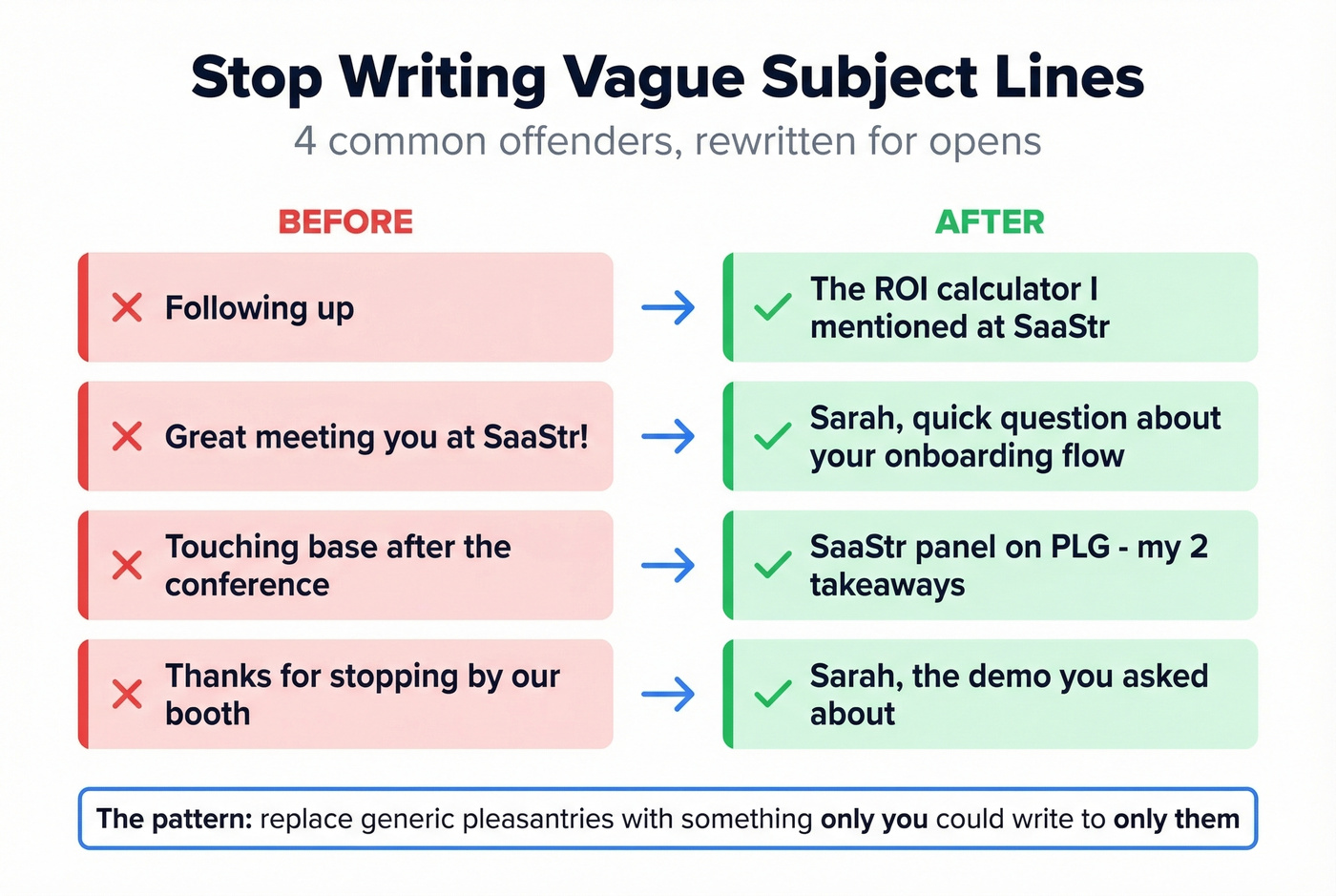
Most post-event subject lines fail because they're vague. Let's fix four common offenders:
| Before | After |
|---|---|
| Following up | The ROI calculator I mentioned at [Event] |
| Great meeting you at [Event]! | [First name], quick question about [topic] |
| Touching base after the conference | [Event] panel on [topic] - my 2 takeaways |
| Thanks for stopping by our booth | [First name], the demo you asked about |
A filled-in version: "Sarah, the ROI calculator we discussed at SaaStr" - front-loaded with name and value, and it survives mobile truncation well.
The pattern is simple: replace generic pleasantries with something only you could write to only them. Vague subject lines like "follow-up" and "touching base" are the fastest way to get archived unread.
Tips for Higher Open Rates
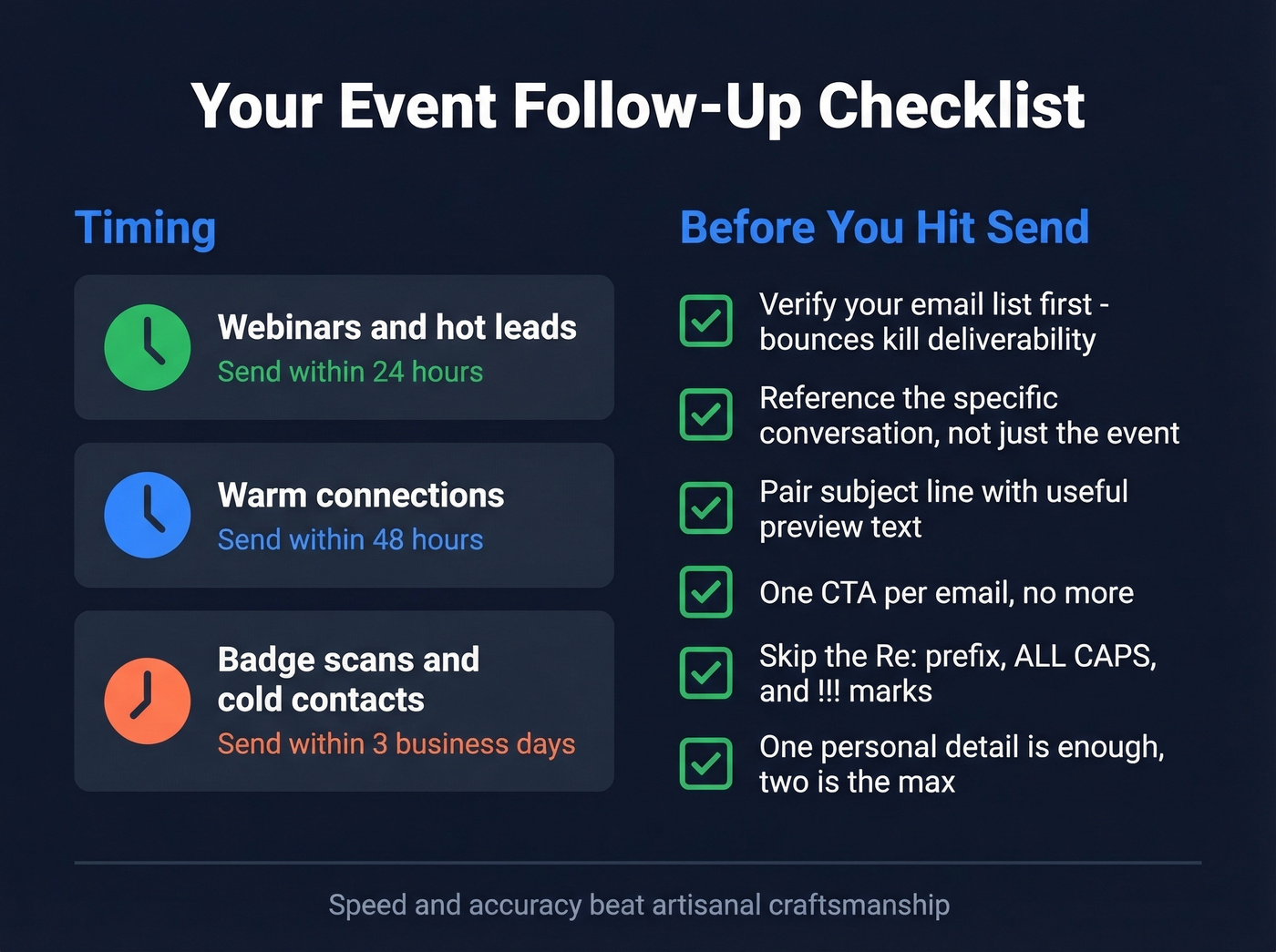
Reference the specific conversation, not just the event name. "[Event]" provides context. "[Event] + [what you actually talked about]" provides a reason to open.
Pair your subject line with preview text. If your subject is "The pricing breakdown we discussed," your preview text should add new info: "Plus the case study I forgot to mention." (More on this in our guide to email preview text A/B testing.)
Send same-day for webinars, next-business-day for conferences. Speed beats polish. If you're unsure about timing, use this best time to send cold emails data as a baseline and adjust for your audience.
Keep one CTA per email. Your follow-up should drive a single action - book a call, download a resource, reply with availability. Multiple CTAs dilute everything and tank your click-through rate. (See email call to action best practices.)
Avoid spam triggers. "Re:" prefixes on first-touch emails, "URGENT," ALL CAPS, and excessive punctuation (!!!) can route your email straight to spam. The consensus on r/coldoutreach is that "Re:" on a cold email is the fastest way to get flagged and lose trust simultaneously. If deliverability is a recurring issue, use an email spam checker and fix the root causes.
Don't over-personalize. This is counterintuitive, but cramming someone's name, company, title, and event into a single subject line can feel surveillance-y rather than thoughtful. One personal detail is enough. Two is the max.
A/B test when your list is big enough. Litmus recommends at least 10,000 recipients for meaningful results - so this applies more to webinar lists than conference contacts.
Treat data quality as step zero. Event contact lists - badge scans, attendee CSVs, business card imports - decay fast. We've watched teams craft beautiful subject lines only to torch their domain reputation because 30% of their list bounced. Run your list through Prospeo's email verification before you send. With 98% email accuracy and a 5-step verification process that catches spam traps and honeypots, there's no reason to let bounced emails kill your deliverability before your subject line even gets a chance. If you want to go deeper on the mechanics, start with our email deliverability guide and email bounce rate benchmarks.
Look, if your average deal size is under $15k, you probably don't need a 45-minute personalization ritual for every follow-up. Segment into three buckets, write three solid subject lines, and send them within 24 hours. Speed and accuracy beat artisanal craftsmanship at that price point.
Only 5-15% of trade show contacts are sales-ready - but most teams can't tell which ones. Prospeo's intent data tracks 15,000 topics so you know which event contacts are actively researching your solution right now.
Segment your event leads by buying intent, not just booth visits.
FAQ
How soon should I send a follow-up email after an event?
Within 24 hours for webinars and hot conference leads, 48 hours for warm connections, and 3 business days for badge scans. Speed matters more than perfection - the memory of your conversation fades fast, and so does your open rate.
Should I use the event name in the subject line?
Yes, but never as the only hook. The event name triggers recognition; pair it with a session topic, a conversation detail, or a resource you promised. That combination gives the reader context and a reason to open.
What makes a good event follow-up email subject line?
The best ones reference something specific - a conversation, a demo, a shared session - rather than defaulting to generic pleasantries. Specificity signals that you're a real person who was actually there, not a mass-blast bot working through a badge-scan CSV.
How do I follow up with someone I barely spoke to?
Reference something shared: the same session, a panel topic, a mutual connection. Don't pretend you had a deep conversation - honesty plus specificity beats fake familiarity. Verify their email first so you're not sending into the void.