

A GTM Strategy Example You Can Actually Use in 2026
Every article out there explains what a GTM strategy is - which you already know - and none show you the actual deliverable. Here's a concrete example of a GTM strategy with real decisions, real numbers, and annotations explaining why each call was made. Hand it to your CEO. Adapt it for a PMM interview take-home. Either way, it works.
The stakes keep climbing. Top-quartile companies grew ARR 93% YTD, up from 78% in 2023. Many B2B SaaS companies now spend $2 in sales and marketing for every $1 of new ARR - a ratio that climbed 14% between 2024 and 2026. Meanwhile, only 58% of AEs hit quota last year. The gap between good GTM and bad GTM is widening, and most teams are on the wrong side.
What a GTM Strategy Actually Is
A GTM strategy isn't a marketing plan. Marketing handles demand gen and awareness. GTM covers the full commercial motion: who you sell to, pricing, channels, sales motion, and success metrics within a defined launch window.
You need one when launching a new product, entering a new market, or targeting a new segment. If you're running ongoing demand gen for an existing product, that's a marketing plan. The distinction matters because GTM requires cross-functional alignment - product, sales, marketing, and CS all rowing together for a specific moment in time.
Pick Your GTM Motion First
Decide your motion before you write anything else. Channels, team structure, and pricing all flow from this choice.
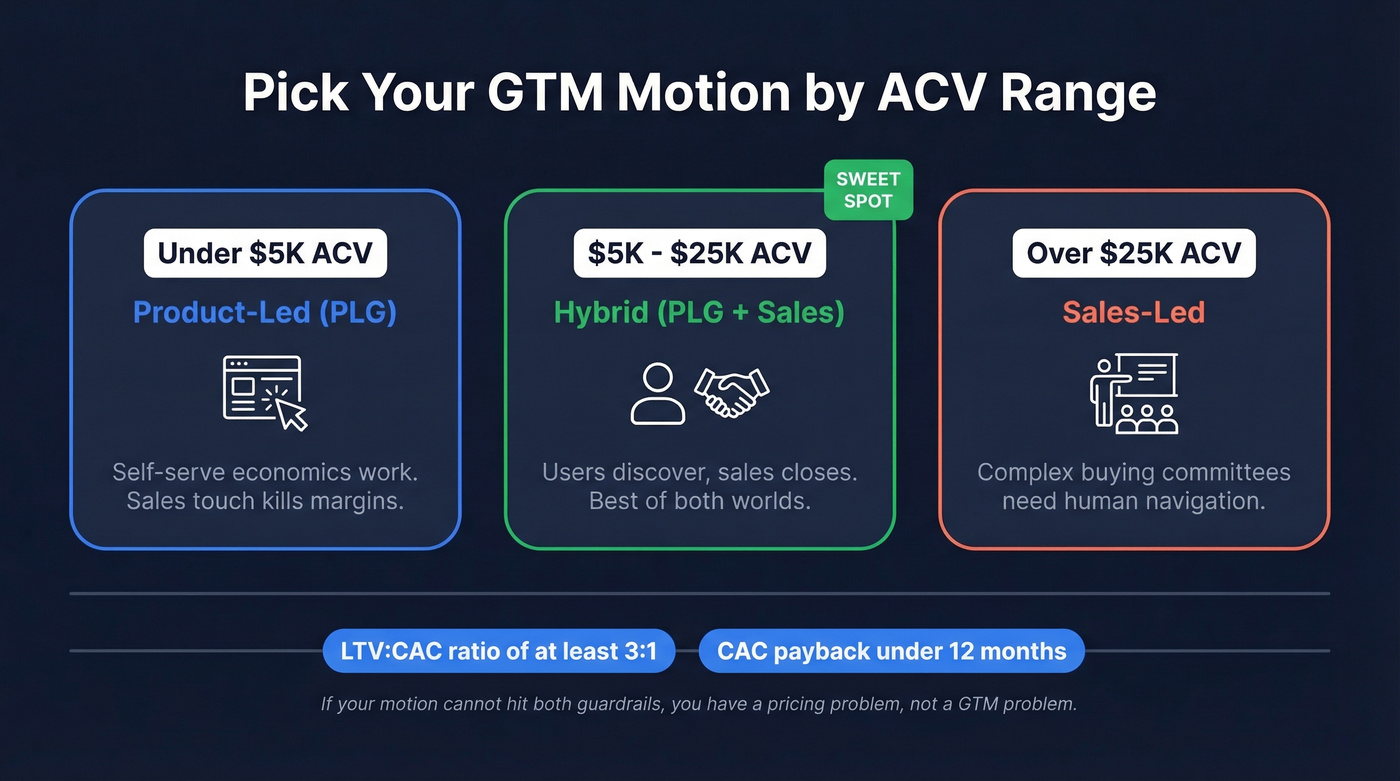
| ACV Range | Recommended Motion | Why |
|---|---|---|
| Under $5K | Product-led (PLG) | Self-serve economics work; sales touch kills margins |
| $5K-$25K | Hybrid (PLG + sales) | Users discover, sales closes; best of both |
| Over $25K | Sales-led | Complex buying committees need human navigation |
Two unit economics guardrails before you commit: LTV:CAC ratio of at least 3:1, and CAC payback under 12 months. If your motion can't hit both, you've got a pricing problem, not a GTM problem. (If you need to sanity-check CAC math, use this cost to acquire customer guide.)
AI-native companies [convert free trials to closed-won at 56% vs. 32%](https://www.iconiqcapital.com/growth/reports/state-of-go-to-market-2025) for non-AI-native peers at the $100M+ ARR tier. With roughly 70% of GTM teams now using AI in their workflows, this isn't a niche advantage anymore - it's table stakes. If your product has an AI-native experience, lean into PLG harder. (For practical workflows, see generative AI sales tools.)

That outbound channel in your GTM plan? It only works if the data is real. Prospeo gives you 300M+ profiles with 98% email accuracy and 30+ filters - including buyer intent, headcount growth, and technographics - so your first 500 ICP contacts actually convert. Teams using Prospeo book 26% more meetings than ZoomInfo users.
Build your launch list in minutes, not days. Start free.
A Filled-Out B2B Go-to-Market Plan
In our experience, the best GTM strategies fit on 3-5 pages. If yours needs a table of contents, you've confused planning with procrastination.
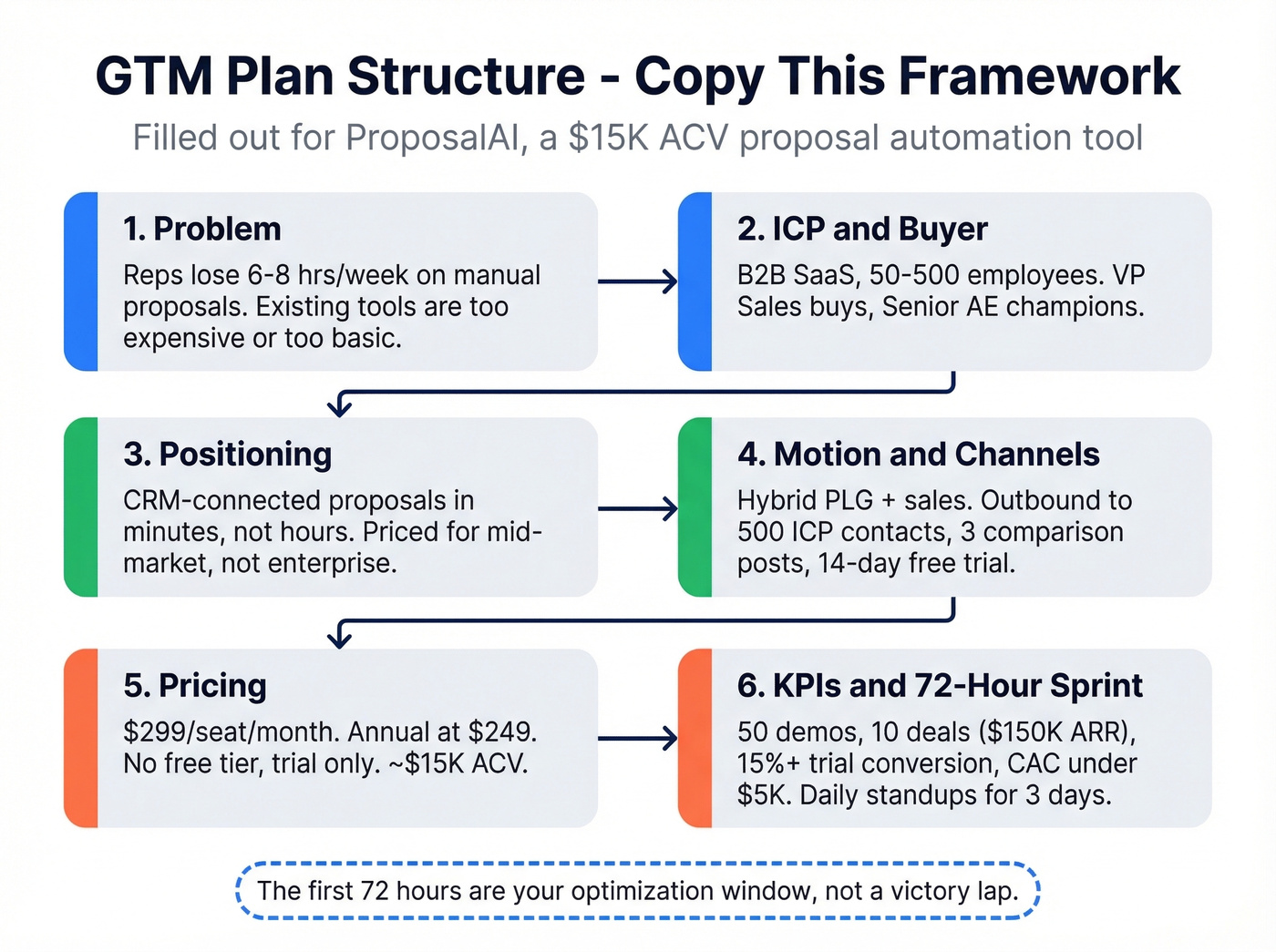
The product: ProposalAI - an AI-powered proposal automation tool for mid-market B2B sales teams. $299/seat/month, ~$15K ACV.
Problem & Market
Mid-market sales teams (50-500 employees) typically lose 6-8 hours per rep per week to manual proposal creation and back-and-forth edits. Existing tools are either enterprise-grade platforms like Loopio and Responsive sold on enterprise contracts, or lightweight doc editors that don't integrate cleanly with CRMs. The total addressable market spans tens of thousands of B2B SaaS companies in this employee range running Salesforce or HubSpot. (If you need to size this properly, use an addressable market framework.)
ICP & Buyer Persona
Company: B2B SaaS, 50-500 employees, $10M-$100M revenue, using Salesforce or HubSpot. Primary buyer: VP of Sales or Head of Revenue Operations. Champion: Senior AE or Sales Manager who feels the proposal pain daily. They have enough deal volume to justify automation but not enough budget for enterprise tools. (If you want a scoring rubric, start with an ideal customer profile template.)
Positioning & Competitive Wedge
For mid-market sales leaders who lose deals to slow proposals, ProposalAI generates CRM-connected proposals in minutes - not hours - at a fraction of enterprise pricing. Key competitors: Loopio (enterprise-focused), PandaDoc (SMB/mid-market doc workflows), and the manual Google Docs process everyone defaults to. Our wedge: AI-native generation from CRM data, priced for mid-market. (If you’re tightening messaging, use a B2B brand positioning checklist.)
GTM Motion & Channel Plan
At ~$15K ACV, this is a hybrid motion: free trial for individual reps, sales-assisted close for team deals. Here's the channel plan for the first 90 days:
- Outbound (primary): Target 500 VP Sales contacts matching the ICP. Build the list with a verified data platform like Prospeo - stale data burns your launch window and domain reputation. Start with the free tier and scale from there. (If you need a system, use these sales prospecting techniques.)
- Content/SEO (secondary): Publish 3 comparison posts (vs. Loopio, vs. PandaDoc, vs. manual process) before launch. (If you’re building the engine, see what is B2B content marketing.)
- Product-led (tertiary): Free 14-day trial with a usage gate - after 3 proposals, prompt team upgrade.

Pricing Model
$299/seat/month, annual billing at $249/seat/month. No free tier - free trial only. At $15K ACV, a free tier attracts the wrong users and creates support load without conversion.
Launch KPIs & the First 72 Hours
90-day targets: 50 qualified demos, 10 closed deals ($150K ARR), trial-to-paid conversion above 15%, CAC under $5K. (To benchmark conversion, use this sales conversion rate guide.)
Here's the thing: the first 72 hours after launch are your optimization window, and we've watched teams waste entire launch weeks because nobody looked at the data until Monday. Run daily standups with sales, marketing, and product. Swap underperforming email subject lines on day 1. (If you need options, pull from these email subject line examples.) Shift ad spend from low-CTR channels on day 2. By day 3, you should know which ICP segment is responding and double down.
Most GTM plans fail not because the strategy was wrong, but because the team treated launch like an event instead of a 72-hour experiment. Plan to be wrong about something. Plan to fix it fast.
Copy this structure for your own plan: Problem -> ICP -> Positioning -> Motion & Channels -> Pricing -> KPIs & 72-hour sprint.
Every GTM plan above lives or dies in the first 72 hours. Stale data from other providers means bounced emails, burned domains, and a wasted launch window. Prospeo refreshes every 7 days - not the 6-week industry average - so your day-one outbound hits real inboxes at ~$0.01 per verified email.
Don't let bad data kill your launch. Verify before you send.
3 Real-World GTM Examples
Zoom ran the PLG playbook better than anyone. Their 2019 10-K includes a standout stat: 55% of customers contributing over $100K in revenue started with at least one free host. The free tier wasn't charity - it was the top of a sales funnel converting individual users into enterprise contracts. That single insight reshaped how an entire generation of SaaS founders thought about freemium.
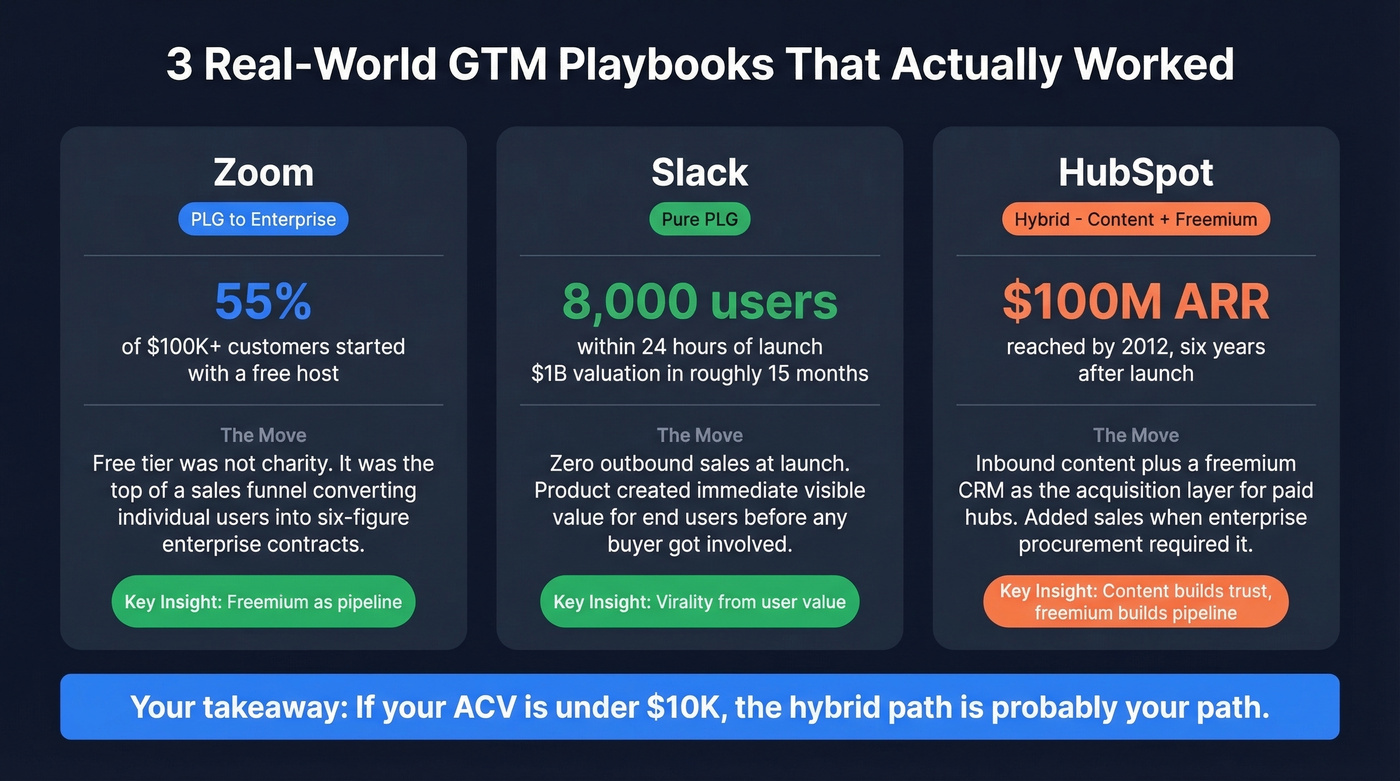
Slack hit 8,000 users within 24 hours of launch and reached a $1B valuation in roughly 15 months through pure product-led virality - zero outbound sales at launch. The lesson isn't "be like Slack." It's that PLG works when the product creates immediate, visible value for the end user before a buyer ever gets involved.
HubSpot took the longer road, reaching $100M ARR by 2012 - six years after launch. Their GTM combined inbound content with a freemium CRM that served as the acquisition layer for paid hubs. Zapier followed a similar hybrid arc, starting pure PLG then adding sales reps once enterprise procurement requirements made self-serve insufficient. Each of these is a strong go-to-market strategy example worth studying, but the takeaway isn't to copy them. If your ACV sits below the $10K mark, the hybrid path is probably your path.
7 GTM Mistakes That Kill Launches
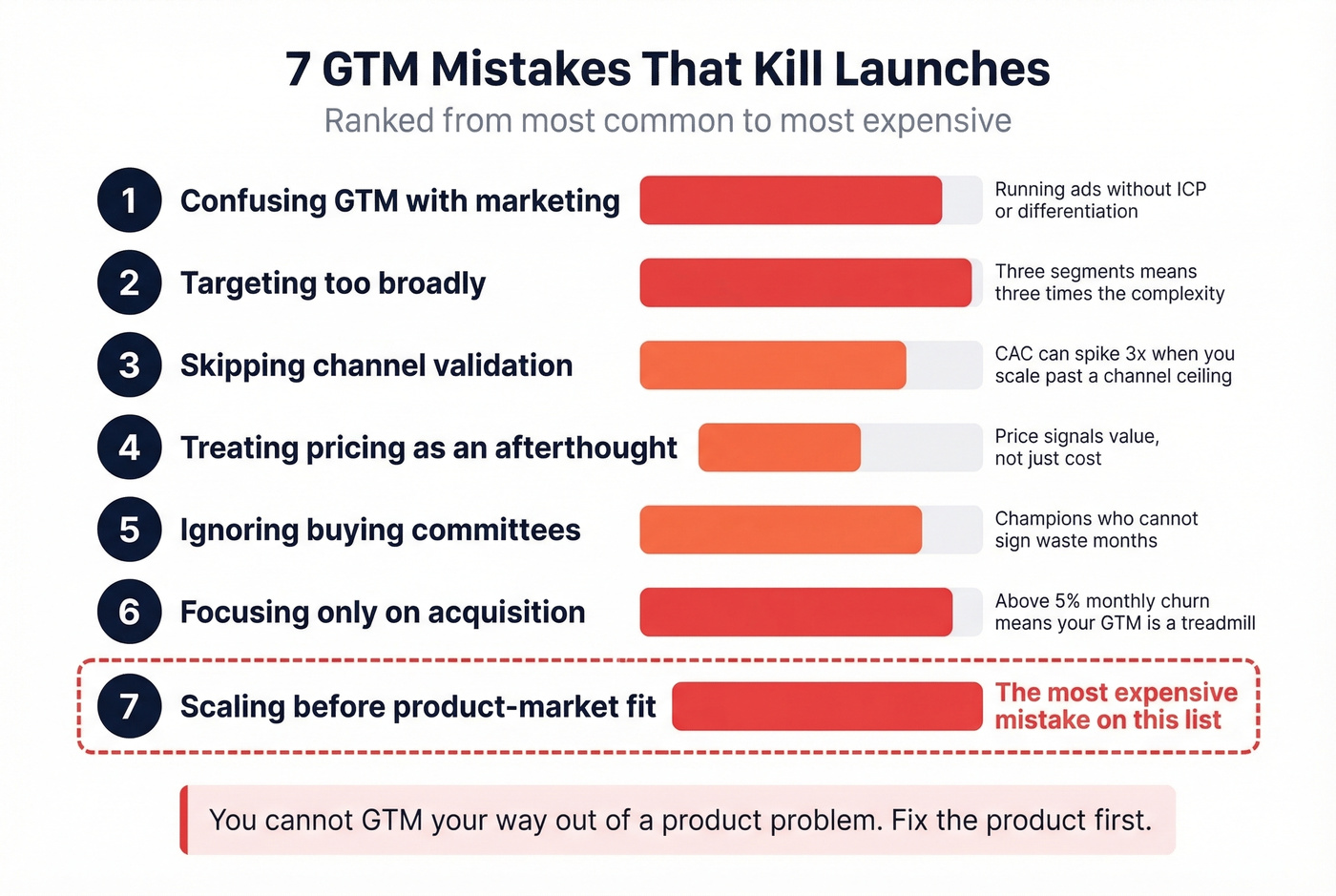
- Confusing GTM with marketing. Running ads without defining your ICP, buyer journey, or differentiation isn't a strategy - it's spending money.
- Targeting too broadly. SMB, mid-market, and enterprise simultaneously means three sales motions, three pricing models, and three times the complexity. Pick one.
- Skipping channel validation. A channel that worked at $50K spend can break at $200K. We saw a healthtech startup's CAC spike 3x when they tried to scale a conference-driven pipeline beyond its natural ceiling.
- Treating pricing as an afterthought. Pricing too low signals low quality. It's a value signal and a unit economics driver, not a line item you fill in last.
- Ignoring buying committee realities. "Self-serve" assumptions break when procurement, legal, and security reviews enter the picture. If you're selling above $25K ACV, skip this if you haven't mapped the full buying committee - you'll waste months chasing champions who can't sign.
- Focusing only on acquisition. If churn is above 5% monthly, your GTM is a treadmill. Fix the leaky bucket first. (If you’re diagnosing retention, start with churn analysis.)
- Scaling before product-market fit. Spending your seed round on GTM while product issues drive churn is the most expensive mistake on this list. The consensus on r/SaaS is blunt about this one: "You can't GTM your way out of a product problem."
FAQ
What's the difference between a GTM strategy and a marketing plan?
A GTM strategy covers the full commercial motion - positioning, pricing, sales model, channels, and ICP - for a specific launch window. A marketing plan is one slice of that: demand generation and awareness. GTM requires cross-functional alignment across product, sales, marketing, and CS.
How long does it take to build a go-to-market plan?
Two to six weeks for a focused B2B SaaS launch, and the document itself should fit in 3-5 pages. If it's taking longer, stop writing and go talk to 10 prospects. Customer conversations compress planning timelines faster than any framework.
Can I use this GTM strategy example for a PMM interview?
Yes - this is exactly the format hiring managers expect. Swap in the company's product for the ICP and channel plan, add your own competitive analysis, and present it as a 90-day plan with measurable KPIs like demo-to-close rate and CAC payback.