

10 Inbound and Outbound Marketing Examples With Real Results
SEO-driven leads close at 14.6%. Outbound leads close at 1.7%. That gap is real - but it doesn't tell the whole story.
The fastest-growing companies aren't picking sides. Teams running hybrid inbound-outbound strategies see 2x faster revenue growth than those betting on a single channel. The question isn't which approach wins - it's how you combine them so each one covers the other's blind spots.
Here are 10 examples of inbound and outbound marketing that actually moved numbers, plus the mistakes that killed campaigns along the way. Quick orientation before we get into specifics:
- Inbound = cheaper per lead, higher close rate, slower to build (4-6+ months before you see real returns)
- Outbound = faster pipeline, higher CPL, depends entirely on data quality
- Best results come from running both - the hybrid approach compounds over time
Inbound vs Outbound in 30 Seconds
| Inbound (Pull) | Outbound (Push) | |
|---|---|---|
| How it works | Attract buyers to you | Reach out to buyers |
| Channels | SEO, blogs, social, webinars | Cold email, ads, events, mail |
| CPL range | $30-$90 | $150-$700+ |
| Time to return | 4-6+ months to start; 1-3 years for substantial SEO ROI | 2-5 weeks via paid search/PPC |
| Scales via | Content compounding | Budget + data quality |
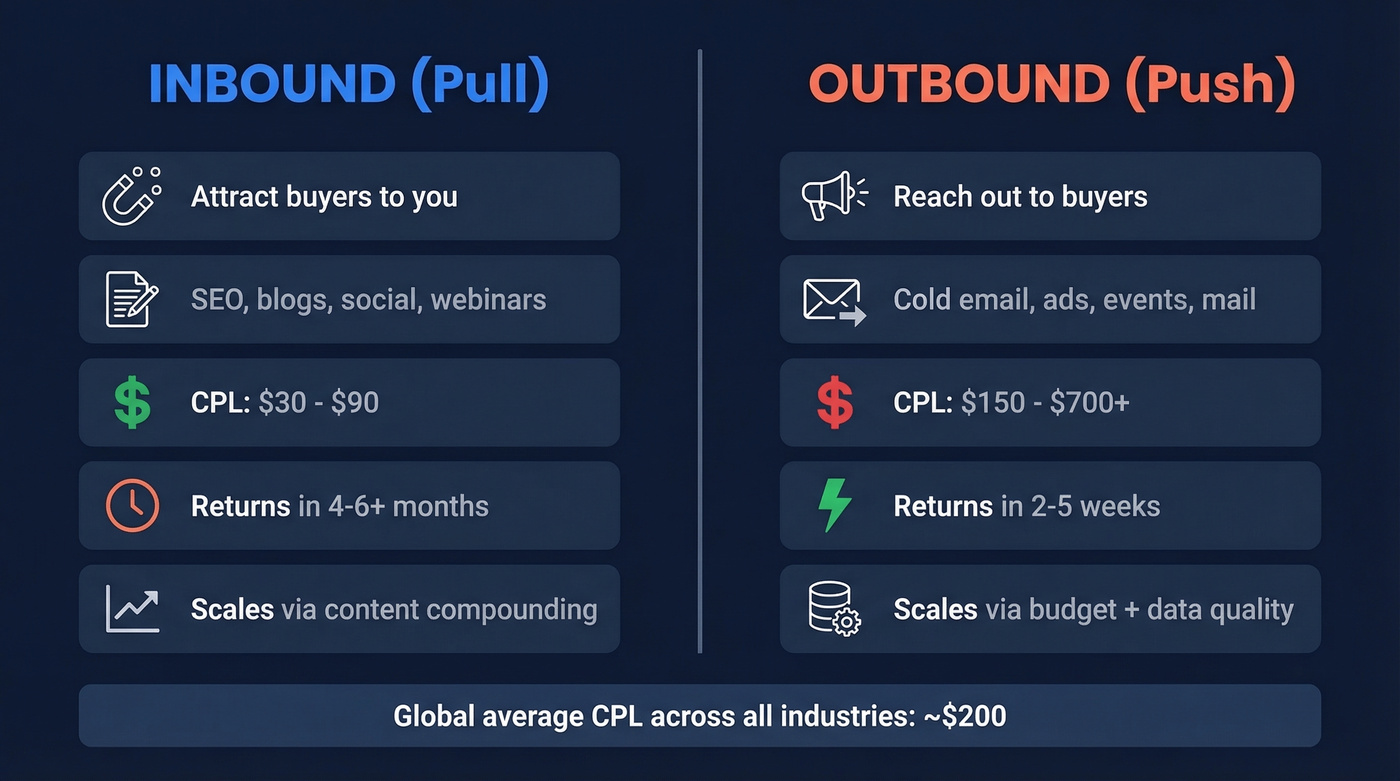
The global average CPL across all industries sits around $200. Inbound channels typically fall well below that line; outbound channels can blow past it fast.
Inbound Marketing Examples
Spotify Wrapped
Every December, Spotify turns user data into a shareable experience. The 2022 edition generated over 400,000 tweets in its first three days. Users create the distribution for free because the content is genuinely interesting to share - no ad spend required. It's the purest form of inbound: build something people want to talk about, then get out of the way.
Ryanair's TikTok
Ryanair built 1.9M followers and 25.7M likes on TikTok with zero ad spend on organic content. The strategy is absurdly simple: self-deprecating humor about being a budget airline. It works because it's authentic, not because it's expensive. Most brands overthink social. Ryanair just leaned into the joke everyone was already making.
HubSpot's Blog and SEO Engine
Website/blog/SEO is the #1 ROI-generating channel for B2B marketers, and HubSpot practices what it preaches. Their blog and SEO engine feed their entire funnel. It took years to build, but the compounding effect is massive - every new article strengthens the domain, which lifts every previous article. For B2C, email marketing tops the ROI chart, followed by paid social and content marketing.
Webinar Lead Generation
Webinars sit in a sweet spot: CPL runs $70-$250, well below cold outreach's $150-$700+ range. The leads are warmer because attendees self-select by topic interest. B2B webinars deliver 430% ROI - one of the highest returns of any B2B channel after SEO.
Email Nurture Sequences
Opt-in email remains the quiet workhorse. Email marketing returns $36-$40 for every $1 spent, and top-performing programs exceed $70 per dollar. The key word is "opt-in." These are subscribers who asked to hear from you, not cold contacts scraped from a list.
Outbound Marketing Examples
Cold Email Sequences
Cold email isn't dead - it's just harder to do well. Current benchmarks: 15-25% open rates, 1-5% reply rates, and sequences with 4-6 emails see up to 50% higher reply rates than single-touch campaigns.
Here's the thing: the difference between a campaign that works and one that tanks your domain comes down to data quality. We've watched teams destroy sender reputation in a single week by skipping verification. Bounces spike, deliverability collapses, and suddenly your entire outbound motion is grounded. This is the part most "cold email is dead" takes conveniently ignore - the email isn't the problem, the list is. (If you want a deeper playbook, see cold email benchmarks and setup.)
Liquid Death x e.l.f. Cosmetics
This collaboration generated 250M+ social impressions. Their Van Leeuwen ice cream collab sold out in under 7 hours and became the #1 most successful grocery limited-time offer on Amazon ever. Liquid Death proves that outbound brand campaigns still move the needle when the creative is genuinely surprising - not just loud.
Trade Shows and Events
Events are expensive. CPL runs $200-$811+, and that's before you factor in travel, booth design, and the three days your team spends away from pipeline. But the leads are high-intent. Face-to-face conversations compress the trust-building timeline that takes weeks over email.
For enterprise deals with six-figure ACVs, the math works. Skip this if your team is closing deals under $15K - the CPL rarely justifies itself at that deal size. (For more on high-ACV motions, see enterprise deals.)
Direct Mail
Physical mail is having a quiet comeback. Every inbox is flooded, but a well-designed piece of direct mail stands out precisely because nobody expects it. The outbound playbook hasn't changed much - advertising, cold email, snail mail, trade shows, telemarketing, and events are still the core plays. What's changed is which ones are oversaturated. If you're testing this channel, start with a tight lead generation workflow.
Chili's BurgerTime Gamification
Chili's turned their Big Smasher promotion into a playable retro game that logged 8,184 hours of gameplay in just 20 days. Chili's pushed the campaign to audiences, but the engagement was entirely opt-in. The line between inbound and outbound blurs when the creative is good enough to make people choose to participate.

You just read it: cold email campaigns live or die on data quality. Prospeo's 98% email accuracy and 7-day refresh cycle mean your outbound lists stay clean - no domain damage, no deliverability collapse. At $0.01 per email, your outbound CPL drops from $700 to something that actually makes hybrid strategies profitable.
Stop destroying sender reputation with bad data.
Results by the Numbers
| Metric | Inbound | Outbound |
|---|---|---|
| Close rate | 14.6% | 1.7% |
| CPL range | $30-$90 | $150-$700+ |
| SEO ROI | 748% B2B / 721% B2C | - |
| Email ROI | 261% B2B / 298% B2C | - |
| SEM/PPC ROI | 36% B2B / 24% B2C | - |
| Time to return | 4-6+ months to start; 1-3 years for SEO | 2-5 weeks via paid search/PPC |
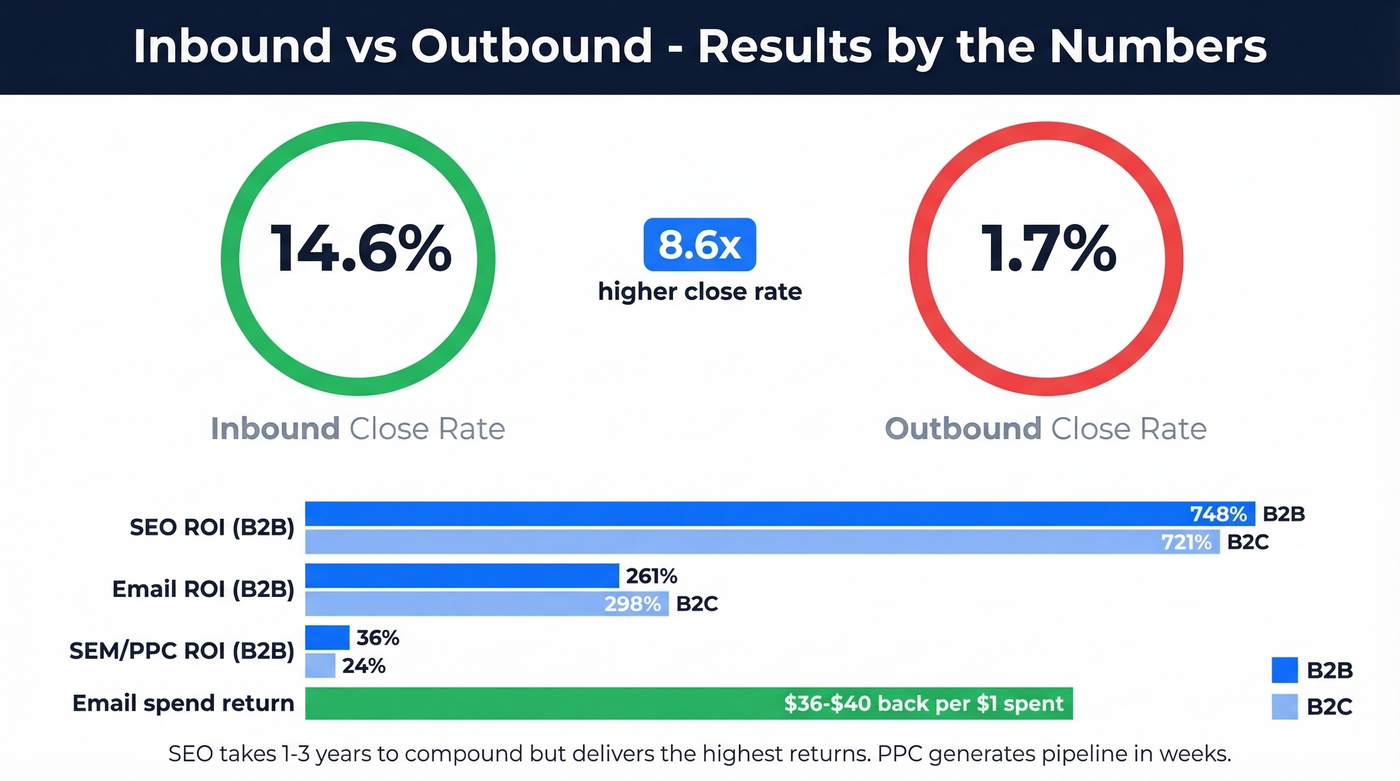
Outbound ROI varies too widely by campaign type for reliable benchmarks - a direct mail piece and a cold email sequence have almost nothing in common financially.
The ROI gap looks dramatic, and it is. But it's misleading without context. SEO's 748% return takes 1-3 years to materialize. A paid search campaign can generate pipeline in two weeks. The right question isn't "which is better?" It's "what does my timeline demand?"
If your average deal size is under $10K, you probably don't need outbound at all. Invest in SEO and email nurture, wait six months, and let compounding do the work. Outbound only makes economic sense when the deal size justifies the CPL.
How to Combine Both Strategies
Companies running hybrid strategies see 2x faster revenue growth than single-channel teams. And the channels aren't as separate as textbooks suggest - when HubSpot surveyed 537 email marketers, 51% called email inbound and 49% called it outbound. The best outbound in 2026 looks inbound: targeted, permission-aware, and content-led.
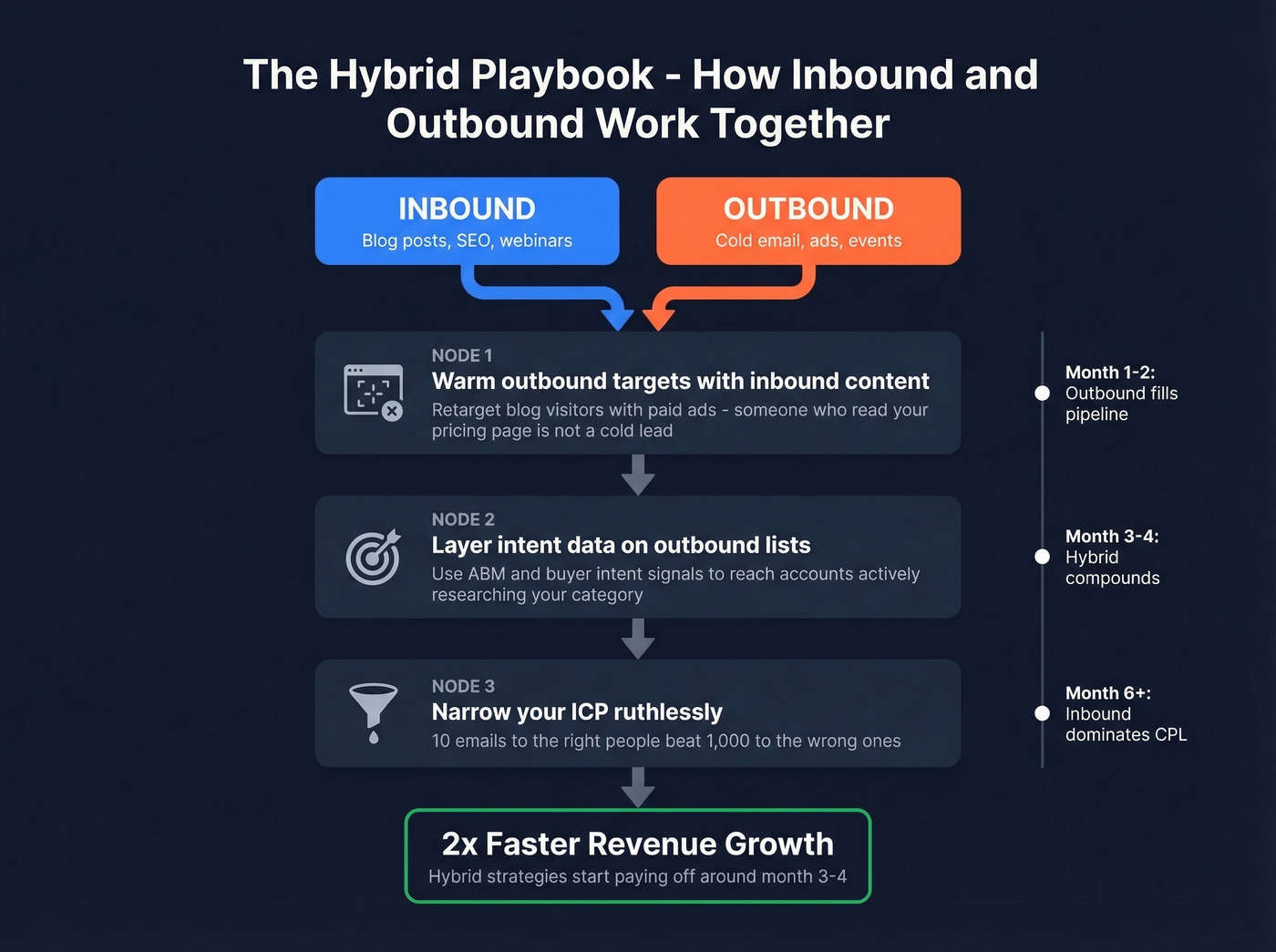
In our experience, the hybrid approach starts paying off around month 3-4. Three moves that accelerate it:
Use inbound content to warm outbound targets. Retargeting pixels on your blog posts let you serve ads to people who already engaged with your content, bridging the pull-push gap. Someone who read your pricing comparison is a fundamentally different prospect than a cold name on a list.
Layer intent data on outbound. ABM and intent-driven targeting mean you're reaching accounts actively researching your category, not spraying cold emails at random. This is where tools like Bombora and platforms that integrate intent signals into prospecting workflows make a real difference. (More on this approach: account-based selling.)
Narrow your ICP ruthlessly. The consensus on r/b2bmarketing is that most AI-generated personalization is "useless garbage." Precision beats volume every time. Ten emails to the right people outperform a thousand to the wrong ones. Use an ideal customer profile to keep targeting honest.
Mistakes That Kill Both Strategies
Slow follow-up. Responding within 5 minutes increases conversion by up to 9x. Most teams take hours. Every minute past five is money left on the table. If you need copy you can ship today, use these sales follow-up templates.
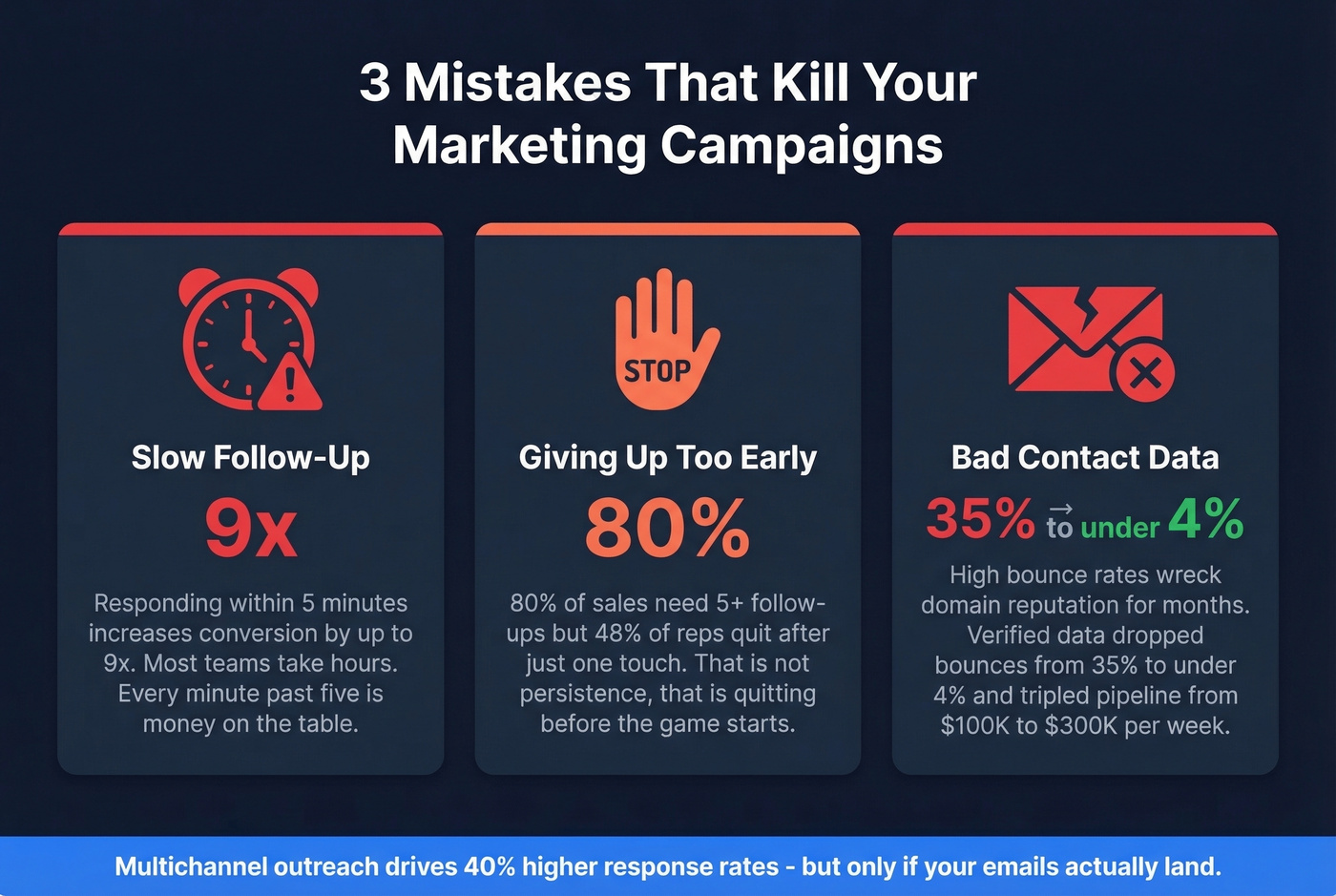
Giving up too early. 80% of sales require 5+ follow-ups, but 48% of reps stop after one touch. That's not persistence - that's quitting before the game starts.
Bad contact data. Let's be honest: this is the one that frustrates us most. Multichannel outreach drives 40% higher response rates than email alone, but only if your emails actually land. High bounce rates don't just waste money - they wreck your domain reputation for months. We've seen teams at Prospeo customers like Meritt go from 35% bounce rates to under 4% just by switching to verified data, tripling their pipeline from $100K to $300K per week in the process. If you're troubleshooting, start with email bounce rate and sender reputation.
Hybrid strategies grow revenue 2x faster - but only when outbound data connects you to real buyers. Prospeo gives you 300M+ profiles with 30+ filters like buyer intent, technographics, and headcount growth so your outbound campaigns target the same high-intent audience your inbound content attracts.
Make your outbound feel inbound with the right targeting.
FAQ
What's the difference between inbound and outbound marketing?
Inbound attracts customers through content they seek out - SEO, blogs, webinars - while outbound pushes messages to audiences who haven't asked, like cold email, ads, and direct mail. Inbound closes at 14.6% vs outbound's 1.7%, but outbound generates pipeline weeks faster. Most successful teams in 2026 run both.
Which is cheaper - inbound or outbound?
Inbound costs $30-$90 per lead on average; outbound runs $150-$700+. The tradeoff is time: inbound takes 4-6+ months to produce meaningful results and 1-3 years to fully compound, while outbound can fill pipeline within two to five weeks.
Can email marketing be both inbound and outbound?
Yes. HubSpot's survey of 537 marketers split almost evenly - 51% called email inbound, 49% outbound. Opt-in newsletters are inbound. Unsolicited cold emails are outbound. The distinction depends on whether the recipient chose to receive the message.
How do you make outbound marketing more effective?
Three things: verified contact data (bounced emails destroy sender reputation), multi-touch sequences (4-6 emails get 50% more replies than single touches), and speed - responding to engaged prospects within 5 minutes increases conversion by 9x.
What are the best examples of inbound and outbound marketing working together?
Retargeting blog visitors with paid ads, using intent data to prioritize outbound lists, and nurturing cold-email responders with inbound content sequences are the most effective hybrid plays. Companies combining both approaches see 2x faster revenue growth than single-channel teams.