

Filling the Funnel: How to Build Pipeline When Inbound Dries Up
It's Q2. Your marketing budget got slashed three months ago, and the MQL report has been a flatline ever since. One sales leader on r/sales put it bluntly: they received zero MQLs all year after budget cuts gutted their inbound engine. That's not an edge case - filling the funnel has never been harder. Only 16% of B2B reps hit annual quota in recent years, sales cycles have stretched 32% longer since 2021, and the teams relying solely on inbound are the ones feeling it most.
The old playbook - blast a list, book some demos, hope for the best - doesn't work when cold email reply rates sit at 1-5% and enterprise buyers have 11 stakeholders involved in every deal. What works now is more precise, more persistent, and more dependent on data quality than most teams realize.
What You Actually Need
Three things move pipeline right now:
- Signal-based targeting. Stop spraying cold emails at static CSV lists. Use intent data, job changes, and funding triggers to find buyers who are already in-market. (If you need a tighter system, start with these sales prospecting techniques.)
- Verified contact data. Bad emails and wrong numbers silently kill your pipeline before outreach even starts. We've seen teams running 35%+ bounce rates without realizing it - that's not a pipeline, it's a bonfire. Start with verified contacts to see the difference firsthand. (More on this in our guide to data enrichment services.)
- Multi-touch persistence. One email doesn't cut it. Buyers are fine with five or more touches before they take a meeting. Build cadences that earn attention across email, phone, and social. (Use these sales follow-up templates to speed up execution.)
What Does Filling the Funnel Mean?
Let's get the definitions straight, because teams confuse these constantly.
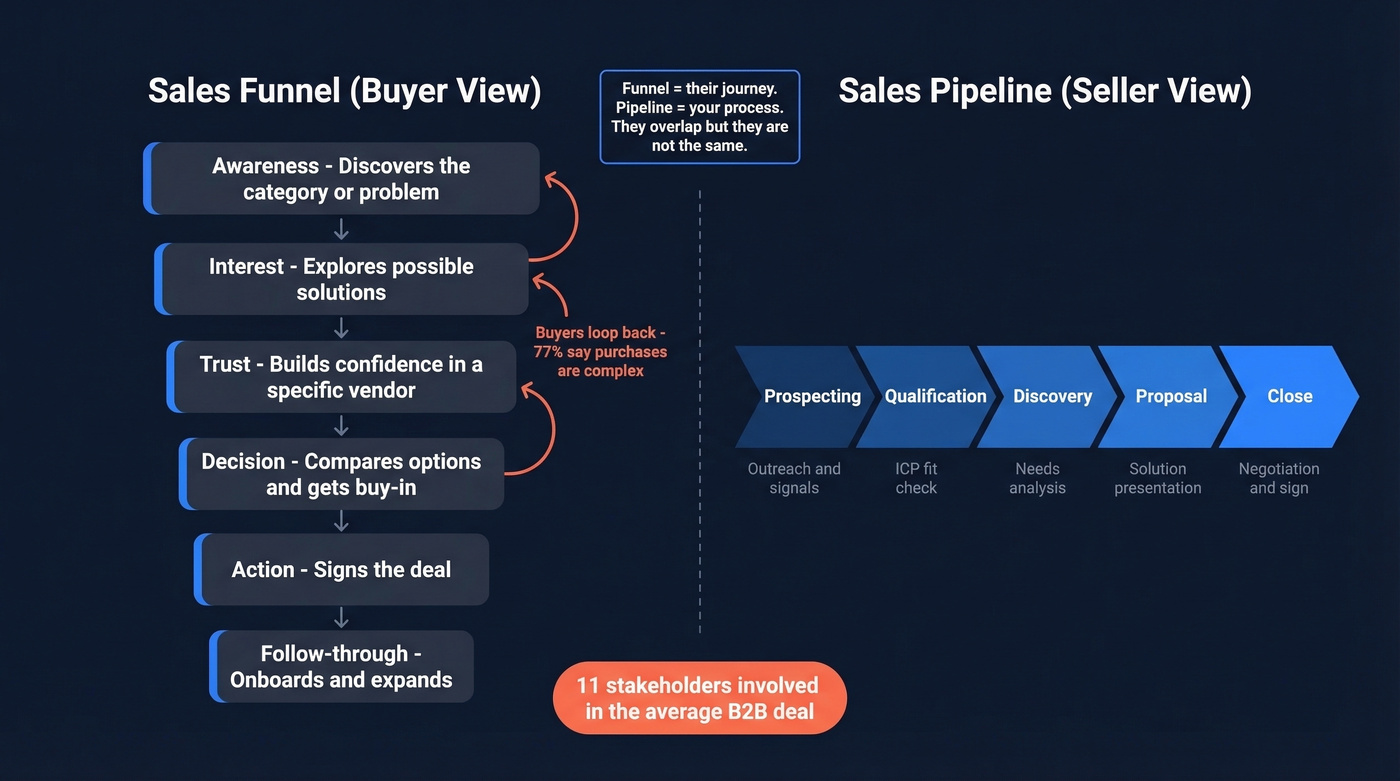
Your sales funnel maps the buyer's journey: Awareness, Interest, Trust, Decision, Action, Follow-through. It's their experience, not yours. A prospect discovers your category, evaluates options, builds confidence in your solution, and eventually commits. Great funnels aren't built by adding more steps - they're built by removing confusion between the few steps that matter.
Your sales pipeline is the seller's side of that equation. It tracks the activities, stages, and milestones your team manages in the CRM to move deals forward. Funnel = buyer perspective. Pipeline = seller perspective. They overlap, but they aren't the same thing.
Here's what most funnel diagrams get wrong: they imply a clean, linear path. Real B2B buying doesn't work that way. According to Gartner's B2B Sales Survey, 77% of B2B customers say their latest purchase was complex or difficult. Buyers re-enter at different stages, loop back to re-evaluate, and involve an average of 11 stakeholders before signing anything.
The other common mistake is building your funnel around your org chart instead of the buyer's journey. If your stages map to internal handoffs - "marketing qualified," "sales accepted," "solutions engineering review" - you've built a process tracker, not a funnel. Your model needs to reflect how buyers actually move, zigzags included, or it's just a pretty slide that doesn't match reality.
The practical implication: this isn't about cramming more names into the top. It's about getting the right people into the right stage and making it easy for them to move forward.
Activity vs. Pipeline - The Biggest Mistake
Here's a pattern we see constantly: a BDR team is "crushing activity metrics." Calls made, emails sent, meetings booked - all green. But pipeline isn't growing, and closed-won is flat. (If you want a clean breakdown of what to track, use these sales activities examples.)
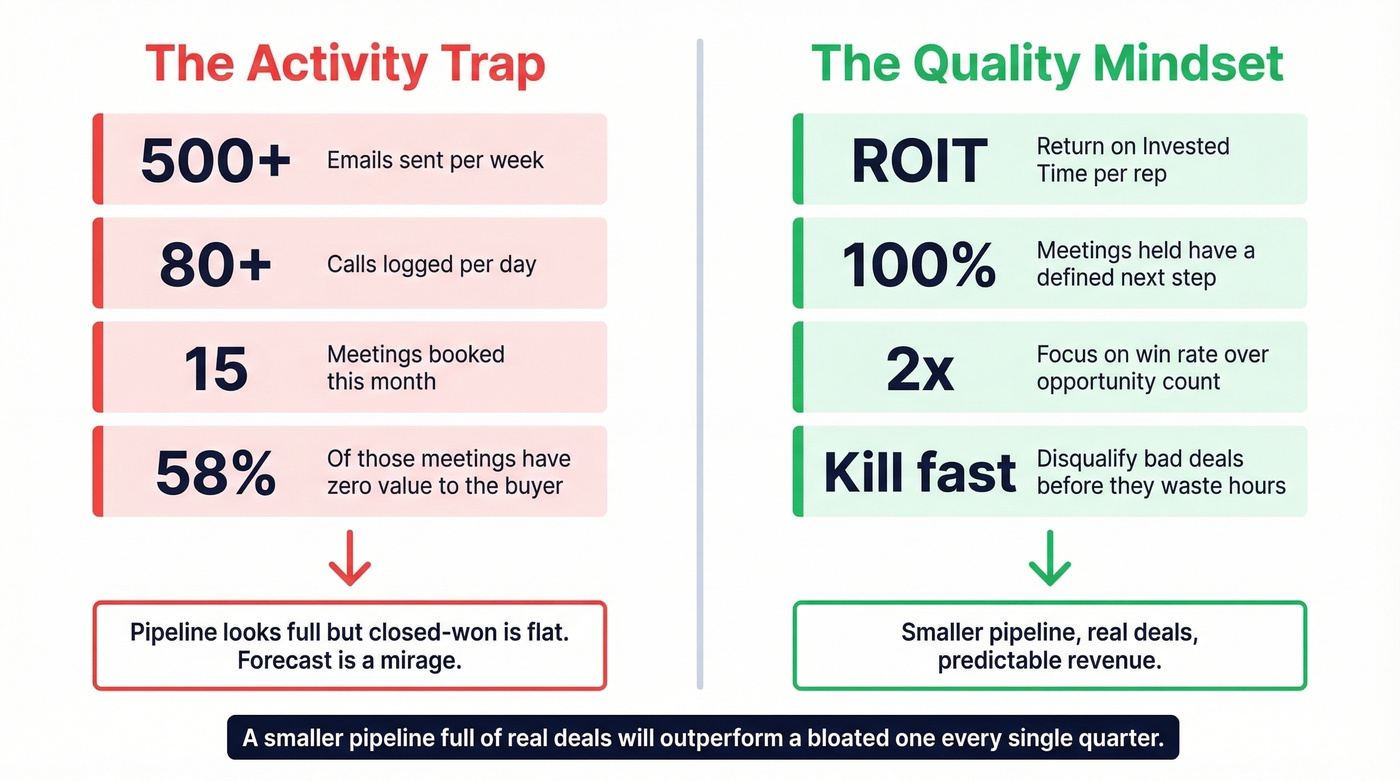
The problem is that "fill the funnel" becomes a mandate for volume, not quality. Managers push reps into proposal-writing mode, padding the pipeline with unqualified opportunities just to survive the next forecast review. 58% of sales meetings aren't even valuable to the buyer. That's not a pipeline - it's a mirage.
The fix is a mindset shift. Focus on hit rate over raw opportunity count. Think about ROIT - Return on Invested Time. Every hour a rep spends on a deal that was never going to close is an hour stolen from one that could. Qualify, re-qualify, over-qualify. Kill bad opportunities fast. A smaller pipeline full of real deals will outperform a bloated one every single quarter. (If you need a framework, start with MEDDIC sales qualification.)
Look, if your average deal is under $15k and your reps spend more time in forecast calls than on the phone with prospects, you don't have a pipeline problem. You have a management problem. The teams that win aren't the ones with the most meetings booked - they're the ones where meetings held create a defined next step.

This article talks about signal-based targeting and verified data as the two pillars of modern pipeline generation. Prospeo combines both: 15,000 intent topics via Bombora, job change triggers, and funding signals - layered on top of 300M+ profiles with 98% email accuracy. Teams using Prospeo book 35% more meetings than Apollo users and cut bounce rates from 35%+ to under 4%.
Stop burning your domain. Start filling your funnel with data that connects.
Pipeline Benchmarks by the Numbers
You can't fix what you can't measure. (To go deeper, compare against these sales pipeline benchmarks.)
Conversion Rates by Stage
| Stage | B2B SaaS (Optimistic) | Baseline (MarketJoy) |
|---|---|---|
| Lead to MQL | 39% | 22% |
| MQL to SQL | 38% | 15% |
| SQL to Opp | 42% | 11% |
| Opp to Close | 37-39% | 7% |
The gap between "optimistic" and "baseline" is enormous. If your team converts MQLs to SQLs at 15%, that's not a disaster - it's average. But it means you need roughly 2.5x more leads at the top to produce the same number of closed deals as a team running at 38%. That's the math that makes pipeline generation feel impossible when it's really a conversion problem.
Pipeline Velocity Formula
(Number of Opportunities x Avg Deal Value x Win Rate) / Sales Cycle Length
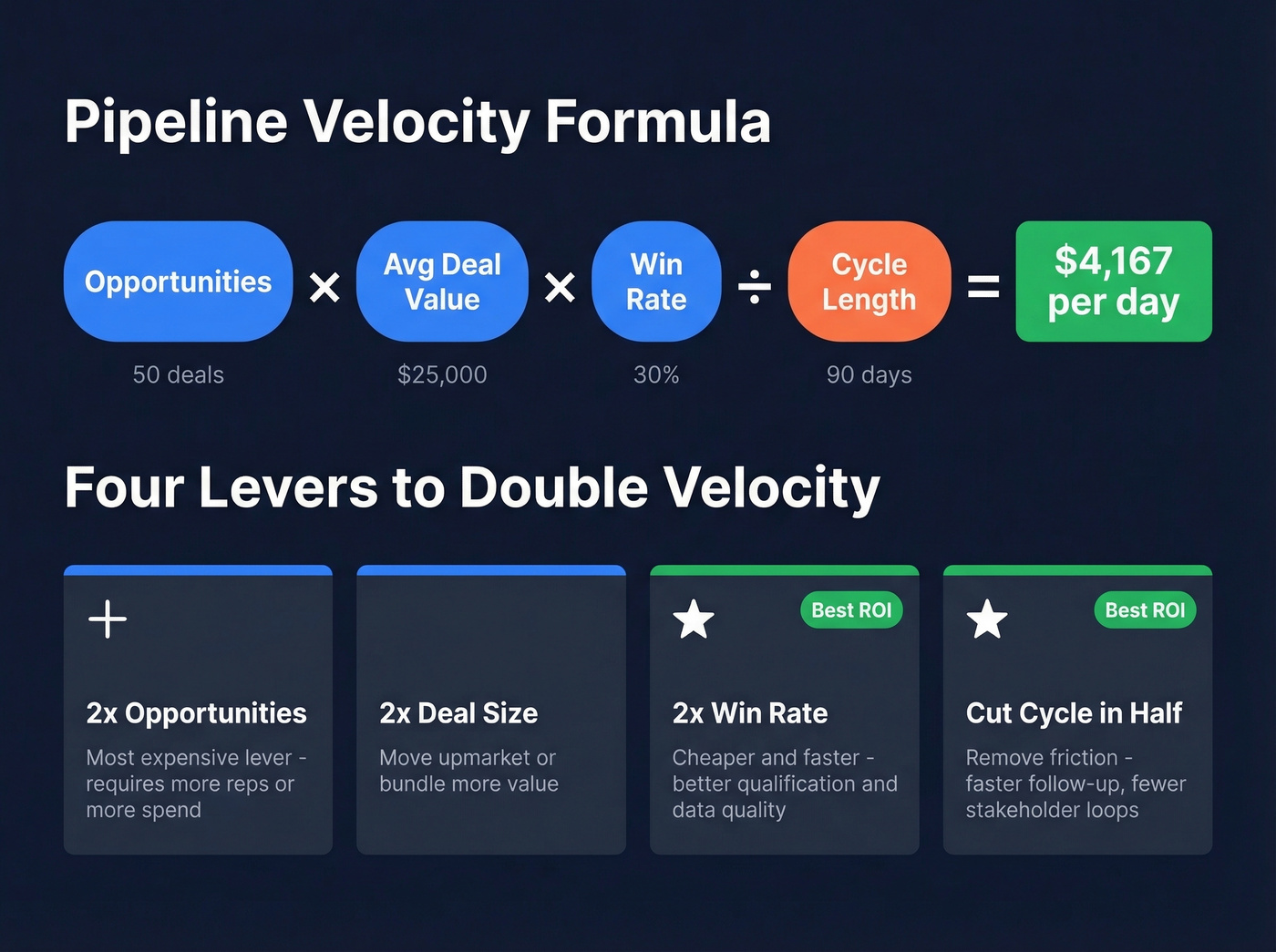
A worked example: 50 opportunities x $25,000 average deal x 30% win rate / 90-day cycle = $4,167/day in pipeline velocity. Want to double that number? You can double your opportunities, double your deal size, double your win rate, or cut your cycle in half. Most teams default to "more opportunities" when improving win rate or shortening cycles would be cheaper and faster. (If you want the exact metrics to monitor, use this pipeline health guide.)
Channel Comparison
| Channel | Visitor to Lead | Opp to Close |
|---|---|---|
| SEO | 2.1% | 38% |
| PPC | 0.7% | 35% |
| Events | 3-8% | 40% |
| Outbound | 1-5% reply rate | 15-25% (signal-targeted) |
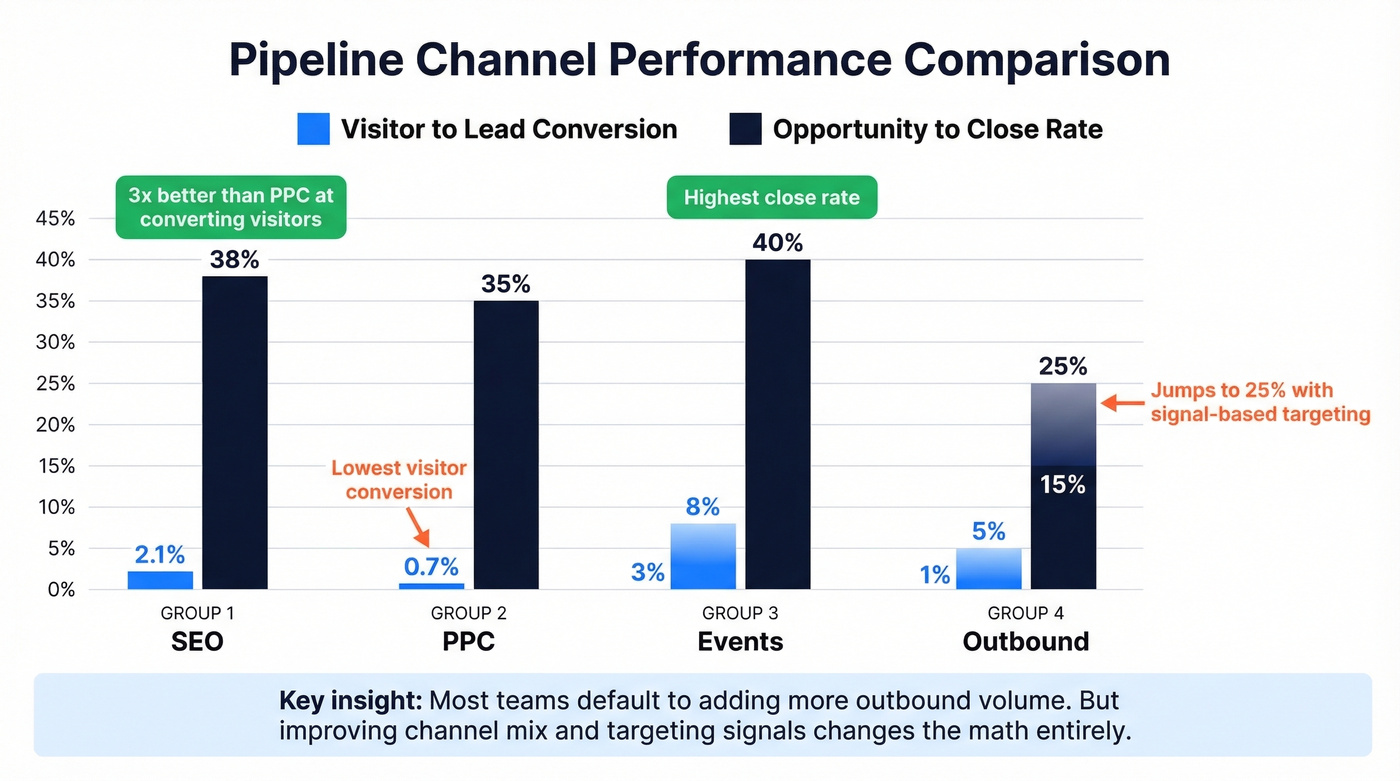
Events close at the highest rate. SEO converts visitors to leads 3x better than PPC. Outbound is a volume game with low reply rates - unless you're targeting with intent signals, which changes the math entirely.
The Modern Playbook to Fill Your Pipeline
Signal-Based List Building
The difference between a cold list and a signal-based list is the difference between knocking on random doors and walking into a store where someone's already holding your product. Intent data, job changes, funding rounds, and technographic signals tell you who's in-market right now - not who might be someday. (If you're formalizing this, use an ideal customer profile to keep targeting tight.)
Bulk CSV lists from an old export are pipeline poison. Contacts change roles, emails go stale, and you're burning your domain reputation with every send. We learned this the hard way watching teams torch their sender scores on data that was six months old.
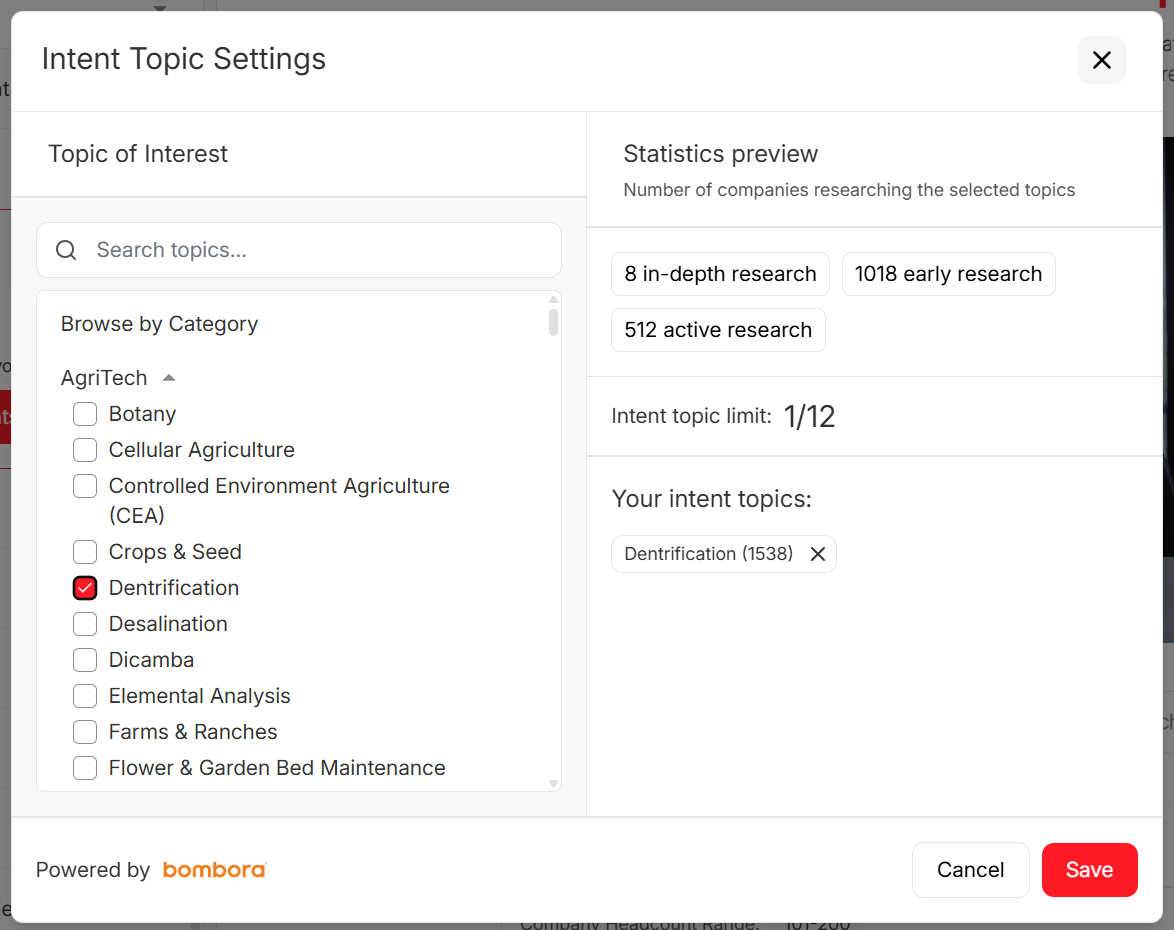
Prospeo's database solves this at the data layer: 300M+ professional profiles with 30+ search filters, including intent data across 15,000 Bombora topics, job changes, funding signals, and technographics. The 98% email accuracy and 7-day refresh cycle mean you're reaching people who are actually at the company you think they're at, with emails that actually work.
Multi-Touch Cadence Design
The data on persistence is clear.
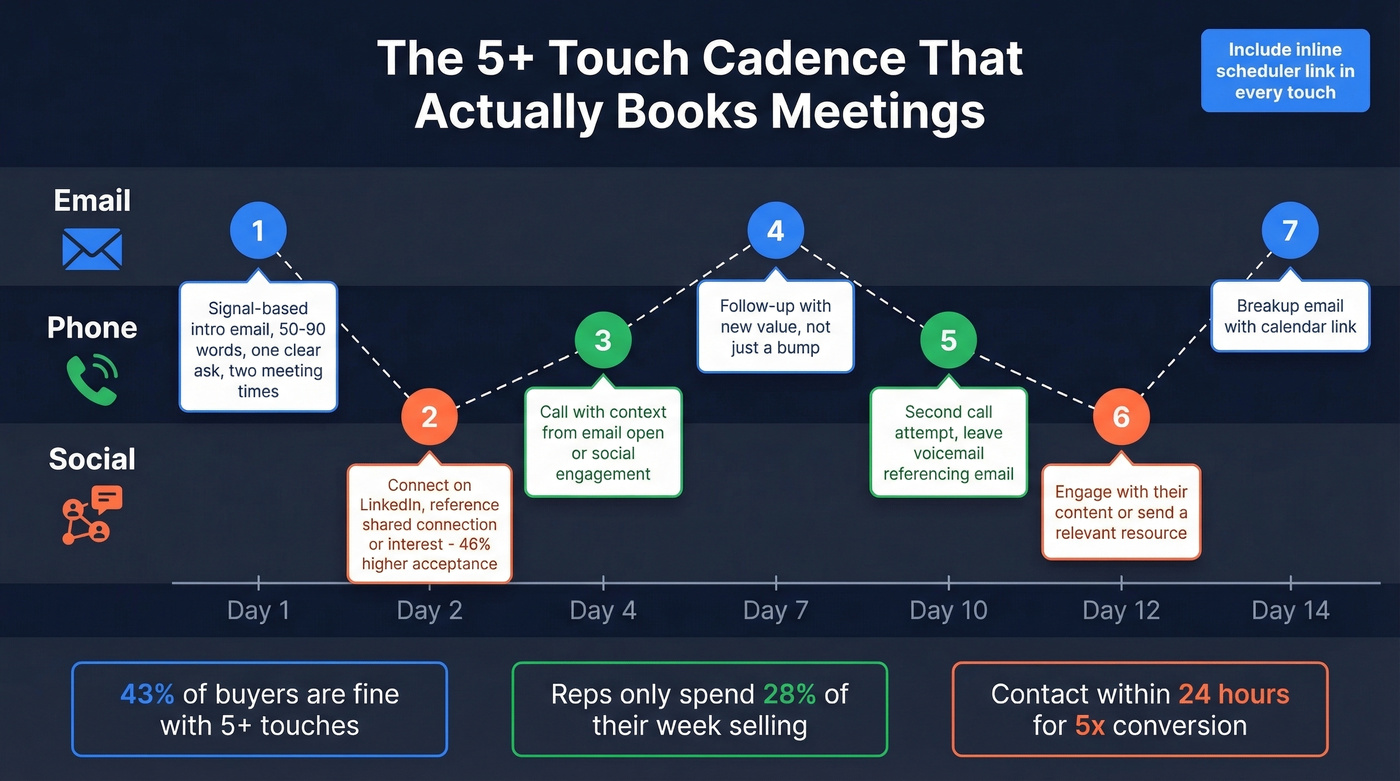
- Plan for 5+ touches minimum. 43% of buyers who accept meetings say it's fine for sellers to contact them five or more times before getting through.
- Mix channels. Email for clarity, phone for momentum, social for context and credibility. A single-channel cadence is easy to ignore.
- Find commonality. InMail acceptance jumps 46% when you mention a shared connection, school, or interest. The same principle applies to cold email - relevance beats personalization theater every time.
- Keep emails short. 50-90 words, one clear ask, two suggested meeting times. That's it. (For more structure, build a B2B cold email sequence.)
Reps spend only 28% of their week actually selling. That stat should make every sales leader uncomfortable. A well-structured cadence with pre-built templates and automated follow-ups gives reps hours back for the work that actually generates revenue.
Calendar-First Booking
Do this: Include an inline scheduler link in every outreach touch. Add automated reminders 24 hours and 1 hour before the meeting. Build a no-show rescue sequence that fires within 5 minutes of a missed call.
Skip this if you're still sending "let me know when works for you" and waiting three days for a reply while the prospect goes cold. Contacting leads within 24 hours of their first engagement increases conversion 5x.
Measure meetings held, not meetings booked. Opens and clicks are directional at best. The only metric that predicts revenue is a conversation that creates a next step.
Data Quality as the Foundation
Bad data is the invisible funnel leak. You can have the perfect ICP, the best cadence, and a killer offer - and none of it matters if 30% of your emails bounce. High bounce rates don't just waste sends; they destroy your sender reputation, which tanks deliverability for every future campaign. (If you're diagnosing this, start with email bounce rate benchmarks and fixes.)
Snyk's 50-person AE team was running bounce rates of 35-40% before switching to Prospeo's 5-step verification. Bounces dropped under 5%, and AE-sourced pipeline jumped 180%. That's not a marginal improvement - it's the difference between a functioning outbound engine and an expensive one that quietly fails.
You just saw the math: at a 15% MQL-to-SQL conversion rate, you need 2.5x more leads to hit the same number. But what if the problem isn't volume - it's data quality? Prospeo's 7-day refresh cycle means your contacts are current, not stale. 92% API match rate on enrichment. 125M+ verified mobiles with a 30% pickup rate. That's how you fix pipeline velocity without just adding more noise.
Better data in, more pipeline out. It really is that simple.
Warm Channels That Build Pipeline
Outbound gets all the attention, but the highest-converting pipeline often comes from warmer sources.
Introductions vs. referrals. There's a critical distinction here. A referral is "use my name when you call." An introduction is person A actively connecting you to person B. With real introductions, close rates can hit 50% - that's 5-7x better than cold outbound. If your reps aren't systematically asking happy customers for introductions, you're leaving the easiest pipeline on the table.
QBRs for expansion. Quarterly Business Reviews aren't just customer success theater. A well-run QBR surfaces new goals, new pain points, and new stakeholders. That's expansion pipeline built into a meeting you're already having. (If you want to run these better, use these QBR questions to ask.)
Private events. Mix high-potential prospects with your best customers in an exclusive setting - a dinner, a roundtable, a workshop. The social proof is built into the room, and attendance rates beat webinars by a wide margin because exclusivity creates urgency.
Multithreading. Deals are 37% more likely to close when more than one contact is engaged. If your reps are single-threaded on a champion and hoping for the best, they're exposed to a single point of failure. Map the buying committee early and build relationships across it.
Cold calls aren't dead - they're misused. A "cold call" preceded by an email sequence, a social touch, and a content download isn't cold anymore. It's a coordinated warm touch that happens to use the phone. The teams killing it with outbound treat calls as the final step in a multi-touch sequence, not the first. (If you want a cleaner approach, start with warm calling.)
Content and SEO. The long game. SEO converts visitors to leads at 2.1% - three times better than PPC - and those leads tend to be higher intent because they searched for the problem. It takes months to build, but it compounds in a way that outbound never will. For teams wondering how to sustain pipeline growth long-term, content is the compounding asset that paid channels can't replicate.
The Funnel-Filling Tech Stack
You don't need ten tools. You need three things working well: verified data, a sequencer, and a CRM. Everything else is a nice-to-have until those three are dialed in. (If you're evaluating options, start with these SDR tools.)
| Tool | Category | Starting Price | Best For |
|---|---|---|---|
| Apollo | Data + Sequencing | Free; $49-$99/mo paid | SMB all-in-one |
| ZoomInfo | Data + Intent | $15K+/yr | Enterprise depth |
| Clay | Enrichment + Workflows | $149+/mo | Custom data workflows |
| Instantly | Email Sequencing | $30+/mo | High-volume sending |
| 6sense | Intent + ABM | ~$60K/yr | Enterprise ABM |
| Demandbase | Intent + ABM | ~$24K/yr | Mid-market ABM |
| HubSpot CRM | CRM | Free; $20+/mo paid | Pipeline management |
| Calendly | Scheduling | Free; $10+/mo paid | Meeting booking |
For most teams, start with verified data and layer a sequencer on top. Add intent data when you're ready to move from "who could buy" to "who's buying right now." A free CRM like HubSpot handles pipeline tracking until you outgrow it, and an inline scheduler eliminates the back-and-forth that kills momentum. The rest can wait.
FAQ
How long does it take to fill a sales funnel from scratch?
Expect 3-6 months to build a functioning outbound pipeline from zero. Teams using intent signals and systematic introductions can compress that to 6-8 weeks for first meetings. The biggest variable is sales cycle length - 90-day cycles mean no revenue impact for at least one full quarter.
What's the best channel for filling the funnel in 2026?
Signal-based outbound paired with systematic introductions delivers the highest ROI for most B2B teams. SEO and events are powerful but take months to build. For outbound specifically, intent data across thousands of topics helps prioritize accounts showing active buying signals, which typically doubles reply rates compared to cold lists.
How do I know if my funnel is healthy?
Run your conversion rates by stage against the benchmarks above and calculate pipeline velocity. If MQL-to-SQL conversion is below 15%, you have a qualification problem, not a volume problem. Check data quality first - if bounce rates exceed 5%, fix that before optimizing anything else.
How do you fill your pipeline with no inbound leads?
Start with signal-based outbound targeting buyers who show active intent - job changes, funding events, and topic-level research signals. Combine that with a systematic introduction program through existing customers. These two approaches produce higher-quality opportunities than inbound alone and don't depend on marketing-generated MQLs.