

How to Write a Follow-Up Email After a Meeting with Action Items
It's 4:15 PM. You just walked out of a 45-minute project sync where the team agreed on six action items, three owners, and a hard deadline. By tomorrow morning, half of those commitments will have evaporated - unless someone writes them down and sends them out.
That someone is you. And the follow-up email after meeting with action items you send in the next hour is the single highest-leverage thing you'll do today.
Subject Lines That Get Opened
A study of 5.5M emails by Klenty found personalized subject lines hit a 46% open rate, with a sweet spot of 2-4 words. That's cold email data - your meeting follow-ups to known contacts should clear 70%+ easily. The principles still apply, though: most mobile clients truncate after roughly 33 characters, so front-load what matters.
Lines that work:
- {Name}, next steps
- Quick recap - {topic}
- [Project] next steps - deadline [date]
- {Company} + {Your Company} timeline
- The {metric} idea from Tuesday
Now the ones to retire. "Follow-up" by itself. "Just checking in." The fake "Re:" thread - recipients see through it instantly. And stuffing numbers into subject lines actually underperforms plain text (27% vs. 46% open rate), so skip the "3 action items from today's call" approach.
If you want more options, pull from these subject lines and adapt them to your meeting context.
What Goes in the Email
This isn't a thank-you note. It's not a meeting recap for the record, either. A post-meeting action items email exists to create accountability - every element should drive someone to do something.
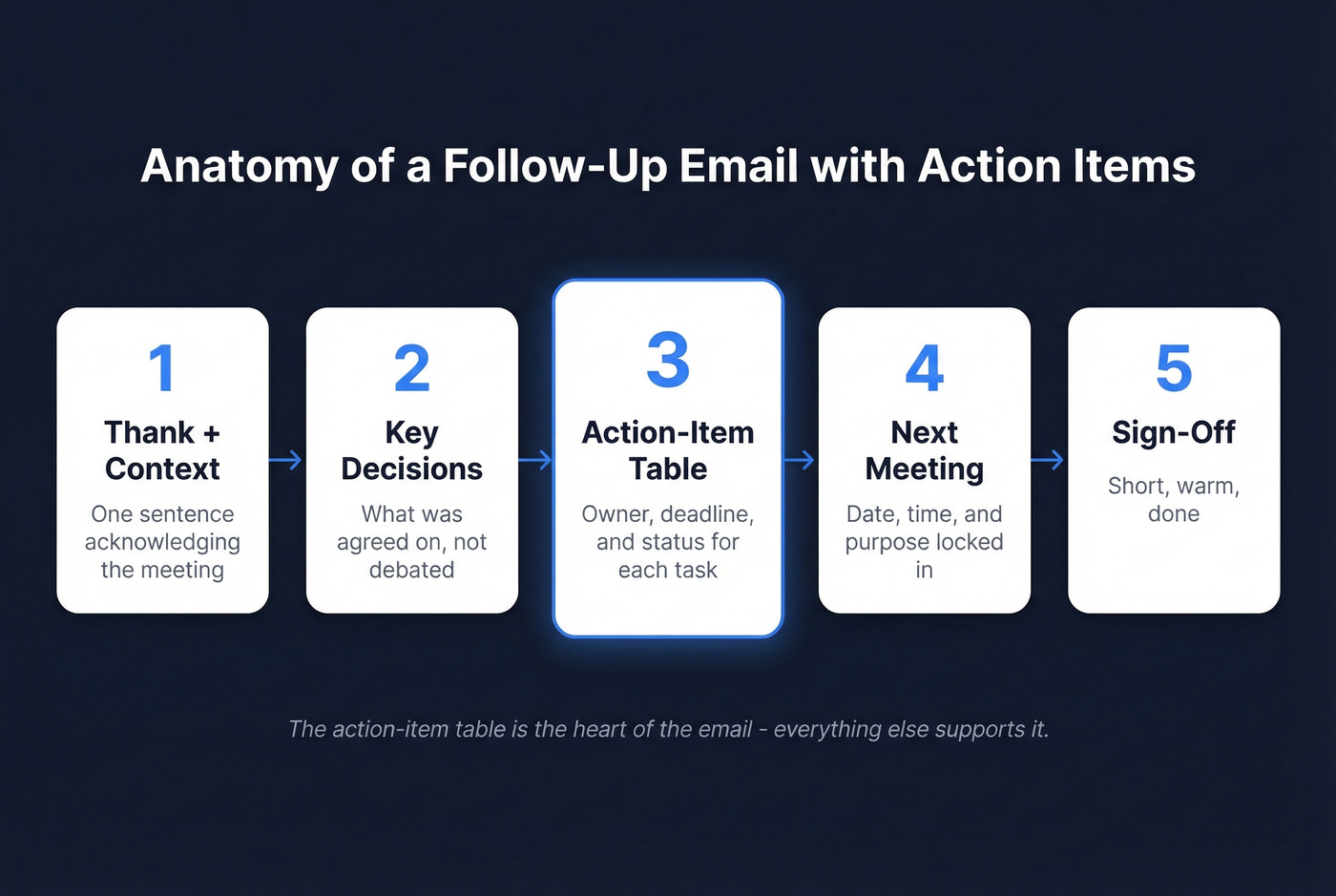
Five parts, every time:
- Thank + context - one sentence acknowledging the meeting
- Key decisions - what was agreed on (not debated, agreed)
- Action-item table - the core of the email
- Next meeting - date, time, purpose
- Sign-off - short, warm, done
Here's the table format we've found works best:
| Action Item | Owner | Deadline | Status |
|---|---|---|---|
| Send revised SOW | Dana | Jan 14 | Pending |
| Pull Q4 pipeline data | Marcus | Jan 15 | Pending |
| Schedule vendor call | Priya | Jan 13 | In progress |
The meeting organizer or agenda owner sends it. If that's ambiguous, volunteer - the person who sends the recap is the person who controls the narrative. CC all invitees including no-shows, add stakeholders who need visibility, and for senior leaders, CC their assistants too.
Keep it short. For internal recaps, 150-250 words is a solid target. For sales follow-ups, 50-125 words is ideal. If the project is complex, move tracking into Asana or Trello and link to it so the email stays scannable. If you're running a sequence, a lightweight sequence management process helps keep owners honest without extra meetings.

You just nailed the meeting recap - clear action items, tight deadlines, every owner named. Then the email bounces. Prospeo verifies emails in real time with 98% accuracy so your follow-ups actually land. 75 free lookups/month, no credit card required.
Don't let a bad email address kill your post-meeting momentum.
Templates for Every Scenario
Below are templates you can adapt for common situations. Each one doubles as a follow-up actions after a meeting sample you can customize with your own details. If you need more variations, these sales follow-up templates cover common asks and objections.
Internal Team Recap
Subject: Q1 launch - next steps
Hey team,
Thanks for a productive sync today. Here's where we landed:
Decisions made: We're going with Vendor B for fulfillment and pushing the launch to Feb 3.
| Action Item | Owner | Deadline | Status | |---|---|---|---| | Finalize vendor contract | Dana | Jan 17 | Pending | | Update launch timeline in Asana | Marcus | Jan 15 | Pending | | Brief design team on new packaging specs | Priya | Jan 16 | Pending | | Send revised budget to finance | Jordan | Jan 18 | Pending |
Next sync: Thursday Jan 16, 2 PM ET. Agenda: vendor onboarding status + design review.
Flag anything that's blocked before then.
- Alex
Client or Partner Follow-Up
Subject: {Company} + Acme - next steps
Hi Sarah,
Great meeting today. Here's a quick recap of what we agreed on:
| Action Item | Owner | Deadline | |---|---|---| | Send case study + ROI deck | Our team | Jan 14 | | Confirm internal stakeholders for pilot | Your team | Jan 17 | | Schedule technical walkthrough | Both | Week of Jan 20 |
I'll have the case study in your inbox by Tuesday. Let me know if any of the above needs adjusting.
- Alex
Before you hit send to someone you met at a conference or a prospect from a demo, verify their email. A bounced follow-up kills momentum faster than a late one. Prospeo's email finder handles this with real-time verification and 98% accuracy, and there's a free tier with 75 lookups a month if you want to test it. If you're doing this at scale, pair it with a basic email deliverability checklist.
Sales Follow-Up with Next Steps
Cold outreach averages just an 8.5% response rate. A warm post-meeting follow-up is your best shot - don't waste it with a sloppy email. The ideal sales follow-up runs 50-125 words. If you're trying to lift replies, benchmark against typical follow-up email reply rate ranges and adjust your ask.
Subject: Jamie, next steps on the pilot
Hi Jamie,
Thanks for walking us through your workflow today. Based on what you shared:
- I'll send a custom ROI projection by Thursday.
- You'll confirm whether your VP of Ops should join the next call.
Can we lock in Tuesday Jan 21 at 10 AM for a 30-minute follow-up? A simple "yes" works.
- Alex
Notice the binary ask at the end. "A simple yes works" gets faster replies than "Let me know your thoughts on timing." If you need alternate phrasing, borrow from these emails that get responses.
When Someone Ignores an Action Item
Here's the thing: the person hasn't done anything wrong. The action item just hasn't been accomplished yet. That reframe - borrowed from Less Meeting's approach to async accountability - changes how you write every reminder. Knowing how to follow up on action items email by email, without sounding like a nag, is a skill worth developing. When in doubt, use a polite chaser email structure and keep the ask binary.
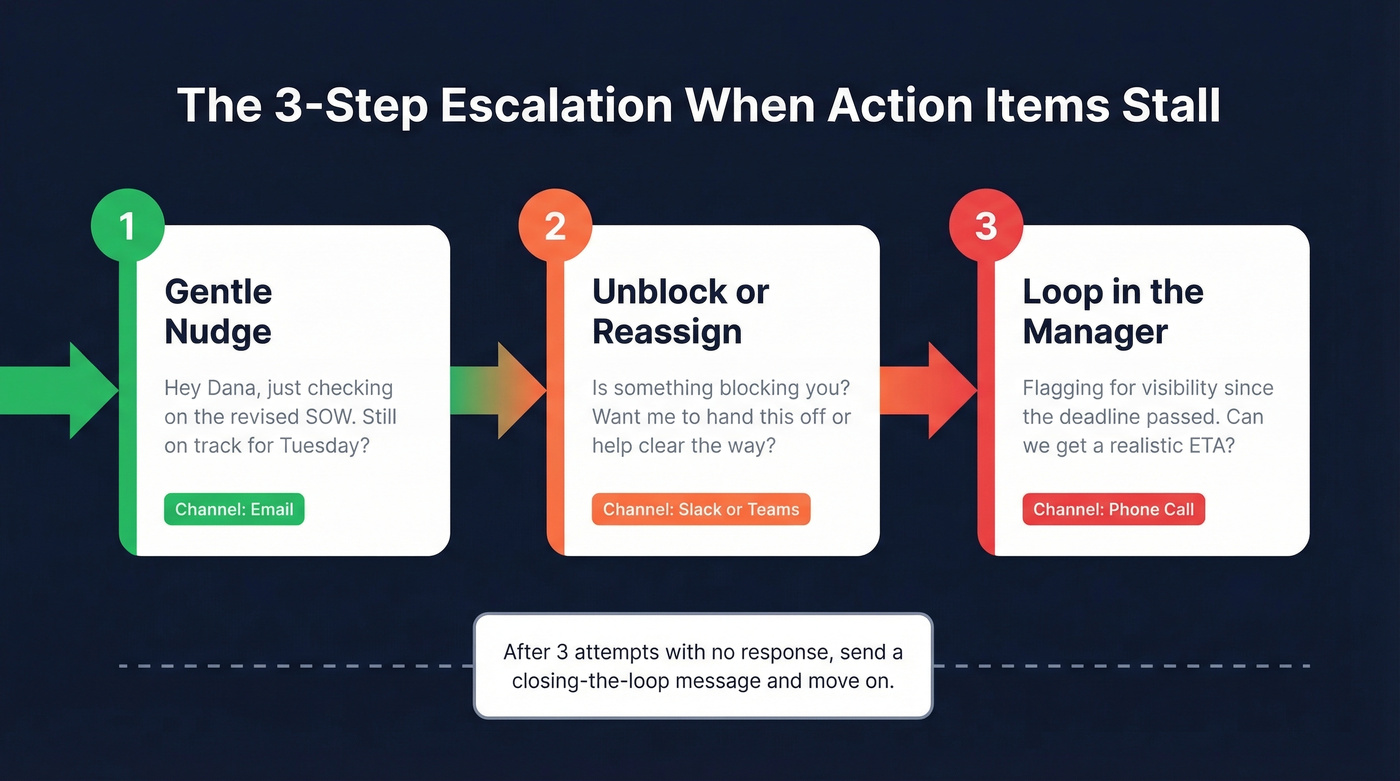
The 3-step escalation:
First reminder - Gentle nudge. "Hey Dana, just checking on the revised SOW. Still on track for Tuesday?"
Second reminder - Unblock or reassign. "Is another team holding this up? Want me to hand this to Jordan, or is there something blocking you I can help clear?" This one matters because it gives the person an exit that isn't "I forgot." Most people didn't forget. They're stuck.
Third reminder - Loop in the manager. Not as a threat - as a bandwidth conversation. "Flagging this for visibility since the deadline's passed. Can we get a realistic ETA?"
Switch mediums as you escalate: email first, then Slack or Teams, then a phone call. After three escalation attempts with no response, send a final "closing the loop" message and move on.
The "unless I hear otherwise, I'll assume..." technique works for low-stakes items. But if you write "I'll assume we're going with Vendor B unless you object by Friday," you'd better actually move forward on Monday. It's a commitment, not a bluff.
Mistakes That Kill Follow-Ups
Let's be honest: most follow-up emails fail not because people forget to send them, but because they're indistinguishable from the 47 other unread messages in the recipient's inbox. The fix is ruthless specificity.
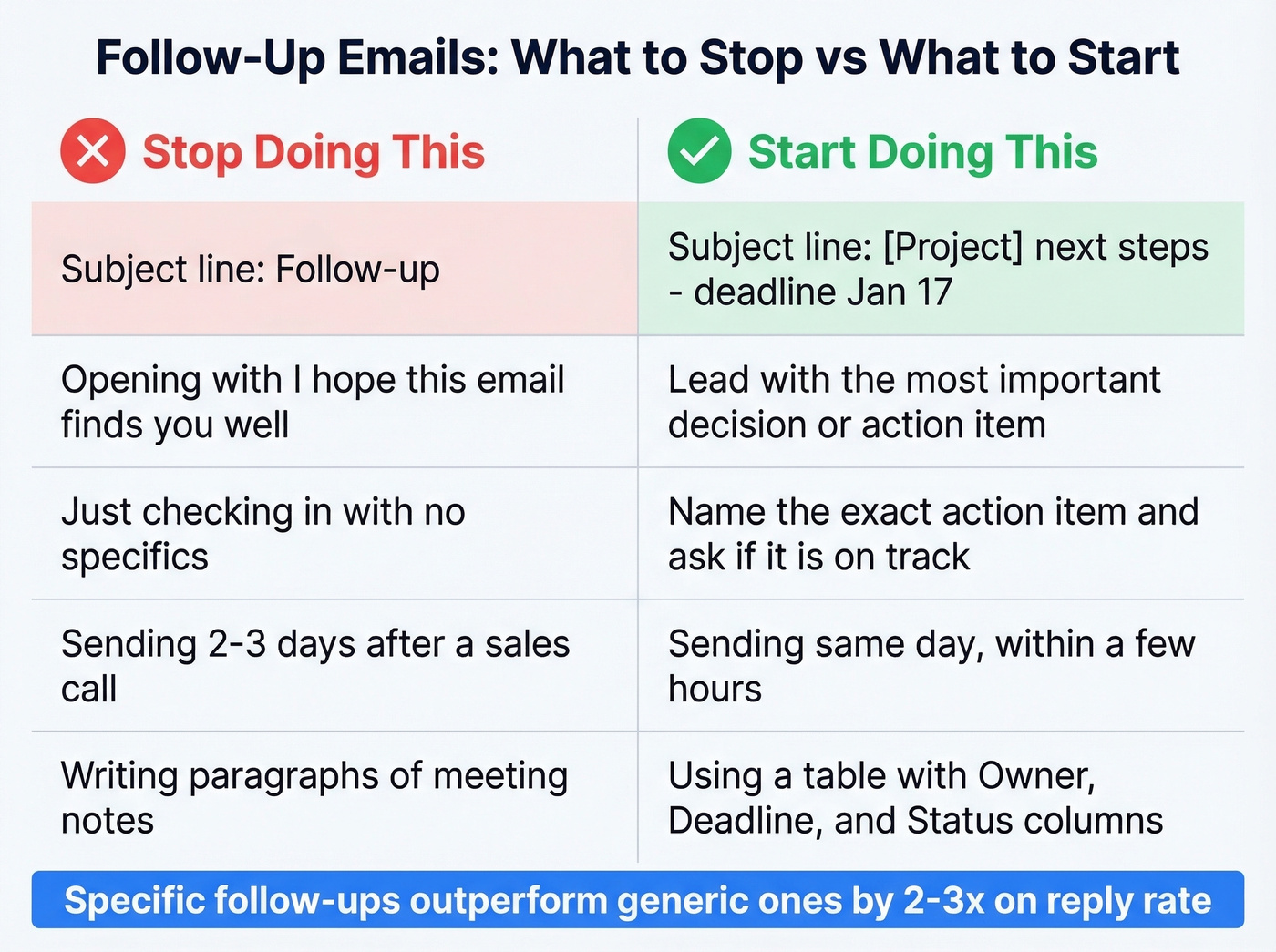
Drop "Follow-up" as your subject line and use "[Project] next steps - deadline [date]" instead. Kill "Just checking in" - name the specific action item and ask if it's on track. And please, never open with "I hope this email finds you well." Lead with the most important decision or action item. We've tested both approaches on our own outbound campaigns, and the specific version consistently outperforms the generic one by 2-3x on reply rate. If you need better language for that opener, this guide on how to say just checking in professionally helps.
Timing matters too. For sales calls, same day is the standard - within 24 hours at the absolute latest. For internal meetings, same day or next morning works fine. And if a meeting produced no decisions or action items? Skip the formal recap. A short note or simply the next calendar invite is usually all you need. If you're unsure about cadence, follow this when should you follow up timing guide.
One more thing: if you're sending follow-ups to prospects whose email addresses you scraped from a badge scan or a business card, verify before you send. A hard bounce on your first touchpoint tanks your sender reputation, and no amount of great copy fixes that. If you're seeing issues, start with email bounce rate benchmarks and then work on sender reputation.
Sending a sales follow-up to a prospect you just met? One bounce destroys the trust you built in that meeting. Prospeo's email finder pulls verified contact data from 300M+ profiles at $0.01/email - so every action-item email hits a real inbox.
Find and verify any prospect's email before you hit send.
FAQ
How long should a follow-up email with action items be?
For internal recaps, aim for 150-250 words. Sales and client follow-ups perform best at 50-125 words. Use a table for action items - it's more scannable than paragraphs and makes ownership unambiguous.
When should I send the follow-up email?
Same day for sales calls (within 24 hours max), end of day or next morning for internal meetings. The closer to the meeting you send it, the less likely people are to misremember what they agreed to.
What are the essential elements of a post-meeting action items email?
Every effective recap confirms key decisions, assigns each action item to a specific owner with a deadline, and sets the date for the next check-in. Without those three elements, even a well-written email won't drive accountability.
How do I follow up with someone I just met at an event?
Send within 24 hours, reference a specific moment from your conversation, and include any resource you promised. If you only have a name and company, use an email finder tool to locate their verified address before you send - a bounced first email is worse than a late one.