

How to Follow Up After No Response (Without Getting Ignored or Flagged)
You sent the email. Clear value prop, clean CTA, personalized subject line. Three days pass. Nothing. A week. Still nothing.
The instinct is to fire off five more follow-ups with increasing desperation, but that's exactly how you end up in spam folders and on block lists. Crafting the right follow-up email after no response is the difference between earning a reply and torching your sender reputation.
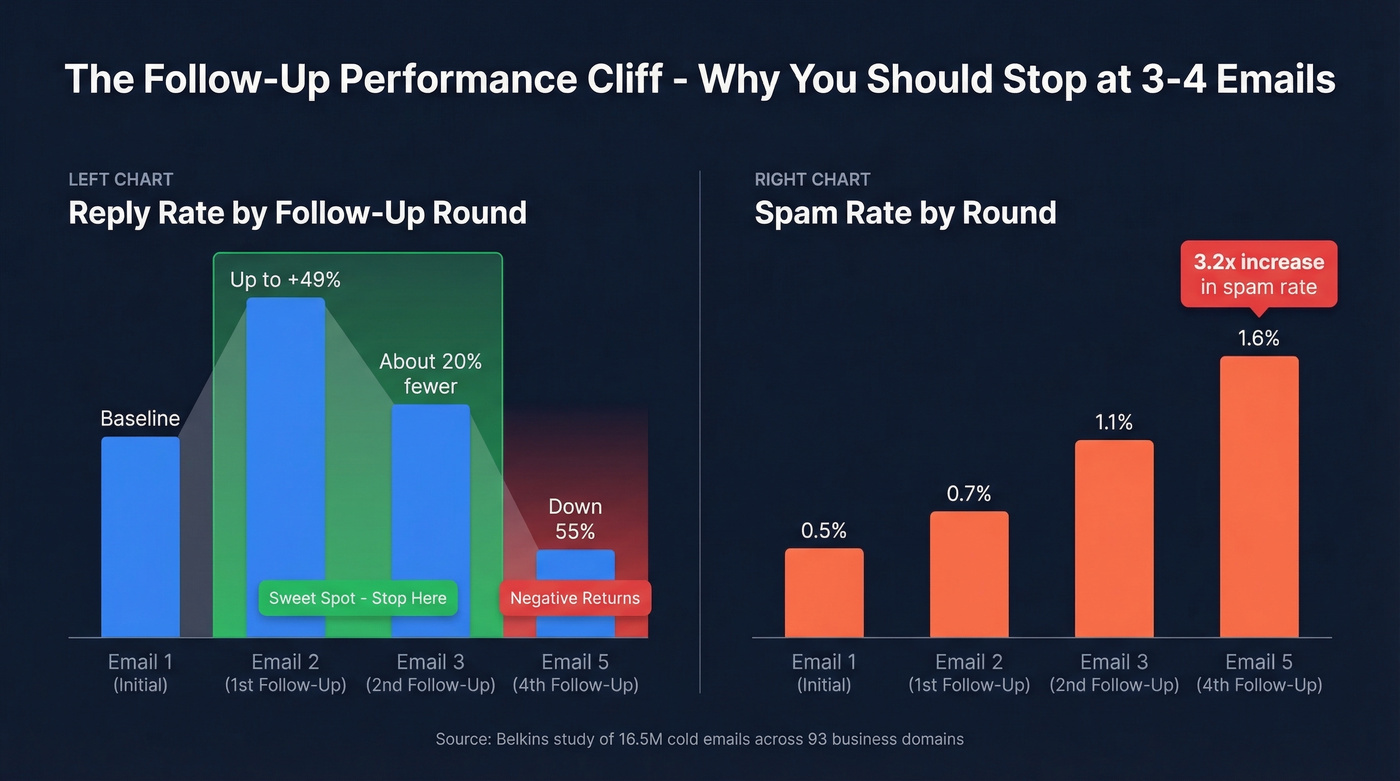
A lot of guides push long sequences - Atlassian/Loom even recommends 6-11 attempts. That advice is dangerous in 2026. A study of 16.5 million cold emails by Belkins shows reply rates dropping 55% by the fourth follow-up while spam rate rises from 0.5% to 1.6% by Round 4, a 3.2x increase. The math doesn't support persistence theater. Here's what actually works when you need to re-engage a silent prospect.
Three Rules Before You Read Anything Else
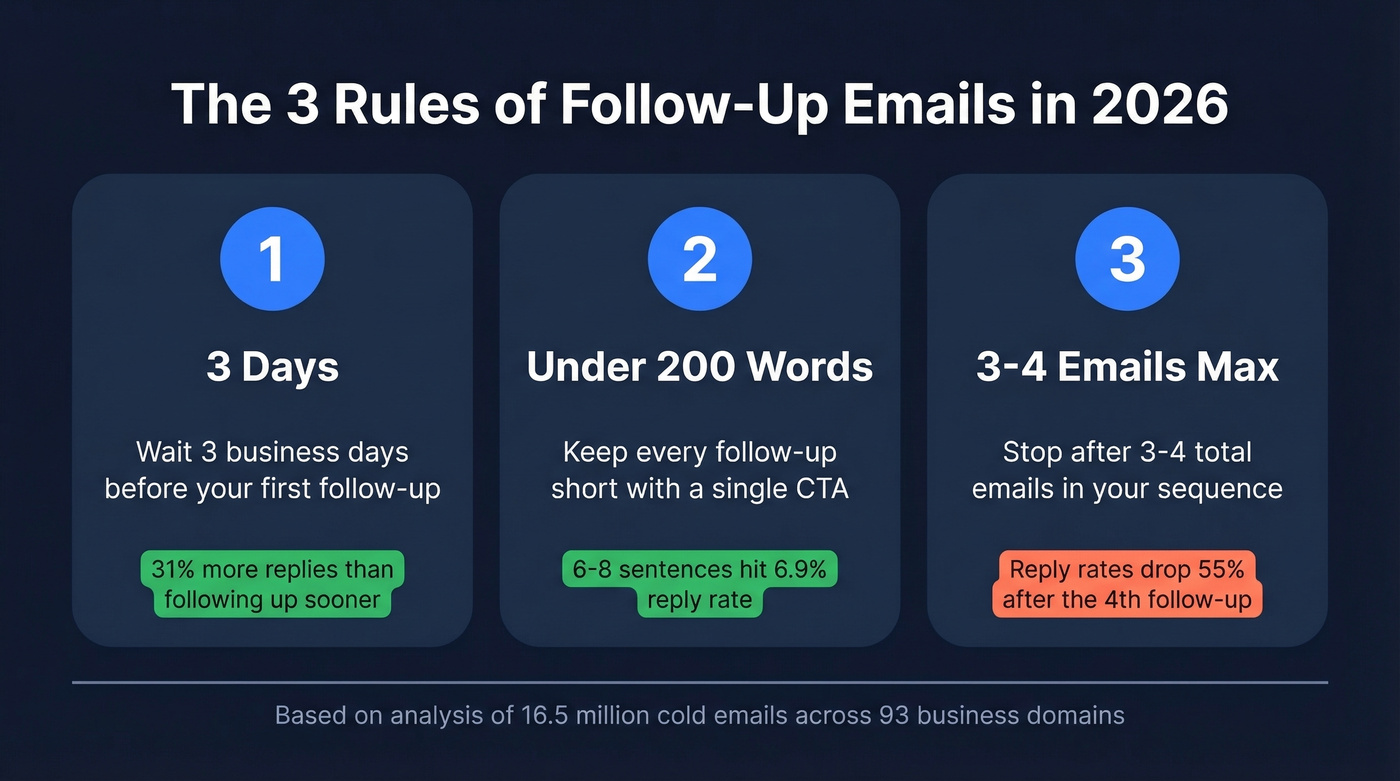
- Wait 3 business days before your first follow-up. Atlassian's research shows this produces 31% more replies than following up sooner.
- Keep every follow-up under 200 words with a single CTA. Emails with 6-8 sentences hit a 6.9% reply rate in the dataset. Longer emails performed worse across the board.
- Stop after 3-4 total emails. Many sequences run 4-7 emails over 14-21 days, but the data shows returns collapse after 3-4. Two to three follow-ups is the sweet spot, not six.
Jump to your scenario:
- Cold outreach
- [Post-meeting / warm intro](#post-meeting - warm-intro)
- [Recruiting / job application](#recruiting - job-application)
- Client invoice or internal stakeholder
What the Data Actually Shows
The 16.5 million cold emails Belkins analyzed spanned 93 business domains throughout 2024. The headline: average reply rates fell from 6.8% to 5.8% year-over-year - a 15% decline. Getting replies is harder than it was even 12 months ago, which makes every unanswered email more consequential to handle correctly.
Here's the follow-up performance curve that should guide your entire strategy:
- First follow-up (2nd email): Reply rates jumped up to 49%. The top 20% of campaigns sometimes doubled their responses with a single follow-up.
- Second follow-up (3rd email): About 20% fewer responses than the first. Still worth sending, but diminishing returns are obvious.
- Fourth follow-up (5th email): Response rates down 55%. You're past diminishing returns - you're in negative territory.
The risk side is just as telling. Spam rate climbs from 0.5% on the first email to 1.6% by Round 4. Unsubscribes rise to 2% by Round 4. You're not just wasting effort - you're actively damaging your sender reputation.
One more number worth internalizing: roughly 60% of replies come after the first follow-up, not the fifth or sixth. The first follow-up does the heavy lifting. Everything after that is increasingly marginal.
When to Send Each Follow-Up
| Scenario | First Follow-Up | Second Follow-Up | Breakup Email |
|---|---|---|---|
| Cold outreach | 3 business days | 5-7 days later | 7-10 days later |
| Post-meeting | 24-48 hours | 5 business days | 10 business days |
| Recruiting | 5 business days | 7-10 days later | 2 weeks (or skip) |
| Invoice/internal | 3-5 business days | 5 days later | Escalate |
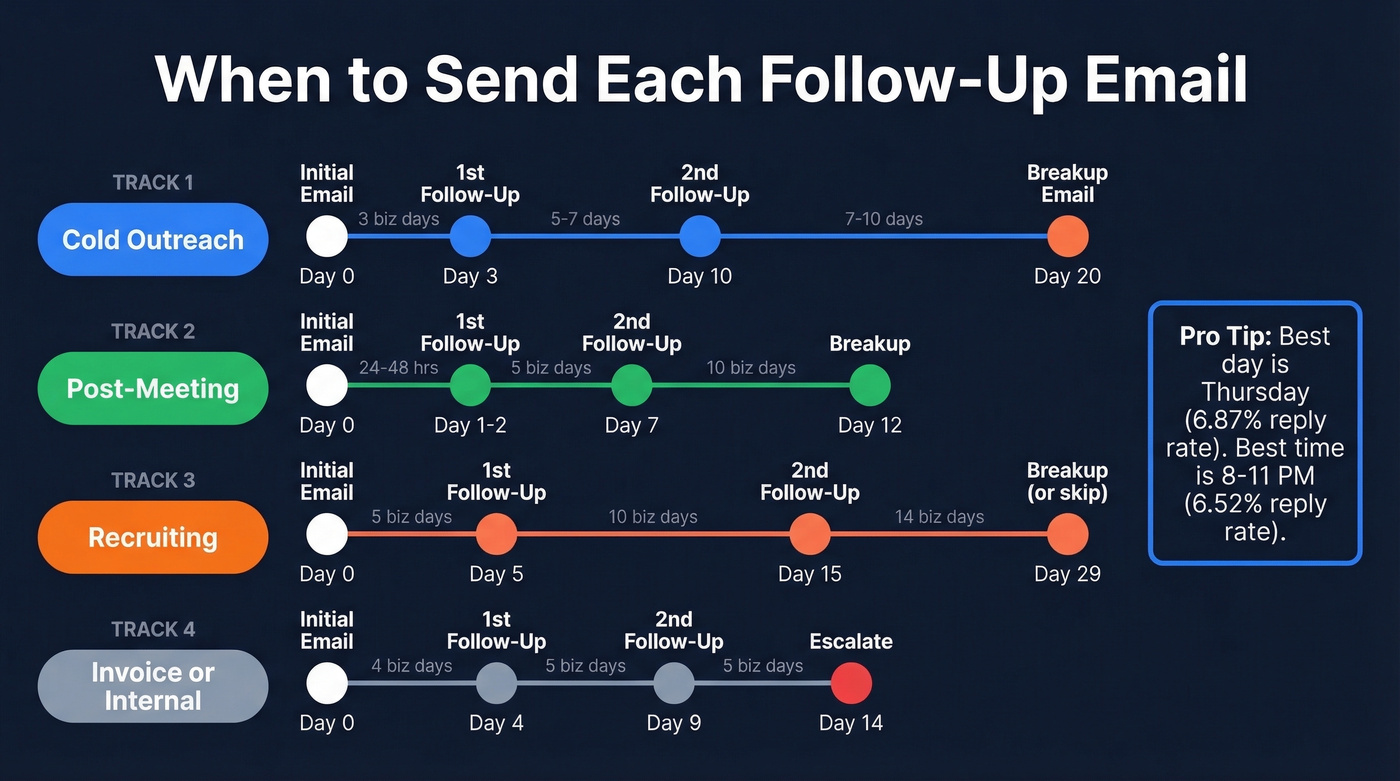
For cold outreach specifically, Thursday generates the highest reply rate at 6.87%. Evenings between 8-11 PM peak at 6.52% - people catch up on email after the workday winds down. Space your 3-4 emails across 14-21 days, not the compressed 7-day blitz some tools default to. (If you want a deeper timing breakdown, see our guide on the best time to send cold emails.)
The Non-Responder Decision Tree
Not all silence means the same thing. What you do next depends on what the recipient actually did with your message.
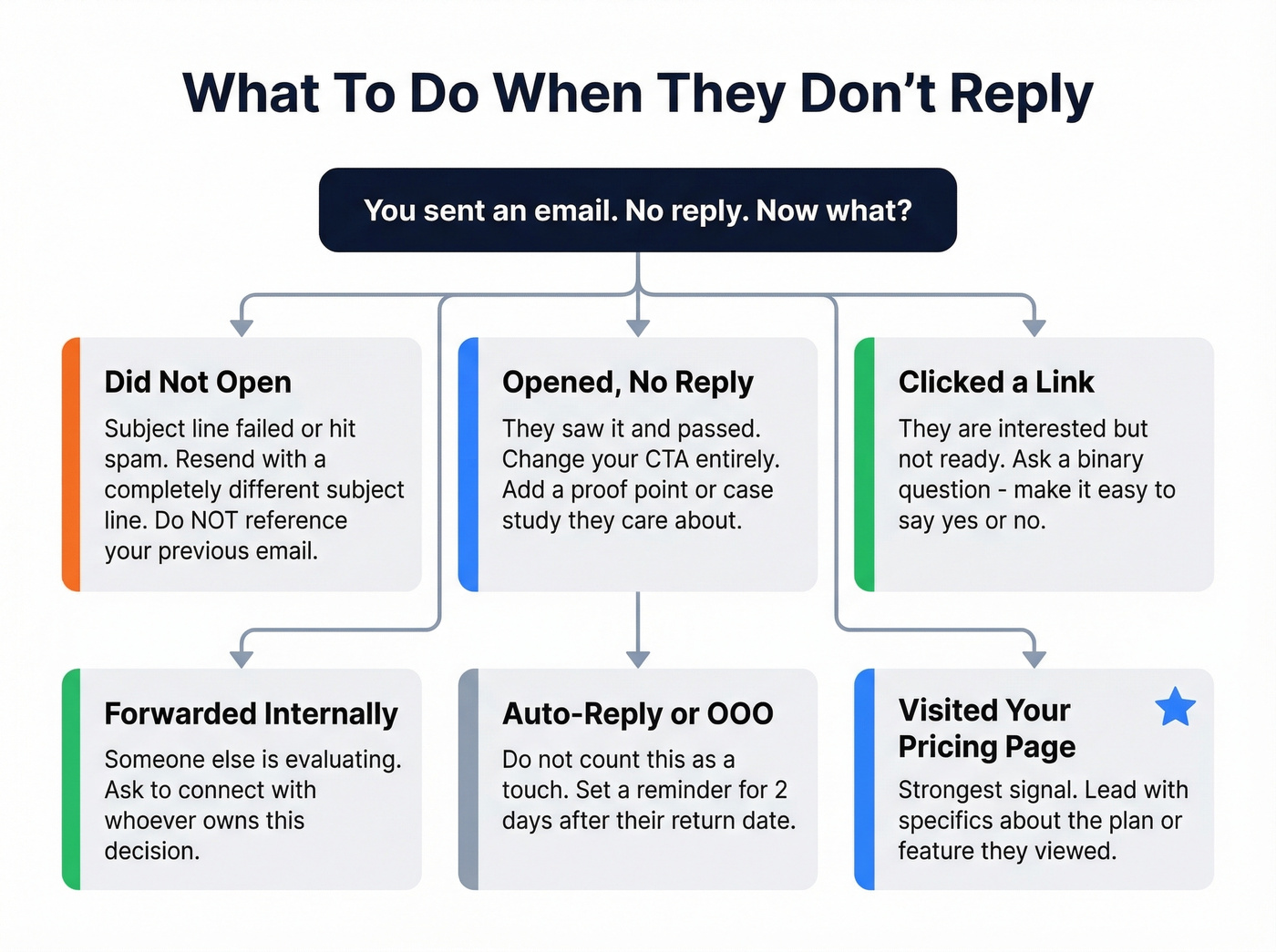
Didn't open: Your subject line failed, or the email landed in spam. Resend with a completely different subject line and a shorter body. Don't reference your previous email - they never saw it. (For more options, borrow from these cold email subject line examples.)
Opened but didn't reply: They saw it and passed. Change your CTA entirely. Add a proof point, a relevant case study, or a specific insight they'd care about. The original pitch didn't compel action, and repeating it won't either.
Clicked a link: They're interested but not ready to commit. Ask a binary question: "Would a 15-minute call next Tuesday work, or is this something for Q3?" Make it easy to say yes or no.
Forwarded internally: Someone else is evaluating. Ask directly: "Looks like this might sit with someone else on your team - happy to connect with whoever owns this."
Auto-reply / OOO: Don't count this as a touch. Set a reminder for two days after their return date and restart your sequence from there. Most reps waste a follow-up on someone who's literally on a beach.
Visited your pricing page: If your CRM tracks website visits, a prospect hitting your pricing page is a stronger follow-up trigger than any email open. Lead with specifics: "Noticed you were looking at [plan/feature] - happy to walk through how it works for teams like yours."
Your targeting matters as much as your copy. Campaigns that contacted 1-2 people per company saw a 7.8% reply rate versus 3.8% when emailing 10+ people at the same company. Spray-and-pray doesn't just feel lazy - it measurably underperforms. (If you’re tightening targeting, start with an ideal customer profile.)
And yes: in cold outreach, non-response is the norm. Around 97% of recipients won't respond, which is exactly why a well-crafted follow-up matters so much. (More benchmarks: follow-up email reply rate.)

Your follow-up sequence is only as good as the email address behind it. With bounce rates climbing and spam filters tightening, sending to unverified contacts burns your sender reputation fast. Prospeo delivers 98% email accuracy with 5-step verification - so every follow-up hits a real inbox, not a spam trap.
Stop following up with dead addresses. Start with data that connects.
Follow-Up Email Templates by Scenario
Every template below follows the under-200-word rule. Each one adds value rather than just "checking in." Copy, customize, send. (If you want more variations, use these sales follow-up templates.)
Cold Outreach (First Follow-Up)
When to use: 3 business days after your initial email, no reply. This is your most important touch in the entire sequence.
Subject: Quick thought on [specific challenge]
Hi [Name],
Sent you a note on [day] about [one-line summary]. Wanted to share something relevant - [specific proof point, stat, or insight tied to their industry].
[Company name] helped [similar company] [specific result] in [timeframe]. Thought it might be worth a quick conversation.
Would 15 minutes on [specific day] work?
[Your name]
Cold Outreach (Second Follow-Up)
When to use: 5-7 days after the first follow-up. Different angle, shorter, binary question.
Subject: Worth a look?
Hi [Name],
I know [their role] at [their company] means a packed inbox. One quick question: is [specific problem your product solves] something your team is actively working on this quarter?
Either way, happy to share the [resource/case study] - no strings.
[Your name]
Cold Outreach (Breakup Email)
The breakup email is underrated. In our testing, it consistently outperforms the third follow-up because it removes pressure. Here's the formula:
Subject: Closing the loop
Hi [Name],
I've reached out a couple of times about [one-line problem] and haven't heard back - totally understand if the timing isn't right. I'll stop following up, but if [specific problem] becomes a priority, I'm here.
Wishing you a great [quarter/month].
[Your name]
Post-Meeting / Warm Intro
When to use: 24-48 hours after a meeting or warm introduction with no response.
Subject: Next steps from [day]
Hi [Name],
Great speaking on [day]. To recap: [one sentence summary of what was discussed]. I've attached [resource/proposal/deck] as mentioned.
Can we lock in [specific next step] by [specific date]?
[Your name]
Recruiting / Job Application
Before sending this one, triple-check the interviewer's name and the exact role title. One wrong letter and you've lost them.
Subject: Following up on [role title]
Hi [Name],
Following up on our conversation on [date] about the [role title] position. You'd mentioned a decision timeline of [timeframe] - I'm still very interested and wanted to check if there's an update.
Happy to provide anything additional that would help.
Best, [Your name]
Invoice or Internal Request
When to use: 3-5 business days after an unanswered invoice or internal request. The soft deadline with an "I'll assume we're good" close forces a response without being aggressive.
Subject: [Invoice #/Request] - need your input by [date]
Hi [Name],
Following up on [invoice #/specific request] sent on [date]. To keep [project/timeline] on track, I need [specific action] by [specific deadline].
If there's a blocker, let me know. Otherwise, I'll assume we're good to proceed on [date].
Thanks, [Your name]
Subject Lines That Get Opened
47% of recipients decide whether to open based on the subject line alone. Even worse, 69% mark emails as spam based purely on the subject line. Your follow-up content doesn't matter if nobody opens it.
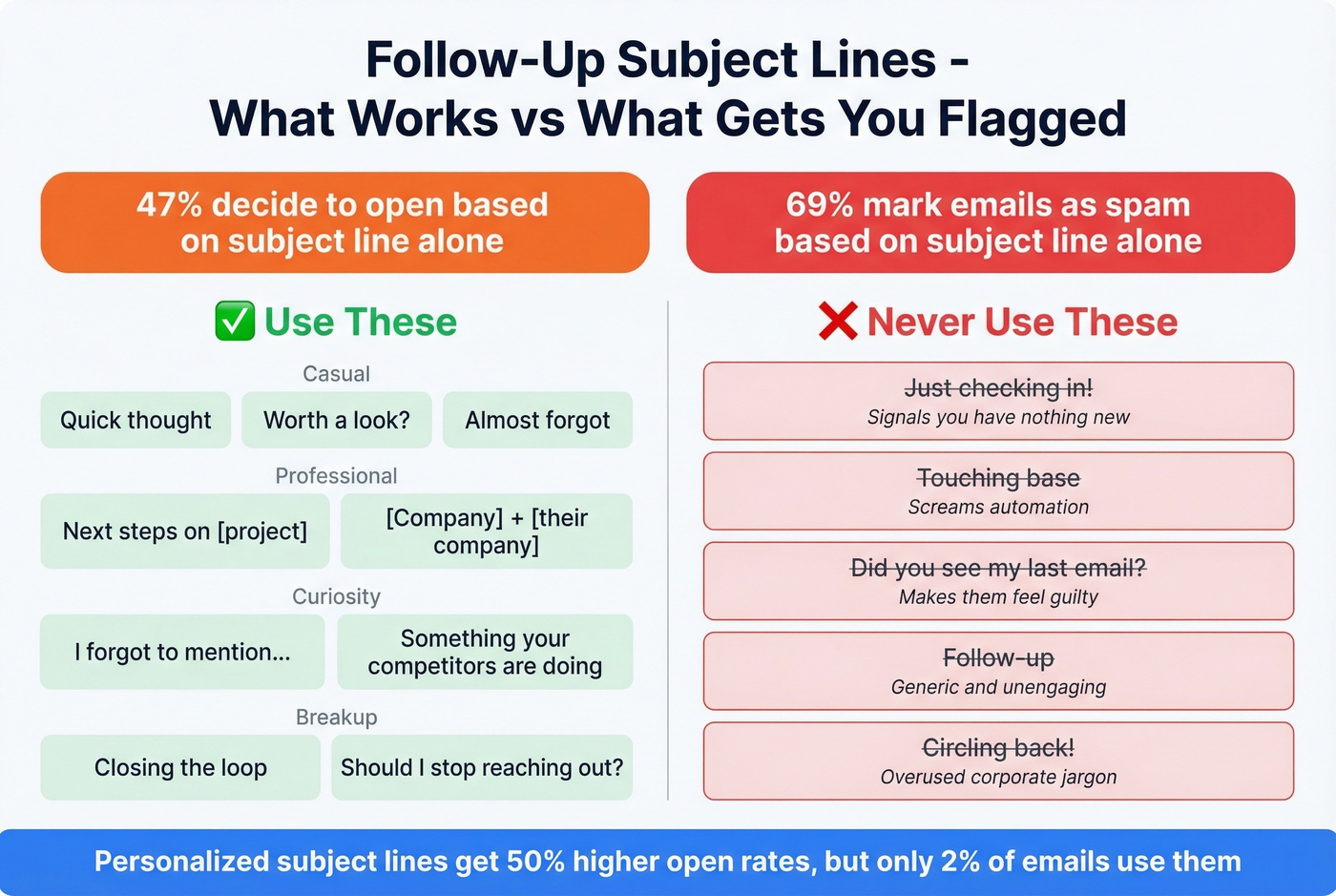
Don't use the word "follow-up" in your subject line - it signals you're about to waste their time. Keep it to 2-4 words when possible. Personalized subject lines can deliver 50% higher open rates, yet only about 2% of emails use them. (More ideas: email subject line examples.)
Casual: "Quick thought," "Worth a look?", "One more thing," "Almost forgot," "Circling back briefly"
Professional: "Next steps on [project]," "Update for [Name]," "Re: [original topic]," "[Mutual connection] suggested I follow up," "[Company] + [their company]"
Curiosity-driven: "I forgot to mention...," "Saw this and thought of you," "This might change your approach," "A question about [specific thing]," "Something your competitors are doing"
Breakup: "Closing the loop," "Should I stop reaching out?", "Last note from me," "No hard feelings"
Skip anything that sounds like marketing automation: "Just checking in!", "Touching base," "Did you see my last email?" These are the subject-line equivalent of holding a sign that says "I have nothing new to offer."
Why Your Follow-Up Isn't Landing
You can write the perfect message, and it still won't matter if it never reaches the inbox. Deliverability is the unsexy foundation that makes everything else work. (If you need the full checklist, start with our email deliverability guide.)
Authentication is non-negotiable. SPF, DKIM, and DMARC must be configured on your sending domain. If you don't know what these are, check SuperSend's deliverability guide - it walks through setup step by step. (Related: DMARC alignment.)
Keep bounce rate under 2% and spam complaints under 0.1%. Anything above 5% bounce risks serious reputation damage. Before you send another message to a silent prospect, verify the addresses are still valid. Stale data is the fastest way to tank your domain. We've seen campaigns recover deliverability within two weeks just by cleaning their list - Prospeo verifies emails in real time with 98% accuracy on a 7-day refresh cycle, so if your list is more than a few weeks old, run it through verification before sending another email. (More on thresholds: email bounce rate.)

Turn off open tracking. This one surprises people, but campaigns saw roughly 3% higher response rates without tracking pixels. Pixels increasingly trigger spam filters, and the open-rate data they provide is unreliable anyway. The deliverability cost outweighs the analytics benefit. (Deep dive: email tracking pixel.)
Volume caps matter. Keep cold sends to about 20 emails per day per inbox. Use a separate sending domain - never your primary - and limit yourself to 3 inboxes per domain. Warm up for at least 3 weeks before launching campaigns, and keep warmup volume at 10-20% of your daily sends even after you're live. (See also: email velocity.)
Plain text beats HTML. HTML emails look like marketing. Plain text looks like a person. For follow-ups especially, strip the formatting.
Here's the thing: if your deal size is under five figures, you probably don't need a 6-email sequence with A/B-tested subject lines and behavioral branching. You need a clean list, two good follow-ups, and a breakup email. The elaborate automation stacks people build for low-ACV deals cost more in deliverability damage than they generate in pipeline. The consensus on r/coldemail backs this up - most experienced senders there have settled on 3-4 touches max.
Common Mistakes to Avoid
"Just checking in to see if you had a chance to review my last email." This adds zero value. Try instead: "Wanted to share a quick data point - [specific insight relevant to their business]. Does this change the conversation?" (If you need alternatives, see how to say just checking in professionally.)
"I hope this email finds you well! I wanted to circle back on my previous message regarding our solution." Too many words, no new information. Better: "Hi [Name] - [one sentence of new value]. Worth 10 minutes on Thursday?"
"Per my last email, I'm reaching out again to touch base about our offering." Passive-aggressive and empty. Instead: "[Similar company] cut their [metric] by 30% using [approach]. Happy to show you how - interested?"
A 400-word follow-up that re-explains everything from the first email. Replace with a 3-sentence email: one new proof point and one binary question.
Every follow-up needs to pass the "value menu" test: does it add a new proof point, a relevant insight, an alternative CTA, a useful resource, or a clean close-the-loop? If it doesn't add one of those five things, don't send it. "Checking in" isn't on the menu.
The data is clear: targeting 1-2 contacts per company gets 2x the reply rate of spray-and-pray. Prospeo's 30+ search filters - buyer intent, job changes, department headcount - let you pinpoint the one decision-maker worth following up with. At $0.01 per email, a precise 3-touch sequence costs less than a single wasted send on bad data.
Reach the right person the first time so your follow-up actually matters.
FAQ
Should I reply in the same thread or start a new one?
Thread for continuity in sales and business contexts - it keeps context visible and reduces friction. Only start a new thread when you're fundamentally changing your angle or value proposition. Threading helps the recipient see your original message without digging through their inbox.
How many follow-ups is too many?
Two to three follow-ups (3-4 total emails) is the sweet spot based on 16.5M cold emails analyzed. Past that, replies drop 55% and spam rate rises 3.2x by Round 4. The breakup email should be your last touch - anyone recommending six or seven attempts is working from outdated data.
What if they said "circle back next quarter"?
Set a calendar reminder for the exact date they mentioned. Reference their words: "You mentioned reconnecting in Q2 - is now a good time to revisit [specific topic]?" This shows you listened and gives them a concrete reason to re-engage rather than ignore you again.
How do I make sure my follow-up actually reaches their inbox?
Verify the email address before sending, authenticate your domain with SPF, DKIM, and DMARC, and keep your bounce rate under 2%. A clean list is the single biggest deliverability factor - we've watched teams go from 35% bounce rates to under 4% just by verifying before every send.
How do I avoid sounding desperate?
Lead with new value every time. Each email should contain a fresh proof point, a relevant resource, or a different CTA - never just a reminder that you emailed before. If you've got nothing new to say, that's your signal to send the breakup email and move on.