

How to Write a Follow-Up Email After Leaving a Voicemail
You left the voicemail. The prospect didn't call back. That's not a failure - that's the plan. 80% of calls go to voicemail, and 48% of reps never follow up at all. The voicemail isn't meant to get a callback. It's meant to get your follow-up email opened.
Two voicemails, max. Send the email the same day - ideally within 5-30 minutes. Use a subject line that's personalized and 2-4 words. Below: the exact templates, subject lines, and day-by-day cadence that make this work.
Why the Voicemail-Email Combo Works
Here's the counterintuitive part: voicemails actually reduce your future connect rate by 28%. Sounds bad until you look at the metric that matters. Gong's analysis of 300M+ cold calls shows voicemails more than double email reply rates - from 2.73% to 5.87%. But leave three or more voicemails and reply rates crater to 2.2%, worse than leaving none.
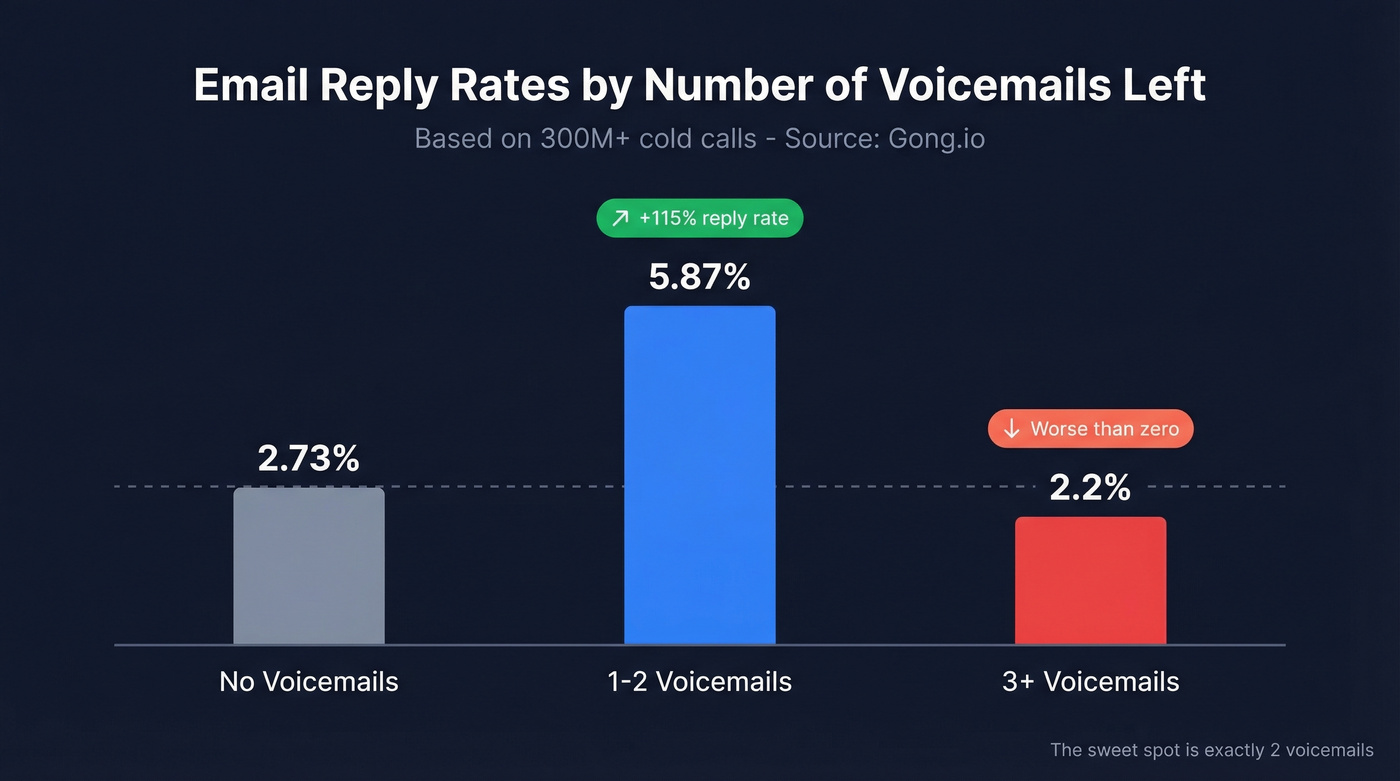
The voicemail is a notification, not a pitch. It plants your name so when your email lands, it feels familiar instead of cold. Stop measuring voicemail success by callbacks - callbacks run in the low single digits. Measure it by what happens to your email engagement. Two voicemails is the ceiling. Three or more and the data turns against you.
What to Say in Your Voicemail
Keep it brutally short. The ideal voicemail runs 8-13 seconds. Under 30 seconds is the absolute max.
- Lead with context (why you're calling, not who you are)
- Don't pitch - curiosity beats information
- Direct them to the email, not to a callback
A practitioner on r/sales shared a script that generates roughly 15 callbacks from 25-35 voicemails per week, with 3-5 converting:
"Hey [Name], this is [Your Name] with [Company], calling in regards to your oversight of the [X] team. I just sent you an email with some details - take a look when you get a chance."
No feature dump, no "I'd love to schedule a call," no 45-second monologue. Curiosity and brevity win.
When to Send the Email
Aim for same day. 5-30 minutes is a strong practical window: under 5 can feel automated, and over 30 the moment cools off.
Close recommends sending the email four to six working hours after leaving a voicemail. The missed-call notification is immediate, even if the voicemail itself goes unplayed for days. For send-time optimization, Yesware's data points to 1 PM as the highest-reply window, with 11 AM as a strong second. If you want a deeper breakdown, see best time to send cold emails.
Subject Lines That Get Opened
"Following up" is the worst subject line in sales. Cold email open rates have dropped from 36% (2023) to 27.7% (2024) - your subject line is doing more work than ever. For more options, pull from these email subject line examples.
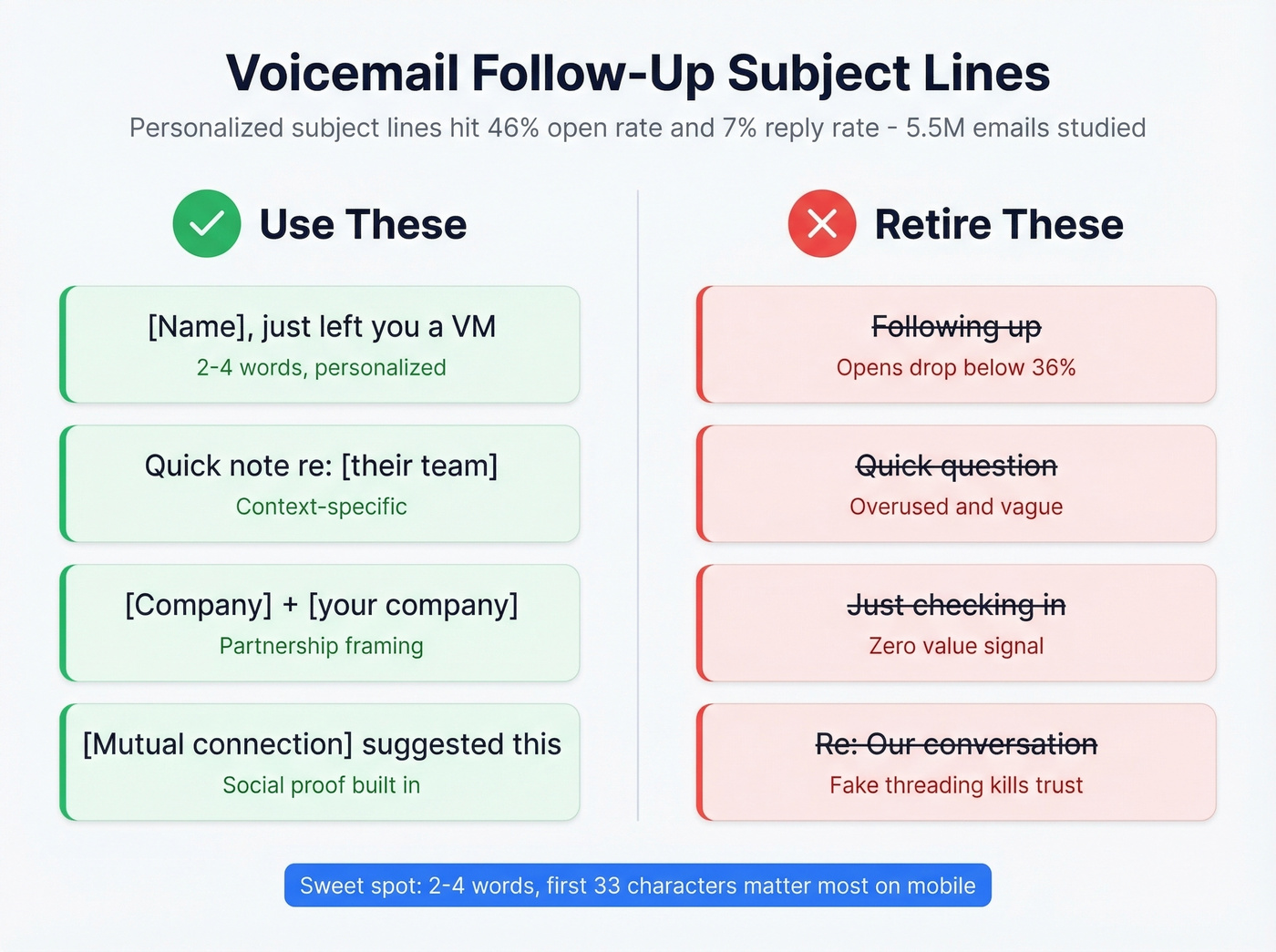
A Belkins study of 5.5M cold emails found personalized subject lines hit a 46% open rate and 7% reply rate - that's +31% opens and +133% replies versus generic alternatives. The sweet spot is 2-4 words. Front-load the key message into the first 33 characters, because that's all most mobile clients display. You can also compare patterns in prospecting email subject lines.
Subject lines that work after a voicemail:
- "[Name], just left you a VM"
- "Quick note re: [their team]"
- "[Company] + [your company]"
- "[Mutual connection] suggested this"
Retire these immediately:
- "Following up" (pushes opens below 36%)
- "Quick question" (same problem)
- "Just checking in"
- Fake "Re:" threading
- Subject lines with numbers (only 27% open rate)
One caveat: Apple Mail Privacy Protection inflates open rates. Focus on reply rate as your real signal.

Personalized subject lines hit 46% open rates - but only if the email actually lands. One bad bounce tanks your domain reputation and kills the entire cadence. Prospeo's 5-step verification delivers 98% email accuracy, so every voicemail follow-up reaches a real inbox.
Stop perfecting templates for emails that bounce. Start with verified data.
Templates That Actually Get Replies
Every template below follows the rules that matter most: personalized subject line, 2-4 words, and a short body under ~100 words. Each references the voicemail naturally in the opener. If you want more variations, use these sales follow-up templates and cold email follow-up templates.
After Your First Voicemail
Subject: [Name], just left a VM
Hi [Name],
Just left you a voicemail. Reaching out because [one sentence of context - e.g., "we help companies like [similar company] cut outbound ramp time by 40%"].
Worth 15 minutes on [specific day]?
[Your name]
Second Attempt (Unanswered Call)
Use this 2-3 days after the first email, no response. This is your follow-up email after a missed call - keep it tight and restate the value.
Subject: [Name] - one more thing
Hi [Name],
Circling back on my note from [day]. The short version: [restate value prop in one sentence]. Worth a conversation?
[Your name]
Warm Lead Follow-Up
Subject: [Referrer name] connected us
Hi [Name],
[Referrer] suggested I reach out - just tried you by phone. They mentioned you're [specific context from referral].
We helped [similar company] with [specific outcome]. Free for a quick call [day/time]?
[Your name]
The Value-Add Touch
This is your third or fourth touch. Stop asking and start giving. The shift from "Can we talk?" to "Here's something useful" resets the dynamic entirely. I've seen this single template revive sequences that were otherwise dead. (More on this approach: how to add value in sales.)
Subject: Thought of you, [Name]
Hi [Name],
Saw [this article/report/data point] relevant to [their challenge]. [One-line summary with link.]
Happy to chat if it sparks questions.
[Your name]
The Breakup Email
This works because of loss aversion - people respond more to what they might lose than what they might gain. We've tested dozens of final-touch variations, and "closing the file" consistently outperforms soft check-ins.
Subject: Should I close your file?
Hi [Name],
Haven't heard back, so I'll assume the timing isn't right. Closing out your file.
If [specific outcome] becomes a priority, just reply to this thread.
All the best, [Your name]
The Full Follow-Up Cadence
Most cadence frameworks either ignore the voicemail cap or treat every touch the same. This one reconciles SalesBuzz's aggressive early-touch system with the two-voicemail ceiling from the 300M-call dataset. If you’re building this into a sequence tool, see sequence management.
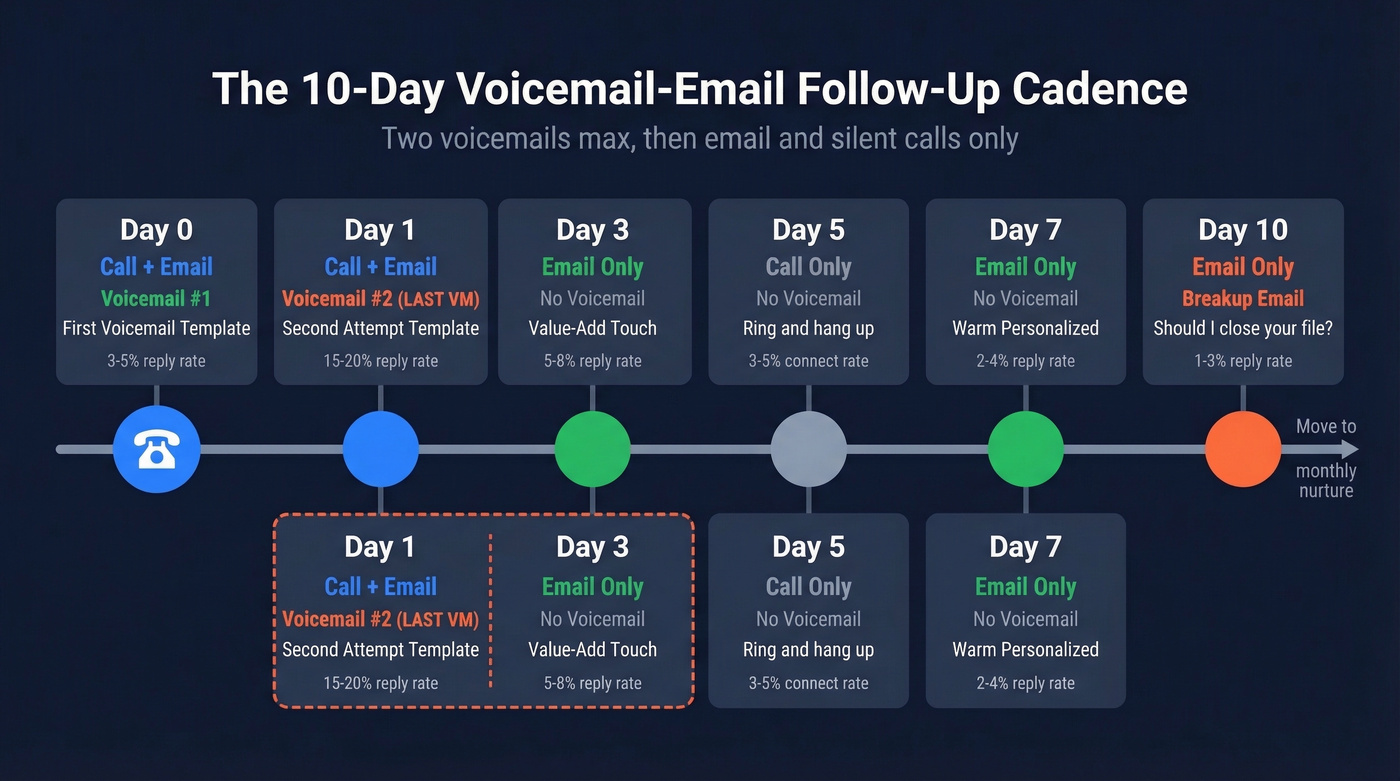
| Day | Channel | Voicemail? | Template | Expected Reply Rate |
|---|---|---|---|---|
| 0 | Call + Email | Yes (VM #1) | First Voicemail | 3-5% |
| 1 | Call + Email | Yes (VM #2) | Second Attempt | 15-20% |
| 3 | Email only | No | Value-Add Touch | 5-8% |
| 5 | Call (no VM) | No | - | 3-5% |
| 7 | Email only | No | Warm/personalized | 2-4% |
| 10 | Email only | No | Breakup Email | 1-3% |
After Day 1, you're done leaving voicemails. You can still call - just don't leave a message. Response rates drop steeply after the second follow-up, but 80% of sales require five or more touches. The breakup email on Day 10 often outperforms the middle touches because loss aversion is powerful. After Day 10, move non-responders to a monthly nurture sequence - don't delete them.
Here's the thing: if your average deal size is under $5K, you probably don't need a 10-day cadence at all. Two voicemails, two emails, one breakup. Five touches, done. Save the elaborate sequences for deals worth the effort.
Mistakes That Kill Your Reply Rate
Writing a novel. Trim to under 100 words. Put the ask above the fold. We've audited hundreds of follow-up emails from our users, and the ones over 150 words almost always underperform - even when the copy is good. For tighter copy, use these email copywriting principles.
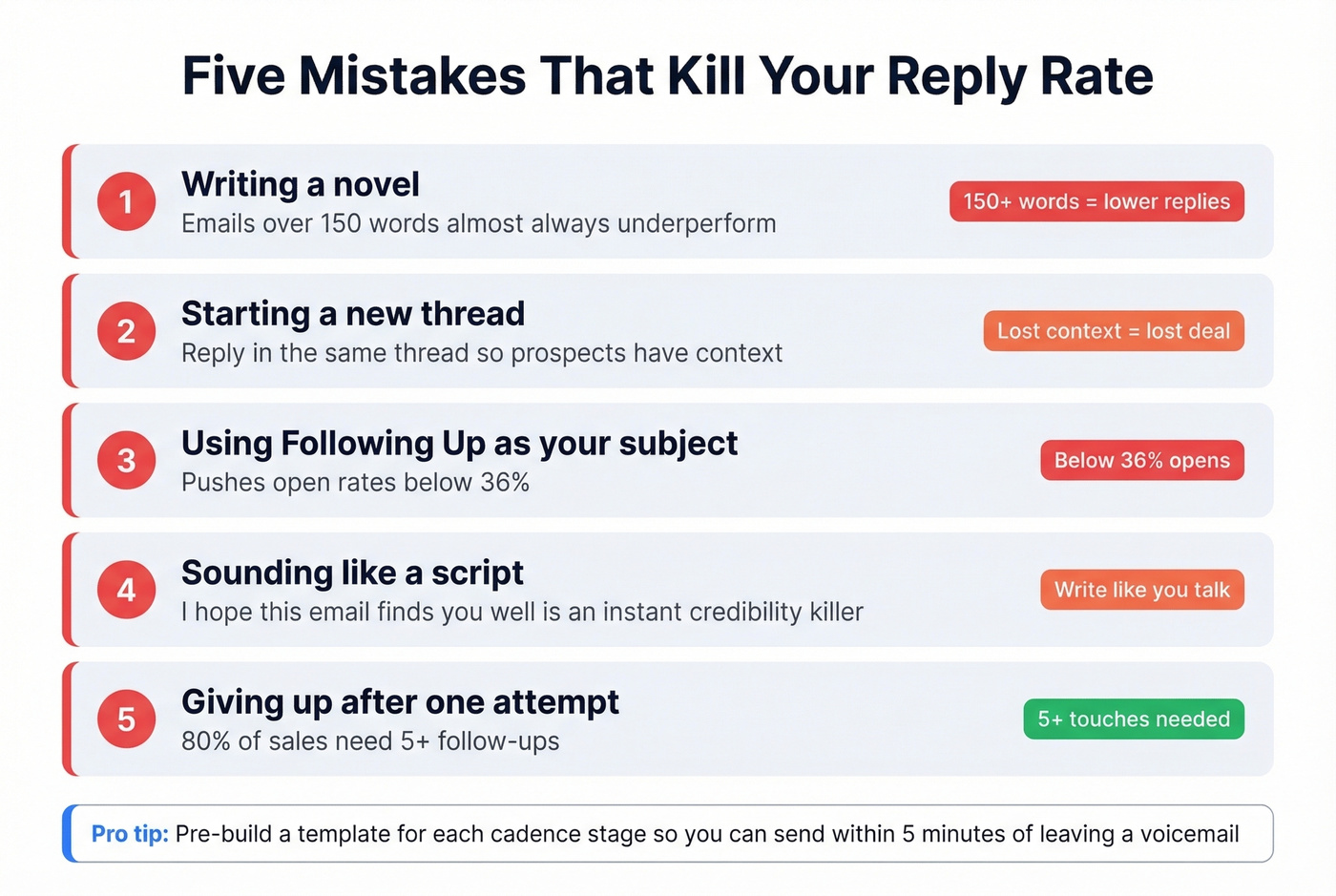
Starting a new thread. Reply in the same email thread. It provides context and saves the prospect from hunting for your original message.
Sounding like a script. "I hope this email finds you well" is an instant credibility killer. Write like you talk.
Using "Following up" as your subject line. The Belkins data shows it pushes opens below 36%. Be specific. If you need alternatives, see subject lines that get opened.
Giving up after one attempt. 80% of sales require five or more follow-ups. One voicemail and one email isn't a sequence - it's a coin flip.
No call-back email template ready. Reps who draft their email in real time waste 5-10 minutes per attempt. Pre-build a template for each stage of your cadence so you can fire it off within minutes.
Bad Data Means More Voicemails
If 80% of your calls go to voicemail, some of that is timing. But a significant chunk is because the number is wrong, disconnected, or a main office line that routes straight to voicemail purgatory. The upstream fix isn't a better voicemail script - it's better phone numbers.
Let's be honest: no amount of cadence optimization matters if you're dialing dead numbers. We've seen teams cut their voicemail rate in half just by switching from corporate switchboard numbers to verified mobile numbers. Prospeo's database includes 125M+ verified mobiles on a 7-day refresh cycle, delivering a 30% pickup rate across all regions. Direct mobile vs. corporate switchboard - that's the difference. The free tier gives you 75 verified emails and 100 Chrome extension credits per month, enough to test whether better data changes your connect rates before you commit. If you’re cleaning and enriching lists upstream, start with data enrichment services.
Your cadence needs direct dials to make Day 0 and Day 5 calls happen. Prospeo gives you 125M+ verified mobile numbers with a 30% pickup rate - 3x the industry average. Pair that with 98%-accurate emails and your voicemail-email combo actually connects.
Get the direct dial and the verified email in one search - starting at $0.01.
FAQ
Should I call or email first?
Call first, then email the same day - ideally within 5-30 minutes. The voicemail creates name recognition that makes the email feel familiar instead of cold. The email is where conversion happens; callbacks run in the low single digits.
How many follow-ups before I stop?
Five to seven total touches over about three weeks. Cap voicemails at two - three or more drops reply rates below the no-voicemail baseline (2.2% vs. 2.73%). After the breakup email, move to a monthly nurture sequence.
How do I know if my voicemail was listened to?
You don't - and it doesn't matter. The voicemail's job is to make your name familiar in the inbox. Track email reply rate, not callbacks. Use verified mobile numbers to ensure you're at least reaching real phones instead of disconnected lines.
Can I reuse these templates for inbound missed calls?
Yes. The same principles apply - short subject line, reference the missed call, include a clear next step. Swap "I just tried calling" for "Sorry I missed your call" and propose a specific time. A follow-up email after a missed call works whether you're the caller or the one who missed it.
Skip this if...
You're in a high-volume, low-touch model where every lead gets an automated sequence and nobody picks up a phone. These templates and this cadence are built for reps who actually dial. If your outbound motion is 100% email, the voicemail layer won't help - focus on your email copy and send timing instead.