

How to Write a Follow-Up Email for Collaboration (With Templates)
You pitched a collaboration two weeks ago. They replied saying they were interested. Then: nothing. You've drafted three versions of a follow-up email in your head, deleted all of them, and now you're here.
The r/careeradvice subreddit is full of people in this exact spot - someone confirmed interest, went silent, and now the sender is paralyzed between following up and sounding desperate. Over on r/UGCcreators, creators agonize about looking "overeager" after a brand promised to reply and vanished.
The fear is universal. The fix is straightforward.
What You Need (Quick Version)
- Wait 3 business days before your first follow-up. Send Tuesday through Thursday, 9-11 AM in their timezone.
- Never say "just checking in." Add new value every time - a metric, a content idea, a shared audience insight.
- Two follow-ups max. A Belkins study of 16.5M cold emails found that 4+ emails triples unsubscribe rates. For relationship-first outreach, two is the ceiling. (If you want more plug-and-play options, see these sales follow-up templates.)
When to Follow Up on a Collaboration
You'll hear the "it takes five follow-ups" stat everywhere. Belkins' 16.5M-email dataset tells a different story: the highest reply rate - 8.4% - comes from one well-crafted email. Reply rates decline as you stack follow-ups, and after four, unsubscribe rates triple while spam complaints more than triple.
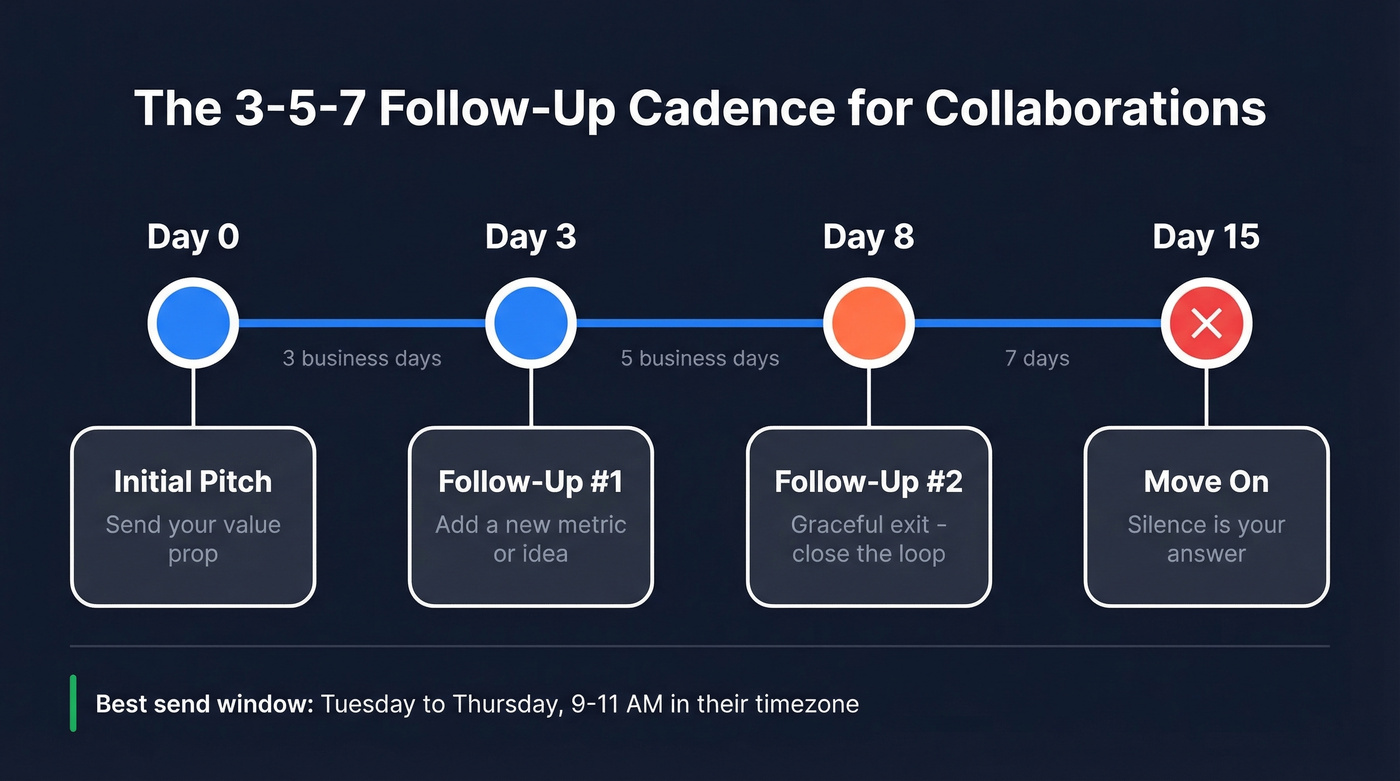
For collaborations, a compressed 3-5-7 cadence works best:
| Touch | Timing | Purpose |
|---|---|---|
| Initial pitch | Day 0 | Value prop |
| Follow-up #1 | Day 3 | Add new value |
| Follow-up #2 | Day 8 | Graceful exit |
| Move on | Day 15 | Silence = answer |
Tuesday through Thursday, 9-11 AM in the recipient's timezone, is a strong default window. Mondays are inbox triage. Fridays are mental checkout.
If two follow-ups get silence, switch channels. The same dataset shows social/profile nurturing - a message paired with a profile visit - drives reply rates up to 11.87%, higher than any email sequence alone. And don't follow up before a stated reply timeframe. "I'll get back to you next week" means wait until next week. (For a broader timing framework, see When Should You Follow Up on an Email?.)
Templates by Collaboration Type
Here's the thing: each follow-up must add something the original email didn't. If you can't add value, don't send the email. The templates below focus on collaboration outreach, but the same value-first structure applies whether you're pitching a co-marketing campaign or an affiliate partnership - the psychology of earning a reply doesn't change based on the deal type. (If you need help tightening the actual copy, use this email copywriting guide.)
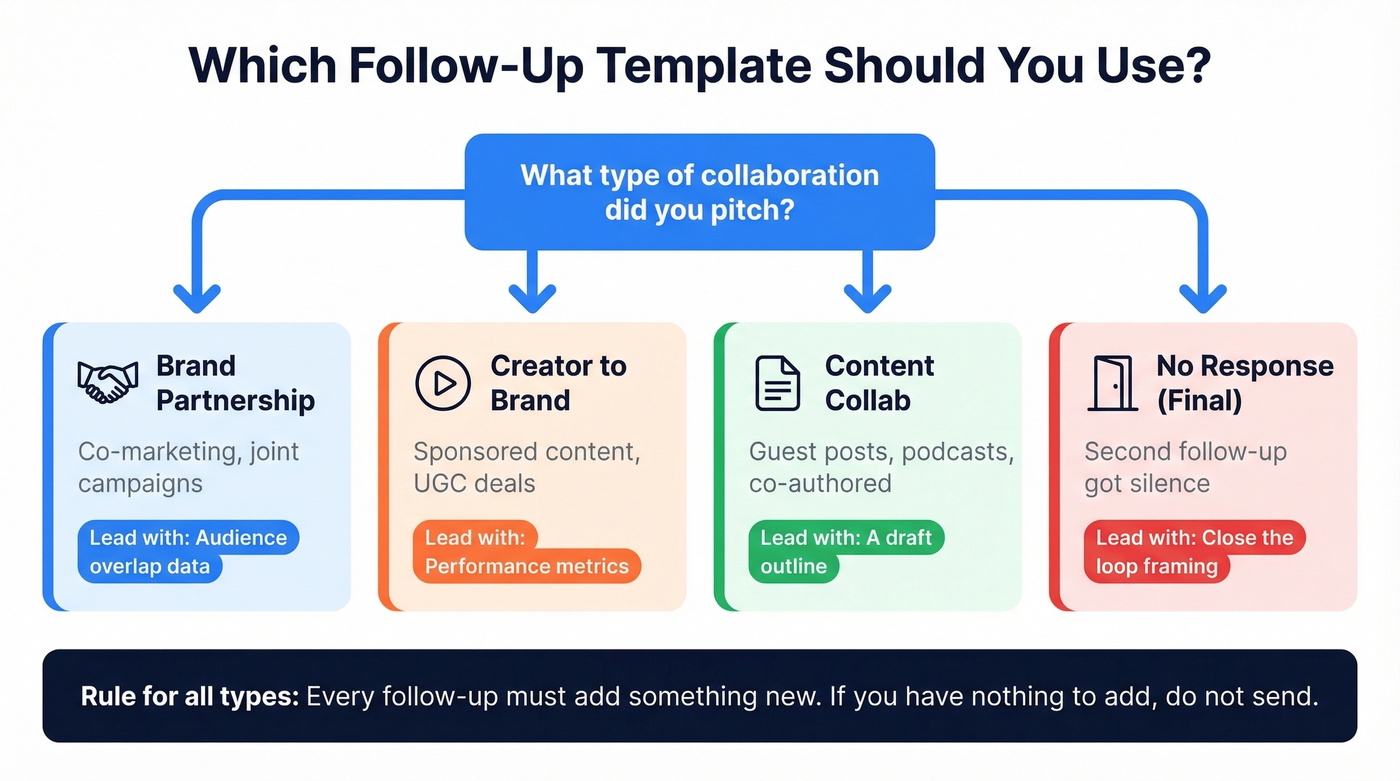
Brand Partnership Follow-Up
Subject: Quick thought on [shared audience segment]
Hi [Name],
Wanted to circle back on the co-marketing idea I sent last week. Since then, I pulled some numbers - our audience overlaps about [X%] with yours in [segment], which means a joint [webinar/case study/campaign] could reach [combined number] without either of us spending on acquisition.
Happy to sketch out a rough plan if you're interested. If the timing's off, no worries at all.
This works because it references a specific metric the first email didn't include. You're not bumping - you're building the case.
Creator to Brand Follow-Up
Wait at least two days. Recent enough to stay relevant, long enough to show you aren't desperate.
Subject: [Brand name] reel hit [X views]
Hi [Name],
Following up on the collab we discussed. Since my last email, I posted a reel featuring [brand/product] that's at [X views/engagement rate] - thought you'd want to see the traction.
I'd love to make this official. Let me know if [specific next step] works on your end.
No "just" anywhere. As Haley Ivers points out, "just following up" minimizes your confidence. The performance stat gives them a reason to care. (More alternatives here: How to Say Just Checking In Professionally.)
Content Collaboration Follow-Up
For guest posts, podcast appearances, or co-authored pieces:
Subject: Draft outline for [topic]
Hi [Name],
Circling back on the [guest post/podcast/content piece] idea. I went ahead and roughed out an outline - [one-sentence description of the angle]. It ties into [their recent content or audience interest].
Want me to send the full outline over?
Attaching a draft outline shows you've already done the work. That makes saying yes dramatically easier than saying "let me think about it."
"No Response" Final Follow-Up
Your graceful exit, for any collaboration type:
Subject: Should I close the loop?
Hi [Name],
I know things get buried. If the timing isn't right for [collaboration type], totally understand - I'll close this out on my end. If it is, I'm still excited about [one-line value prop].
Either way, appreciate your time.
The "close the loop" framing works because of loss aversion - the recipient suddenly faces losing the opportunity, not just ignoring it. It removes pressure while keeping the door open.

You just spent 20 minutes crafting the perfect collaboration follow-up. If it bounces, your sender reputation takes the hit - and your next 100 emails land in spam. Prospeo verifies emails at 98% accuracy with 5-step verification, so every follow-up actually reaches the inbox.
Stop perfecting emails that bounce. Verify first at $0.01 per contact.
Subject Lines That Get Opened
An analysis of 5.5M cold emails breaks down what actually works at the format level:
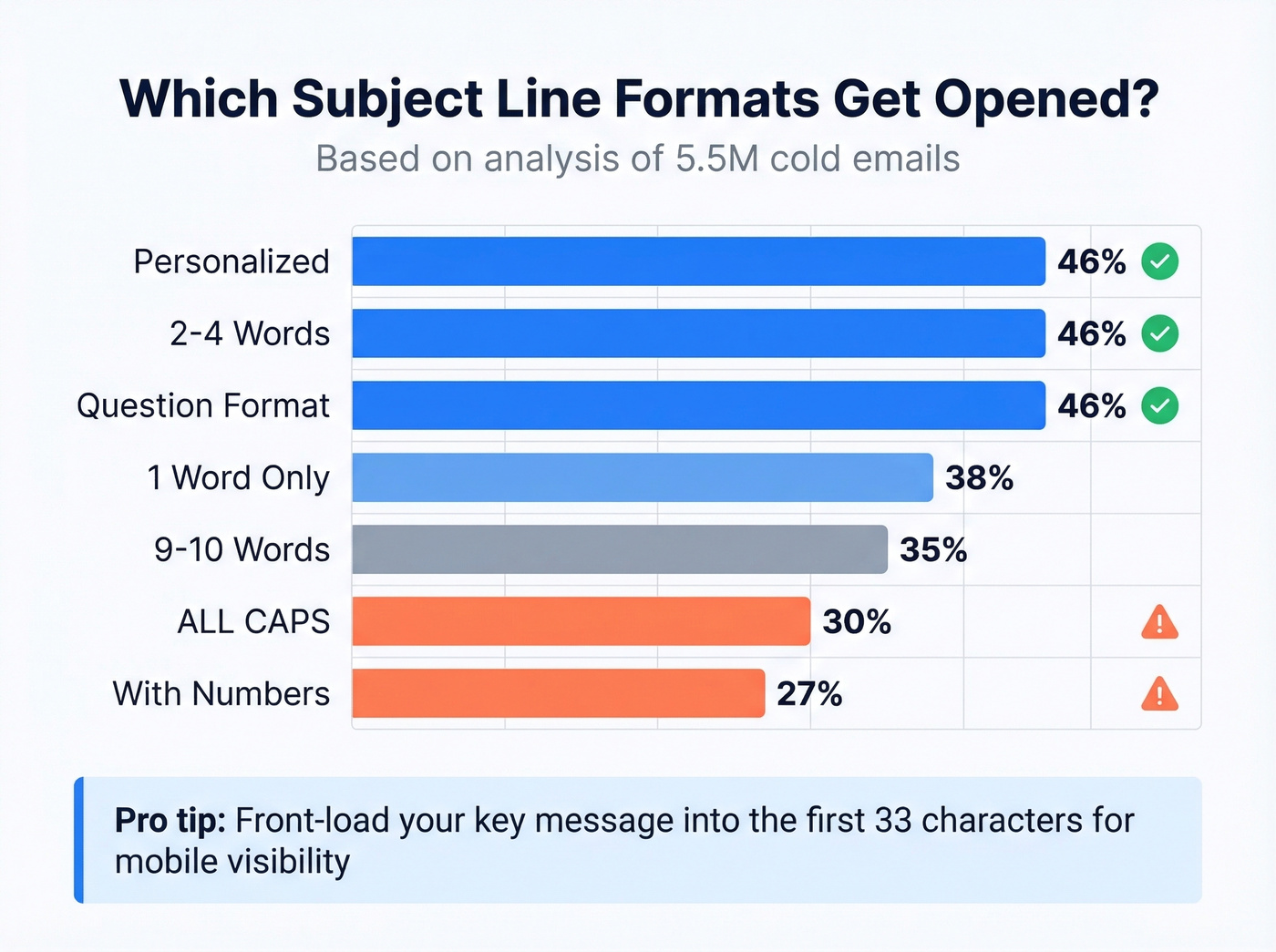
| Subject Line Format | Open Rate |
|---|---|
| Personalized | 46% |
| 2-4 words | 46% |
| Question format | 46% |
| 1 word only | 38% |
| 9-10 words | 34-35% |
| ALL CAPS | 30% |
| With numbers | 27% |
Short, personalized, and specific wins. In our experience, front-loading your key message into the first 33 characters - the safe visibility zone across email clients and mobile - makes the biggest difference. (For more ideas, swipe from these email subject line examples.)
Never put "follow up" in your subject line. NetHunt's research flags it as the kind of subject line that gets ignored and risks spam filters. Try these instead (framework adapted from HubSpot):
| Don't Say | Say This Instead |
|---|---|
| Following up | [Shared audience] idea |
| Just checking in | Draft outline for [topic] |
| Touching base | Quick thought on [metric] |
| Any updates? | Should I close the loop? |
Mistakes That Kill Replies
Sending a "bump" with no new info. Every follow-up needs a new angle - a stat, an idea, a resource. If you don't have one, you aren't ready to send. (This is the core of importance of follow-up in sales, too.)
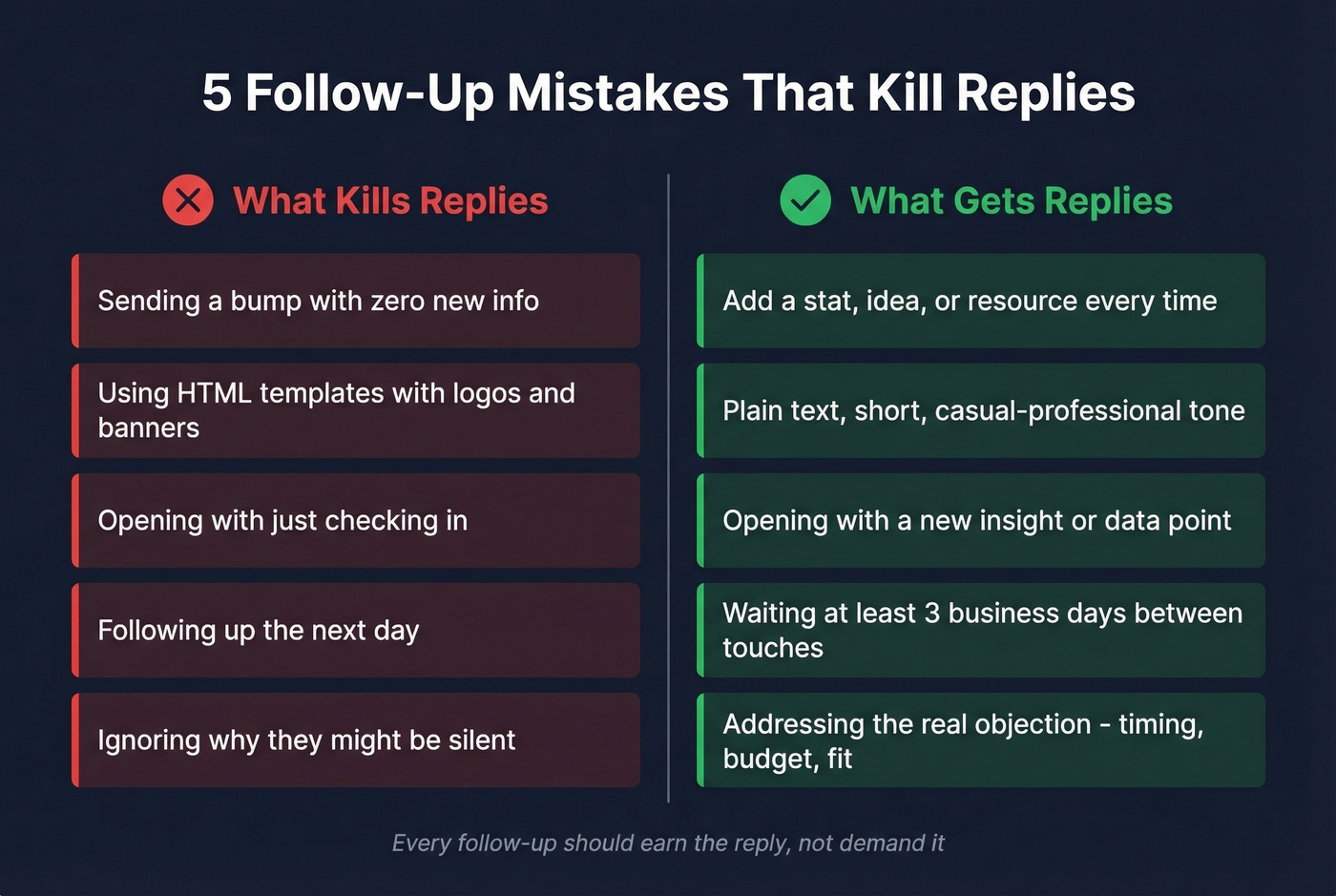
Looking automated. Plain text, short, casual-professional. HTML templates with logos and banners scream mass email, and they're especially toxic in collaboration outreach where the whole point is a personal relationship. (If you're using tooling, compare options in our follow up email software guide.)
Using "just checking in." It signals you have nothing new to say. We've seen this single phrase tank reply rates more than any other opener.
Wrong frequency. Three business days is the minimum gap. Anything sooner feels aggressive, and the person on the other end starts associating your name with annoyance rather than opportunity.
Ignoring the real objection. If they're silent, consider why - timing, budget, fit - and address it directly. A follow-up that says "I know Q1 budgets are tight" shows you're thinking about their situation, not just yours.
Verify Before You Send
Let's be honest: your follow-up might be perfect, but if it bounces, none of it matters. A bounced email damages your sender reputation, which tanks deliverability on every future message you send. Google restricts senders whose spam complaint rate exceeds 0.3% - a threshold that's shockingly easy to hit when you're sending to invalid addresses. (To go deeper, read our email deliverability guide and how to improve sender reputation.)
We've watched people craft the ideal collaboration pitch, nail the timing, personalize every line, and then send it to an email that hasn't been active in two years. Prospeo verifies emails in real time with 98% accuracy, including catch-all domains, and the free tier covers 75 verifications per month - enough to check every collaboration contact before you hit send. (If you're troubleshooting list quality, start with email bounce rate.)
Can't find the right contact for your collaboration pitch? Prospeo's Chrome extension lets you pull verified emails from any company website or professional profile in one click - used by 40,000+ prospectors who'd rather send than search.
Find the decision-maker's real email in seconds, not hours.
FAQ
How many follow-up emails should I send for a collaboration?
Two, maximum. Data from 16.5M emails shows that four or more messages triples spam complaints. Collaborations are relationship-first - two well-timed follow-ups with new value is the ceiling before you move on or switch channels.
What if they said yes but stopped responding?
Wait three business days, then send one follow-up with a new data point or resource. No reply after a second touch? Send a "close the loop" email and move on. Silence after two attempts is an answer.
Should I verify the email address before following up?
Always. A bounced follow-up hurts your sender reputation and kills the opportunity entirely. Prospeo's free tier covers 75 email verifications per month with 98% accuracy, including catch-all domains - enough for most collaboration outreach lists.
What's the best subject line for a collaboration follow-up?
Keep it under four words, personalized, and value-forward. Lines like "[Shared audience] idea" or "Draft outline for [topic]" hit 46% open rates. Skip the words "follow up" or "checking in" - they get ignored and risk spam filters.