

How to Write a Follow Up Email to a Potential Client (Without Being Annoying)
Most advice on writing a follow up email to a potential client boils down to "be persistent." That's incomplete at best, destructive at worst.
A Belkins study of 16.5 million cold emails found the highest reply rate - 8.4% - comes from the first email. Each additional follow-up drops that number. And once you push to 4+ emails in a sequence, unsubscribe and spam-complaint risk more than triples, with the spike hitting hardest around the 4th follow-up.
So here's the framework we use:
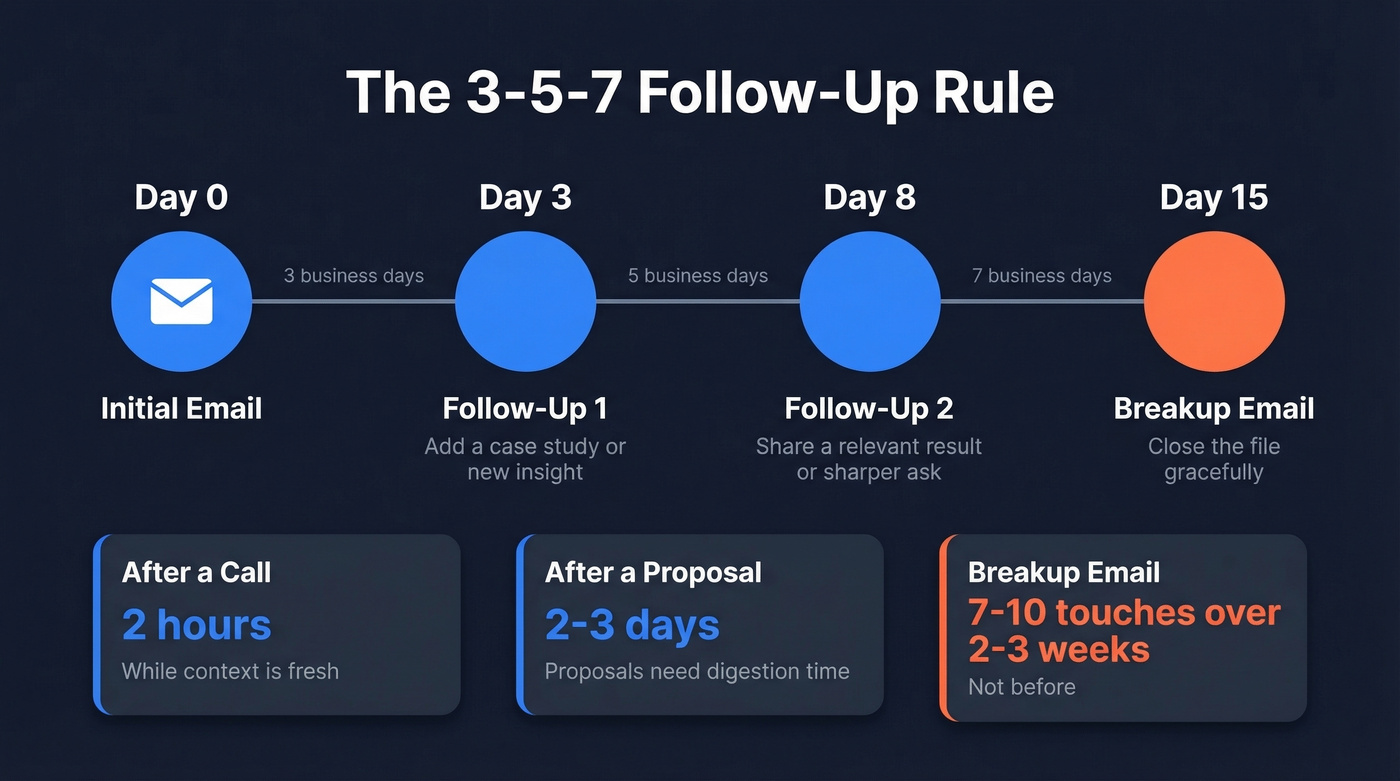
- Follow the 3-5-7 Rule: follow up after 3 business days, then 5 more business days, then 7 more business days - then stop or switch channels. (If you need a deeper cadence breakdown, see When Should You Follow Up on an Email?.)
- Every follow-up must deliver new value - a case study, insight, or clearer next step. Never "just checking in." (More on this in How to Add Value in Sales.)
- Verify the email address before you start the sequence. A bounced follow-up damages your sender reputation and wastes every touch that comes after it. (If you want the full deliverability picture, read our Email Deliverability Guide.)
The 3-5-7 Follow Up Rule
The simplest cadence that works: follow up after 3 business days, then 5 more business days, then 7 more business days. Three touches, spaced wider each time, signaling patience rather than desperation.
Adjust by scenario:
- After a call or meeting: follow up within 2 hours, while context is fresh. (You can also borrow a structure from our sales meeting follow-up email guide.)
- After sending a proposal: wait 2-3 business days. Proposals need digestion time.
- Breakup email: send after 7-10 touchpoints over 2-3 weeks. Not before.
Send-time matters too. Avoid Monday mornings and Friday afternoons - inboxes are either overflowing or abandoned. In our experience, Thursday mornings consistently outperform other slots for follow-ups, and Tuesday mid-morning works well for meeting requests. (For more data, see Best Time to Send Cold Emails.)
Belkins' data also shows company size changes how persistence lands. Smaller businesses tend to hold up better through early follow-ups, while enterprises with 1,000+ employees are far less tolerant of long email sequences - so switch channels earlier when you're going upmarket. (If you're selling bigger deals, this pairs well with Enterprise B2B Sales.)
Templates That Get Replies
Quick threading rule: Reply in the same thread for your first and second follow-ups - it gives the prospect context without clicking around. Start a new thread for your third touch or breakup email, since a long chain signals "you've been ignoring me." (If you want more options, use these sales follow-up templates.)
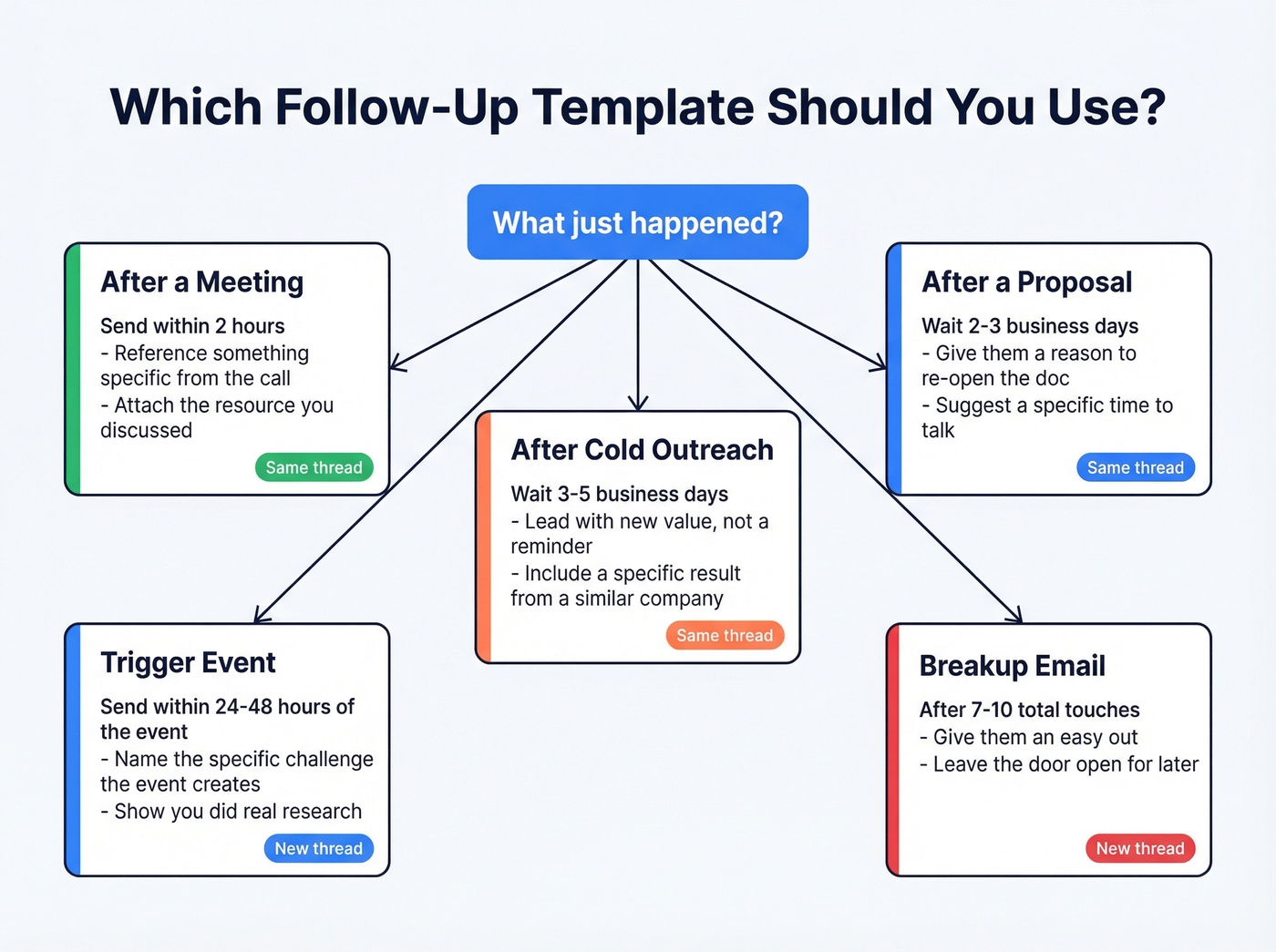
After a Meeting or Call
Subject: Next steps on [specific topic discussed]
Hi [Name], great speaking earlier. I've attached the [resource/deck/summary] we discussed. If [specific next step] works for your timeline, I can have [deliverable] ready by [date]. Worth a quick look?
Anchors to something specific from the conversation while the memory is fresh. Send within 2 hours.
After Sending a Proposal
This is the follow-up most people get wrong. The real fix is simple: give them a reason to re-open the proposal.
Subject: Quick question on the [project name] proposal
Hi [Name], wanted to flag one thing - [specific section or pricing detail] might need a tweak based on [something from your earlier conversation]. Happy to adjust. Does Thursday work for a 10-minute call?
Send at 2-3 business days. The key is creating a reason to revisit the document rather than just asking "did you read it?"
After Cold Outreach
Subject: [Relevant pain point] at [Company]
Hi [Name], I shared [specific resource] last week - curious if [pain point] is still on your radar this quarter. We helped [similar company] cut [metric] by [result]. Worth 15 minutes?
New value, not a reminder. Send at 3-5 business days. (If you're building full sequences, start with our B2B cold email sequence playbook.)
Trigger Event Follow-Up
A funding round, a key hire, or an expansion creates a specific, time-bound challenge. Name that challenge - it proves you did more than skim a headline.
Subject: Congrats on the [funding round / new hire / expansion]
Hi [Name], saw the news about [specific event]. That usually means [relevant challenge]. We've worked with [similar companies] navigating exactly that - happy to share what worked.
The Breakup Email
Subject options: "Should I close your file?" / "Last note from me"
Hi [Name], I've reached out a few times and haven't heard back - totally understand if the timing isn't right. I'm going to close your file on my end, but if [problem] comes back up, I'm here. Just reply to this thread.
A softer alternative for warmer relationships: "No hard feelings if now isn't the time - just didn't want to keep pinging you without checking. I'll circle back in Q[X] unless you say otherwise."
Pipedrive's research frames breakup emails as pipeline hygiene, not defeat. High-performing organizations add half as many prospects to their pipeline but win at least twice as many. Let that sink in. Fewer, better-qualified prospects beat a bloated pipeline every time.

Every follow-up you send to a bad email damages your sender reputation - and tanks deliverability for the rest of your pipeline. Prospeo verifies emails at 98% accuracy with a 5-step process, and you only pay for valid addresses at ~$0.01 each. The free tier covers 75 emails/month.
Clean your prospect list before your next follow-up sequence goes out.
Subject Lines That Get Opened
Keep it short. Subject lines of 2-4 words hit 46% open rates. Personalization lifts opens by 31%. (If you want swipeable ideas, use these email subject line examples.)
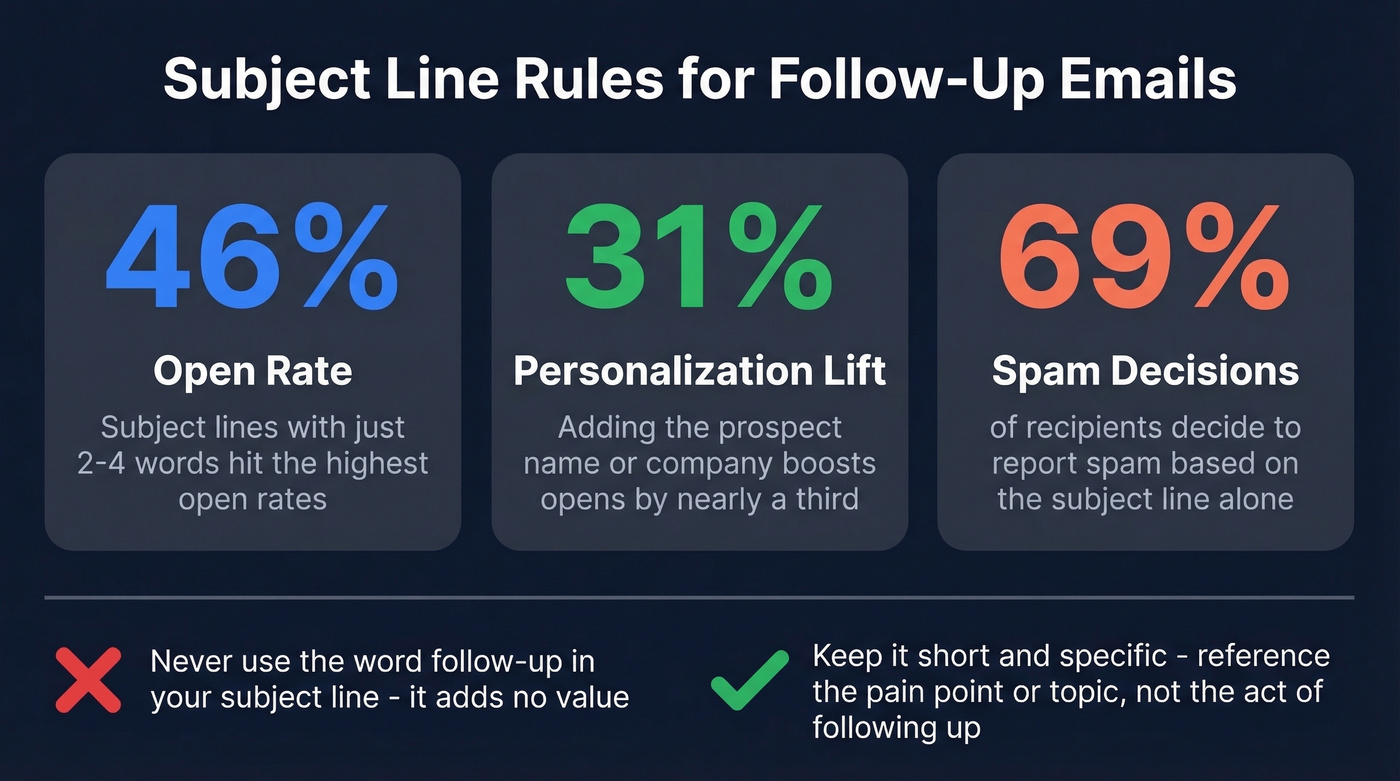
Here's the thing: never use the word "follow-up" in your subject line. It adds no value and makes it easier to ignore. And 69% of recipients decide to mark something as spam based on the subject line alone - whether you're re-engaging a prospective client or nudging someone who went dark after a demo.
Mistakes That Kill Your Follow-Ups
1. "Just checking in" and its cousins. "Touching base," "circling back," "wanted to loop back" - these phrases tell the prospect you have nothing new to say. Every follow-up needs fresh value or a sharper ask. (If you need alternatives, see How to Say Just Checking In Professionally.)
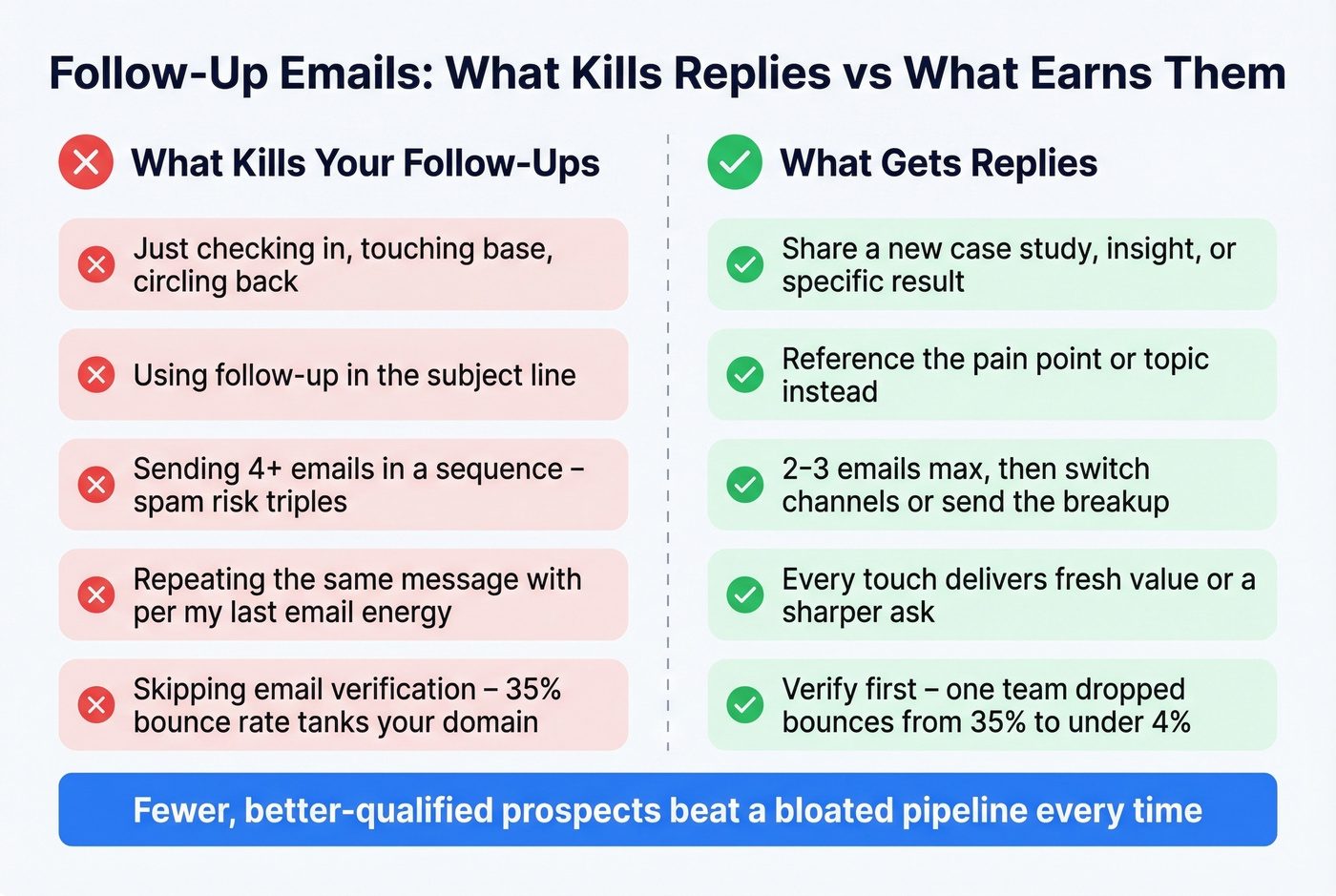
2. Using "follow-up" in the subject line. It's a flag that says "you didn't respond last time." Drop it.
3. Sending four or more emails in a sequence. Once you hit 4+ emails, unsubscribe and spam-complaint risk more than triples. Two to three emails, then switch channels or send the breakup.
4. No new value in each touch. If your second email says the same thing as your first with "per my last email" energy, you're training the prospect to ignore you. We've seen teams cut their sequence from six emails to three and actually increase reply rates - because every remaining touch earned attention.
5. Not verifying the email address first. This one's frustrating because it's so preventable. A bounced follow-up doesn't just waste a touch - it damages your sender domain reputation, which tanks deliverability for every other sequence you're running. One team we worked with saw bounce rates drop from 35% to under 4% after adding verification to their workflow. Prospeo checks emails with 98% accuracy and only charges for valid addresses, with a free tier covering 75 emails per month - enough to clean your active pipeline before every campaign. (To benchmark and fix bounces, see Email Bounce Rate.)
The 3-5-7 rule only works if your emails actually land. One team dropped bounce rates from 35% to under 4% after verifying with Prospeo. With 143M+ verified emails refreshed every 7 days, you're reaching real inboxes - not dead ends that trigger spam filters.
Stop wasting follow-ups on addresses that don't exist.
When to Switch Channels
After two or three unanswered emails, email isn't the problem - the channel is.
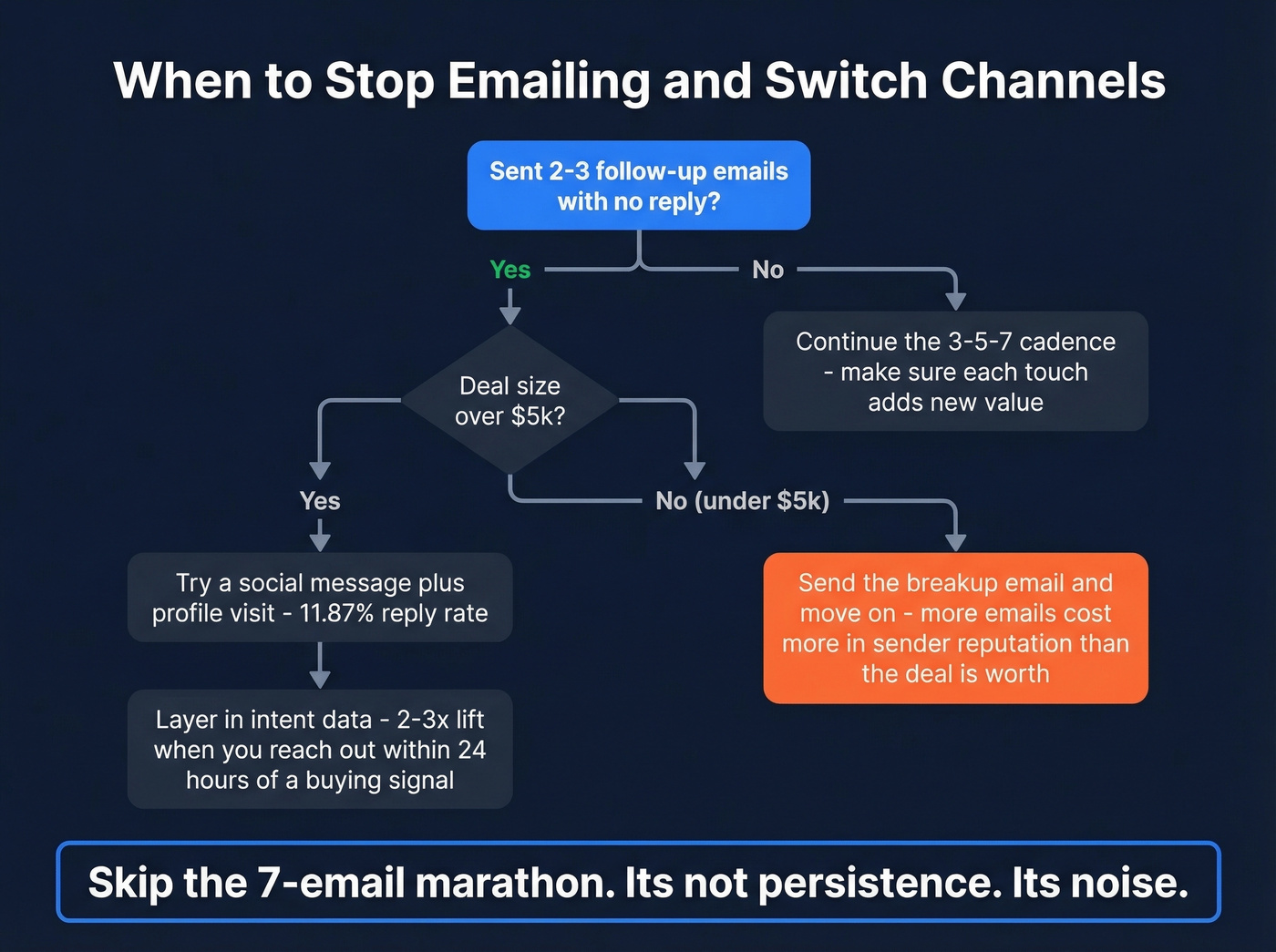
A message on a professional network paired with a profile visit produces an 11.87% reply rate, higher than most email sequences achieve by the third touch. Teams using intent data report a 2-3x lift in response rates when the first touch lands within 24 hours of a buying signal. (If you're building a repeatable outbound motion, start with sales prospecting techniques.)
Let's be honest: if your average deal size is under $5k, a three-email sequence plus one social touch is all you need. Anything more costs you more in sender reputation than the deal is worth. The same logic applies when following up with warm leads - if the prospect already knows you, one or two well-timed touches should restart the conversation.
Skip the seven-email marathon. It's not persistence. It's noise.
FAQ
How many follow-up emails should I send a potential client?
Two to three follow-ups maximum before switching channels or sending a breakup email. Data across 16.5 million emails shows that once you push to 4+ emails, unsubscribe and spam-complaint risk more than triples. Quality and timing beat volume every time.
How long should I wait before following up?
Use the 3-5-7 rule: follow up after 3 business days, then 5 more, then 7 more. The exception is post-meeting - follow up within two hours while context is fresh. After a proposal, wait 2-3 days to give the prospect time to review.
How do I follow up without sounding pushy?
Add new value every time - a relevant case study, a specific insight, or a clearer next step. Never send "just checking in." Verify the address is valid first so you're not wasting touches on dead inboxes. When every message lands and delivers something useful, persistence reads as professionalism, not pressure.