

How to Write a Follow-Up Email When Someone Doesn't Respond (and What to Fix First)
The reason most follow-up emails fail has nothing to do with your words. It's that the email never reached a real inbox.
An analysis of 16.5 million cold emails found the highest reply rate - 8.4% - comes on the first email alone, dropping with every follow-up after that. Before you rewrite your template for the fifth time, make sure the basics aren't broken.
The short version: send one follow-up email after no response 3 business days later - it lifts reply rates by 22%. Keep it under 60 words with one clear ask. And before you follow up at all, verify the address actually works. Once bounce rates climb past ~3%, deliverability and sender reputation start taking real damage.
Why People Don't Respond
Your message isn't always fighting indifference - sometimes it's fighting infrastructure. A HubSpot email marketing report notes that 40% of consumers have at least 50 unread emails in their inbox at any given time. Yours probably got buried. Worse, it may have landed in spam or promotions, and you'll never know unless you check deliverability.
That's the silent killer.
When the email does arrive, most people aren't rejecting you. They're busy and they forgot. A well-timed no-reply follow-up email resurfaces the open loop - the psychological itch of an unfinished conversation. Give them a reason to care in the first three seconds, and friction disappears.
Fix Your Data Before You Follow Up
Here's the thing most follow-up advice gets wrong: it assumes your email reached a human inbox. That assumption is dangerous.
A practitioner on r/Entrepreneur shared a telling case study: bounce rate at 11%, reply rates cratered to 3%, domain reputation tanking with every send. After switching to manually verified lists and running every address through verification, bounce rate dropped below 2% and reply rates doubled to 6%. We've seen similar patterns across our own campaigns - bad data doesn't just waste follow-ups, it poisons your entire sending domain.
If your bounce rate is above ~3%, you're actively damaging sender reputation, which makes every future email less likely to land. Prospeo's email verification catches bad addresses before they hurt you, running catch-all handling, spam-trap removal, and honeypot filtering at 98% accuracy. The free tier gives you 75 verifications per month - enough to clean a small campaign list. (If you want the benchmarks and fixes behind that ~3% threshold, see our guide to bounce rate.)

How Many Follow-Ups to Send
One follow-up is worth it. Full stop. After that, returns diminish fast. The Belkins dataset is blunt: sending 4+ emails in a sequence more than triples your unsubscribe and spam complaint rates. For cold outreach, 2-3 follow-ups is the practical ceiling. (If you're building a full sequence, start with these follow-up templates.)
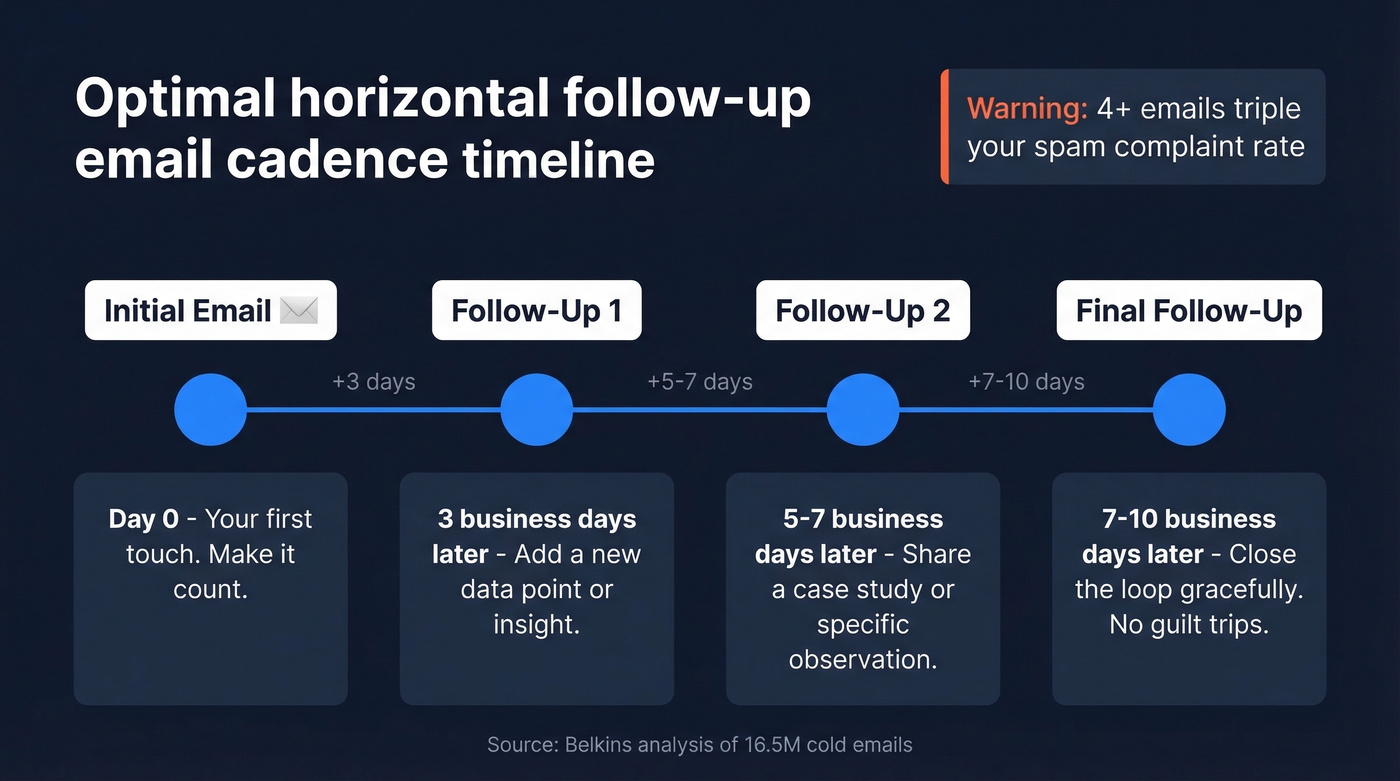
The cadence:
- Follow-up 1: 3 business days after the initial email
- Follow-up 2: 5-7 business days later
- Follow-up 3 (final): 7-10 business days later
Most teams send too many follow-ups to the wrong people. The same Belkins study shows small businesses respond at 9.2%, while enterprise prospects are far less tolerant of persistence. C-suite contacts reply at roughly 5% vs. 8% for entry-level. If you're emailing a VP at a Fortune 500, three touches is generous. A startup founder who's clearly active on social? A fourth warm touch is fair game.
Industry matters too: manufacturing prospects reply at 6.67%, solar at 6.73%, transportation at 6.46%. Know your baseline before deciding your sequence length. (For more ways to improve targeting before you ever hit send, use these sales prospecting techniques.)

Every bounced follow-up damages your sender reputation and kills future deliverability. Prospeo's 5-step verification catches invalid addresses, spam traps, and honeypots before they hurt you - at 98% accuracy and $0.01 per email. Start with 75 free verifications.
Clean your list before your next follow-up sequence goes out.
Five Rules for Replies
Aim for under 56 words. Three short paragraphs max. If you can't say it in 56 words, you haven't figured out what you're actually asking. (If you need help tightening the ask, use these email call to action rules.)
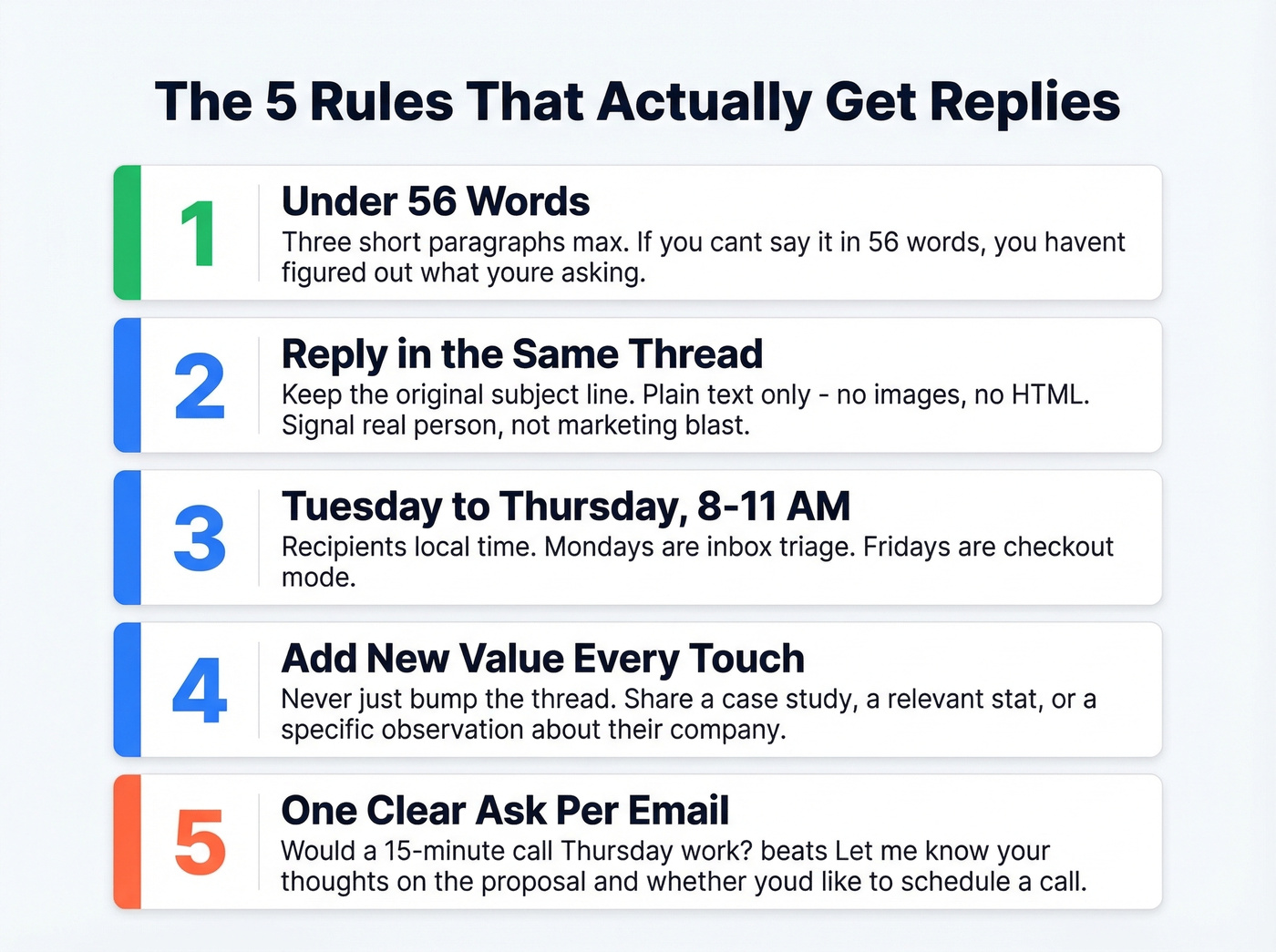
Reply in the same thread. Don't start a new email. Keep the same subject line so the recipient sees full context without digging. Use plain text - no images, no HTML formatting. It signals "real person," not "marketing blast." (For more options, browse these email subject line examples.)
Send Tuesday through Thursday, 8-11 AM recipient time. The practitioner who doubled reply rates from 3% to 6% also tightened sends to this window and saw a 16% improvement in opens. Mondays are inbox triage. Fridays are checkout mode. (More timing data here: best time to send cold emails.)
Add new value every touch. This is the rule most people break. Don't just "bump" the thread. Each follow-up should address one of the five reasons prospects stall: no perceived need, unclear value, no urgency, active disinterest, or lack of trust. Share a relevant case study, a stat that matters to their industry, or a specific observation about their company. Every follow-up earns its existence by giving something new. (Here are practical ways to add value in sales.)
One clear ask per email. "Would a 15-minute call Thursday or Friday work?" beats "Let me know your thoughts on the proposal and whether you'd like to schedule a call." One question. Easy to answer with a short reply.
Templates That Actually Work
Cold Outreach Follow-Up
Hi {{first_name}},
Quick data point - {{specific stat relevant to their industry}}. Thought it might matter given {{company name}}'s focus on {{specific initiative}}.
Worth 15 minutes this week?
After a Meeting or Proposal
Hi {{first_name}},
You mentioned {{specific pain point}} on {{day}} - I pulled a one-pager on how we solved that for {{similar company}}.
Attached. Happy to walk through it.
Job Application Follow-Up
A hiring manager who's conducted 1,000+ interviews shared the technique that works best: mirror the interviewer's own words back to them. Send a thank-you within 24 hours, then a brief status check after 5-7 business days if you haven't heard back. Writing a follow-up email when someone doesn't respond to your application is all about restating your fit for the role without sounding desperate.
Hi {{interviewer name}},
When you mentioned {{key attribute for success}}, it resonated - that's exactly what I focused on at {{previous company}} when we {{specific accomplishment}}.
Looking forward to next steps.
Invoice Reminder
Hi {{first_name}},
Invoice #{{number}} for {{amount}} was due {{date}}. Attached again for convenience.
Pay here: {{payment link}}. Let me know if anything needs adjusting.
The Final Follow-Up
Don't call it a "breakup email." That framing is manipulative and everyone's seen it. A good closing message wraps up the loop gracefully without guilt-tripping the recipient.
Hi {{first_name}},
I don't want to crowd your inbox, so this is my last note. If {{the problem you solve}} becomes a priority, I'm easy to find.
Subject Lines That Work
| Subject Line | Open Rate | When to Use |
|---|---|---|
| Quick question | ~39% | Cold follow-ups |
| {{Company name}} + {{topic}} | ~33% | Personalized outreach |
| I forgot to mention... | Strong for value-adds | Adding new info |
| Re: [original subject] | High (keeps context) | Threading follow-ups |
| Partnership opportunity | <19% | Avoid - too generic |
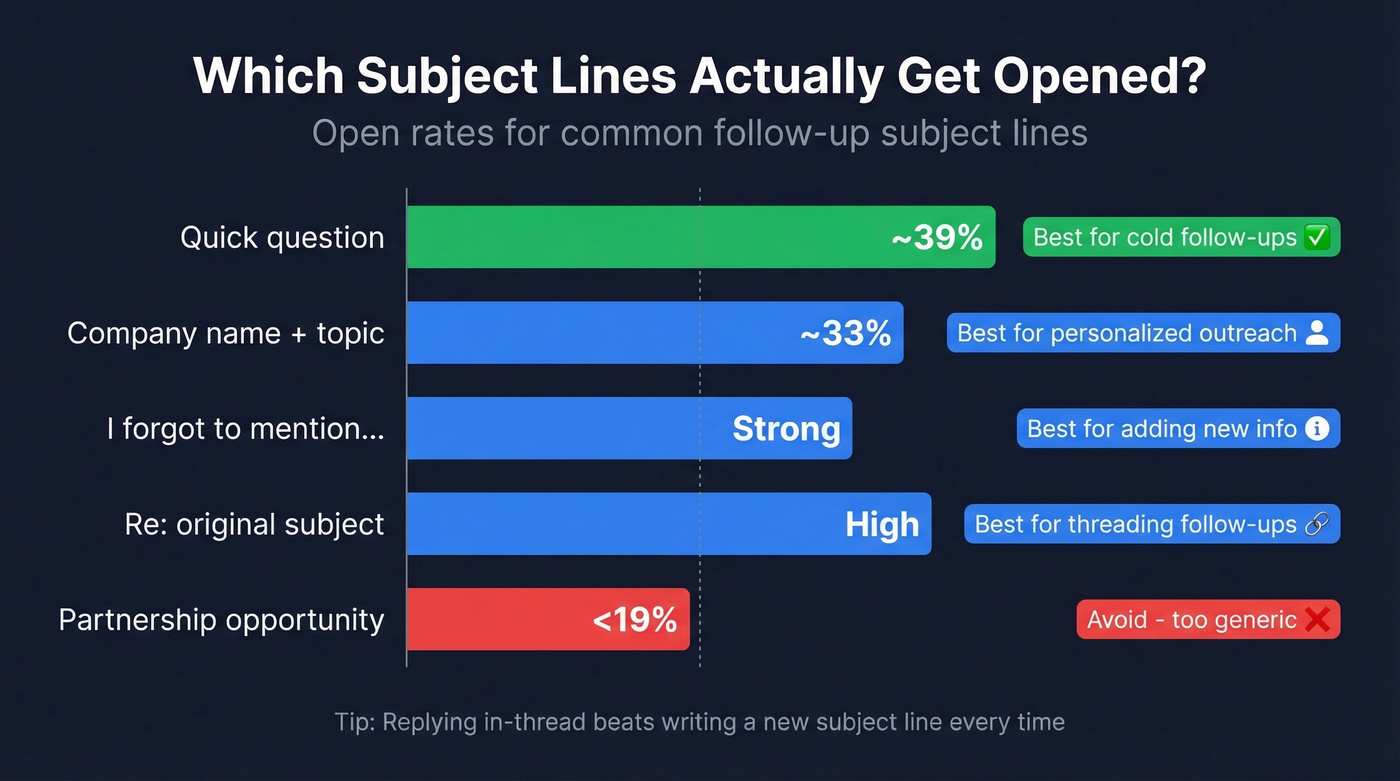
Short, curiosity-driven subject lines outperform clever ones. For follow-ups specifically, replying in-thread beats writing a new subject line every time. (If you're writing for outbound specifically, use these prospecting email subject lines.)
Mistakes That Kill Your Reply Rate
The most common anti-pattern is "just checking in." It adds zero value and signals you have nothing new to say. Every follow-up needs to earn its place with new information - a case study, a relevant stat, a specific observation about their business. When you're figuring out how to write a follow-up email after no response, the answer starts with giving the recipient a reason to engage that they didn't have before. (Here are better options for how to say just checking in professionally.)
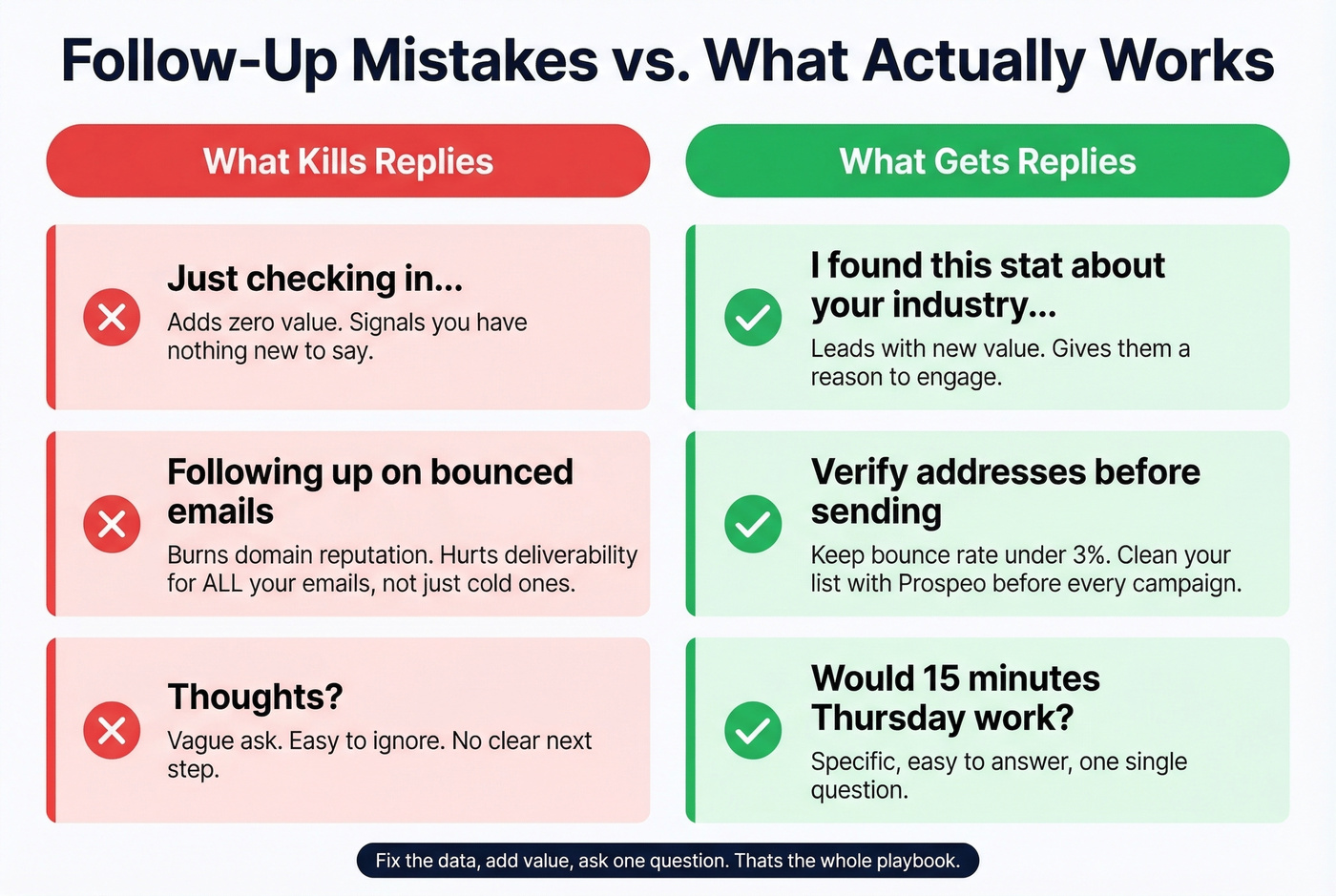
Equally damaging: following up on emails that bounced. If your bounce rate is above ~3%, run your list through Prospeo's verification before your next send. You're burning domain reputation with every bounced message, and that reputation affects deliverability for every email you send afterward - not just the cold ones. Our team has watched clients go from 35% bounce rates to under 4% just by cleaning their lists before a campaign, and the reply rate improvement is immediate. (If you're troubleshooting reputation issues, this guide on how to improve sender reputation helps.)
The third killer is no clear next step. "Thoughts?" isn't a call to action. "Would 15 minutes on Thursday work?" is. Make it obvious, make it easy, and make it one thing.
Let's be honest: if you're sending follow-ups to unverified addresses on a Tuesday morning with a "just bumping this" opener, you're doing three things wrong at once. Fix the data, add value, and ask one question. That's the whole playbook.
The best follow-up template won't help if you're emailing outdated addresses. Prospeo refreshes 300M+ contacts every 7 days - not every 6 weeks like other providers. That means the email you're following up on actually reaches someone real.
Stop following up with ghosts. Get verified contact data first.
FAQ
How long should I wait before following up?
Three business days for cold outreach, 24 hours for a post-interview thank-you, and 5-7 days after a proposal. This gives the recipient enough time to process without losing the context of your original message.
How many follow-ups is too many?
Three is the ceiling for cold outreach. The Belkins dataset shows 4+ emails more than triple spam complaints. Warm contacts with an existing relationship can stretch to four, but stop immediately if there's zero engagement signal across touches.
What if my emails aren't getting delivered?
Check your bounce rate first - anything above ~3% means your list needs cleaning before you send another campaign. Run addresses through a verification tool to remove invalid contacts before they damage your sender reputation.
What's the best approach when someone hasn't replied?
Lead with new value - a relevant stat, a brief case study, or a specific observation about their business. Keep the message under 60 words, reply in the same thread, and include one clear ask. Skip generic openers like "just bumping this" that signal you have nothing new to offer.
Should I change my subject line on each follow-up?
No. Replying in the same thread preserves context and keeps your original subject line visible. Recipients can see the full conversation history without digging, which reduces friction and makes responding easier.