

How to Write a Follow Up Inquiry Email That Actually Gets a Reply
You sent the email. It was clear, professional, well-written. And now it's been four days of silence.
Here's what happened: 40% of people have 50+ unread emails sitting in their inbox right now. Your message didn't get rejected - it got buried. A single follow up inquiry email increases your response rate by 22%. You're not being annoying. You're being professional.
Follow-ups aren't a sales-only skill. They apply to coworkers, clients, recruiters, professors, and anyone else who owes you a reply. This is a core professional habit, and most people are terrible at it.
Three Rules That Determine Whether You Get a Reply
- Wait 3 business days, not 10+. Momentum dies fast. Wait too long and your original email becomes invisible.
- Add something new every time. A resource, a data point, a refined question. Never just "bumping this up."
- Propose a specific next step. "Does Thursday at 2pm work?" beats "Let me know your thoughts" every single time.
When to Send Your Follow-Up
The 3-5-7 cadence gives you a clean structure: first follow-up after 3 business days, second after 5 more, final attempt 7 days after that. But a vendor quote and a job application don't operate on the same clock.
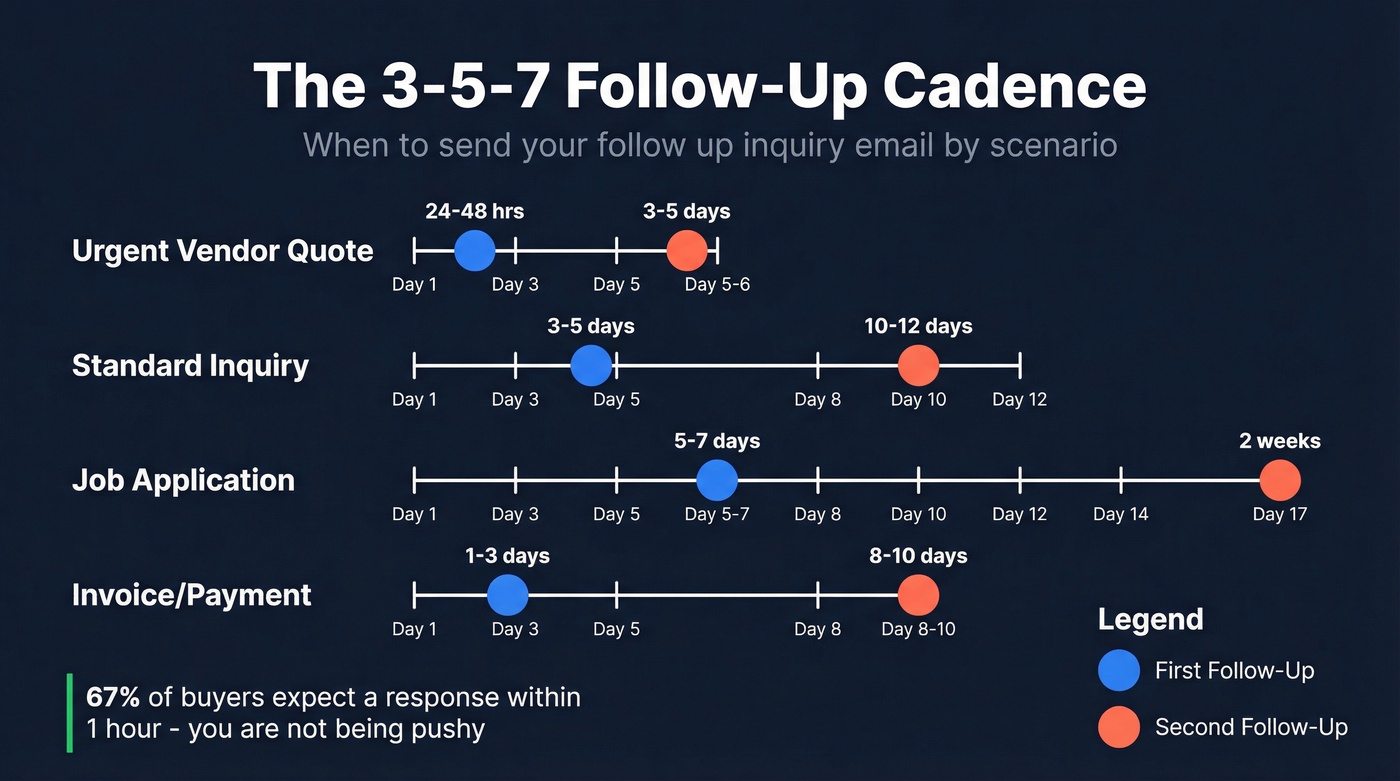
| Scenario | First Follow-Up | Second Follow-Up |
|---|---|---|
| Urgent vendor quote | 24-48 hours | 3-4 days later |
| Standard inquiry | 3-5 business days | 5-7 days later |
| Job application | 5-7 business days | 7-10 business days later |
| Invoice/payment | 1-3 days past due | 5-7 days later |
67% of business buyers expect an email response within one hour, based on Salesforce research across 7,000+ respondents. When you follow up after three days, you're being patient - not pushy.
If you want a deeper breakdown by scenario, see when to follow up on an email.
How to Structure Every Follow-Up
Every effective inquiry follow-up has five parts. Miss one and the whole thing falls flat.
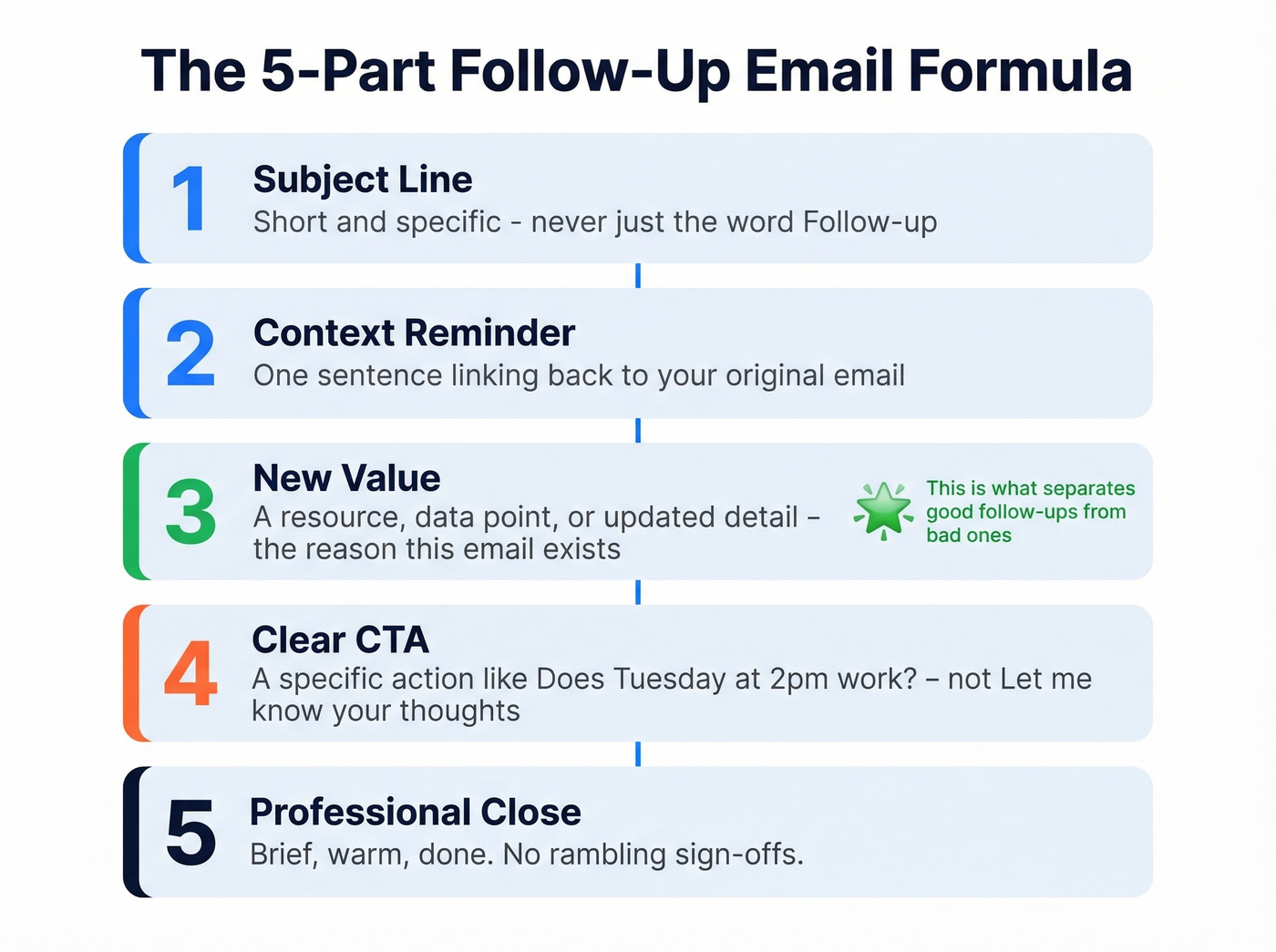
Subject line - short, specific, never the word "Follow-up" by itself. Context reminder - one sentence connecting back to your original message: "I reached out last Tuesday about the Q2 vendor proposal." New value - the thing that justifies this email existing, whether that's a relevant article, an updated timeline, or a clarifying detail. Clear CTA - a specific action, not a vague invitation. If you need help tightening your ask, use these email call to action rules. The best technique we've seen, and the consensus on r/sales backs this up: "I'm finalizing my schedule for next week - does Tuesday work?" It reframes the follow-up as logistics, not begging. Professional close - brief, warm, done.
That structure works whether you're chasing a hiring manager, a vendor, or a client who's gone quiet. If you're building a multi-touch sequence, borrow a proven B2B cold email sequence structure.
10 Follow-Up Inquiry Email Templates
After a Sales Inquiry (No Response)
Subject: Quick question on [product/service]
Hi [Name], I sent over questions about [product] last [day]. I've since noticed [new detail] that might affect timing. Would a 10-minute call on [specific day] work?
If you want more variations, these sales follow-up templates cover common scenarios.
After a Demo or Meeting
Subject: Next steps from [day]'s call
Hi [Name], one thing I've been thinking about since our call: [specific insight or question]. Are you available [specific day] to discuss next steps?
For post-call messaging, a dedicated sales meeting follow-up email format can help.
After Submitting a Proposal
Subject: [Company] proposal - one update
Hi [Name], quick update to the proposal from [date]: [new detail or revised timeline]. Does [day/time] work for 15 minutes to walk through it?
After a Job Application
Subject: [Your name] - [role title] application
Hi [Name], I applied for [role] on [date]. Since then, I [completed relevant project / noticed your team's announcement about X]. Would you have 15 minutes this week?
A hiring manager on Reddit who's conducted roughly 1,000 interviews recommends following up at three touchpoints: when you apply, after each interview step, and again if you haven't heard back within a week. That cadence keeps you visible without being overbearing.
After a Job Interview
Subject: Thanks - [specific topic from interview]
Hi [Name], I appreciated our conversation about [specific challenge]. I've been thinking about your point on [topic] - here's how I'd approach it: [one sentence]. Looking forward to next steps.
Vendor or Supplier Inquiry
Subject: [Product/service] quote - checking timing
Hi [Name], we're finalizing vendor selection by [deadline]. Did you have a chance to review my request from [date]? Happy to send requirements in a shorter format.
Client Who Hasn't Responded
Subject: [Project name] - need your input on one thing
Hi [Name], I need your sign-off on [specific item] to keep [project] on track for [deadline]. Could you take a look by [specific date]? A quick call works too.
Academic or School Inquiry
Subject: [Course/project name] - quick question before [deadline]
Hi [Professor/Name], following up on my email from [date] about [topic]. I have a deadline of [date] and need to finalize [specific element]. Would you have a few minutes this week?
Invoice or Payment Reminder
Subject: Invoice #[number] - due [date]
Hi [Name], invoice #[number] for [amount] was due on [date]. I've reattached it here. Could you confirm receipt and expected payment timing?
The Break-Up Email
Subject: Should I close this out?
Hi [Name], I've followed up a couple of times and haven't heard back - totally understand if the timing isn't right. I'll close this out, but if things change, I'm easy to reach.
The break-up email removes pressure, and that's exactly what triggers a reply. In our experience, it outperforms the second follow-up more often than not.

Great follow-up copy is wasted on bad email addresses. Prospeo gives you 98% verified emails from 300M+ professional profiles so your inquiry actually lands in the right inbox - not a bounce folder.
Stop following up with addresses that don't exist.
Subject Lines That Get Opened
A study of 5.5 million emails found that personalized subject lines hit 46% open rates versus 35% for generic ones. Question-based subject lines performed equally well. The sweet spot for length? Two to four words. For more options, swipe from these email subject line examples.
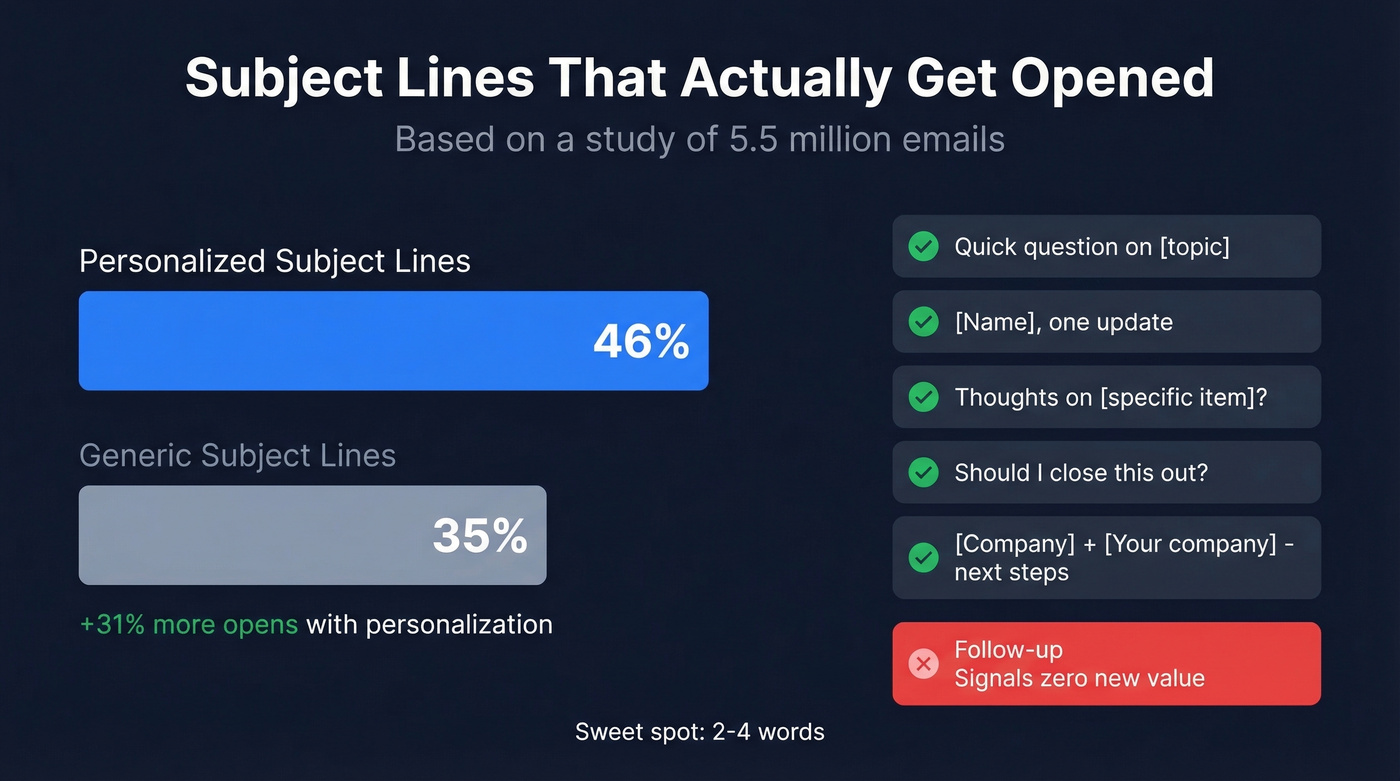
What doesn't work: the word "Follow-up" as your entire subject line. It signals zero new value and gets ignored. If you're writing for outbound, these prospecting email subject lines patterns are a solid baseline.
We've tested dozens of formats. Short and specific wins every time:
- "Quick question on [topic]"
- "[Name], one update"
- "Thoughts on [specific item]?"
- "Should I close this out?"
- "[Company] + [your company] - next steps"
Here's the thing: most people agonize over email body copy when the subject line is doing 80% of the work. Spend half your drafting time on those 3-5 words. If you want to improve the body too, use a modern email copywriting framework.
Phrases to Stop Using
| Stop Saying | Say This Instead |
|---|---|
| "Just checking in" | "Wanted to share [new info]" |
| "Touching base" | "Quick update on [topic]" |
| "Circling back" | "Following up with [new detail]" |
| "Kindly follow up" | "Wanted to resurface this" |
| "Hope this finds you well" | Skip it - go straight to the point |
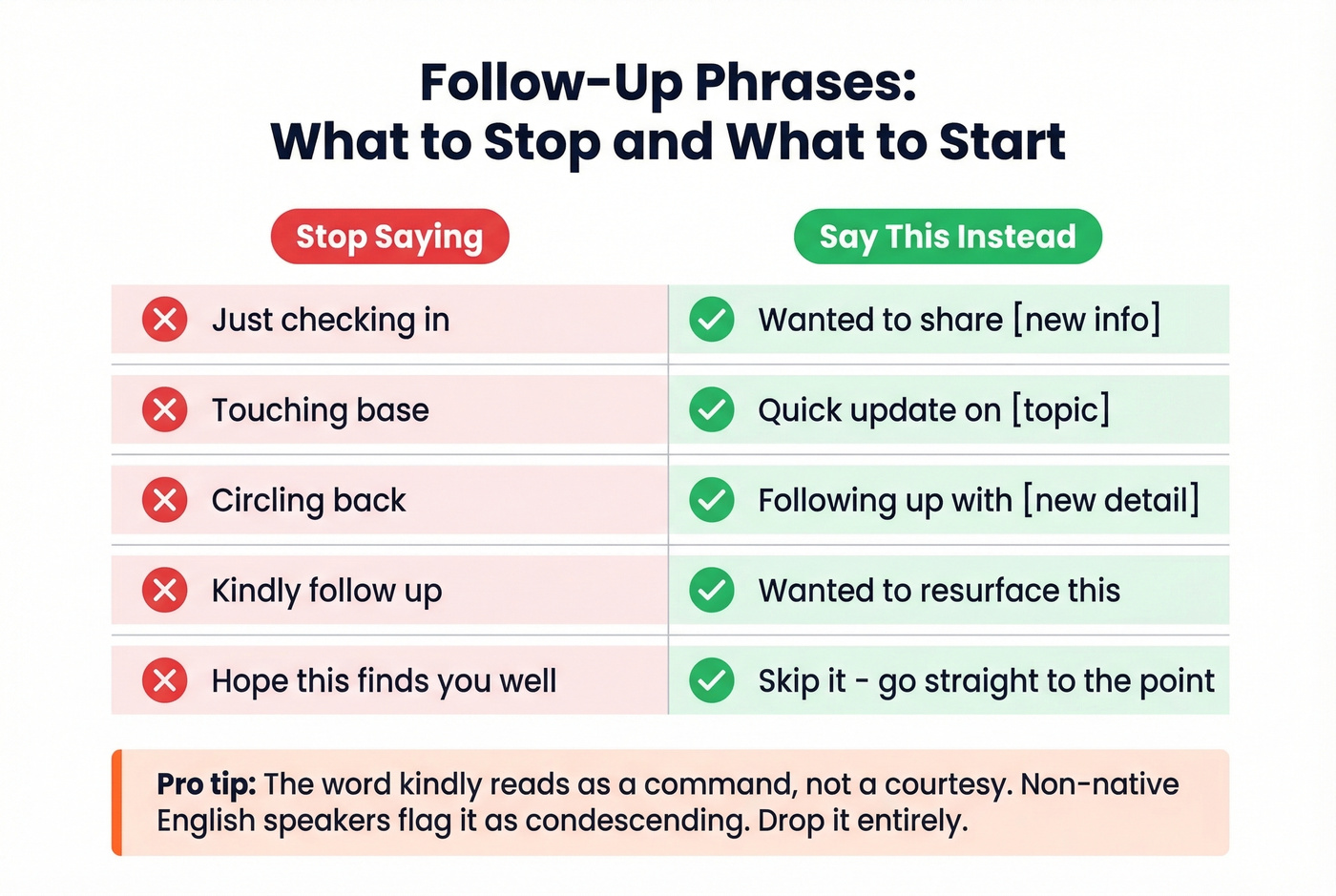
The phrase "kindly follow up" deserves a callout. On r/etiquette, non-native English speakers flag it as condescending - "kindly" reads like a command, not a courtesy. Drop it entirely. If you catch yourself writing "Just checking in," use these alternatives for how to say just checking in professionally.
When to Stop Following Up
Most advice says send more follow-ups. The data says the opposite.
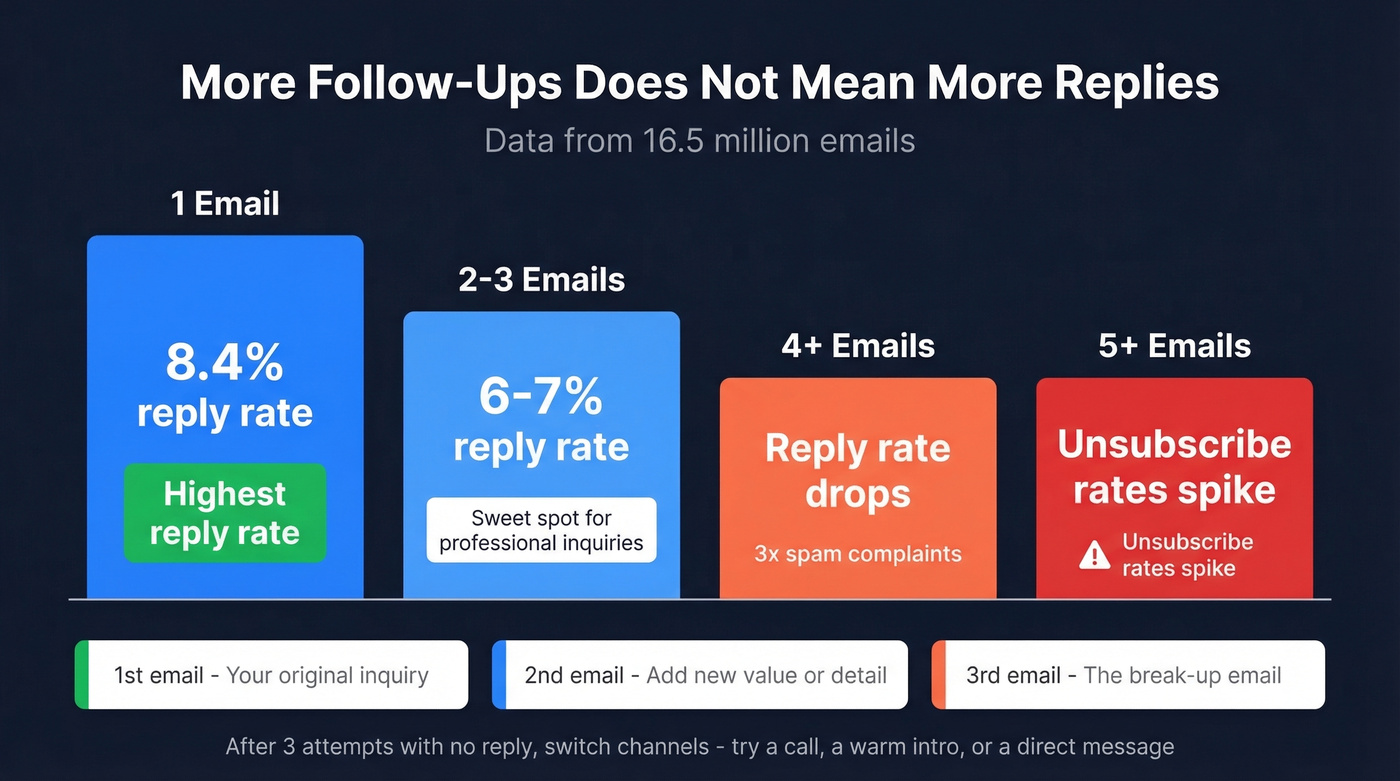
An analysis of 16.5 million emails found the highest reply rate - 8.4% - came from a single email. Four or more emails in a sequence more than triples spam complaints and unsubscribe rates. For non-sales contexts, two to three attempts is the ceiling. One well-crafted follow up inquiry email, one with new information, and if it makes sense, one break-up email. After that, you're either emailing someone who isn't interested or emailing an address that doesn't work. If you want the benchmarks behind this, see follow-up email reply rate.
If email goes cold, switch channels. A phone call, a warm introduction through a mutual connection, or a direct message on a professional network breaks through where email can't.
Still Getting Silence? Verify the Address First
Before you rewrite your follow-up for the fourth time, consider the simplest explanation: the email address is wrong. A typo, an outdated domain, a role filled by someone new - any of these means your message is hitting a dead inbox. We've seen outreach teams burn weeks of follow-up effort on addresses that were never going to deliver in the first place. If you're seeing deliverability issues, start with email bounce rate basics.
An email verification check takes seconds. Prospeo verifies addresses in real time with 98% accuracy, and the free tier covers 75 verifications per month - enough to check every address on a short outreach list before you send a single follow-up. For the full system, use this email deliverability guide to fix issues upstream.
You've built the perfect follow-up cadence. But 35% bounce rates will torch your domain before the second touchpoint. Prospeo's 5-step email verification keeps you under 4% - just like Snyk's 50-person sales team.
Protect your sender reputation at $0.01 per verified email.
FAQ
How many follow-up emails should I send?
Two to three total attempts is the sweet spot for professional inquiries. Data from 16.5 million emails shows the highest reply rate (8.4%) comes from a single message, and spam complaints triple after four touches. Send one follow-up with new value, then a break-up email if needed.
Is it rude to follow up twice?
Not at all. With 40% of professionals sitting on 50+ unread emails, your first message almost certainly got buried. Two follow-ups are expected in professional communication. Just add a new detail, resource, or refined question each time instead of repeating yourself.
What's the best subject line for a follow up inquiry email?
Short, specific, and 2-4 words long. Personalized subject lines hit 46% open rates versus 35% for generic ones. Try formats like "Quick question on [topic]" or "[Name], one update." Avoid using the word "Follow-up" alone - it signals zero new value.
What if they never respond after three follow-ups?
Stop emailing that address. Either the recipient isn't interested or the contact info is outdated. Verify the address first, then try a different channel - a phone call or warm introduction through a mutual connection tends to break through where email can't.