

The Follow Up Plan You Can Steal Today (Day-by-Day Cadence Included)
Only 2% of sales close on the first contact. Yet a follow up plan - a real one, with specific days, channels, and rules - is something most sales teams never actually build. They wing it. You're spending $200 to generate a lead, closer to $600-$800 if it's a demo request, and then 44% of reps stop after just one follow-up attempt. That's not a motivation problem. That's an expensive leak in your pipeline, and the fix is a system that runs whether you feel like it or not.
What Your Follow Up Plan Needs
If you're short on time, here's the entire framework:
- 7 touches over 21 days, mixing email, phone, and a social touch. That's the baseline cadence for warm-to-cool prospects.
- Multi-channel is non-negotiable. Email-only sequences plateau fast. Add a call on Day 3 and a social touch on Day 7 to double your surface area.
- Verify your data before touch one. A bounced email on Day 1 doesn't just waste that touch - it damages your sender reputation for every future email. Run your list through a real-time verification tool before you load a single contact into your sequencer.
Now let's build the full cadence.
Day-by-Day Follow Up Cadence
Here's the 7-touch cadence we use and recommend for B2B outbound to prospects who've shown some signal - visited your site, downloaded a resource, or matched your ICP. Adjust the spacing for colder or warmer leads (more on that below).
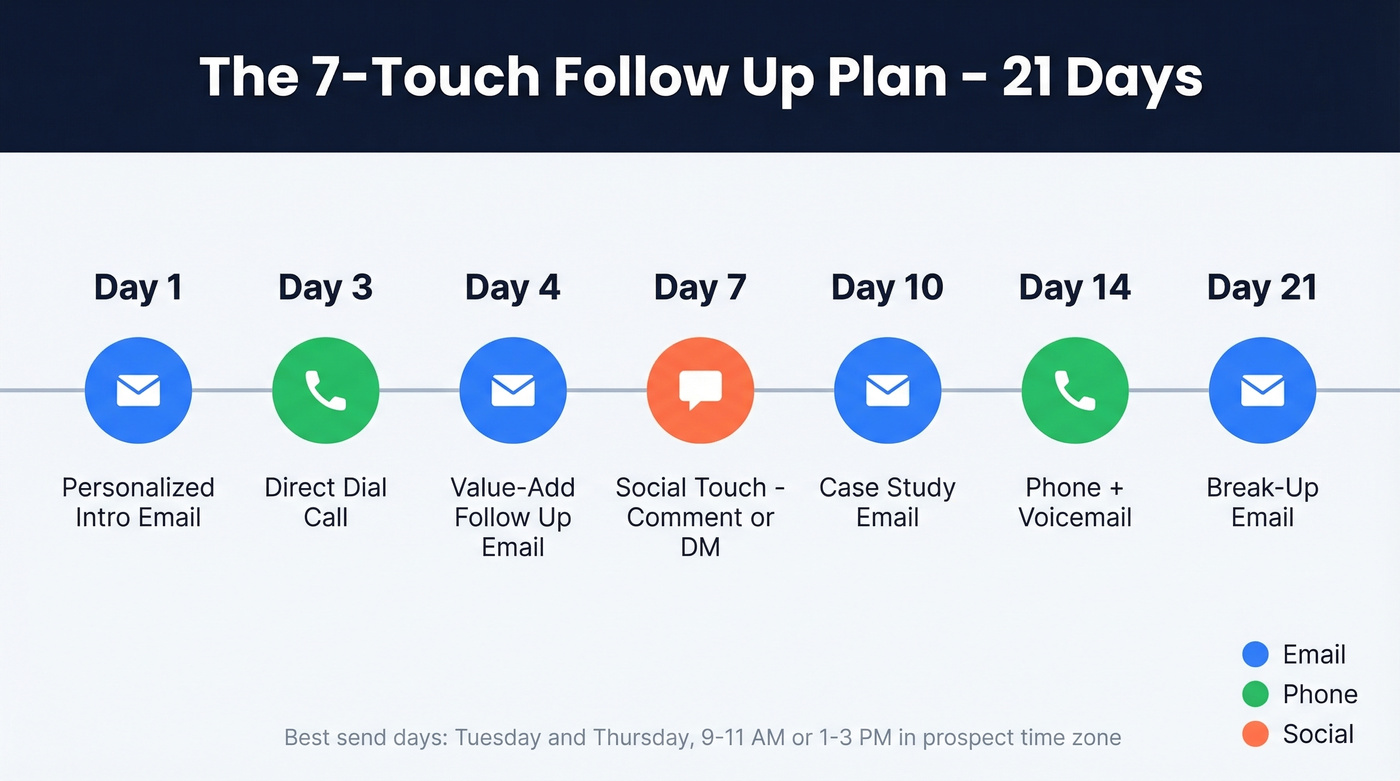
| Day | Channel | Action | Goal |
|---|---|---|---|
| 1 | Personalized intro, one clear CTA | Open the conversation | |
| 3 | Phone | Direct dial, reference the email | Voice contact, build familiarity |
| 4 | Follow-up #1, add new value | Re-engage non-openers | |
| 7 | Social | Comment or DM on their content | Stay visible, different channel |
| 10 | Case study or proof point | Shift from intro to credibility | |
| 14 | Phone + VM | Call, leave voicemail if no answer | Create urgency without pressure |
| 21 | Break-up email, clear next step | Final touch, preserve the door |
A note on "personalized" in that Day 1 email: this doesn't mean {first_name}. It means referencing something specific - a recent hire on their team, a product launch, a quarterly earnings detail. Generic merge tags are wallpaper. Specific details get replies (and if you want plug-and-play copy, use these follow-up templates).
Tuesday and Thursday are your best send days. Woodpecker's data shows reply rates jump from 9% to 18% with just one follow-up email, so the gap between "sent one email" and "sent two" is enormous. Best windows are 9-11 AM and 1-3 PM in the prospect's time zone (more benchmarks here: best send times). Skip Monday mornings when inboxes are in triage mode and Friday afternoons when attention has already left the building.
The spacing matters too. Wait 3-7 days between touches as a general rule. Faster industries like recruiting and real estate can compress to 2-3 days. Enterprise deals with longer sales cycles should stretch to 5-7.
For the Day 7 social touch: engage with their professional content. Comment on a post they published, share an article they wrote, or send a brief DM that references something specific. Don't just connect and vanish.
Adjust by Lead Temperature
That 7-touch, 21-day cadence is a starting point. The real number depends on how warm the lead is and how big the deal.
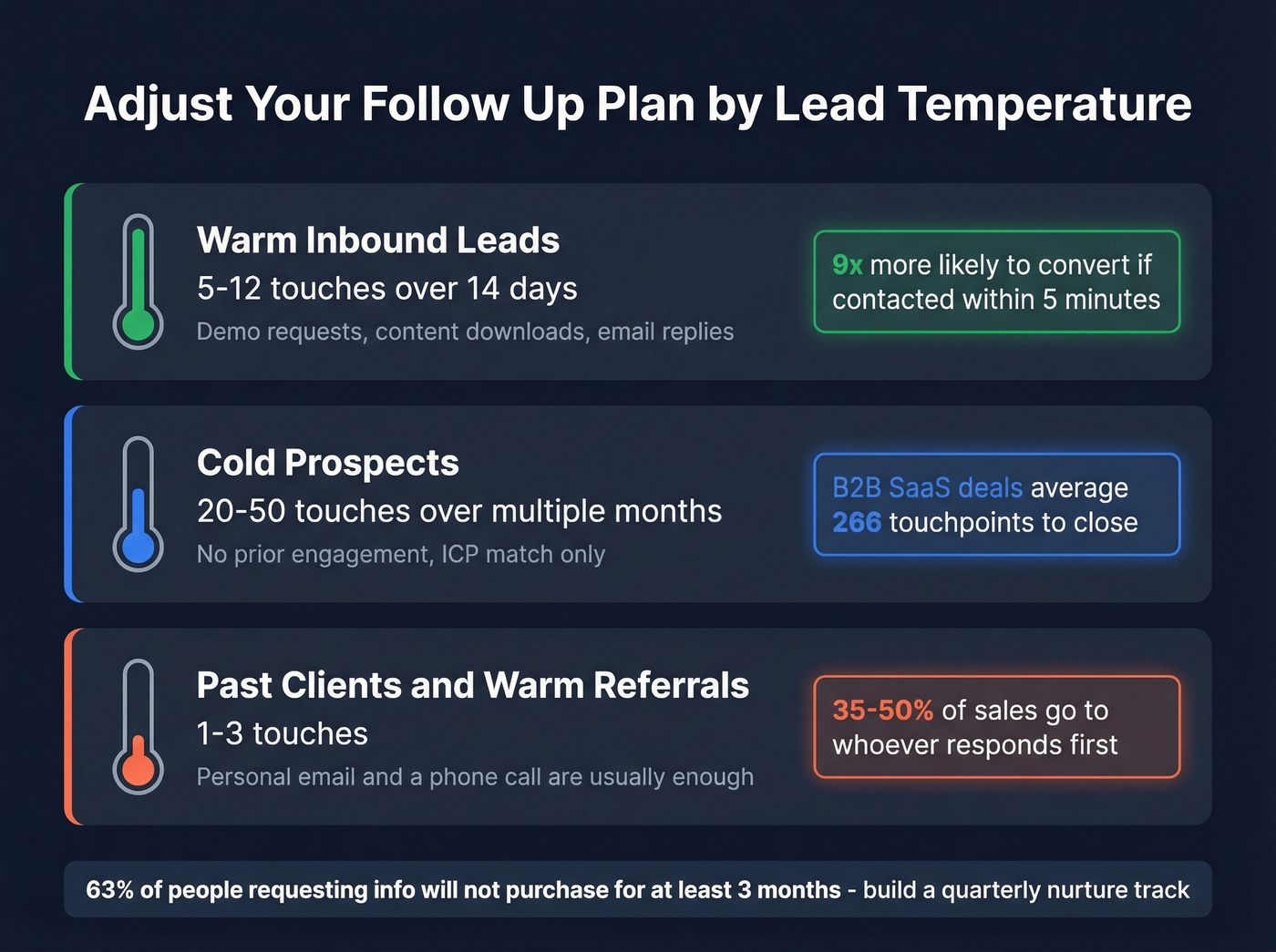
Warm inbound leads - people who downloaded content, requested a demo, or replied to an email - need 5-12 touches. They already know you exist, so move faster. Compress the cadence to 14 days and lean heavier on phone. Speed-to-lead data is brutal here: leads are 9x more likely to convert when contacted within 5 minutes, and calling within the first hour produces a 450% higher response rate than waiting even 24 hours. Put differently, 35%-50% of sales go to whoever responds first. If your inbound follow-up takes more than an hour, you're handing deals to competitors.
Cold prospects with no prior engagement need 20-50 touches across multiple months. High-growth organizations average 16 touches per prospect in just 2-4 weeks, and HockeyStack's touchpoint data shows B2B SaaS deals average 266 touchpoints to close. For deals in the $50K-$100K range, that number climbs to 309. Your 7-touch cadence is just the opening sequence - you'll need a longer nurture track behind it (this is where sequence management matters).
Past clients and warm referrals need 1-3 touches. Don't over-engineer this. A personal email and a phone call are usually enough.
Here's the number that should reframe your patience: 63% of people requesting information won't purchase for at least three months. Your cadence isn't just a 21-day sprint. It's a system that feeds into a quarterly nurture track.

A bounced email on Day 1 kills your follow up plan before it starts. Prospeo's 5-step verification delivers 98% email accuracy and 125M+ verified mobile numbers - so your Day 3 call actually reaches a real person. At ~$0.01 per email, verifying your entire sequence list costs less than one wasted touch.
Clean your list before you launch a single touch.
When to Stop
The anxiety is real. Every rep has stared at a CRM record wondering if the next email crosses the line from persistent to annoying. The consensus on r/sales is that the line between "biggest determinant of success" and "overly aggressive" feels impossibly thin when you're in the middle of a deal.
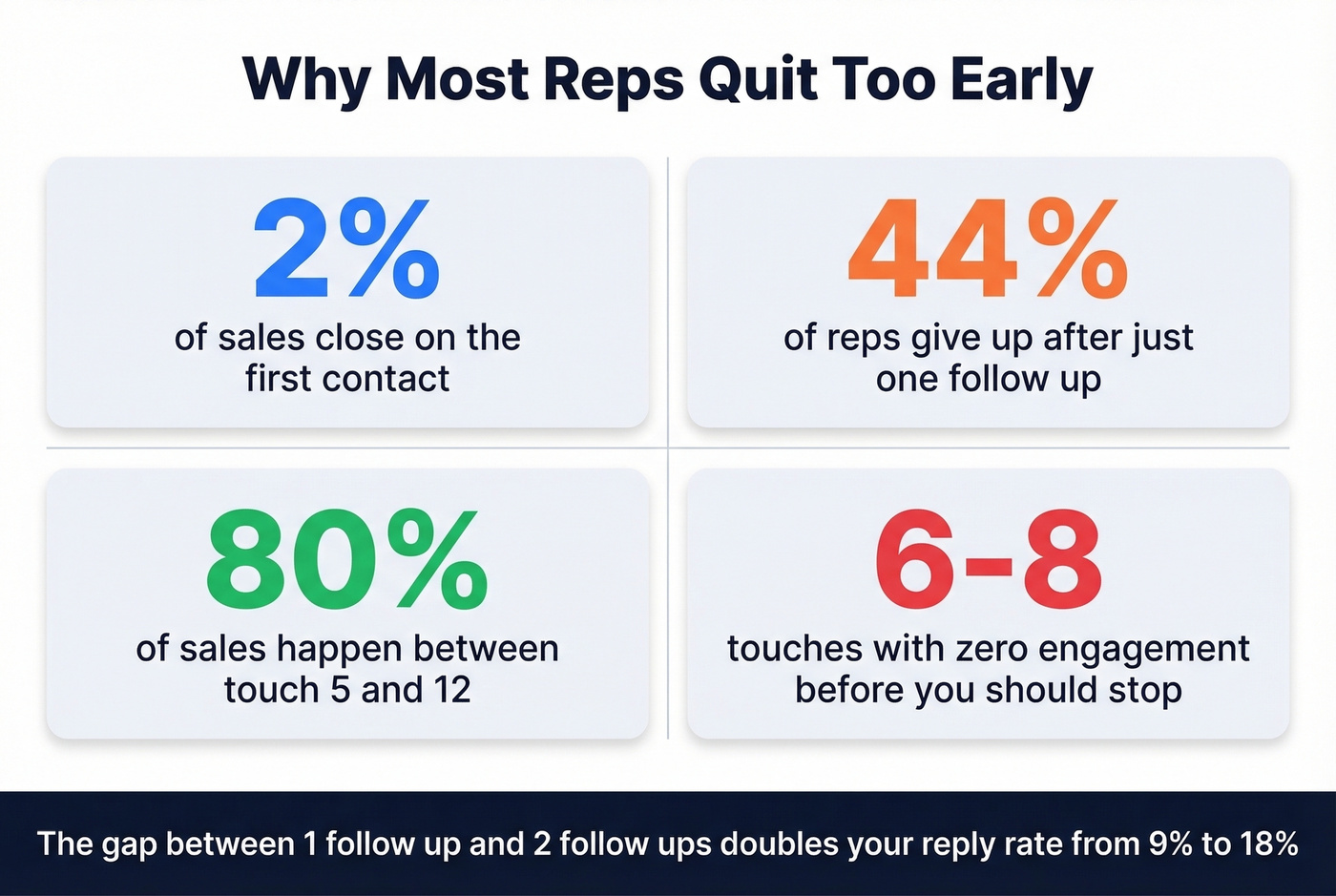
After 6-8 touches with zero engagement - no opens, no replies, no clicks - you've hit diminishing returns. Each additional touch costs you time and risks your sender reputation without meaningfully increasing your odds. Shift that contact to a low-frequency nurture cadence: one touch per quarter, triggered by relevant content or company news.
Your final touch in the active cadence should be a break-up email. Keep it short, remove all pressure, and leave the door open. Something like: "Looks like the timing isn't right. I'll stop reaching out, but if [problem you solve] comes back up, here's my calendar link." Break-up emails consistently outperform generic follow-ups because they flip the dynamic - suddenly the prospect feels like they're losing access, not being chased. Subject lines like "Should I close your file?" or "Permission to close your file" consistently pull 40%+ open rates (you can steal more from these subject line examples).
80% of sales happen between touch 5 and 12. If you're quitting after two emails, you're not even in the game yet.
How to Build a Follow-Up System That Runs
We've seen teams double their reply rates just by verifying their list before launching a sequence. The tool matters less than the system - but the right stack removes friction so you actually execute.
Reps spend nearly 65% of their time on non-selling tasks. Here's what a lean follow-up stack looks like:
| Tool | What It Does | Price |
|---|---|---|
| Pipedrive | CRM + activity reminders | $14-$29/mo/user |
| HubSpot | Free CRM + Starter sequences | Free / $20/mo/user |
| Prospeo | Email + mobile verification | Free / ~$0.01/lead |
| Apollo.io | Prospecting + sequences | Free / $49/mo/user |
| Yesware | Email tracking + templates | $19/mo/user |
| Salesloft | Full sequencing platform | $125-$165/mo/user |
| Zapier | Workflow glue | Free / $20/mo |
Our honest take: a $14/mo CRM like Pipedrive's Essential plan with built-in activity reminders beats a $125/mo sequencer for most teams under 10 reps. You don't need Salesloft to run a 7-touch cadence. You need a repeatable workflow - a system that reminds you to make the call on Day 3 and send the email on Day 10.
Here's the thing: if your average deal size is under $10K, you probably don't need a full sequencing platform at all. A CRM with reminders, a verified contact list, and discipline will outperform an expensive tool stack that nobody actually uses consistently (if you're evaluating options, start with these examples of a CRM).

Where the stack falls apart is data quality. Your follow up plan is only as good as your contact data. Bounced emails damage sender reputation and waste every touch in your cadence. One of our customers, GreyScout, dropped their bounce rate from 38% to under 4% after switching to Prospeo's verification - and their pipeline jumped 140% in the same quarter. That's not a coincidence. Clean data means every touch in your cadence actually lands (and if you want to go deeper, read this email deliverability guide).
Five Mistakes That Kill Follow-Ups
Generic "just checking in" messages. Every follow-up needs to add something - a case study, a relevant insight, a question. "Checking in" is a delete trigger. If you can't articulate what's new since your last touch, skip it and wait until you can (alternatives here: how to say just checking in professionally).
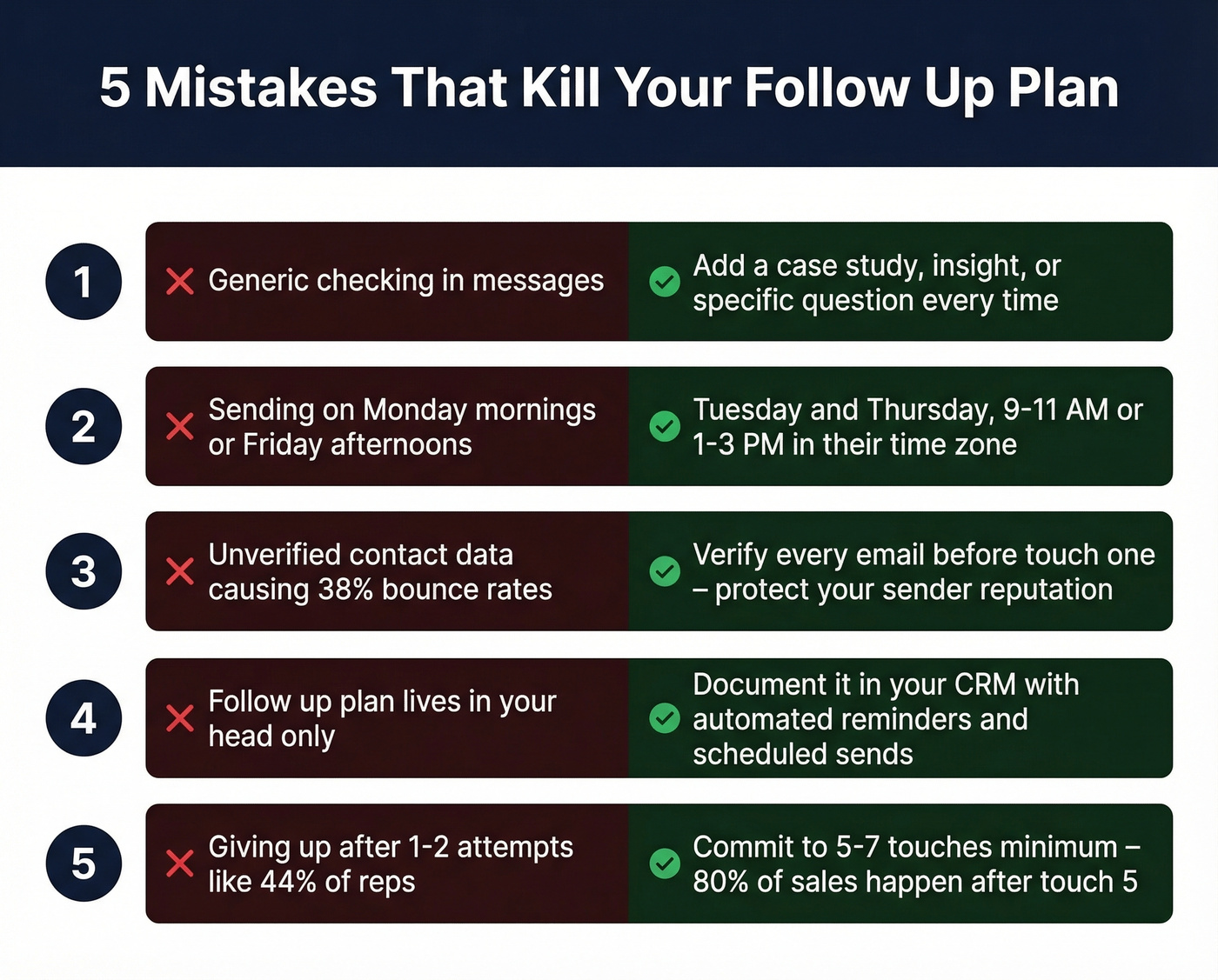
Wrong timing. Monday mornings and Friday afternoons are dead zones. Stick to Tuesday/Thursday, 9-11 AM or 1-3 PM.
Bad contact data. Bounce rates like 38% don't just waste touches - they tank your domain reputation. Verify before you send. Always (use these email bounce rate benchmarks to sanity-check your list health).
No documented process. If your follow up plan lives in your head, it doesn't exist. Put it in a CRM with automated reminders or a sequencer with scheduled sends. We've tested both approaches, and the teams that write their cadence down and automate the reminders outperform "I'll remember" teams by a wide margin every single time.
Giving up after 1-2 attempts. 44% of reps do this. They're leaving 80% of potential deals on the table.
Your cadence needs verified emails and direct dials to work across all 7 touches. Prospeo gives you both - 143M+ verified emails and 125M+ mobile numbers with a 30% pickup rate - refreshed every 7 days so your Day 14 call doesn't hit a disconnected line. Teams using Prospeo book 35% more meetings than Apollo users.
Stop following up with dead data. Start with numbers that connect.
FAQ
How many follow-ups should I include?
Plan for five to seven touches minimum. 80% of sales happen between touch 5 and 12, so quitting after one or two attempts means you're abandoning the vast majority of potential deals. After 6-8 touches with zero engagement, shift to a quarterly nurture cadence rather than going silent.
What's the best day and time to follow up?
Tuesday and Thursday between 9-11 AM or 1-3 PM in the prospect's time zone consistently outperform other slots. Reply rates double from 9% to 18% with just one additional follow-up. Avoid Monday mornings and Friday afternoons.
Why do my follow-up emails bounce?
Stale or unverified contact data is the most common cause - people change jobs, companies rotate domains, and databases decay fast. Run your list through a verification tool before launching any sequence. A clean list protects your sender reputation and ensures every touch actually lands.
How do I build a follow-up system from scratch?
Start with a CRM that supports activity reminders - Pipedrive at $14/mo or HubSpot's free tier both work. Map your cadence day by day, verify your contact list before loading it, and automate the reminders. The goal is a repeatable process where every prospect gets the right touches on the right days, regardless of whether a rep remembers manually.