

Following Up on Our Conversation: Templates & Tips
You just had a great call. The prospect sounded interested, the hiring manager smiled, the investor said "let's stay in touch." Now you're staring at a blank email, overthinking every word, wondering if "following up on our conversation" sounds too stiff or too eager. Some of you want to know if that phrase is even grammatically correct. Others want a template to steal and send in the next five minutes.
Let's cover both.
Quick Answer
"Following up on our conversation" is grammatically correct - it's a present participle phrase, and it works fine. Use it when you have a real prior conversation to reference.
Belkins' dataset of 16.5 million cold emails shows reply rates peak with a single email and decline with each additional follow-up. Two follow-ups is a strong cap before diminishing returns and complaint risk start to bite. Below you'll find templates for eight scenarios, subject lines that get opened, and the mistakes that guarantee you get ignored.
Is the Phrase Grammatically Correct?
Yes. Standard present participle phrase - perfectly grammatical, widely used in professional email, and nobody's going to judge you for it. The phrase itself isn't the problem. The problem is usually what comes after it.
You don't have to use the same opener every time. Here are alternatives matched to context:
- "As a follow up to our conversation" - clean, direct, works everywhere
- "Per our conversation" - slightly formal, good for client-facing emails
- "Building on what we talked about" - casual, fits internal or peer conversations
- "Circling back on our chat" - informal, best for warm relationships
- "Great connecting earlier" - networking events, conferences
- "Thanks for the time today" - post-meeting, post-interview
- "Quick note after our call" - fast, low-pressure, works for sales
Formal contexts (clients, executives, hiring managers) lean toward "following up from our conversation" or "per our conversation." Casual contexts (peers, warm contacts, internal teams) lean toward "building on what we talked about" or "great connecting." Match the tone of the original conversation and you won't go wrong.
What the Data Says
A lot of sales blogs push longer sequences. The biggest dataset we've seen points in the opposite direction: fewer emails, higher quality, and stopping before you generate complaints.
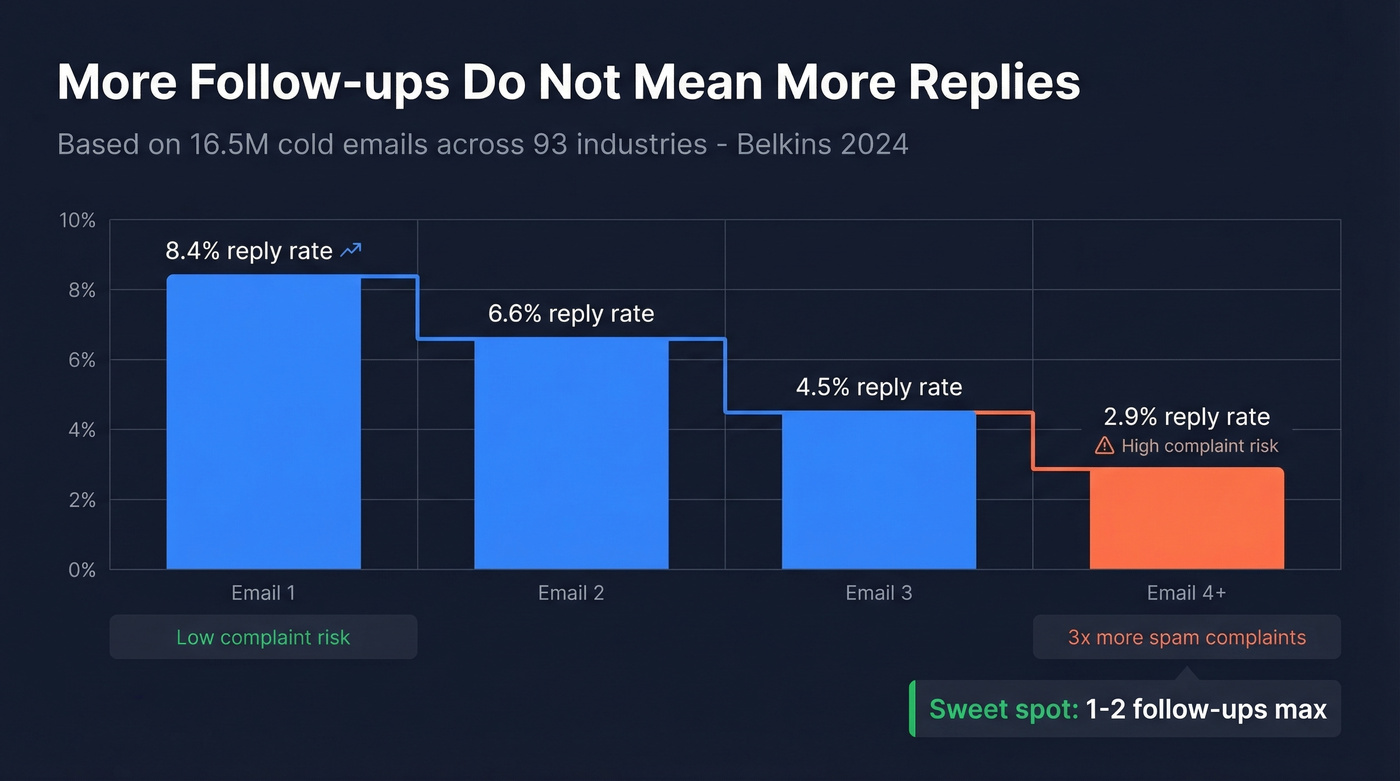
Belkins analyzed 16.5 million cold emails across 93 business domains from January through December 2024. The highest reply rate - 8.4% - came from a single email, and performance declined with each additional follow-up. Sending four or more emails in a sequence more than tripled unsubscribe and spam complaint rates.
Company size changes everything. SMBs (2-50 employees) start at a 9.2% reply rate and bounce back to 8.4% on the second follow-up. Enterprise contacts (1,000+ employees) punish persistence - reply rates drop steadily after the first email. Founders are the most interesting segment: reply rates peak at 6.94% after the second follow-up, then crater to 3.01% by the fourth.
Industry benchmarks for cold outreach sit around 27-35% open rates and 5-6% reply rates. Bounce rates average 7-8%, which is higher than most people realize - and a problem we'll come back to. (If you want the deeper benchmarks and fixes, see our guide to email bounce rates.)
The takeaway: keep your sequence tight. Two follow-ups is usually enough.
Subject Lines That Get Opened
Your follow-up email after a conversation doesn't matter if nobody opens it.
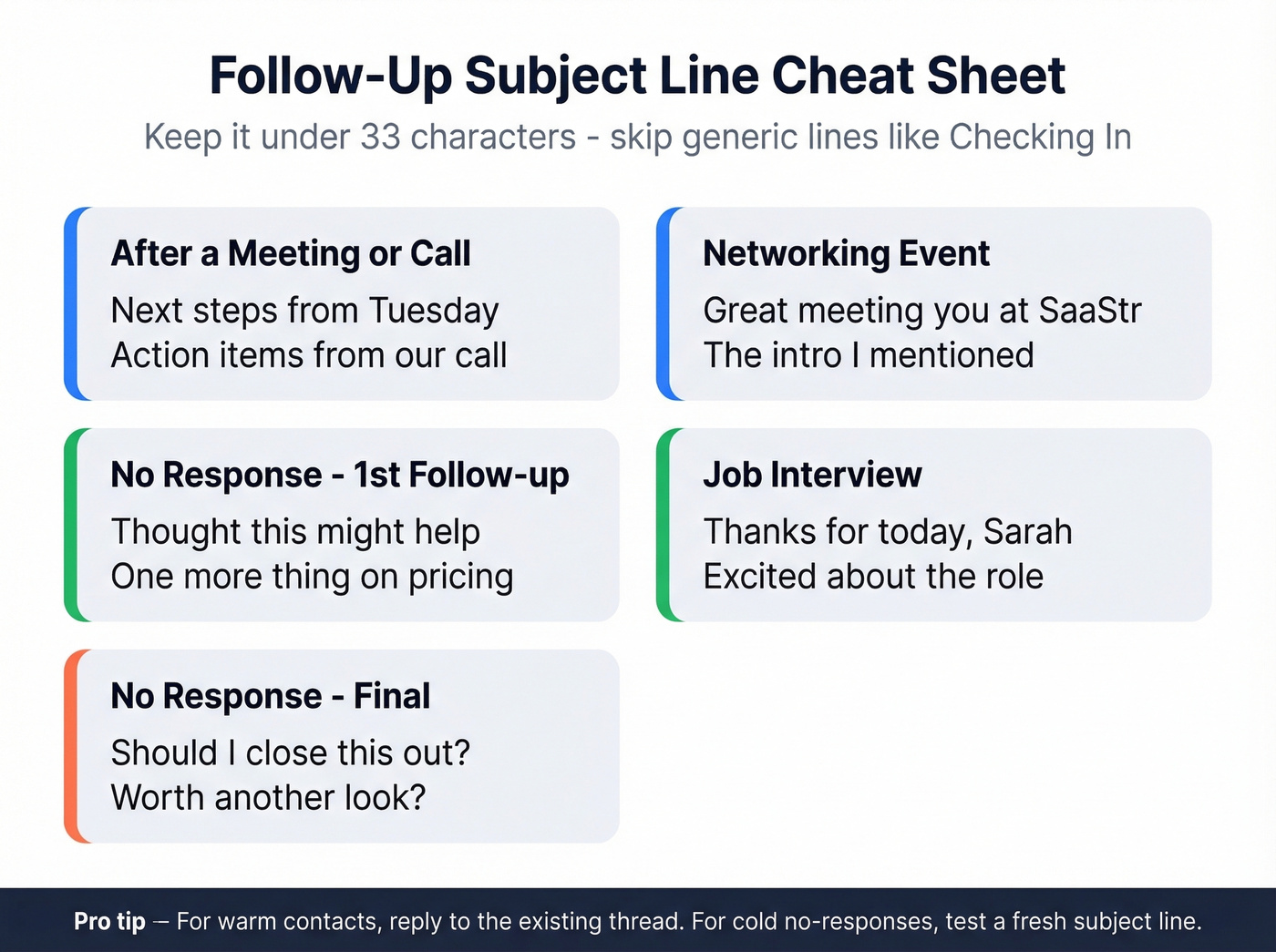
Keep subject lines under 33 characters so they render well on mobile. Avoid generic lines like "Following up" or "Checking in" - they signal low-value, low-specificity email. For warm contacts, reply to the existing thread. For cold no-responses, test a fresh subject line on the next attempt.
"Quick question" and "Hey Sarah" are getting tired. The consensus on r/coldemail is that these once-reliable patterns are losing effectiveness. Here are subject lines worth using instead (or browse more email subject line examples):
After a meeting or call: "Next steps from Tuesday" - "The deck we discussed" - "Action items from our call"
No response (1st follow-up): "Thought this might help" - "One more thing on pricing"
No response (2nd/final): "Should I close this out?" - "Worth another look?"
Networking: "Great meeting you at SaaStr" - "The intro I mentioned"
Interview: "Thanks for today, Sarah" - "Excited about the role"

The data above shows bounce rates averaging 7-8% - and that's before bad contact data enters the picture. Prospeo's 5-step email verification delivers 98% accuracy, cutting bounce rates to under 4% for teams like Snyk and Meritt. Your follow-up templates are only as good as the email address they land on.
Stop crafting perfect follow-ups that bounce. Start with verified data.
Templates for Every Scenario
Every template below follows the same structure: hook (context from the conversation), value (something useful), and a low-friction CTA. Change the name and details, then send. (For more variations, see our cold email follow-up templates.)
After a Sales Call
Subject: Next steps from Tuesday
Hi Sarah,
Thanks for walking me through your team's outbound workflow today. The bottleneck you described around contact verification is something we solve for about 40 other mid-market teams.
I've attached the case study that's closest to your setup - they cut bounce rates from 35% to under 4%. Worth a 5-minute look.
Would Thursday at 2pm work for a quick follow-up?
Best, James
After a Meeting
Send this within 24 hours. Workhuman research shows employees who feel appreciated are 47% more likely to say leaders genuinely care about building a human workplace - and a meeting follow-up is an easy way to signal that. The structure comes from Fellow's 5-part framework: appreciation, recap, key decisions, action items with owners, and next meeting date. If you're doing this in a sales context, you can also use a dedicated sales meeting follow-up email format.
Subject: Action items from our call
Hi team,
Thanks for making time today - productive session. Here's what we landed on:
Recap: We're moving forward with the pilot program for Q2. Key decision: Budget approved for 10 seats. Action items: Sarah to send vendor shortlist by Friday. James to schedule onboarding call by Monday. Next meeting: April 14 at 10am ET.
Let me know if I missed anything.
Best, James
After a Networking Event
HBR's advice here is simple: start with sincere gratitude and reference something specific.
Subject: Great meeting you at SaaStr
Hi Sarah,
Really enjoyed our conversation about scaling outbound in EMEA - your point about localized sequences was spot on. I'd love to continue that over coffee or a quick call next week. Would Tuesday work?
Best, James
After a Job Interview
Here's the thing: thank-you notes influence hiring decisions, yet somewhere between 24% and 57% of candidates don't send them. Send yours within 24-48 hours.
Subject: Thanks for today, Sarah
Hi Sarah,
Thank you for walking me through the RevOps role today. The challenge you described around unifying data across three CRMs is exactly the kind of problem I've spent the last four years solving.
I'm genuinely excited about the opportunity and happy to provide additional references. Looking forward to hearing about next steps.
Best, James
When You Haven't Heard Back
First follow-up (Day 3) - add new value:
Subject: Thought this might help
Hi Sarah,
I came across this Forrester report on outbound deliverability that's directly relevant to what we discussed. Figured it was worth sharing regardless of timing.
Still happy to pick up where we left off whenever it makes sense.
Best, James
Second follow-up (Day 7) - offer a channel switch:
Subject: 10 minutes - your call
Hi Sarah,
I know email gets buried. If it's easier, I'm happy to do a quick call or connect on another channel - whatever works for your schedule.
James
Breakup email (Day 14) - close the loop:
A clean breakup email often works better than endlessly nudging. Something about giving people an exit makes them more likely to respond - we've seen this play out across dozens of outbound campaigns.
Subject: Should I close this out?
Hi Sarah,
I don't want to be the person clogging your inbox. If the timing isn't right, totally understand - I'll close this out on my end. If things change down the road, my door's open.
Best, James
Reconnecting Months Later
This one's for the investor who said "not right now," the prospect who went dark, or the lead who said "reach out in Q3." Lead with progress metrics. Don't rehash the old pitch.
Subject: Quick update since we last spoke
Hi Sarah,
When we spoke in January, you mentioned revisiting once we hit $500K ARR. We crossed that milestone last month, grew the team to 12, and landed three enterprise logos.
Would a 15-minute call next week work?
Best, James
Mistakes That Kill Your Follow-Up
Most follow-up failures aren't about copy. They're about habits.

"Just checking in" is the worst phrase in professional email. It says "I have nothing new to offer but I want your attention anyway." The r/sysadmin crowd will delete you on sight. If you're writing a follow-up referencing a prior conversation, give the recipient a reason to care - new information, a relevant resource, or a clear next step. (More options: how to say just checking in professionally.)
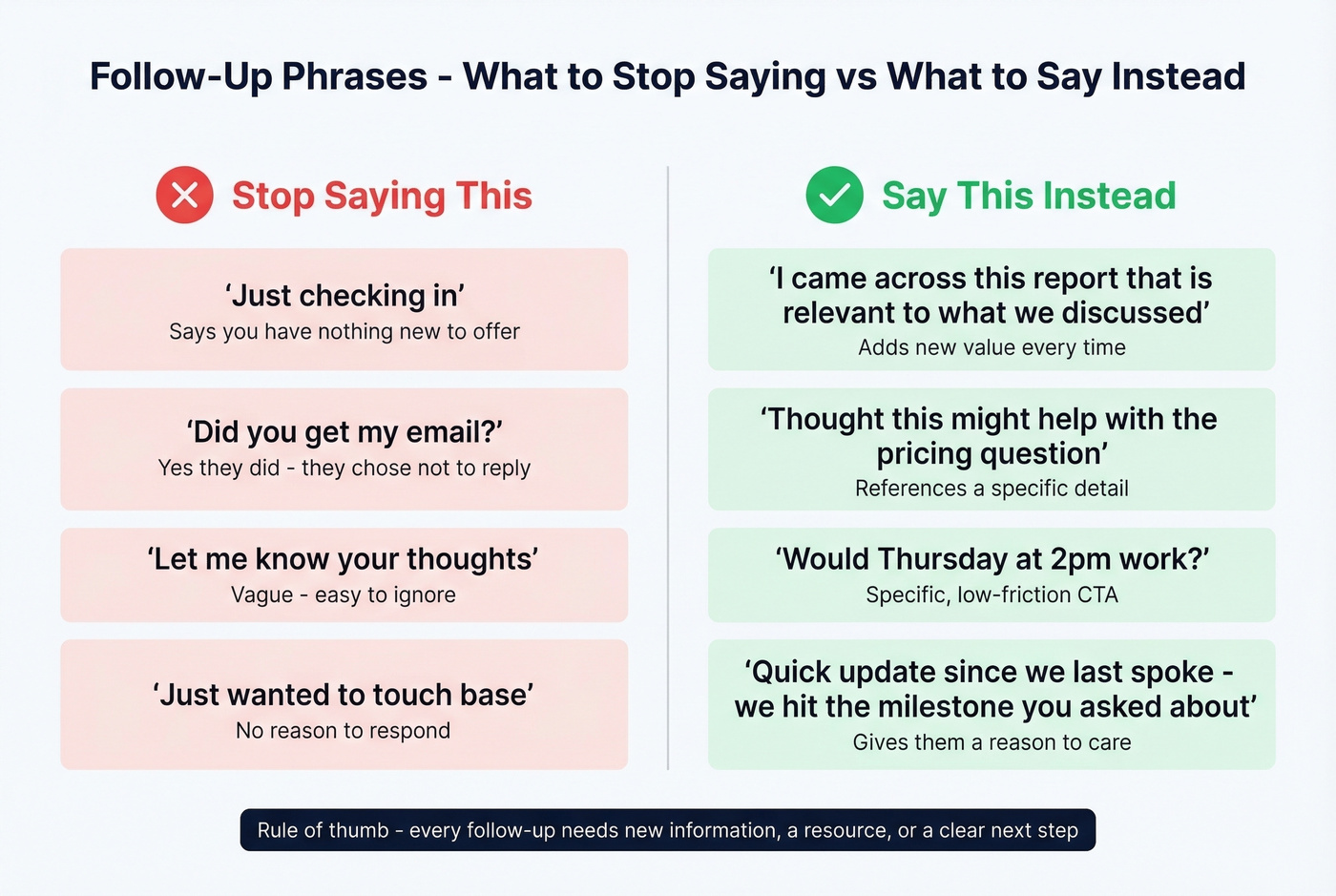
"Did you get my email?" Yes, they got it. They chose not to respond. This phrase makes you sound like you don't understand how email works.
No CTA. Every follow-up needs a clear, low-friction ask. "Would Thursday at 2pm work?" beats "Let me know your thoughts" every time. If you want a tighter framework, use these email call to action rules.
Wrong timing. Spacing emails three days apart results in a 31% increase in replies compared to daily sends. Daily follow-ups don't show persistence; they show desperation.
Sending to a dead email address. Bounce rates across cold outreach average 7-8%, and each bounce chips away at your domain reputation. If your follow-ups aren't landing, the problem isn't your copy - it's your data. Prospeo's 5-step verification catches invalid addresses, catch-all domains, spam traps, and honeypots before you hit send, at $0.01 per check. (If deliverability is a recurring issue, start with an email deliverability guide.)
When to Stop (and Switch Channels)
Here's the cadence that balances persistence with professionalism:
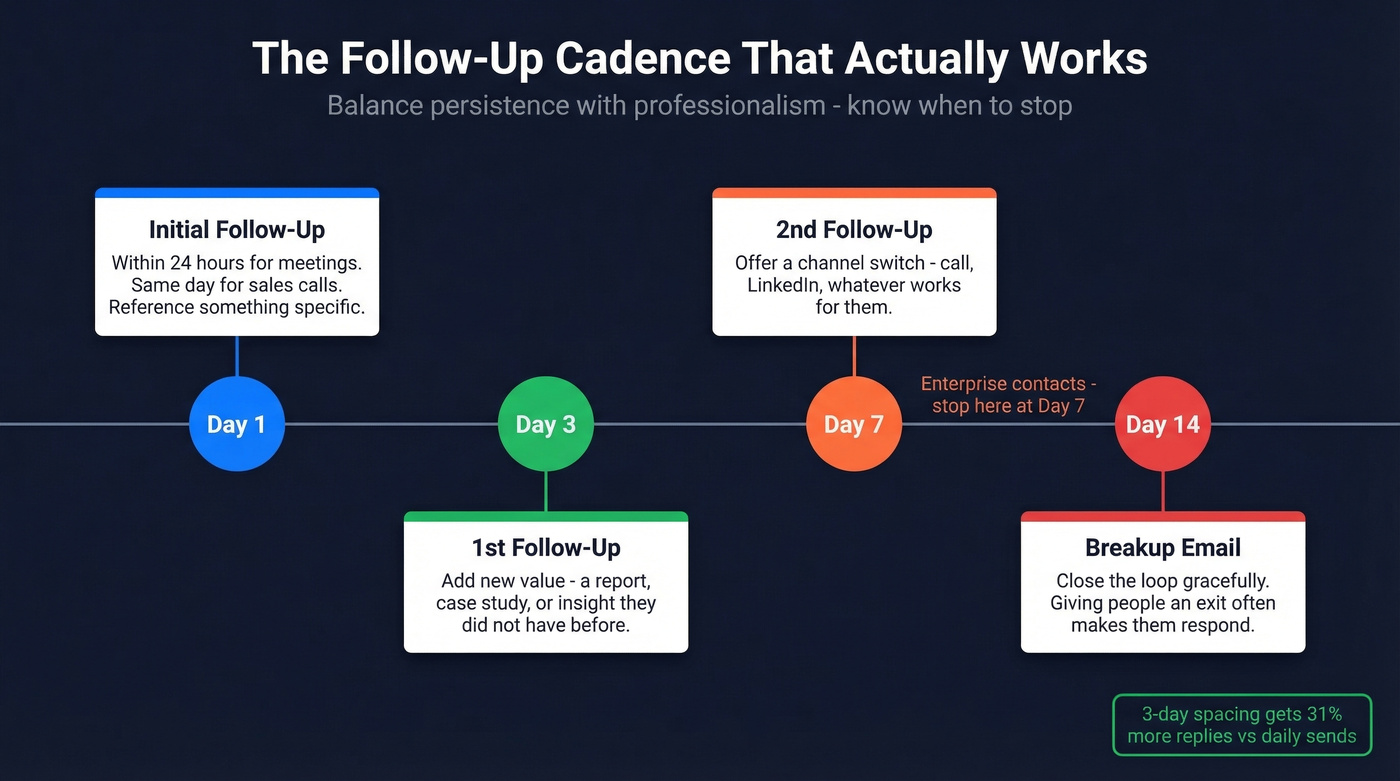
- Day 1: Initial follow-up (within 24 hours for meetings/interviews, same day for sales calls)
- Day 3: First follow-up with new value
- Day 7: Second follow-up, offer a channel switch
- Day 14: Breakup email
Enterprise contacts punish persistence more than SMBs. If you're emailing a VP at a Fortune 500 company, two follow-ups is the ceiling. For SMB founders, you might get a third shot - but the data still shows diminishing returns, and complaint risk jumps once you push past four emails.
Skip the seven-touch sequence if your average deal value is under five figures. Two follow-ups and a breakup email will capture everyone who's genuinely interested. The people who need seven touches to respond aren't going to be great customers anyway.
When email fails, go multi-channel. Data from 16.5 million emails shows that a LinkedIn message plus profile visit combo hit an 11.87% reply rate - higher than any email-only sequence in the dataset. If someone's ignoring your emails, a thoughtful LinkedIn message or a brief voicemail can break through. (If you're building a repeatable process, this sequence management guide helps.)
HBR frames the core problem well: people don't always respond on your timeline, if they respond at all. Learn to read polite rejection signals. "Let me think about it" with no timeline is usually a no. "Not right now, reach out in Q3" with a specific timeframe is usually real. Calibrate accordingly.
Tools That Make Follow-Ups Easier
HubSpot CRM (free tier) tracks email opens and follow-up tasks so nothing falls through the cracks. For teams that need a lightweight system to manage who they've emailed and when, it's hard to beat. If you're comparing options, start with these examples of a CRM.
Calendly (free tier, paid from ~$10-20/month) eliminates the back-and-forth. Drop a scheduling link in your CTA instead of playing calendar tennis across four emails.
Grammarly (free tier) catches the tone issues that make follow-ups sound robotic or aggressive. Particularly useful for non-native English speakers writing to US or UK contacts. (For more on structure and tone, see our guide to email copywriting.)
Belkins' data proves follow-up sequences need to be tight - two emails max before complaints spike. That means every send has to count. Prospeo gives you 143M+ verified emails refreshed every 7 days, so your "following up on our conversation" actually reaches the inbox at $0.01 per email.
Make every follow-up count with emails that actually deliver.
FAQ
How long should I wait before following up?
Send within 24 hours for meetings and job interviews - that's when you're freshest in their memory. For sales or networking, wait 3-5 business days. Data from 16.5 million emails shows daily follow-ups hurt reply rates, while three-day spacing delivers a 31% boost in responses.
Is "following up on our conversation" too formal?
It's appropriate for professional contexts - clients, prospects, hiring managers, executives. For casual contacts or peers, swap to "great chatting earlier" or "building on what we talked about." Match the tone of your original exchange and you'll strike the right register every time.
How many follow-ups is too many?
Two follow-ups after your initial email is the practical ceiling. Beyond that, complaint risk rises sharply and reply rates keep dropping - especially with enterprise contacts. If two follow-ups get silence, switch channels or send a clean breakup email to close the loop.
What should I include in a post-conversation follow-up?
Reference specific topics you discussed, list any agreed-upon action items with owners, and include a clear next step with a proposed date. Proving you listened and making it easy to respond is what separates effective follow-ups from inbox clutter, regardless of whether it's a sales call, interview, or networking chat.