

How to Follow Up on a Meeting (With Templates That Actually Get Replies)
You just walked out of a promising meeting. Great conversation, real momentum, clear next steps. Then you sit down to write the follow-up, type "following up on our meeting" in the subject line, and stare at a blank screen for ten minutes. Meanwhile, 70% of initial emails never get a single follow-up - meaning most promising meetings die in the inbox, not in the boardroom.
We've sent hundreds of these emails, and the pattern is always the same: the ones fired off within an hour get replies. The ones agonized over for two days get silence.
What You Need (Quick Version)
Here's a copy-paste-ready template. Customize the bracketed parts, hit send, read the rest later.
Subject: Next steps from our Tuesday meeting
Hi Sarah,
Thanks for making time today - the conversation around migrating your CRM to HubSpot was really productive.
Quick recap: we agreed to run a pilot with your East Coast team, and your team will send over the current data schema by Friday. I'll have the integration timeline doc to you by [next Wednesday].
Does [Thursday the 15th at 2 PM] work for a check-in?
Best, [Your name]
Three rules: send within 24 hours, keep it under 150 words, include exactly one clear next step.
Why Meeting Follow-Ups Matter
The bar is incredibly low. A mediocre follow-up sent within 24 hours beats a perfect one sent next week. Belkins analyzed 16.5 million cold emails and found the highest reply rate peaks at 8.4% from the first email alone. Warm follow-ups after an actual meeting perform significantly better, but only if you send them while the conversation is still fresh.
Research from the Workhuman Research Institute found that employees who feel appreciated are 47% more likely to say their leaders care about building a human workplace. A follow-up that starts with genuine thanks isn't just polite - it builds trust. And trust compounds across every interaction you'll have with that person.
Your follow-up doesn't need to be brilliant. It needs to exist, arrive quickly, and make the next step obvious.
The 5-Part Structure of an Effective Follow-Up
Every strong post-meeting follow-up hits five beats. Miss one and the email feels incomplete. Nail all five and you've got something the recipient can actually act on.
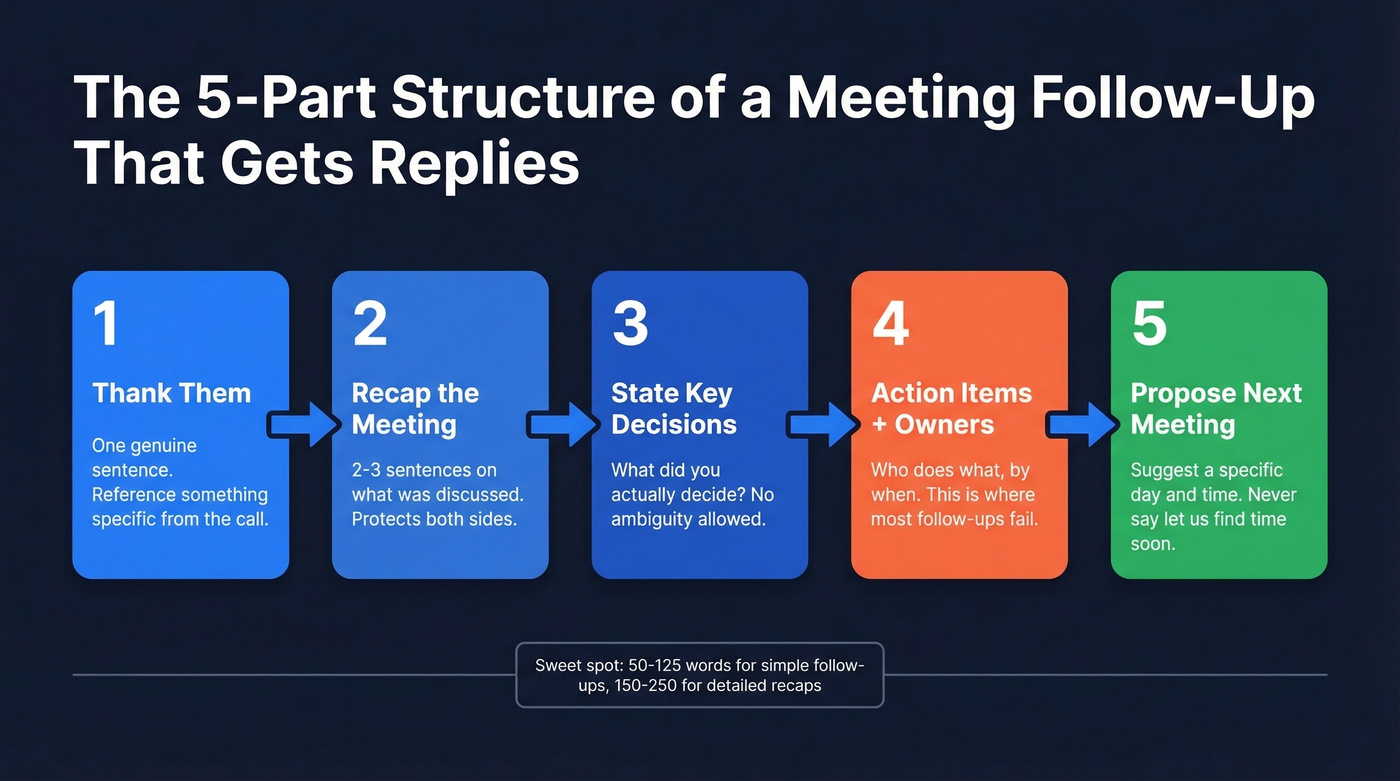
- Thank them. One sentence. Genuine, not generic. Reference something specific from the conversation.
- Recap the meeting. Two to three sentences covering what was discussed - this protects both sides from "that's not what we agreed to" disputes later.
- Summarize key decisions. What did you actually decide? State it plainly so there's no ambiguity.
- List action items with owners and deadlines. This is where most follow-ups fall apart:
| Action Item | Owner | Deadline | Status |
|---|---|---|---|
| Send data schema | Sarah | Jan 17 | Pending |
| Draft integration timeline | You | Jan 22 | In progress |
| Schedule pilot kickoff | Both | Jan 29 | Not started |
- Propose the next meeting date. Don't say "let's find time soon." Suggest a specific day and time.
Pro move: Draft the skeleton of your follow-up before the meeting. Fill in decisions and action items as they happen, and you can send within minutes of hanging up.
For simple follow-ups, 50-125 words hits the sweet spot for reply rates. Most meeting follow-up emails land in the 150-250 word range. Beyond that, you've written a memo, not an email.
If you want more variations you can swipe, keep a few follow-up templates handy for different situations.
Subject Lines That Get Opened
Your follow-up is worthless if it never gets opened. Subject lines do the heavy lifting, and the data points to brevity: roughly 7 words and 41 characters generate the highest engagement. On mobile - where 42% of emails are opened - keep it under 33 characters to avoid truncation.
If you need a bigger swipe file, pull ideas from these email subject line examples and adapt them to your meeting context.
Post-meeting:
- "Next steps from [date]"
- "Action items - [project]"
- "Quick recap: [topic]"
No response:
- "Still on your radar?"
- "Circling back on [topic]"
- "Should I close this out?"
Interview:
- "Thank you - [role] conversation"
- "Great speaking today"
Sales:
- "3 takeaways from our call"
- "Following up on our meeting today"
- "[Prospect company] + [your company] next steps"
Avoid spam triggers: "Free," "Guarantee," ALL CAPS, and excessive punctuation can hurt deliverability. And "Just touching base" is the subject line equivalent of a limp handshake - it tells the recipient nothing and gives them no reason to open.
If deliverability is a recurring issue, it’s worth tightening up your email deliverability basics before you scale follow-ups.

A perfect follow-up sent to a bad email address is a follow-up that never happened. Prospeo verifies every email through a 5-step process - 98% accuracy, refreshed every 7 days - so your post-meeting momentum actually reaches the inbox.
Stop losing deals to bounced follow-ups. Verify before you send.
When to Send
Timing isn't complicated, but getting it wrong kills momentum.
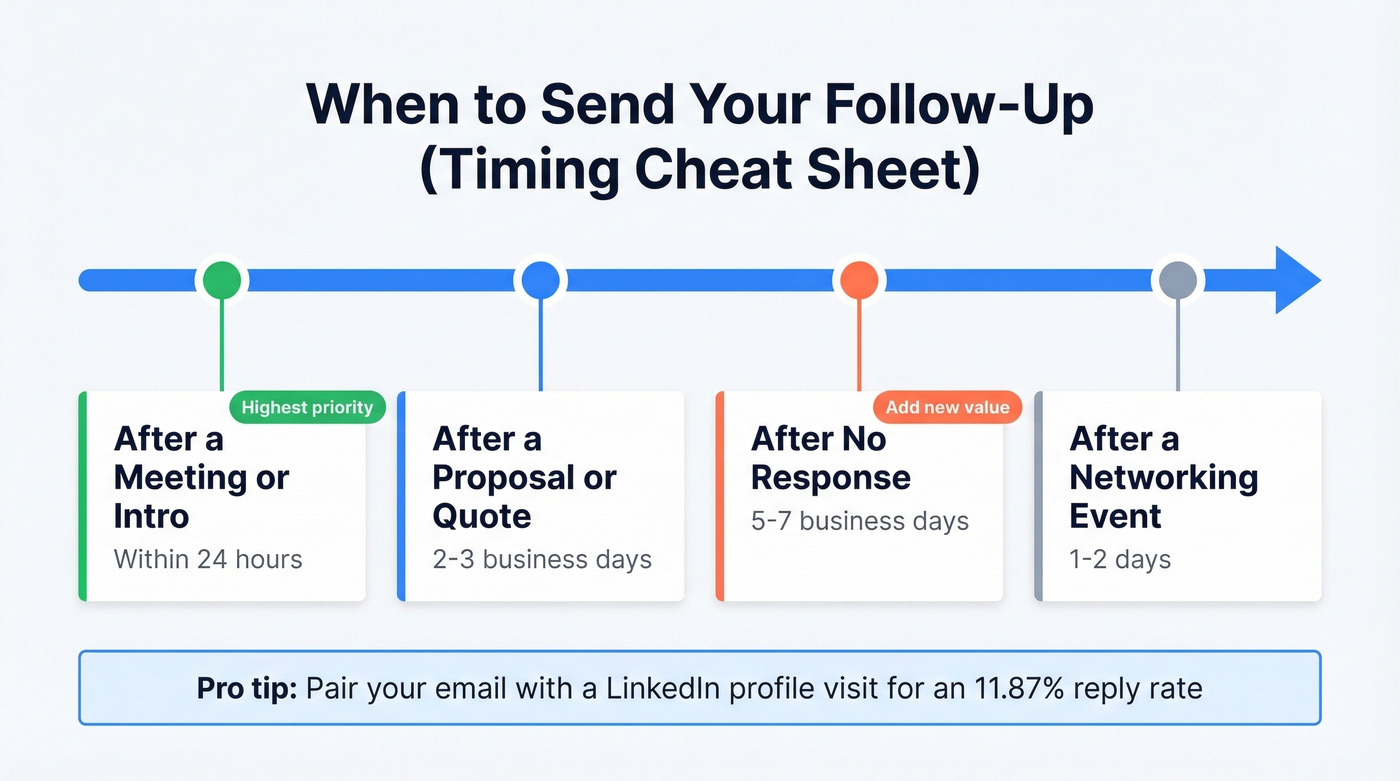
| Scenario | Send Within |
|---|---|
| After a meeting or intro | 24 hours |
| After a proposal or quote | 2-3 business days |
| After no response | 5-7 business days |
| After a networking event | 1-2 days |
If you want a more data-driven schedule, use this guide on the best time to send emails as a baseline.
One channel-mix note worth knowing: data from 16.5M emails shows that a LinkedIn message paired with a profile visit generates an 11.87% reply rate. If your email follow-up isn't getting traction, a quick LinkedIn touchpoint can break through.
Templates by Scenario
Sales / Prospect Meeting
Subject: Next steps - [Project Alpha] pilot
Hi Mark,
Appreciate the time today. The discussion around reducing your team's manual enrichment work hit on exactly the right problems.
| Action | Owner | By When | |---|---|---| | Send pilot scope doc | Me | Friday | | Confirm pilot team | Mark | Next Monday |
Can we reconnect [Thursday the 20th at 3 PM] to finalize?
If you’re building a repeatable outbound motion, these sales prospecting techniques pair well with post-meeting follow-ups.
Internal Team Meeting
Subject: Recap: Q1 planning sync
Team,
Thanks for a productive session. Key decisions: we're prioritizing the EMEA expansion and pausing the partner portal redesign until Q2.
Owners: Jamie owns the EMEA timeline (due Feb 3). Alex will draft the revised roadmap (due Feb 7). Next sync: Feb 10 at 10 AM.
Job Interview Thank-You
Here's your edge: 52% of U.S. candidates report being ghosted after an interview, and while 80% of employers say they value thank-you notes, only 24% of candidates actually send one. That gap is your opportunity.
Subject: Thank you - Product Manager conversation
Hi Dana,
Thank you for the conversation today. Your point about building the analytics layer before scaling the sales team really resonated - it's the same sequencing challenge I tackled at [previous company].
I'm excited about the role and happy to provide anything else you need. Looking forward to next steps.
Networking Event
Subject: Great meeting you at SaaStr
Hi Jordan,
Enjoyed our conversation about PLG pricing models - your approach to usage-based tiers was sharp. How's next Tuesday or Wednesday for coffee?
Client Check-In / Project Kickoff
Subject: Kickoff recap + a resource you'll like
Hi Team,
Great kickoff yesterday. Attached: the onboarding checklist we discussed plus a case study from a similar implementation. Next milestone: data migration review on Feb 5. Calendar invite incoming today.
What to Do When They Don't Reply
Silence doesn't always mean rejection. Sometimes it means a busy week. Sometimes it means your email landed in spam. Here's a 4-touch sequence that escalates without annoying:
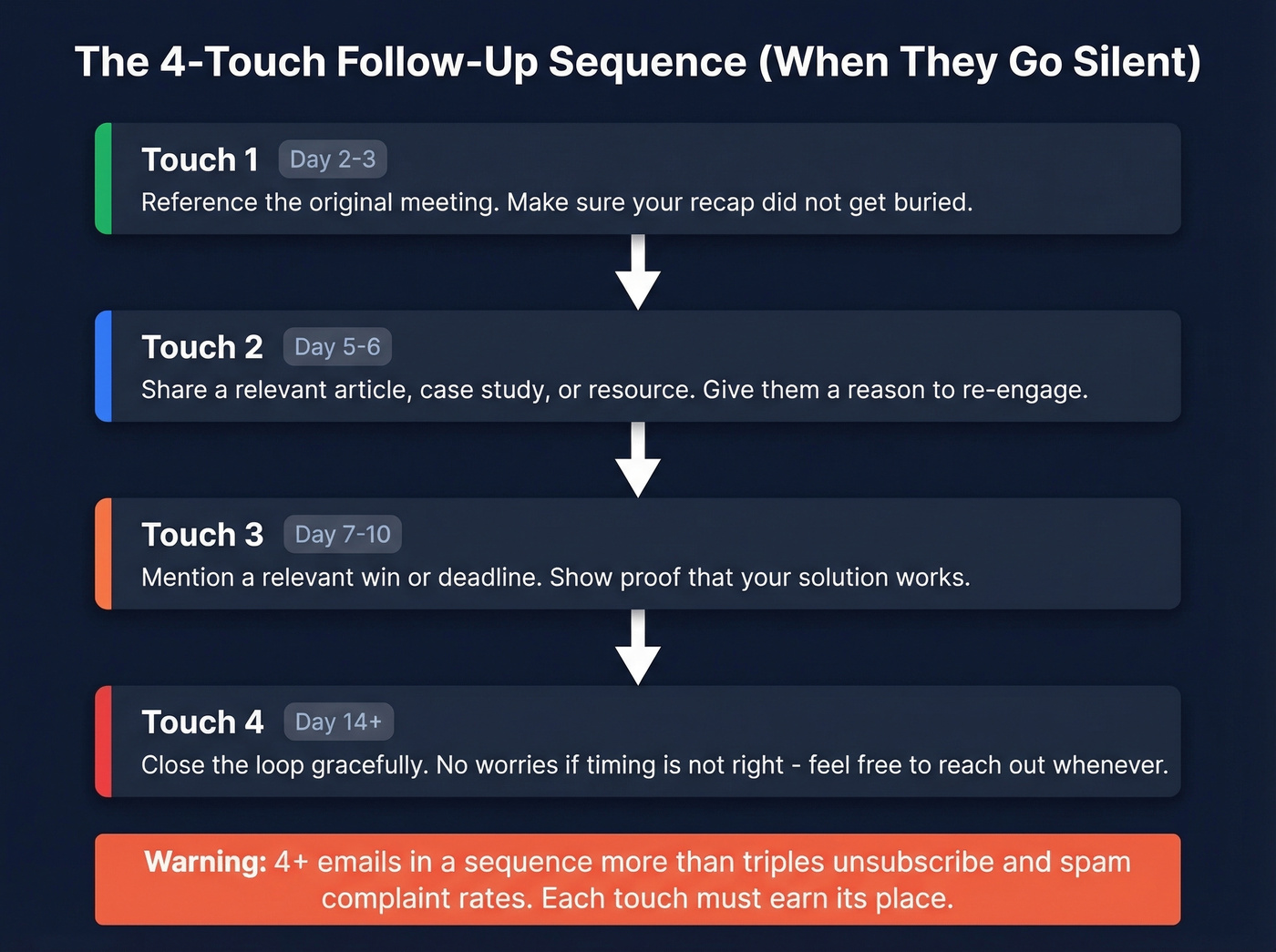
- Touch 1 (Day 2-3): Reference the original meeting. "Wanted to make sure this didn't get buried - here's the recap from Tuesday."
- Touch 2 (Day 5-6): Share a relevant article, case study, or resource. Don't just "check in" - give them a reason to re-engage.
- Touch 3 (Day 7-10): Mention a relevant win or deadline. "We just helped [similar company] cut their onboarding time by 40% - thought you'd want to see how."
- Touch 4 (Day 14+): Close the loop gracefully. "No worries if the timing isn't right. I'll close this out - feel free to reach out whenever it makes sense."
A warning: sending 4+ emails in a sequence more than triples unsubscribe and spam complaint rates. Each touch must earn its place by adding something new.
If you’re trying to improve outcomes, track your follow-up email reply rate and iterate on the touches that actually move deals forward.
Let's be honest - ask any sales engineer and they'll tell you the same thing: the follow-up that recaps specific decisions gets replies; the one that says "great meeting" gets archived.
Before assuming they're ignoring you, check whether your email actually landed. Run the contact through an email verification tool like Prospeo to confirm the address is valid - a bounced email looks identical to silence on your end.
If you’re troubleshooting bounces, start with email bounce rate benchmarks and the most common causes.
Five Mistakes That Kill Your Follow-Up
Buzzword subject lines. "Just touching base" and "circling back" tell the recipient nothing. Use a subject line that references the meeting topic or a specific next step.
If you need better phrasing, here are alternatives on how to say just checking in professionally.
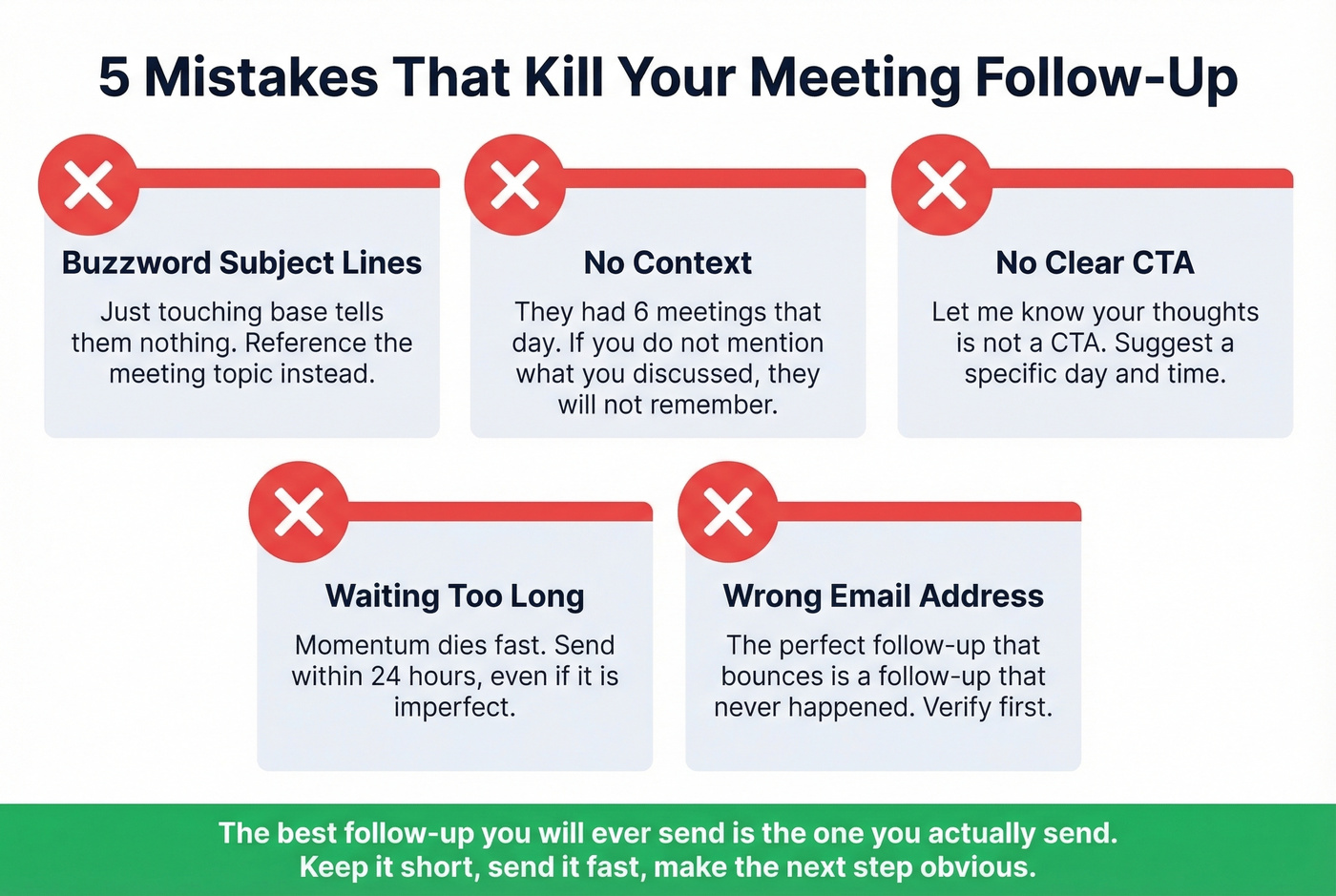
No context. Your recipient had six meetings that day. If your email doesn't mention what you discussed, they won't remember - and they won't reply.
No CTA. Every follow-up needs exactly one clear ask. "Let me know your thoughts" isn't a CTA. "Does Thursday at 2 PM work for a 15-minute check-in?" is.
If you want to tighten your ask, use these email call to action rules and examples.
Waiting too long. Momentum dies fast. After a meeting, send your follow-up within 24 hours - even if it's imperfect. I once lost a $30K deal because I waited until Monday to follow up on a Friday meeting. The prospect had already taken a call with a competitor over the weekend.
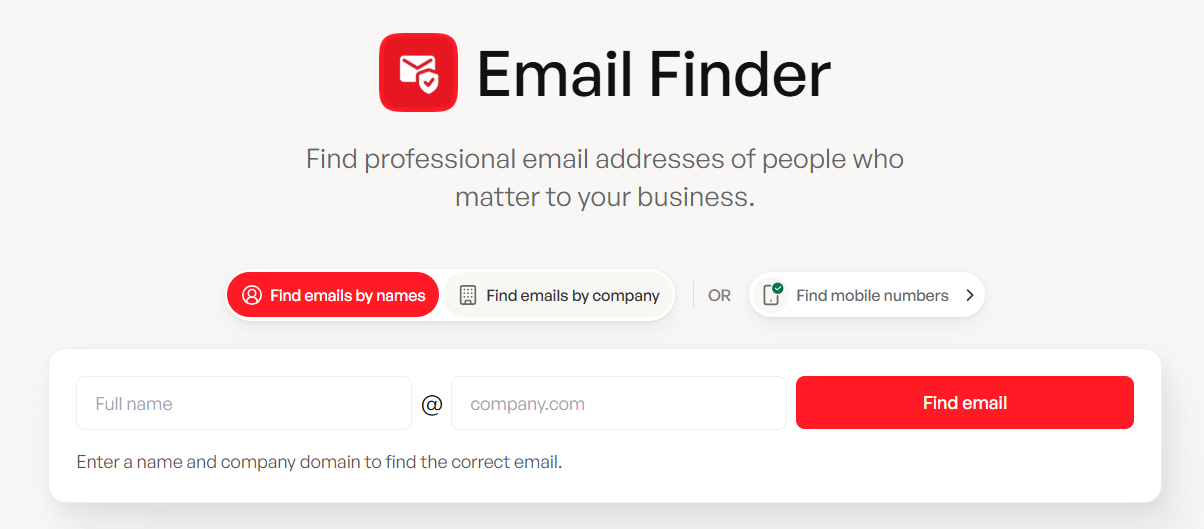
Sending to the wrong address. You wrote the perfect follow-up. It bounced. We've watched deals stall for weeks because someone had a typo in the email field. Before you send, verify the address - Prospeo's Email Finder checks against 300M+ professional profiles with 98% accuracy, and the free tier covers 75 lookups a month.
The best follow-up you'll ever send is the one you actually send. Keep it short, send it fast, and make the next step obvious - whether you're following up on our meeting from this morning or circling back after a week of silence. Everything else is optimization.
Hot take: If your average deal closes under five figures, you don't need a fancy follow-up sequence tool. A well-timed email with a clear action item will outperform any automated drip campaign. Save the automation budget for when you're sending hundreds of follow-ups a month.
If you do decide to tool up later, compare options in our guide to follow up email software.
You nailed the meeting. Now you need the direct email for every stakeholder in the room - not a generic info@ address. Prospeo's database covers 143M+ verified emails across 300M+ professionals, at roughly $0.01 per contact.
Find every decision-maker's real email before your follow-up goes cold.
FAQ
Is "following up on our meeting" professional phrasing?
Yes - it's standard business language appropriate for any professional context. Send within a few hours while context is fresh for the best results. Strong alternatives include "Recap from our meeting," "Next steps from [date]," or "Action items - [topic]." Keep subject lines under 7 words for peak open rates and under 33 characters for mobile.
How many follow-ups is too many?
Cap at three to four total touches. Data from 16.5M emails shows that four or more messages in a sequence more than triples unsubscribe and spam complaint rates. Each follow-up must add new value - a resource, an insight, a specific question. Never send "just checking in" as a standalone message.
What should I include in a post-meeting follow-up email?
Start with a genuine thank-you, recap key discussion points, list action items with owners and deadlines, and propose a specific date for the next check-in. If you're unsure about the recipient's address, paste a name and company domain into Prospeo's Email Finder to get a verified address in seconds. The free tier covers 75 lookups per month.
Should I follow up by email or phone?
Email first - it creates a written record of decisions and action items that both sides can reference. If two emails go unanswered after five to seven days, a brief phone call or LinkedIn message can break through. Pairing channels lifts reply rates to nearly 12%.