

"Following Up Regarding" - Is It Correct, and When Should You Use It?
You're staring at a draft email, cursor blinking after "I'm following up regarding..." and wondering if it sounds like a robot wrote it. The short answer: grammatically correct, professionally safe, and often too stiff for the situation.
Let's break down when to use it, when to swap it out, and how to write follow-ups that actually get replies.
"Following Up Regarding" vs. "Following Up On"
Both phrases are grammatically correct. The difference is register and economy.
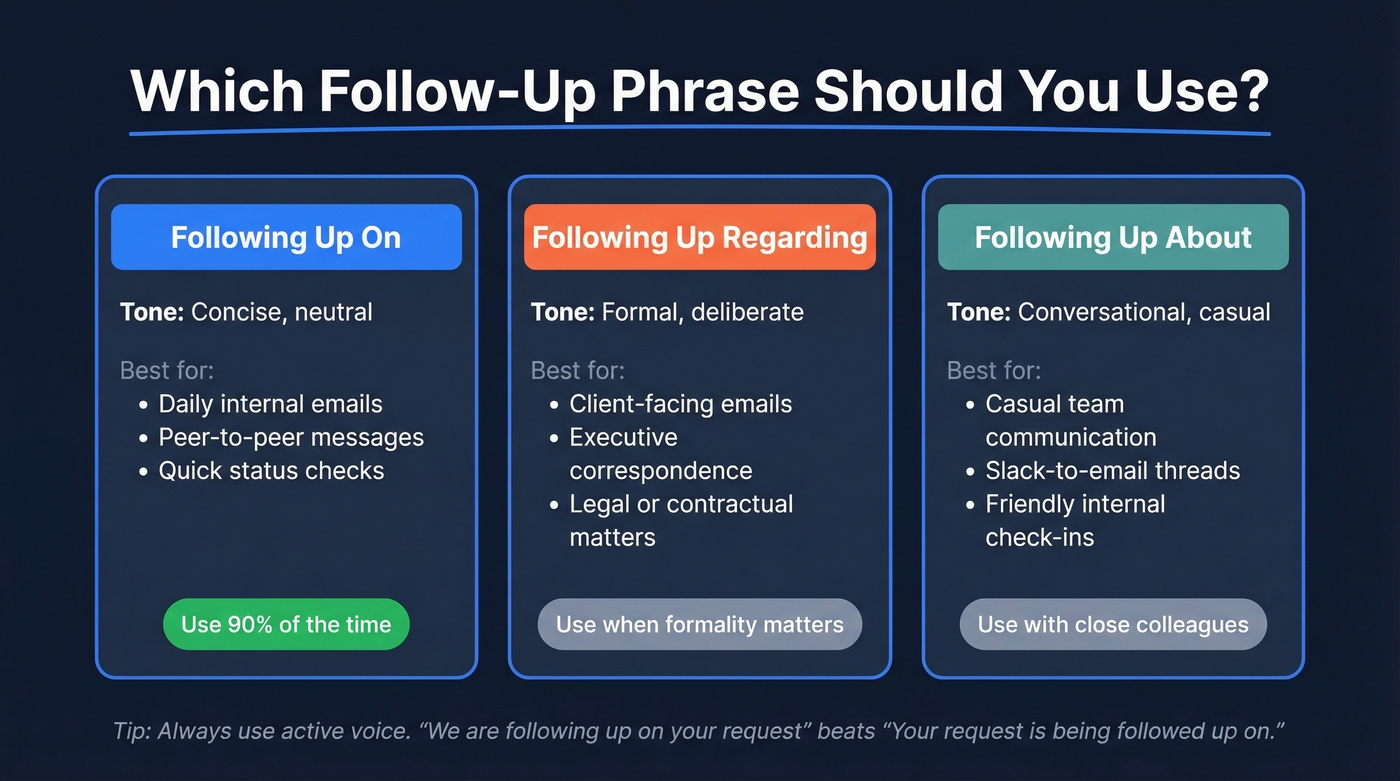
"Following up on" is more concise and far more common in everyday business email. The "regarding" version carries extra formal weight - it signals deliberateness, which works in client-facing communication, executive correspondence, or anything with a legal angle. We've sent thousands of outreach emails across our team, and "on" wins for speed and warmth in about 90% of situations.
Keep it active voice. "We're following up on your request" beats "Your request is being followed up on." The passive version sounds bureaucratic and buries the actor.
| Phrase | Best for | Tone |
|---|---|---|
| Following up on | Daily internal email | Concise, neutral |
| Following up regarding | Client/exec/legal | Formal, deliberate |
| Following up about | Casual teams, Slack-to-email | Conversational |
Use "regarding" when the formality serves a purpose. If you're emailing your teammate about a shared doc, "on" or "about" does the job fine.
Better Alternatives by Formality Level
Grammar isn't the issue with this phrase. Vagueness is. Saying "I'm following up regarding our conversation" tells the reader nothing they don't already know. The fix is specificity, not a different preposition.
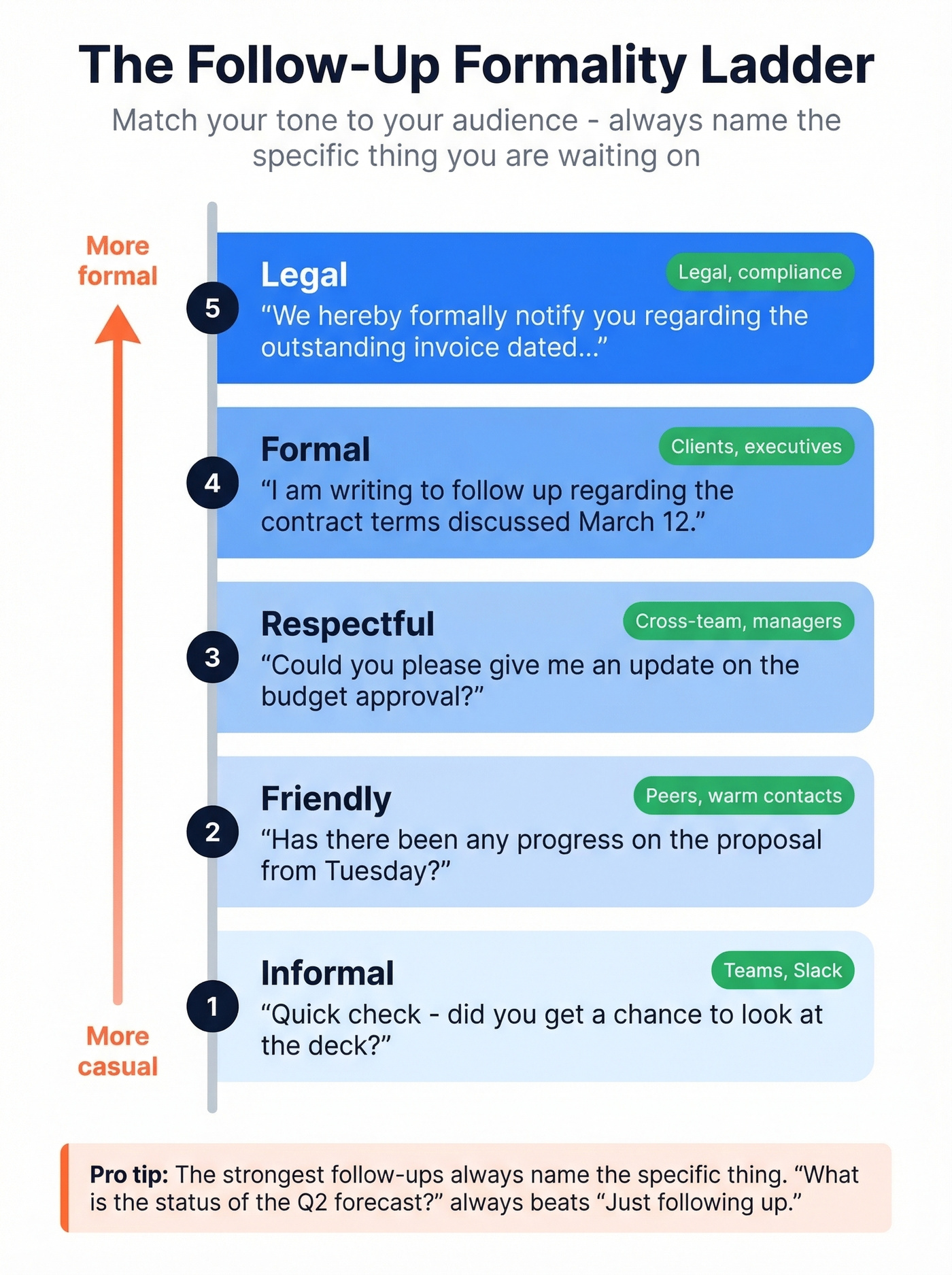
Here's the thing: the follow-ups that actually get replies always name the specific thing they're waiting on. Here's a formality ladder with openers that force you to do exactly that:
| Level | Example opener |
|---|---|
| Informal | "Quick check - did you get a chance to look at the deck?" |
| Friendly | "Has there been any progress on the proposal from Tuesday?" |
| Respectful | "Could you please give me an update on the budget approval?" |
| Formal | "I'm writing to follow up regarding the contract terms discussed March 12." |
| Legal | "We hereby formally notify you regarding the outstanding invoice dated..." |
American English tends toward directness ("Did you review this?"), while British English leans indirect ("I was wondering whether you might have had a chance to..."). Neither is wrong - match your audience.
Request-softening structures like "I'd appreciate an update on..." or "Could you please share the status of..." split the difference between pushy and passive, and they work especially well in cross-cultural teams where directness can land wrong.
The strongest alternatives force you to name the thing. "What's the status of the Q2 forecast?" is always better than "Just following up." As LanguageTool's analysis puts it, vague follow-ups produce vague responses.
Follow-Up Email Templates
None of these subject lines say "Following up." That's intentional - a subject line should preview value, not announce a reminder.
If you want more plug-and-play options, start with these sales follow-up templates and adapt the tone to your audience.
Post-meeting follow-up
Subject: Next steps from Thursday's call
Hi Sarah - thanks for the time Thursday. I wanted to confirm the two action items: I'll send the revised scope by Wednesday, and your team will share the integration requirements by Friday. Let me know if I'm missing anything.
Proposal / no-response follow-up
Subject: Thoughts on the proposal?
Hi Mark - I sent over the proposal last Tuesday and wanted to check if you've had a chance to review it. Happy to walk through the pricing section on a quick call. What does your Thursday look like?
Action-needed follow-up
Subject: Need your sign-off by Friday
Hi Priya - the vendor agreement is ready for your signature. We need it by Friday to keep the April 1 launch on track. I've attached the final version - let me know if anything needs adjusting.

You just crafted the perfect follow-up - specific, well-toned, value-packed. Now imagine it bouncing. 98% of emails verified through Prospeo reach real inboxes, with catch-all detection and spam-trap removal built in.
Fix your deliverability before you fix your phrasing.
Subject Lines That Get Opened
Your subject line matters more than your email body. A Belkins study of 5.5 million B2B emails found personalized subject lines hit a 46% open rate versus 35% without personalization. Question subject lines also hit 46%. The sweet spot for length? Two to four words - performance drops after seven.
For more ideas, pull from these email subject line examples or use a subject line tester before you send.
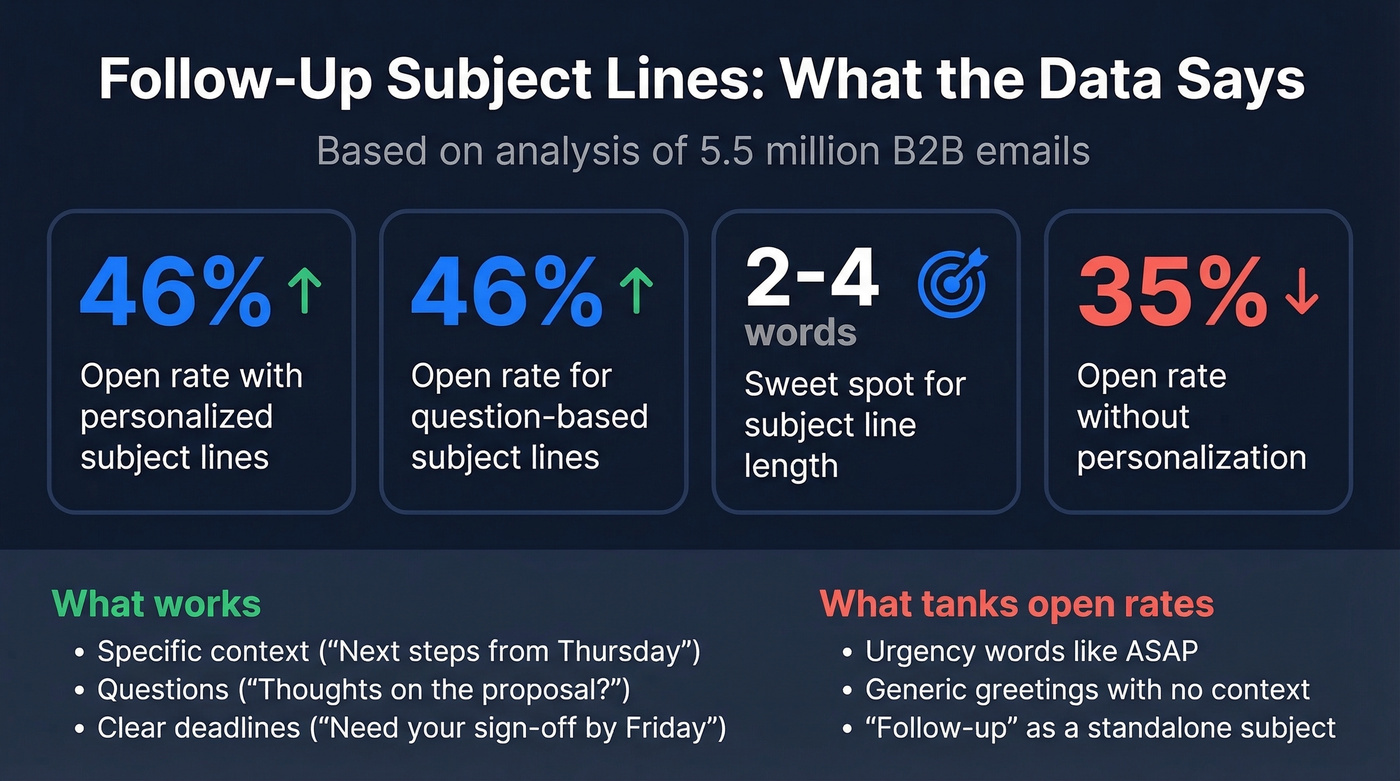
What tanks open rates: urgency words like "ASAP," generic greetings, and "Follow-up" as a standalone subject. Add context or add value.
When and How Often to Follow Up
Leads contacted within five minutes are 9x more likely to engage. For general business follow-ups, send two to three emails spaced seven to ten days apart, mid-morning in the recipient's time zone.
If you're building a sequence, this guide on when should I follow up on an email pairs well with a broader importance of follow-up in sales benchmark view.
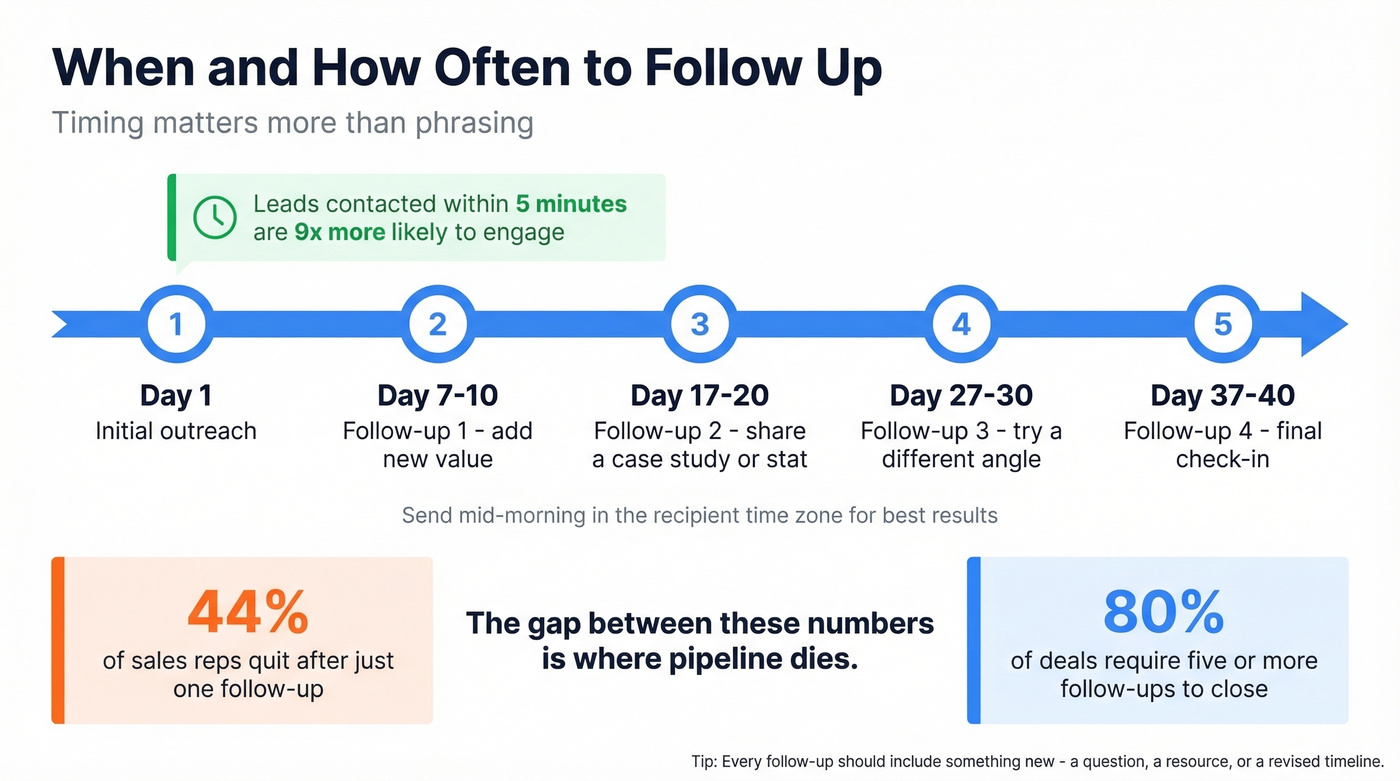
For sales, the numbers are stark. 80% of deals require five or more follow-ups, yet 44% of reps quit after one. That gap is where pipeline dies.
A reliable rule for replacing "just following up" is to lead with a specific question or a new piece of value. In our experience, even linking a relevant case study or industry stat gives the recipient a reason to respond beyond guilt.
Mistakes That Kill Your Follow-Up
Bumping without new information. "Just making sure you saw this" adds nothing. Every follow-up should include something new - a relevant article, a revised timeline, a specific question. If you have nothing new to say, you don't have a reason to send.
If you're not getting responses, it may be a messaging issue (see emails that get responses) or a process issue (see follow-up email reply rate).
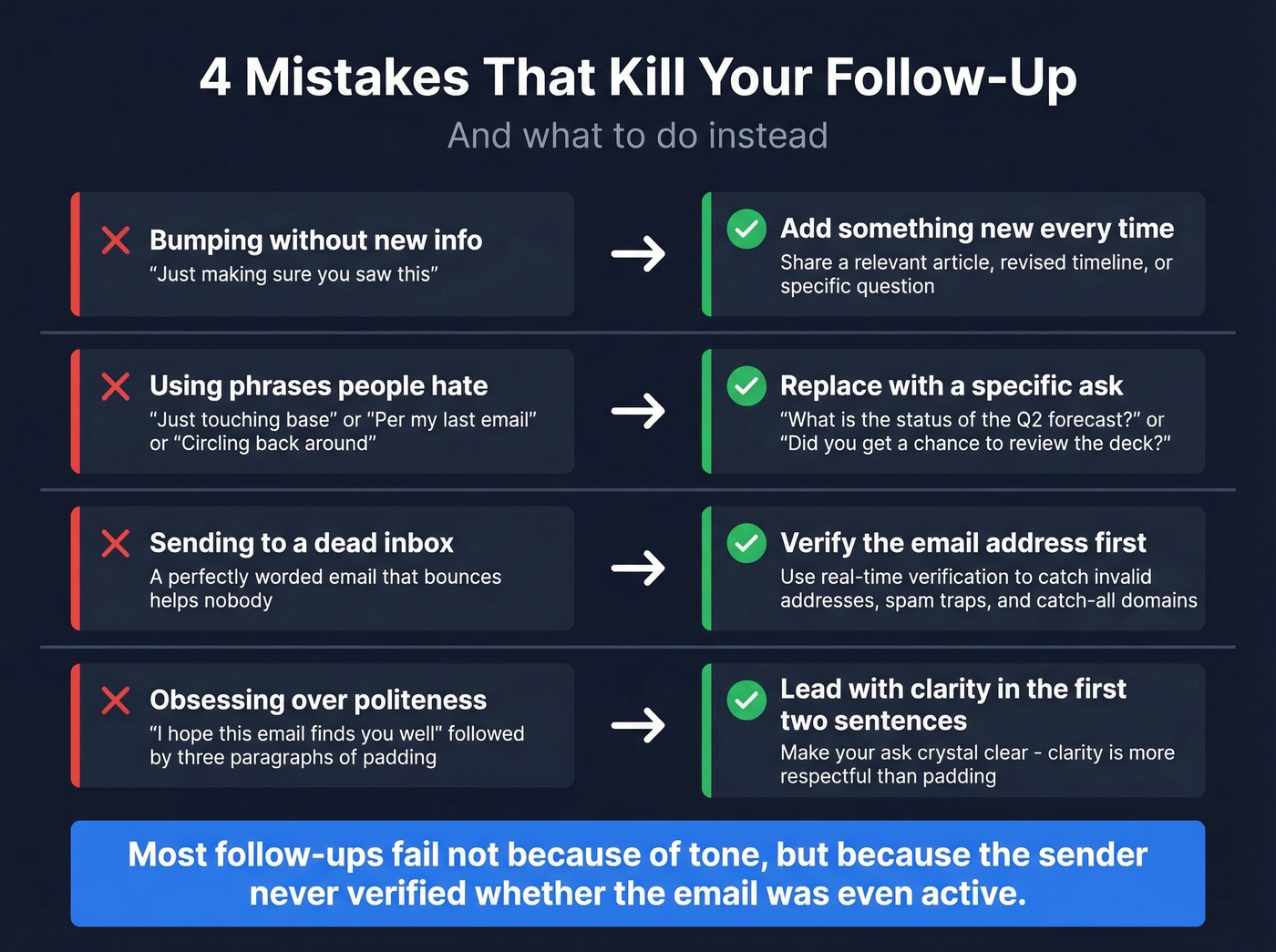
Using phrases that annoy people. "Just touching base," "per my last email," and "circling back around" are the follow-up phrases people hate most, according to a 2024 Preply survey. They signal box-checking, not value. Replace them with a specific ask.
If you need cleaner wording, borrow options from how to say just checking in professionally or use a more direct polite chaser email format.
Sending to a dead inbox. A perfectly worded email means nothing if it bounces. Before you agonize over phrasing, verify the address. Prospeo checks emails in real time with 98% accuracy and flags catch-all domains, spam traps, and invalid addresses before they tank your deliverability.
Obsessing over politeness instead of clarity. Stop wordsmithing "I hope this email finds you well." Make your ask crystal clear in the first two sentences. Clarity is more respectful than padding.
Look, most follow-ups fail not because of tone or phrasing, but because the sender never verified whether the recipient's email was even active. Fix the infrastructure before you fix the prose.
If deliverability is the bottleneck, start with an email deliverability guide and keep an eye on your email bounce rate.
80% of deals need five or more follow-ups, but none of them matter if you're emailing dead addresses. Prospeo verifies contacts in real time for ~$0.01 each - no contracts, no sales calls, 98% accuracy.
Stop following up with inboxes that don't exist.
FAQ
Is "following up regarding" too formal for most emails?
For most internal or peer-level email, yes - it sounds overly stiff. Default to "following up on" for everyday messages and save the "regarding" variant for client-facing, executive, or legal correspondence where deliberate formality adds credibility.
How many follow-ups should I send before giving up?
Two to three for general business requests. For sales outreach, send at least five. 80% of deals close after five or more touches, yet nearly half of reps stop after one attempt.
What's the single biggest follow-up mistake?
Sending to an address that doesn't work. You can craft the perfect email, nail the subject line, time it perfectly - and none of it matters if the mailbox is dead or full. Verify first, write second.