

The Best Free Email Address Search Tools in 2026
You send 500 cold emails on Monday. By Wednesday, 47 have bounced, your domain reputation's taken a hit, and deliverability is cratering for the rest of the week. That's not a hypothetical - it's what happens when you pick the wrong free email address search tool.
Nearly 28% of all emails checked are invalid or risky, per ZeroBounce data. Most tools claim 95%+ accuracy, but benchmarks tell a very different story. We cross-referenced three vendor-run benchmarks and Reddit user reports to build something more useful than the product pages that dominate this topic.
Our Picks (TL;DR)
| Pick | Best For | Free Tier | Why |
|---|---|---|---|
| Prospeo | Accuracy & freshness | 75 emails + 100 extension credits/mo | 98% email accuracy, 7-day data refresh |
| Hunter.io | Domain research | 50 searches/mo | Transparent confidence scoring, strong verification |
| Snov.io | All-in-one outreach | 50 credits/mo | Finder + sequences + warmup in one tool |
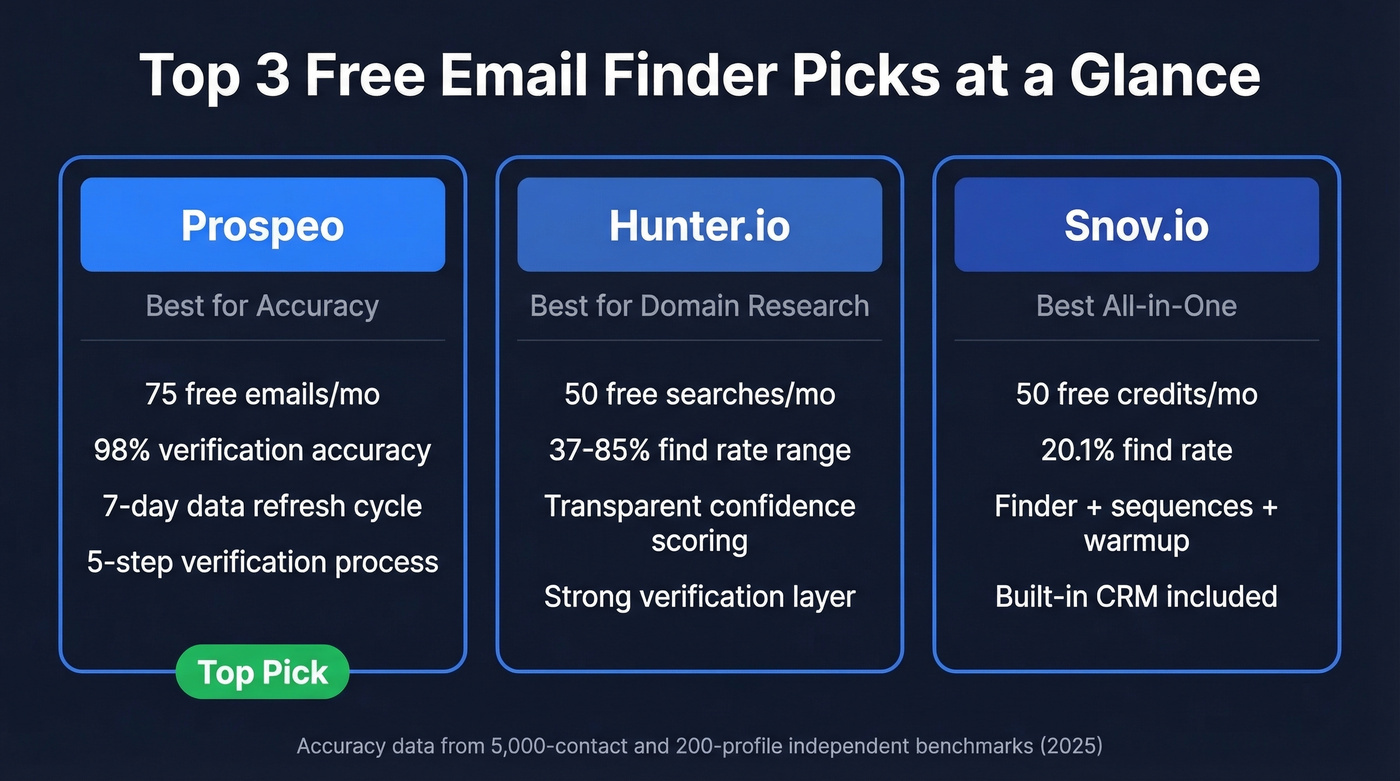
Prospeo wins on raw data quality - 98% verified emails with a 7-day refresh cycle that keeps contacts current. Hunter's the go-to if you already know the company domain and want verified results fast. Snov.io makes sense if you want finding and outreach in the same platform and don't want to stitch tools together.
10 Best Free Email Finder Tools
Prospeo
Prospeo's database covers 300M+ professional profiles with 143M+ verified emails, built from 800M+ collected records and run through a 5-step verification process that includes catch-all handling, spam-trap removal, and honeypot filtering. The result is 98% email accuracy - not a marketing claim, but what their proprietary infrastructure delivers in production. Data refreshes every 7 days, compared to the 6-week industry average, so you're not emailing people who changed jobs two months ago. If you want more options in this category, see our roundup of B2B email finder tools.
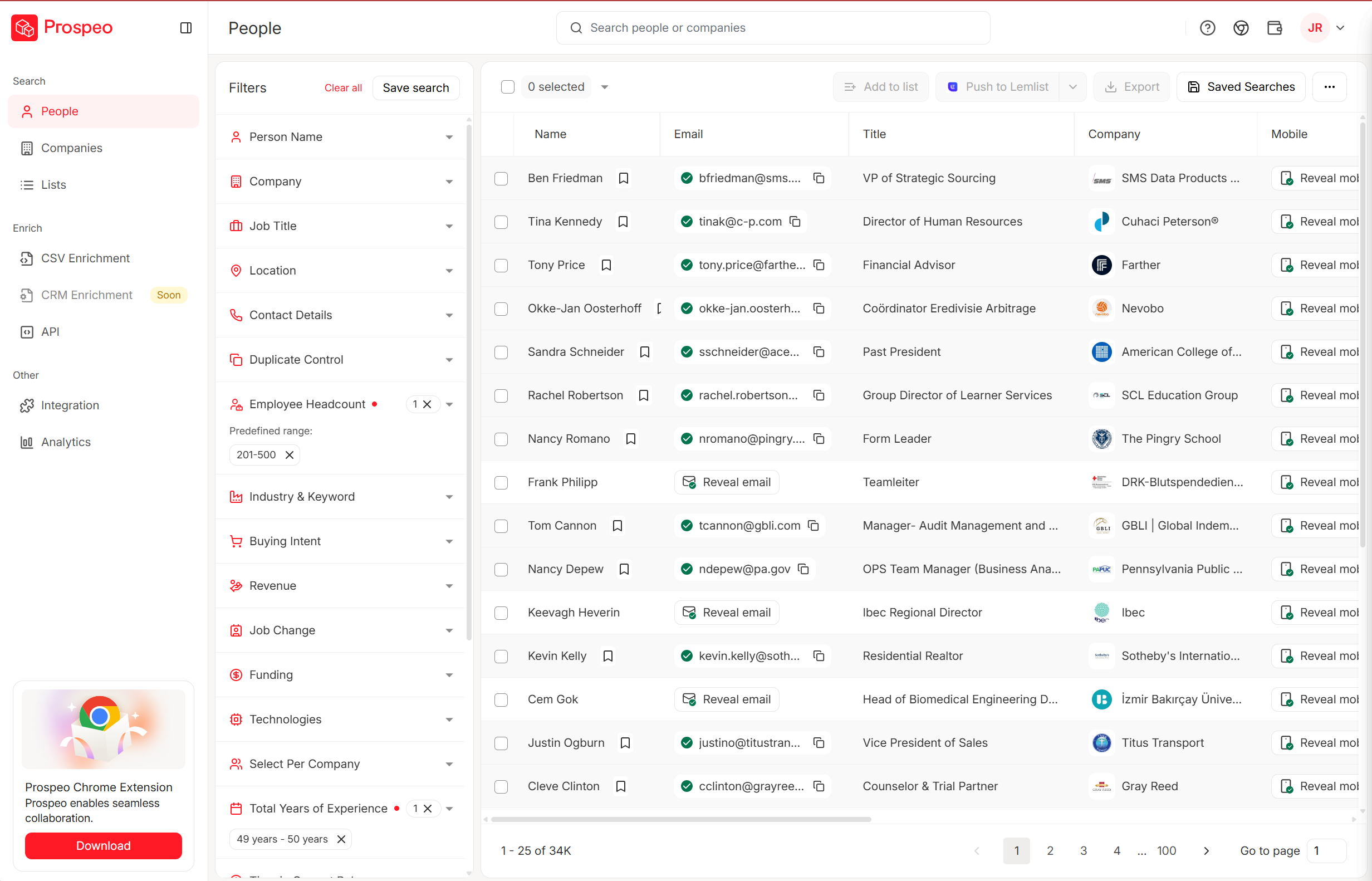
The free tier gives you 75 emails and 100 Chrome extension credits per month, no credit card required. Paid plans run about $0.01 per email with no contracts. The Chrome extension works across company websites and professional profiles (more picks in our email finder Chrome extensions guide), and integrates natively with Salesforce, HubSpot, Instantly, Lemlist, and Clay.
Real-world proof: one team at Meritt switching to Prospeo saw bounce rates drop from 35%+ to under 4%. That's the difference between a domain that's building reputation and one that's getting flagged. If you're troubleshooting bounces, start with a dedicated bounce checker.
Use it if: you need emails that actually deliver and you're tired of bounces killing your sequences. Skip it if: you only need domain-level research and don't care about a full database.
Hunter.io
Hunter built its reputation on domain search - type in a company domain, get every email pattern and address associated with it. The confidence scoring system is transparent in a way most tools aren't, showing you exactly why Hunter thinks an email is valid, risky, or unknown. For a deeper breakdown, see our Hunter.io use cases.

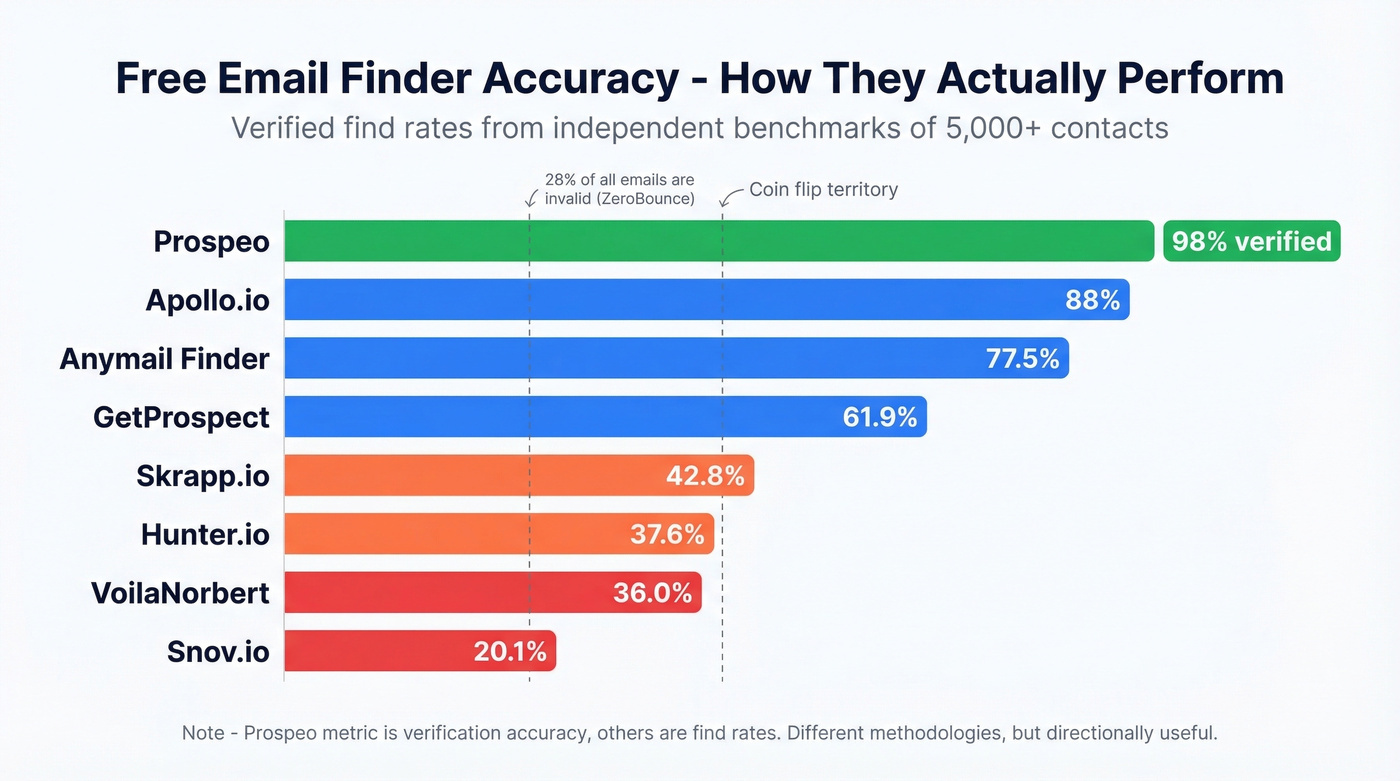
Free tier: 50 searches per month. Starter plans run $39/month for 1,000 requests. In a 5,000-contact benchmark run in late 2025, Hunter hit a 37.6% verified find rate. A separate 200-profile test was kinder - 85% valid. The gap between those numbers tells you something about how benchmarks work, but also about Hunter's sweet spot: it's better at verifying emails you already suspect exist than at finding new ones from scratch.
The consensus across Reddit's r/coldemail and r/agency communities mirrors this: "solid verification accuracy but database is pretty small... works better as a verification layer than a primary source."
Use it if: you know the company domain and want verified results with transparent confidence scores. Skip it if: you need a large-scale prospecting database to build lists from scratch.
Snov.io
Snov.io's pitch is consolidation - email finder, verification, drip campaigns, and CRM all in one platform. For solo founders or small teams who don't want to manage four different subscriptions, that's appealing.
Free tier: 50 credits per month. Starter plans begin at $39/month for 1,000 credits, with a 25% discount on annual billing. The Chrome extension works well, and the built-in email warmup feature is a nice touch that most standalone finders don't offer. If you're comparing verification layers, our email verification tool roundup can help.
Here's the thing, though: in the 5,000-contact benchmark, Snov.io posted a 20.1% verified rate. That's rough. The all-in-one convenience doesn't help much if only a fifth of your found emails are actually deliverable.
Use it if: you want finding + outreach in one tool and your volume is low enough that you can manually verify before sending. Skip it if: accuracy is your top priority.
Apollo.io
Reddit will tell you about Apollo before any benchmark does. "Data feels bad sometimes... lots of bounces on older contacts... pricing per seat gets expensive." We've heard variations of this from dozens of outbound teams. And yet Apollo's database is huge, and the filtering is powerful enough that people keep coming back.
Free tier available with basic filtering, Chrome extension access, and some mobile credits. Paid plans run $49-$119/user/month on annual billing. But the credit math is tricky: email credits are unlimited, while mobile numbers and exports are credit-gated separately. You can't reduce seats until the term ends, so if a rep leaves, you're still paying. (If you're evaluating it specifically for email data, see our Apollo email finder review.)
The 200-profile benchmark gave Apollo 88% valid - solid. But that test used fresh SaaS decision-maker profiles, which is Apollo's wheelhouse. At scale, with older contacts across diverse industries, accuracy drops noticeably. Apollo's great for discovery and filtering, but the data ages faster than you'd expect.
Use it if: you need volume and filtering power for list building. Skip it if: you're running cold email at scale and can't afford bounces tanking your domain.
GetProspect
GetProspect offers 50 free emails per month with a Chrome extension for profile-based prospecting. Starter plans start at $49/month for 1,000 emails. In the 5,000-contact benchmark, it posted a 61.9% verified rate - middling, but better than several bigger names. The interface is clean, the learning curve is minimal, and it does what it says without trying to be a platform.
Use it if: you want a straightforward Chrome-based finder at a reasonable price. Skip it if: you need top-tier accuracy or a deep database.
Anymail Finder
Anymail Finder's billing model is its biggest differentiator: you only pay for valid results. Catch-all and unverifiable emails don't cost you a credit. That's fair in a market where most tools charge you whether the email works or not. For a deeper dive, see our Anymail Finder review.
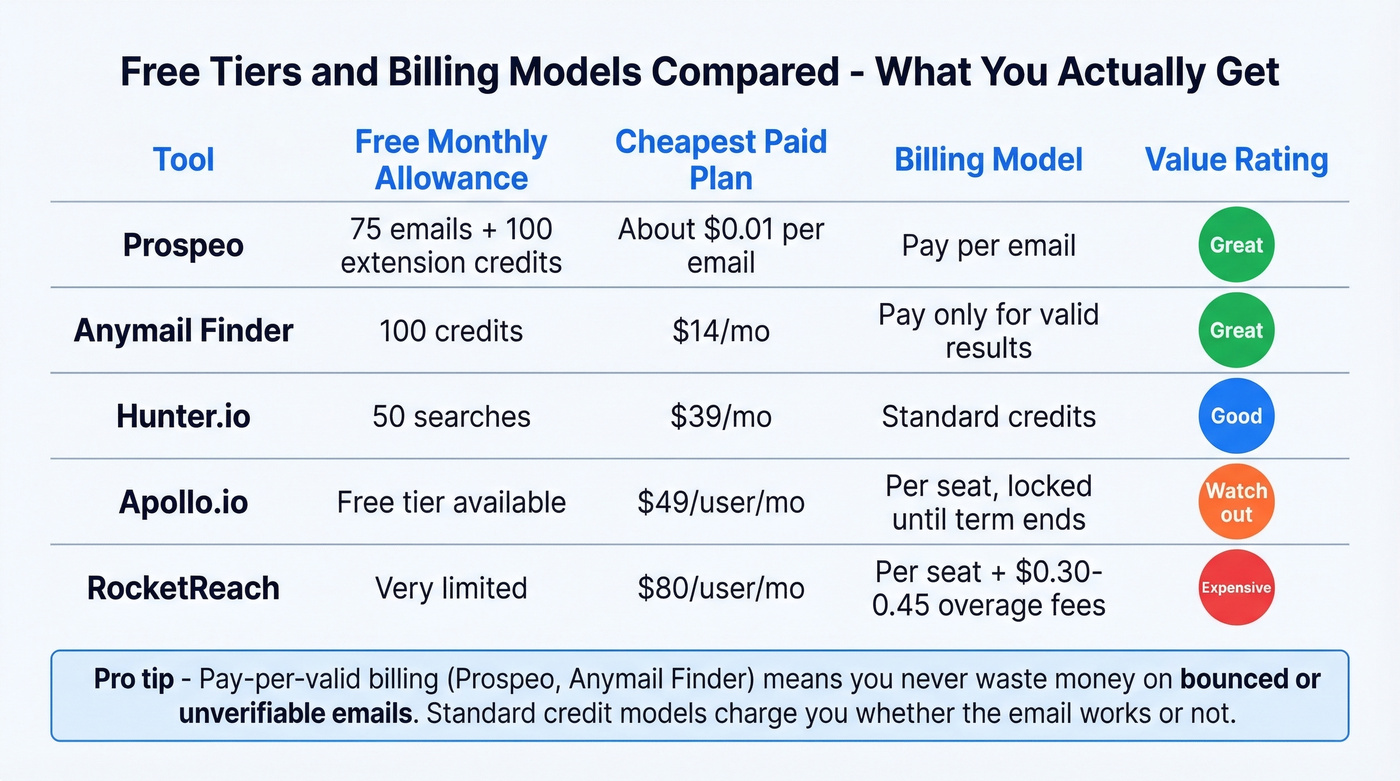
Free tier: 100 credits. Paid plans start at just $14/month. In their own benchmark (which, yes, they ran), Anymail Finder hit 77.5% verified - the highest find rate among all tested tools. Even accounting for home-court advantage, the pay-per-valid model means your effective cost per usable email is lower than tools with higher sticker prices.
Use it if: you want the fairest billing model and a solid budget option. Skip it if: you need a massive database or built-in outreach features.
Lusha
Lusha's free tier gives you 70 credits per month - but the credit math matters. One credit reveals an email. Ten credits reveal a phone number. So that "70 credits" is really 7 phone numbers or 70 emails, not both. Unused credits roll over up to 2x your monthly limit on paid plans.
Lusha's real strength is phone numbers alongside emails. If your outbound motion involves cold calling, not just email, Lusha's a stronger pick than pure email finders. For email-only workflows, you'll get more value elsewhere.
Use it if: you need direct dials alongside emails. Skip it if: you're purely an email-first team.
RocketReach
RocketReach is enterprise-grade pricing for what's essentially a lookup tool. Individual plans run $80-$300/user/month. Team plans start at $83/user/month on annual billing. Overages cost $0.30-$0.45 per additional lookup. There's no meaningful free tier for sustained use.
The data quality is decent, and the coverage across industries is broad. But at these prices, you're competing with Apollo and even ZoomInfo territory without getting the workflow features those platforms include.
Use it if: your company's already paying and you need broad industry coverage. Skip it if: you're budget-conscious or need more than 125 lookups a month without paying $150+.
Skrapp.io
Credit-based finder that charges only for Valid and Catch-All results - you aren't charged for Invalid or Unknown. Free credits are available, with paid plans starting around $30/month. The 5,000-contact benchmark returned a 42.8% verified rate. Decent for quick one-off prospecting, but accuracy lags behind the leaders significantly.
Use it if: you need a cheap, no-frills finder for occasional lookups. Skip it if: you're running sequences where bounces matter.
VoilaNorbert
50 free searches to start. Valet plan runs $49/month for 1,000 leads. The 5,000-contact benchmark returned a 36.0% verified rate. Clean interface, but the data quality doesn't justify the price when Anymail Finder costs $14/month and outperforms it by 40+ points.
Skip this one unless you've burned through free tiers everywhere else and need a quick backup. There are better options at every price point.
Free Tier Comparison Table
One important note before you scan this: the "Accuracy" column mixes two different metrics. Find rate measures how many emails a tool returns from a test set. Verification accuracy measures how many of those returned emails are actually deliverable. A tool can find fewer emails but have nearly zero bounces on the ones it does find - and for cold outreach, that's usually the better outcome. If you need to validate at scale, consider an email list cleaning service.
| Tool | Free/Mo | Paid From | Accuracy Metric | Key Note |
|---|---|---|---|---|
| Prospeo | 75 emails + 100 ext | ~$0.01/email | 98% verification accuracy | Precision-first approach |
| Hunter.io | 50 searches | $39/mo | 37.6-85% find rate* | Best for domain search |
| Snov.io | 50 credits | $39/mo | 20.1% find rate | All-in-one convenience |
| Apollo.io | Free tier avail. | $49/user/mo | 88% find rate* | Seat lock-in |
| GetProspect | 50 emails | $49/mo | 61.9% find rate | Clean, simple UI |
| Anymail Finder | 100 credits | $14/mo | 77.5% find rate | Pay-per-valid billing |
| Lusha | 70 credits | ~$50/user/mo | Not benchmarked | 10 credits per phone |
| RocketReach | Limited | $80/user/mo | Not benchmarked | Expensive overages |
| Skrapp.io | Free credits | ~$30/mo | 42.8% find rate | Accuracy gaps |
| VoilaNorbert | 50 searches | $49/mo | 36.0% find rate | Poor value |
*Range reflects different benchmark methodologies and test set sizes.

The benchmarks above show most free email finders top out at 60-77% accuracy. Prospeo hits 98% with a 5-step verification process that catches spam traps, honeypots, and catch-all domains before they torch your sender reputation.
Get 75 free verified emails per month - no credit card, no bounces.
What Accuracy Tests Actually Show
Most email finders claim 95%+ accuracy. Three independent-ish benchmarks paint a more honest picture, and we triangulated across all three to find the patterns that hold up.
The Dropcontact benchmark tested 15 tools against 20,000 real contacts - 9,800 US, 9,700 Europe, 500 rest of world. The methodology was unusually rigorous: they sent a real email to every found address and measured hard bounces, not just SMTP pings. Top performers by "real enrichment rate" were Dropcontact at 54.9% with a 0.9% hard bounce rate, Enrow at 40.9% with 2.3% bounce, and Findymail at 39.9% with 1.1% bounce. Most tools clustered well below 50%.
The September 2025 benchmark re-ran on 5,000 fresh contacts. Find rates ranged from 77.5% down to 16.9%. But find rate and verification accuracy are fundamentally different metrics. A tool that returns 1,000 emails with 40% accuracy gives you 400 usable contacts and 600 bounces damaging your domain. A tool that returns 300 emails at 98% accuracy gives you 294 usable contacts and almost no domain damage. For cold outreach, the second scenario is almost always better. If you want to go deeper on methodology, see our guide to email address verification.

The ContactOut test used 200 SaaS decision-maker profiles and found Apollo at 88%, Cognism at 86%, Hunter at 85%, and Instantly at 82%.
Let's be honest about something: every benchmark is vendor-funded. Dropcontact ran theirs. Anymail Finder ran theirs. ContactOut ran theirs. Each one ranked themselves near the top. The consistent finding across all three is that most tools land somewhere around 20-80% find rates in practice, not the 95%+ they advertise. And find rate alone doesn't tell you whether those emails will actually land in an inbox.
Our take: If your average deal size is under five figures, you probably don't need a massive database. You need a small, accurate one. A 500-person list with 98% deliverability will outperform a 5,000-person list at 40% accuracy every single time - and it won't torch your sender reputation in the process. If you're building lists in bulk, compare bulk email finder options.
Bounce rates above 4% destroy domain reputation fast. Prospeo's 7-day data refresh means you're never emailing stale contacts - one team cut bounces from 35% to under 4% after switching. At $0.01 per email, it costs less than the damage one bad list does.
Stop paying for emails that bounce. Search 143M+ verified addresses now.
How Email Finders Work
Pattern Generation + SMTP Verification
Most email finders start with pattern matching. Hunter's analysis of 12M+ email addresses found that 49.9% of companies use the {first}@domain format. Tools generate permutations - {first}.{last}, {f}{last}, {first}{l} - then verify each one via SMTP handshake, essentially asking the mail server "does this mailbox exist?" without actually sending an email. If you want the technical breakdown, see our SMTP check guide.
The limitation: only 18.7% of company websites mention at least one email address, based on Hunter's analysis of roughly 905,000 sites. So pattern generation and SMTP verification do most of the heavy lifting for the other 81%.
Catch-All Domains
Catch-all domains accept emails sent to any address at that domain. Send to made-up-name@company.com and it won't bounce - it just lands in a general inbox or gets silently discarded. This makes mailbox-level verification impossible through standard SMTP checks.
The practical impact is significant. Many enterprise companies - including Fortune 500s - run catch-all configurations. Tools that mark catch-all as "risky" and discard those results are effectively removing your highest-value targets. Tools with dedicated catch-all handling maintain accuracy against enterprise domains that trip up standard SMTP checks.
Verification Statuses
When a tool returns results, you'll see three main statuses. Valid means the mailbox is confirmed deliverable - safe to email. Risky typically means catch-all or graylisting, where the server temporarily rejected the verification attempt. Unknown means the server didn't respond at all. For cold outreach, send to Valid addresses confidently, approach Risky with caution at volume, and skip Unknown entirely.
How to Find an Email Address for Free (No Tool Required)
You don't always need a paid tool. We've used all four of these methods on real campaigns, and they still work in 2026. For more step-by-step tactics, see our guide on how to find email addresses for free.
Google search operators are underrated. Try site:company.com "email" or "@company.com" + "VP Sales". You'd be surprised how many contact pages, press releases, and PDF documents surface with real email addresses - this works especially well for smaller companies that haven't locked down their web presence.
Company website team pages are the most obvious source and still worth checking. About 18.7% of company websites mention at least one email address. Look at the team page, press page, and footer. Smaller companies are far more likely to publish them than enterprises.
Email permutation with a free SMTP check is manual but effective for one-off research. Guess the format ({first}.{last}@domain.com is the safest bet), then use a free SMTP verification tool to check if the mailbox exists.
Connection exports from professional networking platforms round out the free toolkit. If you're already connected with someone, most platforms let you export your connections as a CSV that includes email addresses where available. It's limited to your existing network, but the data's usually current.
FAQ
What's the best free email address search tool in 2026?
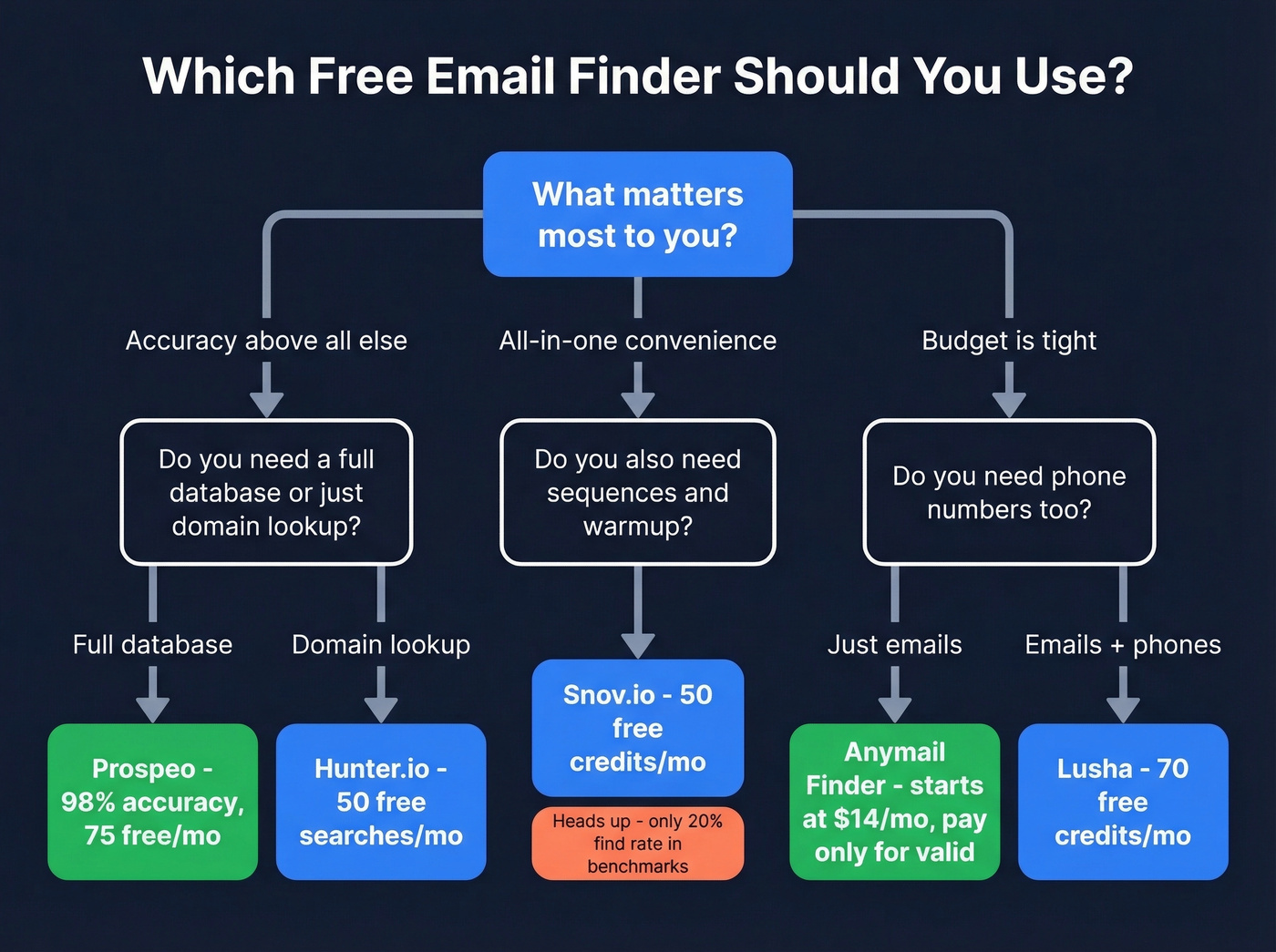
Prospeo offers the strongest combination of accuracy and free credits - 75 emails plus 100 Chrome extension credits per month with 98% verified email accuracy. For domain-specific research, Hunter.io's 50 free monthly searches are hard to beat. For all-in-one outreach, Snov.io bundles finding and sequences in one free tier.
Is it legal to search for someone's email address?
Yes. Finding publicly available business emails is legal in most jurisdictions. GDPR-compliant tools only surface professional emails from vetted sources and honor opt-out requests globally. You're on solid ground as long as you're using the emails for legitimate business outreach and respecting unsubscribe requests.
How accurate are free email finder tools?
Benchmarks show find rates ranging from 16% to 78% across popular tools, depending on the dataset and methodology. Self-reported "95% accuracy" claims rarely hold up under real-world testing. The key distinction is between find rate and verification accuracy. Prioritize tools with real-time verification and low bounce guarantees.
What is a catch-all domain?
A catch-all domain accepts emails sent to any address at that domain, making it impossible to verify whether a specific mailbox exists through standard SMTP checks. Many enterprise companies use catch-all configurations, which is why some tools show "risky" for contacts at large organizations - and why dedicated catch-all handling is a meaningful differentiator.
How many free credits do email finders offer?
Most tools offer 50-100 free lookups per month. Prospeo gives 75 emails plus 100 Chrome extension credits. Hunter and Snov.io each offer 50. Lusha offers 70 credits, but phone lookups cost 10 credits each, so the effective number depends on your mix of emails vs. phone numbers.
Most teams overthink tool selection and underthink data quality. Pick a free email address search tool that prioritizes deliverability over volume, verify before you send, and protect your domain reputation above all else. Everything else is optimization.