

What Does "Gentle Follow Up" Really Mean (and When Does It Backfire)?
You're hovering over the send button, rereading your email for the fourth time, wondering if "gentle follow up" sounds professional or passive-aggressive. You're not alone. The phrase carries more weight than most people realize, and it doesn't always land the way you intend. Here's what it actually signals, when it works, and when it quietly sabotages your message.
What a Gentle Follow Up Actually Signals
A gentle follow up is a low-pressure message sent after an initial email goes unanswered, designed to prompt a response without creating urgency or tension. It signals that you respect the recipient's time while still needing something from them.
That's the textbook version. How it's received depends entirely on context.
A gentle follow up sits between a standard follow-up - neutral, task-focused - and a firm follow-up that's deadline-driven and direct. It's the one you send when the relationship matters more than the timeline: a first nudge to a prospect, a check-in after a job interview, a reminder to a colleague who's probably just buried in their own inbox avalanche.
Quick grammar note: "follow up" written as two words is the verb - "I'll follow up tomorrow." "Follow-up" with a hyphen is the noun or adjective - "Send a follow-up email." Both show up in subject lines, and both are correct in context.
If you want a deeper timing breakdown beyond "it depends," see when to follow up.
The Short Version
- Definition: A polite, low-pressure message asking for a response without creating urgency. Relationship over deadline.
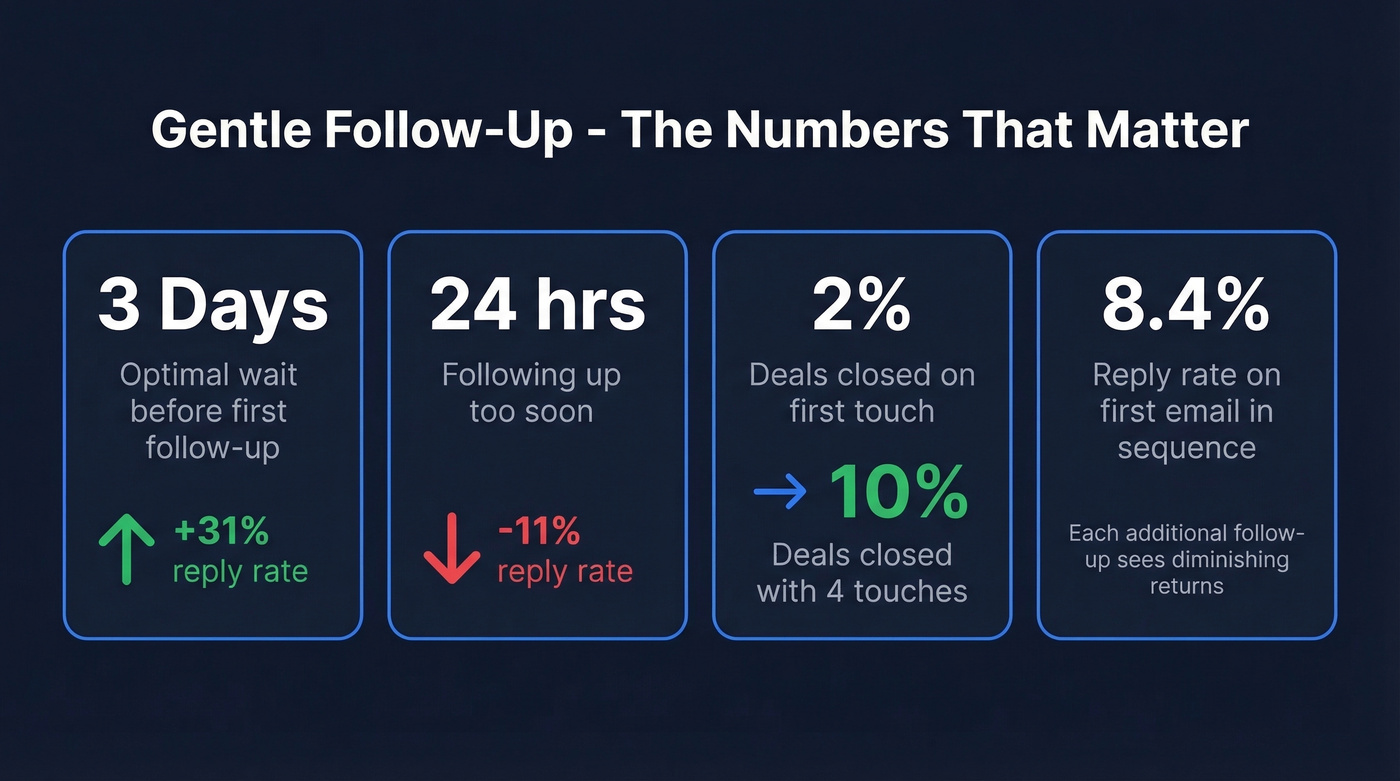
- Timing rule that matters most: Wait 3 days. The 3-day mark yields a ~31% increase in replies. Following up within 24 hours of the initial email hurts your chances by ~11%.
- Biggest mistake: Using "just" ("I just wanted to follow up..."). It signals that what you're asking isn't important. (If you catch yourself writing it, use these alternatives to "just checking in".)
- The reframe: "Gentle" isn't about soft words. It's about clear, respectful communication. Clarity beats cushioning every time.
When It Works - and When It Backfires
Here's the thing: the word "gentle" in a follow-up is doing more psychological work than most people realize. It's supposed to soften the ask. But it can paradoxically draw attention to the fact that you're annoyed enough to need a softener.
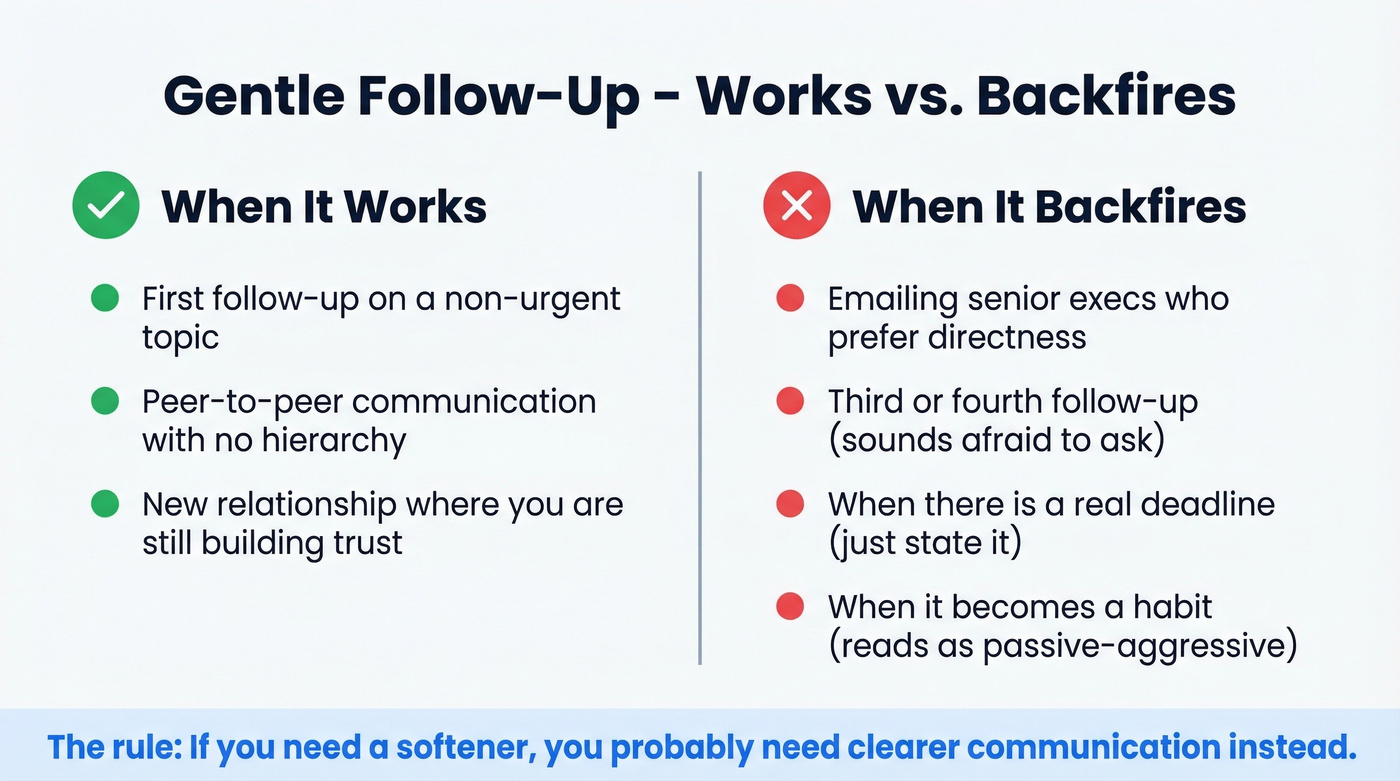
One Reddit user described their boss starting almost every email with "a gentle reminder" - and it felt "ominously less gentle" than a normal reminder. When the phrase becomes a habit, it stops being polite and starts being corporate code for "I'm frustrated you haven't done this yet." English learners explicitly worry that "just a gentle reminder" sounds passive-aggressive, and they're picking up on something native speakers often miss.
The phrase also lands differently across workplaces and communication norms. In some teams it reads as polite; in others it reads as a veiled threat wrapped in a smile.
Then there's the "kindly" trap. Adding "kindly" to a follow-up reads as condescending in many English-speaking business contexts. It sounds like you're instructing the recipient rather than asking them.
So when does "gentle" actually work? Three scenarios: your first follow-up on a non-urgent topic, peer-to-peer communication where hierarchy isn't a factor, and situations where the relationship is new and you're still building trust. Outside those, direct is almost always better. If there's a deadline, say so. If you're emailing senior execs, skip the cushioning - they don't have time to decode your tone. And by the third follow-up, "gentle" just sounds like you're afraid to ask for what you need.
If you need ready-to-send examples, use these sales follow-up templates or the more specific cold email follow-up templates.
When to Send One
Timing matters more than wording. A perfectly written polite follow-up sent too early feels pushy. Sent too late, and the conversation's gone cold.
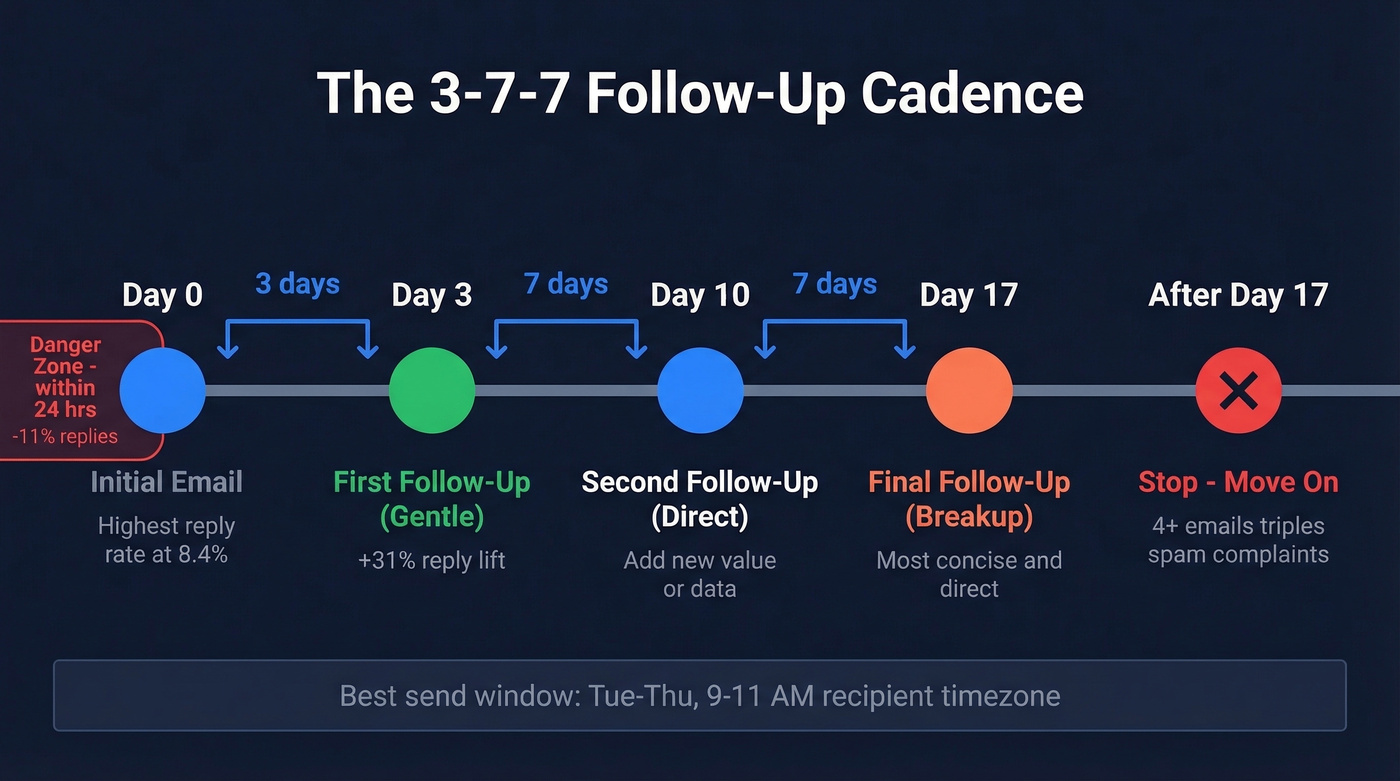
The data points to a 3-7-7 cadence as the sweet spot for most scenarios: first follow-up at day 3, second at day 10, third at day 17. That initial 3-day gap is critical - it produces a ~31% lift in reply rates. Following up within 24 hours of the initial email drops your chances by about 11%. People need time to process, prioritize, and respond.
Here's a stat that should settle any debate about whether follow-ups are worth the effort: only about 2% of deals close on the first touch. With four touches, that number jumps to 10%. Follow-ups aren't optional - they're where the results live. (More context: importance of follow-up in sales.)
A Belkins study of 16.5 million cold emails found that the first email in a sequence gets the highest reply rate at 8.4%, with each additional follow-up seeing diminishing returns. That doesn't mean you shouldn't follow up - it means every follow-up needs to earn its place by adding something new. If you're benchmarking your own performance, compare against typical follow-up email reply rate ranges.
For send timing, Tuesday through Thursday between 9-11 AM in the recipient's timezone performs best for many outreach sequences. (If you want the data and caveats, see best time to send cold emails.) Avoid Monday mornings when inboxes are in triage mode and Friday afternoons when people are mentally checked out.
| Scenario | Wait Before Follow-Up | Subject Line Example |
|---|---|---|
| Job application | 3-5 days | "Checking in on [Role]" |
| After a meeting | 1-2 days | "Great talking - one question" |
| Sales proposal | 3 days | "Thoughts on the proposal?" |
| Invoice/payment | 1-2 weeks before due | "Upcoming invoice reminder" |

A perfectly timed gentle follow-up means nothing if it bounces. Prospeo's 98% email accuracy and 7-day data refresh ensure every follow-up lands in a real inbox - not a dead end. Stop crafting the perfect message for the wrong address.
Find verified emails for $0.01 each. Pay only for valid addresses.
How to Write One That Gets a Reply
Every effective follow-up email follows the same skeleton: subject line, brief opening, context, specific ask, close. Miss any piece and you're adding noise to someone's inbox. (If you want to tighten the whole message, start with these email copywriting fundamentals.)
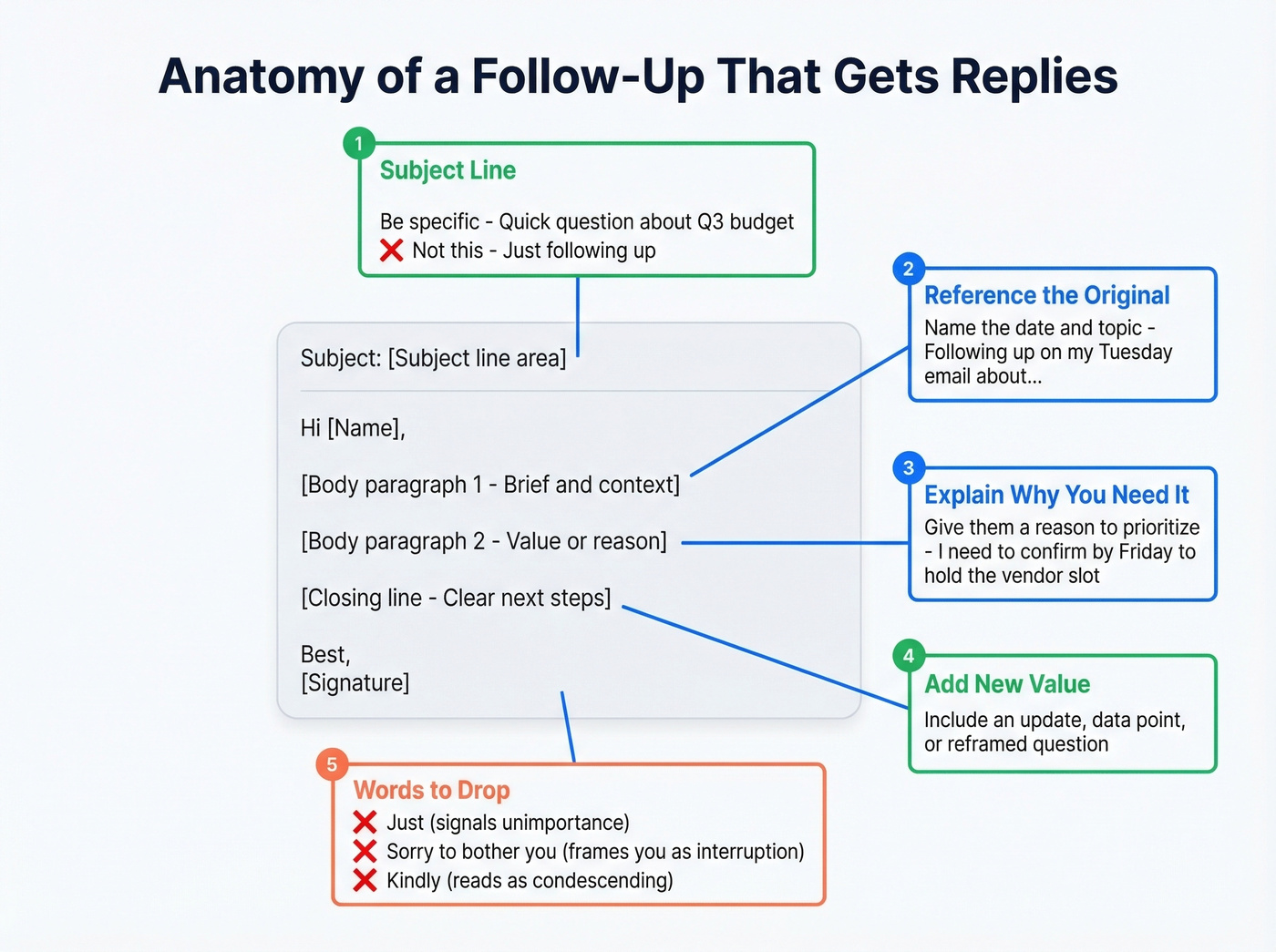
Reference your original email and its date. "Following up on my email from Tuesday about the Q3 budget review" gives instant context. Don't make them dig.
Explain why you need the response. Not "just checking in" - instead, "I need to confirm the timeline by Friday so we can hold the vendor slot." Specificity respects their time because it lets them prioritize accurately.
Drop "just." Every time you write "I just wanted to..." you're telling the recipient your message isn't important. Your follow-up is legitimate. Own it.
Never apologize for following up. "Sorry to bother you" frames you as an interruption. You're not. You're doing your job.
Add new information. Include an update, a relevant data point, or a reframed question. Each touchpoint should offer something the last one didn't.
Five subject lines that hit the right tone without the passive-aggressive undertone:
- "Quick question about [Topic]"
- "Still interested - any updates on [Project]?"
- "Following up on [Date] email"
- "Wanted to make sure this didn't get buried"
- "Any thoughts on [specific thing you proposed]?"
If you want more options, pull from these email subject line examples.
"A Gentle Follow-Up on This Please" - A Sample That Works
People search for this exact phrase expecting a copy-paste template. The problem is that most samples floating around online lean on the exact phrases that trigger a passive-aggressive read - "kindly," "just," "at your earliest convenience." Here's a version that keeps the polite tone without the baggage:
Subject: Following up on [Topic]
Body: "Hi [Name], I wanted to circle back on the [specific item] I sent over on [Date]. I know things get buried - happy to resend or jump on a quick call if that's easier. Let me know what works on your end."
This works because it names the specific item, acknowledges the recipient's workload without apologizing, and offers a concrete alternative action. Compare that to the typical sample: "A gentle follow-up on this please. Kindly revert at your earliest convenience." One reads like a human wrote it; the other reads like a template from 2011.
Templates by Scenario
Job application follow-up
Subject: Checking in on the [Role Title] application
Body: "Hi [Name], I applied for the [Role] position on [Date] and wanted to check in on the timeline. Happy to provide any additional information. Looking forward to hearing from you."
Sales/proposal follow-up
Subject: Thoughts on the proposal?
Body: "Hi [Name], following up on the proposal I sent on [Date]. I've pulled together some additional ROI benchmarks that might help - happy to walk through them. What does your calendar look like this week?"
This one works because it adds new value instead of repeating the original ask, and it closes with a specific next step rather than a vague "let me know."
After a meeting or interview
Subject: Great talking - one quick follow-up
Body: "Hi [Name], thanks again for the conversation on [Day]. I've been thinking about [specific topic discussed] and wanted to share [new insight or resource]. Let me know if it's helpful."
Invoice/payment reminder
Subject: Upcoming invoice - due [Date]
Body: "Hi [Name], friendly heads-up that invoice #[Number] for [Amount] is due on [Date]. Let me know if you need anything from our side to process it."
For contrast, here's the bad version: "Just a gentle reminder that your invoice is overdue. Kindly process at your earliest convenience." That sentence combines every passive-aggressive trigger into one neat package. Skip this if you want to maintain a good working relationship.
When to Stop Following Up
There's a line between persistent and annoying, and the data draws it clearly. Sending 4+ emails in a sequence more than triples unsubscribe and spam complaint rates. Google's sender guidelines flag accounts that exceed a 0.3% spam complaint threshold - and once your deliverability tanks, every future email suffers. (If you're troubleshooting, start with an email deliverability guide.)
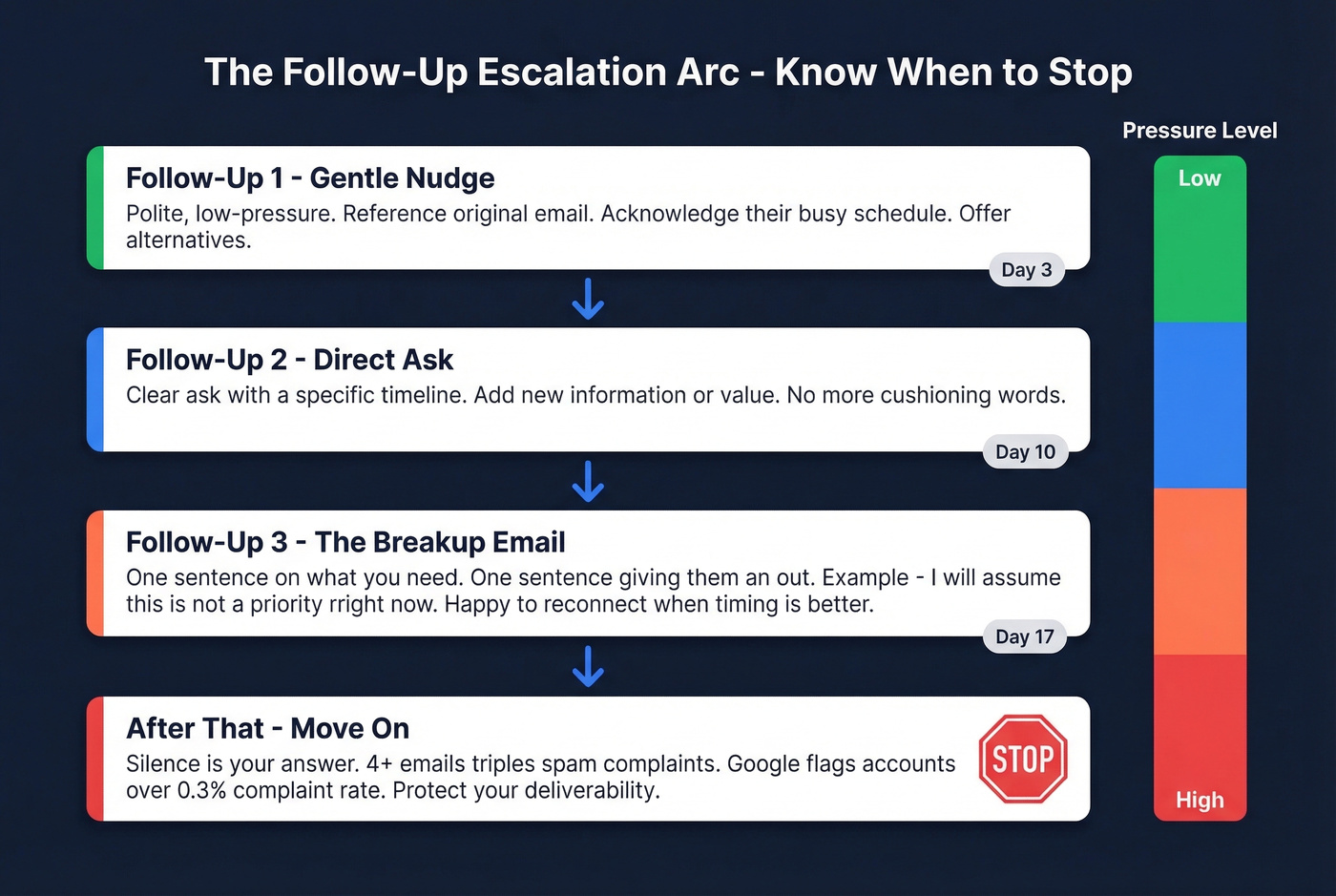
Think of it as an escalation arc: gentle, then direct, then final, then move on. Your first follow-up is the soft nudge. Your second is more direct, with a clear ask and timeline. Your third is the breakup email - "I'll assume this isn't a priority right now. Happy to reconnect when timing's better." After that, silence is your answer.
In our experience, the third follow-up is where most people lose the thread. They either repeat "just checking in" or give up entirely. Neither works. That third email should be your most concise and your most direct - one sentence on what you need, one sentence giving them an easy out.
Let's be honest about the math, though: 4-7 step outreach sequences can generate 3x the reply rate of 1-3 step sequences (9% vs 27%), but only when each step adds genuine value. Repeating "just checking in" four times isn't a sequence - it's spam with a schedule.
Make Sure It Actually Lands
None of this matters if your email bounces. The best-written follow-up fails completely if it never reaches the inbox - and every bounce chips away at your sender reputation, making future emails less likely to land too.
We've seen teams obsess over word choice while ignoring the thing that actually determines whether their email gets read: whether it arrives at all. Having the right email address matters more than having the perfect opening line. Prospeo verifies emails in real time with 98% accuracy, and its data refreshes every 7 days. Before you send that carefully crafted follow-up, run the address through verification. The free tier covers 75 emails a month - enough to check every important follow-up before it goes out. (If you're diagnosing issues, start with email bounce rate benchmarks and fixes.)

Follow-up timing and tone matter - but so does reaching the right person. Prospeo gives you 300M+ verified contacts with 30+ filters so your carefully written follow-ups reach actual decision-makers, not outdated inboxes.
Send fewer follow-ups by reaching the right people the first time.
FAQ
Is "gentle follow up" passive-aggressive?
A single gentle follow-up after 3 days is professional and expected - it's not passive-aggressive. The phrase turns sour when overused, especially by managers who make it a habit. The fix: be specific about what you need and why, rather than relying on "gentle" to do the tonal heavy lifting.
How many follow-ups is too many?
Three is the sweet spot for most situations. A study of 16.5 million cold emails found that four or more emails in a sequence more than triples spam complaint rates. After three unanswered follow-ups, move on or try a different channel entirely.
What's the difference between "follow up" and "follow-up"?
"Follow up" as two words is a verb - "I'll follow up tomorrow." "Follow-up" with a hyphen is a noun or adjective - "Send a follow-up email." Both are correct in their respective contexts, and either form works in subject lines.
What can I say instead of "gentle follow up"?
Skip the word "gentle" and let your tone do the work. Try "Circling back on [topic]," "Wanted to make sure this didn't get buried," or "Any updates on [specific item]?" These sound natural without the passive-aggressive risk. Clarity about what you need is more respectful than any softening word.
How do I make sure my follow-up email actually reaches the inbox?
Verify the recipient's email address before sending - a bounced follow-up damages your sender reputation and wastes effort. Pair verification with proper send-time cadence for the best results.