

The Go-to-Market Plan Checklist That Tells You What Good Looks Like
Every GTM guide tells you to "track your win rate." None tell you what it should be. That's the gap - not the planning itself, but knowing whether your plan is actually working. Here's a go-to-market plan checklist built for operators who need to brief the VP, not impress a professor.
The 95-5 rule frames the challenge well: 95% of your potential buyers aren't shopping right now. McKinsey's data is equally sobering - half of startups convert less than 10% of their ideal customers, and those that miss that threshold are 50% less likely to survive five years. Your GTM action plan needs to account for this from day one.
Choose Your GTM Motion First
Your average contract value dictates your motion. Don't overthink this.
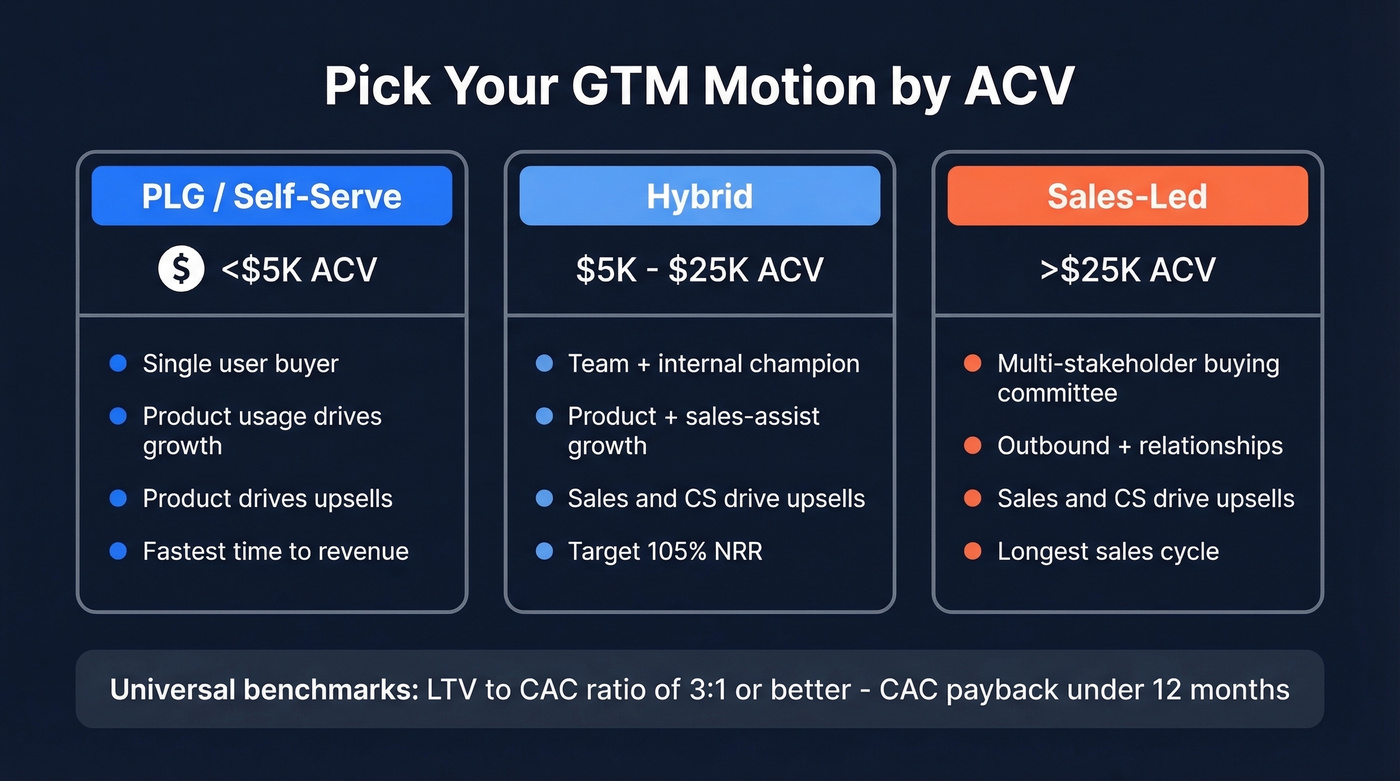
| Factor | PLG / Self-Serve | Hybrid | Sales-Led |
|---|---|---|---|
| ACV | <$5K | $5K-$25K | >$25K |
| Buyer type | Single user | Team + champion | Multi-stakeholder |
| Growth lever | Product usage | Product + sales-assist | Outbound + relationships |
| Upsell driver | Product | Sales/CS | Sales/CS |
In hybrid motions, sales and CS drive the majority of upsells - the product alone accounts for roughly 10%. High Alpha benchmarks put hybrid pricing models at ~105% NRR, a signal the model works for retention, not just acquisition. Target an LTV:CAC ratio of 3:1 or better, with CAC payback under 12 months.
Product Launch Checklist by Phase
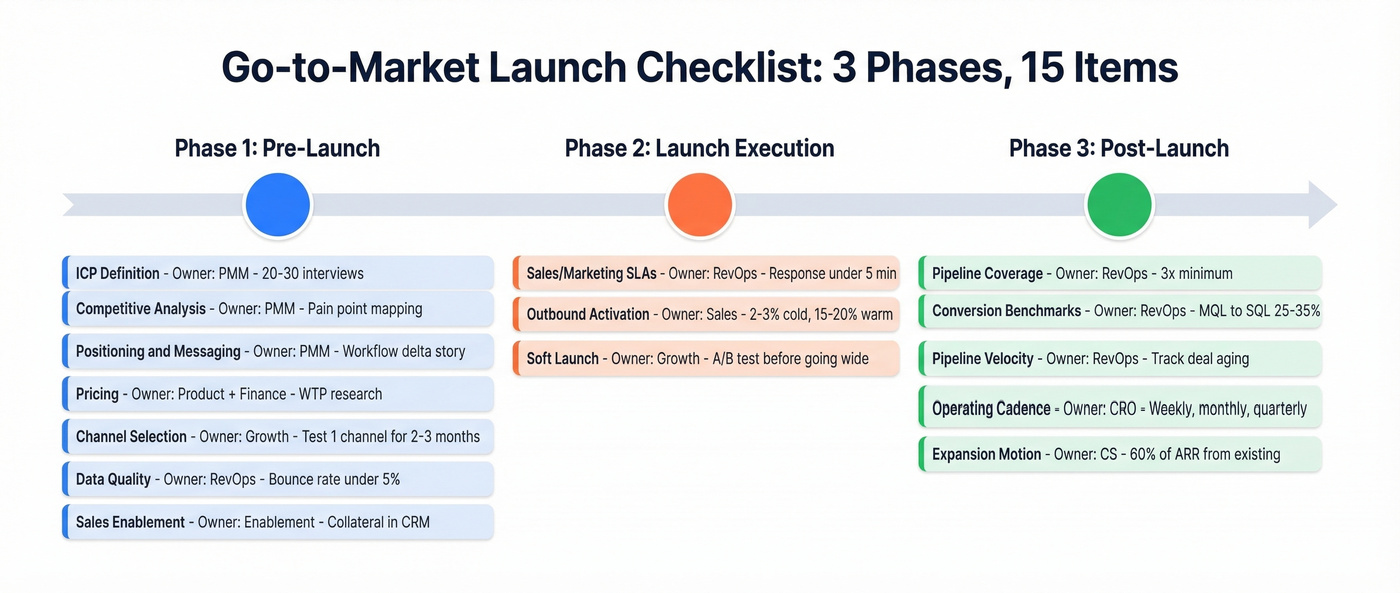
Fifteen items you execute beats a hundred you abandon. Each item below has an owner and a benchmark - if you can't assign both, the item isn't ready.
Phase 1 - Pre-Launch
ICP definition - Owner: Product Marketing. Validate with 20-30 structured customer interviews. Not surveys - conversations. If you haven't talked to real buyers, you're guessing, and guessing at this stage is expensive. (If you need a starting point, use an ICP definition template.)
How do you know your competitive analysis is done? When you can map each persona to their pain points and articulate how your product solves them differently. Owner: Product Marketing. This value matrix becomes the backbone of every sales conversation and every piece of collateral your team produces. (This is also where sales battle cards pay off fast.)
Positioning and messaging - Owner: Product Marketing. Document the workflow your buyer uses today (steps, people, tools, cost) and what it looks like with your product. That delta is your story. Get this wrong and refund rates spike fast (see mistake #1 below). If you're rebuilding from scratch, start with B2B brand positioning.
Pricing - Guessing at pricing is one of the most expensive 2026 GTM mistakes. Owner: Product + Finance. Run willingness-to-pay research alongside competitor benchmarking before you commit.
Channel selection - Owner: Growth / Demand Gen. Test one channel for 2-3 months before expanding. Leads from AI search convert 40% better than traditional search in 2026 - factor that into your mix. (If you're pressure-testing your plan, compare it to current lead generation trends.)
Prospect data quality - Owner: RevOps. Verify your contact list before launch. Bad data doesn't just waste outreach - it damages your sender domain. We've seen teams lose weeks of momentum because they skipped this step. Prospeo runs 5-step verification with catch-all handling and refreshes records every 7 days, which keeps bounce rates under 5% where they need to be. If you want the deeper mechanics, see our email deliverability guide.

Sales enablement readiness - Owner: Enablement / Sales Lead. Playbooks and collateral need to live where sellers work - in pitch decks, digital sales rooms, and CRM. If it's buried in a Google Drive folder, it doesn't exist. (If you're formalizing this function, build a real marketing enablement system.)
Phase 2 - Launch Execution
Sales/marketing SLAs - Owner: RevOps. Set before launch day, not after. Inbound demo requests get contacted within 15 minutes. Outbound follow-up runs 5-7 touches over 10 days. Lead response time under 5 minutes drives 8-21x higher conversion, and 35-50% of deals go to the first responder. Speed isn't a nice-to-have. It's a conversion multiplier. If you need copy you can ship today, use these sales follow-up templates.
Outbound activation - Owner: Sales. Cold outreach converts to meetings at 2-3%. Warm outreach hits 15-20%. If your reps expect cold to perform like warm, they'll burn out by week three. For a tighter system, pull from proven sales prospecting techniques.
Soft launch first. Run a mini-launch with a subset of your ICP before going wide. A/B test messaging and channels with a small cohort before committing budget. Launch week should be final optimization, not scrambling - and delay the big press push until you can actually serve the demand.
Phase 3 - Post-Launch
Pipeline coverage - Owner: RevOps / Sales Lead. Target 3x minimum. If your win rate sits below 25%, push to 4-5x.
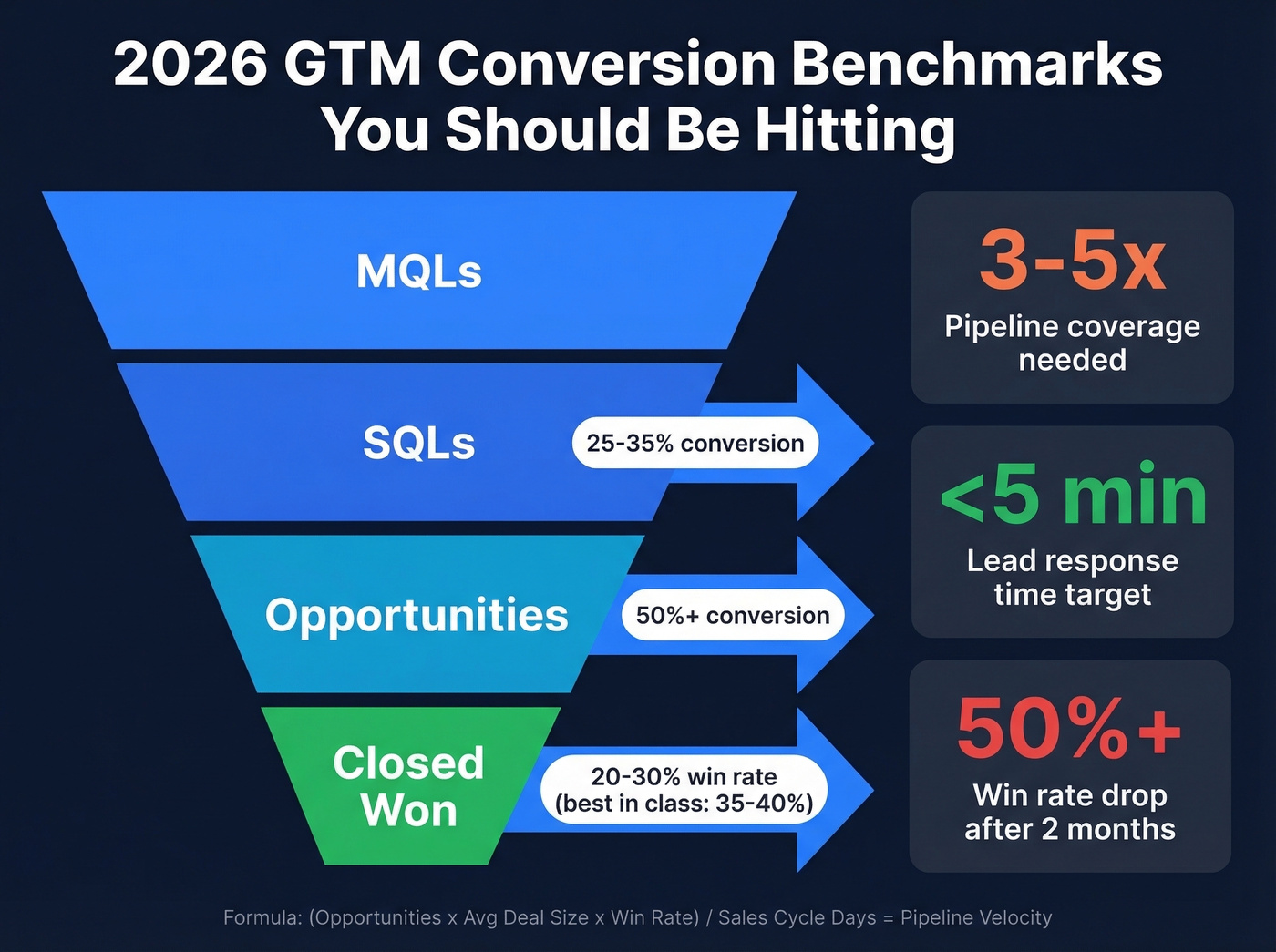
Conversion benchmarks - Owner: RevOps. Track weekly: MQL to SQL at 25-35%, SQL to Opportunity at 50%+, win rate at 20-30% (best-in-class hits 35-40%). If you want more reference points, compare against the average B2B lead conversion rate.
Pipeline velocity - Owner: RevOps. Formula: (Opportunities x Avg Deal Size x Win Rate) / Sales Cycle Days. Deals that slip past two months see win rates drop by more than half. If your pipeline is aging, that's the fire to fight first. (More detail: Pipeline velocity.)
Operating cadence - Owner: CRO / VP Sales. Weekly revenue standup. Monthly GTM QBR. Quarterly planning cycle. Without this rhythm, problems compound silently until the board meeting. A solid operations roadmap assigns each cadence a clear owner and escalation path so nothing falls through the cracks. If you're standardizing the meeting itself, use these QBR questions to ask.
Expansion motion - Owner: CS / Account Management. Beyond $50M ARR, 60% of new ARR comes from existing customers. Expansion deserves its own motion with dedicated owners and targets - don't bolt it onto your new-logo team as an afterthought.
Copy this into your project plan with owner and status columns. Fifteen items, three phases, no fluff.

Mistake #5 kills more launches than bad positioning: dirty data. Prospeo's 5-step verification, catch-all handling, and 7-day refresh cycle keep bounce rates under 5% - so your outbound actually fires on launch day. At $0.01/email, cleaning your list costs less than one bounced sequence.
Don't let bad data flatline your GTM before week one.
Five GTM Mistakes That Kill Launches
1. Mispositioning your product. Pavel Sher, CEO of FuseBase, positioned his product as "all-in-one" when it only had basic features. Result: a 65% refund rate in month one. Aspirational positioning is a refund factory.
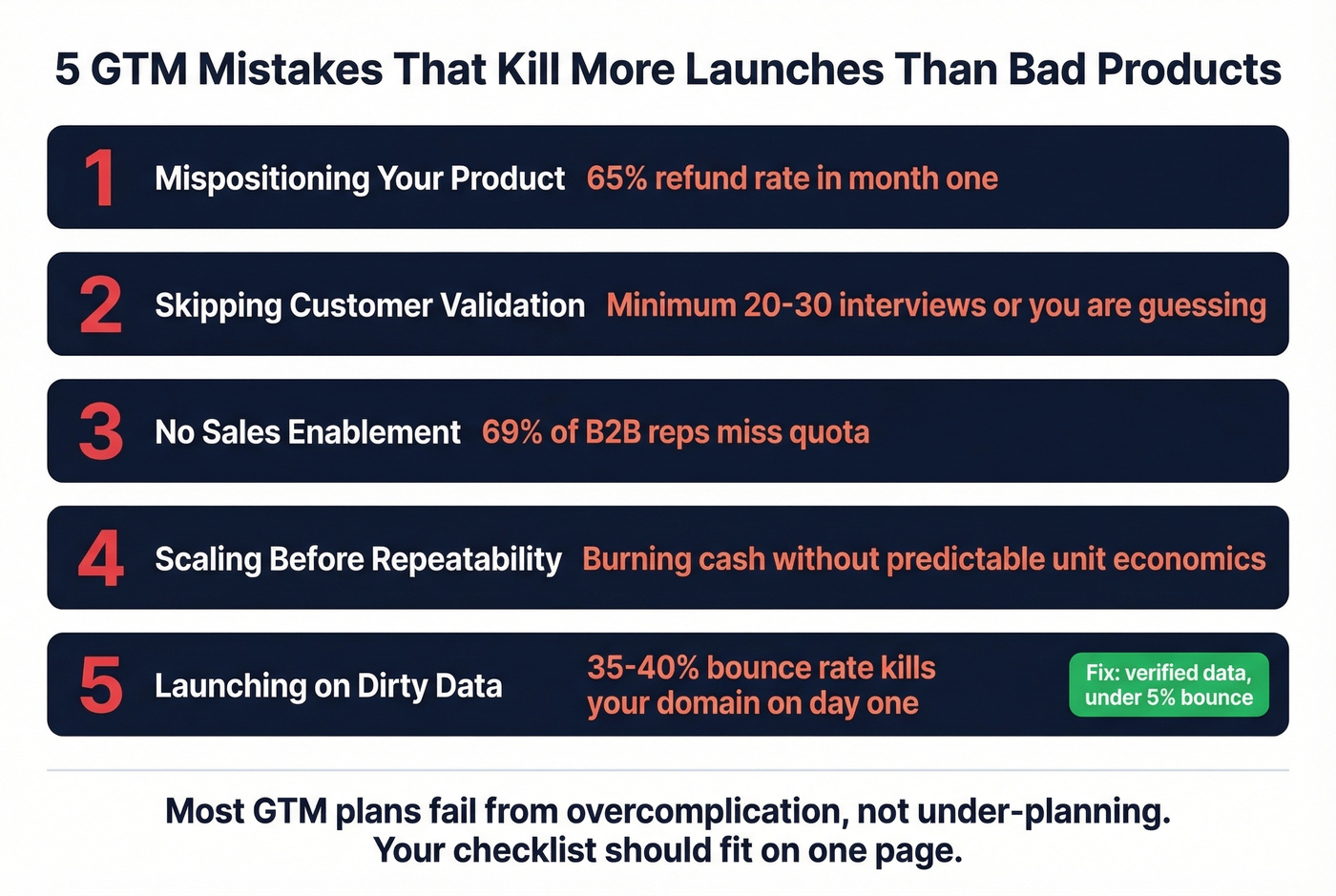
2. Skipping customer validation. Twenty to thirty structured interviews isn't optional - it's the minimum. If you can't get 20 potential customers on the phone, that's data in itself.
3. No sales enablement. Marketing generates leads, sales can't convert them. This is the most common disconnect we see, and it's why 69% of B2B sales reps miss quota. The fix isn't more leads - it's better training and messaging consistency. If you're rebuilding the system, start with sales execution.
4. Scaling before repeatability. Hiring reps and increasing ad spend before you have predictable conversion rates at each funnel stage is lighting money on fire. Get the unit economics right with a small team first.
5. Launching on dirty data. Here's the thing: imagine launch day. Your outbound sequences fire and 35-40% of emails bounce. Your domain gets flagged. Outbound is dead before it started.
We've seen this pattern repeatedly. Snyk's 50 AEs went from 35-40% bounce rates to under 5% after switching to verified data, generating 200+ new opportunities per month. That's not a marginal improvement - it's the difference between a functioning outbound engine and a broken one.
Let's be honest: if your deal size sits below $10K, you probably don't need a 50-slide GTM deck. You need a verified list, a tight value prop, and the discipline to run one channel well for 90 days before adding another. Most GTM plans fail from overcomplication, not under-planning. Your checklist should fit on a single page - if it doesn't, you're planning instead of executing.
Your checklist says outbound activation needs warm, accurate contacts. Prospeo gives RevOps teams 300M+ profiles with 30+ filters - buyer intent, technographics, headcount growth - so reps hit the 15-20% warm conversion benchmark instead of grinding at 2-3% cold.
Build your GTM target list with data that actually connects.
Go-to-Market Plan Checklist: FAQ
What's a realistic GTM timeline?
Most B2B teams build a functional go-to-market plan checklist in 4-6 weeks. The bottleneck is customer validation and sales enablement prep, not the document itself. For a software launch, add 1-2 weeks for technical integration testing and beta feedback loops.
What's the single most important launch metric?
Pipeline coverage - 3x minimum, pushing to 4-5x if your win rate sits below 25%. Pair it with lead response time under 5 minutes for 8-21x higher conversion. Without adequate coverage, even strong win rates can't hit revenue targets.
How does a GTM orchestration checklist differ from a standard plan?
A standard plan defines what to do. An orchestration checklist focuses on cross-functional coordination - ensuring sales, marketing, product, and CS execute in sync rather than in silos. It defines who does what, when, and how handoffs happen between teams. Skip the orchestration layer and you'll watch departments optimize locally while the launch stalls globally.
How do I keep prospect data clean for launch?
Verify emails before every campaign, not just at list build. B2B contact data decays fast - people change jobs, emails go stale. Target bounce rates under 5% at all times, and re-verify any list that's more than 30 days old. The r/sales consensus is pretty clear on this: dirty data is the silent killer of outbound programs, and most teams don't realize it until their domain reputation is already damaged.