

How to Build a Go-to-Market Strategy for a Service Company
Three big referral clients last quarter. Empty pipeline this quarter. If that rhythm sounds familiar, you don't have a demand problem - you need a real go-to-market strategy, not a recycled SaaS playbook.
Most GTM guides assume you're shipping code and running paid ads against a free trial. Service companies sell expertise, not software. The playbook has to reflect that, and honestly, most of the advice floating around doesn't.
What Makes Service GTM Different
Service businesses face constraints that product-led companies simply don't deal with:
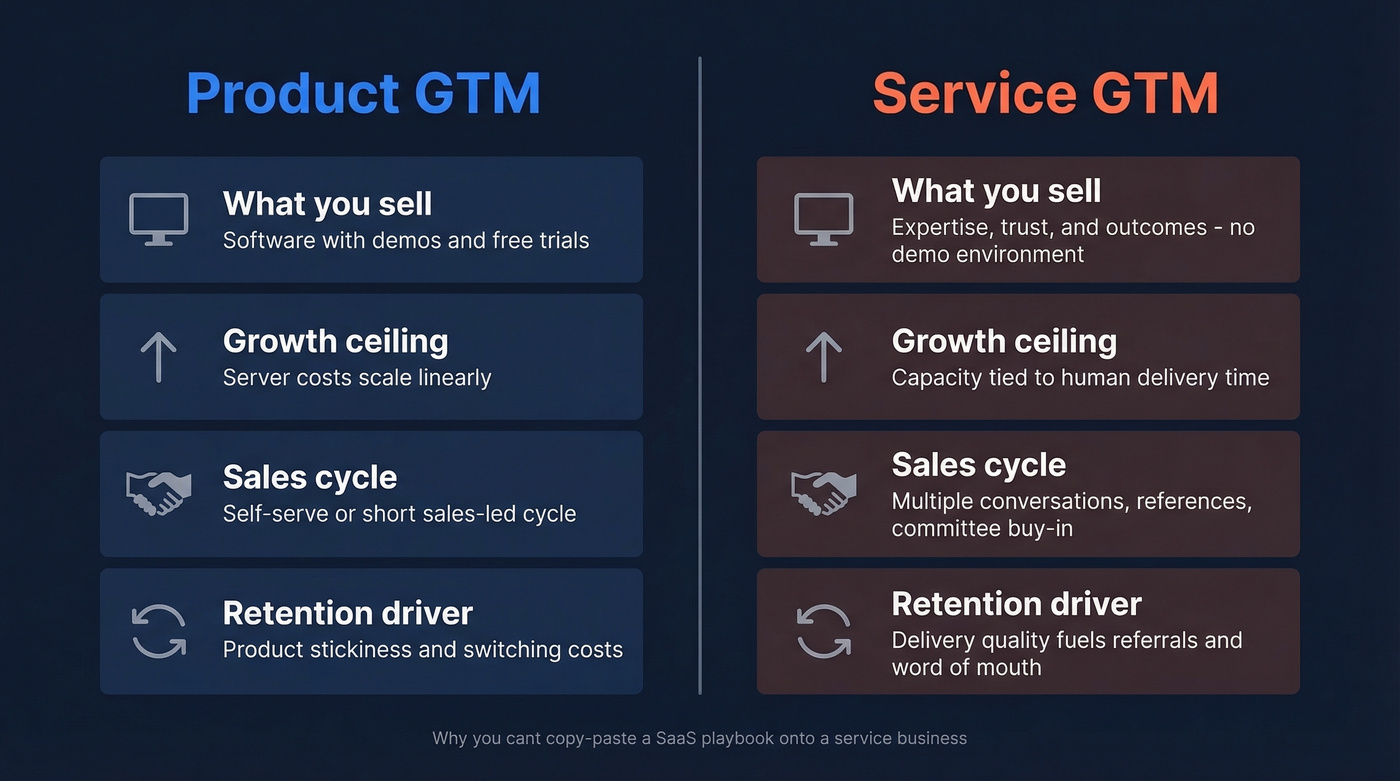
You're selling an intangible. There's no demo environment, no free trial. Buyers evaluate trust, not features. Hinge Marketing's research confirms what we've seen firsthand: complicated purchasing processes make comparison and differentiation harder for services than for products.
Capacity is a ceiling. Every new client requires human delivery time, so your GTM must account for utilization - not just demand generation. Sign too many clients too fast and quality tanks, which torches your referral engine.
Sales cycles are relationship-driven. A consulting buyer needs multiple conversations, references, and often committee buy-in before signing anything.
Delivery IS the product. A missed deadline doesn't just lose one client. It kills the word-of-mouth that probably generated your last three.
7-Step GTM Framework for Service Companies
1. Start With Problems, Not Services
Most service firms build GTM around what they do: "We offer strategy consulting." That's backwards.
If you haven't mapped your addressable market yet, do it before you pick channels.
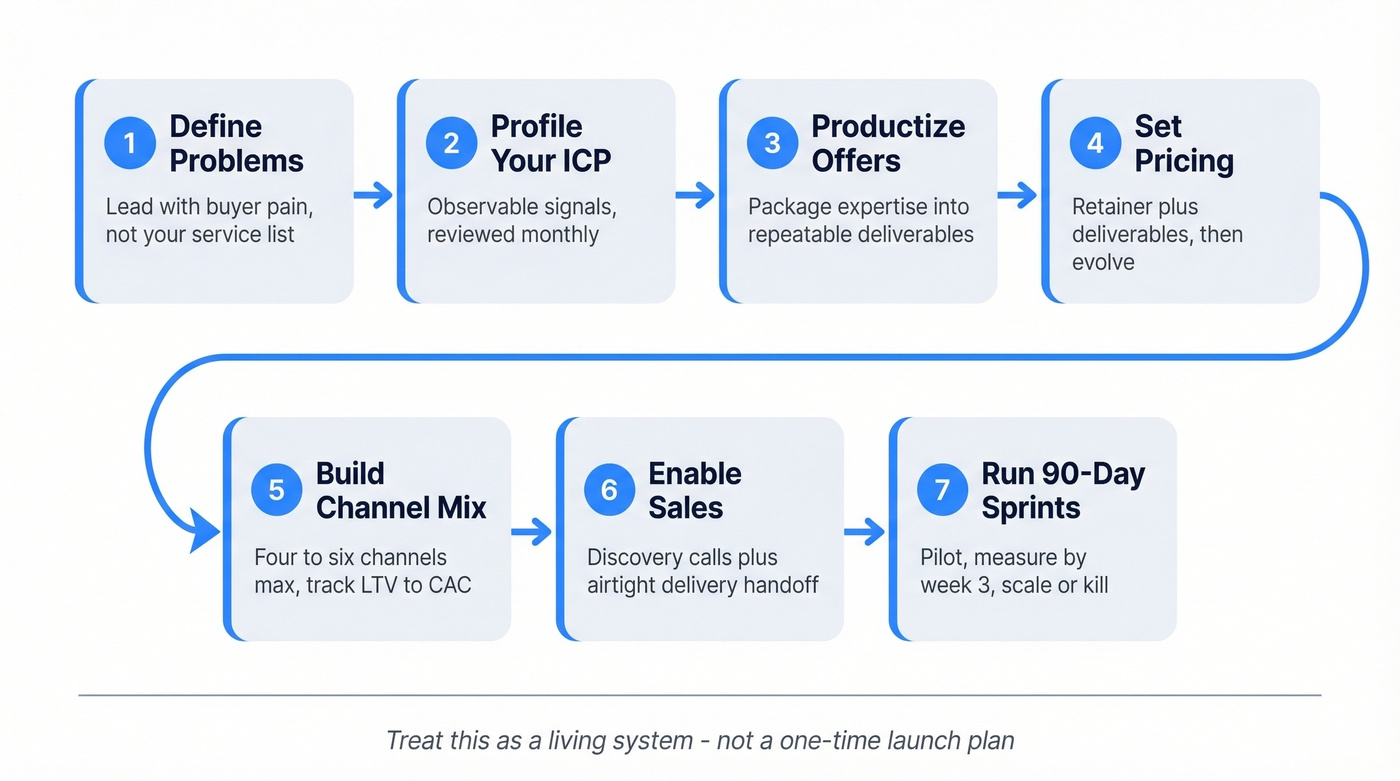
Define your market by the problems you solve. A cybersecurity consultancy targeting "mid-market SaaS companies failing SOC 2 audits" will outperform one targeting "companies that need security help." The problem frames the urgency. The service is just the vehicle.
This is also where you make your positioning decision: are you the thought leader, the deep specialist, or the value play? That choice shapes everything downstream - messaging, pricing, channels, even which conferences you attend. (If you need a tighter narrative, start with B2B brand positioning.)
2. Profile Your Ideal Client
Your ICP isn't a static persona doc collecting dust in Google Drive. Build it from observable signals: firmographics, technographics, intent data, and trigger events like leadership changes, funding rounds, or compliance deadlines.
Then review it monthly. We've seen teams waste entire quarters chasing a stale ICP because nobody revisited the assumptions. One agency we talked to spent four months targeting Series A startups before realizing their best clients were all Series C companies with 200+ employees going through their first real compliance audit.
3. Productize Before You Sell
Research from TSIA shows that best-in-class organizations generate around 80% of their revenue from productized service offerings. That's not a coincidence.
Productization means packaging expertise into repeatable deliverables with clear scope, timelines, and pricing. Use the 80/20 heuristic - identify the 20% of your services that solve 80% of client problems, and systematize those first. Instead of a custom proposal for every lead, offer a fixed-scope assessment with defined deliverables. Use AI to accelerate the repeatable parts (analysis, first drafts, research) while your team focuses on strategy and client relationships. This isn't commoditization. It's making your expertise buyable.
4. Pick a Pricing Model That Scales
Five models dominate service pricing. Each has a failure mode:
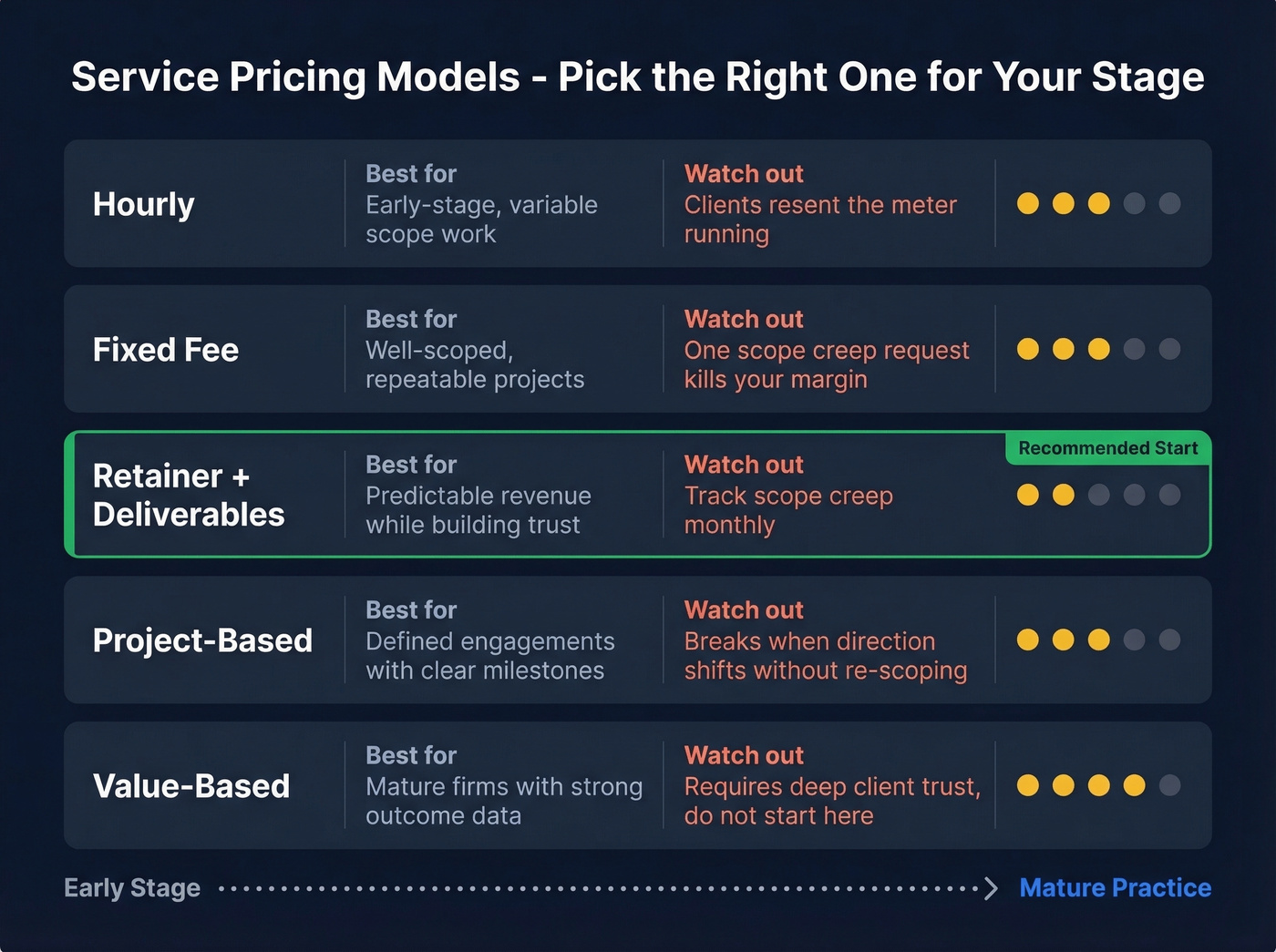
- Hourly - Clients resent the meter running. Admin time eats margin.
- Fixed fee - One "can we also..." and your margin evaporates.
- Retainer - Becomes underpriced fast if you don't track scope creep.
- Project-based - Breaks when direction shifts without re-scoping.
- Value-based - Requires deep client trust. Don't start here.
The industry is moving toward outcome-based pricing, but here's our recommendation: start with a retainer plus defined deliverables. It gives you predictable revenue while you build the trust needed to move toward value-based models later. Most firms we've talked to see 15-25% margin improvement within two quarters of making this shift.
5. Build Your Channel Mix
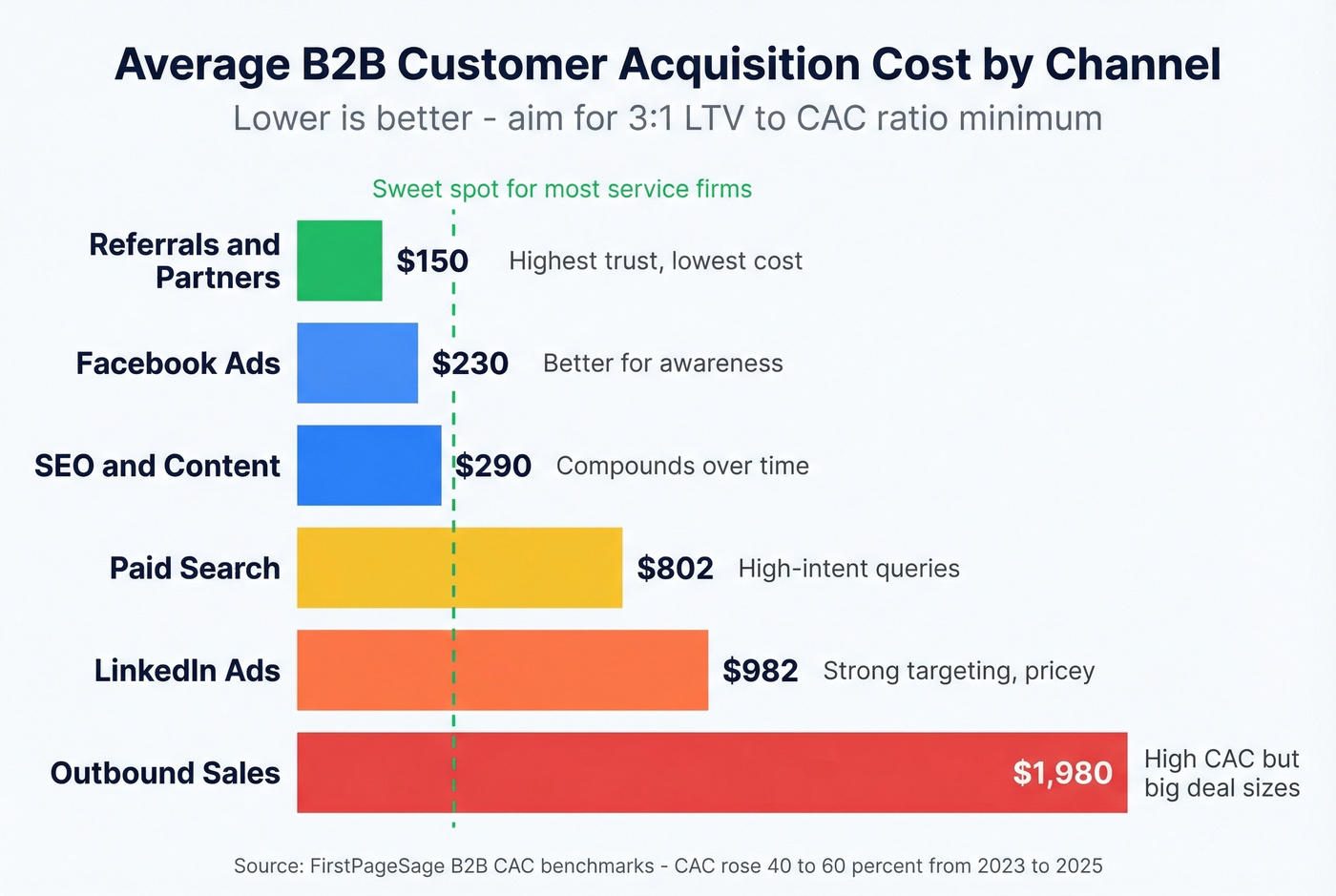
Customer acquisition costs rose 40-60% between 2023 and 2025, so picking wrong is expensive. Here are directional benchmarks from FirstPageSage's B2B CAC data:
| Channel | Avg. B2B CAC | Notes |
|---|---|---|
| Referrals / Partners | ~$150 | Lowest CAC, highest trust |
| SEO / Content | ~$290 | Compounds over time |
| Facebook Ads | ~$230 | Better for awareness |
| Paid Search | ~$802 | High-intent queries |
| LinkedIn Ads | ~$982 | Strong targeting, pricey |
| Outbound Sales | ~$1,980 | High CAC, big deals |
Referrals and partners consistently deliver the lowest CAC, and the numbers above confirm it. Target an LTV:CAC ratio of at least 3:1, and limit yourself to four to six active channels. Spreading thinner than that just means you're mediocre everywhere.
For outbound specifically, accuracy matters more than volume. Prospeo's 30+ search filters - buyer intent, technographics, headcount growth - let you build prospect lists that actually match your ICP, with 98% email accuracy so you're not torching your domain reputation on stale contacts. (If you're building the motion from scratch, start with these sales prospecting techniques.)
6. Enable Your Sales Process
For service companies, discovery IS the product. Your first call isn't just qualification - it's a preview of what working with you feels like. Build talk tracks that demonstrate expertise, not just extract budget info. If you need structure, use a discovery questions framework.
Here's the thing most GTM frameworks skip entirely: the sales-to-delivery handoff. In services, a botched handoff kills the relationship before work even starts. We've watched deals close beautifully only to implode in week two because the delivery team had no context on what was promised. Design this transition as part of your go-to-market strategy, not an afterthought. (A simple handoff email template can prevent a lot of this.)
7. Run 90-Day Sprints
Don't build a 12-month GTM plan and hope it works. Run 90-day sprints: pilot a channel, review leading indicators by week three, then scale or sunset by sprint end. Gartner projects that by 2026, 75% of the highest-growth B2B companies will run a formalized RevOps model. The sprint cadence is what separates a GTM strategy from a GTM deck. If you want a template for the cadence, borrow a 30-60-90 day plan for sales reps and adapt it to GTM experiments.
Let's be honest: if your average contract value is under $25k, you don't need a complex multi-channel GTM. You need three things - a tight ICP, a productized offer, and one outbound motion that works. Nail those before adding anything else.

You just defined your ICP. Now you need to find them. Prospeo's 30+ search filters - buyer intent, technographics, headcount growth, funding stage - let you build prospect lists that match your exact service ICP. 98% email accuracy means your outbound won't torch your domain.
Stop guessing who to target. Start reaching the right buyers at $0.01 per verified email.
Common GTM Mistakes to Avoid
Targeting everyone. Refusing to narrow your ICP because "we can help anyone" is the most expensive mistake in services. Fix: revisit monthly with real pipeline data, not gut feel. (If you need a scoring rubric, use an ideal customer profile template.)
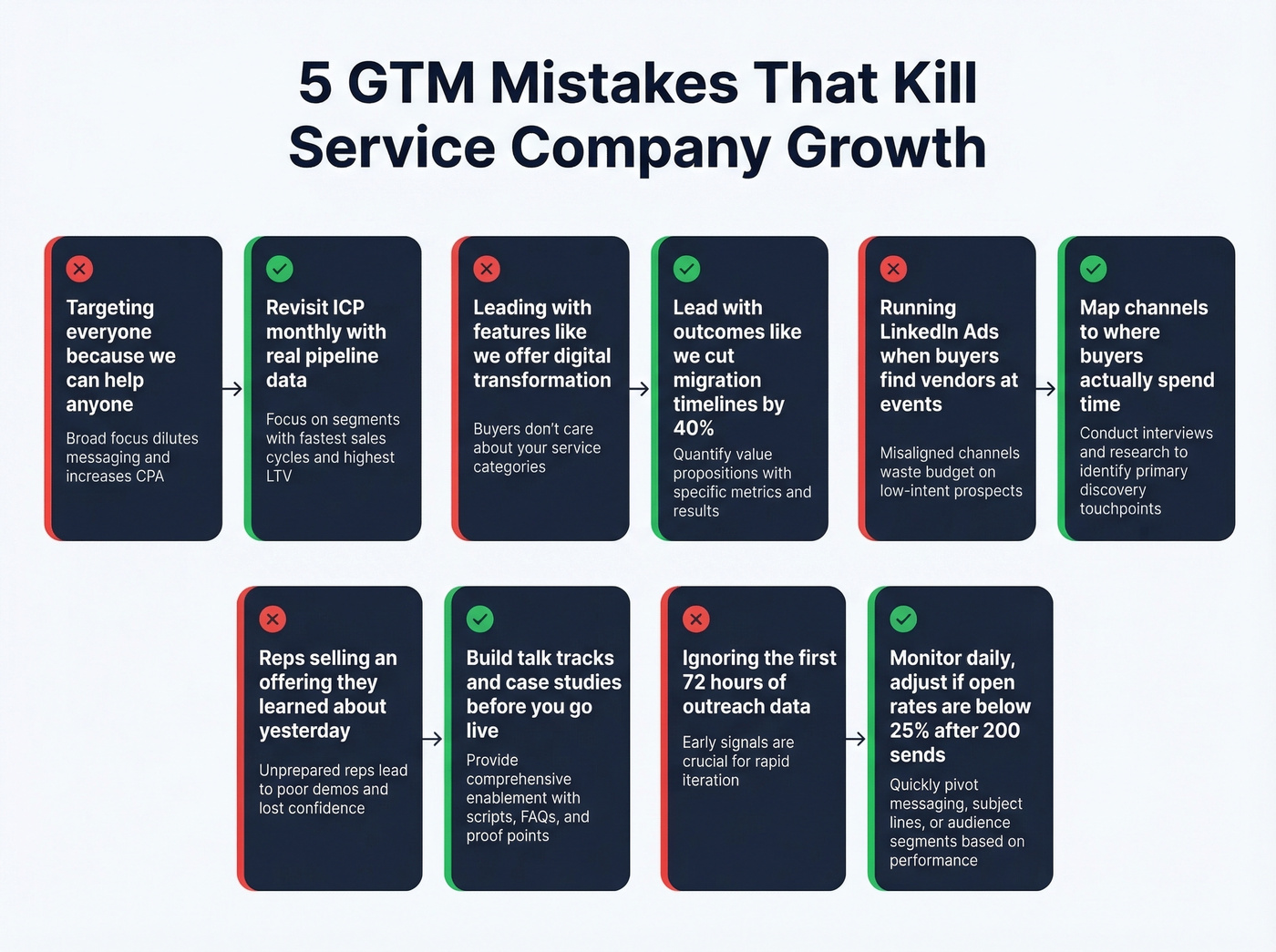
Leading with features, not outcomes. "We offer digital transformation" means nothing. "We cut ERP migration timelines by 40%" means everything. Buyers don't care about your methodology until they believe you understand their problem.
Channel mismatch. Running LinkedIn Ads when your buyers find vendors through industry events and peer recommendations. Fix: map channels to where buyers actually spend time, not where it's easiest to spend budget.
Skipping enablement. Reps can't sell a new offering they learned about yesterday. Fix: build talk tracks and case studies before you go live, not after the first lost deal. (This is classic marketing enablement work.)
Ignoring the first 72 hours. Your first week of outreach tells you more than the next 90 days will. Monitor daily and adjust immediately. If open rates are below 25% or reply rates below 3% after 200 sends, something's wrong with your list, your messaging, or both.
Build a GTM Operating System, Not a Deck
Stop writing a strategy document. Build a GTM operating system.
The plan is 20% of the work. Sprint reviews, monthly ICP recalibration, channel economics tracking - that's the other 80%. Service companies that treat their go-to-market strategy as a living system outperform those that treat it as a launch event. Every time. (If you're not sure what to track, start with pipeline health.)
Skip the elaborate 40-slide GTM presentation. Start with a one-page sprint plan, a shared dashboard tracking three to five leading indicators, and a weekly 30-minute review. You can always add complexity later. You can't get back the six months you spent perfecting a deck nobody followed.
Running 90-day GTM sprints means you can't afford bad data slowing you down. Prospeo refreshes every record on a 7-day cycle - 6x faster than the industry average - so your outbound channel always hits real, active contacts. One agency tripled their pipeline from $100K to $300K/week after switching.
Launch your first outbound sprint with data that actually connects you to buyers.
FAQ
How is a GTM strategy different for services vs. products?
Services sell intangibles with no free trial, face capacity constraints tied to headcount, and rely on relationship-driven sales cycles. Your GTM must treat delivery quality as a core growth lever - not just marketing and sales. A bad project doesn't just churn one client; it poisons the referral pipeline that probably drives 30-50% of your revenue.
What's the best pricing model for a service company going to market?
Start with a retainer plus defined deliverables for predictable revenue. Move toward value-based pricing once you have enough outcome data to justify it. The transition typically takes two to three quarters of consistent delivery and documented results.
How long does it take to see results from a service GTM strategy?
Run 90-day sprints. Most service companies need two to three sprints (six to nine months) to find a repeatable motion. No signal by sprint one usually means an ICP or channel problem - revisit both before investing in sprint two.
What channels work best for service company customer acquisition?
Referrals deliver the lowest CAC (~$150) and highest trust. After that, thought leadership content, targeted outbound with verified contact data, and niche industry events - roughly in that order for most firms under $10M ARR.