

Go-to-Market Strategy Questions Every Founder and PMM Needs to Answer in 2026
A lot of teams spend $2 in sales and marketing for every $1 of new ARR - and still can't tell you which dollar worked. That's not a budgeting problem. That's a go-to-market strategy problem, and the right questions would've caught it before the first dollar was spent.
Roughly 90% of startups fail, and 42% of those failures trace back to building something nobody needed. The average software company now runs 10.5 simultaneous GTM efforts - five core channels plus five-and-a-half experimental ones. That's not strategy. That's panic with a Notion board.
Frameworks like the 7Ps give you categories to fill in. The five questions below give you decisions to make. They're the same questions that come up in PMM interviews, but the answers here are built for execution, not whiteboard exercises.
The Five GTM Questions That Actually Matter
You don't need 30 questions on a checklist. You need five you can answer with evidence.
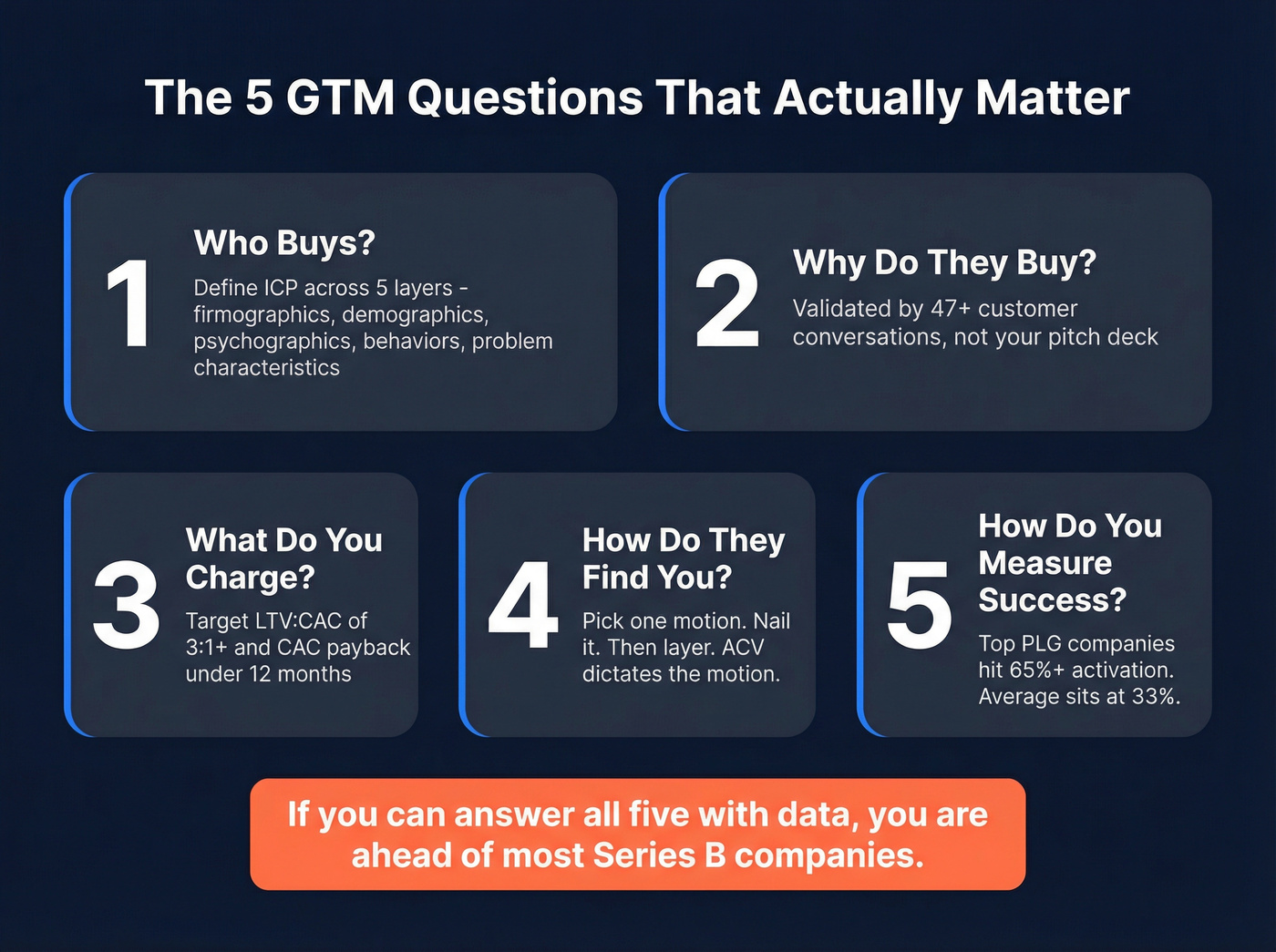
- Who buys? - If your ICP is "any company with 50+ employees," you don't have an ICP.
- Why do they buy? - The answer must come from customers, not your pitch deck.
- What do you charge? - Target LTV:CAC of 3:1+ and CAC payback under 12 months.
- How do they find you? - Pick one motion. Nail it. Then layer.
- How do you measure success? - Top-decile PLG companies hit 65%+ activation rates. The average sits at 33%.
If you can answer all five with data - not opinions, data - you're ahead of most Series B companies we've worked with.
Foundation: Who Buys and Why
This is where most GTM plans collapse. Not in channel selection or pricing, but in a sloppy definition of who you're actually selling to.
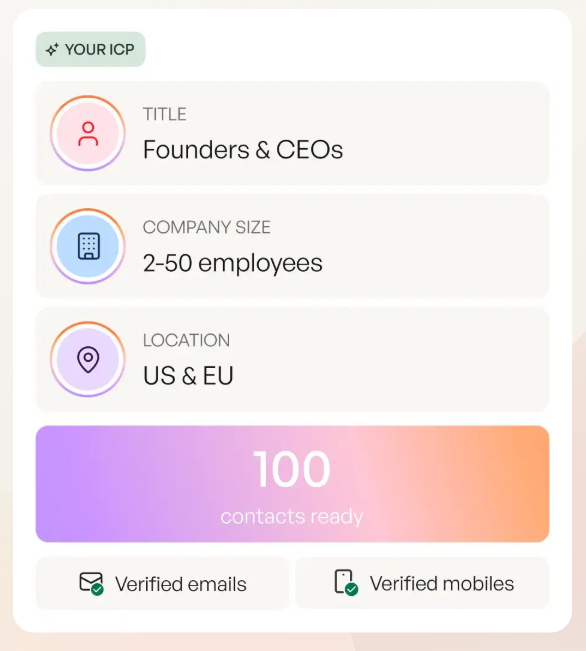
We see the same founder symptom constantly: the target audience feels like everybody. That's the symptom. A five-layer ICP framework is the cure. Start with firmographics - industry, size, revenue. Layer in demographics like title and seniority. Then go deeper: what does this buyer believe about the problem (psychographics), what tools do they already use and what content do they consume (behaviors), and how urgent is the pain, who holds budget authority, and what's the switching cost (problem characteristics). If you can't fill in all five layers, you haven't done enough discovery.
Discovery isn't a one-time exercise. The BuildVoyage cadence works well - 15 problem discovery conversations in weeks one and two, 20 solution validation conversations in weeks three and four, and 12 pricing discovery conversations in weeks five and six. That's 47 conversations before you write a single line of positioning copy.
Your positioning statement should follow this structure: "Unlike [competitor], we help [ICP] achieve [outcome] in [timeframe] by [mechanism] without [objection]." Can't complete that sentence with specifics? Your positioning isn't ready for market.
Motion and Channels: How Buyers Find You
Your ACV dictates your motion. Not your preference, not your board's opinion - your ACV.
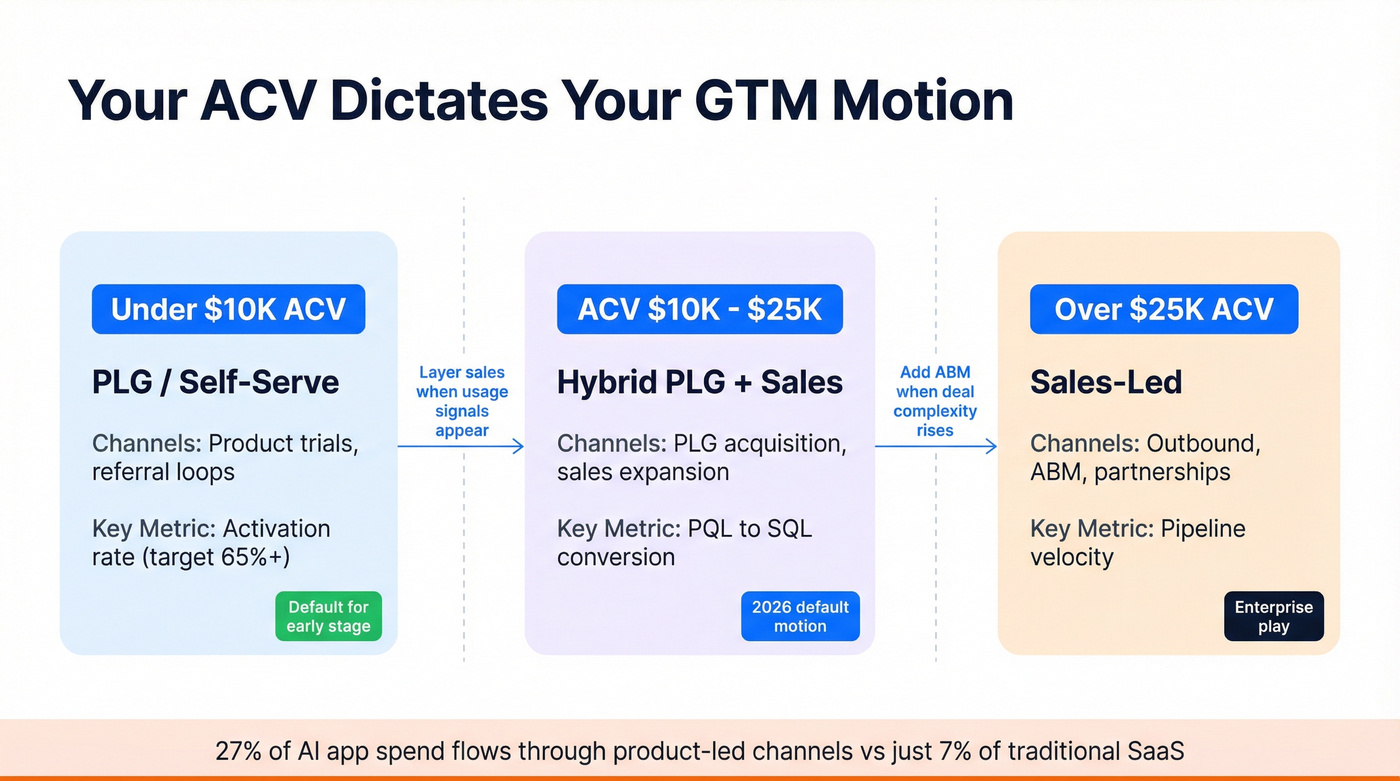
| ACV Range | GTM Motion | Primary Channels | Key Metric |
|---|---|---|---|
| Under $10K | PLG / self-serve | Product trials, referral loops | Activation rate (65%+) |
| $10K-$25K | Hybrid PLG + sales | PLG acquisition, sales expansion | PQL-to-SQL conversion |
| Over $25K | Sales-led | Outbound, ABM, partnerships | Pipeline velocity |
Hybrid PLG is the 2026 default. 27% of AI application spend flows through product-led channels, compared to just 7% of traditional SaaS spend. Dropbox scaled from 100M users in 2015 to 500M in 2017 on a referral-driven PLG motion. That's the template - self-serve adoption first, enterprise sales layered on top when usage signals appear.
One wrinkle for 2026: your PLG "user" may be an AI agent, not a human. That changes activation metrics, support design, and monetization models entirely. Indefinite freemium is dying alongside it. The 2026 default is reverse trials of 7-14 days or credit-based gating.
For early-stage teams, the channel hierarchy is blunt. Founder-led outbound and warm intros are always on. Paid search is never early. Content marketing rarely works before you have PMF. Conferences and partnerships come after you've proven a repeatable sales process.
If you're building a repeatable outbound motion, start with sales prospecting techniques and a clean B2B cold email sequence.

You just read that a team sent 2,000 outbound emails and got 700 bounces. That's what happens when your GTM execution runs on stale data. Prospeo refreshes every record every 7 days - not every 6 weeks - and delivers 98% email accuracy. Meritt switched and watched their bounce rate drop from 35% to under 4% while pipeline tripled to $300K/week.
Don't let bad data kill your go-to-market motion before it starts.
Pricing, Metrics, and Benchmarks
The pricing conversation in 2026 has shifted. Per-seat pricing is giving way to per-task and per-outcome models, especially for AI-native products. Time-to-value expectations have compressed to under 60 seconds for competitive products. If your onboarding takes a week, you're losing to someone whose product delivers value on the first click.
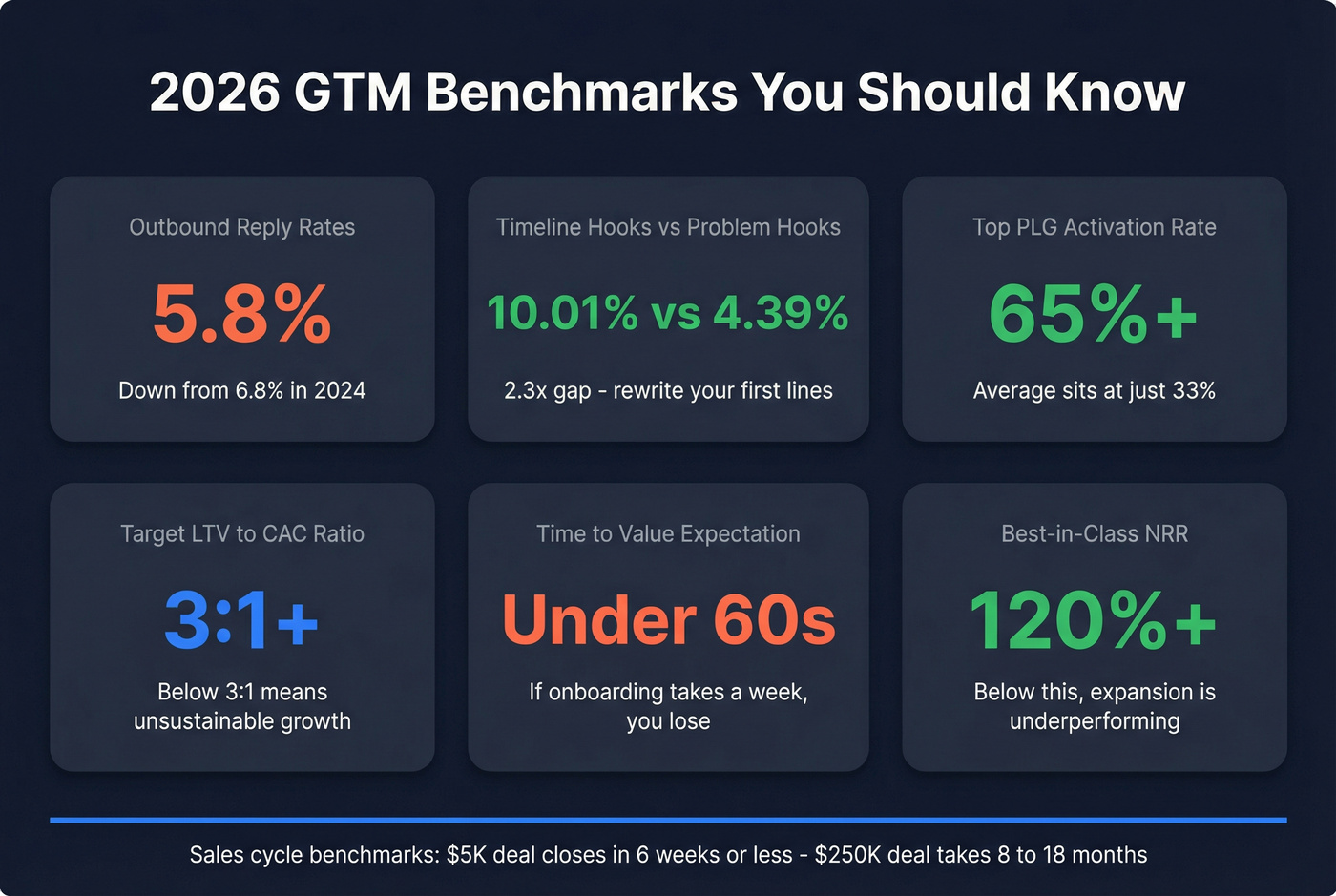
Here's what nobody tells you about cold outbound: the benchmarks keep tightening. Average reply rates dropped from 6.8% in 2024 to 5.8% through 2025. Timeline-based hooks pull 10.01% reply rates versus 4.39% for problem-focused hooks - a 2.3x gap that should reshape how you write every first line. Remember that $2-to-$1 ratio from the top? Fixing your hook strategy alone can cut it in half.
Sales cycle length tracks deal size: a $5K product closes in roughly six weeks or less, while a $250K deal takes 8-18 months. If your cycles are running longer than these benchmarks, your qualification process is broken. Best-in-class NRR sits above 120%. Below that, you're leaving expansion on the table and making growth harder than it needs to be.
To tighten measurement, align your KPIs to funnel metrics and keep an eye on pipeline health.
Execution: Where GTM Plans Die
Here's where we see the most waste. Teams build a beautiful GTM strategy, then execute it on garbage data.
Don't hire salespeople before you have product-market fit. Don't hire a marketing team before you have a repeatable sales process. These aren't suggestions - they're sequencing rules that prevent burning six months of runway on premature scaling.
Data quality is a GTM dependency that most strategy frameworks ignore entirely. I watched a team send 2,000 outbound emails and get 700 bounces back. That's not a messaging problem - that's a data problem that tanks your domain reputation and makes every subsequent email harder to deliver. This is where your data provider becomes a GTM dependency. Prospeo's 98% email accuracy and 7-day data refresh cycle address exactly this failure mode - one customer, Meritt, saw their bounce rate drop from 35% to under 4% after switching, and their pipeline tripled from $100K to $300K per week.
If you're seeing deliverability issues, start with email bounce rate and then work through an email deliverability guide.

Apple moved 270,000 iPhones in 30 hours because every distribution detail was locked before launch day. Your outbound is the same - the execution is only as good as the preparation underneath it.
Five Failure Modes to Diagnose Before Launch
Before you launch, run these five diagnostics. A "no" on any of them means you aren't ready.
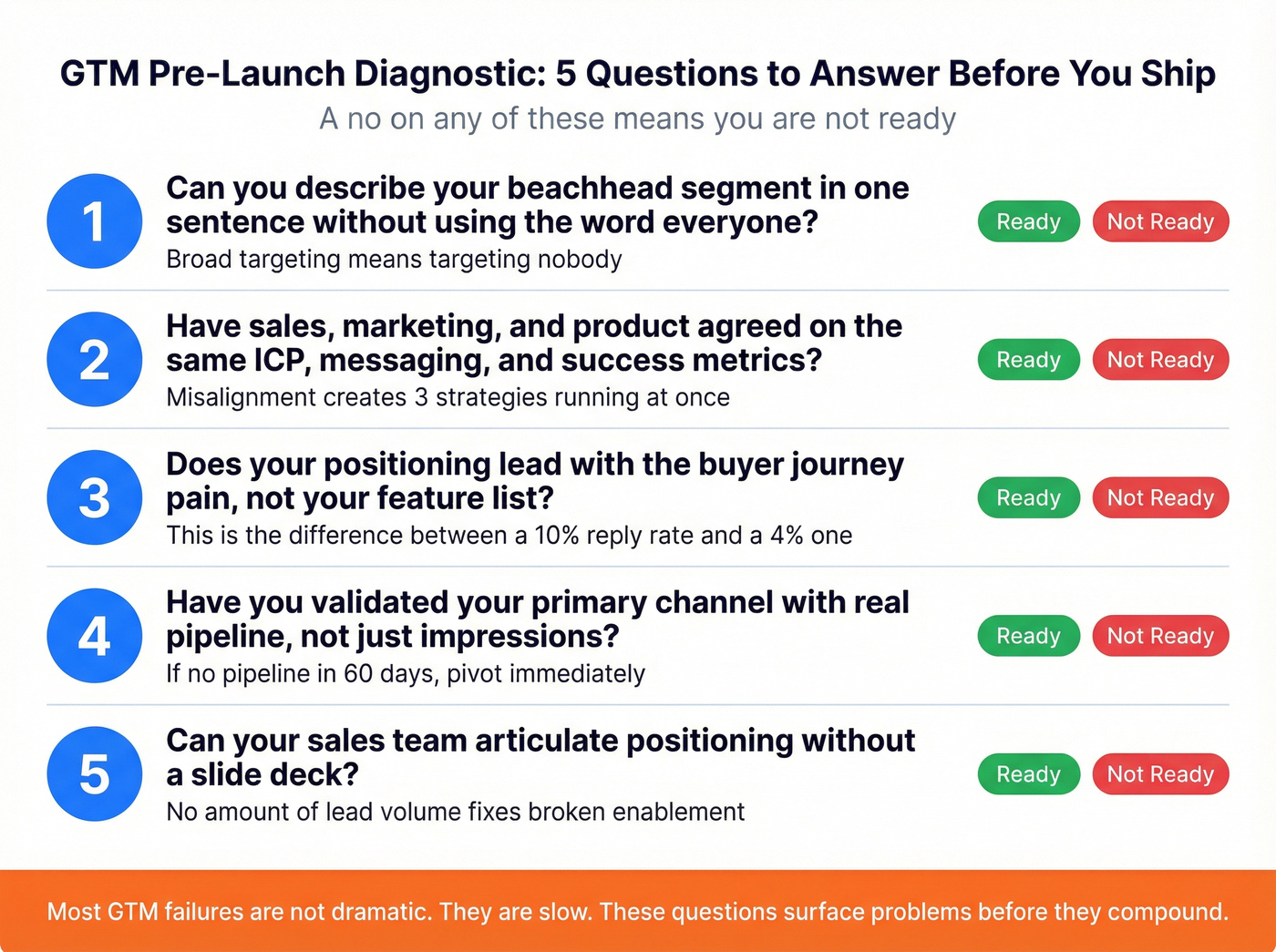
Can you describe your beachhead segment in one sentence without using the word "everyone"? Misaligned market understanding is the top GTM killer. Broad targeting means targeting nobody.
Have sales, marketing, and product agreed on the same ICP, messaging, and success metrics? Cross-functional misalignment creates three different strategies running simultaneously. That's how you end up with 10.5 GTM efforts and zero pipeline.
Does your positioning lead with the buyer journey's pain, not your feature list? This is the difference between a 10% reply rate and a 4% one.
Have you validated your primary distribution channel with real pipeline - not just impressions? If it doesn't produce pipeline within 60 days, pivot. Don't wait for "more data." You have enough.
Can your sales team articulate your positioning without a slide deck? If they can't, your sales enablement is broken, and no amount of lead volume will fix a team that can't tell your story in a hallway conversation.
Let's be honest: most GTM failures aren't dramatic. They're slow. A slightly wrong ICP. A channel that works at low volume but breaks at scale. A pricing model that attracts the wrong buyers. These go-to-market strategy questions won't guarantee success, but they'll surface the problems before they compound.
Skip the multi-channel blitz if your deal size sits below $10K. You probably don't need enterprise-grade ABM, a partner program, and a content engine. You need one motion that works, executed on clean data, measured weekly. Everything else is a distraction dressed up as ambition.
FAQ
How many GTM channels should an early-stage startup run?
One primary channel, executed well, plus founder-led outbound. The average software company runs 10.5 simultaneous GTM efforts, but early-stage teams that spread across more than two channels before product-market fit burn cash without learning what works.
What's a good LTV:CAC ratio for a SaaS go-to-market plan?
Aim for 3:1 or higher with CAC payback under 12 months. Below 3:1 means your unit economics can't sustain growth. Above 5:1 often signals you're under-investing in acquisition and leaving market share on the table.
How do I fix high bounce rates in outbound campaigns?
Switch to a data provider with verified, frequently refreshed contacts. Any provider refreshing slower than monthly is feeding you stale data that damages sender reputation. Prospeo's 7-day refresh cycle and 98% email accuracy are built for exactly this problem - Meritt cut their bounce rate from 35% to under 4% after switching.
When should I switch from PLG to sales-led?
When your ACV consistently exceeds $25K or your buyers require multi-stakeholder consensus. Below that threshold, hybrid PLG - self-serve acquisition with sales-assisted expansion - outperforms pure sales-led motions for most B2B software in 2026.
Your ICP framework means nothing if you can't reach the buyers in it. Prospeo gives you 300M+ profiles with 30+ filters - buyer intent, technographics, job changes, headcount growth, funding - so your outbound hits the exact segments your GTM strategy targets. At $0.01 per email, you stop spending $2 to earn $1.
Turn your GTM strategy questions into pipeline answers for free.