

Good Email Openers That Actually Get Replies (Data-Backed)
Inbox placement for organizations sending 1,000+ emails per month dropped from ~50% to ~27.6% between Q1 2024 and Q1 2025. Most of your emails aren't reaching the inbox - and the ones that do compete with AI-generated noise from everyone else. Good email openers aren't a style choice anymore. They're a survival mechanism.
Cold outreach benchmarks tell a rougher story: ~42% opens, ~3% replies, ~1% meetings booked. Every word has to earn its spot, starting with the first one.
What Makes Strong Opening Lines Work in 2026
Here's the short version before we get into examples and data:
- Use a conversational greeting. "Hey" pulls a 64% response rate. "Dear" pulls 56.5%. That's a real gap across 300,000+ email threads.
- Keep cold emails under 60 words. The sweet spot for any professional email is 50-125 words. For cold outreach, practitioners push that down to 40-60. (If you're building a full sequence, see our B2B cold email sequence guide.)
- Write at a 3rd-grade reading level. Not dumbing it down - it's a 36% response lift over college-level writing. If you want a deeper framework, use our email copywriting playbook.
- Front-load your ask in the first 140 characters. That's what mobile previews and AI email summaries capture. Waste those characters on "I hope this email finds you well" and you've already lost. (You can also test this with email preview text A/B testing.)
- Verify your list first. The best opener in the world can't save an email that bounces. Start with email bounce rate benchmarks and fixes.
Which Email Greetings Get Replies (300K Emails Analyzed)
Boomerang analyzed over 300,000 email threads and measured which opening salutations correlated with getting a reply. The biggest takeaway isn't which greeting wins - it's that using any greeting crushes the baseline.
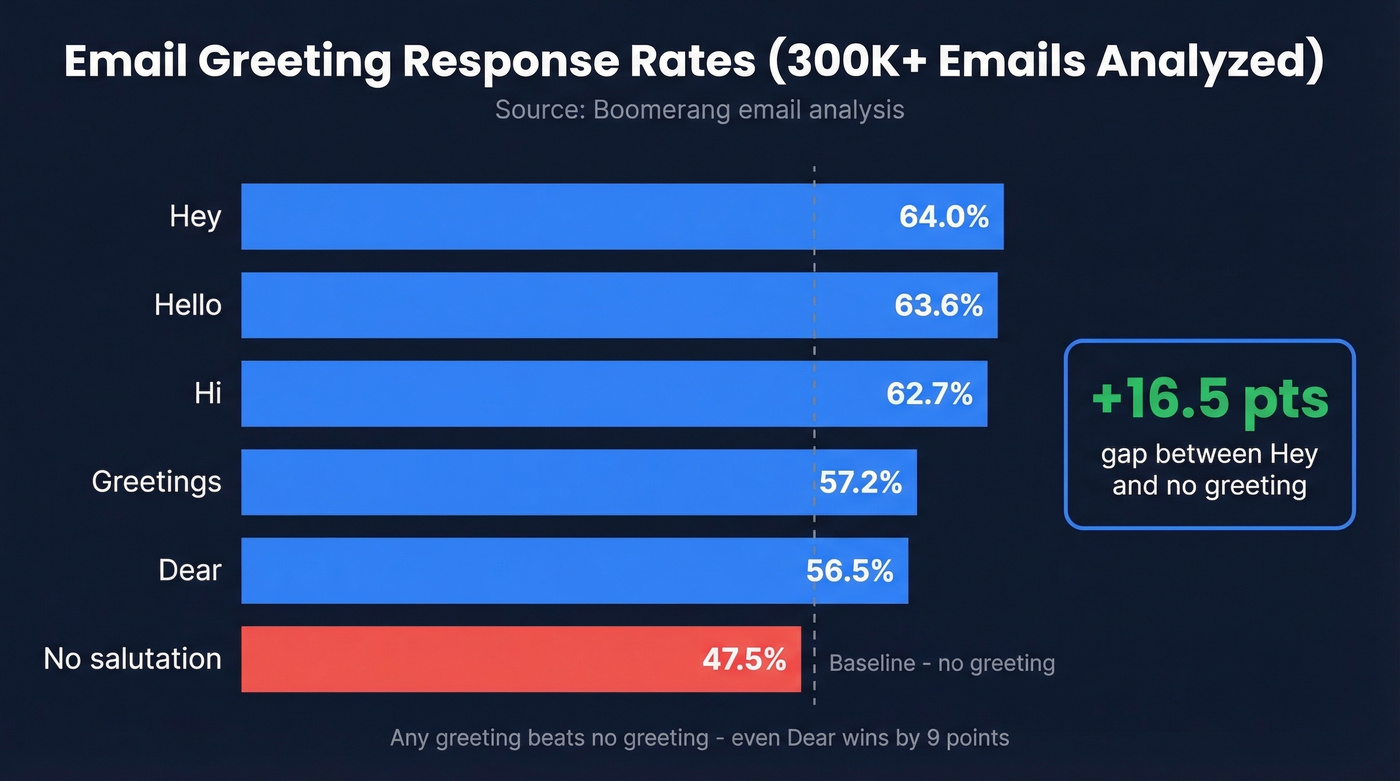
| Salutation | Response Rate | Best For |
|---|---|---|
| Hey | 64.0% | Peers, warm contacts, casual industries |
| Hello | 63.6% | Safe default for any business email |
| Hi | 62.7% | Cold outreach, first-time contacts |
| Greetings | 57.2% | Group emails, newsletters |
| Dear | 56.5% | Senior executives, formal industries |
| No salutation | 47.5% | Never - always use a greeting |
The gap between "Hey" and the dataset baseline is 16.5 percentage points. Even "Dear" - the most formal option - beats skipping a greeting by 9 points. A conversational tone signals you're a human writing to another human, not a system generating output.
This dataset comes from professional email threads, not exclusively cold outreach. In cold email, the greeting matters less than what follows it. But starting with "Hi [Name]" instead of diving straight into your pitch still sets a warmer frame for everything after.
Email Starters by Scenario
Cold Outreach to a Decision-Maker
The consensus on r/coldemail is brutal and simple: 40-60 words, total. Not 40-60 words for the opener - for the entire email. Every extra sentence is a reason to delete. (If you want more angles, borrow from these sales prospecting techniques.)
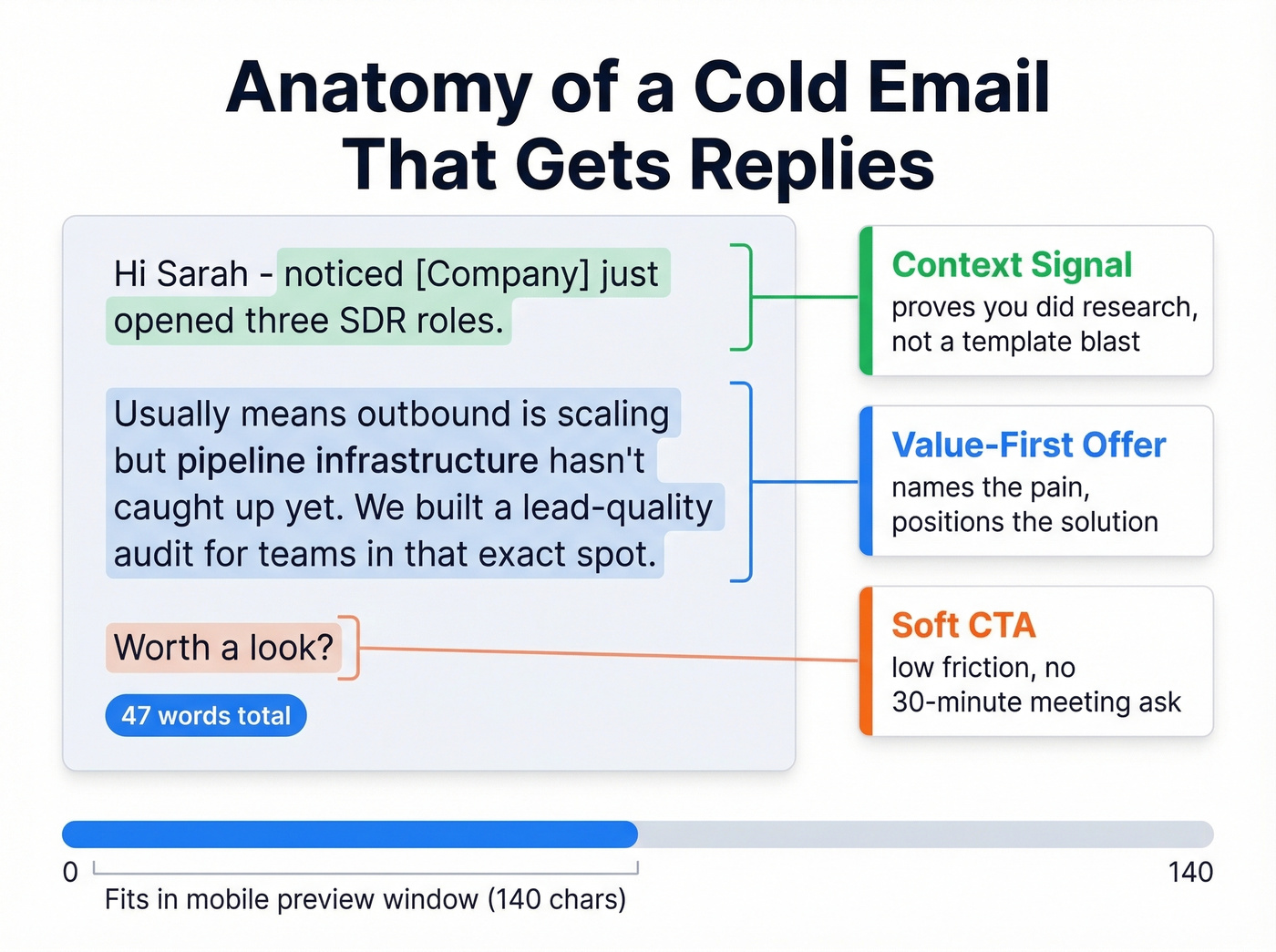
The structure that works: a context signal proving you did research, a value-first offer, and a soft CTA. If you're struggling with the ask, use these email call to action rules.
Hi Sarah - noticed [Company] just opened three SDR roles. Usually means outbound is scaling but pipeline infrastructure hasn't caught up yet. We built a lead-quality audit for teams in that exact spot. Worth a look?
That's 47 words. The context signal ("three SDR roles") proves you're not blasting a template. The CTA is low-friction - "worth a look" instead of "can we schedule 30 minutes." Specificity beats generic personalization every time. "Congrats on the funding round" is something 200 other reps already said. "Noticed you're hiring three SDRs" shows you actually looked.
In our experience, the context signal is what separates a 2% reply rate from a 6% one. We've consistently seen a 10-30% relative lift from relevance-first openers versus generic pleasantries.
Here's a second cold opener for a different angle - leading with a pain point instead of an observation:
Hi Marcus - most teams scaling past 5 AEs find their CRM data decays faster than they can enrich it. We cut that problem for [Similar Company] in two weeks. Quick demo worth your time?
Follow-Up After No Reply
Never say "just following up" without adding new value. It's the email equivalent of tapping someone on the shoulder and saying nothing.
Instead, bring something the first email didn't: a relevant case study, a data point, a different angle. Time it around three days after the first email - not ten. And keep it shorter than the original. (For ready-to-send options, see our sales follow-up templates.)
Hi Sarah - since my last note, [Competitor] published their outbound playbook. Two things jumped out that apply to your SDR ramp. Here's the breakdown: [link]
That's 30 words with a concrete reason to re-engage. Compare that to "Just wanted to circle back on my previous email" - which gives the recipient zero reason to respond.
Warm Intro or Reconnection
Warm emails have a massive built-in advantage: shared context. Use it in the first sentence, not after a pleasantry.
Hey Jordan - Alex mentioned you're rethinking your outbound stack. We just rebuilt ours from scratch and the results were night and day. Happy to share what worked.
Great conversation at SaaStr last week. You mentioned the enrichment problem - here's what we've seen work for teams your size: [link]
Congrats on the Series B. If you're scaling the sales team, we should talk about data infrastructure before the bad-data problems start.
The pattern: shared context first, value second, soft CTA third. No "I hope you're doing well" preamble. These opening lines work because they prove you have a reason to reach out.
Internal or Team Emails
Put the ask first. Internal emails don't need warmth - they need clarity. The military calls this BLUF (Bottom Line Up Front): lead with what you need, then provide context.
Need approval on the Q3 vendor budget by Friday. Details and comparison sheet below.
Compare that to "Hope everyone had a great weekend! I wanted to touch base about something..." which buries the point under 20 words of filler. We've seen teams cut internal email threads in half just by adopting BLUF.
International Recipients
Mirror the recipient's culture. American directness can read as rude in Germany or Japan, where more formal email openings are expected. When in doubt, match the register of local business correspondence.
Dear Dr. Muller - thank you for your time at the Berlin conference. I'd welcome the opportunity to discuss how our platform might support your team's expansion plans.
Skip idioms and abbreviations that don't translate. "Let's circle back" means nothing to someone in Tokyo.

Your opener earns the click. But if your email bounces, no one ever reads it. Prospeo's 98% email accuracy and 7-day data refresh mean every crafted opener actually lands in a real inbox - not a dead address.
Stop perfecting openers for emails that bounce. Fix the data first.
Phrases to Stop Using Immediately
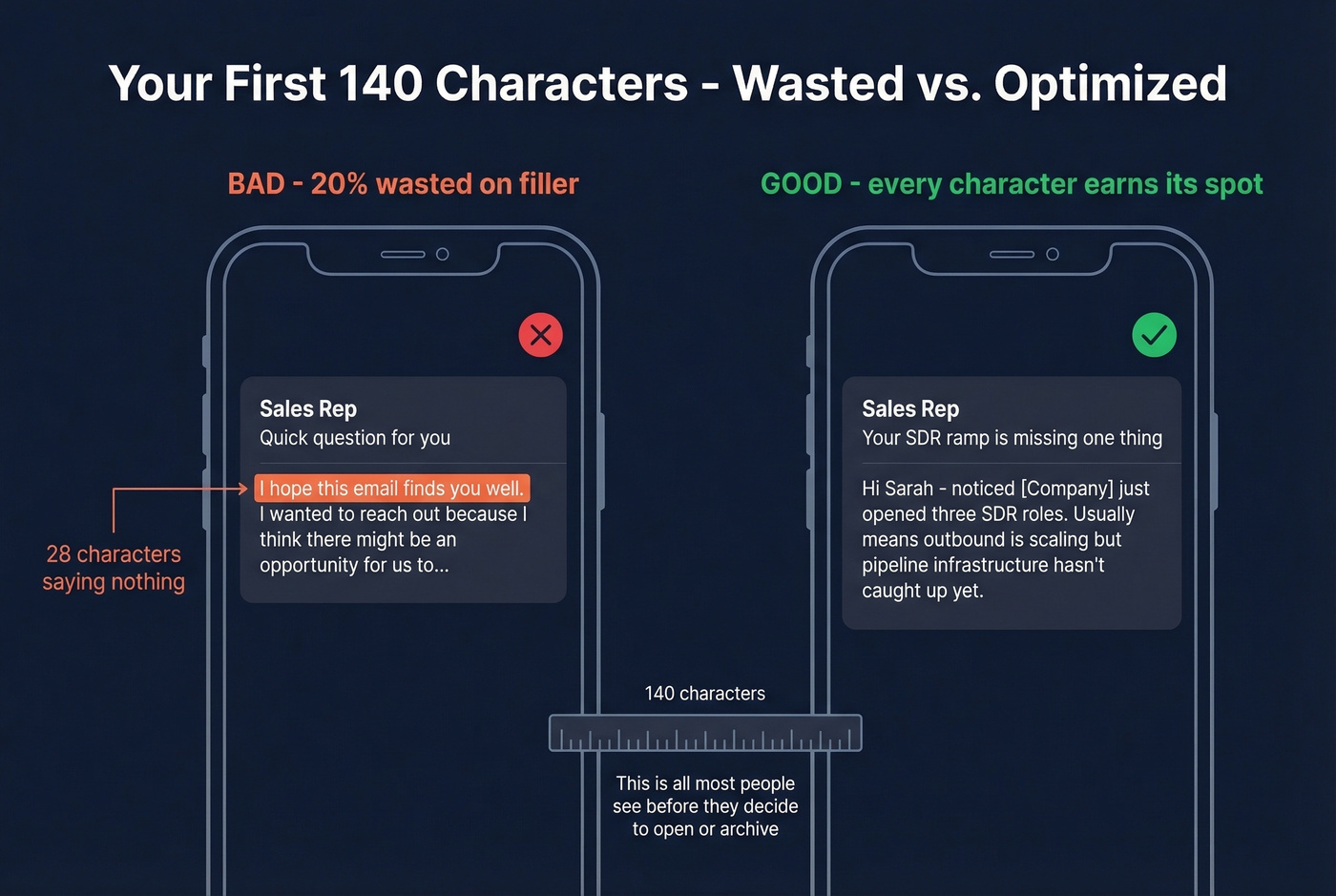
"I hope this email finds you well." Those 28 characters eat up 20% of your 140-character mobile preview, and they communicate nothing except "I couldn't think of a better way to start." Grammarly's own analysis flags it as overused and rooted in the letter-writing era.
"To Whom It May Concern." If you don't know who you're writing to, you haven't done enough research to be writing at all.
"Just following up." Without new value, this is a guilt trip disguised as politeness.
"I know you're busy, but..." You've just told the recipient that what follows isn't worth their time.
Here's the math: your first 140 characters are the only thing most recipients see before deciding to open or archive. Spending 28 of those characters on a pleasantry is like using a fifth of a billboard for your company's legal disclaimer.
The 140-Character Rule
Mobile email clients truncate previews at roughly ~140 characters. AI email summaries pull from the same opening text. Your first sentence isn't just an opener - it's the entire pitch for most recipients.
This is where BLUF becomes essential. Put your ask, your value proposition, or your most compelling hook in those first 140 characters. Not after a greeting. Not after a pleasantry.
The same logic applies to subject lines. Constant Contact's guidance is straightforward: front-load the value, keep it under 40 characters for mobile, skip ALL CAPS and excessive punctuation. Here's how a subject line and opener work together:
Subject: Your SDR ramp is missing one thing Opener: Hi Sarah - noticed [Company] just opened three SDR roles. Usually means outbound is scaling but pipeline infrastructure hasn't caught up yet.
Your subject line gets the open. Your first 140 characters get the read. Your offer gets the reply. Each one is a gate, and most emails fail at gate one or two. (Need more ideas? Steal from these email subject line examples.)
Beyond the Opener - The Full System
Look, if your reply rate is below 3%, rewriting your opener is the wrong move. Fix your infrastructure first. Start with the fundamentals in our email deliverability guide.
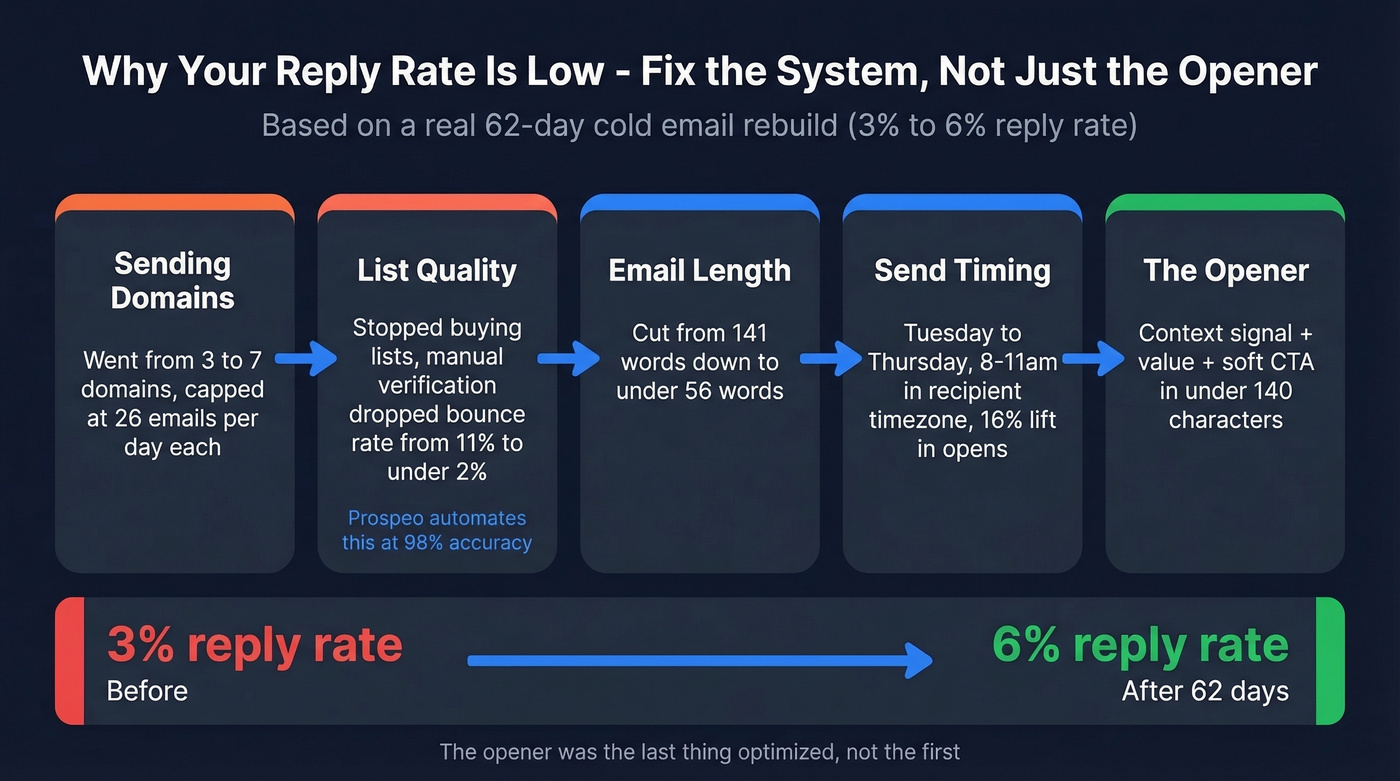
A practitioner on r/Entrepreneur documented their cold email rebuild over 62 days. Reply rates had cratered from 8% to 3% over 18 months. After the rebuild, they hit 6%. The opener wasn't the problem - everything around it was.
Sending domains went from 3 to 7, each capped at 26 emails per day. List-buying stopped entirely - manual verification dropped bounce rates from 11% to under 2%. Email length fell from 141 words to under 56. Sends shifted to Tuesday-Thursday, 8-11am in the recipient's timezone, which drove a 16% lift in opens.
The bounce rate fix is the one most teams skip. An 11% bounce rate doesn't just mean 11% of your emails fail - it degrades your sender reputation with every send, dragging down deliverability for the other 89%. That practitioner fixed it through manual verification. Prospeo automates this at scale with 98% email accuracy across 143M+ verified addresses and real-time verification that catches bad addresses before they hit your sending infrastructure.
The 300K-thread dataset reinforces this system view. Emails written at a 3rd-grade reading level produce a 36% lift. Slightly positive or slightly negative emotional tone generates 10-15% more responses than neutral. The 50-125 word sweet spot yields response rates above 50%. None of these are about the opener alone - they're about the entire email working as a unit.
Cold email benchmarks from Smartlead's dataset put the baseline at ~42% opens, ~3% replies, ~1% meetings booked. If you're below those numbers, don't start by rewriting your first line. Start by checking your list quality, your sending infrastructure, and your email length. The opener is the last thing to optimize, not the first.
That 47-word cold email only works when you have the right context signal. Prospeo gives you 30+ filters - job changes, hiring signals, funding rounds - so your opener proves you did the research.
Find the context signal that turns a 2% reply rate into 6%.
FAQ
Does the email greeting really matter?
Yes. Emails with any salutation outperform those without one by 9-17 percentage points in response rate, per the 300K-thread analysis. Conversational greetings like "Hey" and "Hi" beat formal options by 6-8 points. The biggest mistake isn't picking the wrong greeting - it's skipping one entirely.
Why aren't my cold emails getting replies?
If you're below a 3% reply rate, check your list quality before rewriting a single word. Bounced emails destroy sender reputation, which tanks deliverability for every message you send. Real-time verification catches invalid addresses before they hit your sending infrastructure - teams routinely cut bounce rates from 30%+ to under 4% after cleaning their lists.
How many opening line variations should I test?
Test three to five variations per campaign, rotating different context signals and value propositions across segments. Most teams find that relevance-first openers outperform generic templates by 10-30%, but the specific winner varies by industry and persona. Run each variant for at least 200 sends before drawing conclusions.
What should the first 140 characters of my email say?
Lead with a specific context signal or value statement - never a pleasantry. Mobile previews and AI summaries only capture ~140 characters, so those words are your entire pitch for most recipients. A strong pattern: "[Greeting + Name] - [specific observation about their company] + [one-sentence value hook]."