

The Best GTM Software in 2026 - Costs, Features, and What You Actually Need
A RevOps lead we know ran a full stack audit last quarter. Their GTM software stack: fourteen tools, $9,200/month. Three of them did essentially the same thing, and nobody could explain who owned the intent data workflow. That's not an edge case - it's the norm. The martech space hit 15,384 solutions in 2025, and instead of the promised consolidation wave, teams got what MarketBridge accurately called "AI-enhanced sprawl" - more point solutions, more overlap, more invoices.
Marketing teams now allocate 31.4% of their budget to technology, and ZoomInfo renewals keep landing like grenades. The consensus on r/SaaS is blunt: $20K+ annual is "wild" for a startup.
You don't need twelve go-to-market tools. You need three to five, chosen deliberately.
Our Picks
| Pick | Best For | Starting Price |
|---|---|---|
| Prospeo | Data accuracy & self-serve prospecting | Free tier; ~$0.01/email |
| Apollo.io | All-in-one for SMBs | Free; paid from $59/user/mo |
| Clay | Enrichment workflows & power users | Free; paid from $185/mo |
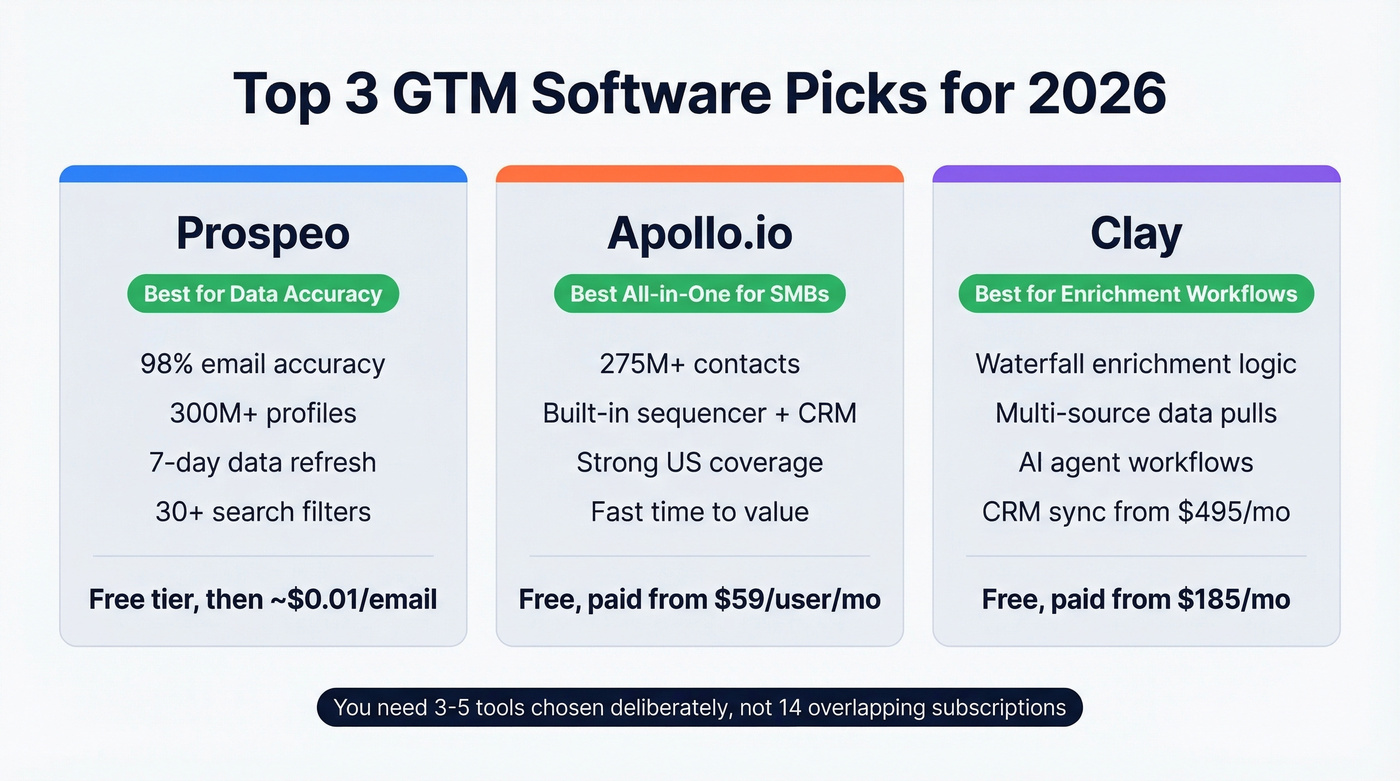
Prospeo leads on verified data quality - 98% email accuracy, a 7-day refresh cycle, and pricing that makes ZoomInfo look absurd. Apollo is the obvious starting point if you want database + sequencing + lightweight CRM in one tool. Clay is the standout enrichment platform in 2026, especially after its March 2026 pricing overhaul made CRM integrations accessible at a lower tier.
What Go-to-Market Software Does
GTM software is any tool that helps revenue teams find buyers, engage them, close deals, and measure what worked. Think of it as four pillars: Data (who to target), Outreach (how to reach them), Attribution (what's working), and AI/Orchestration (automating the connective tissue between everything else).
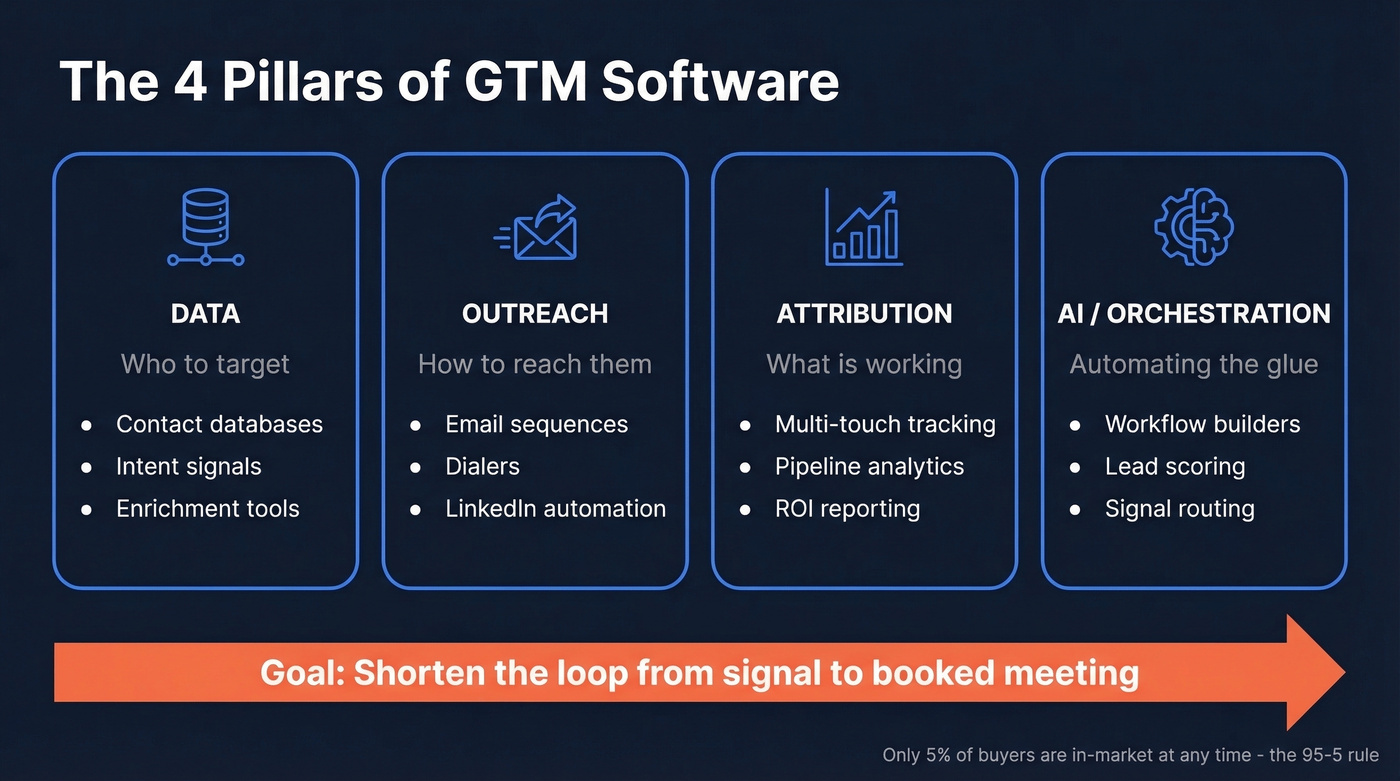
The 95-5 rule from the B2B Institute frames why this matters: 95% of your potential buyers are out-of-market at any given time. Only 5% are actively looking. Your entire stack exists to find and convert that 5% - and to stay visible to the 95% so you're top of mind when they enter the market. The metric that matters most isn't feature count. It's speed-to-meeting. How fast can your reps go from signal to booked call? Every tool you buy should shorten that loop. If it doesn't, it's bloat.
GTM benchmarks show top sellers close deals 3x faster and generate 11x more revenue per day than average performers. The gap isn't talent - it's tooling and process.
Best GTM Software Platforms in 2026
Prospeo
Use this if: You need verified contact data that actually works - emails that don't bounce, mobiles that get picked up, and a refresh cycle that doesn't leave you prospecting with stale records.
Skip this if: You're looking for a full sequencing platform or built-in dialer. Pair Prospeo with an engagement tool like Outreach or Lemlist for that.
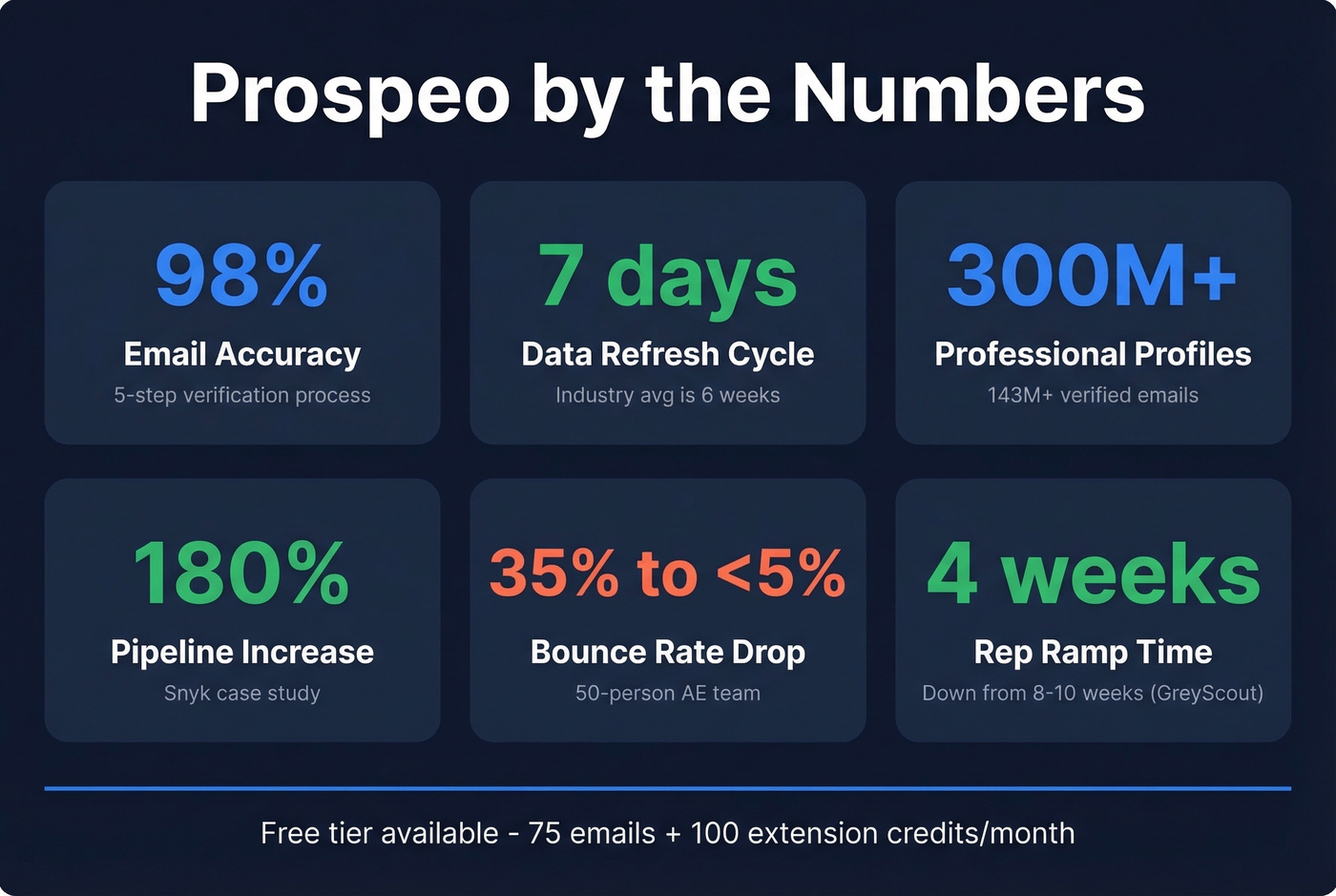
Prospeo's B2B database covers 300M+ professional profiles, 143M+ verified emails, and 125M+ verified mobile numbers with a 30% pickup rate across all regions. The 98% email accuracy comes from a proprietary email-finding infrastructure that doesn't rely on third-party providers - a 5-step verification process with catch-all handling, spam-trap removal, and honeypot filtering. The 7-day data refresh cycle is the real differentiator; the industry average is about 6 weeks, which means a meaningful chunk of records are already decaying by the time you export them.
The 30+ search filters include buyer intent powered by Bombora (15,000 topics), technographics, job changes, headcount growth, and funding signals. The Chrome extension has 40,000+ users and works across company websites and professional profiles. CRM and CSV enrichment returns 50+ data points per contact at a 92% API match rate, with native integrations into Salesforce, HubSpot, Smartlead, Instantly, Lemlist, Clay, Zapier, n8n, and Make.
The proof is in the pipeline numbers. Snyk's 50-person AE team dropped bounce rates from 35-40% to under 5% and saw AE-sourced pipeline jump 180%, generating 200+ new opportunities per month. GreyScout doubled their sales team and cut rep ramp time from 8-10 weeks to 4 while pipeline climbed 140%.
Pricing runs ~$0.01 per email with a free tier (75 emails + 100 Chrome extension credits per month). No contracts, no sales calls, self-serve onboarding.
ZoomInfo
Use this if: You're a 200+ person sales org running outbound, ABM, and intent from a single platform, and you have the budget and ops team to extract full value.
Skip this if: You're under 100 employees, your ACV is below $50K, or you don't have a dedicated RevOps person to manage the implementation.
ZoomInfo is the 800-pound gorilla of GTM data. List prices run $14,995-$35,995/year by tier, but that's misleading - most teams pay $30K-$75K+ annually once you add seats, modules, and intent data. Vendr's procurement data shows SalesOS contracts ranging from $24,800 to $161,900 depending on headcount. Discounts of 30-65% are common if you negotiate hard, but you'll still land well above what smaller tools cost.
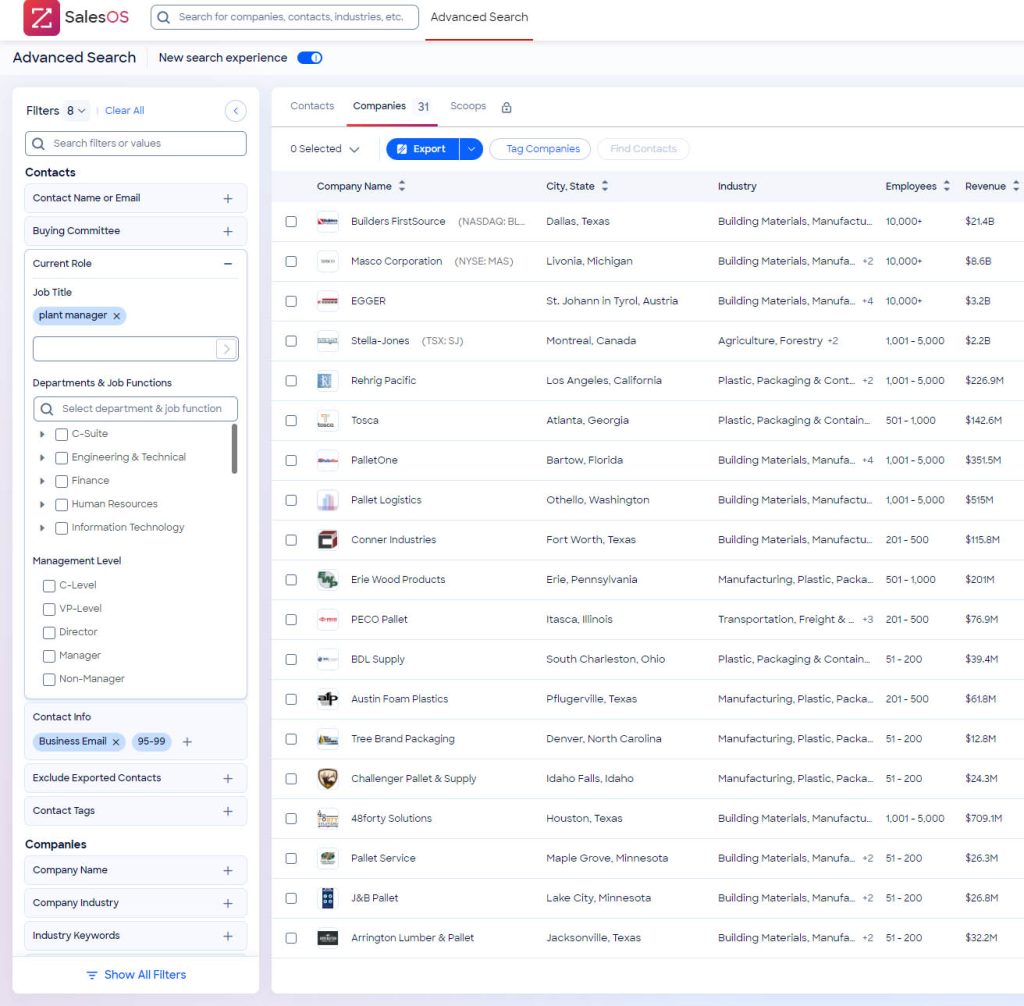
Here's the thing: ZoomInfo is still the best all-in-one go-to-market platform for enterprise. But most teams don't need all-in-one - they need accurate data and a good sequencer, and they're paying $50K/year for features they never touch.
Apollo.io
Use this if: You're an SMB that wants database, sequencing, and a lightweight CRM without stitching together three separate tools.
Skip this if: You're selling heavily into EMEA or need phone-verified mobile numbers. Apollo's data accuracy drops off noticeably outside the US, and email accuracy sits around 79% - roughly 1 in 5 emails bounce.
Apollo runs a hybrid pricing model: per-user fees plus usage-based credits. The tier structure breaks down as Free / Basic ($59/user/mo) / Professional ($99/user/mo) / Organization ($149/user/mo, annual-only, minimum 3 seats). Credits get consumed for searching contacts, revealing mobiles, and exporting data - and they don't roll over. That expiration mechanic catches teams off guard, especially on the Organization plan where three seats burn through credits fast.
The free tier is legitimately useful for solo founders testing outbound. The database is strong for US contacts, and the built-in sequencer means you can go from search to send without leaving the platform. Where Apollo falls short: data accuracy and international coverage. Where it wins: price, speed to value, and the fact that you can be running sequences within an hour of signing up.
If you're comparing providers, start with a dedicated guide to sales prospecting databases before you commit.
Clay
Use this if: You're a power user or GTM engineer who wants to build custom enrichment workflows with waterfall logic, AI agents, and multi-source data.
Skip this if: You want a simple search-and-export database. Clay has a learning curve, and it's not the right tool for someone who just needs a list of emails.
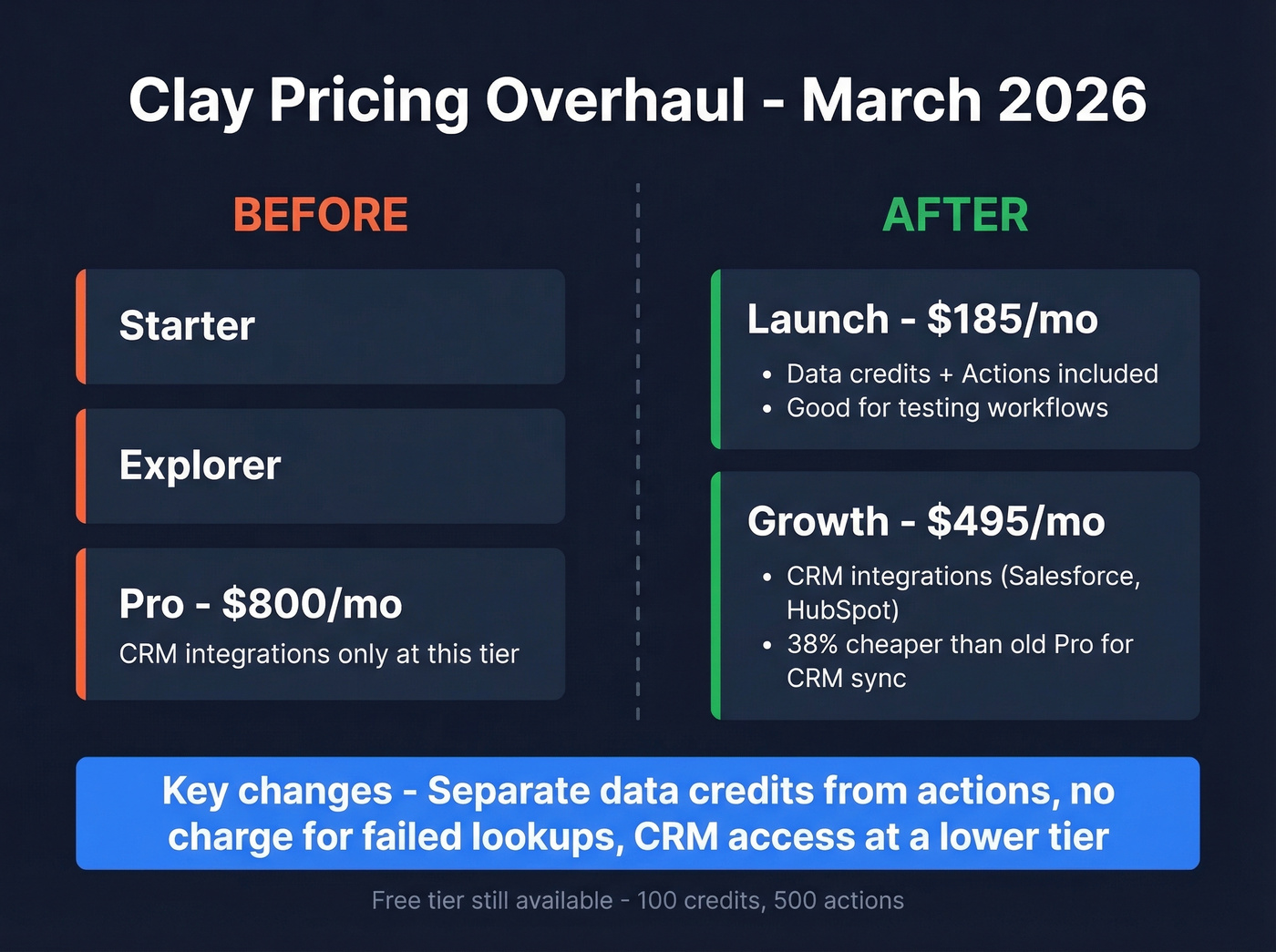
Clay's March 2026 pricing overhaul made it more accessible. The old Starter/Explorer/Pro tiers are gone, replaced by Launch ($185/mo) and Growth ($495/mo). The big win: CRM integrations dropped from the $800/mo Pro tier to the $495/mo Growth tier - a 38% price cut for teams that need Salesforce or HubSpot sync.
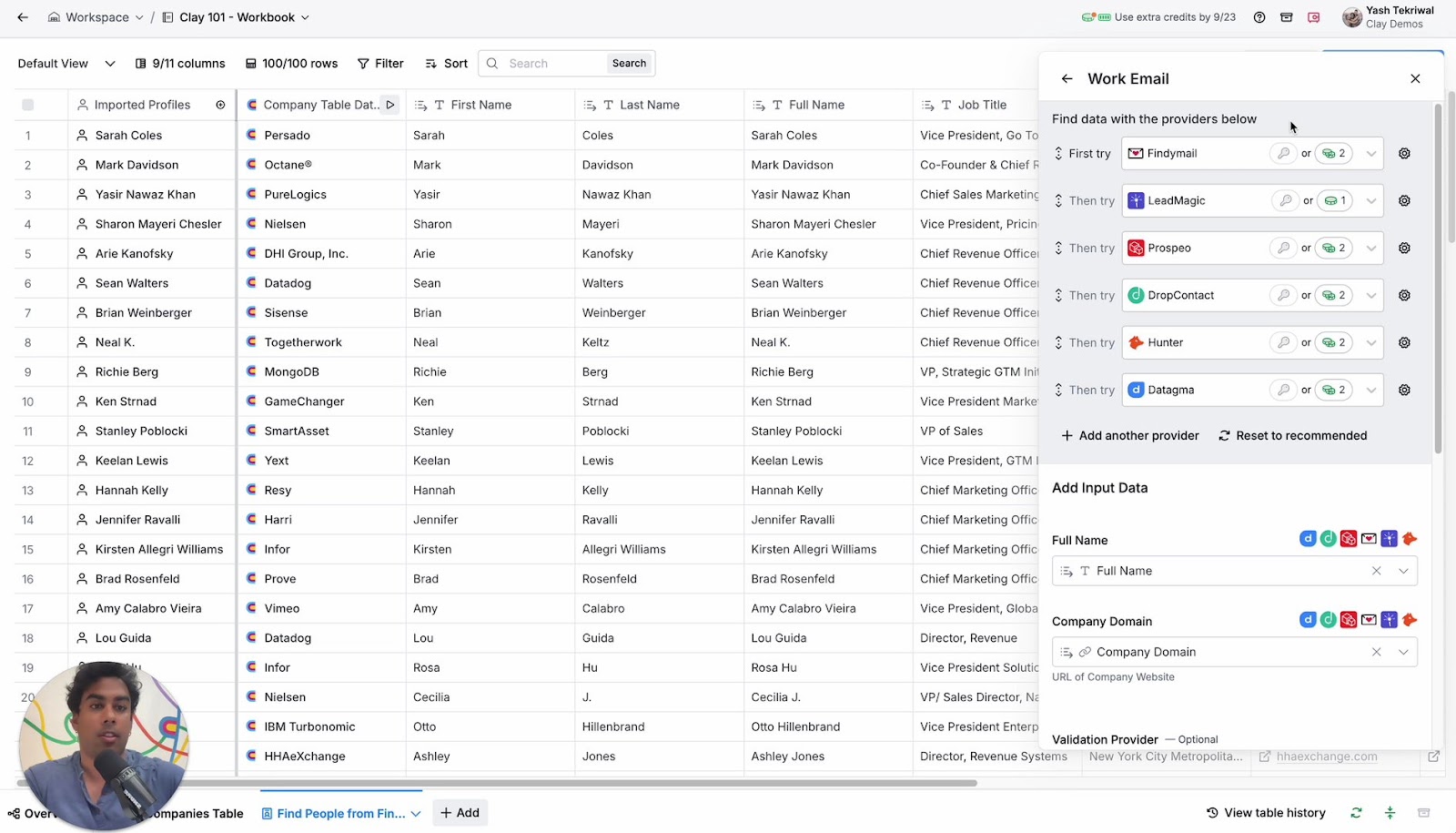
Clay now separates Data Credits (for buying data) from Actions (for running workflows), and they don't charge for failed lookups. The waterfall enrichment approach - pulling from multiple data sources sequentially until you get a match - consistently outperforms single-source tools. Reddit's r/sales crowd keeps naming Clay as a favorite, and for good reason. The free tier (100 credits, 500 actions) is enough to test whether the workflow-builder approach fits your team.
If you want a more tactical walkthrough, see our breakdown of Clay list building.
6sense
Use this if: You're running enterprise ABM with $50K+ ACVs, you have a dedicated ops team, and you need account-level intent signals to prioritize pipeline.
Skip this if: Your deal sizes are in the four-figure range or you don't have someone who can operationalize intent data.
6sense offers a free tier with 50 credits/month - enough to kick the tires on Company & People Search, Sales Alerts, and the Chrome Extension. The real product lives behind custom pricing that typically runs $60K-$200K+ per year, often with two-year commitments. Credits don't roll over.
The platform combines intent data, predictive analytics, and account identification in ways that are genuinely powerful for enterprise ABM. Forrester research suggests AI-driven pipeline prioritization yields 15-20% higher forecast accuracy and 30% faster conversion rates. But 6sense only delivers that ROI if you have the team and deal sizes to justify the investment. For most companies under $50M ARR, the money is better spent on data quality and outreach execution. Before you sign, model total cost of ownership including implementation and training - not just the license fee.
If you're building an intent motion, align it with intent based segmentation so signals actually route to action.
Cognism: The EMEA Answer
If you're selling into Europe, this is the comparison that matters. Cognism's positioning is strongest in EMEA, especially for phone-verified mobile numbers and coverage across European markets. ZoomInfo still wins on US database depth and workflow breadth. Cognism also emphasizes GDPR and CCPA compliance, including DNC handling in multiple countries. Expect ~$1,000-$3,000/mo for small teams, scaling from there. One r/sales user summed it up: "Cognism for Europe, ZoomInfo for the US, and honestly you might not need both."
HubSpot
HubSpot is the default CRM for SMBs, and it's increasingly a go-to-market platform in its own right. The free CRM is a real product, not a demo. Marketing Hub pricing spans from low-cost Starter tiers to Enterprise plans that run into the thousands per month, and Breeze Intelligence adds enrichment capabilities natively.
The tradeoff is real, though: you get CRM + marketing automation + basic enrichment without managing multiple vendors, but you're locked into HubSpot's ecosystem. Outgrowing it means a painful, expensive migration. For teams under 50 people who aren't sure they'll outgrow it? Hard to beat.
If you're still evaluating CRMs, it helps to review a few examples of a CRM side-by-side.
Gong
The ROI case for Gong is simple: it records calls, surfaces deal intelligence, and provides AI coaching that changes rep behavior. At ~$100-$150/user/mo, it's not cheap. But for mid-market+ teams with complex sales cycles, understanding why deals stall matters more than generating more leads. If your reps are booking meetings but deals keep dying in Stage 3, Gong will tell you exactly what's going wrong. When your problem is top-of-funnel volume, spend the money elsewhere.
Outreach
Outreach runs ~$100-$130/user/mo for multichannel sequences with AI-powered workflows. The AI features have gotten meaningfully better in 2026 - smart send times, automated A/B testing, and deal risk scoring. Best for teams with 10+ SDRs who need structured, repeatable outbound at scale.
If you're rolling this out across a team, follow a real plan for implementing a sales engagement platform.
SalesLoft
Salesloft now combines sales engagement with revenue intelligence and forecasting. At ~$75-$125/user/mo, it's slightly cheaper than Outreach and offers pipeline visibility that Outreach doesn't match natively. Best for teams that want engagement + forecasting in one platform without buying separate tools for each.
HockeyStack
HockeyStack handles multi-touch attribution and account-level analytics for B2B marketing teams. Pricing is custom and typically lands around ~$1K-$5K/mo for mid-market. If your CMO is asking "what's working?" and nobody can answer confidently, HockeyStack is the tool that fixes that.
Demandbase
Demandbase combines ABM, intent data, and advertising in one enterprise platform. Pricing typically runs $30K-$100K+/year, and it requires a dedicated ops team. Compared to 6sense, Demandbase leans harder into the advertising side - coordinating display campaigns with sales outreach based on account-level intent signals.
Brief Mentions
- Clearbit / Breeze Intelligence - Enrichment inside the HubSpot ecosystem. Clearbit-style enrichment is typically priced at $20K+/year depending on volume; Breeze Intelligence is HubSpot-native for teams already on that stack.
- UserGems - Tracks job changes among your customers and prospects, surfacing warm leads when champions move to new companies. Custom pricing; ~$1K-$3K/mo is common.
- Warmly - Website visitor identification that de-anonymizes traffic and routes to reps. ~$500-$2K/mo. Best for inbound-heavy teams.
- Unify - AI-powered outbound orchestration that automates prospecting workflows. ~$500-$1,500/mo. Best for lean teams that want AI agents handling top-of-funnel.
If you're trying to keep spend down early, start with a shortlist of free lead generation tools and add paid tools only when you hit a real ceiling.

Your GTM stack is only as good as its data layer. Prospeo gives you 300M+ profiles with 98% email accuracy, 125M+ verified mobiles, and a 7-day refresh cycle - at ~$0.01/email. No $50K contracts. No six-week-old records.
Cut the bloat. Start with data that actually connects you to buyers.
Snyk's 50 AEs dropped bounce rates from 35% to under 5% and grew pipeline 180% - because their GTM data stopped decaying. Prospeo's 7-day refresh cycle and 5-step verification mean your reps prospect with live records, not last quarter's leftovers.
Stop paying enterprise prices for data that's already stale.
GTM Software Comparison
| Tool | Category | Starting Price | Best For | Our Take |
|---|---|---|---|---|
| ZoomInfo | Data & Intelligence | ~$15K/yr (list) | Enterprise platform | Enterprise-only; overpay risk |
| Apollo.io | Data & Intelligence | Free; $59/user/mo paid | SMB all-in-one | Start here if budget-constrained |
| Clay | Enrichment & Orchestration | Free; $185/mo paid | Power users, GTM engineers | Most flexible enrichment tool |
| 6sense | ABM & Intent | Free; ~$60K/yr paid | Enterprise ABM | Worth it above $50K ACV only |
| Cognism | Data & Intelligence | ~$1K-$3K/mo | EMEA-focused teams | Best for European markets |
| HubSpot | CRM & Marketing | Free; low-cost Starter tiers | SMB CRM + marketing | Default SMB CRM for a reason |
| Gong | Conversation Intelligence | ~$100-$150/user/mo | Deal execution | Best for fixing Stage 3+ losses |
| Outreach | Sales Engagement | ~$100-$130/user/mo | Mid-market outbound | Gold standard for 10+ SDR teams |
| Salesloft | Sales Engagement | ~$75-$125/user/mo | Engagement + forecasting | Better value than Outreach |
| HockeyStack | Attribution | ~$1K-$5K/mo | Marketing attribution | Best answer to "what's working?" |
| Demandbase | ABM | ~$30K-$100K+/yr | Enterprise ABM + ads | 6sense alternative, ad-heavy |
How to Build Your Stack
The right stack depends on your budget and GTM motion, not on what's trending on LinkedIn.
The $500/mo Stack (Startups & Founders)
The $2K-$5K/mo Stack (Growth-Stage Teams)
A dedicated data provider for enrichment, Clay for waterfall enrichment and workflow automation, a paid CRM (HubSpot Starter or Salesforce), and one engagement tool like Outreach, Salesloft, or Lemlist. This stack gives you verified data flowing through automated enrichment into structured sequences. It's the sweet spot for teams of 5-20 reps.
If you're building this from scratch, start with proven sales prospecting techniques so the tools actually get used.
The $10K+/mo Enterprise Stack
ZoomInfo or Cognism for database depth, 6sense or Demandbase for intent and ABM, Gong for conversation intelligence, and Outreach or Salesloft for engagement. This is the full-featured stack for 50+ person sales orgs with dedicated RevOps. Expect $10K-$25K/mo depending on seat counts and modules. Before committing at this level, run a proof of concept with your top two or three vendor finalists to validate data quality and integration fit with your existing workflows.
GTM Stack Mistakes to Avoid
1. Buying tools before mapping workflows. As one Reddit practitioner put it: "Tools don't create use cases. Tools solve problems." Map your end-to-end process first, identify the repetitive or time-consuming steps, decide what to automate - then choose your stack. The reverse order is how teams end up with fourteen tools and no clarity.
2. Paying for overlapping features. This is the "AI-enhanced sprawl" problem: teams keep adding AI point solutions without retiring old ones. Apollo has a CRM. HubSpot has enrichment. Outreach has analytics. Before adding a new tool, audit whether an existing one already covers 80% of that function.
3. Ignoring credit mechanics. Apollo credits don't roll over. 6sense credits expire at the end of each billing cycle. Clay separates Data Credits from Actions. If you don't model your burn rate before signing, you'll either overpay for unused credits or hit walls mid-month. We've watched teams blow through a quarter's worth of credits in six weeks because nobody did the math upfront.
If you're running cold email, keep an eye on email bounce rate so bad data doesn't tank deliverability.
4. Chasing the hype cycle. Let's be honest - we've all seen it. A team switches tools three times in nine months: Clay to an AI agent nobody's heard of, back to Apollo, then to a "next-gen" platform that shuts down. Each migration costs two weeks of productivity and wipes out institutional knowledge. The "LinkedIn echo chamber" effect is real. Pick your stack, commit for at least two quarters, and actually learn the tools before deciding they don't work.
5. Skipping the integration audit. A tool that doesn't integrate with your CRM creates manual work that compounds every week. Before you buy, confirm the integration exists, test it in a sandbox, and verify that data flows bidirectionally. A tool that can't push enriched data back into Salesforce isn't saving you time - it's creating a new workflow.
6. Ignoring data compliance. GDPR and CCPA aren't optional, and using non-compliant data providers creates legal risk that scales with your contact volume. Verify that your data vendors have clear opt-out enforcement and DPAs available before you import a single record.
FAQ
What is GTM software?
GTM software is any tool that helps revenue teams execute their go-to-market strategy - finding buyers, engaging them, closing deals, and measuring results. It spans four categories: data and intelligence, outreach and engagement, attribution and analytics, and AI orchestration. Most teams need three to five tools across these pillars.
How much does a full GTM stack cost?
Startups can run a functional stack for under $500/mo using free tiers from Prospeo, Apollo, and HubSpot. Mid-market teams typically spend $2K-$10K/month. Enterprise stacks with ZoomInfo, 6sense, and Gong easily exceed $15K/month. Match spend to deal size - your stack shouldn't cost more than a few closed deals per quarter.
What are the best go-to-market tools for startups?
Prospeo's free tier (75 verified emails/mo) handles contact data, Apollo covers sequencing without a paid plan, and HubSpot's free CRM keeps everything organized. This combination covers data, outreach, and CRM for under $500/mo - enough to validate your motion before scaling spend.
What's the difference between GTM software and a CRM?
A CRM stores relationship data - contacts, deals, activities, notes. GTM software is the broader ecosystem that feeds and acts on that data: providers that find contacts, engagement tools that run sequences, intent platforms that prioritize accounts, and analytics that measure pipeline contribution. Your CRM is one piece, not the whole stack.
Which tool has the most accurate B2B data?
Prospeo leads with 98% email accuracy and a 7-day data refresh cycle, compared to roughly 87% for ZoomInfo and 79% for Apollo. The 125M+ verified mobile numbers with a 30% pickup rate add another layer of reliability. For teams hurt by bounced emails or disconnected numbers, data freshness matters most.