

How to Build a GTM Team That Actually Works in 2026
A VP of Sales quits six months into a product launch. Marketing blames sales for not following up on leads. Sales blames marketing for sending garbage. The CEO blames everyone. We've watched this exact scenario play out repeatedly - and every time, the root cause wasn't talent. It was alignment.
That's why so many GTM teams implode despite having smart people in every seat.
53% of companies experience a broken handoff where sales follows up with fewer than 35% of marketing-engaged prospects. Only 11% achieve both an effective handoff and high audience overlap. Those numbers explain why most go-to-market teams feel like they're running on fumes - and why "just hire better" isn't the fix.
What You Need (Quick Version)
A GTM team isn't a department. It's a cross-functional revenue unit with shared metrics and clear ownership. Most fail because of alignment chaos, not missing talent. What follows covers how to build one from scratch: roles by stage, a RACI framework, the metrics that actually matter (with formulas), and the minimum viable tech stack to tie it all together.
What a Go-to-Market Team Actually Is
Let's clear something up: a go-to-market team isn't "sales and marketing working together." That framing undersells what's required and oversimplifies the coordination problem.
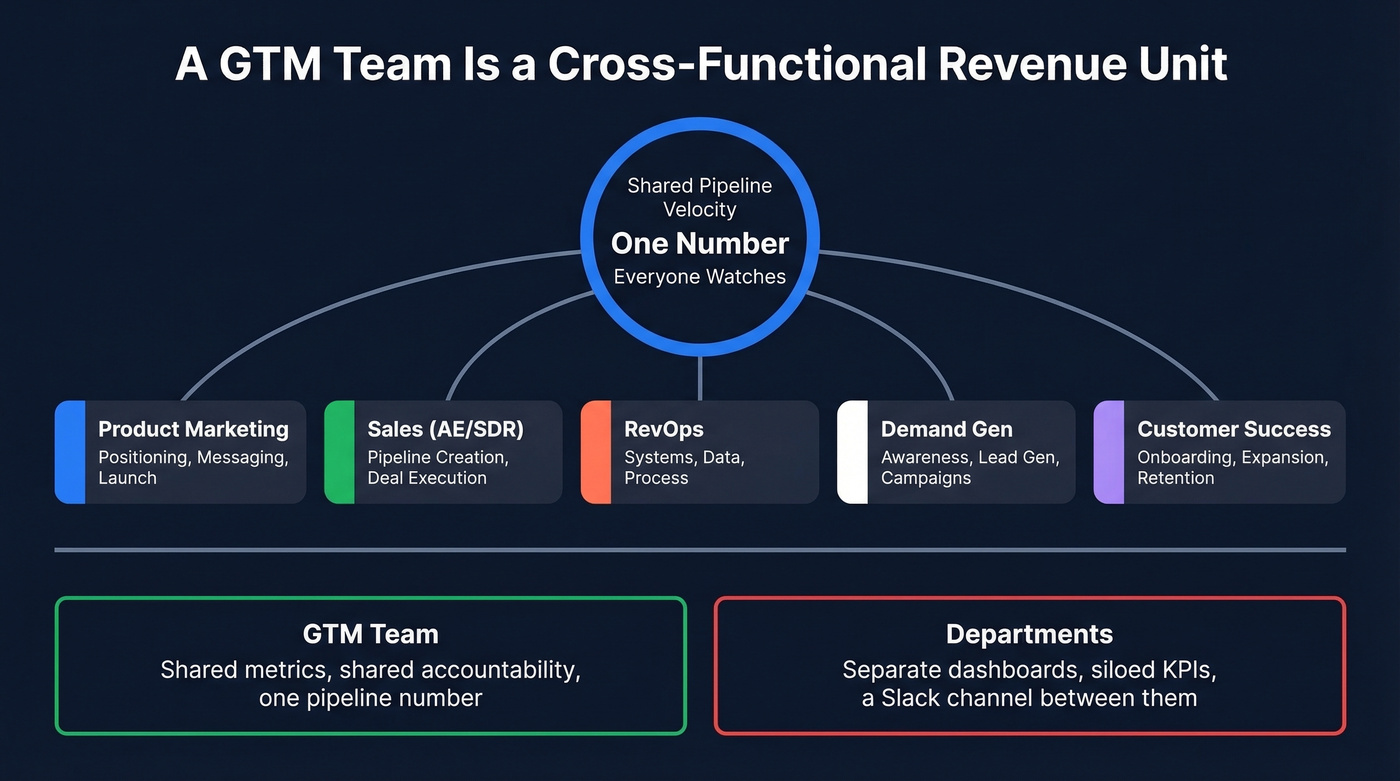
It's a cross-functional revenue unit spanning marketing, sales, product marketing, RevOps, and customer success - all operating against shared goals and shared accountability. The key word is shared. When marketing gets rewarded for MQLs and sales gets measured on closed revenue, you don't have a unified team. You have two departments with a Slack channel between them.
The distinction changes how you hire, how you measure, and how you run your operating cadence. A real go-to-market organization has a single pipeline velocity number that everyone watches. Departments have dashboards that nobody outside their function ever opens.
Why Most GTM Teams Underperform
A common pattern on r/ProductMarketing is what one PMM called the "Frankenstein plan." Marketing gets pressured to generate pipeline for a product that isn't fully ready - missing pricing, missing PS support, missing enablement materials. Leadership sets pricing that contradicts competitive research. Sales targets get set without win/loss data. The result is a plan stitched together from conflicting opinions rather than upstream research.
Most failures aren't execution problems. They're readiness problems. Proponent's analysis identifies seven failure modes, and these four show up constantly:
- Mistaking internal confidence for market readiness. The product team is excited. The board is excited. Nobody validated with enough prospects whether they'd actually pay.
- Treating early traction as proof of scalable fit. Early adopters aren't mainstream buyers. What works at 20 customers often breaks at 200.
- Assuming buying journeys are linear. 85-90% of the B2B buying process now happens without live calls. Buyers loop back, stall, and re-enter at random stages. Your motion needs to meet them wherever they are, not force them through a funnel.
- Siloed KPIs that create misaligned incentives. Marketing optimizes for MQLs. Sales optimizes for revenue. CS optimizes for retention. Nobody optimizes for the customer journey.
There's also an invisible tax most teams ignore: data quality. When 20%+ of your contact data is stale, every downstream metric suffers - bounce rates spike, domain reputation drops, SDR productivity craters. We've seen teams fix this single variable and watch their entire outbound motion improve within weeks.
Core Roles and Functions
Every go-to-market organization needs clear ownership boundaries. Fuzzy role definitions are how you end up with three people building competing pitch decks and nobody owning the launch timeline.
| Role | Primary Ownership |
|---|---|
| Product Marketing | Positioning, messaging, launch |
| Sales (AE/SDR) | Pipeline creation, deal execution |
| RevOps | Systems, data, process, reporting |
| Marketing (Demand Gen) | Awareness, lead gen, campaigns |
| Customer Success | Onboarding, expansion, retention |
| Sales Enablement | Training, content, playbooks |
Three emerging roles are worth watching. GTM Engineers - hybrid ops/technical people who build automated workflows across your stack - are a best-fit hire around the $2-5M ARR stage. Partnerships/Channel leads matter once you've proven direct sales works and want to layer distribution. BI/Analytics specialists become essential when your data volume outgrows RevOps' bandwidth.
The ownership boundary that causes the most friction? Pricing and packaging. Product thinks they own it. PMM thinks they own it. Sales has opinions. Finance has a spreadsheet. Assign a single accountable owner in your RACI or watch this become a six-month committee exercise.

You just read that 20%+ stale contact data taxes every downstream GTM metric. Prospeo refreshes all 300M+ profiles every 7 days - not the 6-week industry average. That means your SDRs prospect with 98% accurate emails, your demand gen campaigns actually land, and your RevOps team stops firefighting bounce rates.
Fix the data layer and watch your entire GTM motion accelerate.
GTM Team Structure by Stage
Staffing a B2B go-to-market team is a sequencing problem, not a headcount problem.
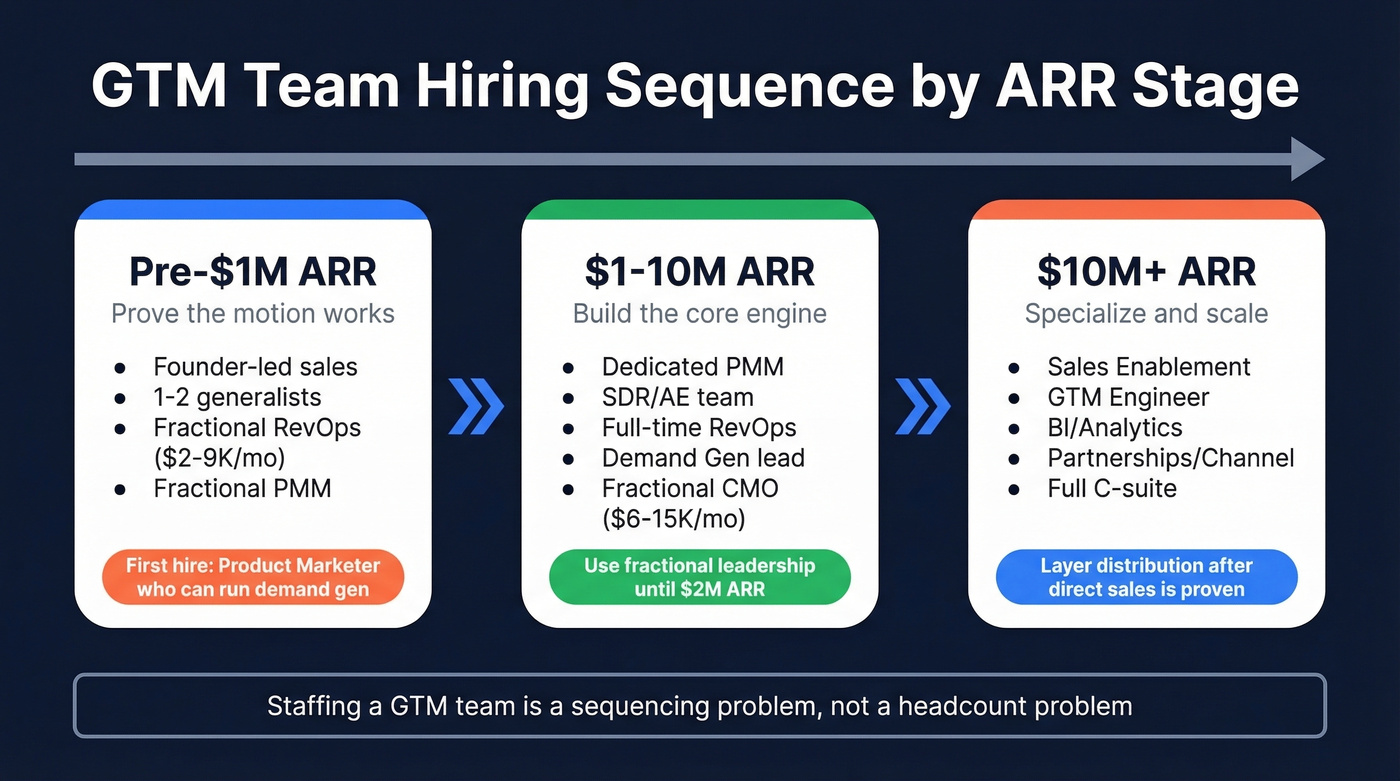
| ARR Stage | Core Team | Hiring Priority |
|---|---|---|
| Pre-$1M | Founder + 1-2 generalists | Fractional RevOps, PMM |
| $1-10M | PMM, SDR/AE, RevOps, Demand Gen | First dedicated hires |
| $10M+ | Specialized functions across all roles | Enablement, BI, Partnerships |
The fractional vs. full-time decision is real at early stages:
| Role | Fractional Cost | Full-Time Cost |
|---|---|---|
| CMO | $6-15K/mo | $250-350K+/yr |
| GTM Engineer | $2-9K/mo | $120-180K/yr |
| Agency (demand gen) | $3-25K+/mo | N/A |
These aren't theoretical numbers. SocialLadder brought on a fractional CMO and saw a 130% increase in qualified opportunities, a 220% rise in qualified outbound, and a 135% jump in pipeline value - all without committing to a $300K+ full-time salary.
Before you open a req, answer five questions: Is this a leadership, specialty, or capacity problem? Is the work stable for the next 12 months? Does the role require deep internal context daily? What's the cost of a 3-month recruiting cycle? And who'll manage this person?
Our hiring sequence opinion: the first hire after founder-led sales should be a product marketer who can also run demand gen. Not a VP of Sales. Not a BDR. A PMM who understands positioning, can write a cold email sequence, and knows how to measure what's working. Use fractional leadership until $2M ARR. One underrated early investment: a full-time or contract designer. Brand quality compounds faster than most founders realize, and scrappy design stops being charming around your 50th customer.
The RACI - Who Owns What
The Frankenstein plan problem from earlier? A RACI prevents it. Here's a matrix you can steal:
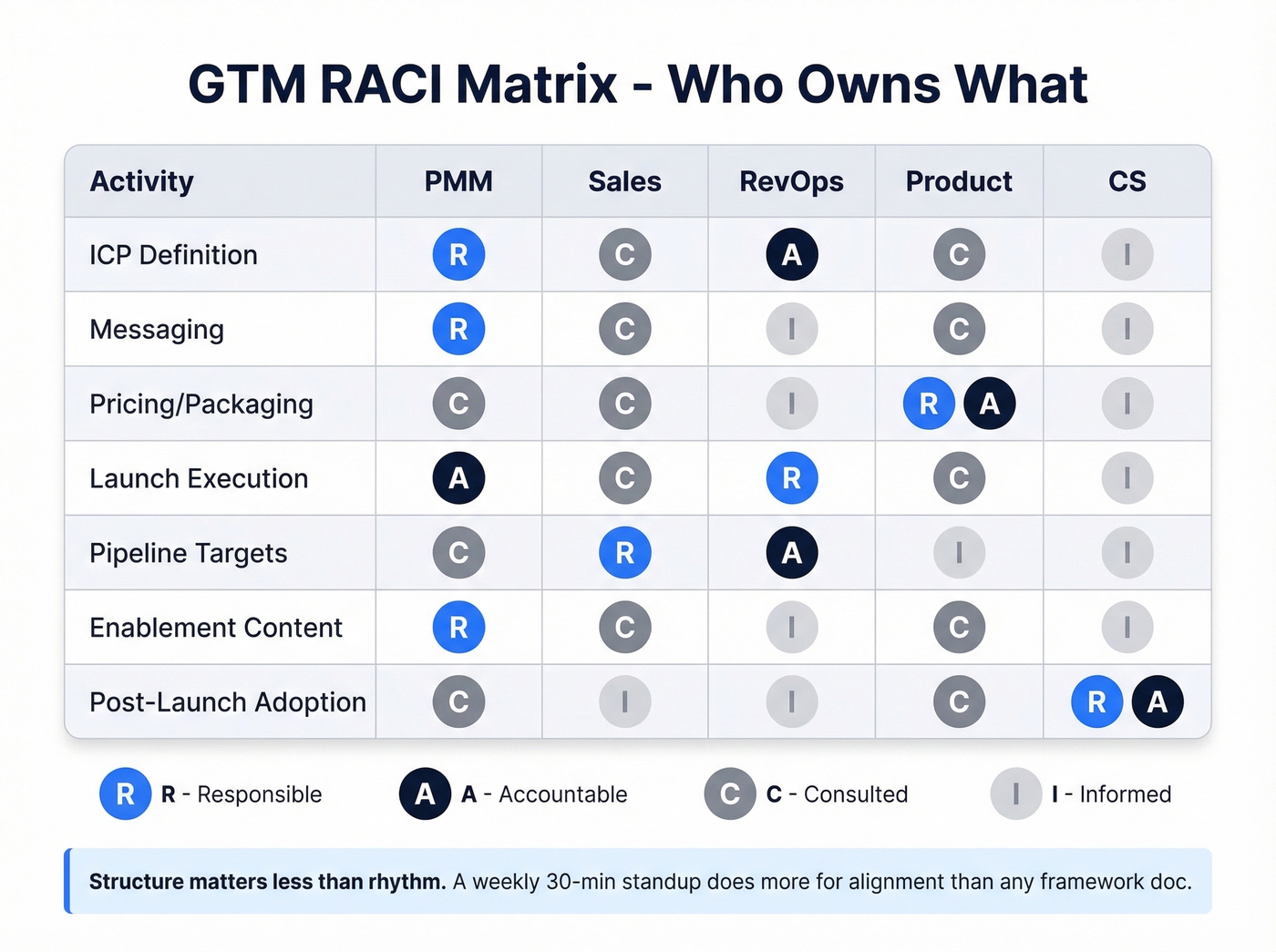
| Activity | PMM | Sales | RevOps | Product | CS |
|---|---|---|---|---|---|
| ICP definition | R | C | A | C | I |
| Messaging | R | C | I | C | I |
| Pricing/packaging | C | C | I | R/A | I |
| Launch execution | A | C | R | C | I |
| Pipeline targets | C | R | A | I | I |
| Enablement content | R | C | I | C | I |
| Post-launch adoption | C | I | I | C | R/A |
R = Responsible, A = Accountable, C = Consulted, I = Informed.
Here's the thing: structure matters less than rhythm. A weekly 30-minute standup where marketing, sales, and CS share what's working, what's stuck, and what changed will do more for alignment than any framework document. The RACI tells you who shows up to that meeting with answers. The meeting is where alignment actually happens.
Build a standardized messaging framework - some teams call it a "Messaging House" - so everyone references the same positioning pillars. Without it, your sales deck, website, and outbound sequences will slowly drift apart until they're telling three different stories.
Metrics That Matter for GTM Teams
If your team doesn't have a shared pipeline velocity number, you don't have a go-to-market team. You have departments. The framework that works organizes metrics into three buckets: Production (are you creating enough pipeline?), Distribution (is your messaging reaching the right people through the right channels?), and Conversion (are deals moving through the funnel and closing?).
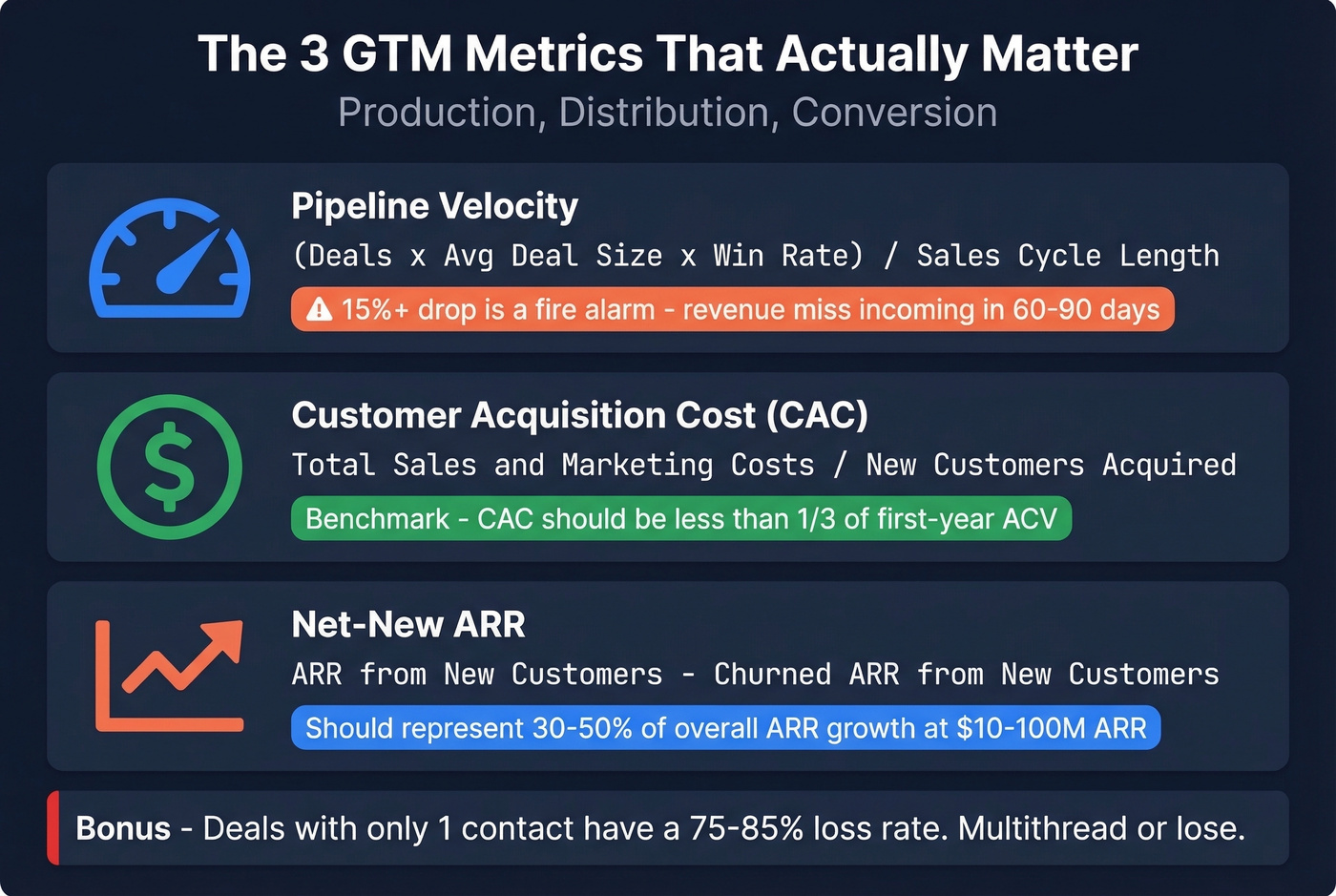
Pipeline Velocity is the single most important number:
(Number of Deals x Average Deal Size x Win Rate) / Sales Cycle Length
This is your leading indicator. Pipeline velocity typically drops 60-90 days before a revenue miss shows up in your P&L. A 15%+ drop is an early warning sign - treat it like a fire alarm, not a yellow flag.
CAC keeps you honest:
Total Sales & Marketing Costs / Total New Customers Acquired
Benchmark: CAC should be less than one-third of first-year ACV. If you're spending $15K to acquire a customer worth $12K in year one, your motion is underwater. (If you want a deeper breakdown, see cost to acquire a customer.)
Net-new ARR tells you if you're growing or just replacing churn:
Total ARR from New Customers - Churned ARR from New Customers
For SaaS companies in the $10-100M ARR range, net-new ARR should represent 30-50% of overall ARR growth. New-logo volume benchmarks vary by motion: SMB teams should close 100+ logos per quarter, mid-market 10-50, and enterprise reps might close single-digit deals per quarter and still be crushing it.
One more metric worth watching: multithreading ratio. Deals with only one contact have a 75-85% loss rate in later stages. If your reps aren't multithreading into the buying committee, your pipeline is thinner than it looks. (Related: what is team selling.)
Building Your Tech Stack
The typical mid-sized company runs 150+ tools. Most of them overlap. The winning approach isn't adding more - it's integrating fewer layers that actually talk to each other.
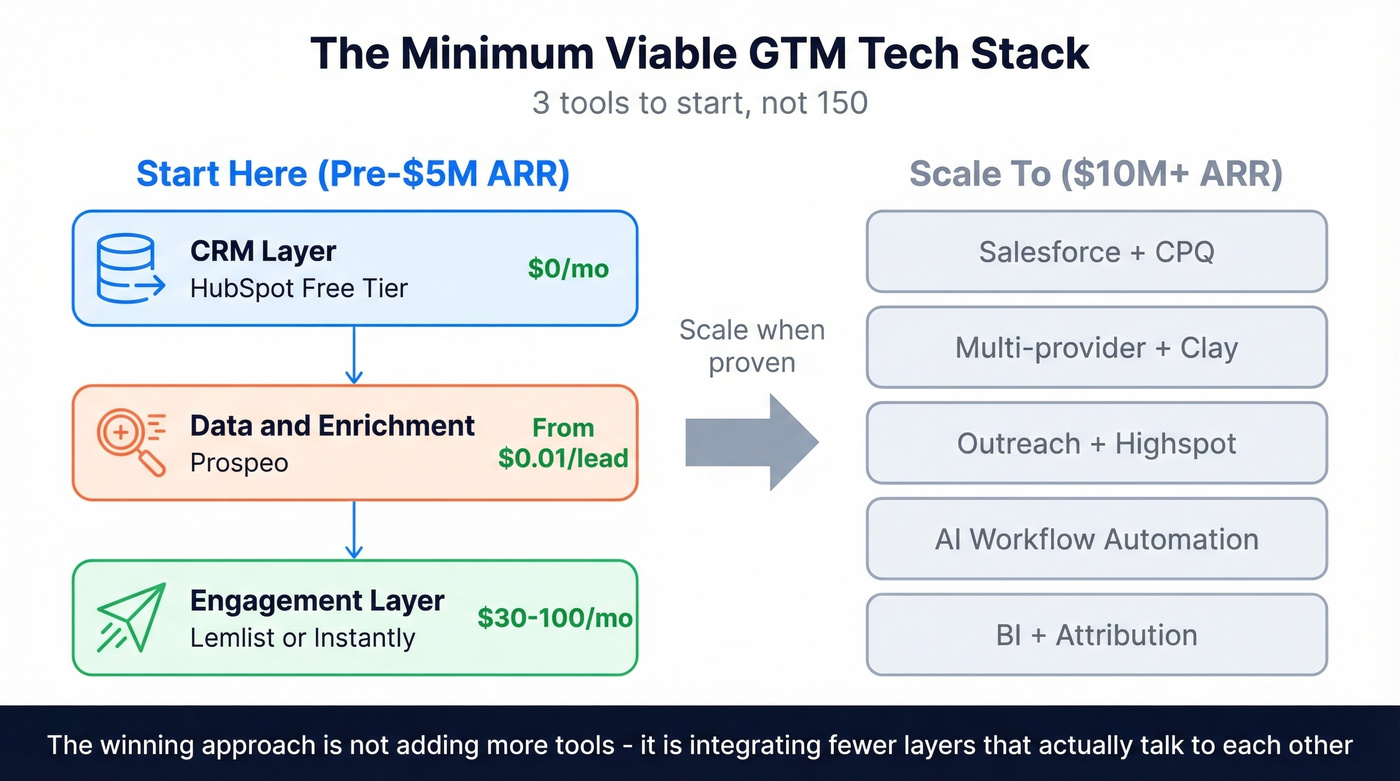
| Layer | Minimum Viable | Approx. Cost | Mature Stack |
|---|---|---|---|
| CRM | HubSpot (free tier) | Free | Salesforce + CPQ |
| Data/Enrichment | Prospeo | ~$0.01/lead, free tier | Multi-provider + Clay |
| Engagement | Lemlist ($32-97/mo) or Instantly ($30-78/mo) | $30-100/mo | Outreach + Highspot |
| AI Orchestration | - | - | Workflow automation |
| Analytics | CRM reports | Free | BI + attribution |
If we were building from scratch today: HubSpot for CRM, Prospeo for data and enrichment, and Lemlist or Instantly for outbound. Three tools. You can run a legitimate outbound motion on around $500/month with that stack for a small team. (More options: best outbound lead generation tools.)

Your outbound motion is only as good as the data feeding it. Prospeo's 300M+ professional profiles with 98% email accuracy, 30+ search filters (buyer intent, technographics, job change, headcount growth, funding signals), and a 7-day refresh cycle give you a data foundation that doesn't rot between campaigns. It integrates natively with HubSpot, Salesforce, Clay, Lemlist, Instantly, and automation platforms like Zapier, Make, and n8n - at roughly $0.01 per lead with a free tier to start. (If you're comparing providers, see data enrichment services and lead enrichment.)
Skip ZoomInfo if your average deal size is under $20K. It's a strong platform, but most early-stage teams pay for features they'll never touch. The consensus on r/SaaS reflects this - teams are paying for multiple overlapping tools when three well-integrated ones would outperform the whole stack. Start with self-serve tools, validate your ICP, and upgrade only when your pipeline volume demands it.
Scaling from founder-led sales to a full GTM org means every new hire needs reliable contact data from day one. Prospeo gives your team 30+ filters - buyer intent, technographics, headcount growth, funding - so SDRs, AEs, and demand gen all work from the same qualified pipeline. At $0.01 per email, it costs less than a single bad meeting.
Stop hiring around a data problem you can solve today.
Common Mistakes to Avoid
Six mistakes that kill go-to-market teams - and we've seen every one of them:
No clear owner. When everyone owns the plan, nobody owns it. You get the Frankenstein plan: conflicting priorities stitched together by committee. Assign one person - usually the Head of Product Marketing or a dedicated lead - who has final say.
Targeting "everyone." A focused ICP beats a broad TAM every time. If you can't name the three job titles and two company characteristics that define your best customer, you're not ready to scale outbound. (Use an ideal customer profile template to force clarity.)
Siloed KPIs. Marketing celebrates MQL volume. Sales celebrates closed-won. CS celebrates NPS. Nobody celebrates the customer journey. Align incentives around pipeline velocity and net-new ARR instead. (If you're diagnosing issues, start with pipeline health.)
Launching without a 30-60-90 day post-launch plan. Launch day isn't the finish line. The first 90 days of iteration, feedback loops, and enablement updates determine whether the launch actually sticks. (Steal a 30-60-90 day plan for sales reps and adapt it for GTM.)
Optimizing execution when assumptions are wrong. Running more sequences faster doesn't help if you're targeting the wrong persona with the wrong message. Step back and validate before you scale.
Buying tools before fixing process. A new intent data platform won't save a team that can't agree on ICP definition. Fix the workflow first, then automate it.
FAQ
What's the difference between a GTM team and a sales team?
A sales team is one function within a go-to-market team. The broader unit includes marketing, product marketing, RevOps, and customer success - all aligned around shared revenue metrics like pipeline velocity and net-new ARR. Sales closes deals; the full team orchestrates the motion from awareness through expansion.
When should a startup hire its first dedicated role?
After founder-led sales proves repeatable - typically around $500K-$1M ARR. The first hire should be a product marketer who can also run demand gen. Use fractional leadership ($6-15K/month) until you hit $2M ARR and the work justifies full-time commitment.
What tools does a go-to-market team need?
At minimum: a CRM (HubSpot's free tier works early), a data enrichment tool for verified contact data, and one engagement platform for outbound. Everything else - intent data, AI orchestration, conversation intelligence - can wait until $5M+ ARR when pipeline volume justifies the spend.
How do you measure GTM team performance?
Track pipeline velocity as your north-star metric: (Deals x Deal Size x Win Rate) / Sales Cycle Length. A 15%+ drop signals trouble 60-90 days before revenue misses appear. Layer in CAC (should be under one-third of first-year ACV) and net-new ARR to get the full picture.
The Bottom Line
GTM teams fail because of alignment problems, not talent problems. Get the RACI right, watch pipeline velocity like a hawk, and resist the urge to over-hire or over-tool before you've nailed your ICP. The companies that win aren't the ones with the biggest go-to-market organization - they're the ones where marketing, sales, and CS actually operate as one unit.