

How to Handle Objections in the Selling Process (Without Relying on Scripts Alone)
Your rep just got "not interested" for the twelfth time today. She's got a solid pitch, a decent talk track, and a list that looked good on paper. But the list was stale, the prospect had already researched three competitors, and the objection was over before it started.
That's the reality of handling objections in the selling process in 2026. 57% of sales professionals say the cycle is getting longer, and 73% of B2B buyers actively avoid sellers who send irrelevant outreach. Meanwhile, 71% of prospects prefer independent research over talking to a rep, and 96% research your product before they'll even take a call. Reps also spend roughly 60% of their time on non-selling tasks - so when they finally get someone on the line, the objection better not catch them flat-footed. Objections aren't just harder. They arrive pre-loaded.
The Short Version
- 74% of all objections come from just 5 types. Master those first.
- The proposal stage is the hardest - not cold calling. 31% of sales pros say it's where objections are toughest to navigate.
- Sellers who handle objections well hit close rates as high as 64%. The difference isn't talent. It's pausing before you respond, fixing your data upstream, and drilling weekly.
What 300M+ Cold Calls Reveal About Objections
An analysis of 300M+ cold calls sorted every objection into three categories:
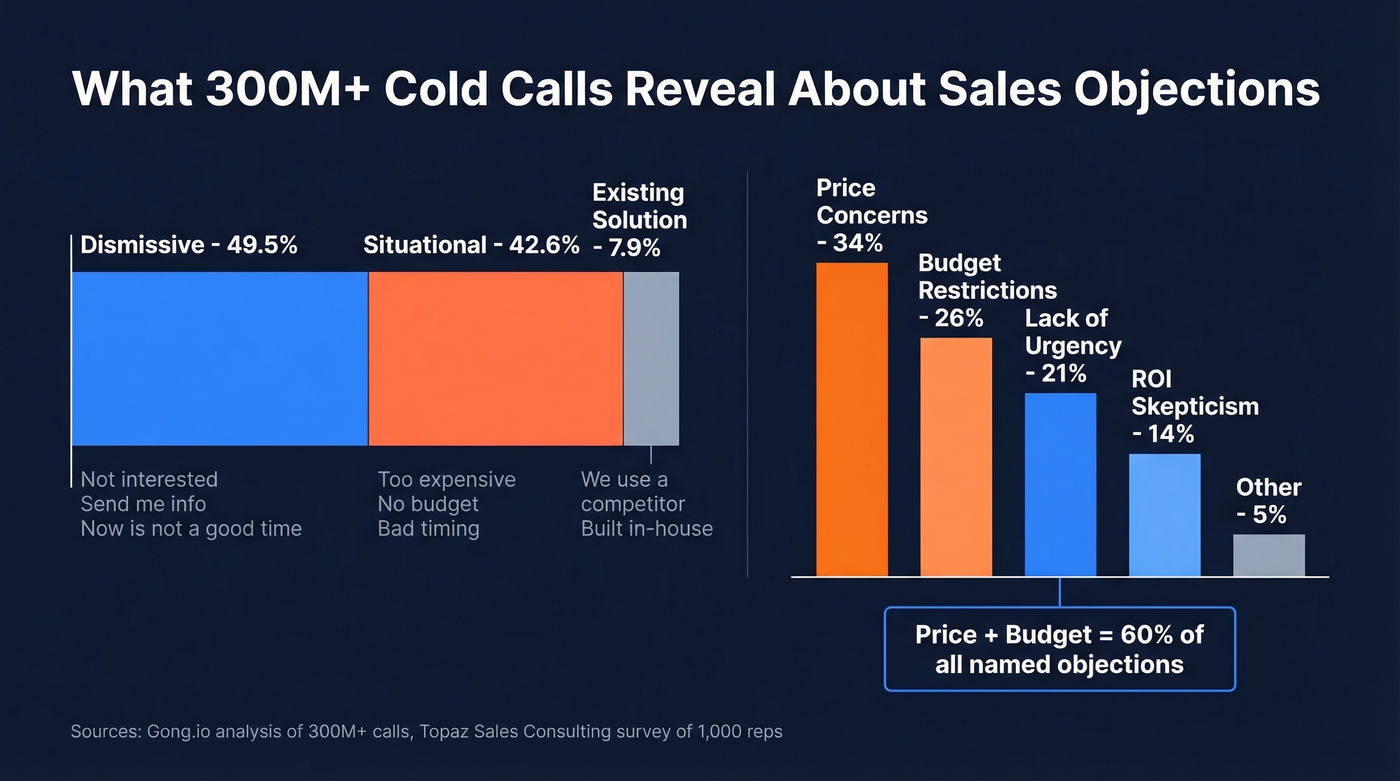
| Category | Share | Examples |
|---|---|---|
| Dismissive | 49.5% | "Not interested," "Send info" |
| Situational | 42.6% | "Too expensive," "No budget" |
| Existing solution | 7.9% | "We use a competitor," "In-house" |
Nearly half of cold-call objections are dismissive - the prospect isn't even engaging with your value prop. That's not a rebuttal problem. It's a targeting problem.
Most guides sort objections by topic: price, timing, need, authority. That's useful for scripting but useless for diagnosis. These three categories tell you why the prospect is pushing back, which changes your entire approach.
A survey of 1,000 sales professionals fills in the detail: 34% price concerns, 26% budget restrictions, 21% lack of urgency, 14% ROI skepticism, 5% everything else. Price and budget alone account for 60% of named objections.
Where Objections Hit Hardest by Stage
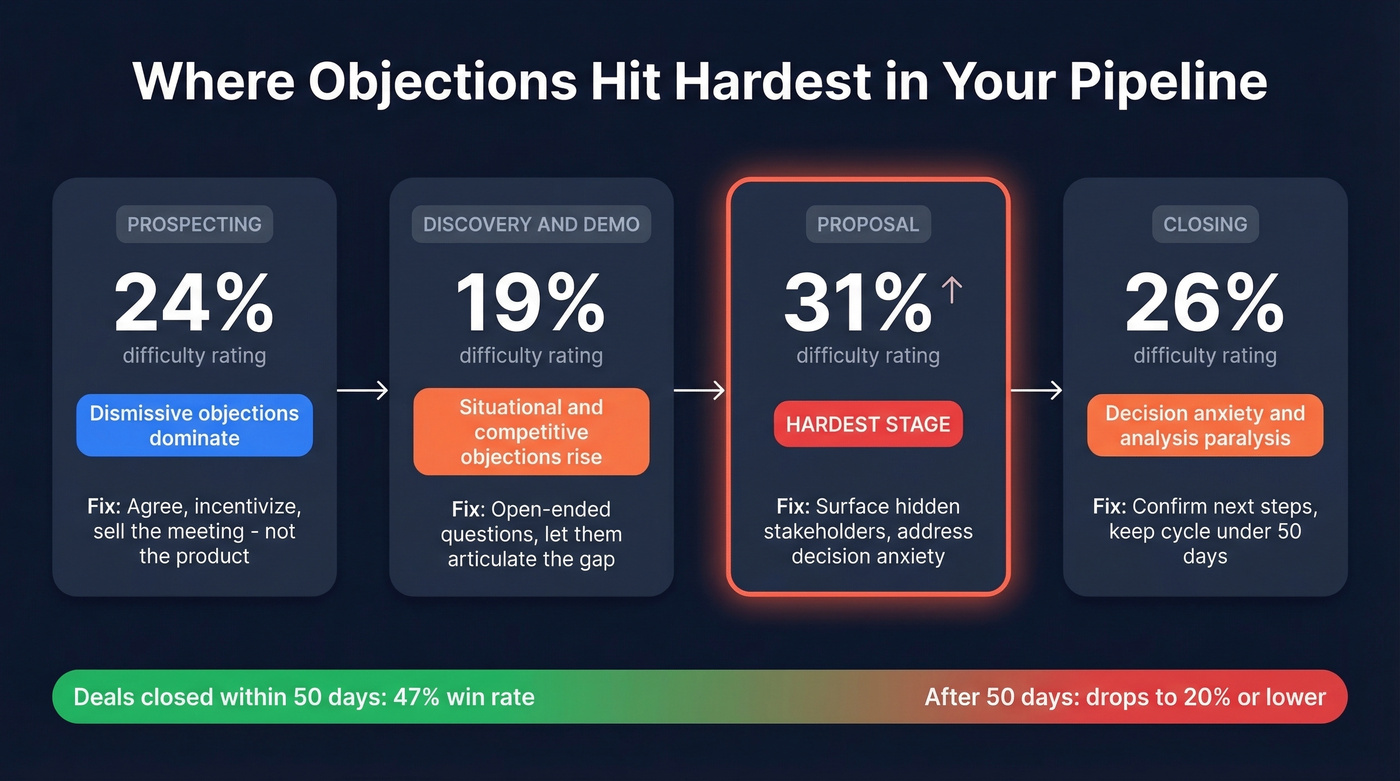
Where an objection shows up in your pipeline changes everything about how you respond. Difficulty breaks down like this across stages: 31% proposal, 26% closing, 24% initial contact, 19% negotiation.
Prospecting
Dismissive objections dominate here. The recommended framework: Agree, incentivize, sell the test drive. You're not selling the product on a cold call. You're selling the next conversation.
But here's the thing - if half your objections are "not interested," the problem is upstream. Wrong person, wrong message, stale data. We've watched teams cut their dismissive objection rate dramatically just by switching to contact data that's actually current. Prospeo refreshes records every 7 days and verifies emails at 98% accuracy, which means reps spend time on real conversations instead of dead ends.
If you want to tighten this stage further, start with better sales prospecting techniques and a clearer ideal customer profile.
Discovery and Demo
Situational and competitive objections rise sharply at this stage. Common blockers from a thread on r/salesengineers: "Our current tool does this too," "Competitor showed us the same thing," and "We tried something like this before."
Handling a dismissive objection with a feature dump is like answering "I'm not hungry" by reading the entire menu. Lean on open-ended questions instead and let the prospect articulate the gap between what they have and what they need. If your team needs a tighter question bank, use a discovery questions framework. And if demos are where deals stall, a simple product demo checklist helps prevent avoidable pushback.
Don't trash competitors - the moment you go negative, you taint your own credibility. A lightweight competitive intelligence strategy is usually enough to stay factual without sounding defensive.
Proposal and Close
This is the hardest stage, and we've seen it trip up even experienced teams. Late-stage objections aren't about features or price - they're about decision anxiety, new stakeholders surfacing, and analysis paralysis.
The right exploration questions: "What would need to change for you to feel confident moving forward?" and "Who else has input on this decision that we haven't connected with?" Data from Outreach shows deals closed within 50 days have a 47% win rate. After that, it drops to 20% or lower. Every unresolved objection drags your cycle past that cliff, and teams that build a repeatable objection-handling process for this stage consistently outperform those that wing it.
If your late-stage objections are really pipeline hygiene issues, audit your pipeline health and fix the common sales pipeline challenges first.

49.5% of objections are dismissive - "not interested" before you even pitch. That's not a skills gap. It's a data gap. Prospeo refreshes 300M+ profiles every 7 days with 98% email accuracy, so your reps reach the right person with the right context instead of burning dials on dead leads.
Kill dismissive objections at the source. Start with better data.
One Framework for Every Stage
You don't need ten frameworks. You need one model you actually use.
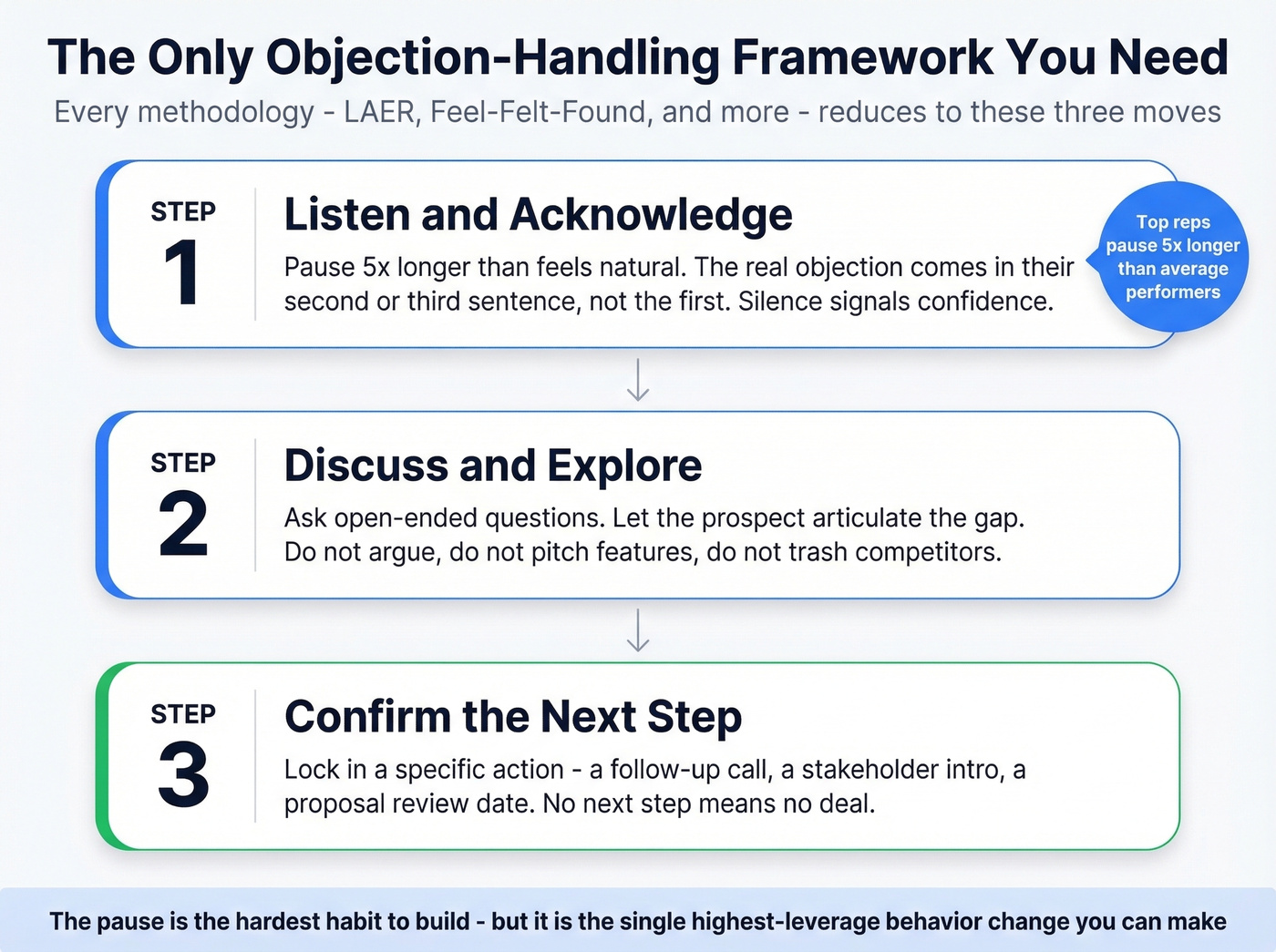
Every popular methodology - from LAER to Feel-Felt-Found - boils down to the same three moves: (1) Listen and acknowledge, (2) Discuss and explore, (3) Confirm the next step. We've tested variations of this across dozens of teams, and the core pattern holds regardless of which acronym you prefer.
The one behavioral change worth memorizing: top reps pause 5x longer after hearing an objection than their less-successful peers. Silence signals confidence and gives the prospect space to elaborate. In our experience, the pause is the hardest habit to build - but the real objection usually comes in the prospect's second or third sentence, not the first.
If you want to systematize this beyond training, build it into your sales process optimization and sales communication standards.
Scripts That Actually Work
These aren't magic words. They're starting points - adapt them to your voice and your buyer.
"We don't have budget right now." "Totally fair - most teams we work with didn't have a line item for this either. If we could show ROI within the first quarter, would it be worth splitting the cost across two budget cycles?"
"Competitor X is cheaper." "They might be on sticker price. Can I ask what you're comparing - same scope, or are there pieces you'd need to add on?"
"I need to run this by my boss." "Of course. What would make that conversation easier - a one-pager with the ROI case, or a quick 15-minute call where we walk through it together with them?" This works because you're arming your champion, not pressuring them.
"We don't see the ROI." "What does success look like for your team this quarter? Let's work backward from that number and see if the math holds."
"The timing isn't right." "When would be right? I'll send over the prerequisites so you're ready to move fast when the window opens."
What NOT to Do
Let's be honest - most objection-handling advice focuses on what to say. Knowing what to avoid matters just as much.
- Don't disengage after the first objection. Only 12% of reps make three or more follow-ups, which means 88% of your competition gives up before the deal is even lost. If you need a baseline process, use these sales follow-up templates.
- Don't argue or get defensive. You're not in a debate. You're in a conversation.
- Don't use pressure tactics. FUD doesn't work on buyers who've already done their research.
- Don't trash competitors. It backfires almost every time. Ask what they like about the alternative instead.
- Don't default to discounting. Dropping price signals you were overcharging. Reframe value first.
Skip the objection-handling playbook entirely if your deal sizes sit below $15k and your reps are spending more time rehearsing rebuttals than generating pipeline. The problem isn't objection handling - it's that you're reaching the wrong people. Fix the list before you fix the talk track.
Training Drills That Build Real Skill
Three drills, 45 minutes a week. We've found this is the minimum effective dose for improving how your team handles objections throughout the selling process.
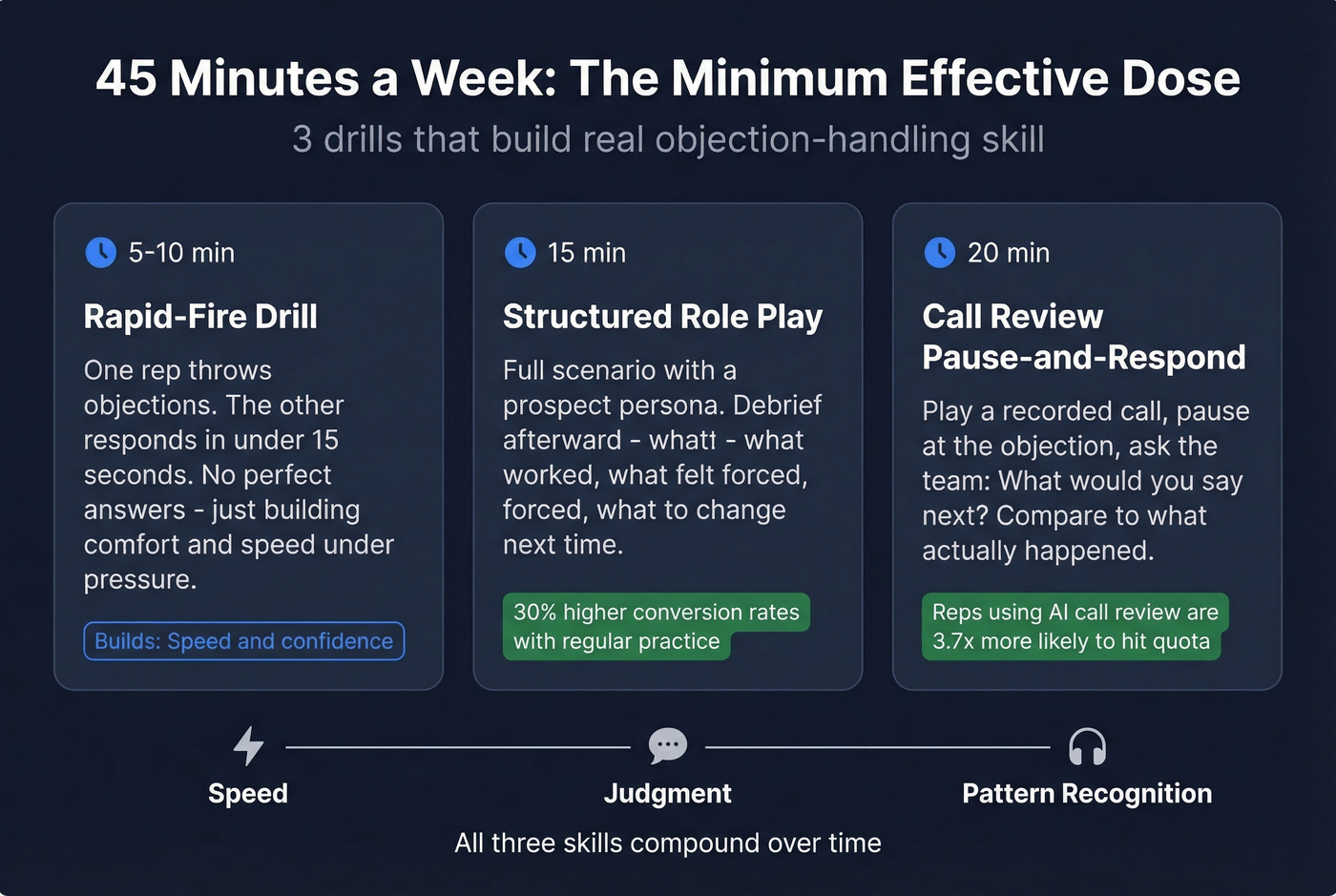
Rapid-fire objection drill (5-10 min). One rep throws objections, the other responds in under 15 seconds. No perfect answers - just reps building comfort and speed under pressure.
Structured role play (15 min). Full scenario with a prospect persona. Debrief afterward: what worked, what didn't, what felt forced. Companies that practice role play regularly see up to 30% higher conversion rates, and this is where reps learn to overcome pushback through repetition rather than memorization.
Call review pause-and-respond (20 min). Play a recorded call, pause at the objection, and ask the team: "What would you say next?" Compare to what actually happened. Sellers using AI-powered call review tools are 3.7x more likely to meet quota, so invest in the tooling that makes this drill possible. If you're building a modern stack, start with a shortlist of SDR tools.
Late-stage objections cost you deals - and every unresolved one drags your cycle past the 50-day cliff where win rates drop to 20%. Teams using Prospeo's 30+ filters and Bombora intent data walk into proposals knowing exactly who's in-market, cutting through budget and ROI objections with precision.
Stop losing deals to objections you could have prevented upstream.
FAQ
What are the most common sales objections?
Price concerns lead at 34%, followed by budget restrictions (26%), lack of urgency (21%), and ROI skepticism (14%). On cold calls specifically, 49.5% of objections are purely dismissive - "not interested," "send me info" - before any real conversation begins.
Which sales stage has the hardest objections?
Proposal and presentation, with 31% of sales pros ranking it hardest, followed by closing at 26%. Most guides over-index on cold-call rebuttals, but the real challenge is late-stage decision anxiety when new stakeholders appear and analysis paralysis sets in.
What's the best framework for overcoming objections?
Listen, explore, confirm next step - every major methodology reduces to this pattern. The single highest-leverage behavior change: pause 5x longer after hearing an objection. The real concern usually surfaces in the prospect's second or third sentence, not the first.
How does bad data cause more objections?
Stale contact info means reps reach the wrong person or arrive with irrelevant context, triggering dismissive objections before any value conversation starts. Teams that switch to data refreshed on a weekly cycle and verified at 98%+ accuracy consistently report bounce rates dropping below 4% and connect rates climbing, because reps are actually reaching verified decision-makers instead of fighting through "not interested" on every dial.