

What High Performing Sales Teams Actually Do Differently (And How to Build One)
It's the Q3 pipeline review. Your reps are at 43% of annual target. The VP of Sales is blaming marketing, marketing is blaming lead quality, and the CFO is asking why you hired twelve reps when six of them haven't closed a deal in two months.
Sound familiar?
The problem isn't your people - it's your system. And despite the digital-first narrative, Gartner found that 72% of B2B transactions still close through rep-led channels. Your team is still the revenue engine. The question is whether that engine is tuned or misfiring.
84% of sales reps missed quota last year. Reps spend 60% of their time on non-selling tasks. These aren't individual failures - they're systemic ones. High performing sales teams aren't collections of superstars who grind harder. They're engineered systems where structure, hiring, coaching, compensation, and data quality compound into consistent results, and if you're serious about building a winning revenue org, you need to treat every one of those levers as interconnected.
Fix These Five Things First
If you only address five things, make it these:
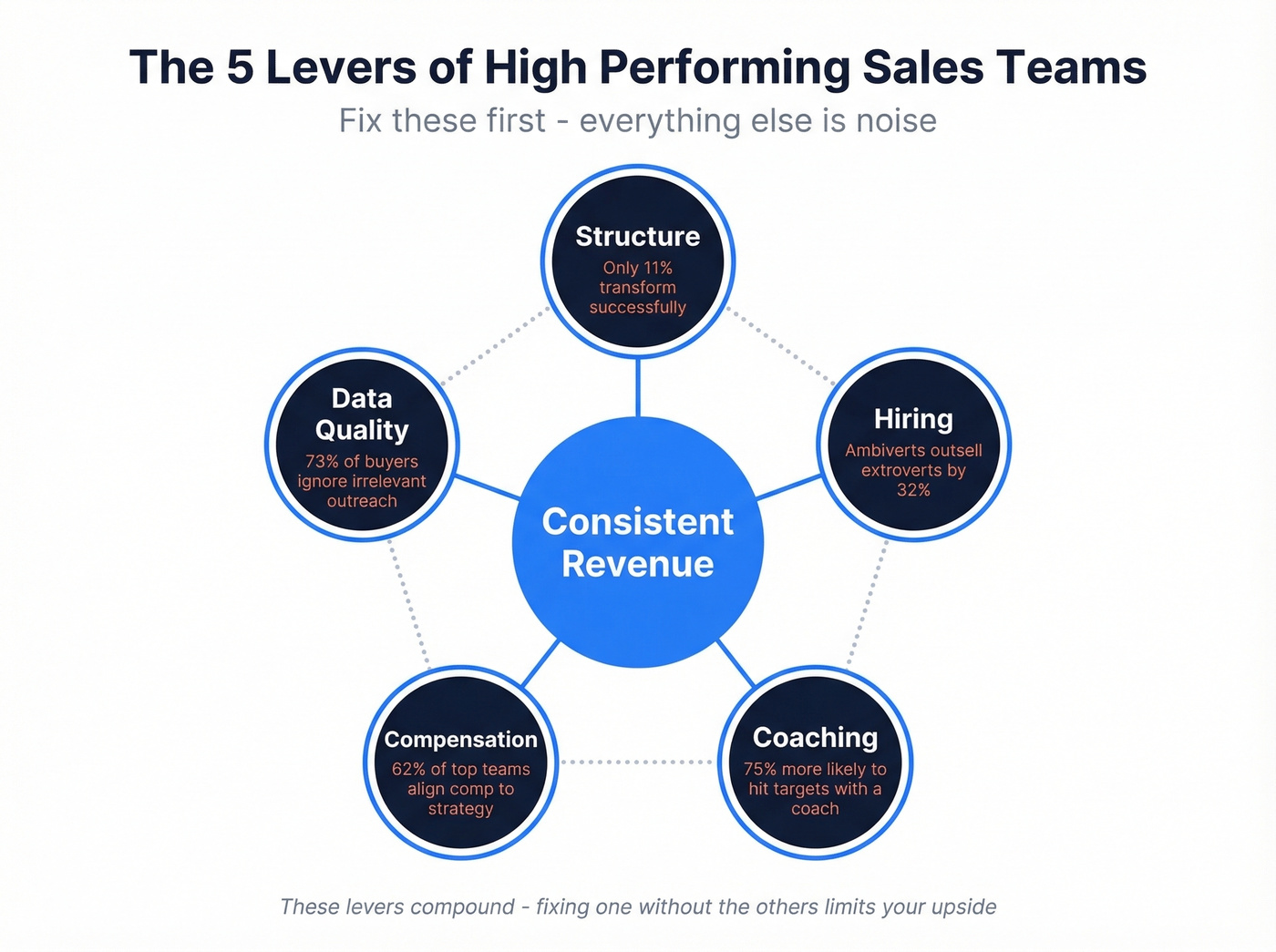
- Structure: Match your team model (island, assembly line, or pod) to your deal complexity - only 11% of sales orgs successfully transform while maintaining commercial results.
- Hiring: Ambiverts outsell extroverts by 32%. Stop hiring for charisma and start hiring for curiosity.
- Coaching: Reps with a coach or mentor are 75% more likely to hit targets. Training without coaching is wasted budget. (If you need a repeatable ramp, start with a 30-60-90 day plan.)
- Compensation: 62% of top teams have comp aligned to strategy vs. 32% of everyone else. Simplicity wins. (Use the same logic you’d apply to OTE in sales to sanity-check incentives.)
- Data quality: 73% of B2B buyers ignore irrelevant outreach. Your reps can't sell if they're emailing dead addresses and calling wrong numbers. (A lightweight fix is adding data enrichment to your workflow.)
What Top Sales Teams Do Differently
A Korn Ferry survey of 282 sales leaders across 32 countries and 12 industries produced the clearest picture we've seen of what separates top teams from the rest. The gaps aren't subtle.
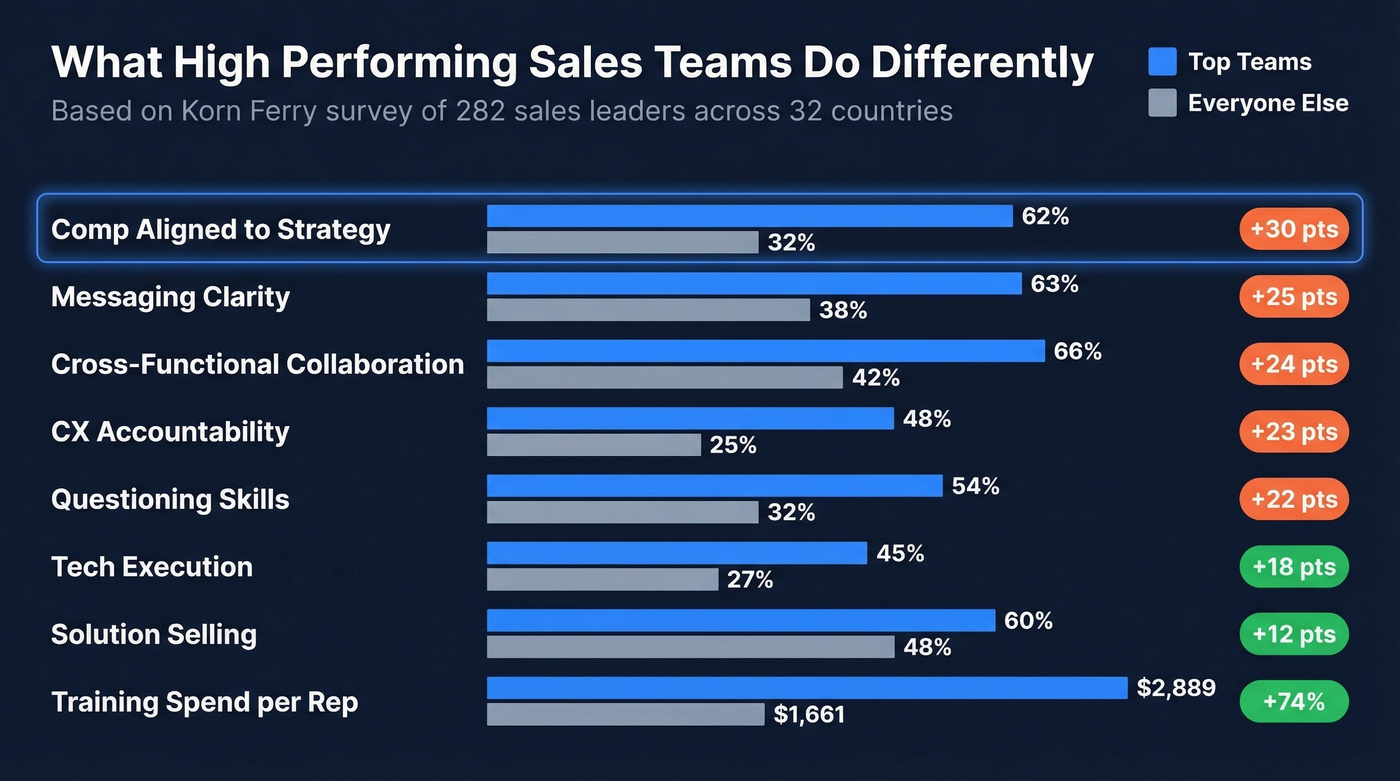
| Dimension | Top Teams | Everyone Else | Gap |
|---|---|---|---|
| Comp aligned to strategy | 62% | 32% | +30 pts |
| Messaging clarity | 63% | 38% | +25 pts |
| Cross-functional collab | 66% | 42% | +24 pts |
| CX accountability | 48% | 25% | +23 pts |
| Questioning skills | 54% | 32% | +22 pts |
| Tech execution | 45% | 27% | +18 pts |
| Solution selling | 60% | 48% | +12 pts |
| Training spend/rep | $2,889 | $1,661 | +74% |
The pattern is unmistakable. Top teams don't win on one dimension - they win across all of them simultaneously. The biggest gap is comp alignment (30 points), followed closely by messaging clarity (25 points). The best teams are nearly twice as effective at articulating how their solution matches customer needs. That's not a talent gap. That's a training and enablement gap.
Look at the questioning skills row: 54% vs. 32%. This reinforces something we'll come back to in the hiring section - the best sellers aren't the loudest talkers. They're the best listeners. A top-performer analysis across industries consistently shows that curiosity and active listening outrank assertiveness as predictors of quota attainment. Top teams also supplement training with dynamic manager-led coaching at 2x the rate of their peers, and they spend about 74% more per rep on training. Every lever reinforces the others.
Three Team Structure Models
Your org structure determines how deals flow, who owns what, and where handoffs break. Get this wrong and everything downstream suffers.
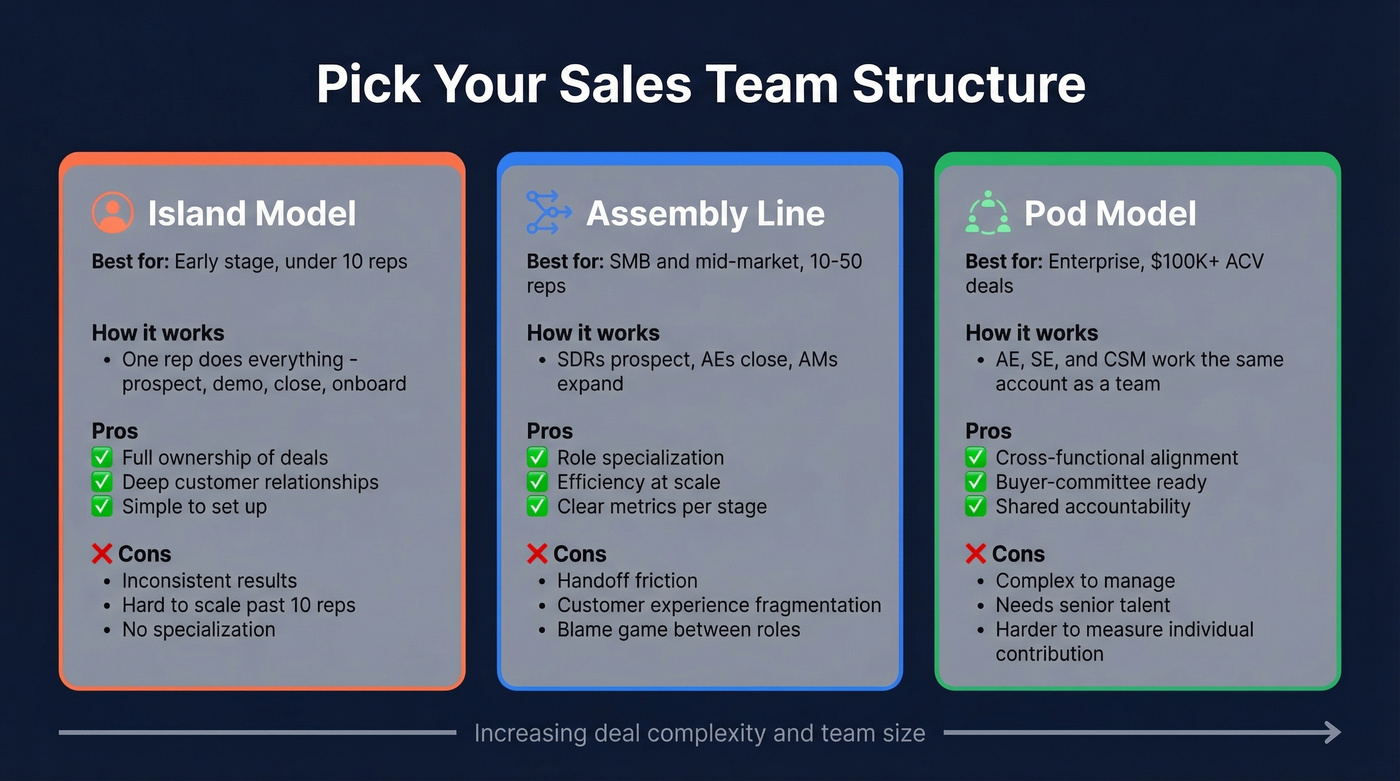
| Model | Best For | Pros | Cons |
|---|---|---|---|
| Island | Early stage, <10 reps | Full ownership, deep relationships | Inconsistent, hard to scale |
| Assembly Line | SMB/mid-market, 10-50 reps | Specialization, efficiency | Handoff friction, fragmentation |
| Pod | Enterprise, $100K+ deals | Cross-functional, buyer-aligned | Complex to manage, needs senior talent |
Most teams default to the island model because it's the easiest to set up. One rep does everything - prospect, demo, close, onboard. That works when you have three reps who are all A-players. It falls apart at ten.
Under 20 reps selling mid-market deals? Assembly line. Specialize your SDRs, AEs, and AMs. Enterprise deals over $100K ACV? Pods - you need an AE, an SE, and a CSM working the same account simultaneously, especially when buying committees average around seven people. When tracking pod KPIs, measure the pod as a unit (pipeline created, deal velocity, expansion revenue), not just individual contribution. (If you’re moving to team-based coverage, team selling is the mental model.)
Ask any sales leader on r/sales what they'd change about their org and you'll hear the same regret: they waited too long to specialize roles. Gartner found that only 11% of sales orgs can drive commercial success while executing a transformation. Get this right the first time. Restructuring mid-year while trying to hit number is a nightmare you don't need.
Who to Hire (And Who Not To)
The biggest hiring myth in sales is that you need extroverts. Research commonly cited in sales hiring circles shows ambiverts - people who balance listening with assertiveness - outsell extroverts by 32%. The best sellers ask better questions, not louder ones.
Here's the thing: that Korn Ferry questioning skills gap (54% vs. 32%) isn't a coincidence. It's a signal that hiring managers should screen for curiosity, not confidence. (A structured sales leadership approach makes this easier to enforce.)
A practical hiring checklist:
- Structured interviews over gut feel. Unstructured interviews are barely better than a coin flip at predicting performance. Use scorecards with clear evaluation criteria tied to the competencies that actually predict success in your specific sales motion.
- The "would you buy from this person?" test. SaaStr's Jason Lemkin puts it simply - if you wouldn't personally buy from this candidate, don't hire them.
- The one-sales-cycle rule. New reps should show real progress within one full sales cycle. If nothing happens after one cycle, it won't.
- Skip the "fancy company" hire. Don't bring in your first VP of Sales from a company that stopped being a startup years ago. They've never built from zero - they've managed at scale. Different skill entirely.
- Beware the stretch VP. A VP candidate who has never personally hired quota-hitting reps is a gamble you'll lose.
Culture Is 40% of Your Performance Gap
Sales culture accounts for 40% of the performance gap between high- and low-performing teams. That makes it the single biggest lever most leaders ignore.
It's not a poster on the wall. It's whether your team trusts the system enough to follow it.
Sellers who reach "trusted partner" status with buyers achieve 48% higher quota attainment and 25% higher win rates than those stuck at "approved vendor" status. That trust isn't built by individual reps - it's built by organizations that hold themselves accountable. Top orgs have CX accountability cultures at nearly double the rate of peers (48% vs. 25%). Shared goals, transparent pipeline reviews, and peer accountability separate cultures that retain talent from those that bleed it. (If you’re trying to build consistency, start with sales leadership trust.)
Average sales rep turnover runs 20-35% annually. Every rep who leaves costs you a full ramp cycle - months of lost productivity and pipeline. Culture is the cheapest retention tool you have, and the most expensive one to rebuild.
We've seen the player-coach trap kill team development repeatedly. You promote your best AE to manager. They keep closing their own deals instead of coaching. The team stagnates. If your managers are still carrying a personal quota, you don't have managers - you have senior reps with a title.

73% of B2B buyers ignore irrelevant outreach. Your reps can't hit quota if they're emailing dead addresses and dialing wrong numbers. Prospeo delivers 98% verified emails and 125M+ direct dials - refreshed every 7 days, not every 6 weeks.
Fix your data before you blame your reps.
Training Without Coaching Is Wasted Money
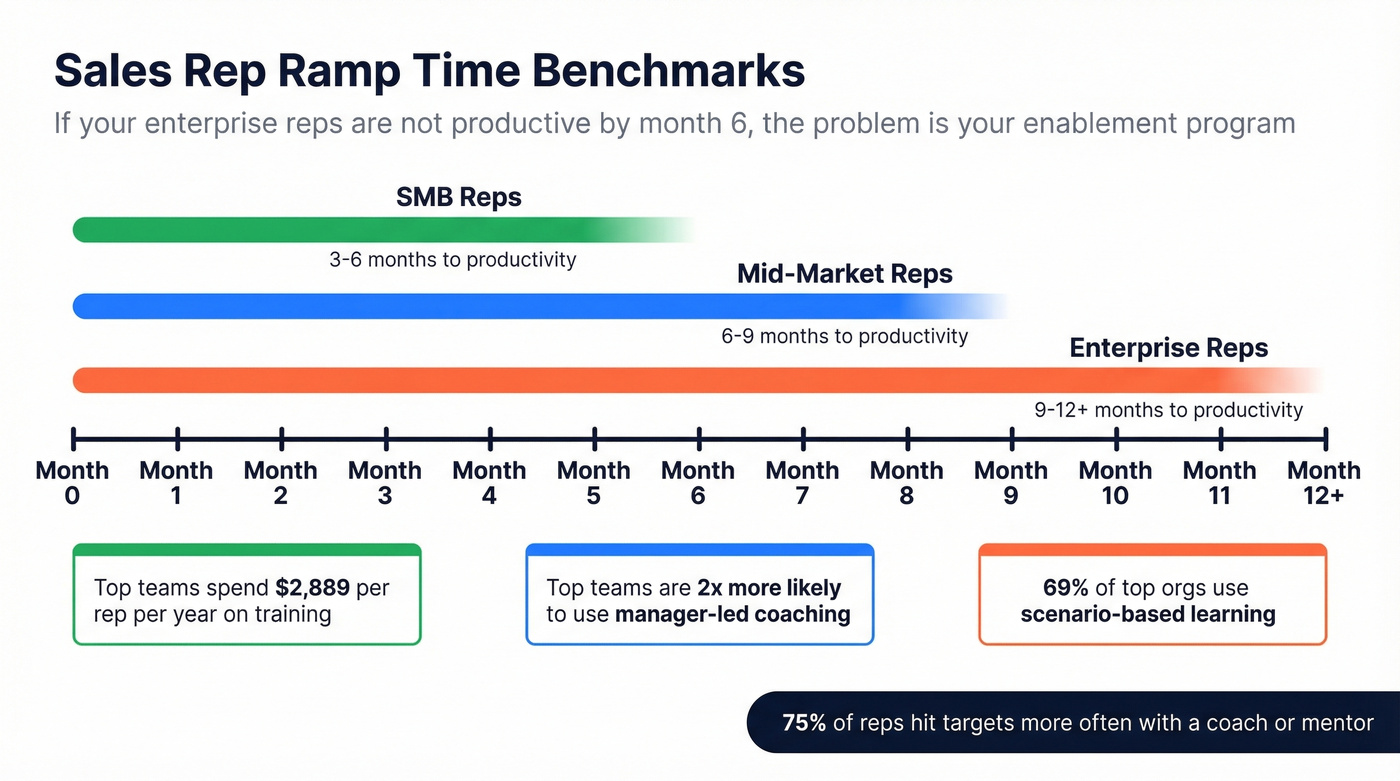
Spend at least $2,500 per rep per year on training. Top teams spend $2,889. Pair it with dynamic, manager-led coaching - top teams are 2x more likely to do this. Use scenario-based learning (69% of top-performing orgs do). Set clear ramp time expectations by segment. (For a practical framework, use sales training tips as your baseline.)
Skip one-and-done onboarding bootcamps with no follow-up. Skip generic training content that doesn't map to your sales process. And don't expect reps 3-10 to learn by osmosis from your first two hires.
75% of reps say they're more likely to hit targets with a coach or mentor.
Ramp time benchmarks to plan around: 3-6 months for SMB reps, 6-9 months for mid-market, 9-12+ months for enterprise. If your enterprise reps aren't productive by month six, the problem isn't the rep - it's your enablement program. Structured coaching is the fastest path to performance improvement across every segment.
Let's be honest: if you can't afford $2,500 per rep per year on training, you can't afford to hire the rep. The math doesn't work otherwise.
Compensation That Drives Behavior
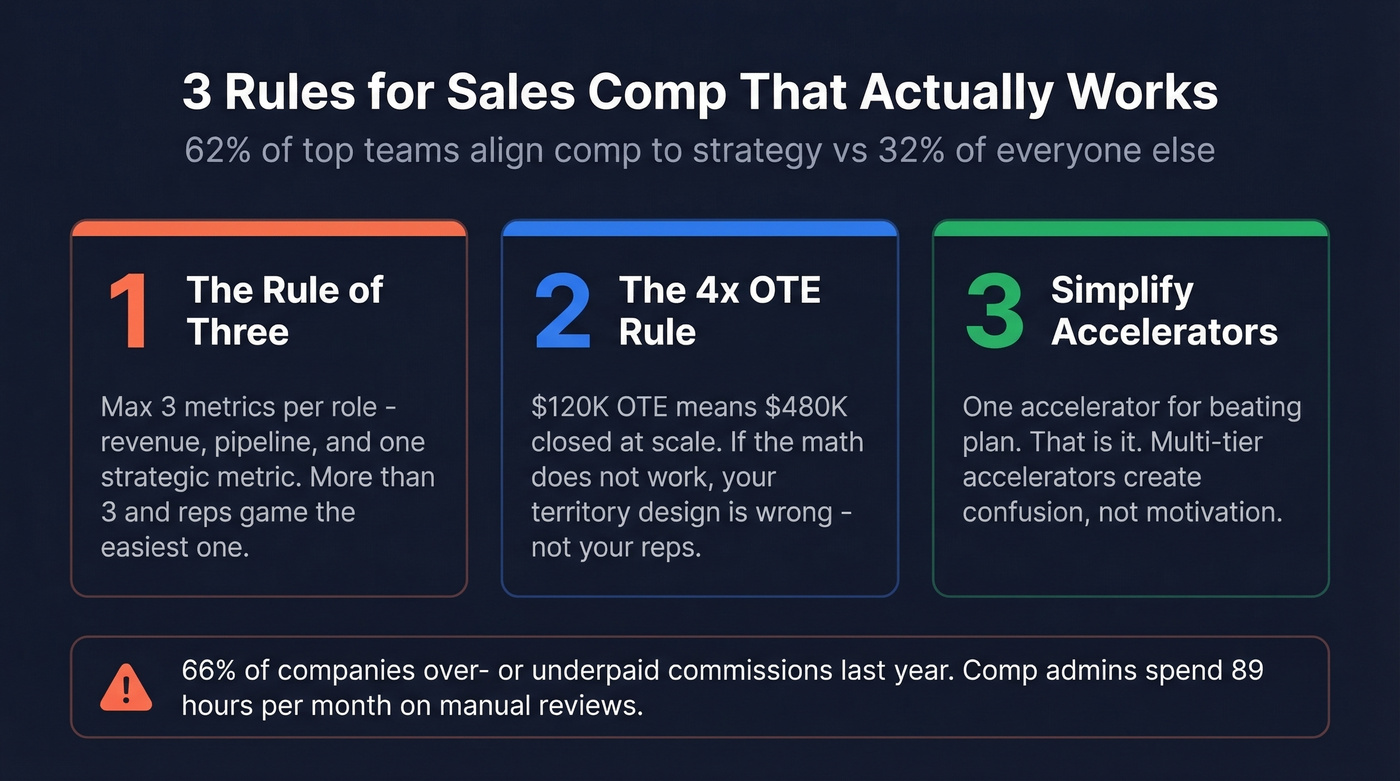
If your reps can't explain their comp plan in 30 seconds, it's broken. 62% of top teams have comp plans aligned to sales strategy. Only 32% of everyone else does.
Three rules that work:
The rule of three. No more than three core metrics per role. Revenue, pipeline created, and one strategic metric - new logos, expansion, whatever matters this quarter. Anything beyond three and reps start gaming the easiest one.
The 4x OTE rule. A rep should eventually close roughly 4x their total comp to be profitable. $120K OTE means $480K closed at scale. If the math doesn't work, your territory design is wrong.
Simplify accelerators. One accelerator for beating plan. That's it. Complicated multi-tier accelerators create confusion, not motivation.
The operational reality is ugly. 66% of companies over- or underpaid commissions last year. Comp admins spend 89 hours per month on manual payout reviews and dispute resolution. Complexity doesn't just confuse reps - it creates expensive errors. When 49% of top-team reps perceive their comp as fair versus only 30% at average orgs, you can see how trust in the plan directly feeds performance.
The Tech Stack That Actually Matters
45% of sales professionals feel overwhelmed by the number of tools in their stack. Meanwhile, only 45% of top teams successfully execute on available sales technology vs. 27% of everyone else. The gap isn't about having more tools - it's about having the right ones and actually using them.
Skip gamification platforms, VR demos, and shiny AI toys until you've nailed the five fundamentals below. Most teams don't have a tool problem. They have a "we bought tools and nobody uses them" problem.
You need five categories. Everything else is optional until you're past $10M ARR.
CRM. Salesforce or HubSpot. This isn't a debate anymore - pick one, configure it properly, and enforce data hygiene. (If you’re evaluating options, see examples of a CRM.)
Sales engagement. Outreach, Salesloft, or Instantly for sequences. The tool matters less than the process. Make sure every rep follows the same cadence framework, and use outreach performance reporting to identify which sequences convert and which ones stall. Manager visibility into campaign performance is what turns a sequence tool from a cost center into a revenue driver. (If you need copy that actually gets replies, use sales follow-up templates.)
Prospecting and data. This is where most teams waste time and money. Reps spend 60% of their day on non-selling tasks, and a huge chunk of that is hunting for contact info, cleaning lists, and dealing with bounced emails. Tools like Prospeo solve this at the foundation level - 300M+ professional profiles, 143M+ verified emails, 98% email accuracy, and 125M+ verified mobile numbers on a 7-day refresh cycle. The industry average refresh is six weeks, which means most databases are serving stale data by default. When GreyScout switched, their bounce rate dropped from 38% to under 4%, and rep ramp time was cut from 8-10 weeks to 4. (If you’re building a repeatable outbound motion, start with sales prospecting techniques.)

Enablement. Gong for call intelligence, Highspot for content management. These pay for themselves once you have 10+ reps.
Analytics and intent. Bombora for intent signals, your CRM's native reporting for pipeline analytics. Don't buy a separate BI tool until your CRM reporting is maxed out. Use team performance dashboards to surface patterns - which reps are building pipeline, which are stalling, and where process breakdowns hide. (To keep reporting focused, use a pipeline health scorecard.)
Mistakes That Kill Sales Team Effectiveness
SaaStr estimates these happen more than 50% of the time. Every one is avoidable.
Hiring a VP of Sales you wouldn't buy from. If they can't sell you on themselves in the interview, they can't sell your product to prospects.
Hiring from a big company that stopped being a startup years ago. They know how to manage a machine. They don't know how to build one.
Not training reps 3 through 10. Your first two reps learned directly from the founder. Rep number seven learns from... who, exactly? Without a structured program, you're relying on osmosis. It doesn't work.
Wrong lead allocation. Too few leads per rep and nobody earns. Too many and reps cherry-pick while good prospects rot. There's an optimal number per segment - find it and enforce it.
Overcomplicated comp plans. One accelerator. Three metrics. If your spreadsheet needs a legend, start over.
Not specializing roles. Asking the same person to prospect, demo, close, and manage accounts works for exactly one sales cycle. Then it breaks.
Ignoring data quality. 73% of B2B buyers actively avoid sellers who send irrelevant outreach. If your reps are emailing the wrong people at the wrong companies with the wrong titles, no amount of coaching fixes that.
Hiring a "stretch VP" who has never recruited quota-hitting reps. Managing existing reps and building a team from scratch require completely different skills. Over-indexing on a candidate's playbook from their last company is how you end up with a strategy that doesn't fit your market.
No visibility into what's working. Without clear dashboards showing activity, conversion, and pipeline health by rep and by segment, you're flying blind. You can't improve what you can't measure.
The AI Multiplier
The gap between teams using AI and those that aren't is widening fast. Sellers who partner with AI sales tools are 3.7x more likely to meet quota. High performers are 1.7x more likely than underperformers to use prospecting agents. And 88% of reps with AI agents say it increases their odds of hitting targets.
This isn't about replacing reps. It's about eliminating the 60% of time they waste on non-selling tasks - research, data entry, list building, manual enrichment. AI-assisted prospecting layered with buyer intent signals across thousands of topics and job change data lets reps prioritize accounts instead of guessing. For distributed teams in particular, AI-driven activity tracking replaces the hallway check-ins that remote orgs lose.
Teams that don't adopt AI-assisted prospecting and prioritization in 2026 aren't just leaving money on the table. They're falling behind competitors who are already there.
High performing teams spend 74% more on enablement per rep. But the highest-ROI investment? Accurate contact data at $0.01/email. Prospeo gives your AEs, SDRs, and pods verified emails and mobiles so they spend time selling, not searching.
Stop funding non-selling activity. Start connecting reps to real buyers.
Build the System, Not the Hero
High performing sales teams aren't built on heroics. They're built on structure that matches deal complexity, hiring that favors curiosity over charisma, coaching that happens weekly instead of quarterly, compensation that's simple enough to explain in 30 seconds, and data clean enough that reps actually trust it.
Fix the system, and performance follows. The 84% who missed quota last year didn't fail because they weren't talented. They failed because the system around them wasn't designed to let them win.
FAQ
What metrics measure sales team progress?
Track quota attainment (top teams average 74% org-wide), win rate (benchmark around 21%), pipeline conversion rate, ramp time by segment, and rep retention. Keep it to 5-7 KPIs. Focus on leading indicators like pipeline creation velocity, not just lagging revenue numbers, and review them in weekly standups.
How long does it take to build a top-performing team?
Expect 6-12 months minimum. SMB reps ramp in 3-6 months, mid-market in 6-9, enterprise in 9-12+. Add time for hiring, methodology design, and establishing a coaching cadence. Only 11% of sales orgs drive commercial success while executing a transformation simultaneously - plan for disruption.
What's the biggest mistake when scaling a sales org?
Hiring a VP of Sales from a large company who has never built from scratch - SaaStr estimates this happens over 50% of the time. The second biggest mistake is skipping structured training for reps 3-10, assuming they'll learn by osmosis from your first hires.
How do you fix an underperforming team?
Pull a performance report on prospecting activity, conversion rates, and deal velocity by rep. Identify whether the gap is top-of-funnel (not enough pipeline), middle (deals stalling), or bottom (poor close rates). Study what your top reps do differently, codify it, then layer in coaching, fix data quality, and simplify comp. In our experience, data quality is the fastest fix - when reps trust their contact info, everything else accelerates.
How much should you spend on training per rep?
Top-performing teams spend $2,889 per rep annually vs. $1,661 for average teams - a 74% gap. But spending alone isn't enough. Top teams are 2x more likely to supplement formal training with dynamic, manager-led coaching. Without that coaching layer, training content evaporates within weeks.