

How to Hire an AI BDR Without Wasting $44K
Your VP of Sales just forwarded you an AI BDR demo and asked if you can replace two headcount. The pitch deck looks incredible - autonomous prospecting, personalized emails at scale, meetings booked while you sleep. The reality is messier. Most teams that hire an AI BDR churn within 90 days, and the ones that succeed do something specific before they ever turn the tool on.
30-Second Verdict
- Budget-friendly outbound: Agent Frank at $416/month - lowest barrier to test
- Transparent quotas: AiSDR at $900/month with clear per-meeting math
- All-in-one (if you have the budget): Artisan, but go in eyes open - median contract $26,250/year
- Skip all three if your contact data isn't verified first. Bad data kills every AI sales agent. Verify emails before plugging in any tool.
AI BDR vs. Human BDR: Real Costs
A fully loaded human BDR costs far more than base salary, and most teams underestimate management overhead and churn. The average human BDR tenure runs about 14 months with a 3-4 month ramp - roughly 10 productive months before you're hiring again. Meanwhile, 83% of sales teams using AI saw revenue growth versus 66% without.
| Cost Component | Human BDR | AI BDR |
|---|---|---|
| Base cost | $50k-$65k salary | $12k-$30k platform |
| Benefits/taxes | $17k-$25k | - |
| Tools | $3k-$5k | $1.2k-$3k email infra |
| Training/setup | $5k-$10k | $2k-$5k one-time |
| Management | $8k-$12k | $3k-$6k optimization |
| Total | $83k-$117k/yr | $18k-$44k/yr |
The cost gap is real. But cheaper doesn't mean better - an AI agent sending emails to dead addresses from a burned domain is worse than no BDR at all.
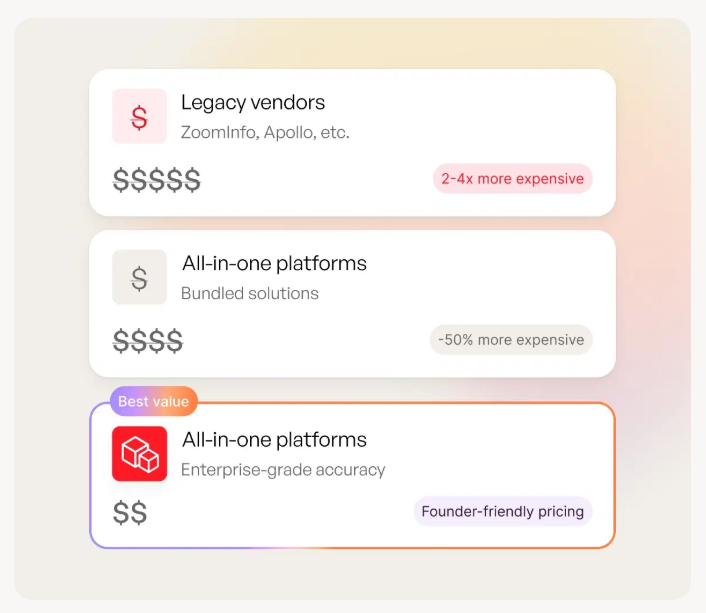

You're about to spend $18K-$44K on an AI BDR platform. Don't let it send emails to dead addresses. Prospeo's 5-step verification delivers 98% email accuracy on a 7-day refresh cycle - at $0.01/email, it's the cheapest way to protect your domain and your investment.
Fix the data layer before you turn on the AI layer.
Tools Worth Evaluating in 2026
Artisan (Ava)
The most visible player in the space, and the most polarizing. Their 300M+ contact database, built-in email warmup, and end-to-end automation make it genuinely all-in-one. G2 reviewers praise customer support and ease of getting started - 3.9/5 from 22 reviews.
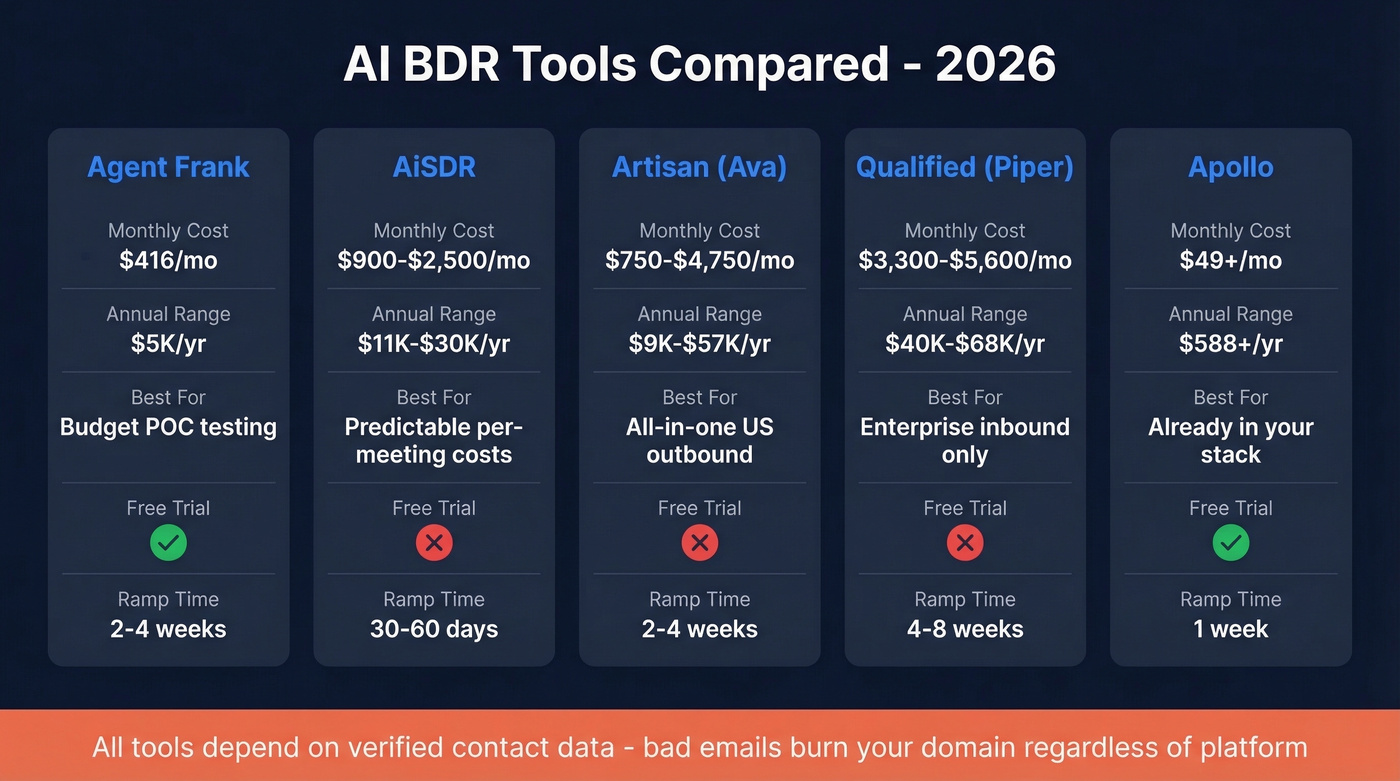
That same G2 profile surfaces recurring complaints about data accuracy and personalization quality. One Reddit practitioner described the experience as "falling for a marketing campaign" - features promised "very soon" that didn't arrive. Artisan also lacks buying-signal awareness and has thinner EMEA/APAC coverage than US.
Pricing runs $9,000-$57,000/year based on Vendr data, with a median of $26,250/year paid annually upfront. Best for US-focused teams wanting a single platform who can stomach the commitment.

AiSDR
Use this if you want predictable costs. AiSDR's Explore plan runs $900/month - billed quarterly at $2,700 upfront - for 1,200 messages and about 3 expected meetings at $300 each. The Grow plan at $2,500/month targets 11 meetings at $227 each.
Here's the catch: there's no free trial, and deliverability ramp takes 30-60 days. Follow-ups count against your message quota, so 1,200 messages doesn't mean 1,200 new prospects. Skip this if you need instant results.
Agent Frank (Salesforge)
The budget pick. At $416/month per user-reported Reddit data, Agent Frank is the cheapest named AI sales agent worth testing. The feature set is thinner than Artisan or AiSDR, and the brand is less established. But for teams wanting to run a proof of concept without a $10k+ annual commitment, it's the obvious starting point. We've seen teams use it as a low-risk way to validate whether AI outbound even makes sense for their ICP before committing to a bigger platform.
Qualified (Piper)
Don't confuse this with outbound tools. Qualified's Piper is an inbound AI agent handling chat, voice, and video. Starts at $40,000-$68,000/year for Premier, with year-one TCO running $95,000-$165,000 including Salesforce and add-ons. Enterprise inbound teams only - everyone else should look elsewhere.
Quick Mentions
Apollo is "low-key an AI SDR" per practitioners on r/gtmengineering - and honestly better than half the dedicated tools. It's already in most stacks, with a free tier for basic sequences and paid plans from $49/month. Skyp.ai earns praise for deliverability focus but requires separate lead sourcing via Apollo or Clay; expect to request a demo for pricing.
Why Most AI BDR Deployments Fail
Let's be honest about the numbers. The churn is brutal: 50-70% of users quit within 3 months. That's not a tool problem. It's a deployment problem, and it almost always traces back to one of three root causes.
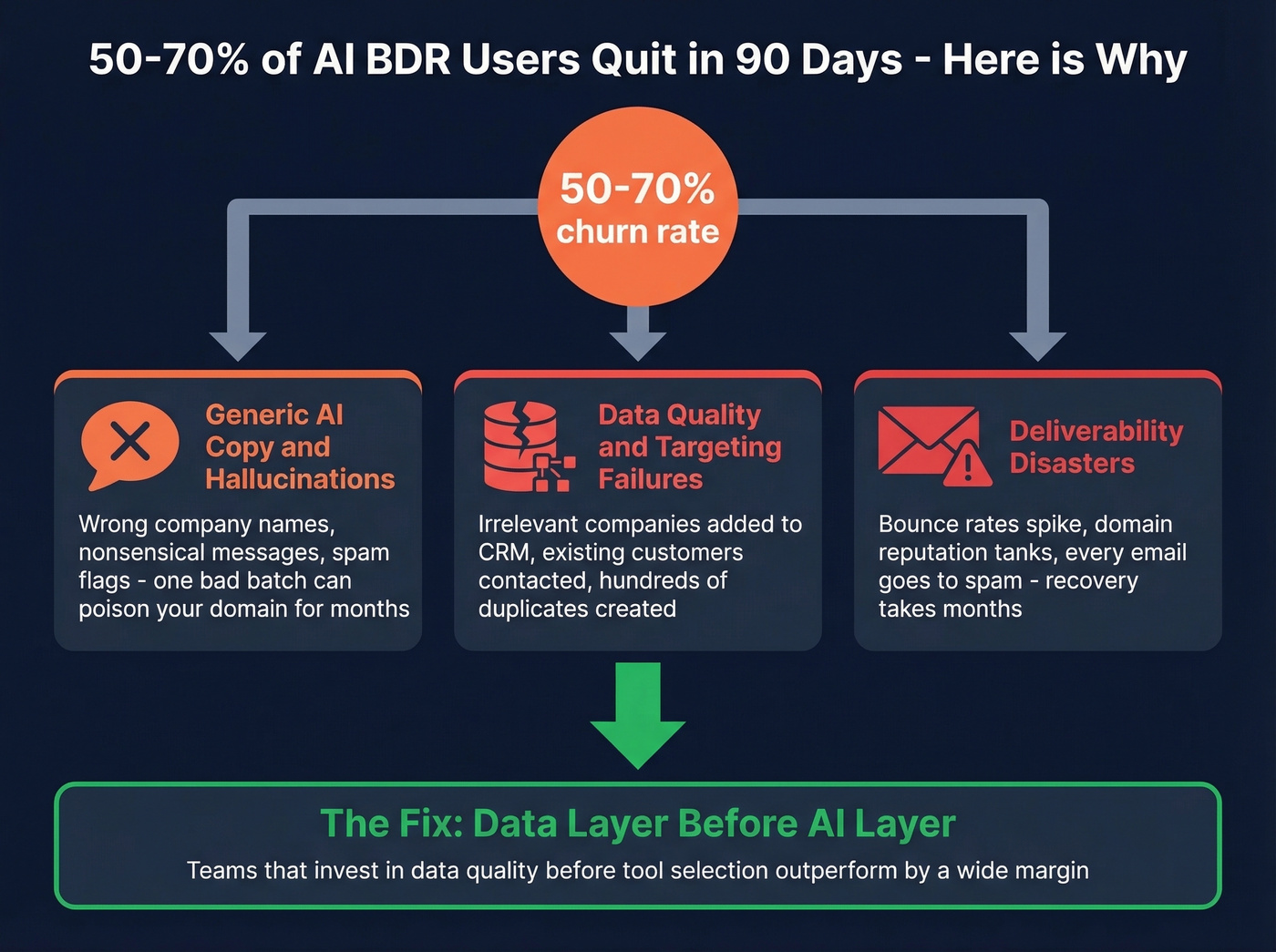
Generic AI copy and hallucinations. The AI writes something nonsensical, references the wrong company, or produces messages so generic they get flagged as spam. Brand damage is real and hard to undo - one bad batch can poison a domain for months. (If you need safer messaging patterns, start with these email blast templates and adapt them for outbound.)
Data quality and targeting failures. One 11x.ai user reported that the tool added irrelevant companies to their CRM and reached out to existing customers. It also ignored targeting rules and created hundreds of duplicates. Cleanup took weeks.
Deliverability disasters. If your bounce rate spikes, your domain reputation tanks and every subsequent email goes to spam. Recovering a burned domain takes months, and some teams never fully recover. If you’re troubleshooting, use a proper email reputation check and confirm you know how to check domain reputation.
Here's the thing: the AI layer matters less than the data layer. In our experience, teams that spend more time on data quality than tool selection outperform by a wide margin. Prospeo's 5-step verification delivers 98% email accuracy on a 7-day refresh cycle - at roughly $0.01/email, it's a rounding error compared to the $18k-$44k you're spending on the platform itself. If you’re building lists, follow a cold email lead list building workflow and run data enrichment only after verification.

Pre-Launch Checklist
The typical AI BDR workflow runs: research, targeting, personalization, send-time optimization, tracking, qualification, handoff. Every step downstream breaks if the first step feeds bad data. Lock these down before you go live:
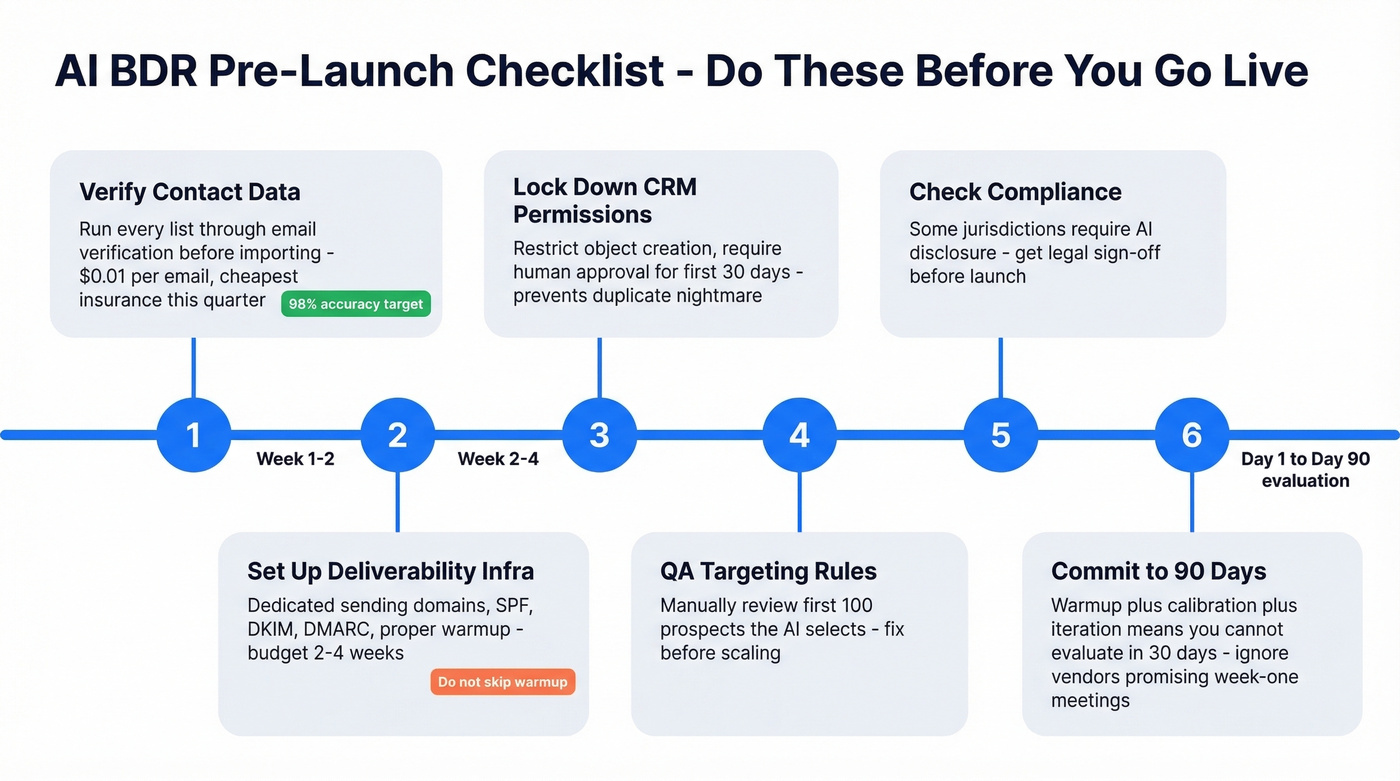
Verify your contact data first. Every AI agent is only as good as the emails it sends to. Run your list through a verification tool before importing anything. At $0.01/email with no contracts, this is the cheapest insurance you'll buy all quarter. (If you’re comparing vendors, see the best email verifier breakdown.)
Set up deliverability infrastructure. Dedicated sending domains, proper warmup, SPF/DKIM/DMARC. Budget 2-4 weeks before launch. Don't skip this - we've watched teams burn brand-new domains in 48 hours because they skipped warmup. Use a real sender authentication checklist and a structured Gmail warm up plan.
Lock down CRM write permissions. Don't let the AI create records freely, or you'll spend weeks cleaning up duplicates and junk contacts. Restrict object creation and require human approval for the first 30 days. If you need guardrails, start with CRM automation software patterns that limit write access.
QA your targeting rules. Run a manual review of the first 100 prospects the AI selects. Fix targeting before scaling. If the first batch includes existing customers or competitors, your rules are broken. Tighten your Ideal Customer Profile before you scale volume.
Check compliance requirements. Some jurisdictions require disclosure that outreach is AI-generated. Get legal sign-off before launch. (If you operate in regulated regions, review B2B compliance basics.)
Commit to 3 months minimum. Between warmup, calibration, and iteration, you can't evaluate results in 30 days. Any vendor promising meetings in week one is overselling.
50-70% of AI BDR users churn within 90 days - almost always because of bad data. Prospeo gives you 300M+ verified profiles with 30+ targeting filters including buyer intent, so your AI agent reaches real buyers from day one. No contracts, no sales calls.
The teams that succeed with AI BDRs start with verified contacts.
FAQ
What's the difference between an AI BDR and an AI SDR?
Functionally, almost nothing - vendors use the terms interchangeably. BDR traditionally implies outbound prospecting, while SDR can include inbound qualification. Ignore the label and evaluate whether the platform handles outbound, inbound, or both.
How long until an AI BDR produces results?
Expect 30-60 days before measurable pipeline impact due to deliverability warmup and targeting calibration. Budget a full 90 days before evaluating ROI. The rollout reality involves setup and iteration cycles that can't be skipped, no matter what the sales deck promises.
Can an AI BDR fully replace a human rep?
Not yet. AI handles volume outreach and follow-ups well but struggles with complex objection handling and relationship building. Most successful teams use AI for top-of-funnel volume while humans focus on qualified conversations and deals above $25k ACV. Think of it as a force multiplier, not a replacement.
What's the cheapest way to test an AI BDR?
Agent Frank at $416/month is the lowest-cost named option. Pair it with a free verification tier to validate data quality before scaling spend. If results look promising after 90 days, evaluate a larger platform like AiSDR or Artisan.