

How to Get Clients: The Data-Backed Guide to Channels That Actually Work
You've been in business for six months. Three clients, all from people you already knew. Pipeline's empty and you're refreshing your inbox for the third time today.
If you're asking yourself "how do I get clients," you're not alone - and you're probably overthinking it. Most guides hand you 15 tactics with zero data on what any of them cost or produce. This one covers what channels actually work, what they cost per client, and how to build a system around the two or three that fit your business.
The Quick Version
Starting from zero? Tap your warm network, build one proof-of-work project, then do targeted outreach. In that order.
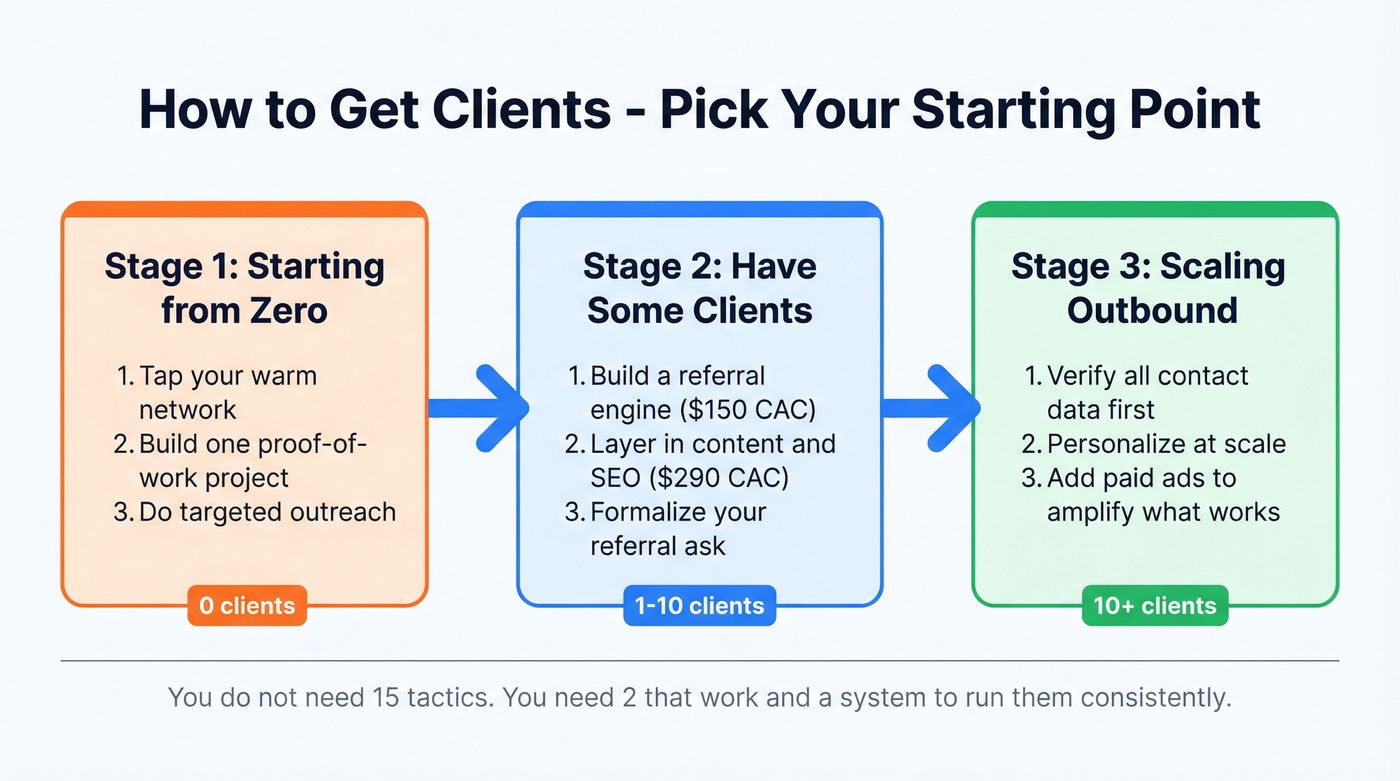
Already have some clients? Build a referral engine ($150 CAC) and layer in content/SEO ($290 CAC). They're consistently cheaper than paid search ($802) and outbound sales ($1,980).
Scaling outbound? Verify your contact data first. Nearly 20% of cold emails get flagged as spam, and bad data is a top reason outreach fails.
Why Most Acquisition Advice Falls Apart
Customer acquisition costs rose 40-60% between 2023 and 2025, and the trend hasn't reversed. The playbooks that worked three years ago - blast cold emails, run Facebook ads, post on LinkedIn twice a week - don't produce the same results at the same price anymore. Finding new customers today requires a fundamentally different approach than it did even two years ago.
Here's a real example. A beginner tried cold emailing 20+ Product Hunt startups over three days. The result: one reply saying "Not interested." No credibility, no clear offer, no targeting. That's not a client acquisition strategy - it's spam with a prayer attached.
The core problem isn't that people try the wrong channels. It's that they try too many channels with no system behind any of them. You don't need 15 tactics. You need two that work and a system to run them consistently.
Define Your Ideal Client First
Every channel downstream gets less effective when you skip this step. Before you write a cold email, record a TikTok, or ask for a referral, you need to know exactly who you're trying to reach.
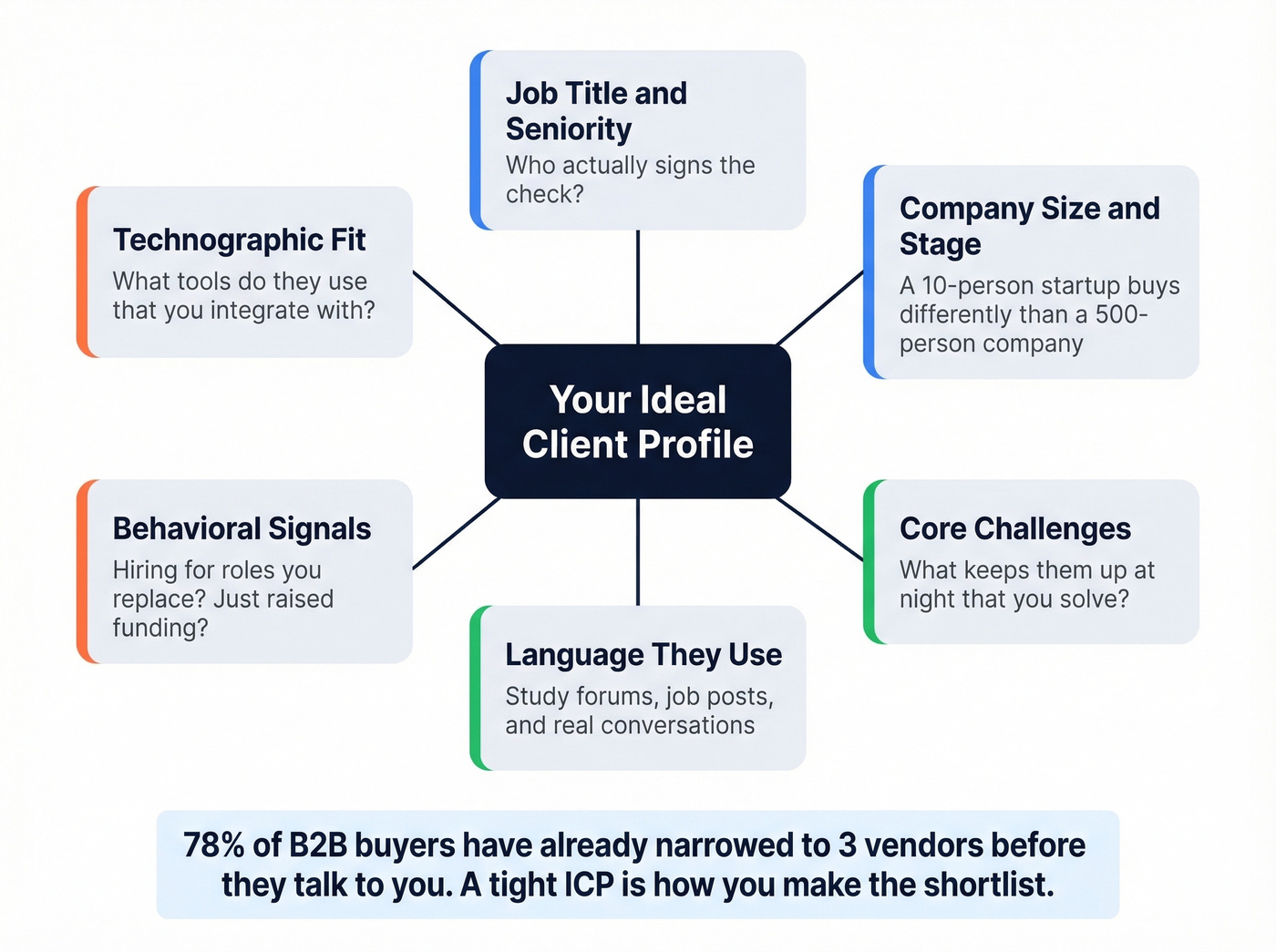
Build an ICP framework that covers these dimensions:
- Job title and seniority - who actually signs the check?
- Company size and stage - a 10-person startup and a 500-person mid-market company buy differently
- Core challenges - what keeps them up at night that your service solves?
- Language they use - study how they describe their own problems on forums, in job postings, and in conversations
- Behavioral signals - are they hiring for roles your service replaces? Did they just raise funding? (More on buying signals.)
- Technographic fit - what tools do they already use that your service integrates with or replaces? (See firmographic and technographic data.)
This matters more than most people think. The average B2B deal involves five decision-makers, takes over two months to close, and by the time buyers engage with you, 78% have already narrowed their shortlist to three vendors. A tight ICP is how you get on that shortlist early. If you're not on it, you're fighting for scraps.

You just read that a tight ICP is how you get on the shortlist. Prospeo's 30+ search filters - buyer intent, technographics, funding, headcount growth - let you build that exact ICP list in minutes, not days. 300M+ profiles, 98% email accuracy, verified before you ever hit send.
Define your ideal client, then find every one of them instantly.
Channels That Produce Clients (With Numbers)
Referrals and Your Warm Network
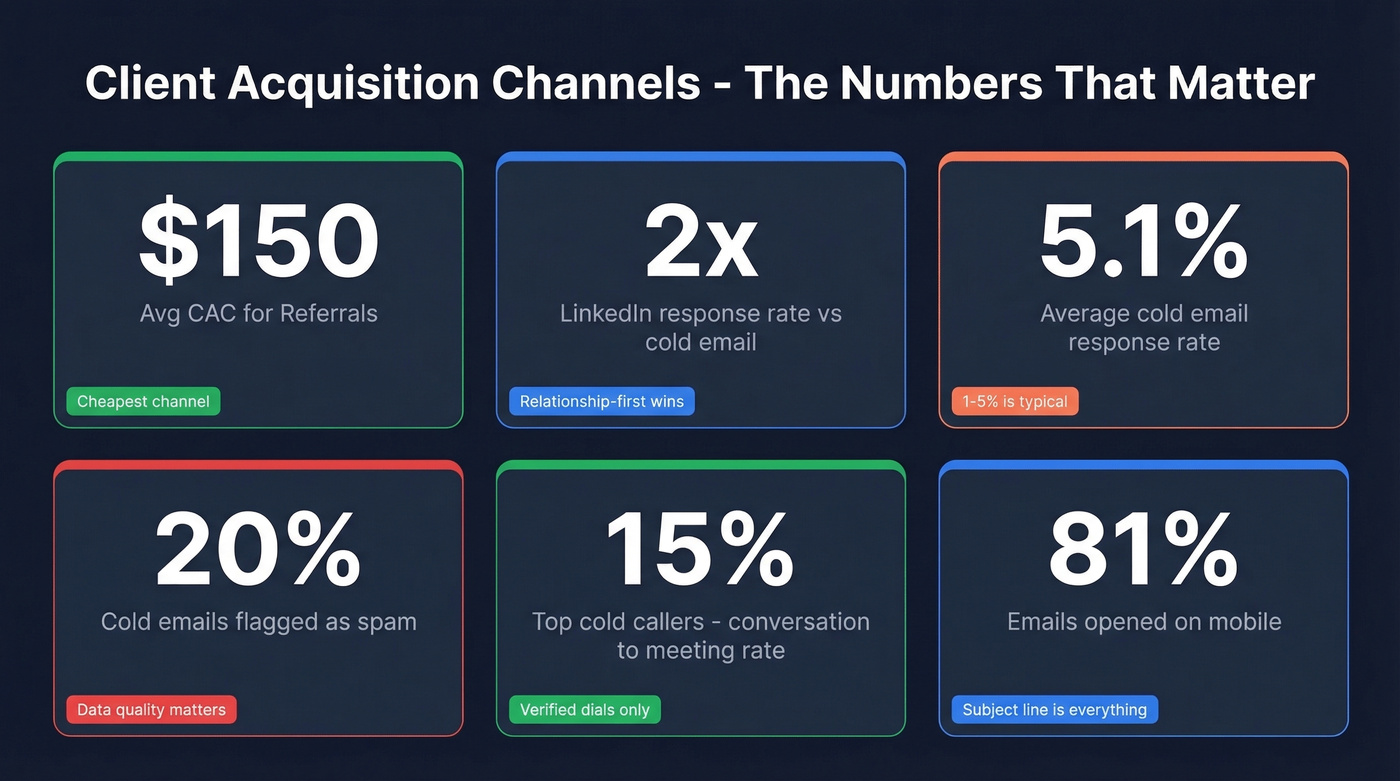
Referrals are the lowest-CAC channel in B2B benchmarks - $150 on average for SaaS companies. Compare that to $1,980 for outbound sales. The math is brutal.
A concrete way to kickstart this: offer a $100 credit toward next month's retainer for every referral that books a call. It costs you almost nothing and turns happy clients into a lead generation engine. We've seen teams double their pipeline in a quarter just by formalizing a referral ask they'd been doing informally for years.
Use this if: You have even one happy client and haven't systematically asked for introductions.
Skip this if: You have zero clients yet - in which case, build one proof-of-work project first. As one r/smallbusiness thread put it, "clients don't hire potential, they hire proof." Build a real landing page, booking system, or dashboard that solves a specific problem. Your first customer almost always comes from someone who already trusts you.
Content and Organic SEO
Organic content produces a CAC as low as $290 - the second-cheapest channel after referrals. The tradeoff is time. SEO and thought leadership are long-game plays. You won't see results in week one, but by month six, a consistent content engine compounds in ways paid channels never will. (If you want a deeper breakdown, see what is B2B content marketing.)
The SBA recommends combining content with referral strategies for exactly this reason - they reinforce each other. A prospect who finds your blog post, then hears your name from a colleague, is essentially pre-sold.
LinkedIn Outreach
LinkedIn outreach delivers double the response rate of cold email. It's also the channel where relationship-first tactics actually scale. Here's a condensed workflow adapted from a Forbes contributor's approach:
- DM people who comment on your posts - thank them privately, start a real conversation. Don't pitch.
- Define your ICP in detail - job title, company size, challenges, and the exact language they use. (Use an ideal customer profile template if you need structure.)
- Accept connections strategically - LinkedIn caps you at 30,000. Be selective.
- Show up consistently - treat your profile as a business asset, not a resume.
- Organize your DMs like a CRM - use snippets but keep conversations genuine. (More sales prospecting techniques here.)
Typical benchmarks for targeted ICP lists: connection acceptance rates of 20-40%, with reply rates of 5-15% depending on how personalized your messages are.
Cold Email
The average cold email response rate is 5.1%, with most campaigns landing between 1-5%. Advanced personalization can double those rates. But nearly 20% of cold emails get flagged as spam, and 81% of emails are opened on mobile - meaning your subject line and first sentence do almost all the work. (If you're stuck, borrow from these cold email subject line examples.)
Remember that beginner who emailed 20 strangers on Product Hunt and got one rejection? That's what happens when you skip targeting and data quality. Generic emails to unverified addresses aren't outbound - they're noise.
What actually works: verify your contact data before you hit send. Prospeo runs emails through a 5-step verification process with 98% accuracy, catch-all handling, and spam-trap removal. The free tier gives you 75 verified emails per month, enough to test whether cold email works for your business before you invest further. (If you want to go deeper, start with an email deliverability guide.)
Cold Calling
Top-performing cold callers convert up to 15% of conversations into meetings. The key word there is "conversations" - you need to actually reach someone. That means verified direct dials, not switchboard numbers. Invest in a data source with verified mobile numbers and a real pickup rate, or you'll burn hours dialing dead lines. (See a full cold calling system.)
Short-Form Video (TikTok)
This is the channel most guides won't mention because it doesn't feel "professional." The data says otherwise.
One agency shared their January client breakdown on Reddit, and TikTok was their top source. A generator services client came through a TikTok lead form - call happened the same day, payment came the next. $1,500/month retainer, closed in under 24 hours. They also noted that TikTok Lives, even just a couple hours a week, consistently produced leads in other months.
Let's be honest: if your average contract value is under $15k/month, TikTok is probably a better prospecting channel than LinkedIn Ads right now. It's underpriced, undercompeted, and the algorithm rewards consistency over production quality. Most B2B marketers are sleeping on it because it doesn't look "serious." Their loss.
Paid Ads
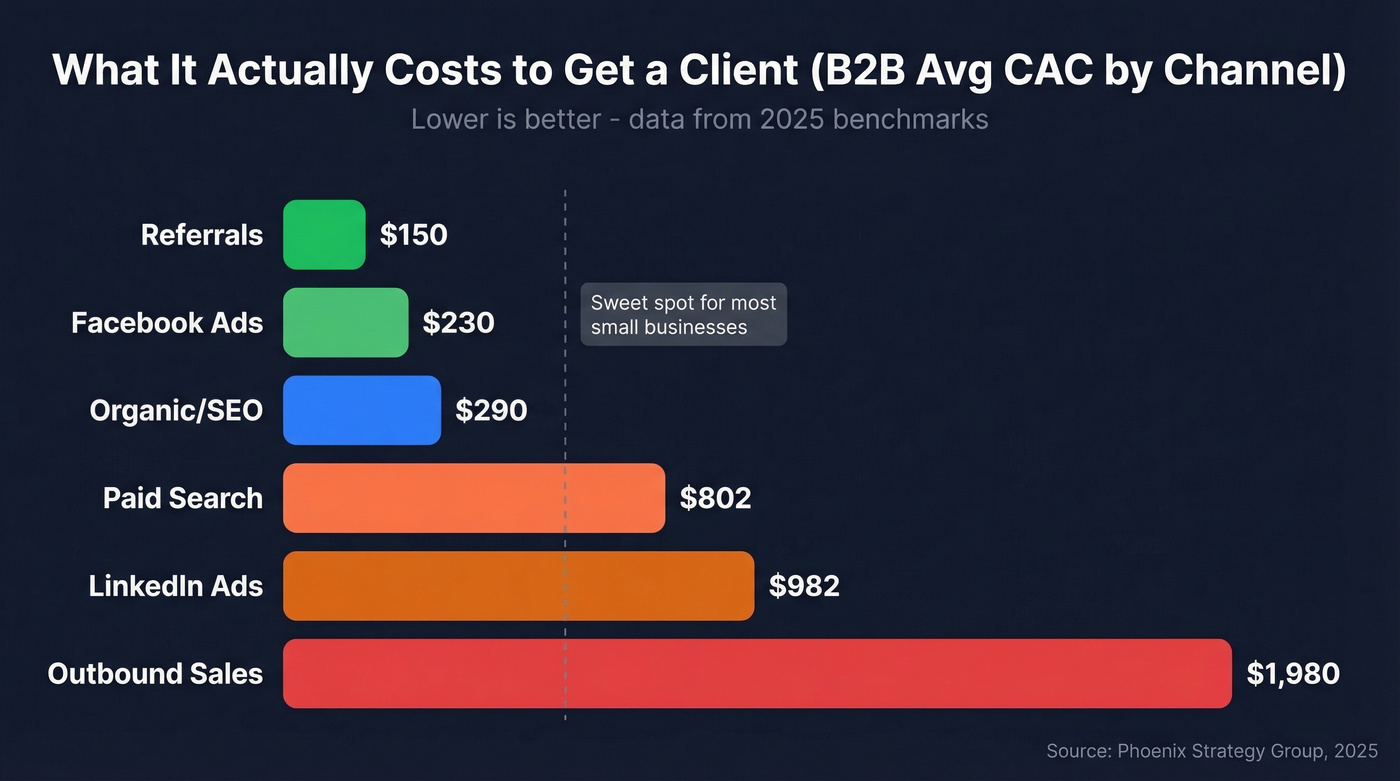
Paid channels work but they're expensive. Paid search averages $802 CAC for B2B. LinkedIn ads run $982. Facebook is the relative bargain at $230.
One tip that saves most teams money: start with retargeting, not cold traffic. Exhaust referrals, content, and organic outreach before spending on ads. Paid amplifies what's already working - it doesn't fix what isn't.
Partnerships
Complementary business partnerships are underrated. Find companies that serve your same ICP but don't compete with you, then co-market. If your web design client also needs SEO, and you know an SEO freelancer, that's a two-way referral pipeline waiting to happen. The agency from the Reddit case study sourced multiple clients this way - cross-referrals between non-competing service providers who share the same customer base.
What Each Channel Actually Costs
| Channel | Avg B2B CAC | Best For |
|---|---|---|
| Referrals | $150 | Everyone, always |
| Facebook Ads | $230 | Retargeting warm traffic |
| Organic/SEO | $290 | Long-term pipeline builders |
| Paid Search | $802 | High-intent keyword capture |
| LinkedIn Ads | $982 | Enterprise targeting |
| Outbound Sales | $1,980 | High-ACV deals ($25k+) |
And here's how CAC varies by industry, per FirstPageSage's dataset:
| Industry | Combined CAC |
|---|---|
| B2B SaaS | $239 |
| Construction | $281 |
| IT & Managed Services | $454 |
| Business Consulting | $533 |
| Legal Services | $749 |
The benchmark to aim for is a 3:1 LTV-to-CAC ratio. If you're not tracking cost per client, you're flying blind - and you're probably overspending on the wrong channels.
Speed Kills (Slowly)
The agency that sourced clients from TikTok had a hard rule: no more than 12 hours before follow-up. For most leads, they responded within hours, often with a personalized Loom video walking through what they'd do for the prospect's business. That generator services client? Closed in under 24 hours because the team moved fast.
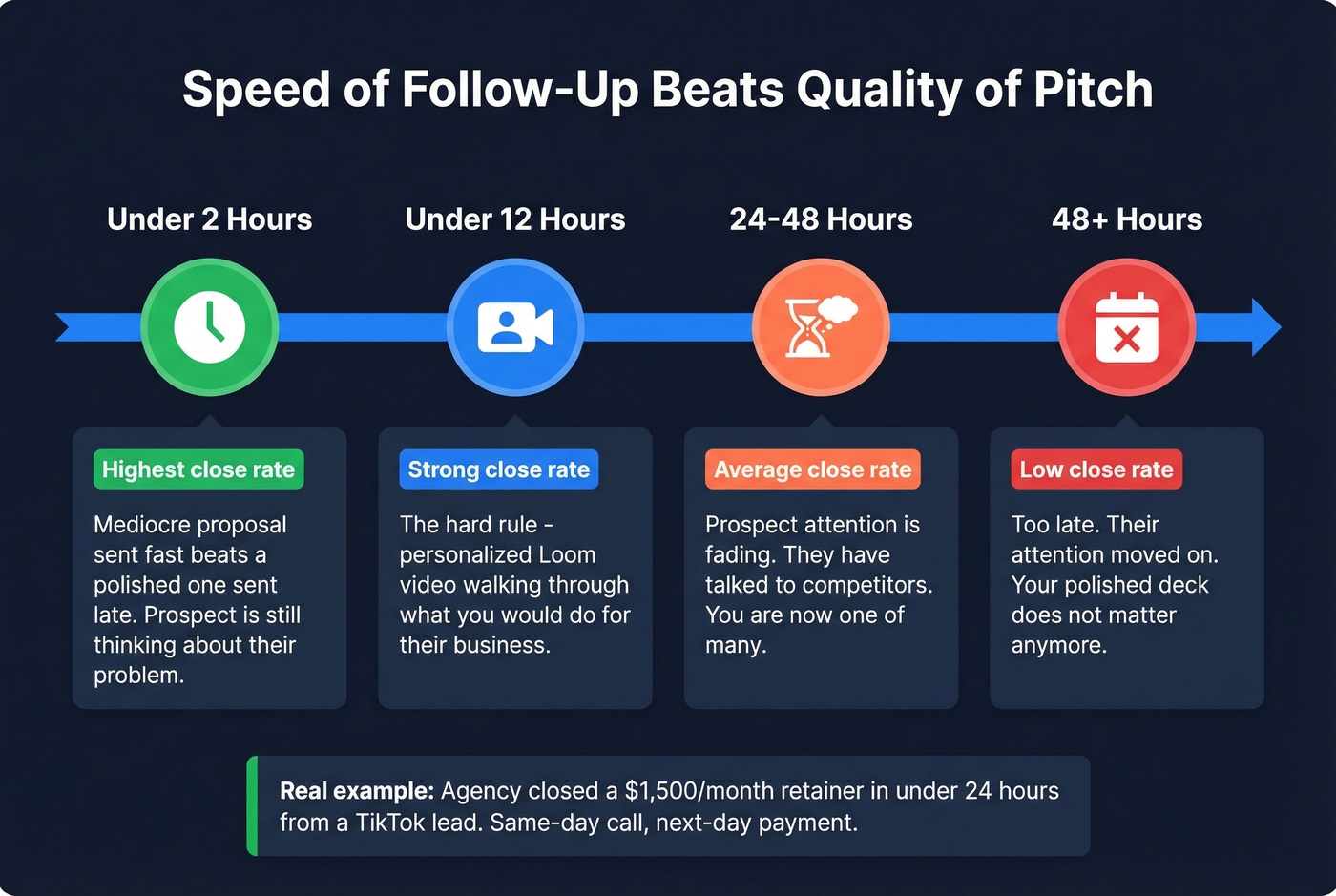
Speed of follow-up matters more than the quality of your pitch deck. A mediocre proposal sent in two hours beats a polished one sent in two days. The prospect's attention has already moved on.
Here's a follow-up timeline that works:
- Hour 1: Personalized Loom video or direct reply addressing their specific problem
- Day 3: Check-in with a relevant insight or quick question
- Day 7: Share a value-add resource - a case study, a relevant article, a quick audit
- Day 14: Final touch. If they're not responsive, move them to a nurture list
In our experience, teams lose deals they should've won simply because they took 48 hours to respond to an inbound lead. Don't be that team. (If you need copy, use these sales follow-up templates.)
Build a System, Not a Tactic List
Tactics without a system produce random results. The framework that actually works has four pillars, adapted from a modern GTM playbook:
- Plan - define your ICP, set CAC targets, pick two channels max
- Activate - start conversations through outbound, content, or referrals
- Establish authority - publish proof like case studies, results, and real projects
- Nurture - follow up consistently, track everything in a CRM
You don't need 15 channels. Pick two that fit your business, build a repeatable process around them, and measure what you spend per client. For most B2B teams, that means referrals plus one outbound channel - cold email, LinkedIn, or content - supported by a CRM and clean data. (To tighten the process, see lead generation workflow.)
For outbound at scale, pair a CRM like HubSpot with a verified data source like Prospeo's B2B database to keep your contact lists fresh. Prospeo refreshes records every 7 days versus the 6-week industry average, so you're not emailing people who changed jobs two months ago.
The article's math is clear: bad data kills outbound before it starts. Nearly 20% of cold emails hit spam, and unverified contacts are the top reason. Prospeo's 5-step verification with catch-all handling and spam-trap removal keeps your bounce rate under 4% - just like it did for Snyk's 50-person sales team. Start with 75 free verified emails per month.
Verify your contacts first, then watch your reply rates double.
FAQ
How do I find clients with no experience?
Build one real project that solves a specific business problem - a landing page, booking system, or dashboard. Then tap your warm network: friends, family, former colleagues. Platforms like Upwork and Fiverr help build initial proof and reviews. Your first client almost always comes from someone who already trusts you.
What's the cheapest way to acquire customers?
Referrals average $150 per client in B2B SaaS - the lowest CAC across all channel benchmarks. Organic content and SEO come next at around $290. Both beat paid search ($802) and outbound ($1,980) by a wide margin. Build a referral system before spending on ads.
Does cold email still work in 2026?
Yes, but only with verified data and specific messaging. The average response rate is 5.1%, and personalization doubles it. The catch: 20% of cold emails hit spam, often due to outdated addresses. Running your list through a verification tool with catch-all handling and spam-trap removal eliminates most of that risk.
How long does it take to land B2B clients?
The average B2B deal takes over two months to close and involves five decision-makers. By the time buyers engage with you, 78% have already narrowed their shortlist to three vendors. Start building visibility and trust well before you need the revenue.
What tools help with finding new customers?
For outbound, use a verified data platform to find decision-maker contacts - look for 98%+ email accuracy and verified mobile numbers. Pair it with a CRM like HubSpot to track follow-ups. For freelancers just starting out, Upwork and Fiverr are solid platforms to build initial proof and reviews.