

How Many Emails Is Too Many to Send? The Honest Answer for 2026
Four newsletters to 10,000 purchased contacts. That's all it took to torch one sender's domain so badly that even personal replies started landing in spam. The answer to how many emails is too many starts with your list quality, not your volume.
The Short Answer
- Marketing emails: 2-4 per week for B2B, up to daily for ecommerce if engagement supports it
- Cold outreach: 30-50 per day per inbox, ramped over 4-6 weeks
- Transactional emails: No practical cap if SPF, DKIM, and DMARC are configured and you maintain low complaint rates
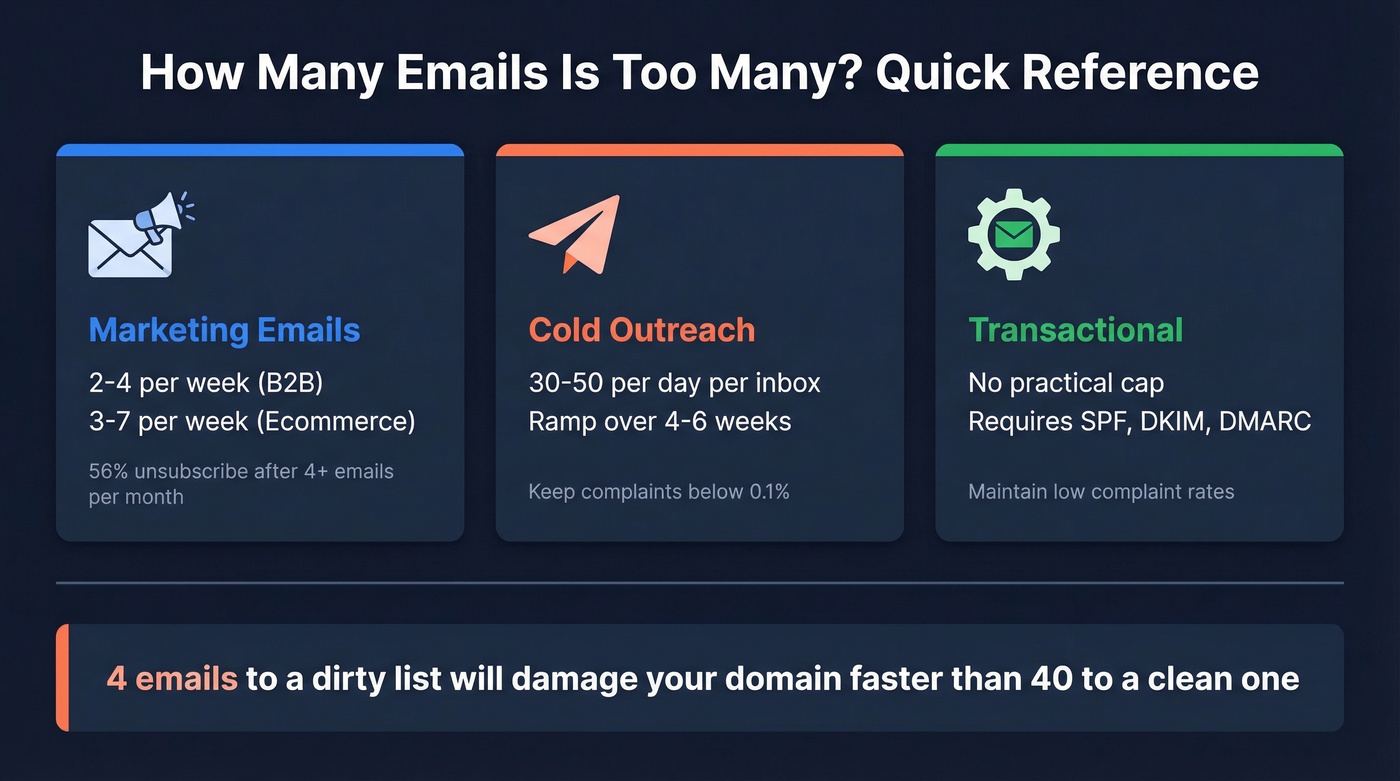
Four emails to a dirty list will damage your domain faster than forty to a clean one. Everything below explains why.
Why Every Blog Disagrees
You've probably seen "50 emails per day per inbox" repeated everywhere. A practitioner on r/coldemail dug into this and couldn't find a single official source backing that number - because there isn't one.
The scale makes the confusion understandable. An estimated 392.5 billion emails will be sent globally every day in 2026, up from 376.4 billion in 2025. The average office worker receives 121 business emails daily. Providers are getting more aggressive about filtering, and that's the real context behind every "limit" you've read.
Marketing Email Frequency Limits
Industry matters more than any universal rule:
| Industry | Recommended Frequency |
|---|---|
| Ecommerce | 3-7/week |
| B2B | 1-2/week |
| SaaS | 2-5/week |
| Newsletters | 1-7/week |
| Agencies/Consultants | 1-3/week |
The tolerance ceiling is lower than most marketers think. A GetApp survey of nearly 6,000 consumers found that 56% would unsubscribe after receiving 4+ emails from the same company in a 30-day period, with 53% citing volume as the primary reason. Start conservative and let engagement data guide you upward.
Gmail's Subscription Center changed the equation in mid-2025. It now shows users exactly how many emails they receive from each sender. Some senders saw unsubscribe volumes spike to nearly twice their average after the rollout. High frequency is more visible than ever, and recipients are acting on it.
If you're trying to improve performance without increasing volume, start with email subject lines and tighter targeted email campaigns.

Four emails to a bad list destroyed that sender's domain. The fix isn't sending less - it's sending to verified addresses. Prospeo's 5-step verification catches spam traps, honeypots, and invalid emails before they torch your reputation. Teams using Prospeo cut bounce rates from 35% to under 4%.
Stop gambling with your domain. Verify 75 emails free - no credit card required.
Cold Outreach Sending Limits
Official caps and safe practice are two different things:
| Provider | Official Cap | Safe Zone |
|---|---|---|
| Google Workspace | 2,000/day | Under 1,500/day |
| Gmail (free) | 500/day | 100-200/day |
| Microsoft 365 | 10,000 recipients/day | 2,000-3,000/day |
| Outlook.com | 5,000 recipients/day | 150-200/day |
| Yahoo Mail | 500/day | 100-150/day |
A fresh Google Workspace account blasting 1,500 emails on day one will get throttled immediately. Don't confuse "official cap" with "what you can safely do on a new domain."
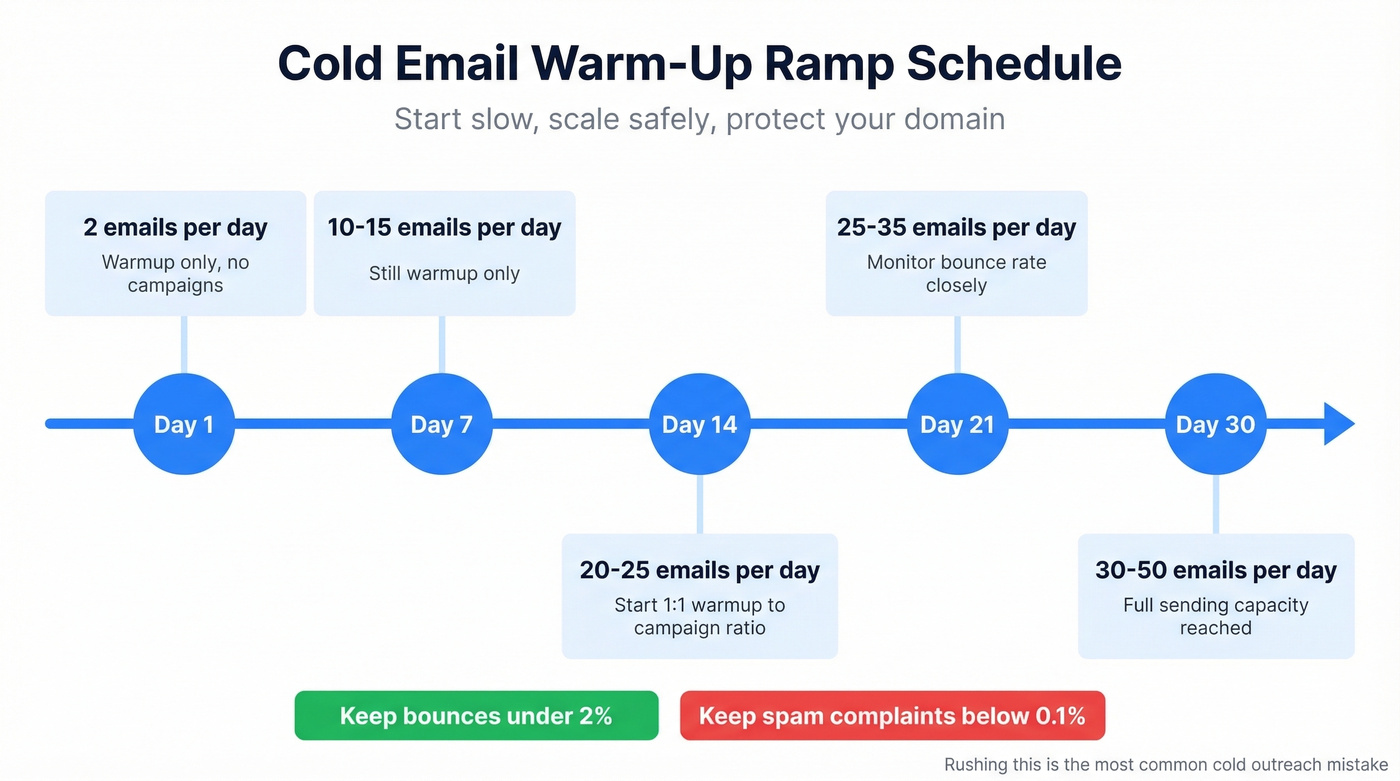
The warm-up math is straightforward: start with 2 emails on Day 1, ramp to 30-40 per day by Day 30, and maintain a 1:1 warmup-to-campaign ratio after Day 14. In our testing, the complaint rate threshold matters more than any daily cap - keep bounce rates under 2% and spam complaints below 0.1%. Google's bulk sender guidelines explicitly call out 0.1% as the line.
If you want a deeper breakdown of safe ramping, see email velocity and the bulk email threshold.
What Actually Gets You Flagged
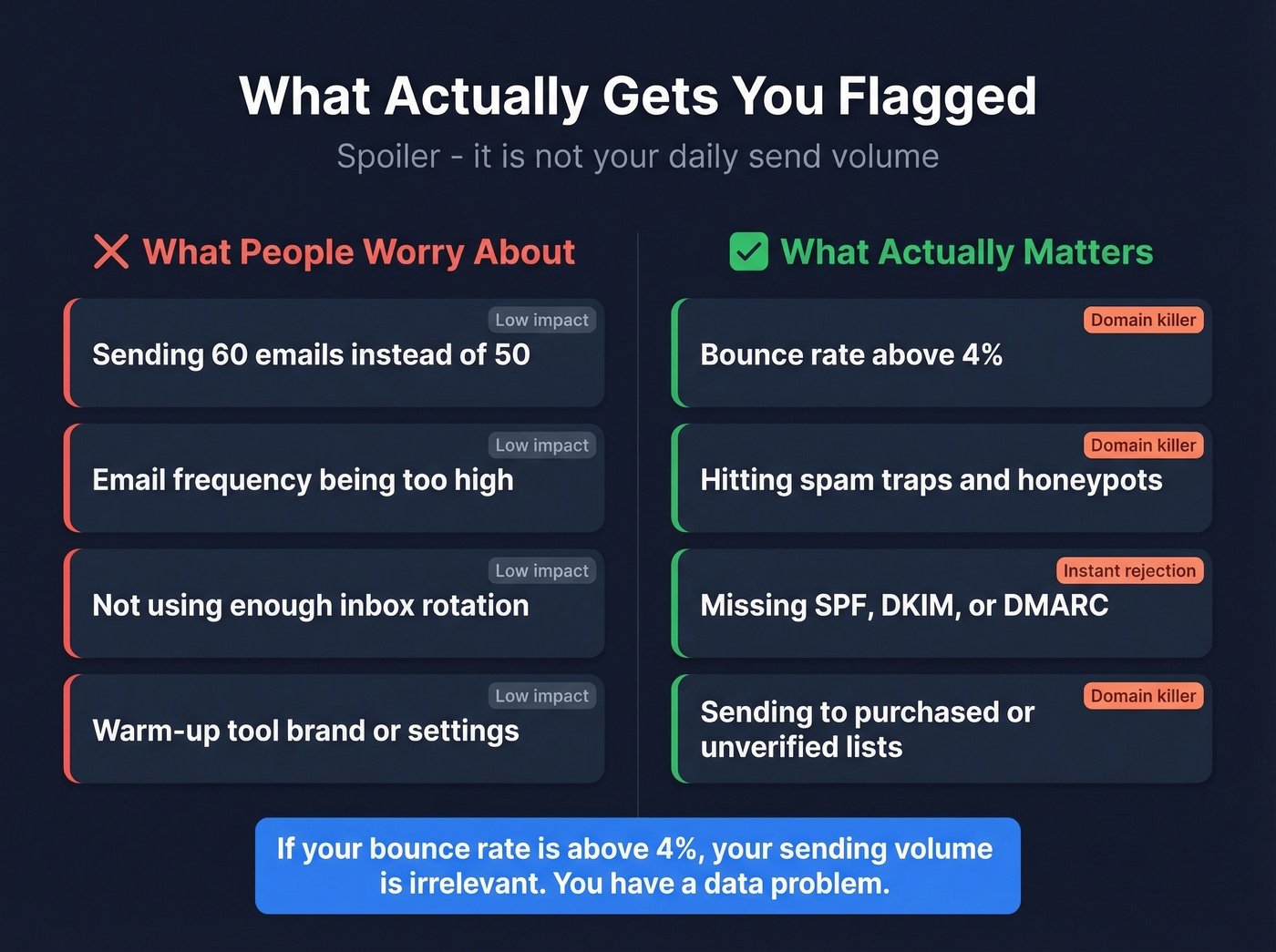
Volume alone rarely kills your domain. Bad data does.
One sender on r/Emailmarketing bought a CSV of roughly 10,000 contacts and sent just four newsletters over eight months. That destroyed their domain reputation so thoroughly that even personal 1:1 replies landed in spam. Google support told them "everything looks good." It wasn't.
Google ramped up enforcement in November 2025, introducing temporary deferrals and permanent rejections for non-compliant bulk senders. The requirements aren't optional anymore: SPF, DKIM, DMARC with alignment, one-click list-unsubscribe headers, valid rDNS, and TLS. Miss these and your messages get deferred or rejected outright - not just deprioritized.
Here's the thing: teams obsess over daily send volume while ignoring the addresses they're sending to. Bounces, spam traps, and honeypot addresses do exponentially more damage than sending 60 emails instead of 50. If your bounce rate is above 4%, your sending volume is irrelevant - you have a data problem, not a frequency problem. We've seen teams go from 35% bounce rates to under 4% just by running lists through Prospeo's 5-step verification before hitting send, catching invalid addresses, spam traps, and honeypots that would've torched their sender reputation.
To diagnose the root cause faster, benchmark your email bounce rate and follow a full email deliverability guide.
It's Not About Volume - It's About List Quality
The real question isn't how many emails is too many to send. It's how clean is your list and how relevant is your content.
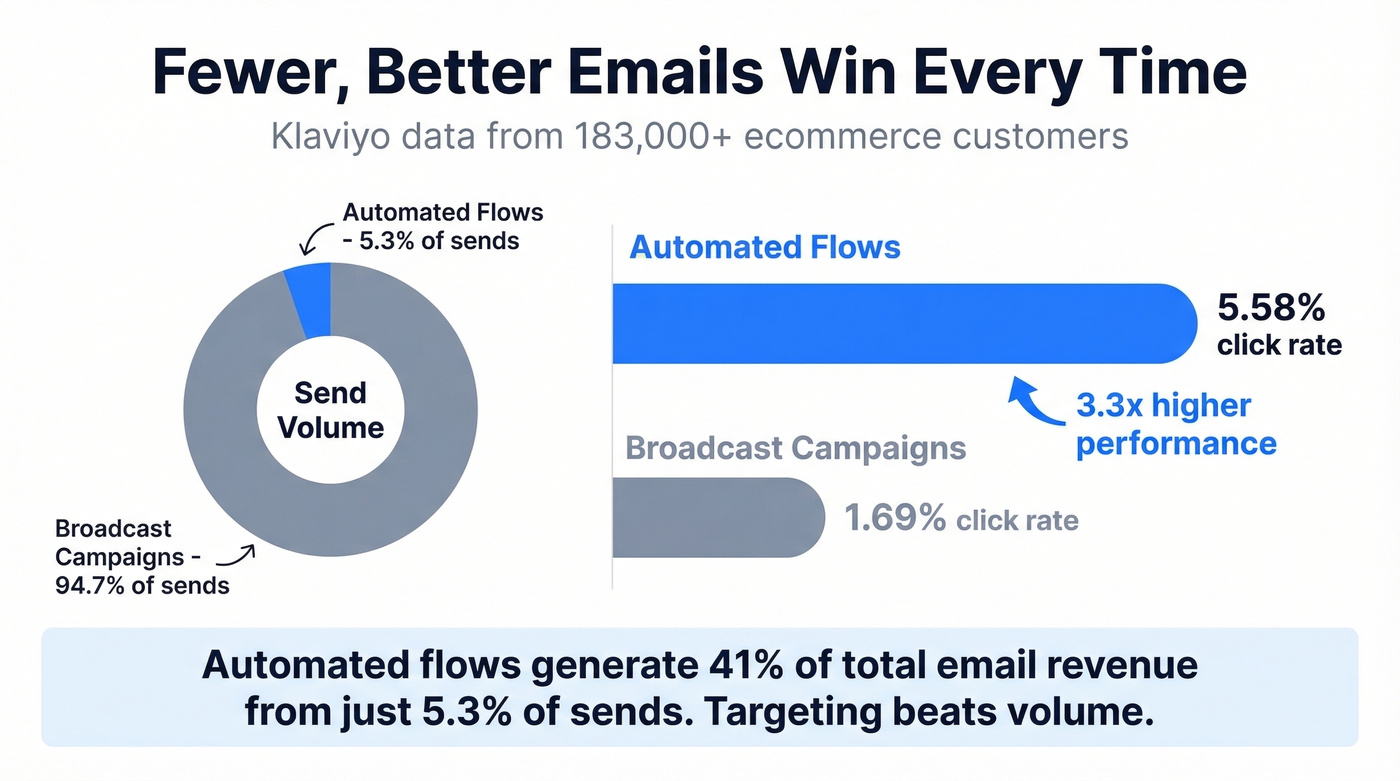
Klaviyo's dataset across 183,000+ ecommerce customers proves this: automated flows generate 41% of total email revenue from just 5.3% of sends, with a 5.58% click rate versus 1.69% for broadcast campaigns. Fewer, better-targeted emails outperform high-volume blasts by a factor of three.
If you're building outbound lists, it also helps to understand how to generate an email list and when buying data crosses the line (see Is It Illegal to Buy Email Lists?).
One practitioner on r/Emailmarketing spent over a year in spam with open rates under 5%. Recovery took a fresh domain, a 50-emails-per-day ramp over six weeks, aggressive list hygiene, and a consistent Tuesday/Thursday cadence. We've watched teams recover from spam placement in as little as 6 weeks with this approach. The biggest lever was never reducing volume - it was cleaning the list and earning engagement back.
Let's be honest: if you're sending cold outreach and you haven't verified every address in your sequence, you're gambling with your domain. Skip this step and no amount of warm-up will save you.
If you need a practical framework, start with an AI cold email outreach playbook and proven cold email follow-up templates.
Your sending ceiling isn't 50 emails per day - it's however many clean addresses you have. Prospeo delivers 98% email accuracy with spam-trap removal, catch-all verification, and a 7-day data refresh cycle. That's why agencies like Stack Optimize maintain sub-3% bounce rates across every client campaign.
Send more emails without wrecking your domain. Start with 75 free verified emails.
FAQ
What happens if I exceed my provider's sending limit?
Most providers temporarily block your account for 1-24 hours. Google Workspace suspends sending privileges entirely; Microsoft 365 throttles delivery speed. Repeated violations can trigger permanent restrictions that take weeks to resolve.
How long does it take to warm up a new email domain?
Plan for 4-6 weeks minimum. Start with 2 emails on Day 1, ramp to 30-40 per day by Day 30. Keep bounce rates under 2% and spam complaints below 0.1% throughout. Rushing this is the single most common cold outreach mistake we see.
Does email verification actually improve deliverability?
Yes - dramatically. Sending to invalid addresses triggers bounces that damage sender reputation with every major provider. Spam traps are worse: a single hit can flag your entire domain. Pre-send verification tools like Prospeo, NeverBounce, or ZeroBounce catch these before they enter your list.