

How Often to Send Follow-Up Emails in 2026: What 16.5M Emails Reveal
Most guides on follow-up email frequency tell you to send more. Five touches, seven touches, "80% of deals close after the fifth email." A [study of 16.5 million cold emails](https://belkins.io/blog/sales-follow-up-statistics) by Belkins shows a harsher reality: your highest reply rate comes from the first email, and piling on follow-ups quickly erodes performance. By the fourth follow-up, your risk of being marked as spam more than triples.
The quick version: send your initial email plus one to two follow-ups over 10-14 days using graduated spacing (2 days, then 4-7 days). That's the sweet spot. Below you'll find the exact cadence, the data behind it, and the mistakes that are quietly killing your reply rate.
What 16.5M Emails Actually Show About Follow-Up Frequency
Belkins analyzed 16.5 million cold emails across 93 business domains from January through December 2024. The headline finding is uncomfortable for anyone running 7-step sequences: the first email in any sequence produced the highest reply rate at 8.4%, and one-touch sequences outperformed longer ones overall.
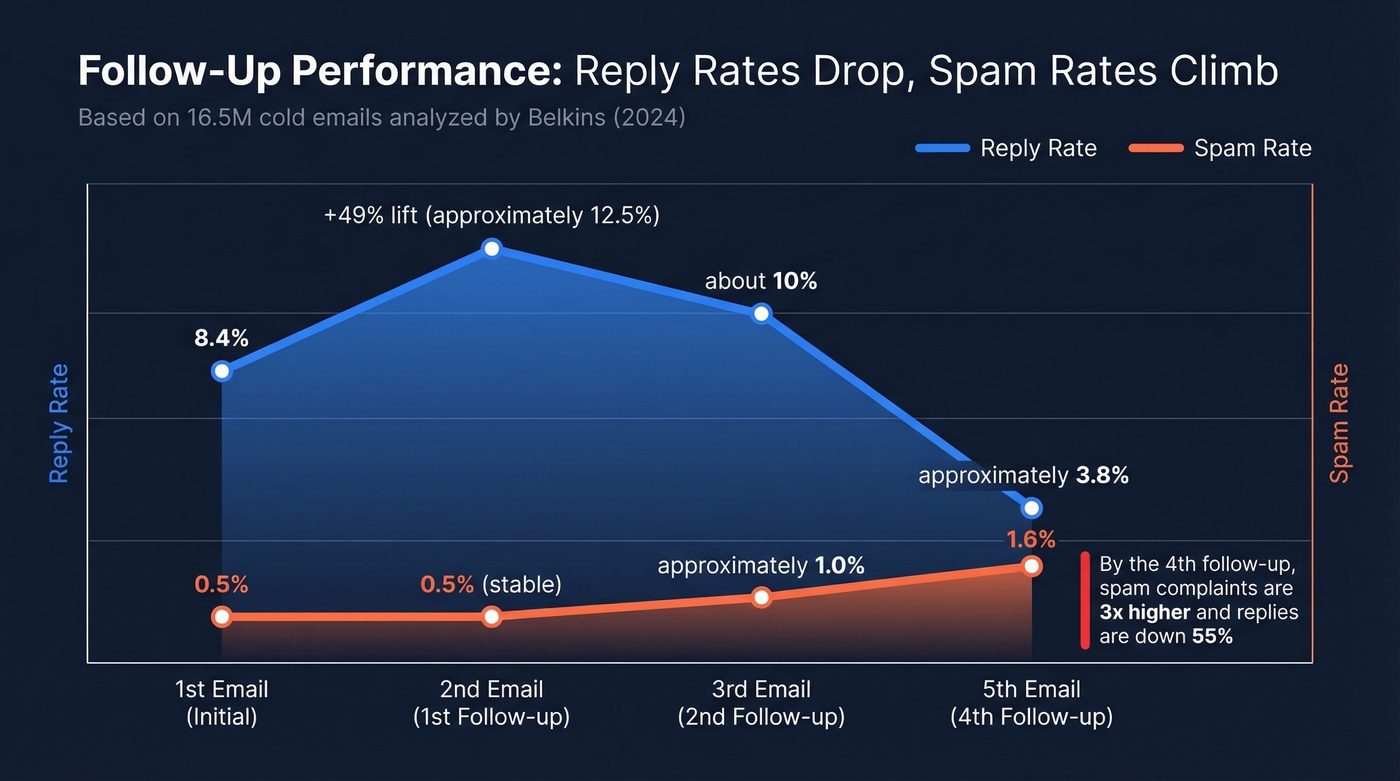
For context, global cold email reply rates sit around 3% based on Smartlead's 14.3 billion-send dataset, so even that 8.4% first-email rate represents top-tier performance.
The first follow-up can still help - in top-performing campaigns, it lifted replies by up to 49%. But the curve drops fast. A third email produced 20% fewer responses. By the fourth follow-up, reply rates had fallen 55% from peak.
Here's the thing most articles won't tell you: that "80% of sales require five touches" stat conflates all channels - calls, meetings, demos, social touches. It doesn't mean five emails. Treating it as an email-specific benchmark is how teams burn their domains.
The negative signals are even more damning than the reply decline:
| Follow-Up # | Reply Rate Impact | Spam Rate | Unsub Rate |
|---|---|---|---|
| 1st (initial) | 8.4% (peak) | 0.5% | 0.1% |
| 2nd (1st follow-up) | Up to +49% lift | ~stable | 0.05% |
| 3rd (2nd follow-up) | -20% vs prior | rising | 0.8% |
| 5th (4th follow-up) | -55% vs peak | 1.6% | 2.0% |
Founders show a similar pattern. Reply rates stay flat through the first follow-up (6.64% to 6.66%), peak slightly at the second (6.94%), then crater to 3.01% by the fourth. If your sequence has more than three emails, you're actively working against yourself.
One more finding from the same dataset: turning off open-tracking pixels improved response rates by about 3%. Tracking pixels hurt deliverability and erode trust - a trade-off most teams make without thinking about it.
The Optimal Cadence and Timing
Graduated spacing beats static intervals. Sending every two days at the same time looks automated to both recipients and spam filters. Instantly's timing research recommends widening the gap between each touch:
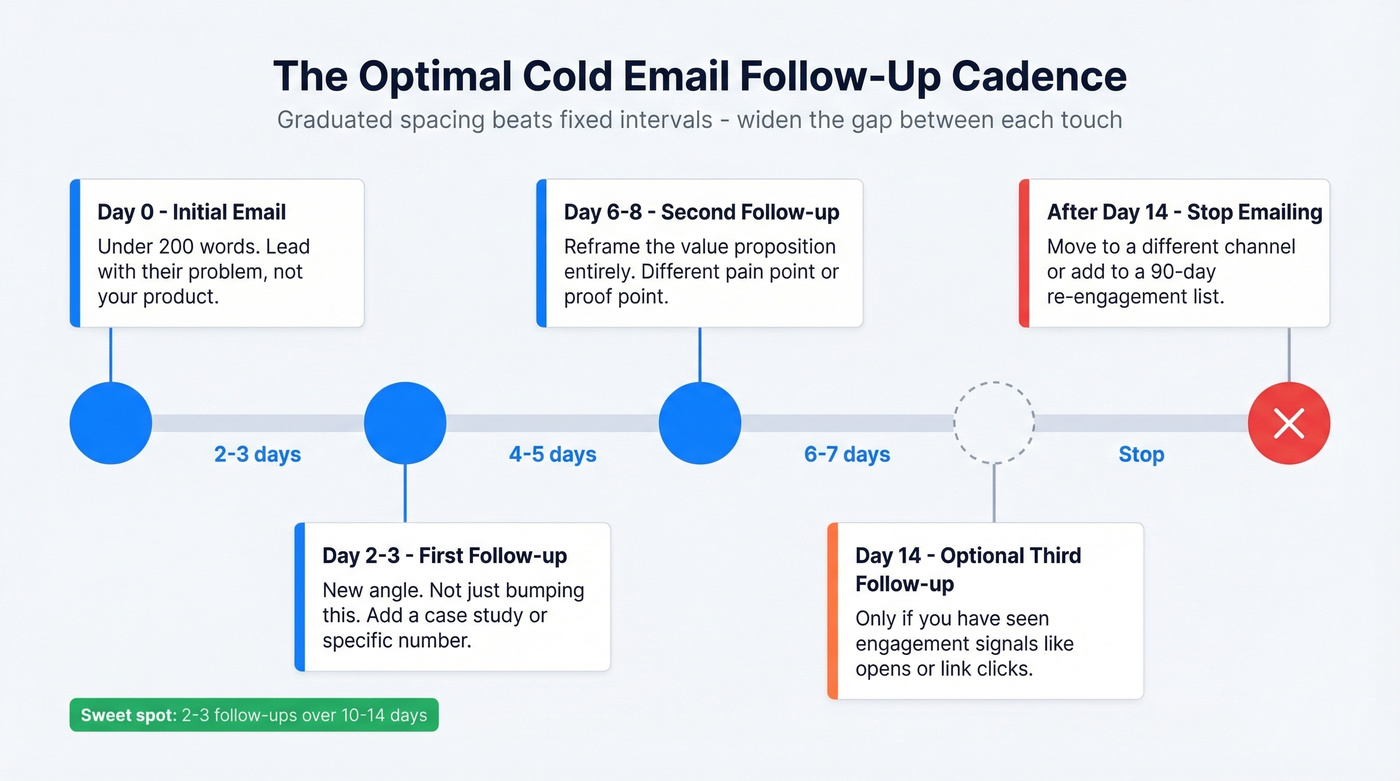
- Day 0 - Initial email. Keep it under 200 words.
- Day 2-3 - First follow-up. New angle, not a "just bumping this" rehash (see how to say just checking in professionally).
- Day 6-8 - Second follow-up. Reframe the value proposition entirely.
- Day 14 - Optional third follow-up, only if you've seen engagement signals like opens or link clicks.
- After Day 14 - Stop emailing. Move to a different channel or add them to a 90-day re-engagement list.
This cadence is for cold outbound. For inbound leads - someone who filled out your form or replied to content - respond within five minutes, not days. Instantly's research ties sub-5-minute response time to dramatically higher connect rates.
Adjust for persona. Executives get longer gaps - at least three business days between touches. SMB owners operate faster; a two-day gap works. Best send windows: Tuesday through Thursday, 9-11 AM in the recipient's local time zone (more detail in our best time to send cold emails guide).
On r/Emailmarketing, one creator running daily automation to roughly 3,300 subscribers reported 38.5% average open rates - but that's newsletter territory, not cold outbound. For cold email, daily follow-ups are a domain death sentence.

The data is clear: 2-3 follow-ups max, then stop. But even the perfect cadence fails when 30% of your list has decayed. Prospeo's 5-step verification catches invalid addresses, spam traps, and honeypots before they enter your sequence - keeping bounce rates under 4% and your domain reputation intact.
Fix your list before you fix your cadence. 75 free verifications to start.
Follow-Up Mistakes That Kill Replies
Treat each follow-up as a standalone pitch with new information. Add a case study, a specific number, a different angle on the problem. The GMass team documented the most common anti-patterns, and "just checking in" with no new value tops the list. Don't copy-paste your first email with "per my last message" bolted on. Don't address the same objection three times. And don't send at identical intervals - it screams automation.
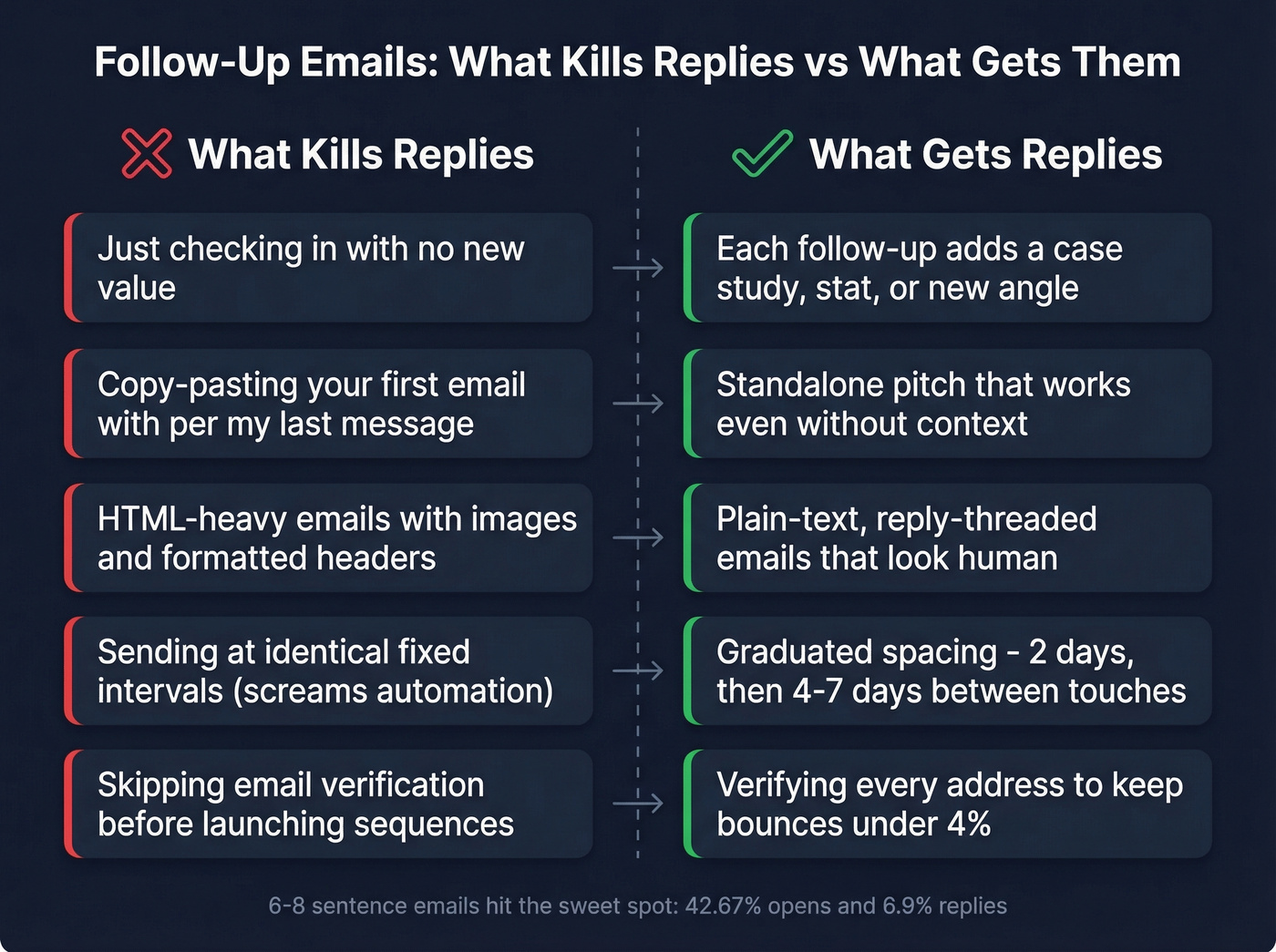
Send plain-text, reply-threaded emails. They look human. HTML-heavy follow-ups with formatted headers and image blocks look like marketing automation, and recipients treat them accordingly. Your follow-up should also be shorter than your initial email, not longer. The 16.5M-email dataset shows 6-8 sentence emails hit the sweet spot for both opens (42.67%) and replies (6.9%). If you need examples, use these sales follow-up templates or these cold email follow-up templates.
Verify your list before launching any sequence. This is the one we see teams skip constantly, and it's the most expensive mistake. Follow-ups to invalid addresses don't just fail silently - they generate bounces that damage your sender reputation, pushing future emails to real people into spam. Prospeo's 5-step verification catches invalid addresses, spam traps, and honeypots before they enter your sequence. The free tier covers 75 verifications per month (see email bounce rate benchmarks and fixes).
Don't assume your CRM data is clean because it was "verified" six months ago. Data decays at roughly 30% per year - a list verified in January is 15% stale by July. If you're building lists at scale, follow a repeatable lead generation workflow and add data enrichment before you sequence.
Why Over-Following-Up Burns Your Domain
Gmail's spam complaint threshold sits at 0.3%. Cross it, and inbox placement drops fast.
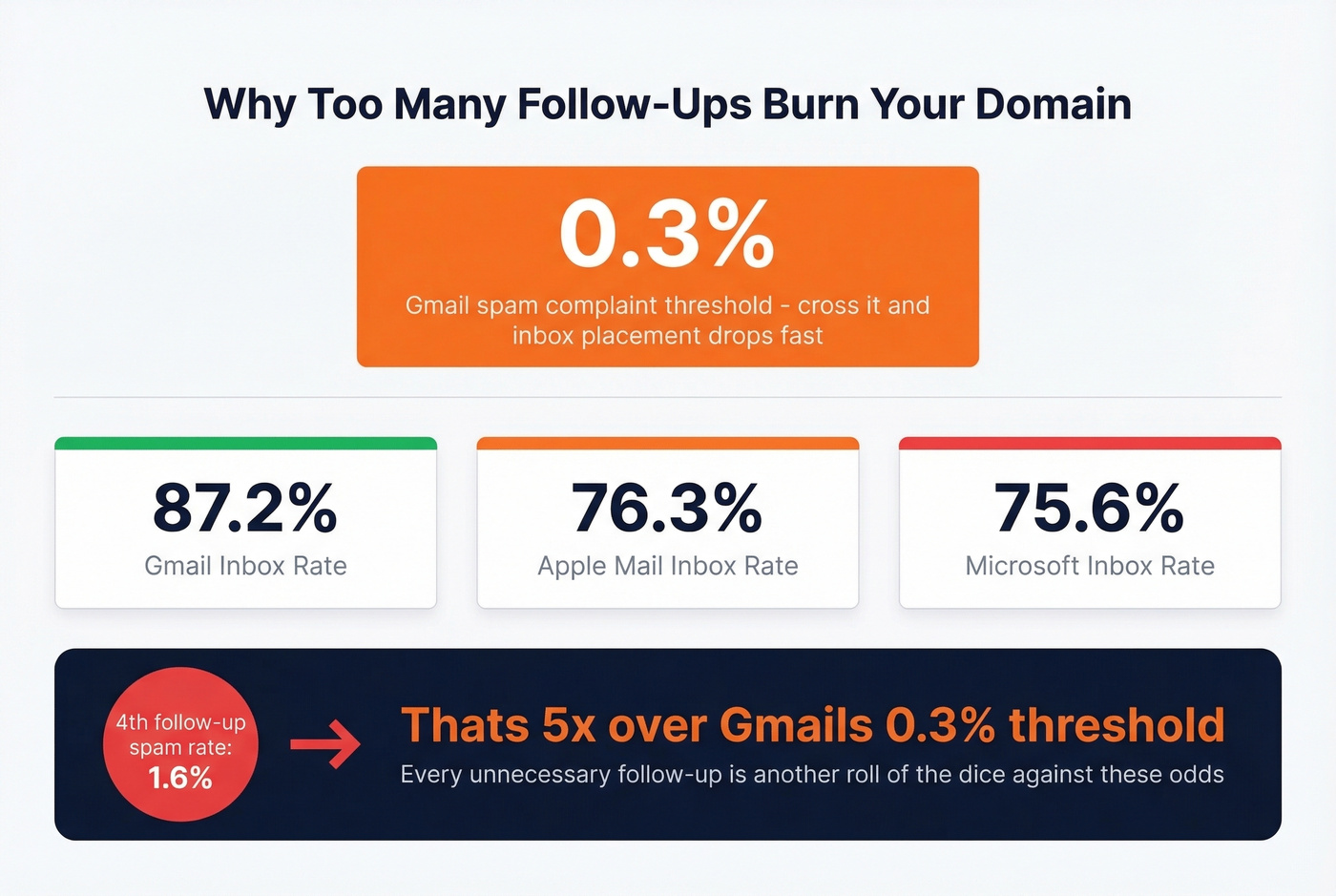
Look at the data again: spam complaints jump from 0.5% on the first email to 1.6% by the fourth. If you're running 5+ touch sequences at any real volume, you're almost certainly pushing past that threshold. Getting your follow-up frequency wrong doesn't just hurt reply rates - it damages the sender reputation you need for every future campaign (here’s how to improve sender reputation).
The ISP numbers make it worse. Gmail delivers 87.2% of emails to inbox, but Microsoft only manages 75.6%. Apple Mail sits at 76.3%. Every unnecessary follow-up is another roll of the dice against those odds. Google and Yahoo have required SPF, DKIM, and DMARC authentication for bulk senders since 2024, plus one-click unsubscribe honored within two days. Microsoft enforces similar requirements as of 2025 (use an email deliverability guide to audit your setup).

Let's be honest: before you stress about follow-up timing, make sure the emails you're following up on are reaching real inboxes. In our experience, the single biggest follow-up killer isn't bad cadence - it's bad data. We've seen agencies cut bounce rates from 35% down to under 4% just by running lists through real-time verification before launching sequences. Stack Optimize, for example, built to $1M ARR while maintaining 94%+ deliverability and sub-3% bounce rates across all their clients.
Stack Optimize built to $1M ARR with sub-3% bounce rates. Snyk's 50 AEs dropped bounces from 35% to under 5%. The difference wasn't cadence - it was sending follow-ups to verified emails. Prospeo delivers 98% email accuracy at $0.01 per lead with data refreshed every 7 days, not 6 weeks.
Stop burning your domain on stale data. Every follow-up deserves a real inbox.
FAQ
How many follow-up emails should I send for a job application?
Stick to one or two follow-ups spaced 5-7 business days apart. Hiring managers operate on slower cycles than sales prospects, and persistence past two unanswered follow-ups rarely changes the outcome. After that, move on.
Should each follow-up use a new subject line?
Keep the same thread for your first one to two follow-ups - it provides context and looks more human. Only use a fresh subject line if you're restarting after a gap of two or more weeks, or shifting the angle entirely.
What's the ideal follow-up schedule for cold outreach?
Send one to two follow-ups over 10-14 days with graduated spacing: a 2-3 day gap after your first email, then 4-7 days before the next. Beyond that, reply rates drop sharply while spam complaints climb. Fixed daily intervals signal automation and hurt deliverability.
Does email verification affect follow-up success?
Bounces from invalid addresses damage your sender reputation, pushing every subsequent email - including follow-ups - into spam. Verifying addresses at 98% accuracy before they enter your sequence keeps bounce rates under control and protects the domain reputation that makes your follow-ups land in the first place.