

How to Align Sales and Marketing in 2026: The Practitioner's Playbook
It's Monday morning. Marketing's slide says 847 MQLs delivered last quarter. The sales VP pulls up Salesforce and says, "These leads are garbage." Nobody can explain what happened between MQL and closed-won - it's a black hole.
If you've spent any time on r/marketing threads about alignment, you've seen the same pattern: marketing says they delivered leads, sales says the leads are junk, and nobody can prove either side right because they're measuring different things. Figuring out how to align sales and marketing is the single most impactful operational fix a B2B team can make. Most companies still get it wrong.
This scene plays out at companies running HubSpot, Salesforce, and every other tool combination you can think of. The tools aren't the issue. A study of 105 B2B companies by Influ2 found that 53% have a fundamentally broken handoff - sales contacts fewer than 35% of the prospects marketing actually engaged. That's not a communication problem. It's an engineering problem with specific, fixable causes.
What Misalignment Actually Costs
The revenue impact isn't abstract. SuperOffice documented a 34% increase in new business revenue within two years of fixing alignment at their Benelux office. Flip it around and the losses are just as concrete.
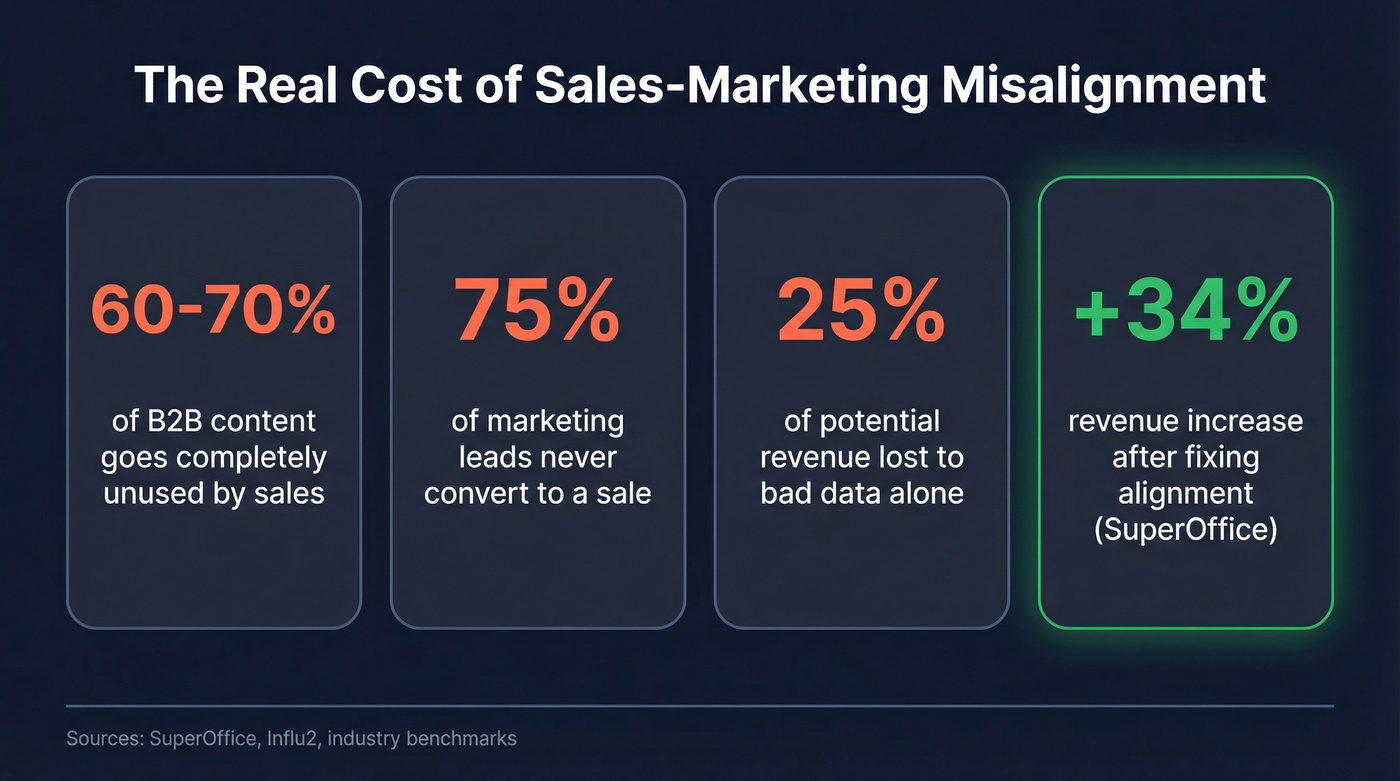
Industry benchmarks consistently show that 60-70% of B2B content goes completely unused by sales, roughly 75% of marketing leads never convert, and bad data alone costs companies up to 25% of potential revenue. These aren't soft costs - they show up in pipeline velocity, win rates, and quota attainment. "Align better" isn't a strategy. What follows is.
Three Things to Do Monday
If you do nothing else from this guide, do these three things. Everything else is optimization.
- Write down your MQL and SQL definitions in a shared doc. If sales and marketing can't recite the same definition, you don't have one.
- Set an 8-hour SLA for lead follow-up and enforce it in your CRM. Leads that sit for days are dead leads. (If you need copy you can paste into sequences, start with these follow-up templates.)
- Audit your contact data quality before blaming anyone for "bad leads." Bounced emails and disconnected numbers aren't a lead quality problem - they're a data problem. (If you're missing fields, data enrichment services can help.)

The #1 reason sales calls marketing leads "garbage"? Bounced emails and disconnected numbers. Prospeo verifies every contact with 98% email accuracy and refreshes data every 7 days - so every lead in your handoff queue is real, reachable, and ready to work.
Kill the "bad leads" argument before your next pipeline review.
The Step-by-Step Alignment Playbook
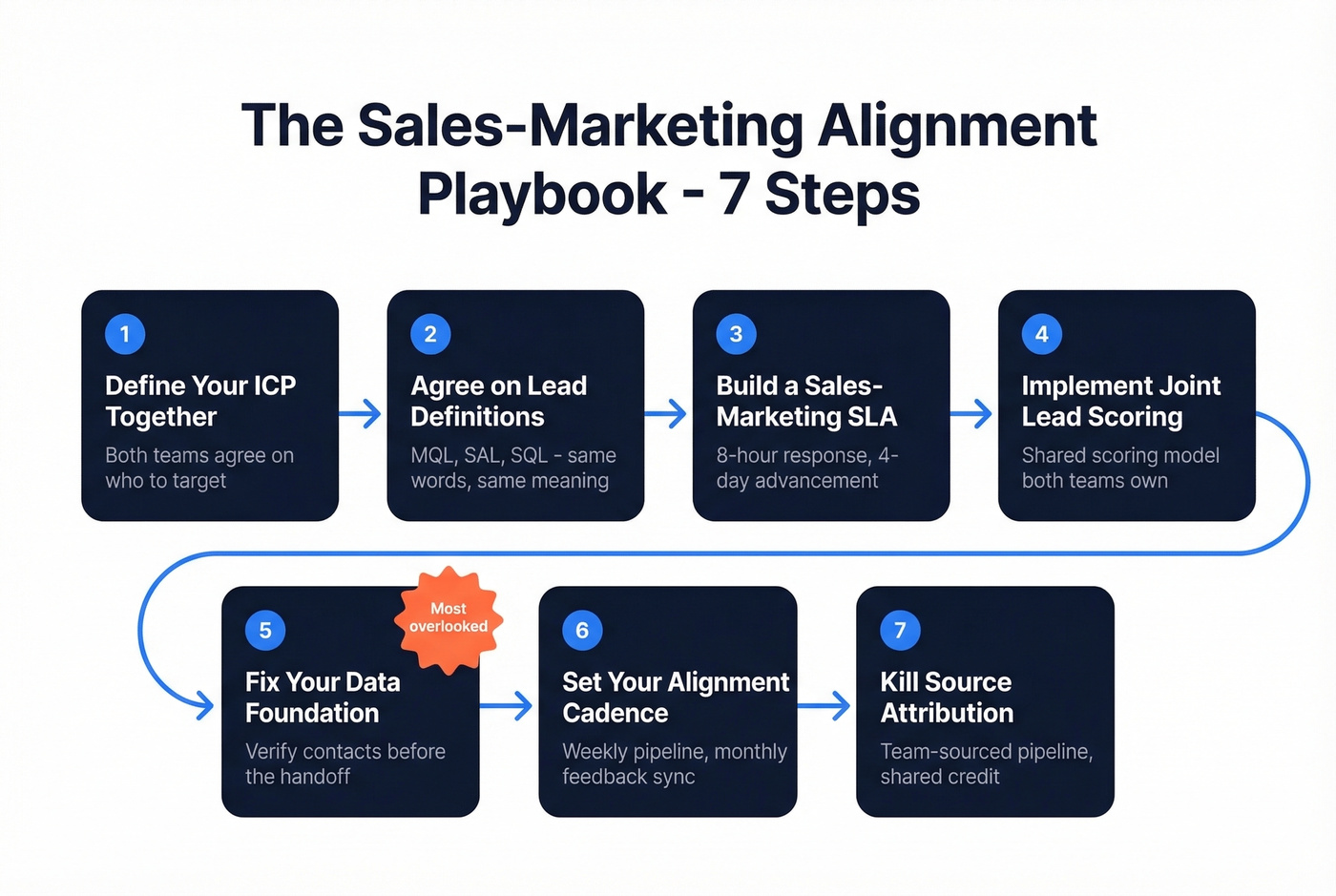
Define Your ICP Together
Your ideal customer profile can't be a marketing exercise that sales inherits. It needs to be a joint artifact built with input from the people who actually close deals. (Use an ICP template to keep it concrete.)
That Influ2 study found 36% of companies have an effective handoff process but a "cold sales audience" sitting outside marketing's targeting - marketing engages the right people, but sales works a completely different list. That's an ICP mismatch, and no amount of SLA enforcement fixes it. Get both teams in a room, agree on firmographics, titles, and buying signals, and document the result before you touch anything else. (If you need a framework for signals, see identifying buying signals.)
Agree on Lead Definitions
The single most common alignment failure we see is teams that use the words MQL, SAL, and SQL without ever defining them together. Marketing adds qualification layers. Sales ignores them. (A clean lead status model in your CRM makes this much easier to enforce.)
Your definitions work if: Sales can describe a qualified lead using the exact same criteria marketing uses to score one, and marketing can explain why a specific lead was passed over.
Skip your current definitions if: Your sales team can't define a qualified lead in the same terms as your marketing team, or you've added an outsourced SDR layer between MQL and SQL without shared criteria.
The fix is uncomfortable but fast: pull up 20 recent closed-won and 20 closed-lost deals, and reverse-engineer what actually qualified. One afternoon. Real data. No opinions.
Build a Sales-Marketing SLA
An SLA turns alignment from a vibe into a contract:
- Marketing commits to: a volume of qualified leads per period, with agreed-upon scoring criteria
- Sales commits to: accept or reject each lead within 8 hours. Rejected leads revert to marketing for nurture.
- Advancement timeline: sales advances a lead to SQL within 4 days, or it recycles back to marketing
- Starting conversion assumption: if you don't know your lead-to-revenue rate, start with 1.5% and adjust quarterly (benchmarks: average B2B lead conversion rate)
In our experience, the 8-hour window is the sweet spot - anything longer and reps mentally discard the lead. Track MQLs generated, MQL-to-SQL conversion rate, sales response time, and SQL-to-closed-deal percentage as live CRM reports, not quarterly slides.
Implement Joint Lead Scoring
Scoring only works when both teams own it. Here's a concrete model based on Belkins' internal system:
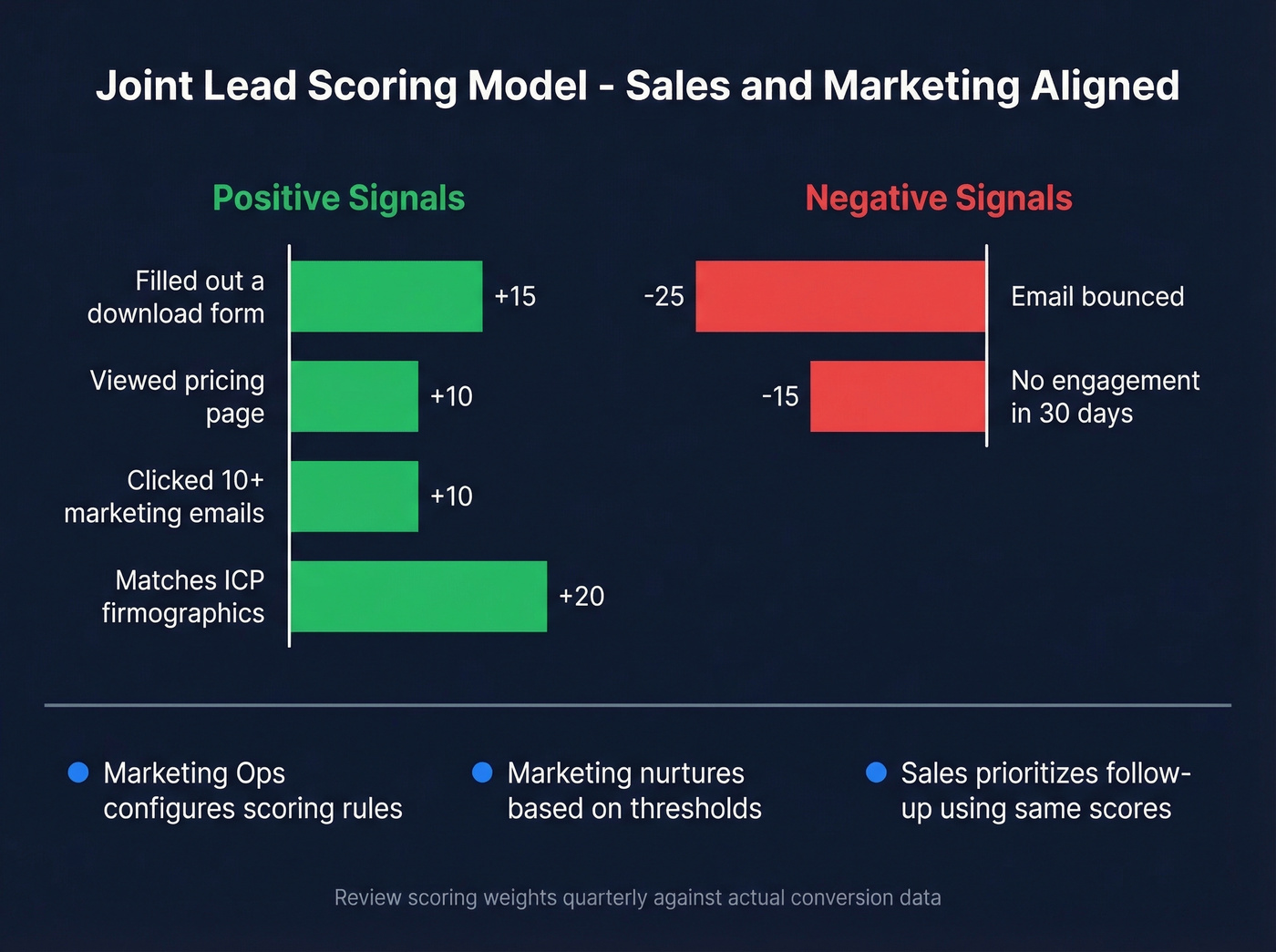
- Viewed pricing page: +10
- Filled out a download form: +15
- Clicked 10+ marketing emails: +10
- Email bounced: -25
That negative score matters. A bounced email signals the record is stale or fake, and it should actively suppress the lead's priority. Marketing ops configures the scoring rules, marketers nurture based on score thresholds, and sales prioritizes follow-up using the same scores. Review scoring weights quarterly against actual conversion data, and shift weight toward on-site behavior like pricing page visits - open rates are increasingly unreliable thanks to Apple's Mail Privacy Protection and similar changes. (If you want a deeper framework, use this lead scoring guide.)
Fix Your Data Foundation
Here's the thing: every alignment mechanism described above - ICP definitions, lead scoring, SLAs - breaks down when the underlying data is bad. And it's almost always bad.
Picture an SDR's Monday morning. They pull 50 "hot" MQLs from the handoff queue. Eight phone numbers are disconnected. Three emails bounce immediately. Two contacts left the company months ago. By 10 AM, the SDR has mentally written off marketing's leads as garbage. That frustration poisons every downstream conversation about alignment, and no amount of process documentation fixes it.
Bad data costs companies up to 25% of potential revenue. It's the invisible root cause of the "leads are garbage" complaint. Before you blame the scoring model or the SLA, audit the data itself. We've found that teams running verification before the handoff - using a tool like Prospeo with its 98% email accuracy and 7-day data refresh cycle - eliminate the most common source of friction between sales and marketing entirely. When every lead in the queue has a verified email and a working phone number, the "garbage leads" argument disappears. (If bounces are a recurring issue, start with email bounce rate.)
Set Your Alignment Cadence
Demandbase recommends sales teams spend 60-70% of their time selling and only 10-15% in internal meetings. Every alignment meeting needs to earn its slot.
| Meeting | Frequency | Duration | Purpose |
|---|---|---|---|
| Pipeline review | Weekly | 30-60 min | Deal status, handoff quality, SLA compliance |
| Feedback sync | Monthly | 45 min | Objections, content gaps, lost-deal patterns |
| All-hands | Monthly | 60 min | Shared metrics, wins, alignment score |
| Postmortem | Monthly | 30 min | Closed-lost analysis, lead quality audit |
The monthly feedback sync is the most underrated meeting on this list. Cover top customer objections, which assets actually advanced deals, content gaps, and patterns from lost deals. Everything else can be async - Slack channels, CRM dashboards, shared docs. Don't let meetings become the alignment strategy; they're the checkpoint, not the mechanism. (To keep the pipeline conversation grounded, track pipeline health metrics.)
Kill "Marketing-Sourced" vs. "Sales-Sourced"
This is the single most counterproductive attribution model in B2B. When pipeline is "marketing-sourced" or "sales-sourced," you've built a system that incentivizes finger-pointing. Only 32% of marketing leaders can prove campaigns drove revenue - and that's a symptom of the wrong measurement framework, not a marketing competence problem.
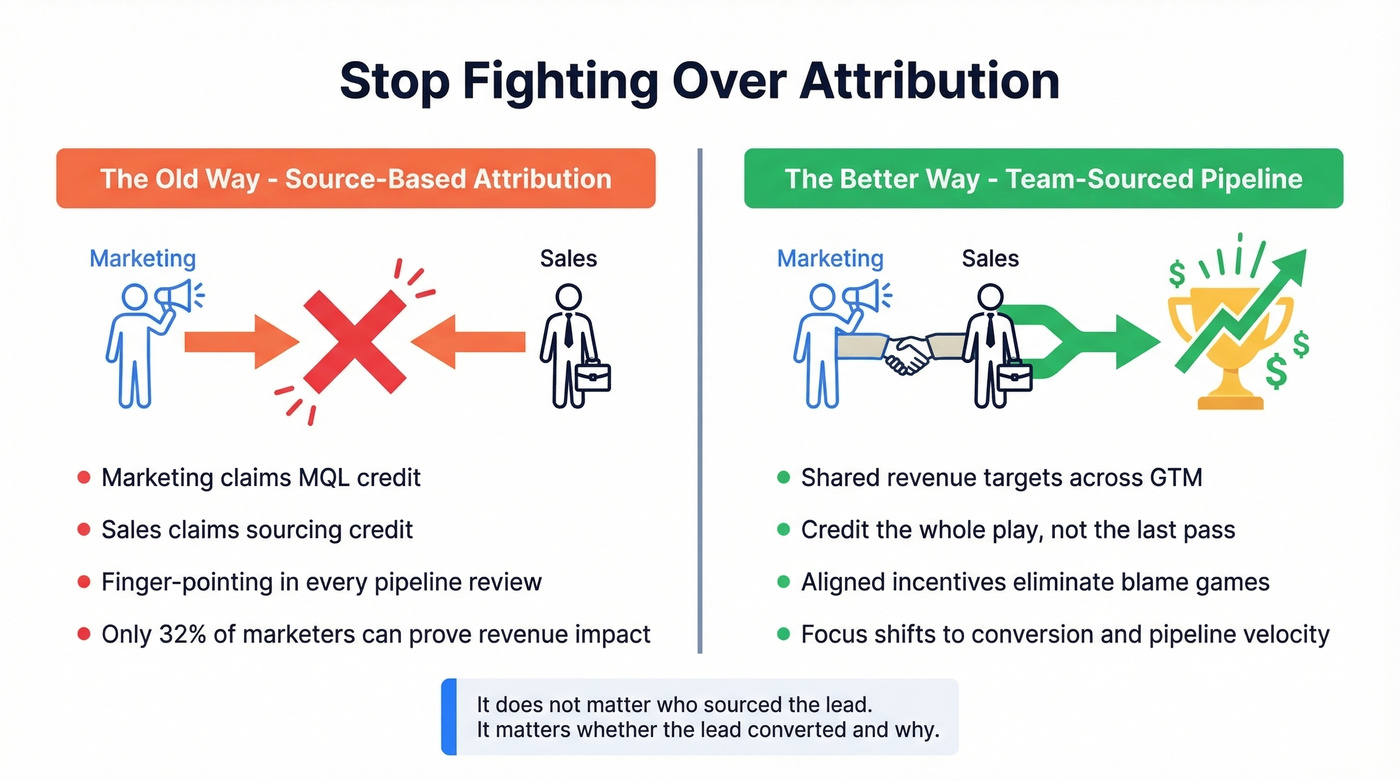
Shift to team-sourced pipeline where the entire GTM org shares credit and accountability. Demandbase uses a soccer-team analogy: you don't credit the goal to the last pass - the whole team built the play. It doesn't matter who "sourced" the lead. It matters whether the lead converted and why. Shared revenue targets eliminate the incentive to fight over attribution.
When to Consider RevOps
If you've implemented the steps above and alignment still feels fragile after six months of consistent execution, you probably need a structural change. Revenue Operations formalizes alignment across four pillars: People, Processes, Data, and Technology.
The impact data is compelling: companies investing in RevOps report 10-20% increases in sales productivity, 30% reduction in GTM expenses, and 36% revenue growth. You don't need a dedicated RevOps hire to start - but you need someone who owns the cross-functional handoffs. Consider it when you're seeing persistently low conversion rates, lengthening sales cycles, or rising CAC that nobody can explain. (If you're scoping the role, start with a RevOps manager breakdown.)
Mistakes That Kill Alignment
We've seen these four anti-patterns break alignment at dozens of companies:
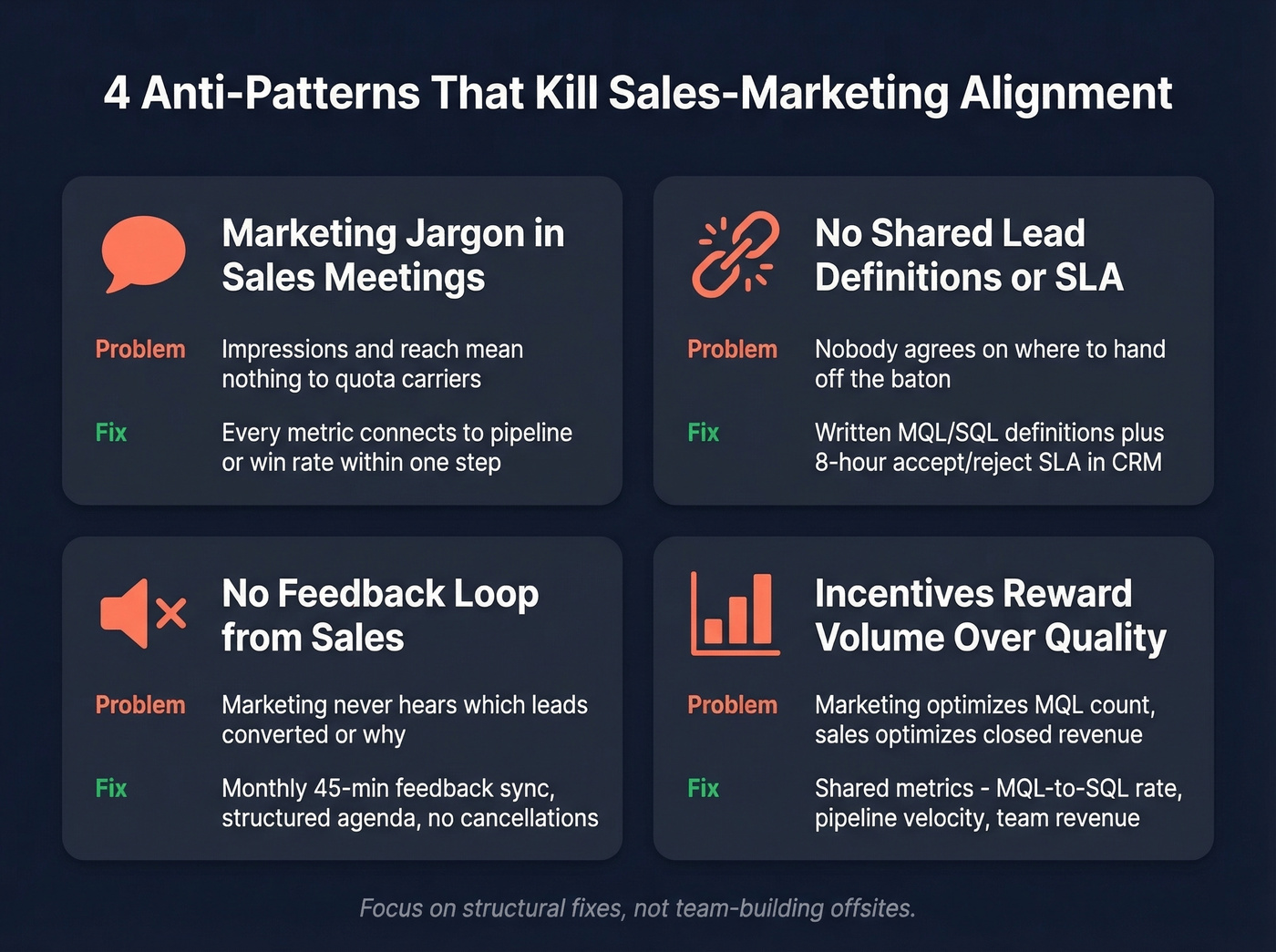
Speaking marketing jargon instead of pipeline language. Every marketing metric should connect to pipeline or win rate within one step. "Impressions" don't belong in a sales meeting. Full stop.
No clear lead definition and no SLA. You're running a relay race where nobody agrees on where to hand off the baton. Shared definitions plus an 8-hour accept/reject SLA, enforced in the CRM, fix this immediately.
No feedback loop from sales. Marketing can't improve targeting if they never hear which leads converted and why. Monthly 45-minute feedback sync, structured agenda, no cancellations. This is non-negotiable.
Incentives that reward volume over quality. If marketing is measured on MQL count and sales on closed revenue, they'll optimize for different things forever. Shared metrics fix this: MQL-to-SQL conversion rate, pipeline velocity, team-sourced revenue.
Let's be honest: most alignment initiatives fail because they focus on empathy and communication instead of structural fixes. You don't need a team-building offsite. You need shared definitions, enforced SLAs, clean data, and aligned incentives. That's how to align sales and marketing in practice, not in theory.
Your SLA means nothing if 8 out of 50 phone numbers are disconnected by Monday morning. Prospeo gives your SDRs 143M+ verified emails and 125M+ verified mobiles - updated weekly, not monthly - so alignment processes actually survive contact with reality.
Start every handoff with contacts that actually pick up.
FAQ
What is sales and marketing alignment?
It's the operational integration of goals, definitions, handoffs, and data between both teams. That means shared MQL/SQL definitions, enforced SLAs, joint lead scoring, and unified pipeline metrics - not just "better communication." Companies with strong alignment see up to 34% more new business revenue.
How can you align both teams quickly?
Write shared MQL/SQL definitions, set an 8-hour lead follow-up SLA, and audit your contact data quality. One meeting and one CRM configuration change will produce immediate improvement in handoff trust. These three steps fix the most common friction points faster than any workshop or offsite.
How do you measure alignment success?
Track MQL-to-SQL conversion rate, average lead follow-up time, SLA compliance rate, and team-sourced pipeline. The Influ2 benchmark defines effective handoff as 35%+ of marketing-engaged prospects contacted by sales. If you're below that threshold, start with ICP and definition audits.
How does data quality affect alignment?
Bad contact data - bounced emails, wrong numbers, stale records - makes sales blame marketing for "garbage leads" regardless of targeting quality. Verifying data before the handoff is a prerequisite for any SLA to work. Tools with high accuracy rates and frequent refresh cycles eliminate the most common source of cross-team friction.
Do you need RevOps to fix alignment?
No. SLAs, shared definitions, and joint lead scoring work without a dedicated RevOps hire. Start with process fixes first. If alignment still breaks after six months of consistent execution, invest in a RevOps function to formalize cross-functional ownership of pipeline, data, and technology.