

How to Build a Sales Cadence That Actually Books Meetings
Most cadence advice comes from the platforms selling you seats. They'll tell you 15 touchpoints is the minimum and that you need a long nurture sequence. Practitioners tell a different story: a lot of meetings happen by the first call connect or the third email, and everything after that is insurance, not strategy.
Here's the thing - if you're figuring out how to build a sales cadence that actually converts, the formula isn't complicated. It's 5-8 touches for SMB, 15-20+ for enterprise, ultra-short emails (40-60 words), soft CTAs, and clean data as the non-negotiable foundation. Below is the framework we've refined across dozens of outbound campaigns.
What Is a Sales Cadence?
A sales cadence is a structured series of outreach attempts across multiple channels - email, phone, social, video - spaced over a defined timeframe. It's the difference between "I'll follow up when I remember" and a repeatable system that books meetings consistently.
When you build one, you're committing to a process. Not just good intentions.
The Numbers That Matter
RAIN Group research shows meetings require 8 touches on average. Outreach puts the sweet spot at 17-21 days with 8-12 touchpoints. Phone calls generate outsized response rates despite making up only 20-30% of total touches - most reps under-index on calls because they're uncomfortable, not because calls don't work.
McKinsey data suggests systematic sales engagement processes drive 10-20% pipeline improvements. Not from magic, but from consistent execution. The cadence itself isn't the competitive advantage. Following it is.
How to Structure Your Cadence in 5 Steps
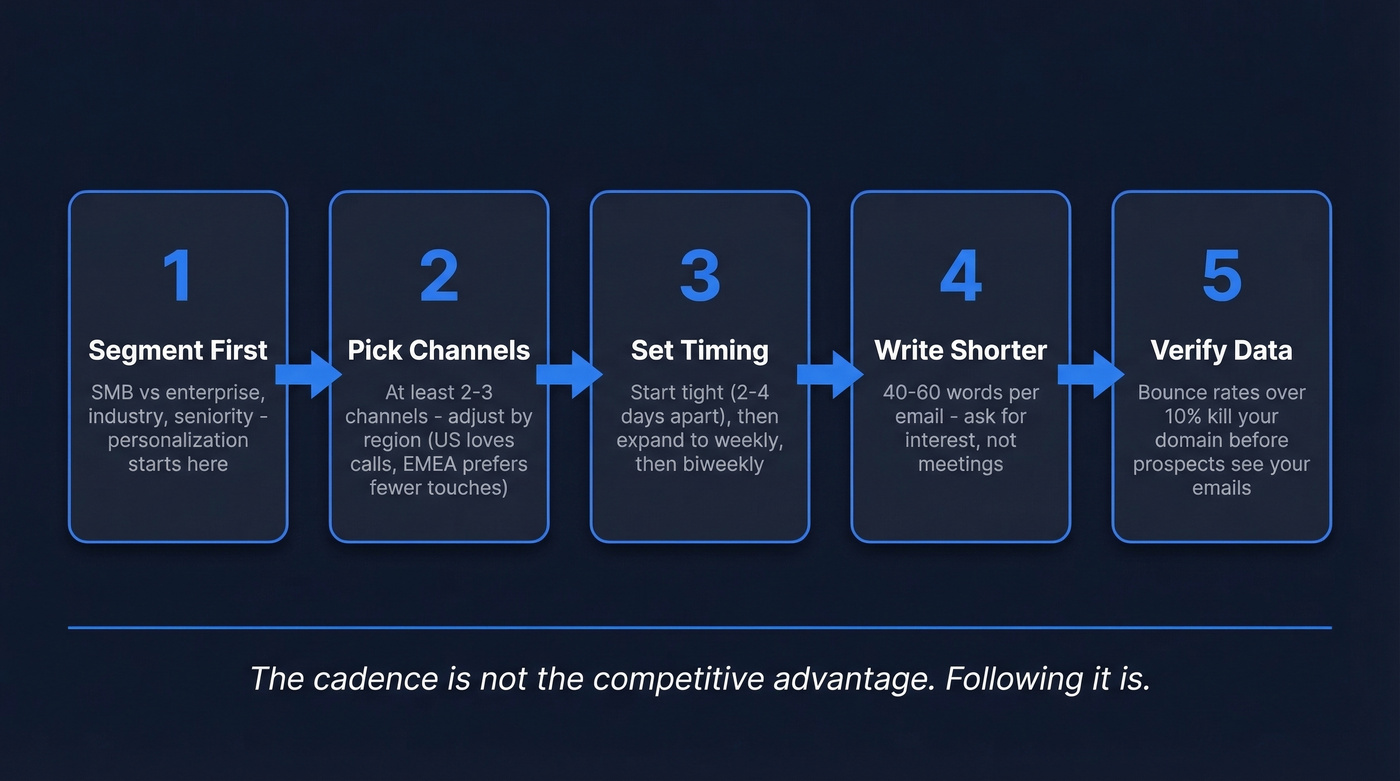
1. Segment Before You Write
An SMB cadence and an enterprise cadence share almost nothing in common. Segment by deal size, buyer seniority, and industry first. Epsilon's data shows prospects are 80% more likely to engage with personalized experiences - but personalization starts with knowing who you're talking to, not with inserting a first name token. Customizing outreach sequences by industry is one of the highest-leverage moves you can make before writing a single email.
If you need a starting point, build a simple Ideal Customer Profile first, then segment from there.
2. Pick Your Channels
Build around at least two channels, ideally three. Regional differences matter more than most teams realize - cold calling is more accepted in the US, while APAC and EMEA prospects often need fewer touchpoints. Triple touches on Day 1 can feel intrusive in DACH markets. Know your territory.
If calls are a weak spot, a simple cold calling system helps reps stay consistent.
3. Set Your Timing
Start tight, then expand. Space your first few touches close together, then stretch out later follow-ups.
Outreach's guidance is 1-2 days between early touches, expanding to 3+ days later. A practitioner on r/sales shared a simple decay pattern that mirrors how a lot of reps actually operate: first 3 touches 2-4 days apart, then 1 week, then 2 weeks, then exit. We've seen this spacing outperform fixed-interval cadences when the offer is strong and the list is clean - the early density creates urgency without tipping into annoyance, and the longer gaps later give prospects room to circle back on their own timeline.
If you're unsure when to send each touch, use a best time to send cold emails baseline and test from there.
4. Write Shorter Emails
Gong's analysis of millions of cold emails found that 30-150 words perform best. Top practitioners are pushing toward the low end of that range - 40-60 words where the offer does the heavy lifting. Here's what Gong's data says about specific language:
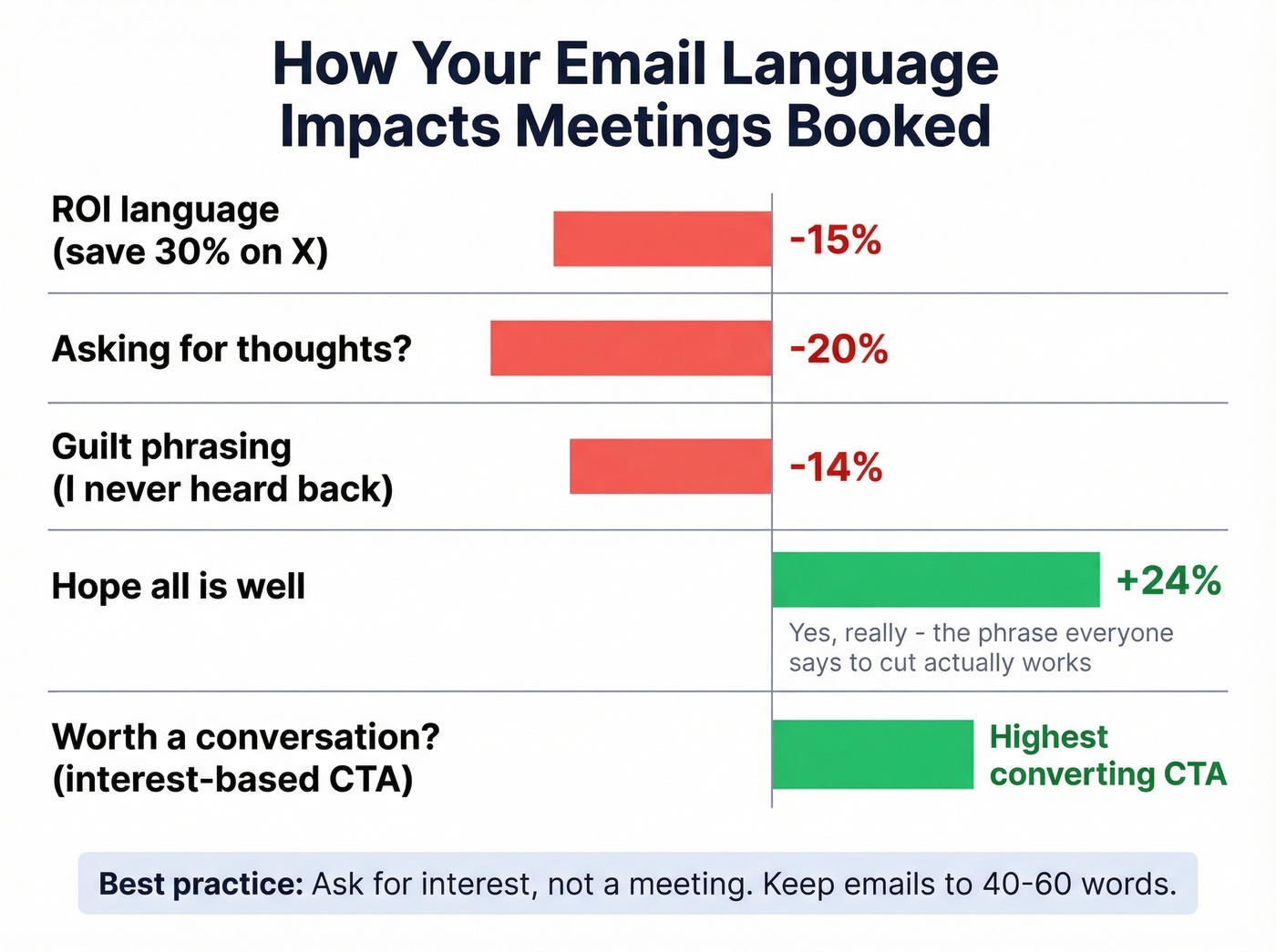
- ROI language ("save 30% on X") decreases meetings booked by 15%
- Asking for "thoughts?" drops meetings by 20%
- Guilt phrasing ("I never heard back") kills 14% of meetings
- "Hope all is well" - the phrase every trainer tells you to cut - correlates with 24% more meetings
The highest-performing CTA? Ask for interest, not a meeting. "Worth a conversation?" beats "Do you have 30 minutes Thursday?" every time. And personalizing at the individual level - referencing a prospect's recent hire, funding round, or tech stack - is what separates the 5% reply rate from the 20% reply rate.
For more examples you can copy/paste, keep a swipe file of cold email follow-up templates.
5. Verify Your Data Before Launch
If 10%+ of your emails bounce, your cadence is dead on arrival. Not because the messaging failed, but because your domain reputation tanked before prospects ever saw your emails. Snyk had 50 AEs each spending 4-6 hours per week on prospecting - after switching to verified data through Prospeo, their bounce rate dropped from 35-40% to under 5%, and AE-sourced pipeline jumped 180%.
Let's be honest: most teams obsess over subject lines when their real problem is that a chunk of their emails never reach an inbox. Fix the data first. The copy improvements compound on top of deliverability, not the other way around.
If you want the deeper mechanics, start with an email deliverability guide and then track your email bounce rate.

Every cadence step you just mapped out depends on one thing: emails that actually reach inboxes. Prospeo's 5-step verification delivers 98% email accuracy with a 7-day refresh cycle - so your Day 1 connection request isn't followed by a Day 2 bounce. Start with 75 free verifications.
Clean data turns a good cadence into a pipeline machine.
Adapt Your Cadence by Deal Size
| SMB | Enterprise | |
|---|---|---|
| Sales cycle | 1-3 months | 6-12+ months |
| Touchpoints | 5-8 | 15-20+ |
| Stakeholders | 1-2 | 6-25 |
| Rep capacity | 50 prospects/day | Fewer accounts, deeper research |
| Max touches | 2-3 before drop | Full cadence + ABM |
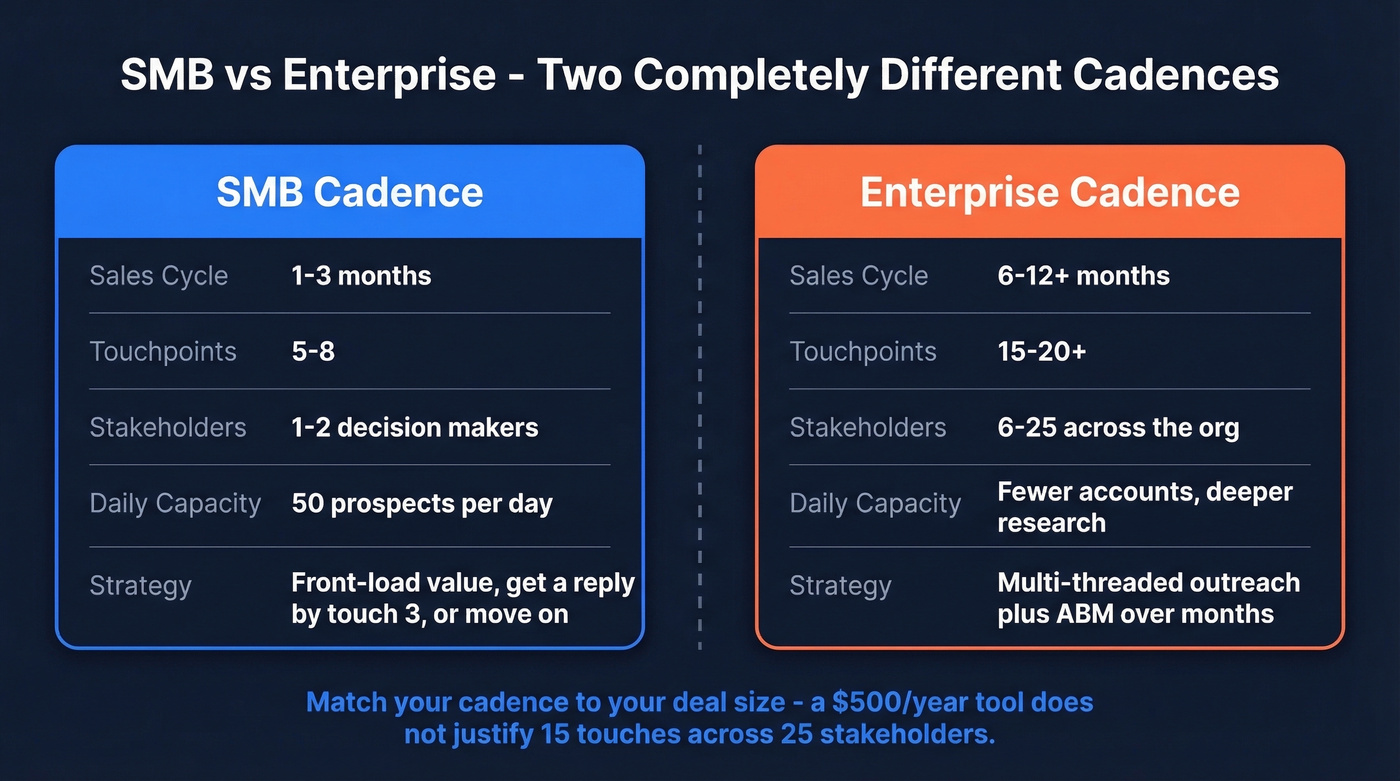
SMB reps talk to 50 prospects a day and get 2-3 touches max before moving on. As SaaStr puts it, they'll drop anything remotely hard to close because volume economics demand it. Front-load value, get a response by touch 3, or move on.
Enterprise is the opposite - 15 touches across 6-25 stakeholders isn't aggressive, it's necessary. Skip this approach if you're selling a $500/year tool to startups; you'll burn time you don't have on accounts that won't justify the effort.
If you're building for larger accounts, borrow a few patterns from account-based selling best practices.
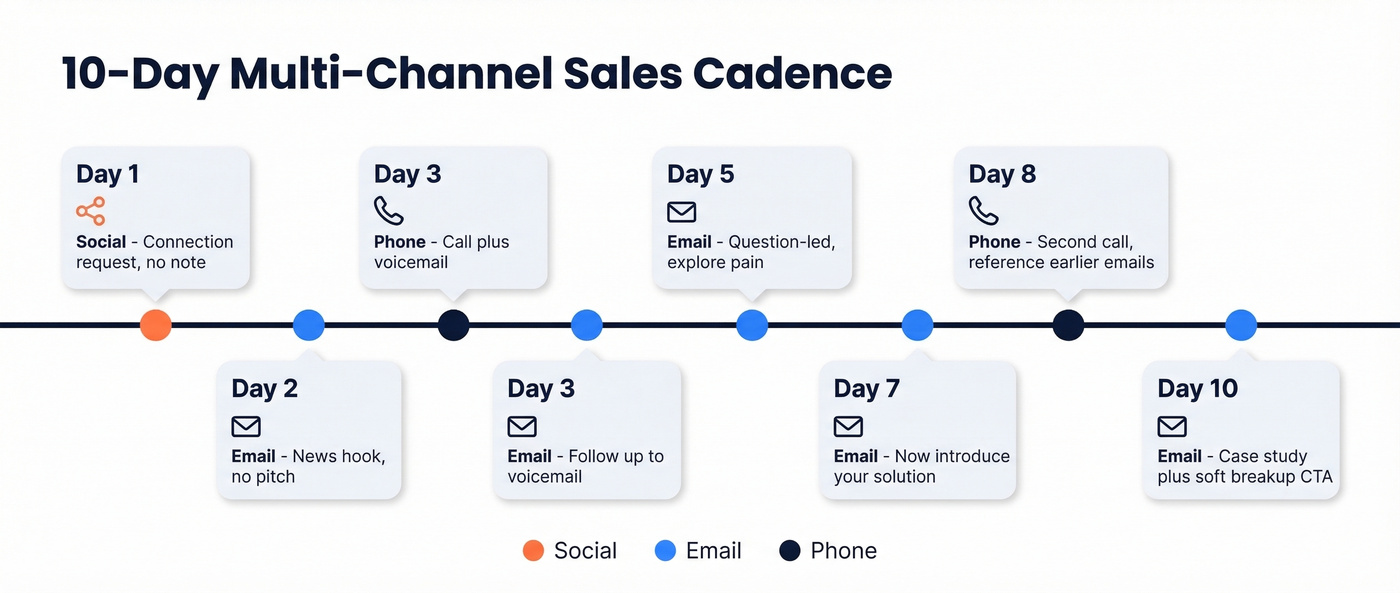
Sales Cadence Template: Day by Day
| Day | Channel | Action | Note |
|---|---|---|---|
| 1 | Social | Connection request, no note | Higher accept rate |
| 2 | News hook, no pitch | Context-led, ask questions | |
| 3 | Phone | Call + voicemail | Say you'll email next |
| 3 | Follow-up to voicemail | Short, reference the call | |
| 5 | Question-led, explore pain | Still no product pitch | |
| 7 | Solution-focused | Now introduce your offer | |
| 8 | Phone | Second call attempt | Reference earlier emails |
| 10 | Case study + breakup | Soft CTA, last touch |
A Day 2 email in practice (~47 words):
Noticed [Company] is hiring 3 SDRs - usually means outbound is a priority this quarter. We helped [Similar Company] cut ramp time from 8 weeks to 4 while keeping bounce rates under 3%. Worth a conversation?
Most teams run cadences through platforms like Outreach or Salesloft, but the framework matters more than the tool. The real work happens before adding prospects to sequences: cleaning your list, segmenting by persona, and matching messaging to the buyer's context.
If you need more options for the later touches, pull from these sales follow-up templates.
Common Cadence Killers
Bad data is the silent killer. Bounce rates above 10% damage sender reputation fast, and recovery takes weeks. Prospeo's 5-step verification process - including catch-all handling, spam-trap removal, and honeypot filtering - catches bad emails at 98% accuracy, and the free tier covers 75 verifications per month so you can audit a list before committing to a full campaign.
Single-channel outreach limits your surface area for replies. If you're only emailing, you're invisible to the 40% of buyers who'd respond to a call or a social touch first.
Guilt phrasing and ROI language in cold emails actively decrease meetings booked. We've seen reps rewrite a single breakup email - swapping "I never heard back" for a genuine case study - and double their reply rate on that touch alone.
And for teams selling into the EU: GDPR fines run up to EUR 20M or 4% of global annual revenue. Compliance isn't optional.
If you're scaling outbound, it helps to standardize sequence management so reps don’t freestyle the process.
Snyk's 50 AEs dropped bounce rates from 35% to under 5% and grew AE-sourced pipeline 180% - not by rewriting their cadence, but by switching to verified contact data. Prospeo gives you 300M+ profiles with verified emails and direct dials at $0.01/email, so your 8-touch sequence actually reaches real buyers.
Stop optimizing subject lines on emails that never arrive.
Test and Optimize
Test one variable at a time - subject line, CTA, personalization depth - with 100-200 prospects per variant. Let the full cadence complete before declaring a winner. We've watched teams "peek" at results after 20 sends and pivot too early, chasing noise instead of signal. Don't.
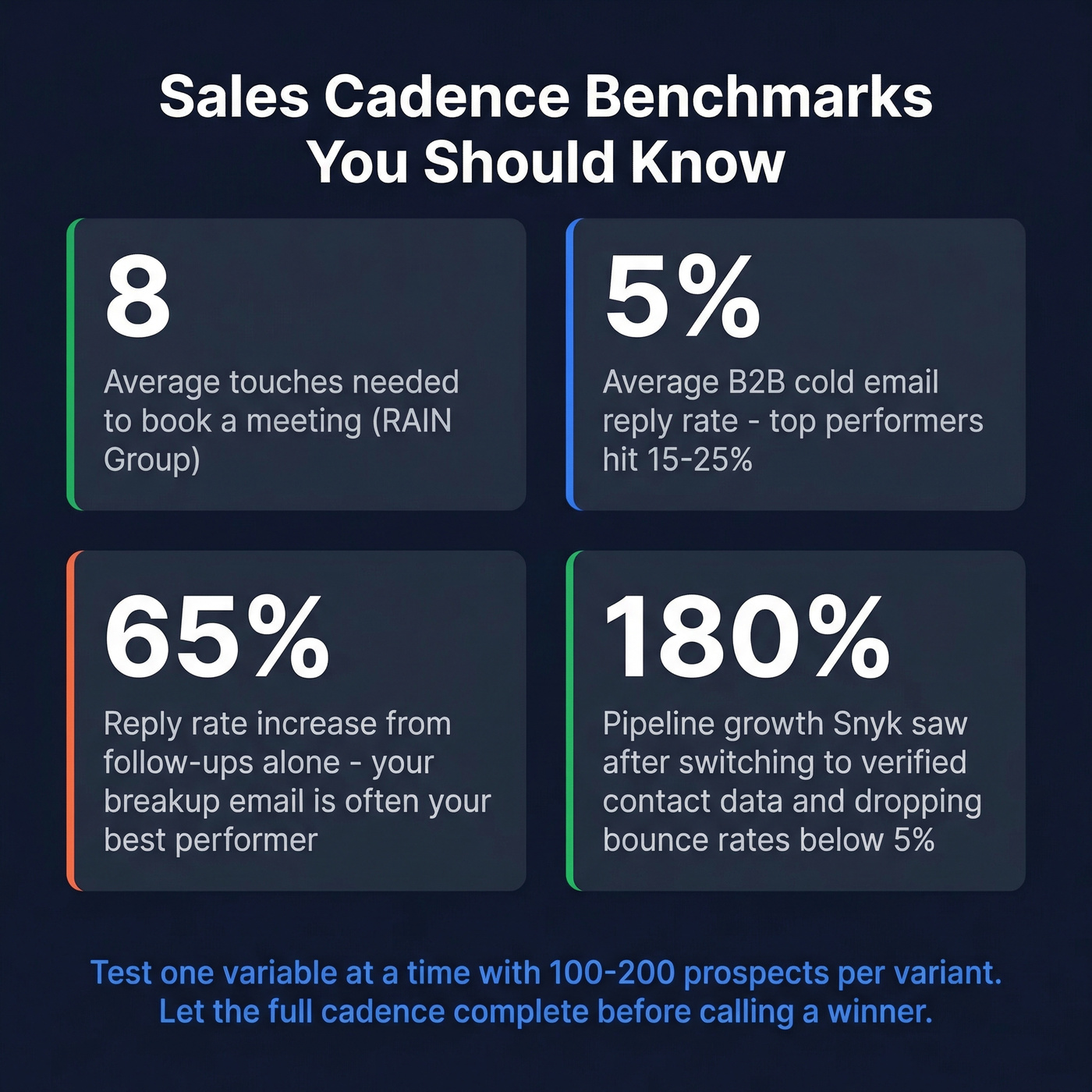
Average B2B cold email reply rates sit around 5%. Top performers hit 15-25%. Follow-ups alone increase reply rates by up to 65%, which is why the breakup email isn't optional - it's often your highest-converting touch. The consensus on r/sales backs this up: the "I'm closing your file" email consistently outperforms every other touch in the sequence.
To improve results without guessing, use a simple follow-up email reply rate benchmark and iterate.
FAQ
How many touchpoints should a sales cadence have?
Eight to twelve over 17-21 days for mid-market deals. SMB sequences need 5-8 touches; enterprise accounts need 15-20+ spread across multiple stakeholders. Always match cadence length to your average deal size and sales cycle.
What's the best CTA for a cold email?
Ask for interest, not a calendar slot. "Worth a conversation?" consistently outperforms direct meeting requests. It lowers commitment and doubles as a qualifying question.
How do I stop cadence emails from landing in spam?
Verify every contact before launching - bounce rates above 10% tank domain reputation fast. Tools like Prospeo cover 75 free email verifications per month at 98% accuracy, which is enough to audit a small campaign list before you hit send.
Can I use the same cadence for every prospect?
No. SMB buyers need 5-8 fast touches over 10-14 days, while enterprise stakeholders require 15-20+ touchpoints across multiple contacts over months. Segment by deal size, seniority, and region before building a single sequence.