

How to Build an Email List From Scratch - The Phased System That Actually Works
A practitioner on Reddit built a simple landing page, shared it in a few niche forums, sent 20-30 genuine DMs, and collected 150 email subscribers in a few weeks. Zero ad spend, zero existing traffic. That's not a growth hack. That's the boring, repeatable system that actually works when you're building an email list from scratch. Every guide promising 10,000 subscribers in 30 days is lying. Let's build something real instead.
The Only Asset You Own
Social platforms change algorithms overnight. Ad costs climb every quarter. But your email list? That's yours - no middleman, no pay-to-reach-your-own-audience tax.
The numbers back this up. There are 4.48 billion email users worldwide, projected to hit 4.73 billion by 2026. Email marketing returns roughly $36 for every $1 spent, and 81% of companies use it as a core channel. No other owned asset comes close to that reach-to-ROI ratio.
Here's the catch, and it's the thing most "grow your list fast" guides conveniently ignore: a 500-person list of verified, engaged subscribers will outperform a 5,000-person list full of dead addresses and spam traps every single time. We've watched teams celebrate hitting 10K subscribers only to discover half those addresses bounce on the first real send. That celebration turns into a deliverability crisis fast.
What You Need (Quick Version)
Three phases, one clear path:
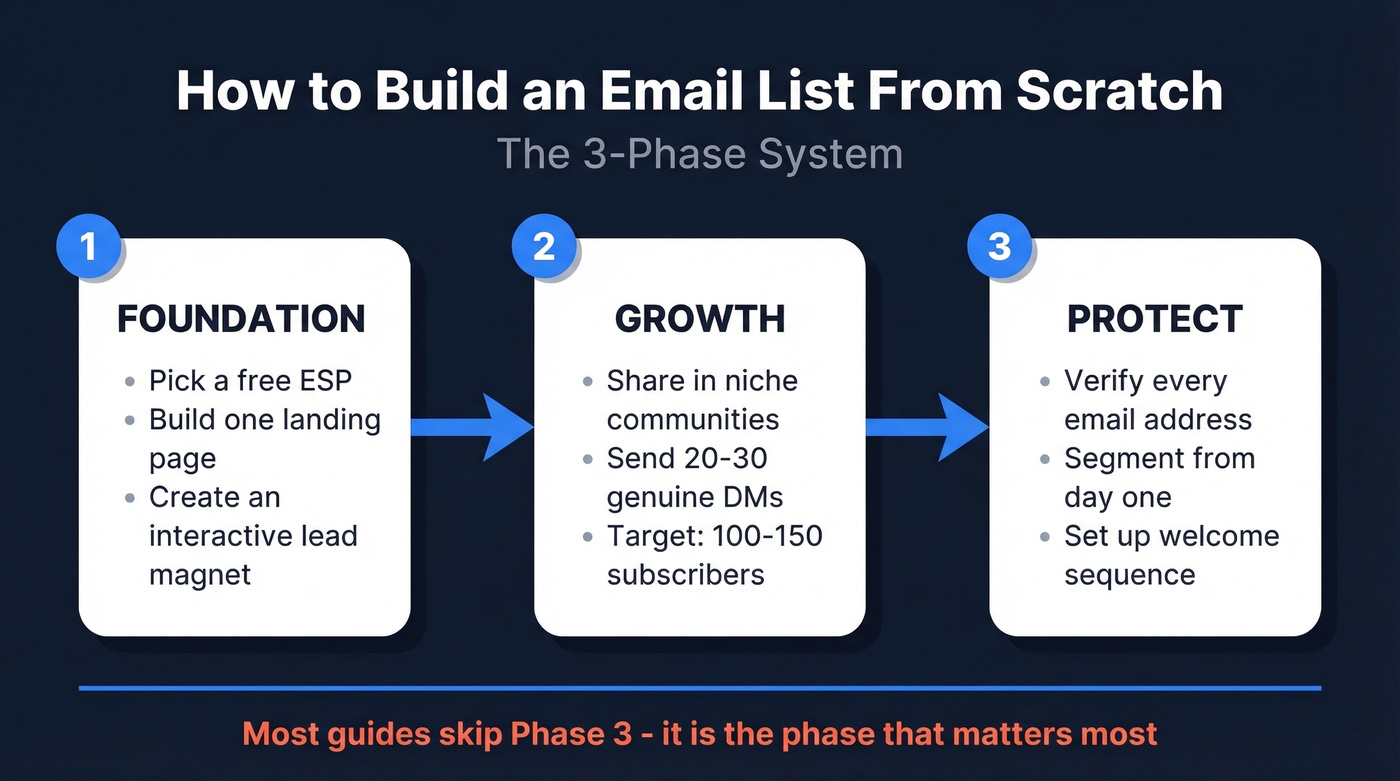
- Foundation - Pick a free ESP, build a landing page, create one interactive lead magnet.
- Growth - Share it in niche communities, DM 20-30 people directly. Expect around 100-150 subscribers in your first few weeks.
- Protect - Verify every email before you send your first campaign.
That's the system. The rest of this article fills in the details.
Never Buy an Email List
Twilio puts it bluntly: "The answer is no. It's always no." Purchased lists contain spam traps, dead addresses, and people who never asked to hear from you. The consequences cascade fast - your ESP shuts down your account, ISPs denylist your domain, and your sender reputation gets destroyed before you've sent a single real campaign. There's no shortcut here. Build it yourself.
Phase 1 - Lay the Foundation
Pick Your ESP
You don't need to overthink this. Start free, upgrade when you outgrow it.
| ESP | Free Tier | Paid From | Best For |
|---|---|---|---|
| MailerLite | 1,000 sends/mo, 500 contacts | $10/mo | Best free features |
| Brevo | 300 emails/day | $9/mo | High contact storage on free |
| Mailchimp | 1,000 emails/mo, 500 contacts | $13/mo | Templates, brand recognition |
| HubSpot | 2,000 emails/mo, 1,000 contacts | $20/mo | CRM integration |
| Klaviyo | 500 emails/mo, 250 contacts | $30/mo | E-commerce flows |
MailerLite gives you a strong free starter set - automation, landing pages, and 1,000 sends per month. Brevo's free tier lets you send 300 emails per day and store up to 100,000 contacts, which adds up fast. I'd start with MailerLite unless you're running an e-commerce store, in which case Klaviyo's flow builder is worth the higher price.
Build a Landing Page
One page. One offer. One CTA. That's it.
Frame it as a prelaunch waitlist if you're building before you have a product - "Get early access and 15% off when we launch" is a proven hook. We've seen strong prelaunch pages pull hundreds of signups before anything has shipped, but even 100 verified subscribers is a solid foundation to build on.
Ditch the PDF - Build Something Interactive
Generic PDFs are dead. Audiences recognize AI-generated ebooks and templated checklists for what they are - low-effort content that doesn't earn an email address. As one Redditor in r/smallbusiness put it: "people LOVE clicking on stuff and entering their own numbers." In our experience, interactive calculators outperform static PDFs by a wide margin.
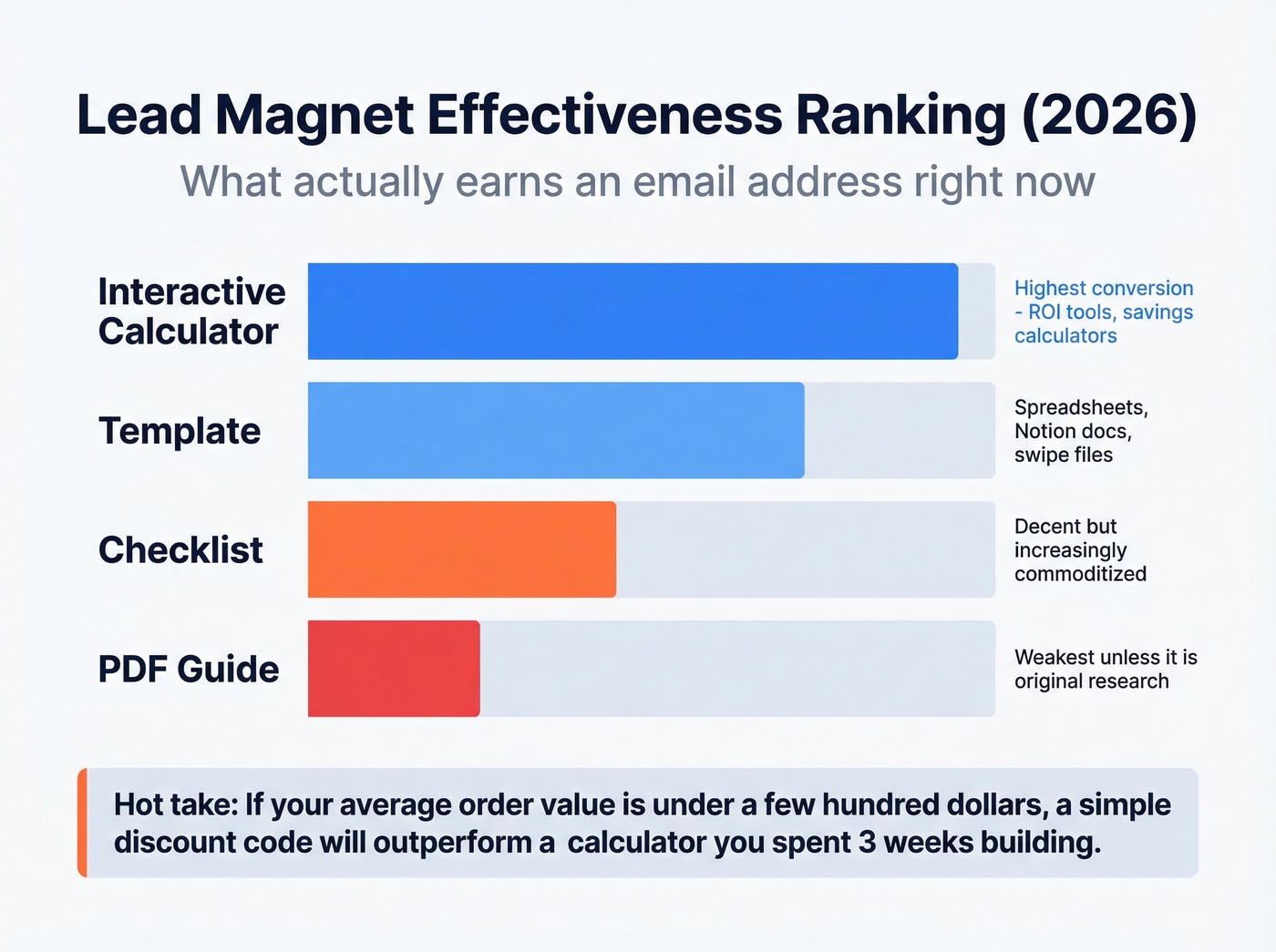
What converts right now, ranked:
- Interactive calculator - ROI estimators, savings calculators, scoring tools. Highest conversion by far.
- Template - spreadsheets, Notion docs, swipe files. Strong and practical.
- Checklist - decent, but increasingly commoditized.
- PDF guide - weakest unless it's genuinely original research.
One concrete example: an SEO agency built an ROI calculator in Google Sheets where prospects enter their traffic, conversion rate, and LTV, and the sheet projects revenue growth over 12 months. That's a lead magnet people actually want because it gives them a personalized answer, not a generic download they'll never open. (If you're doing this for outbound too, pair it with a clean list-building workflow like Clay list building.)
Hot take: If your average order value is under a few hundred dollars, you probably don't need a fancy lead magnet at all. A simple discount code or early-access waitlist will outperform a calculator you spent three weeks building. Match the magnet to the math.
Set Up Double Opt-In
Double opt-in means subscribers confirm their address via a confirmation email before they're added to your list. It adds one extra step, but it filters out typos, bots, and fake signups. For deliverability and compliance - especially if you're emailing anyone in the EU - it's the safest approach. (If you want the deeper mechanics, see our email deliverability guide.)

Double opt-in filters typos and bots, but it doesn't catch stale addresses or spam traps that sneak in over time. Prospeo's 5-step verification - with catch-all handling, spam-trap removal, and honeypot filtering - delivers 98% email accuracy. Verify every address before it touches your ESP.
Protect your sender reputation before you even have one.
Phase 2 - Get Your First 500
Prelaunch and Direct Outreach
The Reddit practitioner who collected 150 emails in a few weeks did three things: built a simple landing page with a clear incentive, shared it carefully in niche forums and relevant subreddits, and sent 20-30 genuine DMs to people who'd actually care. No paid ads. No viral tricks. Just targeted distribution of a clear offer. (If you need more channels, start with these free lead generation tools.)
Set realistic expectations. Your first 500 subscribers are the hardest. Growth compounds after that as your existing subscribers share, your content ranks, and your reputation builds. But the early phase is manual work, and anyone who tells you otherwise is selling something.

Popups and Signup Forms
Exit-intent popups, scroll-depth triggers, and time-on-page delays all work - the question is how well. Typical popup conversion rates run 1-5%. Strong ones hit 5-10%. Gamified popups like spin-to-win wheels can push conversion rates above 10%, though they tend to attract lower-quality subscribers who came for the discount, not your content. Test one format, measure, iterate. (If you're tracking list growth like a funnel, use these funnel metrics.)
Content Upgrades and Social
Embed signup CTAs inside your blog posts - not just in the sidebar, but inline where the reader is already engaged. "Want the spreadsheet version of this framework? Drop your email." That kind of contextual offer converts far better than a generic "subscribe to our newsletter" box.
Guest appearances on podcasts, newsletters, and webinars work as growth levers too. Every collaboration puts you in front of someone else's audience. I've seen a single podcast guest spot drive more subscribers than a month of social media posting. (For B2B, this pairs well with a clear B2B content marketing plan.)
Offline Capture
Don't overlook the physical world. QR codes at events, in-store signage, and even business cards still work. Point the QR code at your landing page, not a generic homepage.
Phase 3 - Protect Your List
Verify Before You Send
You spent weeks collecting subscribers from nothing. If 10% of addresses bounce on your first send, your ESP flags your account before you've even established a sender reputation. Verification is the step most guides skip - and it's the one that matters most when you're starting from zero. (If you're troubleshooting bounces, start with email bounce rate.)
Prospeo's 5-step verification process catches invalid addresses, spam traps, catch-all domains, and honeypots before they damage your deliverability. At 98% email accuracy, the free tier covers 75 email verifications per month - more than enough when you're building your first few hundred subscribers. (If you're comparing tools, see Bouncer alternatives.)
Make It Easy to Unsubscribe
This sounds counterintuitive, but a visible, one-click unsubscribe link actually improves your list quality. People who don't want your emails will either unsubscribe or mark you as spam. One costs you a subscriber. The other costs you your sender reputation. Make the choice easy for them.
Segment From Day One
Don't wait until you have 5,000 subscribers to start segmenting. Use the "Core Four" framework from day one: firmographic data like company size and industry, demographic details like role and seniority, behavioral signals based on what they clicked or downloaded, and funnel stage from new subscriber through engaged to ready-to-buy. (If you want a more operational approach, use intent based segmentation.)
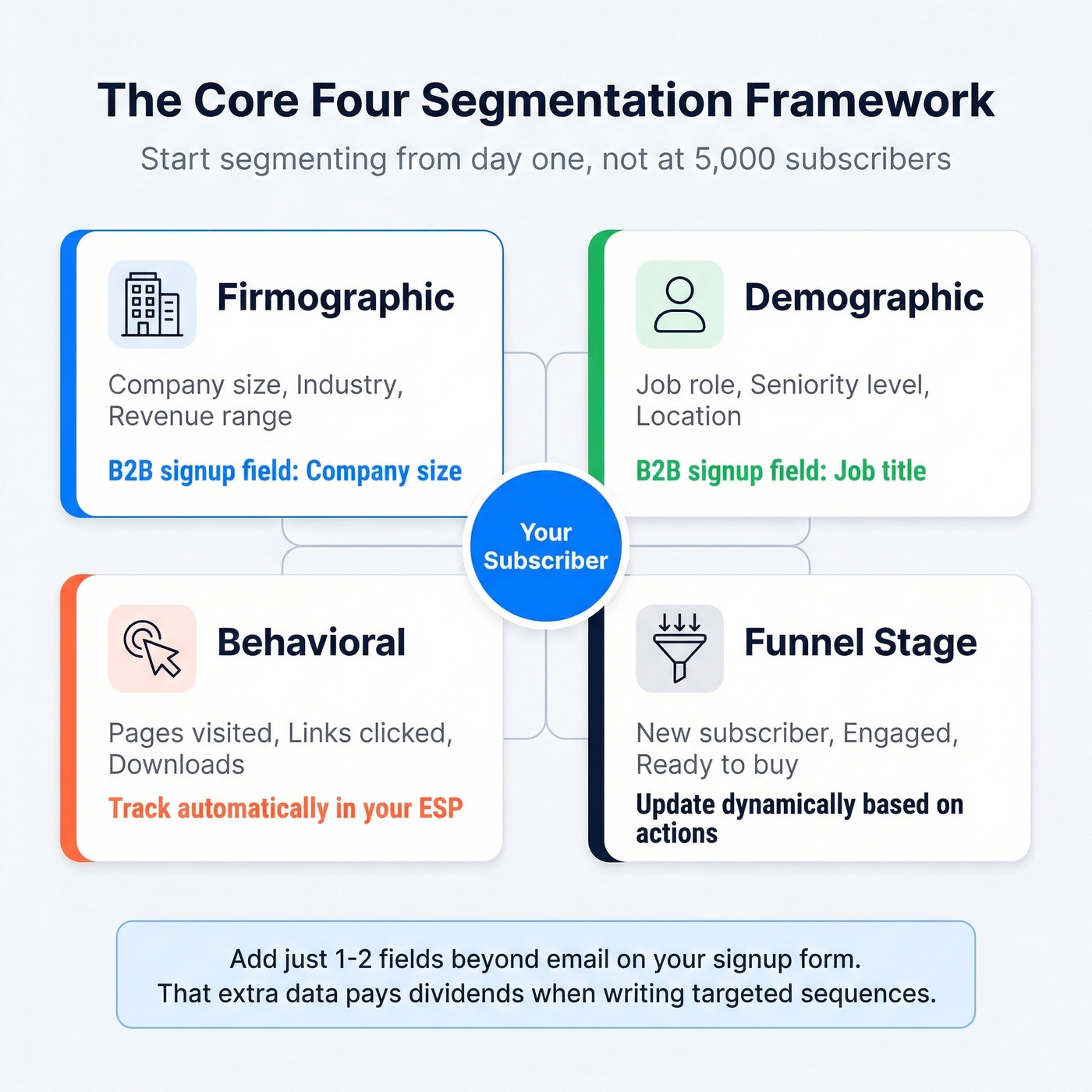
Add 1-2 fields beyond email on your signup form. For B2B, job role and company size. For B2C, primary interest or goal. That extra data pays dividends when you're writing targeted sequences later.
Set Up a Welcome Sequence
Welcome emails have the highest CTR of any campaign type - 4.9% on average. Build a 3-5 email sequence: deliver the lead magnet, introduce yourself, set expectations for what you'll send and how often. This is your first impression. Make it count. (If you want to improve clicks, use the click rate formula in email marketing.)
2026 Email Benchmarks
Here's what "good" looks like right now, based on HubSpot's analysis of 80,000+ accounts - the most robust dataset we've found. Other sources report lower open rates and higher CTRs; benchmarks vary by methodology, industry mix, and how they handle Apple Mail Privacy Protection. Use these as directional, not gospel.
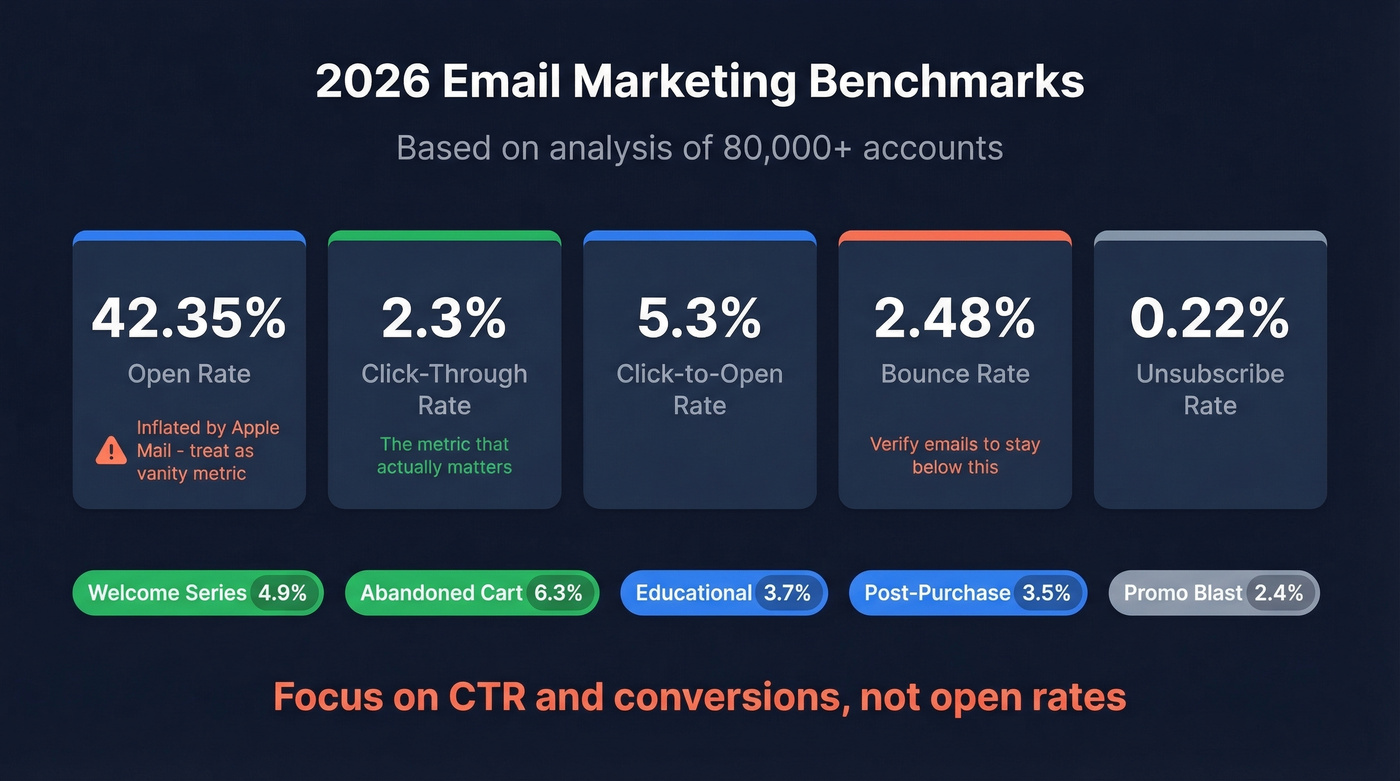
| Metric | Average |
|---|---|
| Open rate | 42.35% |
| CTR | 2.3% |
| CTOR | 5.3% |
| Bounce rate | 2.48% |
| Unsubscribe | 0.22% |
And here's how different campaign types compare on CTR:
| Campaign Type | CTR |
|---|---|
| Welcome series | 4.9% |
| Educational flow | 3.7% |
| Abandoned cart | 6.3% |
| Promo blast | 2.4% |
| Post-purchase | 3.5% |
Let's be honest: open rates are a vanity metric now. Apple Mail Privacy Protection inflated them by 18 points across 80,000+ accounts, and Apple Mail represents 46% of email clients. If you're reporting open rates to your boss, you're reporting fiction. Focus on CTR and conversions.
Compliance You Can't Skip
GDPR and CAN-SPAM aren't optional, and they apply more broadly than most people realize. GDPR covers any organization processing EU residents' data - even if you're based in the US. Cumulative GDPR fines have hit roughly EUR 5.88 billion across 2,245 enforcement actions. Maximum penalties run EUR 20 million or 4% of global annual turnover, whichever is higher.
CAN-SPAM carries penalties of up to $53,088 per email violation. The compliance checklist is straightforward: truthful headers, non-deceptive subject lines, include your physical address, provide a working unsubscribe link, and honor opt-outs within 10 business days. Double opt-in strengthens consent and list hygiene, and it's a safe default if you market to GDPR-covered audiences. (For the deliverability side of compliance, see how to improve sender reputation.)
Five Mistakes That Kill Your List
Automation without personalization. Setting up a 12-email drip and forgetting it isn't a strategy. If your automation doesn't adapt to what subscribers actually do, it's just scheduled spam. (If you're writing sequences, start with email copywriting.)
Ignoring mobile. Tiny text, broken layouts, hard-to-tap CTAs - practitioners flag this constantly. A huge share of subscribers read on their phone. If you aren't testing every email on a mobile screen before sending, you're guessing.
Over-emailing because you can. Having automation tools doesn't mean you should email daily. Fatigue drives unsubscribes and spam complaints, both of which tank your sender reputation.
Blasting your entire list. Segmentation exists for a reason. A promo email that's relevant to 30% of your list and irrelevant to the other 70% will hurt more than it helps. (If you need a practical framework, use targeted email campaigns.)
Never verifying your data. Invalid addresses, spam traps, and catch-all domains accumulate silently. By the time your bounce rate spikes, the damage to your sender reputation is already done. Verification costs pennies per address - a damaged reputation costs months of recovery.
You just spent weeks grinding for your first 500 subscribers. A 10% bounce rate on your first campaign kills your domain reputation before it starts. Prospeo verifies emails at $0.01 each with 98% accuracy - cheaper than rebuilding a burned sender domain.
Don't let bad data destroy the list you built from nothing.
FAQ
How long does it take to build an email list from scratch?
Expect 100-200 subscribers in your first month with a landing page, a strong lead magnet, and active distribution in niche communities. The first 500 are the hardest - growth compounds after that. Copy Posse generated $84,000 from 8 emails to just 2,350 subscribers, proving a small engaged list beats a bloated one.
How do I create an email list with no audience?
Pick a free ESP like MailerLite, build a single landing page with a clear offer, and create one lead magnet that solves a specific problem. Then distribute manually - share in niche subreddits, relevant Slack communities, and send 20-30 genuine DMs to people who fit your target audience. The first 100 subscribers come from hustle, not hacks.
Do I need to verify my email list?
Yes. Unverified lists contain invalid addresses, spam traps, and catch-all domains that spike your bounce rate and damage sender reputation on your very first send. Verification costs pennies per address; a damaged reputation costs months of recovery.
What's the best free email marketing tool for beginners?
MailerLite offers the strongest free features - 1,000 sends per month, 500 contacts, automation, and landing pages included. Brevo's free tier allows 300 emails per day and stores up to 100,000 contacts. Both are solid starting points; upgrade when you outgrow the limits.