

How to Close High Ticket Sales: Scripts, Systems, and Data Behind Deals That Actually Close
Great discovery call. Prospect said all the right things. Then - 11 days of radio silence.
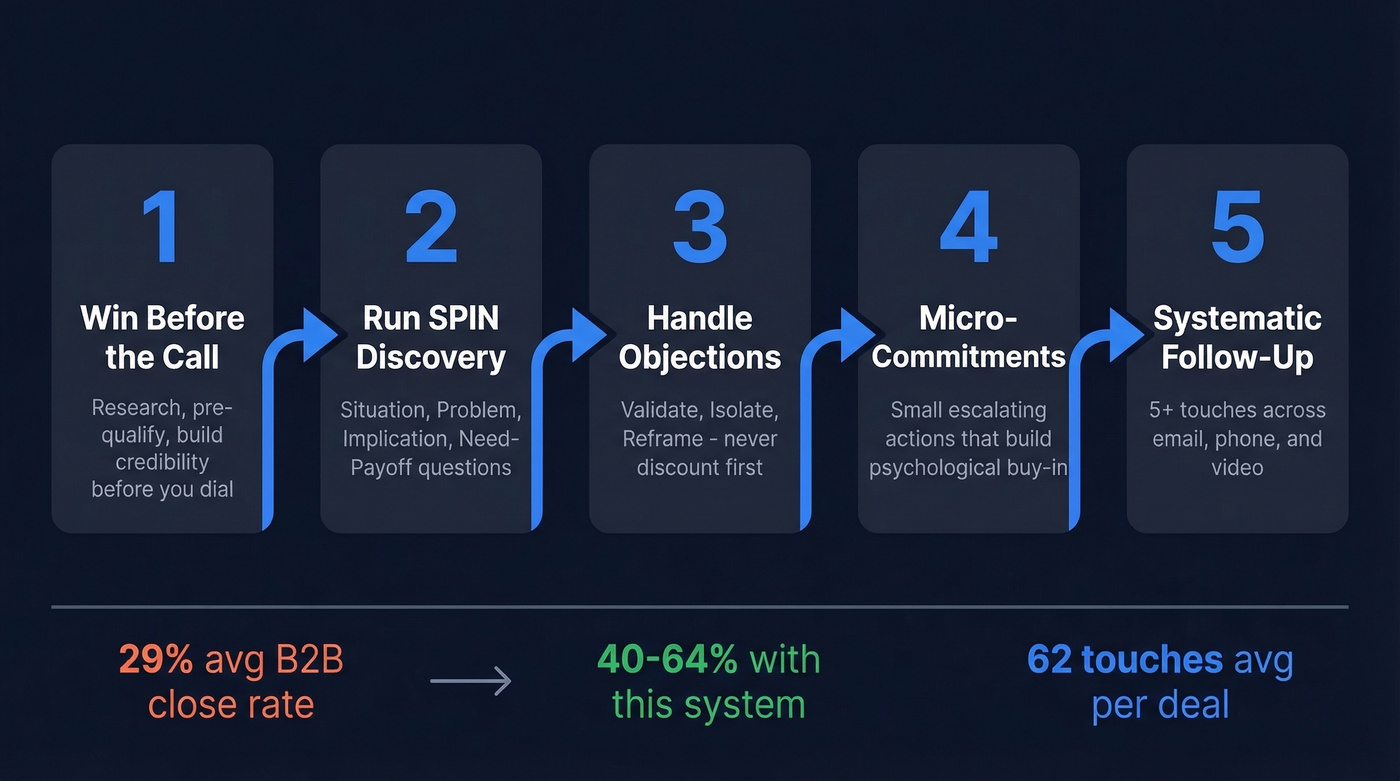
If you're figuring out how to close high ticket sales consistently, that pattern is the problem. 36% of sales professionals say closing is the single hardest part of their job, the average B2B close rate hovers around 29%, and modern deals require roughly 62 touches across three or more channels just to reach a signature.
What You Need (Quick Version)
High-ticket closing isn't a moment. It's a system. You need a discovery framework (SPIN), an objection-handling method (Validate, Isolate, Reframe), and a follow-up cadence that doesn't quit after one email. Below: the exact scripts, benchmarks, and micro-commitment tactics to run that system - whether you're learning to close bigger deals or refining a process that's already working.
What Changes at High Ticket
High-ticket typically means $2,000-$50,000+ per deal. At that price point, buyer psychology shifts. The decision isn't impulsive - it's deliberative, multi-stakeholder, and risk-averse. Three pillars drive every high-ticket purchase: perceived value, risk reduction, and emotional justification.
96% of prospects research companies before engaging a rep. 71% prefer doing that research independently. Most B2B deals involve 6-10 decision-makers, and 81% of revenue leaders say their deals are more complex than ever. You're not closing one person - you're building consensus across a buying committee, and understanding that dynamic is the first step in winning big accounts.
| Factor | Low Ticket (<$2K) | High Ticket ($2K-$50K+) |
|---|---|---|
| Sales cycle | Days to weeks | Weeks to months |
| Buyer mindset | Impulse / convenience | Deliberation / ROI |
| Decision-makers | 1-2 | Often 6-10 |
| Objection depth | Surface-level | Multi-layered |
| Follow-up effort | Light | Systematic |

Closing $10K+ deals means reaching 6-10 decision-makers with verified contact data - not guessing at email formats. Prospeo gives you 98% accurate emails and 125M+ verified mobile numbers so every touch in your follow-up cadence actually lands.
Stop losing high-ticket deals to bad contact data.
The 5-Step System for Closing Big Deals
1. Win Before the Call
The call should be a confirmation, not a persuasion event. If you're still "selling" on the call, you've already lost leverage.
A big part of winning early is nailing your sales prospecting and pre-call prep so discovery starts with context, not guesswork.
2. Run Discovery with SPIN
Neil Rackham's 12-year study of 35,000+ sales calls found that aggressive closing techniques actually hurt conversion in complex deals. Structured questioning lifts close rates by 20%.
| Stage | Purpose | Example Question |
|---|---|---|
| Situation | Understand context | "Walk me through how you're handling X today." |
| Problem | Surface pain | "Where does that process break down?" |
| Implication | Amplify stakes | "What does that cost you per quarter in lost deals?" |
| Need-Payoff | Let them sell themselves | "If you could cut that cycle in half, what would that mean for Q3?" |
If you want more prompts to pull real pain (not surface-level “nice to have” answers), build a bank of discovery questions and keep them in your CRM notes.
For shorter sales cycles, try a Micro-SPIN variant: one concise Situation question, a sharp Problem, a quick Implication, an immediate Need-Payoff - then ask for a micro-commitment. Full SPIN works best for enterprise deals. Micro-SPIN keeps momentum in faster-moving conversations.
3. Handle Objections Without Discounting
Here's the thing: sellers who handle objections effectively reach close rates as high as 64% - more than double the 29% average. The framework is Validate, Isolate, Reframe.
If objection volume is consistently high, it’s usually a positioning or qualification issue upstream - use a simple plan to reduce sales objection rate before you “get better at rebuttals.”
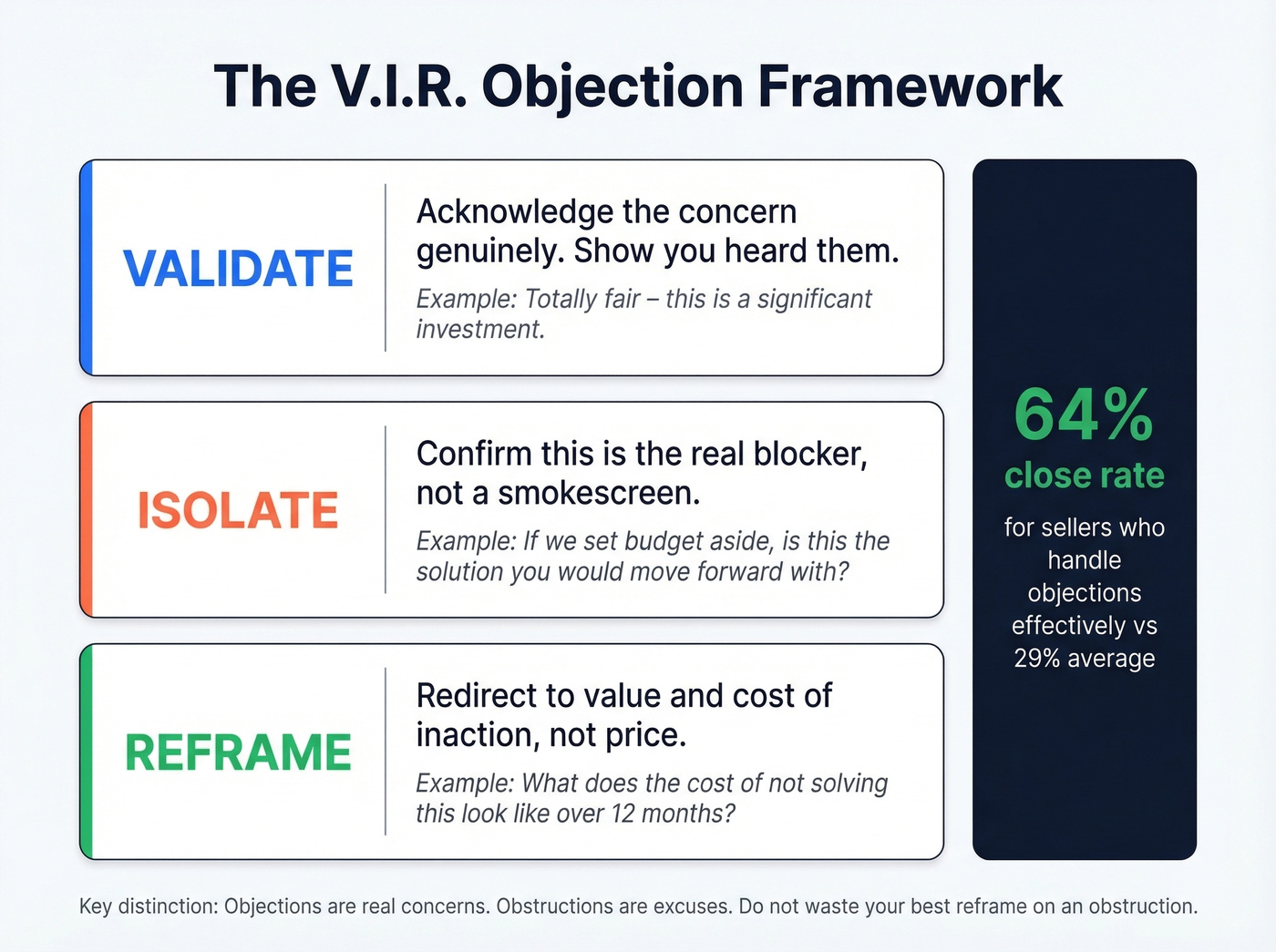
First, acknowledge the concern genuinely. Then isolate it - make sure it's the real blocker, not a smokescreen. Finally, reframe the conversation around value, not price. One important distinction: an objection is a real concern about buying. An obstruction ("I'm just too busy right now") is an excuse. Don't waste your best reframe on an obstruction.
Some practitioners go further by proactively surfacing likely objections before the prospect raises them. This preemptive reframe removes the adversarial dynamic entirely and puts you in a consulting position rather than a selling one.
Three scripts you can use today:
Price objection: "Totally fair - this is a significant investment. If we set budget aside for a second, is this the solution you'd move forward with? Great. Then let's talk about what the cost of not solving this looks like over the next 12 months."
Timing objection: "I get it. What specifically changes next quarter that makes this easier? Usually what we find is the problem compounds - teams that wait end up paying more to fix it later."
Authority objection: "Makes sense - you'll want your team aligned. What questions do you think they'll ask? Let's build the business case together so you walk in with answers, not just a pitch."
4. Build Momentum with Micro-Commitments
Big deals die in the gap between "interested" and "signed." Micro-commitments close that gap with small, escalating actions that build psychological investment.
This is also where team selling matters: align the champion, the technical buyer, and the economic buyer with clear next steps.
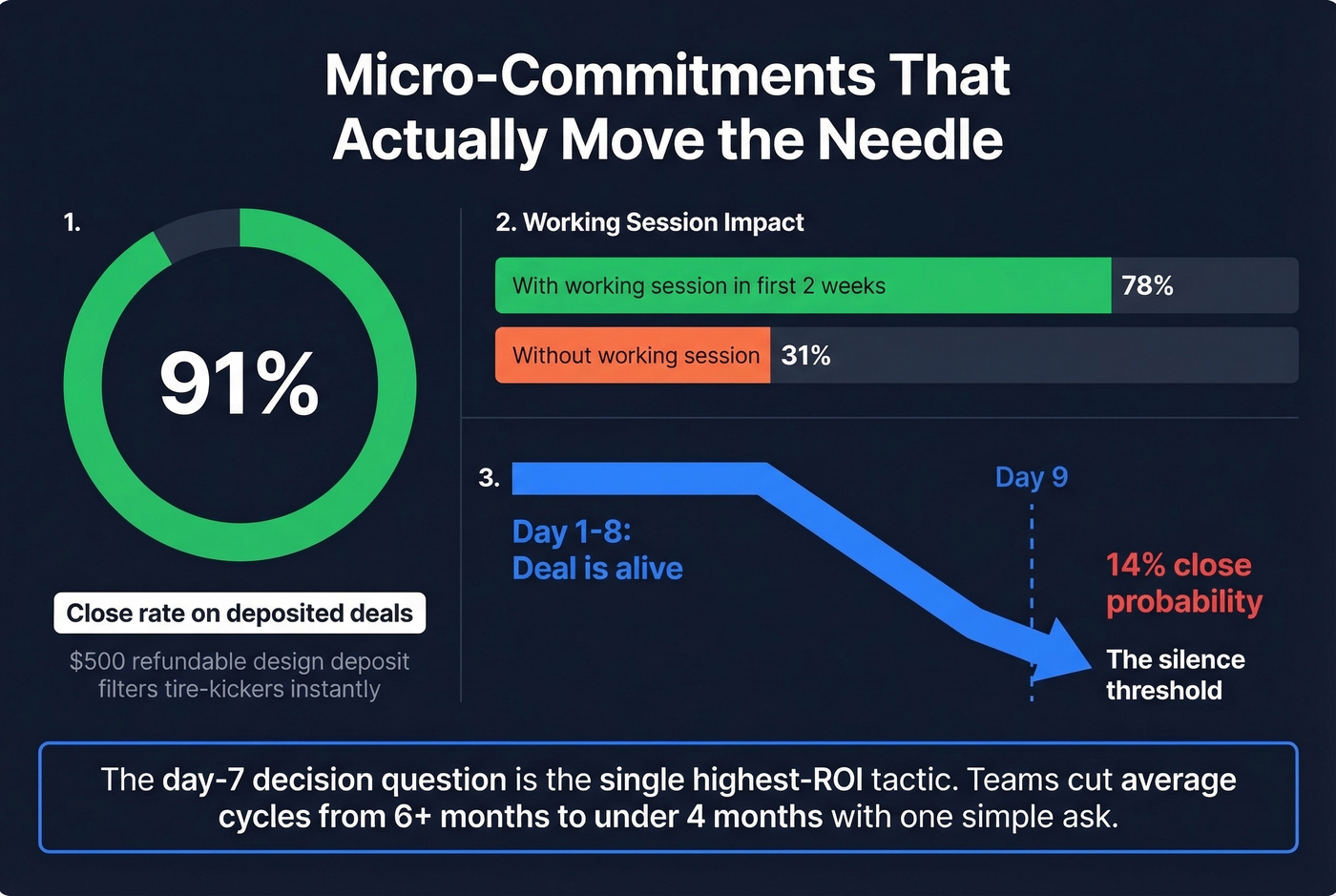
Charging a $500 refundable design deposit raised close rates to 91% on deposited deals - it filters tire-kickers instantly. Requiring a working session within the first two weeks produced a 78% close rate versus 31% without one. And tracking response lag reveals a brutal threshold: if a prospect goes silent for more than 9 days, close probability drops to just 14%.
In our experience, the day-7 decision question is the single highest-ROI tactic in this entire system. Something as simple as "Are we still aiming for a Q2 start, or has something changed?" forces a response without being pushy. We've seen teams cut their average cycle from 6+ months to under 4 months with that one move alone. If you're working deals north of $10K, this micro-commitment cadence is where to start.
5. Follow Up Like a System
80% of sales require at least five follow-ups, yet 44% of reps give up after one. That's not a skill gap. It's a systems gap.
If you want plug-and-play copy for each touch, keep a set of sales follow-up templates ready so reps don’t “wing it” when the deal goes quiet.
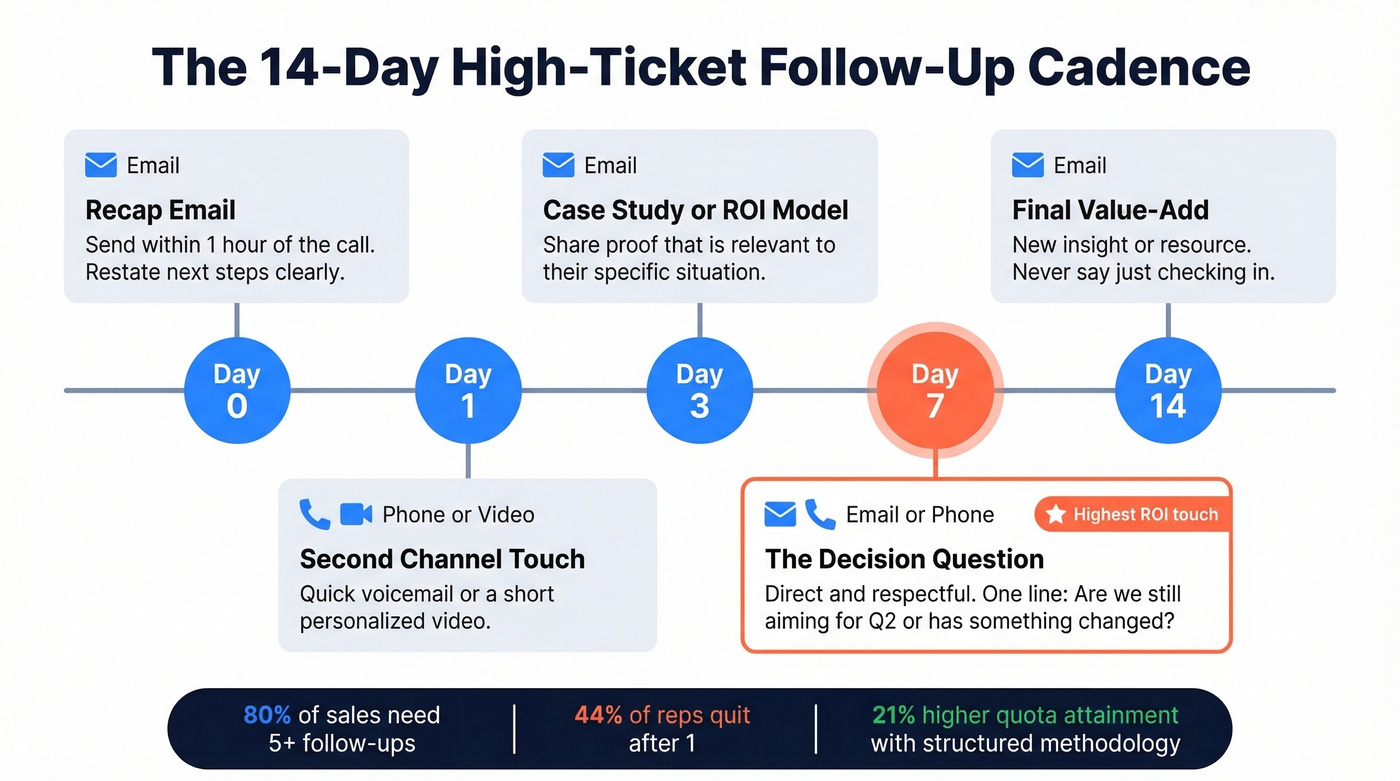
Build a cadence and stick to it:
- Day 0: Send a recap email within 1 hour of the call. Restate next steps.
- Day 1: Connect on a second channel - a quick voicemail or a short video.
- Day 3: Share a relevant case study or ROI model.
- Day 7: The decision question. Direct, respectful, one line.
- Day 14: Final value-add touch. New insight, not a "just checking in."
Teams that reach 75%+ adoption of a structured sales methodology see quota attainment jump 21% and win rates climb 15%. The methodology doesn't have to be complicated. It just has to exist - and reps have to actually follow it.
To make the cadence actually happen, many teams standardize it inside follow up email software or a sales engagement platform.
Mistakes That Kill High-Ticket Deals
Fake urgency. "This price expires Friday" doesn't work on a $30K deal. One sales leader reported a 20% win-rate increase after replacing urgency gimmicks with data-backed proposals and tailored value maps. Let the ROI create the urgency - sophisticated buyers see through "limited spots available" immediately.
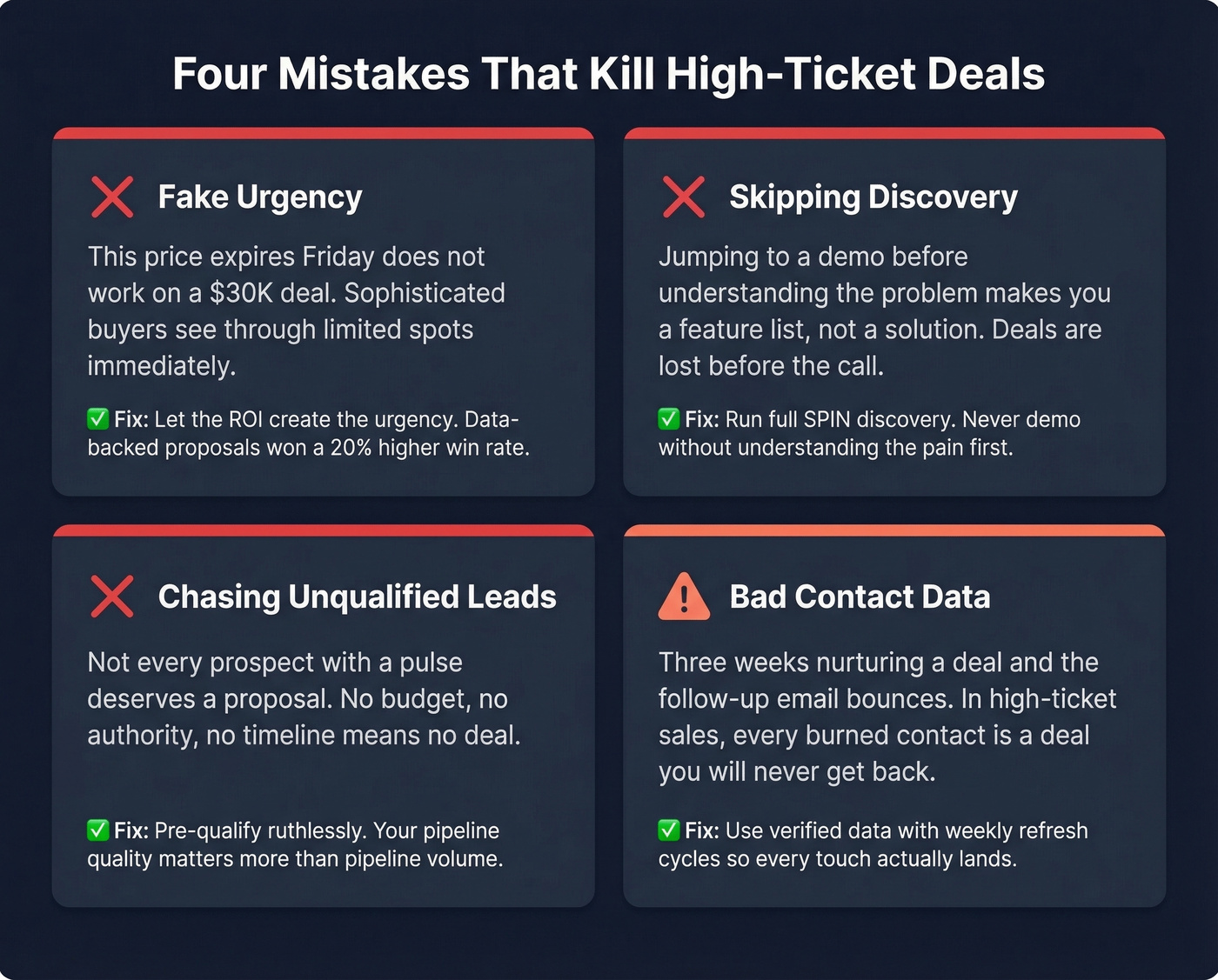
Skipping discovery. Jumping to a demo before understanding the problem is the fastest way to commoditize yourself. You become a feature list instead of a solution. Deals aren't lost on the call - they're lost before it, when reps skip the homework.
If your demos are getting “nice” feedback but not decisions, tighten the handoff with a product demo checklist so every demo maps to a buying trigger.
Chasing unqualified leads. Real talk: not every prospect with a pulse deserves a proposal. If they don't have budget, authority, and a real timeline, move on. Your pipeline will thank you. Landing premium accounts requires discipline about which opportunities deserve your time in the first place.
A simple way to enforce that discipline is using an ideal customer profile and scoring leads before you invest in multi-stakeholder cycles.
Bad contact data. You spent three weeks nurturing a deal, and the follow-up email bounces. In high-ticket sales, your addressable market is small - every burned contact is a deal you won't get back. Use a B2B data platform with verified emails and a weekly refresh cycle so you're reaching the right people, not guessing at formats and hoping for the best.
If bounces are a recurring issue, track your email bounce rate and fix the list hygiene before you scale touches.
Let's be honest about one thing: if your average contract value is under $5K, you probably don't need a 5-step closing system. A solid discovery call and two follow-ups will get you there. This system is built for deals where one lost opportunity costs you a quarter's worth of revenue.
Your 5-touch follow-up cadence is worthless if emails bounce and calls hit dead lines. Prospeo's 7-day data refresh means you're always reaching real buyers - not stale records. Teams using Prospeo book 35% more meetings than Apollo users.
Every follow-up deserves a real inbox on the other end.
FAQ
How do you close high ticket sales consistently?
Run a repeatable system: structured SPIN discovery, a Validate-Isolate-Reframe objection framework, and a multi-channel follow-up cadence of at least five touches. Teams using this combination consistently hit 40-64% close rates versus the 29% B2B average.
How many follow-ups does a high-ticket deal need?
At least five. 80% of sales require five or more follow-ups, yet 44% of reps stop after one. Build a cadence across email, phone, and video - and track response lag so you catch deals going cold before they flatline.
What's the biggest mistake in high-ticket closing?
Skipping pre-qualification. Reps who jump straight to a demo without confirming budget, authority, need, and timeline waste weeks on deals that were never real. Discipline at the top of the funnel is what separates 60%+ closers from the 29% average.