

How to Cold Email for Networking - A Step-by-Step System That Gets Replies
You spent 20 minutes crafting the perfect networking email to a VP you admire. You hit send. It bounced. Your sender reputation took a hit, and you never even got a chance to make your ask.
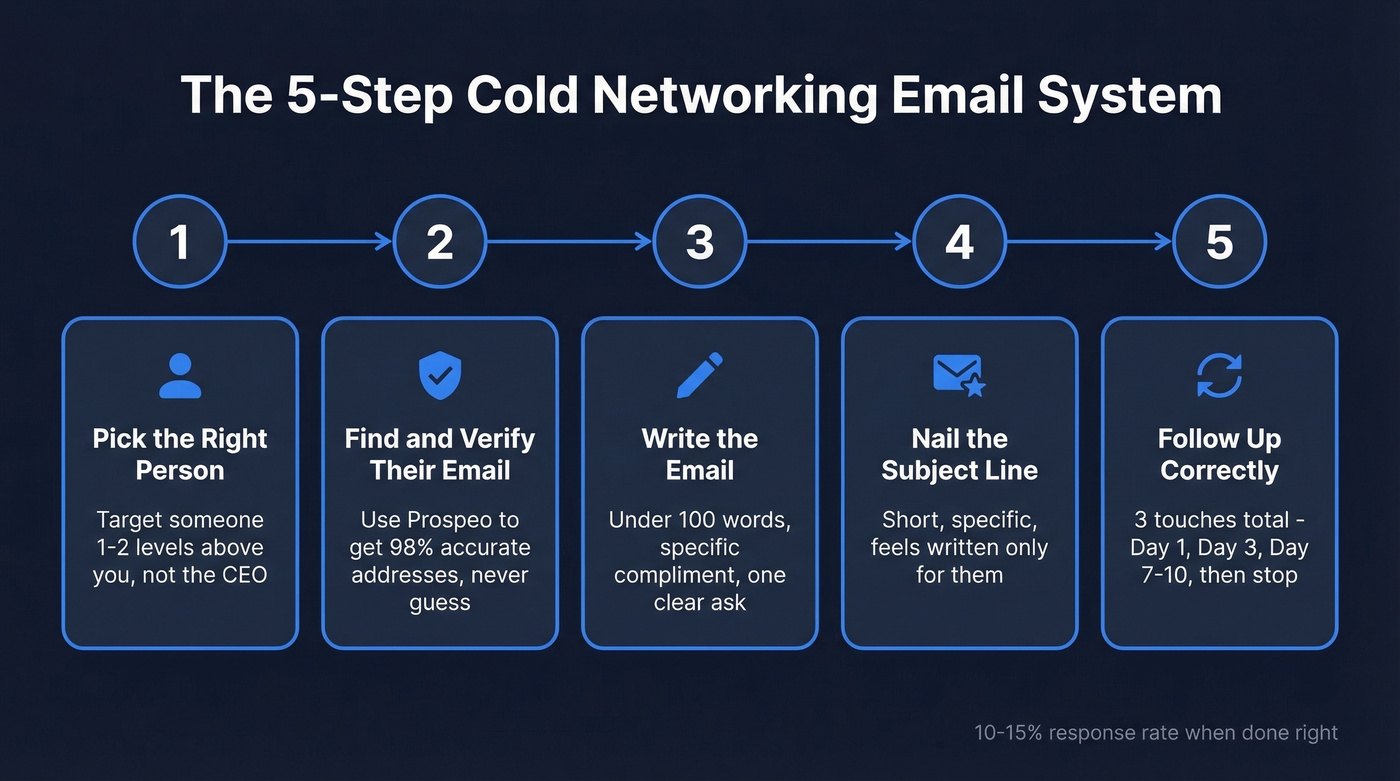
That scenario plays out thousands of times a day, and it's almost always preventable. If you're figuring out how to cold email for networking, the real reason most outreach fails isn't bad writing. It's bad logistics: wrong email address, wrong person, wrong length, no follow-up. One Wall Street Oasis user who tracked 1,500+ cold networking emails landed about 215 calls - roughly a 10-15% response rate. The consistent advice from finance professionals in that thread? Keep the email as short as possible. Word choice matters less than most people think. The system matters more.
Most networking advice obsesses over templates. But the best-written email in the world is worthless if it bounces or lands in spam. Fix the plumbing first, then worry about the prose.
The Quick Checklist
- Find the right person, not the right company. Target individuals 1-2 levels above you.
- Get a verified email before you send anything. A bounce hurts your domain.
- Write 4-6 sentences max. Under 100 words.
- Make one specific ask. "Could we chat for 15 minutes about X?" Not "I'd love to pick your brain."
- Follow up once at 3 days, once around a week later. Then stop. A 10-15% response rate is genuinely good.
The 5-Step Cold Networking Email System
Step 1 - Pick the Right Person
"Dear Hiring Team" goes straight to the trash. You want a specific human being, ideally someone 1-2 levels above where you are or want to be. Don't email the CEO of a Fortune 500 company when a senior director would actually take the call and give you better advice.
If you're a student, use your .edu email address. It signals you're genuinely learning, not selling, and it bumps up response odds noticeably.
Step 2 - Find and Verify Their Email
Every networking guide tells you what to write, then casually says "find their email" as if that's trivial. It isn't. And if you guess a format like firstname.lastname@company.com and get it wrong, that bounce damages your sender reputation. We've seen it over and over - the bounce-then-spam spiral is the #1 reason networking campaigns fail silently, and most people never realize what happened.
Prospeo's Chrome Extension pulls verified emails from professional profiles or company pages in one click - 75 free emails per month, 98% accuracy. Don't guess formats or send to info@ addresses. If you want a deeper breakdown of tools and methods, see our guide to email search tools.

Step 3 - Write the Email
Crafting a strong networking message comes down to structure, not cleverness. Forbes' cold networking email framework breaks this into three parts: a specific compliment, brief context about you, and one clear ask. That's the whole email. Under 100 words, 4-6 sentences. Never write "I'd love to pick your brain" - it's vague, overused, and puts all the burden on the recipient to figure out what you actually want.
If you want more examples beyond networking, borrow proven patterns from emails that get responses and tighten your ask with these email call to action rules.
Template 1 - Informational Interview:
Subject: Quick question about [their specific role/company]
Hi [Name],
I've been following [specific project/article/talk they did] - [one sentence about what impressed you]. I'm currently [your role/situation in one line] and exploring [specific area they know about].
Would you have 15 minutes in the next couple weeks to share how you approached [specific question]? I'd be grateful for any perspective.
Thanks, [Your full name] [Title | Company or School] [Phone number]
Template 2 - "I Admire Your Work":
Subject: Your [talk/article/project] on [topic]
Hi [Name],
Your [specific piece of work] changed how I think about [specific takeaway]. I'm working on [related project or career move] and had one question I think you'd have a unique perspective on.
Could we do a quick 15-minute call sometime this month? Happy to work around your schedule.
Best, [Your full name] [Title | Company or School] [Phone number]
End with a clear signature block. Harvard Law School's networking guidance recommends including your full name, email address, and cell phone number so the recipient can respond however they prefer.
Step 4 - Nail the Subject Line
Your subject line determines whether the email gets opened. Keep it short, specific, and impossible to confuse with spam.
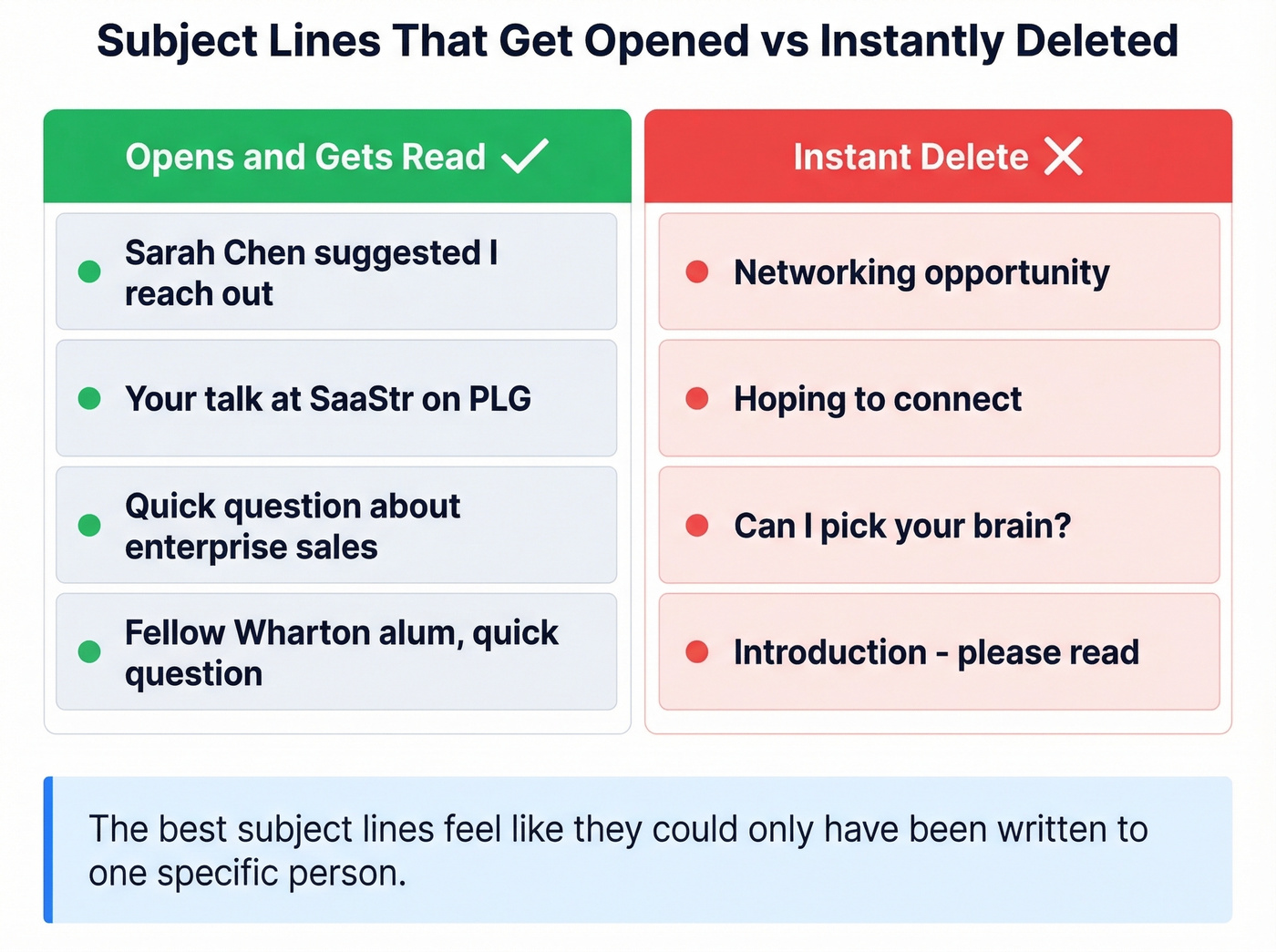
Proven formulas:
- Mutual connection: "Sarah Chen suggested I reach out"
- Specific work reference: "Your talk at SaaStr on PLG"
- Direct question: "Quick question about enterprise sales"
- Shared affiliation: "Fellow Wharton alum, quick question"
The best subject lines feel like they could only have been written to this one person. "Networking opportunity" and "Hoping to connect" are instant deletes. For more options, swipe ideas from these email subject line examples and this data-backed guide on subject lines that get opened.
Step 5 - Follow Up (Correctly)
Here's the thing: follow-ups often get more replies than the original email. People are busy. They saw your message, meant to respond, and forgot.
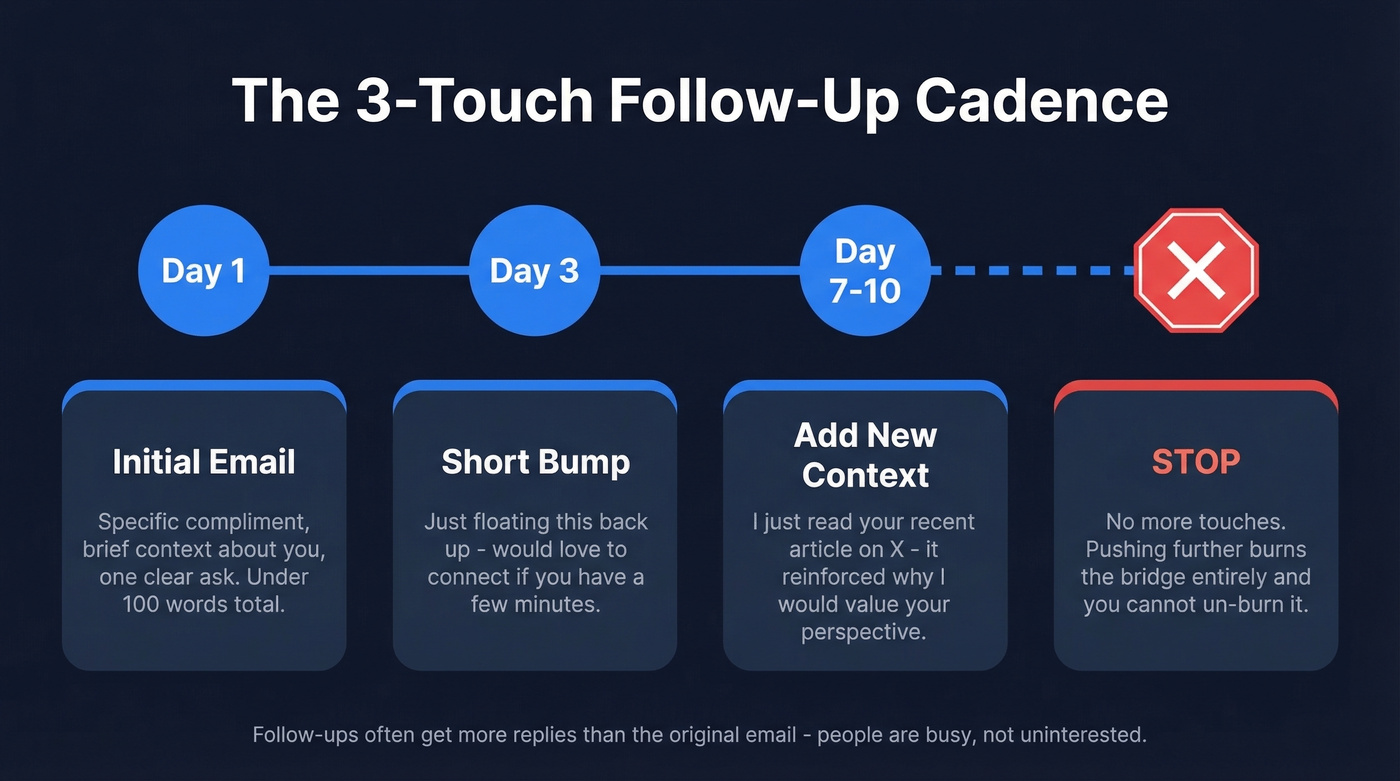
The cadence:
- Day 3: Short bump. "Just floating this back up - would love to connect if you have a few minutes."
- Day 7-10: Add new context. "I just read your recent [article/post] on [topic] - it reinforced why I'd value your perspective."
Three touches total. No more. Pushing further burns the bridge entirely, and you can't un-burn it. If you need wording, adapt these cold email follow-up templates or use a more gentle polite chaser email approach.

You just saw the system: find the right person, verify their email, write a tight message, follow up twice. Prospeo handles the hardest part - step 2. Our Chrome Extension pulls verified emails from professional profiles in one click with 98% accuracy, so your carefully crafted networking email actually reaches a human inbox instead of triggering a bounce.
75 free verified emails per month. No credit card, no bounces.
What to Do After They Reply
Getting the reply is only half the battle. Let's be honest - most people fumble this part.
Keep it to 15-20 minutes. You asked for 15. Don't run to 45 unless they're clearly enjoying the conversation. Prepare 3 specific questions - not "tell me about your career path," but "How did you decide between staying IC and moving into management at [Company]?" The difference between those two questions is the difference between a forgettable call and one where they actually want to help you.
Send a thank-you within 24 hours. Reference something specific they said. Then offer something back: share a relevant article, make an introduction, or offer a skill you have. Reciprocity turns a one-time call into an actual relationship. If you want a clean post-call workflow, use this sales meeting follow-up email structure and adapt it for networking.
Timing and Send Logistics
Send emails Tuesday through Thursday, 8-10 AM in the recipient's time zone. Cold email benchmarks from Growbots consistently show these windows get the highest open rates. Monday inboxes are flooded. Friday attention is already gone.
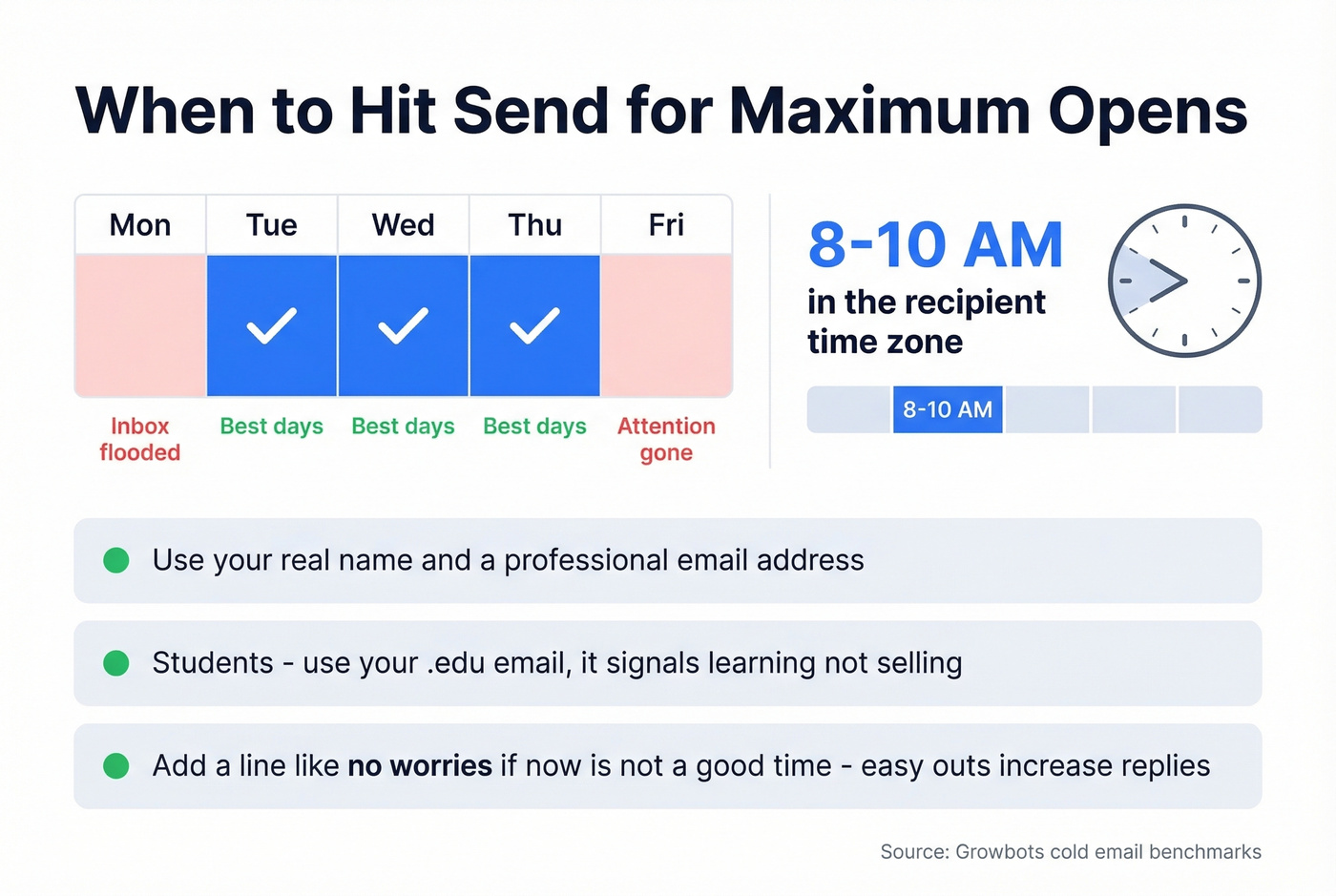
Use your real name and a professional email address. Gmail is fine for students; for everyone else, a company or personal domain looks more credible. And add a simple "no worries if now isn't a good time" line to make the message feel respectful and easy to decline - it sounds counterintuitive, but giving people an easy out actually increases response rates because it removes the pressure of commitment. If you're sending more than a handful, read up on email deliverability and how to improve sender reputation.
A 10-15% response rate on networking emails is genuinely good - but only if 100% of your emails actually arrive. One bounce damages your sender reputation and silently kills every email that follows. Prospeo's 5-step verification catches bad addresses before you hit send, keeping your domain clean at $0.01 per email.
Protect your sender reputation before your next outreach campaign.
FAQ
What's a good response rate for cold networking emails?
10-15% is realistic and genuinely good for well-targeted, short emails sent to verified addresses. Below 5% usually means your emails are too long, too generic, or bouncing before they reach anyone. Track bounces separately - if more than 4% bounce, your contact data is the problem, not your writing.
How long should a cold networking email be?
Under 100 words and 4-6 sentences. Include one specific compliment, one sentence about you, and one concrete ask. The recipient owes you nothing, so respect their time. Shorter messages consistently outperform longer ones in every response-rate dataset we've seen.
How do I find someone's email address for networking?
Use a verified email finder instead of guessing formats. Prospeo's Chrome Extension pulls verified addresses from professional profiles and company pages with 98% accuracy, and the free tier gives you 75 emails per month. Guessing formats risks bounces that damage your sender reputation over time - and once that reputation drops, even your emails to people who know you start landing in spam.