

How to End an Email to a CEO - And Actually Get a Reply
Stop debating "Best regards" versus "Best." That choice is irrelevant. The closing sentence determines whether a CEO responds. The sign-off word is just punctuation.
You don't need 89 options. You need one framework and five examples.
CEOs receive roughly 120 emails a day - some tech executives push 700-800. They spend about 10 seconds scanning each one, assuming it clears the executive assistant screening obvious sales pitches. Your closing needs to earn a reply in the tail end of that window.
What a CEO Email Closing Actually Is
Most people conflate three things that are distinct.
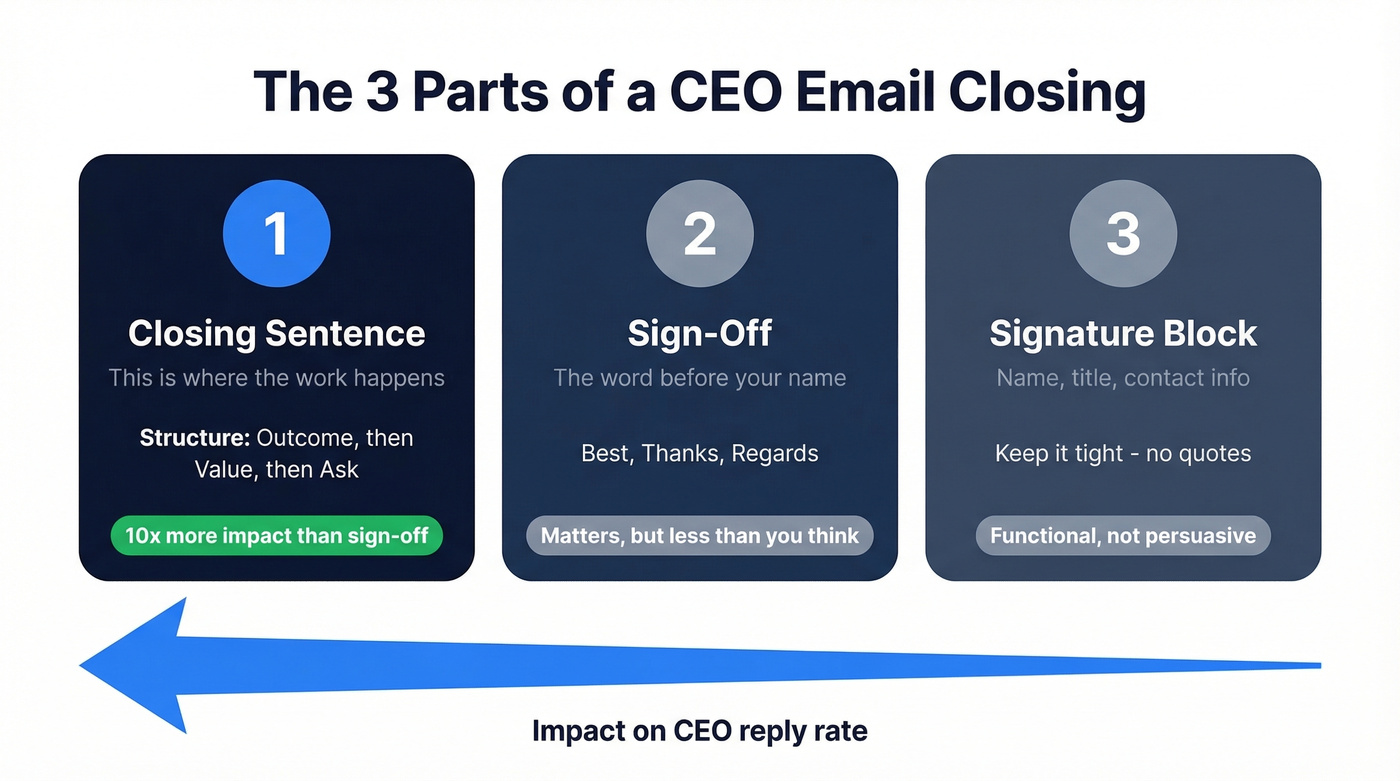
The closing sentence is where the work happens. It's your call to action - the thing you're asking the CEO to do. Structure it as Outcome → Value → Ask: lead with the business result, connect it to something they care about, then make a specific, small request. In a recent survey, 62% of CEOs ranked growth as their top priority, so lead with a growth-related outcome whenever possible. (If you want more CTA patterns, see call to action.)
The sign-off is the word or phrase before your name. "Best," "Thanks," "Regards." Data shows some perform better than others, but the closing sentence carries ten times more weight.
The signature block is your name, title, and contact info. Keep it tight. No inspirational quotes.
Best Sign-Offs by Response Rate
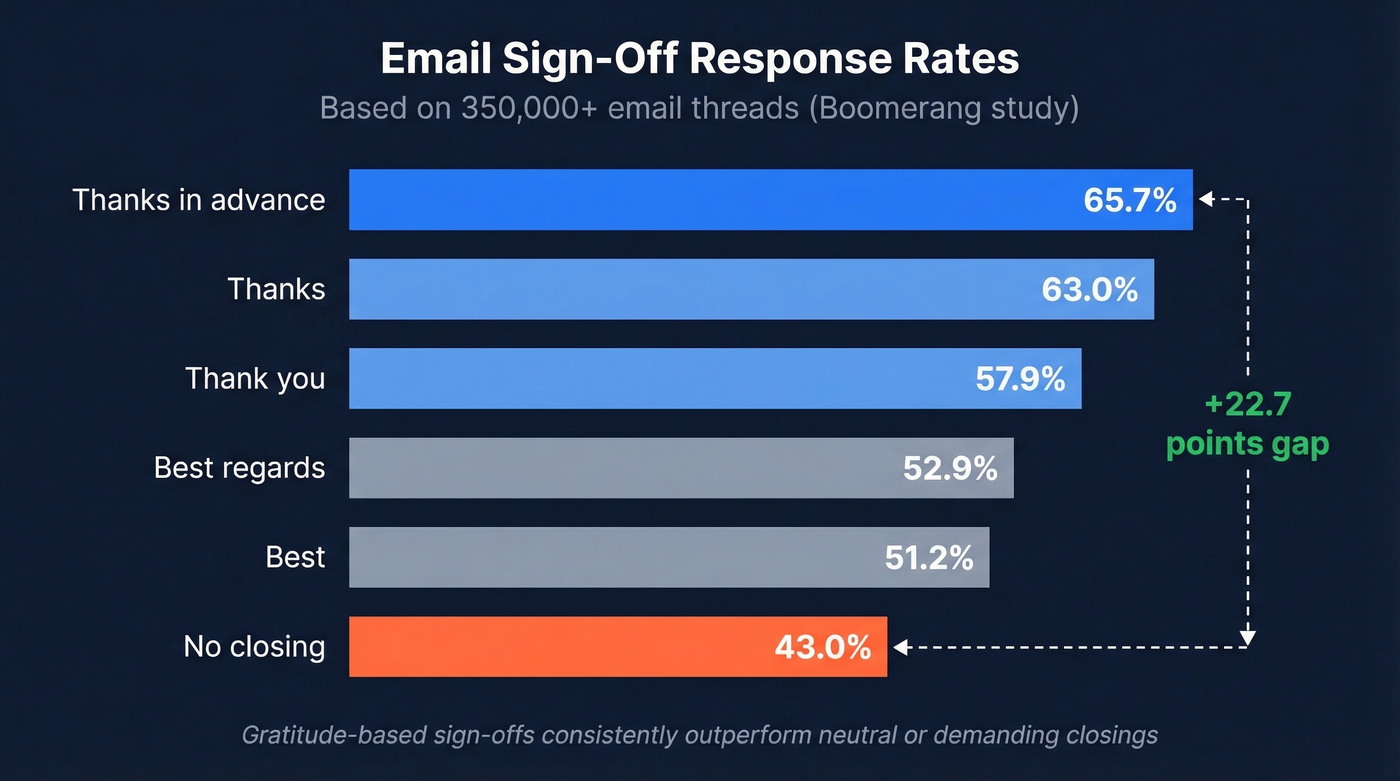
A Boomerang analysis of 350,000+ email threads gives us actual numbers instead of guesswork.
| Sign-Off | Response Rate |
|---|---|
| Thanks in advance | 65.7% |
| Thanks | 63.0% |
| Thank you | 57.9% |
| Best regards | 52.9% |
| Best | 51.2% |
| No closing | 43.0% |
Gratitude wins. "Thanks in advance" outperforms everything else by a wide margin - it presupposes the recipient will help, which is a subtle psychological nudge. That's a 22.7-point gap between the best-performing closing and no closing at all. A 2010 study by Grant & Gino backs this up: expressions of gratitude increased helping behavior by 66%.
"Demanding" closings like "I look forward to your prompt response" fall below 47%. Don't do that to a CEO.

Cold emails to CEOs get one shot. If that email bounces, your closing sentence never gets read. Prospeo verifies executive emails with 98% accuracy and a 7-day data refresh - so the address is current, not six months stale.
Don't waste your best closing on a dead inbox.
Closings by Scenario
The sign-off stays mostly the same. The closing sentence changes everything. Let's break it down by context - cold outreach, internal updates, and follow-ups each demand a different approach.
Cold Outreach to a CEO
The average C-suite cold email response rate sits around 4.26%. But timeline-focused emails - ones with a specific, time-bound ask - jump to 10.44%, a 2.45x lift. "Let me know your thoughts" is a response killer. A date and a number aren't.
If you're building a full sequence (not just one email), use cold email sequence best practices and keep an eye on email deliverability.
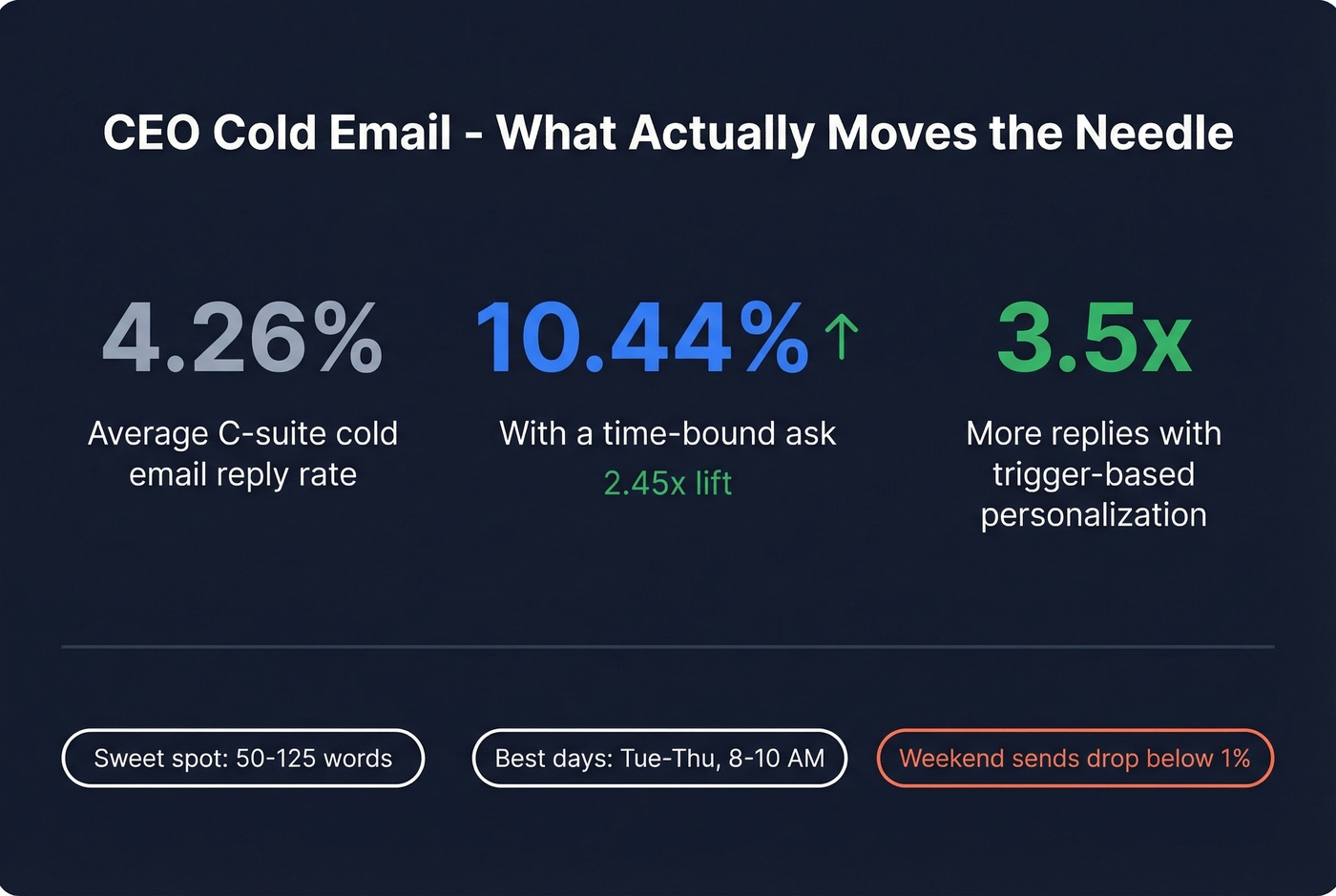
Trigger-based personalization pushes results even further. Referencing a recent product launch, new hire, or expansion earns up to 3.5x more replies than static templates. We've seen emails with perfect subject lines die because the closing was vague - specificity is what separates replies from silence. (More on this in personalized outreach.)
We helped [similar company] cut onboarding time by 40% last quarter. Worth a 15-minute call this Thursday or Friday?
Thanks in advance, [Name] | [Title] | [Phone]
Keep the entire email to 50-125 words. Emails in that range tend to see reply rates around 50%. Send Tuesday through Thursday between 8-10 AM - weekend sends drop below 1%. For more timing data, see best time to send cold emails.
One thing that matters more than your closing: making sure the email actually reaches the CEO's inbox. Verify the address before you hit send. Prospeo's Email Finder checks executive emails with 98% accuracy and real-time verification, so you're not wasting your one shot on a dead address. (If you're troubleshooting bounces, start with email bounce rate.)
Internal Email to Your CEO
Internal emails need softer CTAs. You're not selling - you're informing and requesting a decision. State what you've prepared, offer to walk through it, and suggest a specific time slot. "Thank you" or "Best regards" fits the internal tone. The key is making the decision easy: attach the options, include the numbers, and give them a single action to take.
Follow-Up After No Response
If a CEO doesn't reply within two days, a follow-up can increase response rates by 49%. Here's the cadence that works:
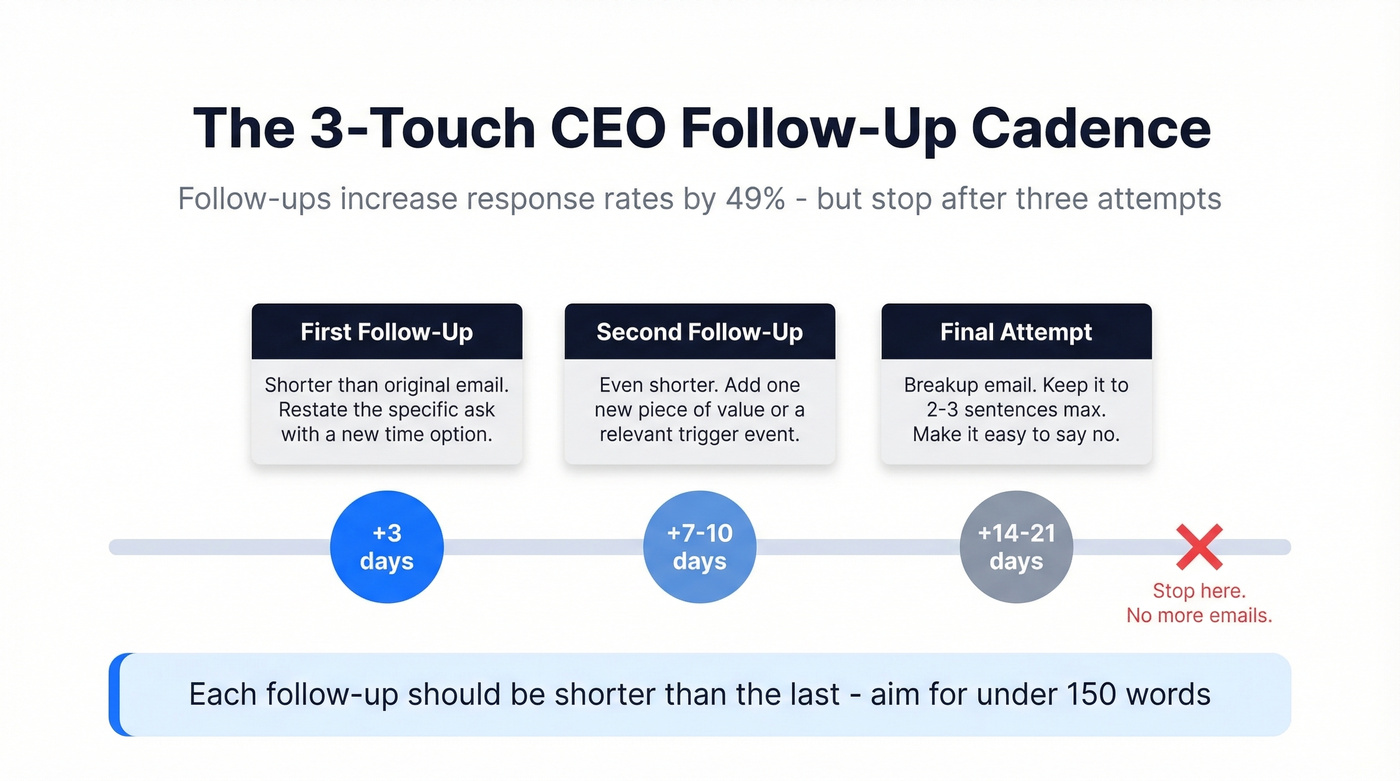
- First follow-up at +3 days
- Second at +7-10 days
- Final attempt at +14-21 days
Stop after three attempts. Each follow-up should be shorter than the last. The consensus on r/Entrepreneur is that no business email should exceed 300 words - and for follow-ups, aim for half that. If you want ready-to-send language, pull from sales follow-up templates or cold email follow-up templates.
Circling back - if next week works better for a quick call, I'm flexible on timing.
Thanks, [Name]
Partnership or Investor Pitch
This is where specificity earns its keep. Vague "synergy" language gets deleted. Concrete numbers get forwarded to the chief of staff.
Our distribution partnership with [Company X] drove $2.3M in co-sourced pipeline last year. I'd love to explore whether there's a similar fit - could we find 20 minutes next week?
Thanks in advance, [Name]
Cross-Cultural Sign-Off Etiquette
Sign-off conventions vary more than most people realize, and getting it wrong can tank your credibility before the CEO finishes reading.
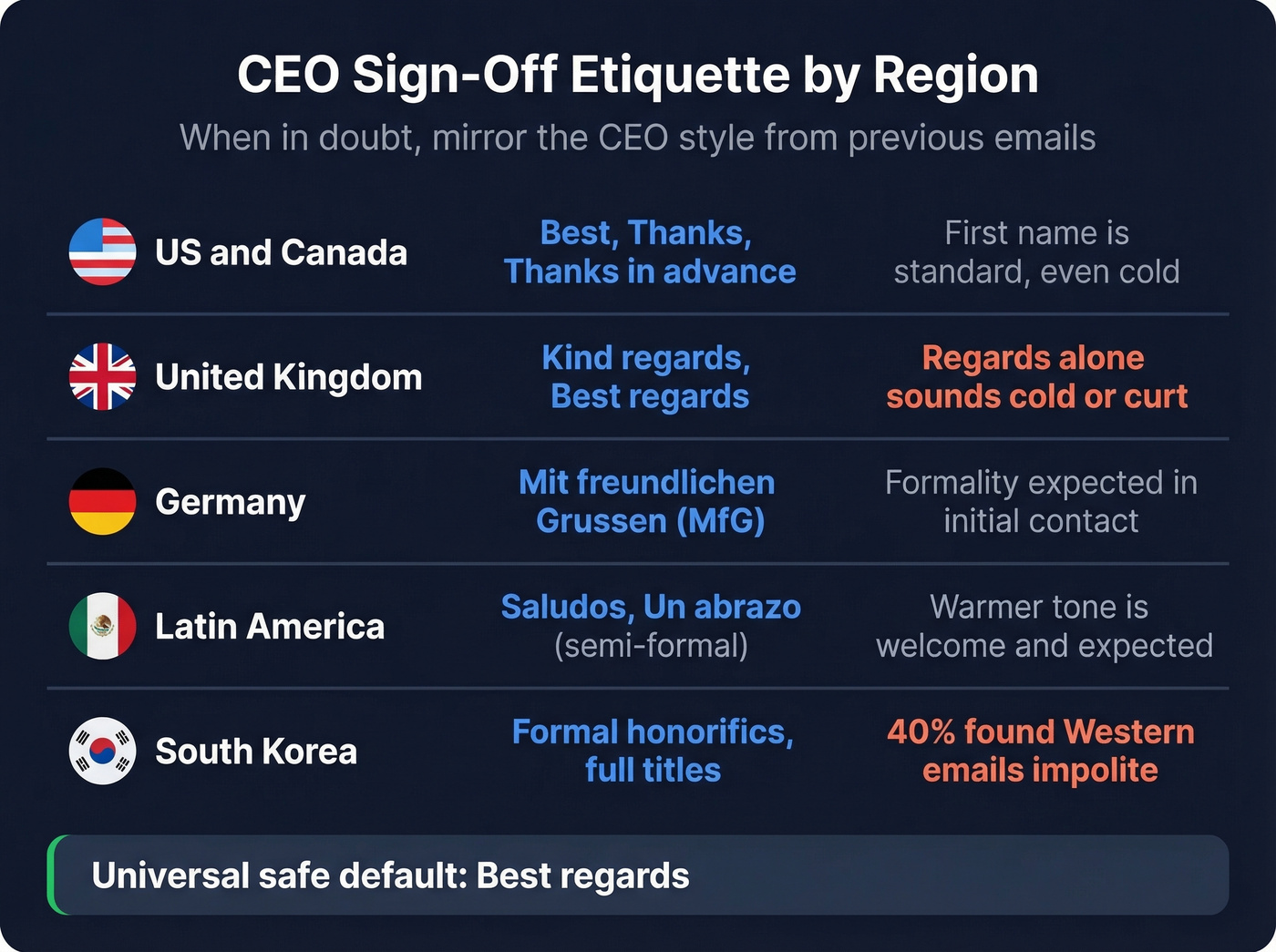
In the UK, "Regards" alone sounds cold or even curt. "Kind regards" or "Best regards" is the safe choice - a BBC analysis of workplace email culture found this distinction matters more than Brits will admit. In Germany, "Mit freundlichen Grüßen" (often abbreviated MfG) is standard business formality. Latin American executives are comfortable with "Saludos" and even "Un abrazo" in semi-formal contexts - something that would feel bizarre in a Scandinavian inbox.
A study comparing Korean and Australian email norms found 40% of Korean respondents considered Australian emails impolite, versus 28% the other way around. Here's the thing: when in doubt, mirror the CEO's own sign-off style from any previous correspondence. If there's no precedent, "Best regards" is the safest universal default.
Mistakes That Get Your Email Deleted
"Per my last email" and "Just checking in" both read as passive-aggressive, especially to someone who gets 120+ emails a day. "Let me know your thoughts" is a vague CTA that gives the CEO nothing to act on - replace it with a specific ask and a timeframe. Over-formality like "I humbly request the honor of your time" doesn't signal respect; it signals you've never emailed a CEO before. (Alternatives here: how to say just checking in professionally.)
A few more that I see constantly: mobile footers like "Sent from my iPhone" signal the email wasn't worth sitting down for. And typos in the closing - the last thing they read - stick harder than typos anywhere else.
Look, most people agonize over business email etiquette when the real problem is that their closing asks for nothing. A grammatically imperfect email with a clear, specific CTA will outperform a polished email with "thoughts?" every single time. We've watched it happen across thousands of outbound campaigns.
You just learned that trigger-based personalization earns 3.5x more CEO replies. Prospeo's database of 300M+ profiles lets you filter by job changes, funding rounds, and headcount growth - so your closing line references something the CEO actually cares about right now.
Start with the right trigger. Send to the right address. Get the reply.
FAQ
Should I use "Dear" or the CEO's first name?
First name for cold outreach in most Western business contexts. "Dear [First Name]" works in regulated industries or cultures that expect formality. Match the company's tone - "Hi Sarah" beats "Dear Ms. Chen" at a Series B startup.
Is "Best" too casual for a CEO?
No. "Best" generates a 51.2% response rate in the Boomerang data - perfectly respectable. A sharp, specific CTA paired with "Best" will outperform a vague ask with "Respectfully" every time.
How long should my email to a CEO be?
Keep the entire email between 50-125 words - emails in that range see roughly 50% reply rates. Your closing sentence should be one sentence, two at most. If the CEO has to scroll to find your ask, you've already lost.
How do I find a CEO's verified email address?
Use a dedicated email finder rather than guessing formats. Prospeo covers 300M+ professional profiles at 98% accuracy, so you can verify the address is live before sending. The free tier includes 75 lookups per month - enough to test a targeted CEO outreach list without spending a dollar.