

How to Find Your Target Market - The Guide That Actually Tells You How
Every article on how to find your target market says the same thing: create personas, look at competitors, analyze your audience. Then it stops. No scripts. No formulas. No templates. You're left knowing what to do but not how - and that's the gap where most marketing strategies quietly die.
Companies that nail personalization generate 40% more revenue than their slower-growing competitors, per McKinsey. The difference isn't awareness. It's execution.
Here's the step-by-step process, with actual scripts, sizing math, and templates.
7 Steps to Identify Your Target Market
- Analyze what you're selling - map product to problem to person.
- Research your market - free and paid tools, plus offline methods.
- Segment your market - demographic, geographic, psychographic, behavioral.
- Build customer profiles - structured question banks, not guesswork.
- Validate with interviews - 5-7 core questions, copy-paste ready.
- Size your market - TAM, SAM, SOM with real formulas.
- Test and refine - review every 6-12 months, minimum.
Target Market vs. Audience vs. ICP vs. Persona
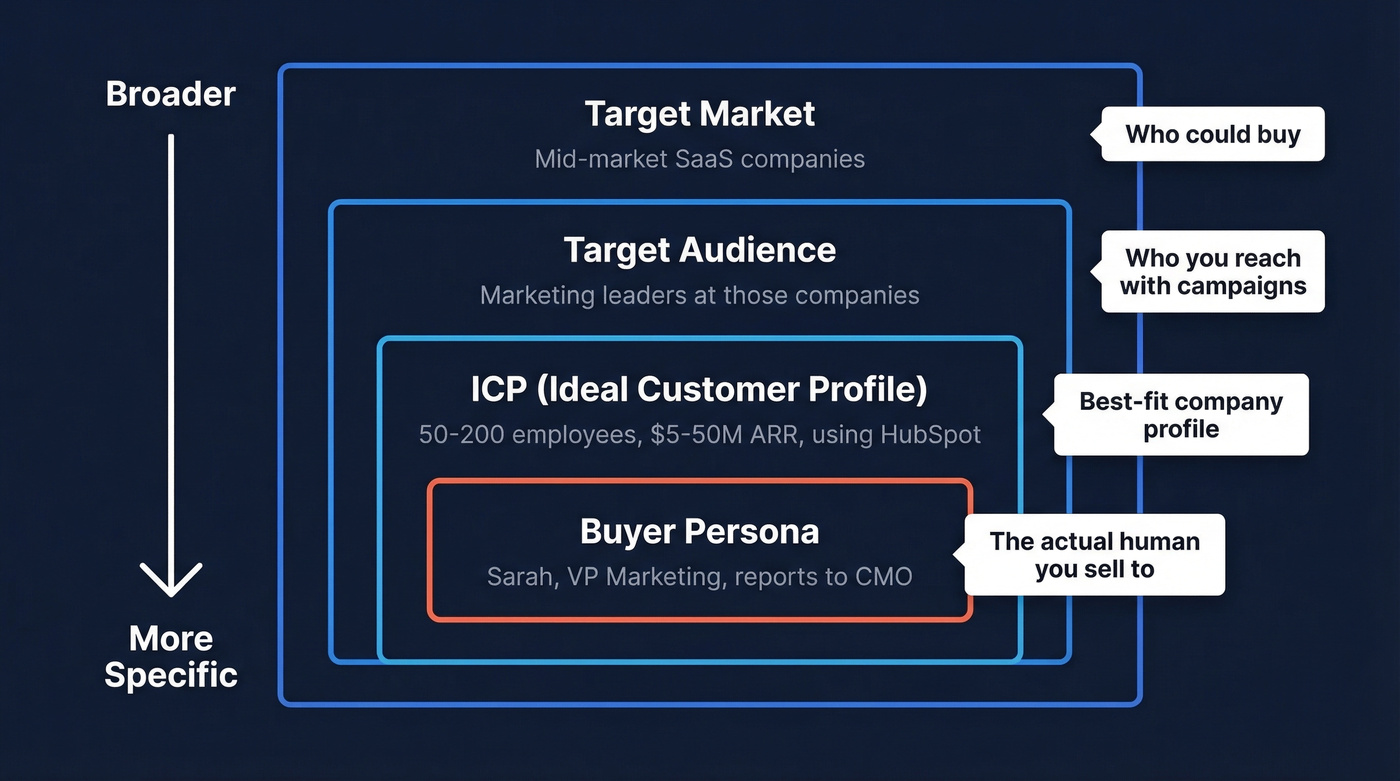
These four terms get used interchangeably, and that creates confusion. They're a hierarchy, moving from broadest to most specific.
| Term | Scope | Example |
|---|---|---|
| Target market | Broadest group | Mid-market SaaS companies |
| Target audience | Campaign-specific | Marketing leaders at those companies |
| ICP (B2B) | Firmographic profile | 50-200 employees, $5-50M ARR, using HubSpot |
| Buyer persona | Individual archetype | "Sarah," VP Marketing, reports to CMO |
For B2B, the persona layer gets more complex because you're rarely selling to one person. A CRM purchase involves the end-user (the rep), the champion (the sales manager who pushes for it), and the decision-maker (the VP or CFO who signs the check). Your market definition stays the same, but your messaging needs to address each role differently.
Step-by-Step Target Market Research
Step 1 - Analyze What You're Selling
Before you research anyone else, get clear on three things: the product, the problem it solves, and the person who has that problem. Most teams skip this explicit mapping and jump straight to demographics.
Write one sentence that connects all three:
- Product: What you sell (be specific about the version or tier)
- Problem: What pain it eliminates or outcome it creates
- Person: Who experiences that pain most acutely
Here's what this looks like in practice. Slack didn't define its market as "businesses that communicate." It mapped the product (real-time messaging with channels) to the problem (email overload killing team speed) to the person (engineering and product teams at tech companies). That specificity drove their early growth - they expanded later, after they'd dominated the niche.
If you're pre-revenue, start with the problem you solve. Who has that problem? Where do they talk about it? What are they currently doing instead? That's your starting point - not a demographic spreadsheet, but a pain point with a face attached to it.
Step 2 - Research Your Market
Free tools:
- Google Trends - validates whether interest in your category is growing, flat, or declining. Search your core terms and compare against alternatives.
- Census Bureau / BLS data - demographic sizing. How many people in a given geography match your age, income, or occupation criteria? The SBA's market research guide walks through additional government data sources.
- GA4 - shows who's already visiting your site. Look at acquisition channels and behavior flow.
- Meta audience tools - social audience sizing. You can estimate how large a demographic + interest segment is before you spend a dollar.
Paid tools:
- SparkToro (paid plans from around $50/month) - audience intelligence. Shows where your audience hangs out online, what they read, and who they follow.
- SimilarWeb (paid plans typically start around $125/month) - competitor traffic analysis. See where competitors get their traffic and which audience segments engage most.
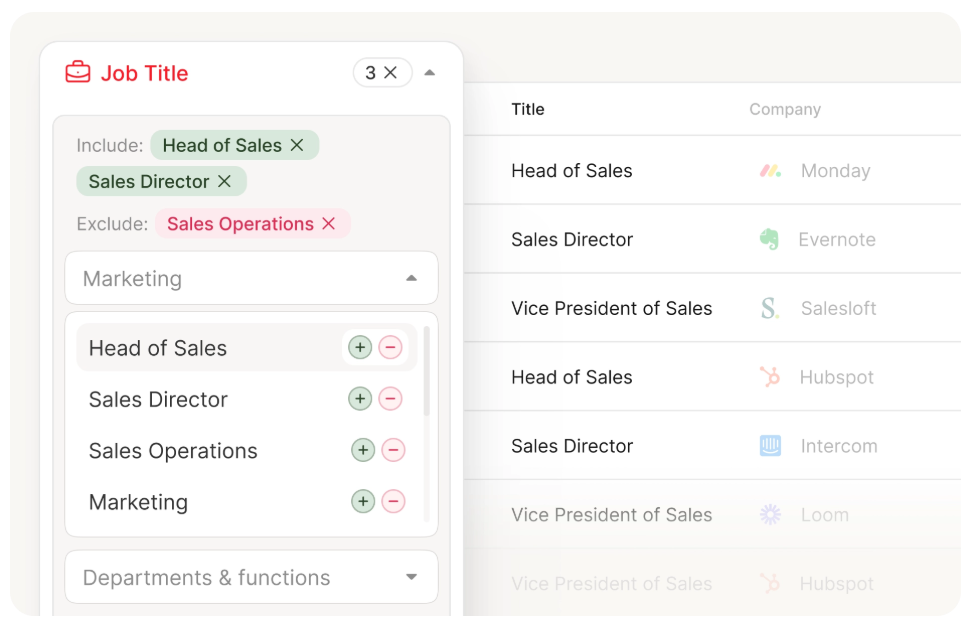
For B2B teams, intent data gives you a different angle entirely. Prospeo offers intent data across 15,000 topics, powered by Bombora, layered on top of its 300M+ professional profiles - so you can see which companies are actively researching solutions in your category before they ever hit your website. That kind of buyer-signal research lets you prioritize accounts showing real purchase intent over cold lists. If you want to operationalize that approach, start with intent data segmentation and then build your filters using firmographic and technographic data.
What if your audience isn't online? One startup founder on r/startups described trying to reach event organizers in a specific city - people who "aren't usually available on the internet." Digital research won't cut it for every market. Look at industry association member directories, trade show attendee lists, local business registries, and chamber of commerce databases. Sometimes the best customer discovery happens offline.
Step 3 - Segment Your Market
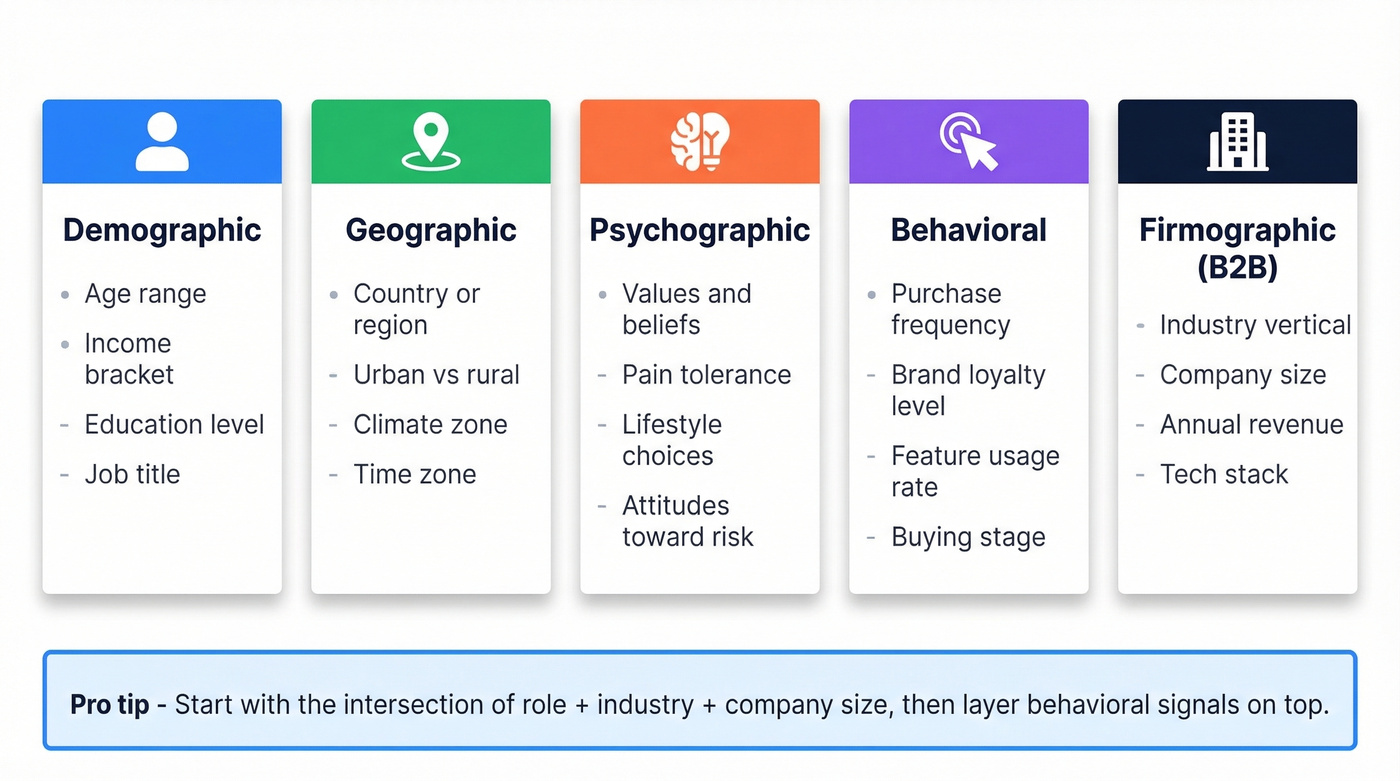
Segmentation is where you take a broad market and carve it into groups you can target with distinct messaging. Four classic dimensions, plus a fifth for B2B:
| Type | Example Questions |
|---|---|
| Demographic | Age? Income? Education? Occupation? |
| Geographic | Country? City? Urban vs. rural? Climate? |
| Psychographic | Values? Lifestyle? Attitudes? Pain tolerance? |
| Behavioral | Purchase frequency? Brand loyalty? Usage rate? |
| Firmographic (B2B) | Industry? Company size? Revenue? Tech stack? |
The confusion isn't usually about what these categories are. It's about which combination to use. A founder on r/Entrepreneur described this perfectly: they built a video-conference post-processing tool and couldn't decide whether to target administrative assistants (role), marketing and IT companies (industry), or admin assistants specifically in marketing/IT (combination).
The answer is almost always the combination. Role alone is too broad. Industry alone ignores who actually buys. Start with the intersection of role + industry + company size, then layer in behavioral signals - like "actively hiring for marketing roles" or "using Zoom as their primary conferencing tool" - to pinpoint the right audience within the broader segment. (If you need a practical way to implement this in your stack, use firmographic filters and a simple lead scoring model.)
Here's the thing: if your average deal value is under $5,000, you probably don't need five segments. Pick two, dominate them, and expand later. Over-segmentation kills small teams faster than under-segmentation does.
Step 4 - Build Customer Profiles
Most persona templates ask you to name your fictional customer "Marketing Mary" and give her a stock photo. That's not a profile - it's creative writing. Real customer profiles are built from structured questions that surface actionable insights. If you want a plug-and-play structure, use an ideal customer profile template and adapt it to your segment.
Use this framework, adapted from a Scribd market research template:
Demographics - Gender, age range, occupation, income bracket, location. The basics, but don't stop here.
Painful Current State - What are they afraid of? What frustrates them daily? What embarrasses them about their current solution? How would they describe the problem to a friend over drinks?
Desirable Dream State - If they had a magic wand, what would their workflow look like? Who do they want to impress? What outcome would make them look like a hero internally?
Values and Beliefs - Who do they blame for the problem? What have they tried before that failed? How do they evaluate new solutions? Which brands or thought leaders do they trust?
Roadblocks - What's preventing them from solving this today? What mistakes have they made? What don't they understand about the solution space?
Where do you find answers to these questions? Don't guess. Go look at Reddit threads, YouTube comments on competitor product videos, Amazon reviews for books in your space, competitor testimonials, and industry forums. The language your market uses to describe their problems is the exact language you should use in your copy.
Build an anti-persona too - a clear description of who you're not targeting. We've seen teams skip this step and waste months chasing bad-fit leads. It prevents the "Everyone Target" mistake and gives your sales team permission to disqualify.
Step 5 - Validate With Interviews
Profiles built from desk research are hypotheses. Interviews turn them into evidence. Here's a copy-paste interview script, drawn from practitioner recommendations on r/ProductMarketing:
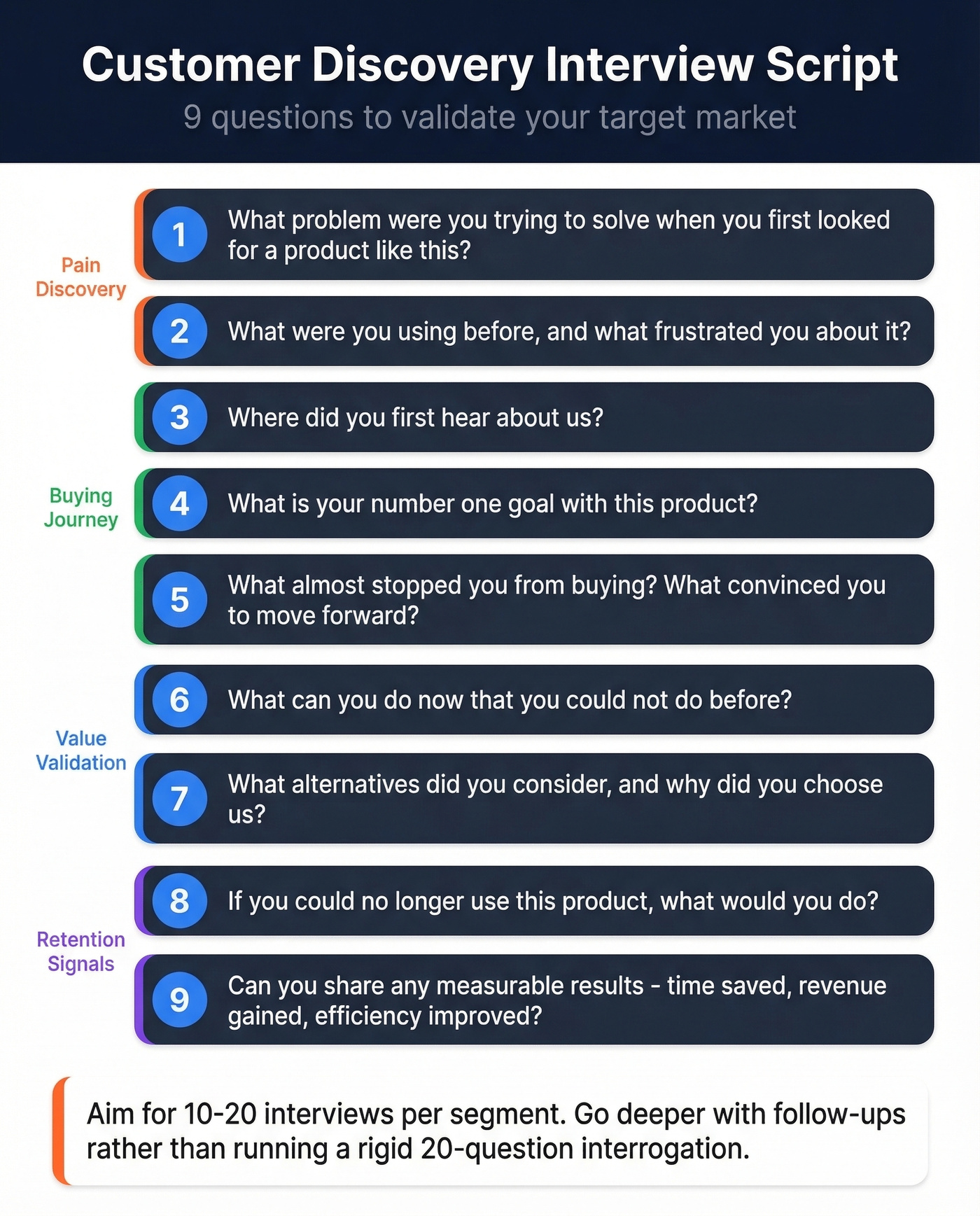
- What problem were you trying to solve when you first looked for a product like this?
- What were you using before, and what frustrated you about it?
- Where did you first hear about us?
- What's your #1 goal with this product?
- What almost stopped you from buying? What convinced you to move forward?
- What can you do now that you couldn't before?
- What alternatives did you consider, and why did you choose us?
- If you could no longer use this product, what would you do?
- Can you share any measurable results - time saved, revenue gained, efficiency improved?
Keep it to 5-7 core questions and go deeper with follow-ups rather than running a rigid 20-question interrogation. The best insights come from "tell me more about that" moments, not from checking boxes.
Sample sizes: 10-20 customer discovery interviews per segment is enough to spot patterns and validate or kill your hypotheses. For quantitative validation, aim for 100+ survey responses.
The key principle is triangulation - combine interviews, surveys, and analytics data. No single method tells the full story.
Step 6 - Size Your Market
Let's be honest: almost no target market guide on the internet covers market sizing. That's a problem. Defining segments without sizing them is like building a business plan without revenue projections - you're guessing at the opportunity.
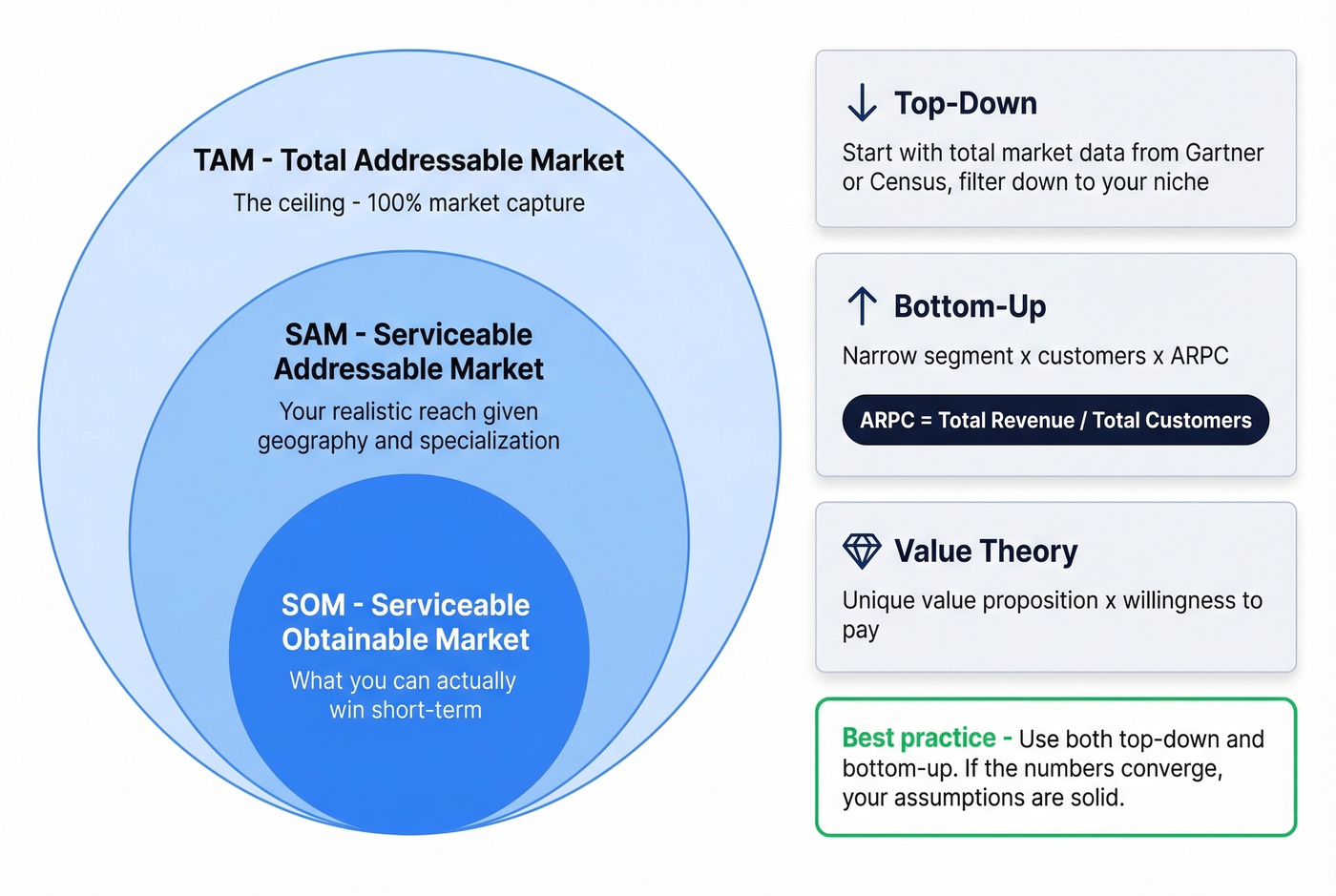
You need three numbers:
- TAM (Total Addressable Market) - maximum revenue if you captured 100% of the market. The ceiling.
- SAM (Serviceable Addressable Market) - the portion of TAM you can realistically target given your geography, specialization, and go-to-market.
- SOM (Serviceable Obtainable Market) - the portion of SAM you can realistically win, accounting for competition. Your short-term target.
Three ways to calculate:
- Top-down: Start with total market size from Gartner, Nielsen, or Census data and filter down to your niche.
- Bottom-up: Start with your narrow segment, estimate customers x ARPC (Average Revenue Per Customer), and build up. Formula: ARPC = Total revenue / Total customers.
- Value theory: Size based on your unique value proposition x willingness to pay.
In our experience, bottom-up produces the most defensible numbers for investor conversations. Top-down is faster for internal planning. Use both and see if the numbers converge - if they're wildly different, your assumptions need work. (If you want a deeper walkthrough, see our guide to addressable market.)
Step 7 - Test, Refine, Repeat
Your target market isn't a one-time decision. It's something you update regularly.
Review every 6-12 months at minimum, and re-evaluate sooner if any of these triggers hit:
- You launch a new product line or enter a new vertical
- Conversion rates decline for 2+ consecutive quarters
- A major market shift changes buyer behavior - new regulation, economic downturn, technology disruption
- Your best customers start looking different from your original ICP
The teams that win aren't the ones who define their market perfectly on day one. They're the ones who update it relentlessly.

You just mapped your segments by role, industry, and company size. Prospeo lets you activate that work instantly - filter 300M+ profiles by 30+ criteria including technographics, headcount growth, funding stage, and buyer intent across 15,000 topics.
Turn your target market definition into a verified contact list in minutes.
3 Targeting Mistakes That Kill Marketing
Kellogg School of Management faculty identified three targeting errors that show up constantly:
The Everyone Target. Your market is too broad, your message is watered down, and you end up resonating with nobody. This usually comes from weak segmentation or a fear of excluding potential buyers. If you can't describe your ideal customer's specific problem, job title, and buying trigger in one sentence, your target is too broad.
The Popular Kid Target. You pick the biggest, most obvious segment - and so does every competitor. SpotHero learned this the hard way: shifting focus from occasional leisure parkers to business parkers (a less obvious segment) drove their market leadership. Underserved beats overcrowded.
The Egocentric Target. You evaluate your marketing from your own perspective instead of the target's. You're not the customer. If you haven't talked to 10 potential customers, your persona is fan fiction. One founder on r/startups described the problem bluntly: they skipped validation and "now can't figure out where these people even are."
Old Spice's pivot is the classic example. They stopped competing with Axe on "smell attractive to women" and repositioned around "feel confident." Triple-digit growth followed.
7 Segmentation Mistakes to Avoid
80% of consumers expect personalized experiences, and 76% get frustrated when they don't get them. Bad segmentation is the root cause.
| Mistake | Fix |
|---|---|
| Demographics only | Layer in behavioral + psychographic data |
| Too many segments | Prioritize 3-5 high-value, actionable groups |
| Never updating | Review every 6-12 months |
| Ignoring micro-segments | Use CLV to find high-value niches (80/20 rule) |
| Forgetting context/timing | Add lifecycle triggers - job change, funding round, behavior shift |
| Neglecting qualitative data | Mix survey numbers with interview insights |
| Not connecting to personalization | Activate segments in automation and tailored journeys |
Templates and Resources
- Bluleadz Target Market Analysis Worksheet - downloadable PDF with fill-in fields for market definition, competitive analysis, and positioning.
- Community-shared marketing Google Sheet - includes a user persona creation guide, 12-month content calendar, campaign planner, and engagement trackers. Originally shared on r/marketing.
- Scribd Market Research Question Bank - structured prompts covering demographics, pain states, dream states, values, and roadblocks.
- SBA Market Research Guide - government resource for competitive analysis and free data sources.
Skip the paid template packs unless you've already done the work above. A $97 "ultimate persona kit" won't help if you haven't talked to a single customer.
From Research to First Contact
Every guide ends at "now you have personas." None answer the obvious next question: how do you actually find these people?
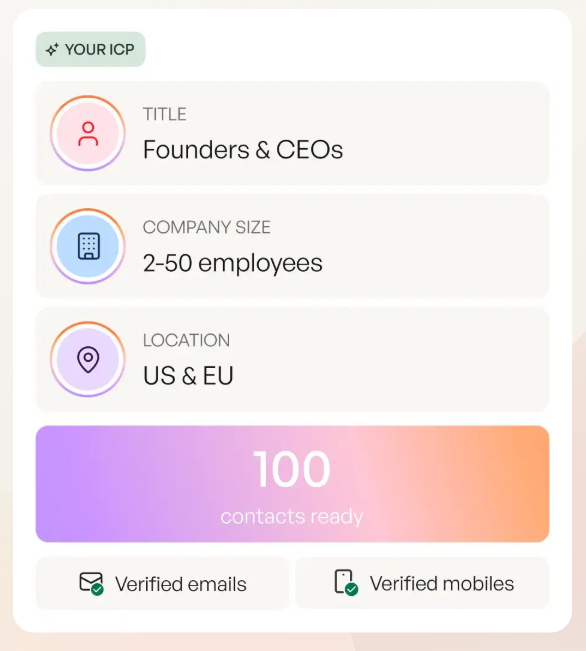
Say you've identified VP-level marketing leaders at SaaS companies with 50-200 employees as your ideal segment. You've validated it. You've sized the market. Now you need verified contact info - and that's where the research stalls for most teams.
Prospeo bridges that gap. With 300M+ professional profiles and 30+ search filters - job title, company size, industry, technographics, buyer intent - you can turn your market definition into a verified contact list in minutes. 98% email accuracy, verified mobile numbers, and a 7-day data refresh cycle mean you're reaching real people, not stale records. The free tier gives you 75 verified emails per month to start testing. Once you have the list, pair it with proven sales prospecting techniques and a tight set of sales follow-up templates to turn research into meetings.
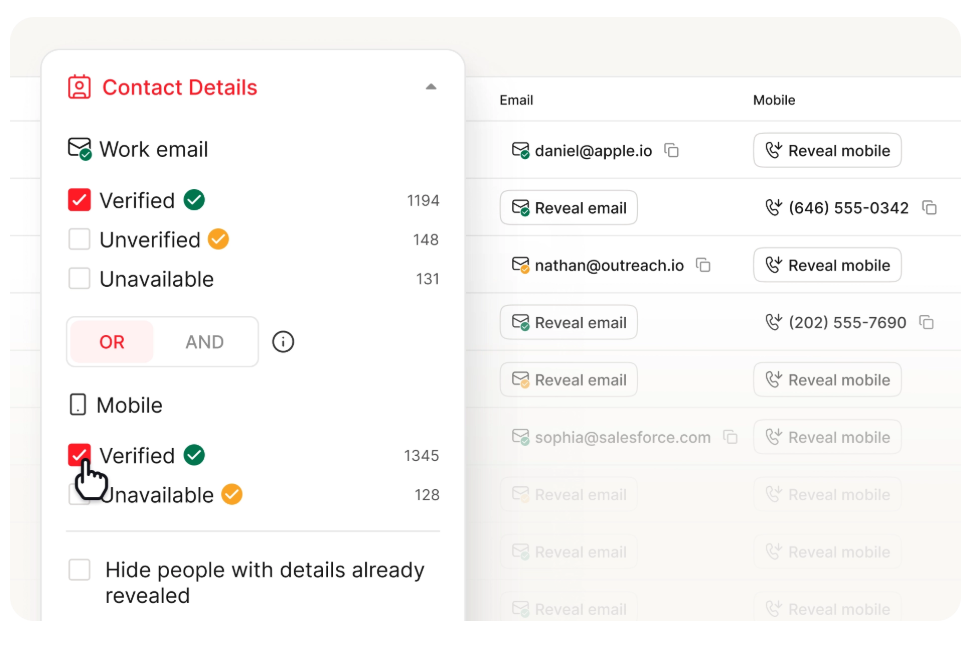
Intent data turns target market research from theory into pipeline. Prospeo tracks 15,000 Bombora topics layered on top of firmographic and technographic filters - so you reach companies actively researching your category, not just companies that fit a profile.
Stop guessing who's in-market. Start with companies already searching for what you sell.
FAQ
What's the difference between a target market and a target audience?
A target market is the broad group of consumers your product serves - like "mid-market SaaS companies." A target audience is the narrower subset you aim a specific campaign at, such as "marketing directors at those companies evaluating CRM tools." Target market is the ocean, target audience is the fishing spot.
How often should I update my target market?
Review every 6-12 months at minimum. Re-evaluate sooner if you launch a new product, enter a new geography, or see conversion rates decline for two or more consecutive quarters. Markets shift faster than most teams update their targeting.
What if I don't have any customers yet?
Start with the problem you solve, not existing buyers. Find communities discussing that problem - Reddit, industry forums, niche Facebook groups - and interview 10-15 people. Build profiles from real conversations, not assumptions. Pre-revenue doesn't mean pre-research.
How do I turn a defined target market into an actual prospect list?
Use a B2B database with firmographic and intent filters to match your ICP criteria. Filter by job title, company size, industry, tech stack, and buyer intent, then export verified emails and direct dials. A free-tier tool can give you enough contacts to validate your first outreach campaigns before you commit to a paid plan.
How do I know if my target market is too broad?
If you can't describe your ideal customer's specific problem, job title, and buying trigger in one sentence, it's too broad. The Kellogg "Everyone Target" mistake is the most common cause - teams fear excluding potential buyers and end up resonating with nobody. Narrower almost always outperforms broader. You can expand once you've dominated a niche.