

How to Follow Up With a Potential Client Without Being Annoying
You sent the proposal three days ago. Radio silence. You're hovering over the "just checking in" button, knowing it won't work but not sure what else to do.
The best reply rate on a cold email is 8.4% - and that's on the first message. Every follow-up after that performs worse. Meanwhile, 40% of people have 50+ unread emails sitting in their inbox right now. Your message isn't being ignored - it's being buried.
The fix isn't sending more emails. It's sending better ones, at the right time, across the right channels.
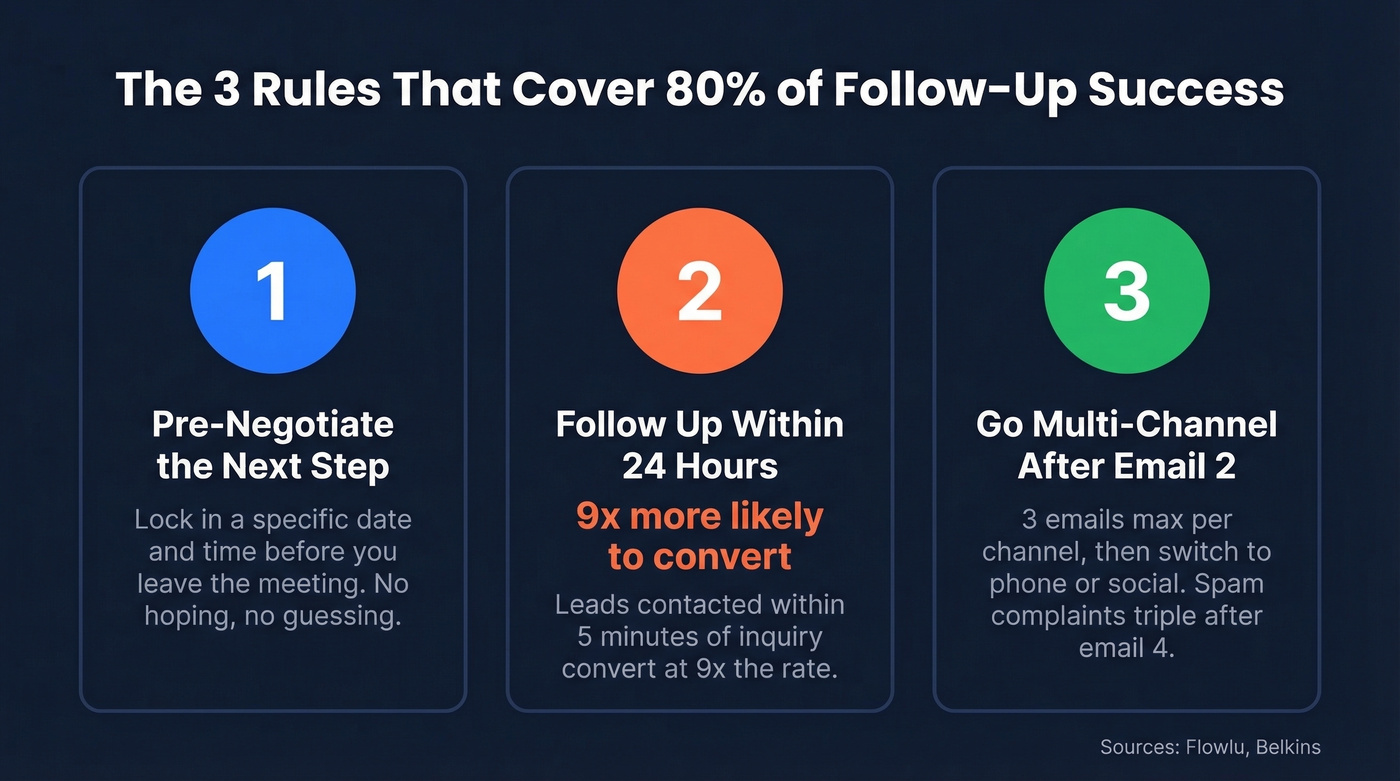
The Three Rules That Cover 80% of Follow-Up Success
- Pre-negotiate the next step before you leave the meeting or end the call. Don't hope they'll respond - lock in a date.
- Follow up within 24 hours. Leads are 9x more likely to convert when contacted within 5 minutes of an inquiry. Even next-day beats next-week by a wide margin.
- Go multi-channel after email two. Three emails max per channel, not twelve. After that, switch to phone or social.
The Follow-Up Framework That Actually Works
Set the Next Step Before You Leave
The single highest-leverage move in follow-up isn't the email - it's what you do before the email exists. At the end of every meeting, propose a specific date and time for the next conversation: "Can we aim to speak Thursday the 15th, once you've had a chance to review the proposal?"
Amy Sklar put it well: "If there's hesitation to scheduling a follow-up on the spot, something isn't quite aligned and you need to go back a step."
That hesitation is diagnostic. If they won't commit to a 15-minute call next Tuesday, you haven't sold them yet. Address that now, not in a follow-up email they'll ignore.
Nail the Timing
Your first follow-up should land within 5-23 hours of the initial contact. Not three days later. For phone outreach specifically, calling within one hour of an inquiry produces a 450% higher response rate.
Best days: Tuesday and Thursday. Best windows: 8-10 AM and 4-5 PM local time. Worst time: 1-2 PM any day - people are in post-lunch mode and your email gets scrolled past.
Research from Outreach and McKinsey puts the sweet spot at 8-12 touchpoints spread across 17-21 days. That's the window where systematic follow-up drives a 10-20% improvement in pipeline. Fewer touches leave money on the table, more touches trigger fatigue. Space your early messages 1-2 days apart, then expand to 3-4 days as the sequence progresses.
If you want a tighter, data-backed schedule, use a proven follow-up cadence instead of guessing.
How to Follow Up Across Multiple Channels
Here's the thing: sending a fourth email to someone who ignored the first three isn't persistence. It's spam. Belkins' data across 16.5M cold emails and 93 business domains shows that once you push into the 4th follow-up, unsubscribe and spam complaint rates more than triple.
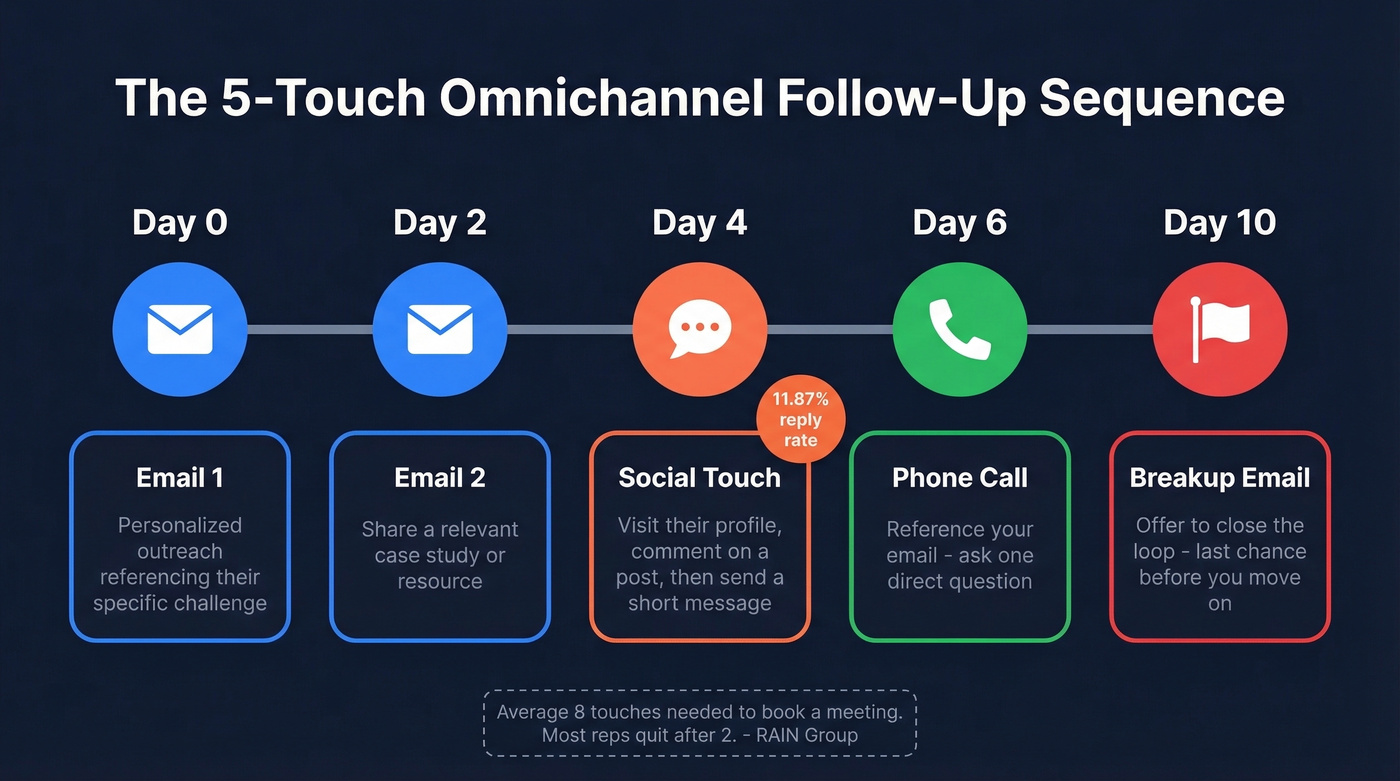
There's a distinction worth understanding here. Multichannel means using multiple channels in silos. Omnichannel means coordinating them - a social reply pauses your email sequence, a phone call references the resource you emailed. Coordinated omnichannel outreach converts up to 250% better than single-channel approaches, and companies with strong omnichannel strategies retain 89% of customers versus 33% for those without.
If you're building this into a repeatable system, start with an omnichannel outreach playbook and adapt it to your deal size.
| Touch | Channel | Timing | What to Say |
|---|---|---|---|
| 1 | Day 0 | Personalized outreach referencing their specific challenge | |
| 2 | Day 2 | Share a relevant case study or resource | |
| 3 | Social | Day 4 | Visit their profile, comment on a post, then send a short message |
| 4 | Phone | Day 6 | Reference your email - ask one direct question |
| 5 | Day 10 | Breakup email offering to close the loop |
A social message paired with a profile visit pulls an 11.87% reply rate. That's higher than any email follow-up after the first send. RAIN Group's research confirms the broader point: it takes an average of 8 touches to get a meeting with a new prospect. Most reps quit after 2.
To make those touches consistent, borrow a few sales cadence templates and customize the language to your ICP.
Our take: If your average deal is under $5K, you probably don't need a 12-touch sequence. Three emails and a phone call will tell you everything you need to know. Save the elaborate cadences for enterprise deals where the payoff justifies the effort.

Multi-channel follow-up only works when you have the right contact data. Prospeo gives you 98% accurate emails and 125M+ verified mobile numbers - so your Day 6 phone call actually reaches a real person. At $0.01 per email, bad data stops killing your sequences.
Stop following up into the void. Start with contacts that connect.
Three Follow-Up Sequences for Prospective Clients
After a Meeting (No Proposal Yet)
Same day: Send a recap within 2 hours. Summarize what you discussed, confirm the next step you agreed on, attach anything you promised. Personalized subject lines generate 22.2% higher open rates than generic ones, so reference something specific from the conversation.
If you need copy you can send today, use these follow up email after a meeting templates.
Day 2: Share a relevant resource tied to their specific pain point - a case study, a benchmark, an article. Every subsequent interaction should add value, not just ask for attention.
Day 4: Ask a direct question tied to their timeline. "You mentioned Q1 budget planning - does it make sense to get the proposal over this week so it's ready for that conversation?"
After Sending a Proposal
This is where most reps lose deals by waiting passively. Don't.
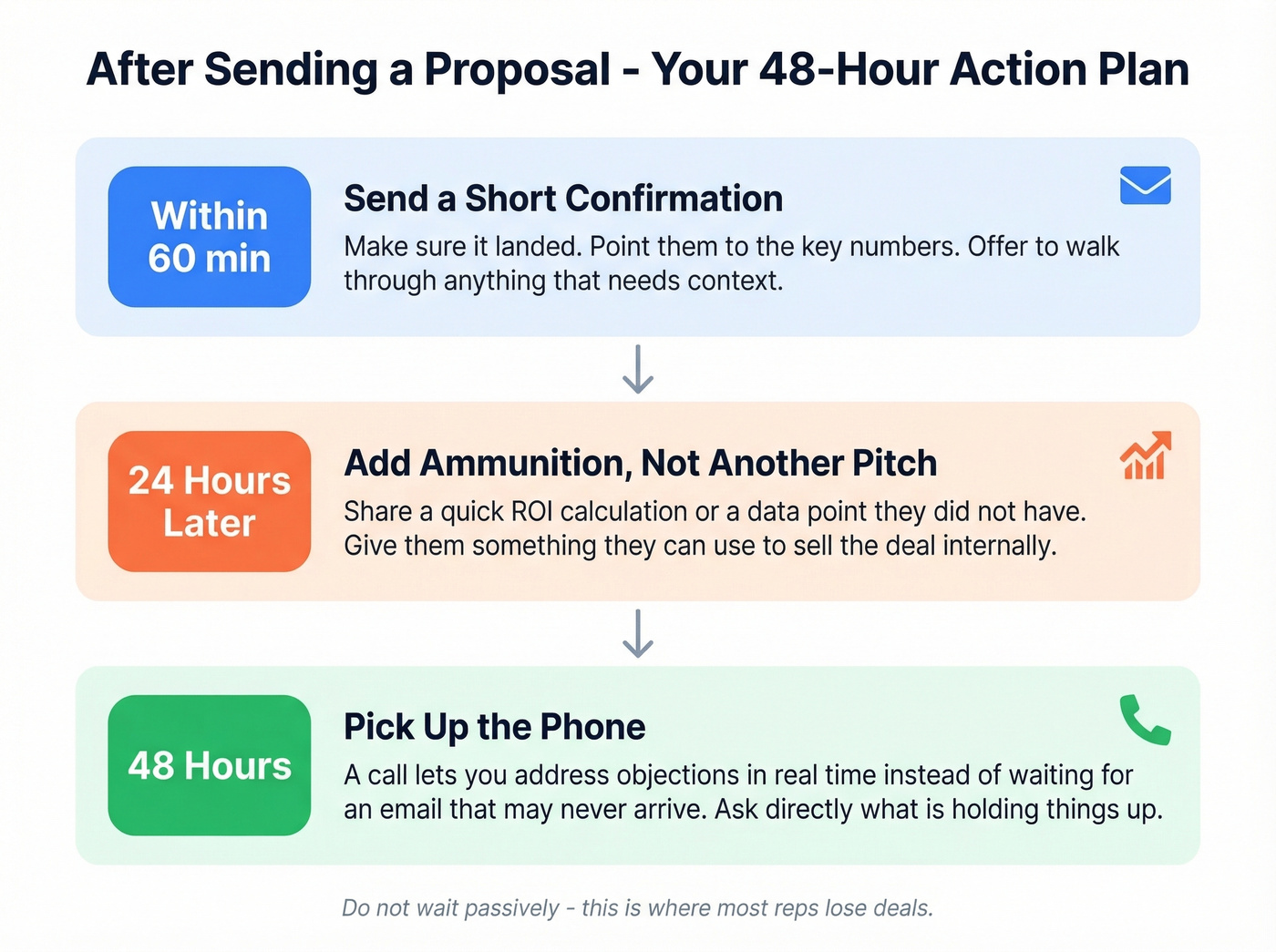
Within 60 minutes, send a short confirmation: "Just sent the proposal - wanted to make sure it landed. The key numbers are on page 2. Happy to walk through anything that needs context." Twenty-four hours later, share a value-add that reinforces the proposal - a quick ROI calculation or a data point they didn't have. Don't re-pitch. Add ammunition they can use internally to sell the deal up the chain. At the 48-hour mark, pick up the phone. A call lets you address objections in real time instead of waiting for an email that may never arrive.
If you're still not getting replies, switch to a structured follow up email sequence strategy rather than ad-hoc nudges.
Re-Engaging a Cold Prospect
When someone's gone dark for 2+ weeks, shift your framing entirely. Don't pretend the conversation is still warm.
Day 1 - "Is [project/initiative] still a priority for Q2, or has the timeline shifted?" Plain text. No HTML. No images. It should look like a real email from a real person.
If you're dealing with total silence, this guide on how to get a client to respond is a good next step.
Day 4 - Share something new: a market shift, a competitor move, fresh data. Give them a reason to re-engage that isn't about you.
Day 7 - The breakup email. "I don't want to keep filling your inbox if the timing isn't right. If this comes back around, I'm here." Breakup emails often pull surprisingly high reply rates - people respond when they feel the pressure of losing access. We've seen this pattern across dozens of outbound campaigns, and the consensus on r/sales backs it up: the breakup email is frequently the one that gets the reply.
Five Mistakes That Kill Deals
- "Just bumping this" without new information. If your follow-up doesn't add value, it's noise. Full stop.
- Sending 4+ emails to the same channel. Triples spam complaints. After three, switch channels or stop.
- Not addressing the real objection. There are really only five objections: no need, not worth the cost, no urgency, don't want it, or don't trust you. Name it and address it directly.
- Over-designed HTML emails. Plain text outperforms templates for follow-ups. Your message should look like it came from a colleague, not a marketing department.
- Following up at 1-2 PM or Friday afternoon. Dead zones. Tuesday and Thursday mornings between 8-10 AM are your strongest slot.
For more benchmarks and what’s normal by channel, keep a running sheet of sales statistics as you iterate.
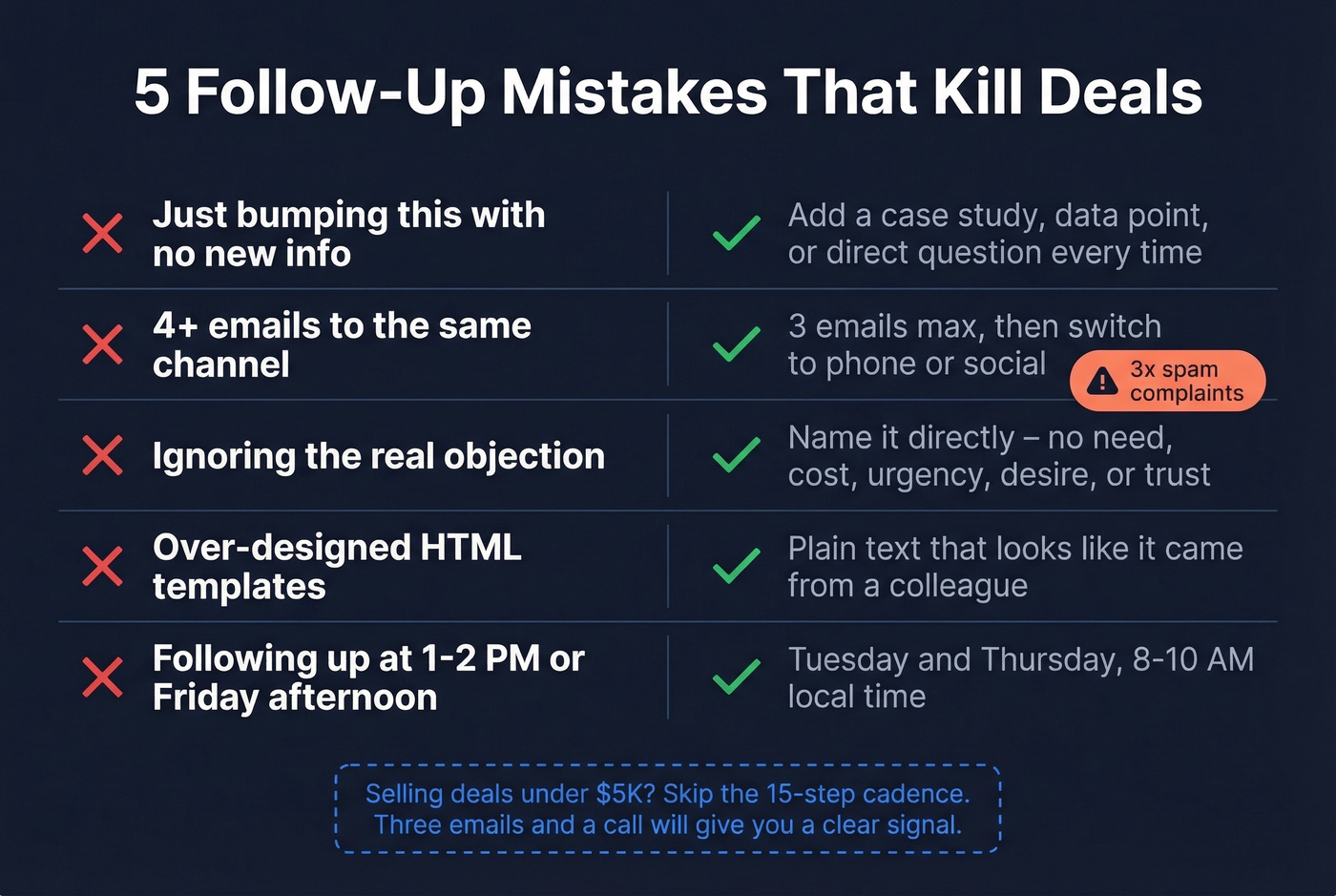
Skip the elaborate 15-step cadence if you're selling deals under $5K. For teams running high-volume outbound, three emails and a call per prospect will give you a clear signal without burning your list.
Verify Your Data Before You Follow Up
None of this matters if you're emailing the wrong address. A bounced follow-up doesn't just waste your effort - it damages your domain reputation and pushes future emails to spam. We've watched teams build a perfect 5-touch sequence only to torch their sender score because 15% of their list was stale.
If deliverability is slipping, run a quick domain reputation check before you scale volume.
Prospeo runs a 5-step verification process that includes catch-all handling, spam-trap removal, and honeypot filtering, hitting 98% email accuracy. The free tier gives you 75 emails per month, and paid plans run roughly $0.01 per lead. Clean your list before you start the sequence - knowing how to follow up with a potential client means nothing if the message never arrives.
If you want the deeper mechanics behind that, here’s a full breakdown of customer email verification.
Re-engaging cold prospects means nothing if your emails bounce or your phone numbers are dead. Prospeo refreshes every record on a 7-day cycle - so even contacts from months ago still connect. Teams using Prospeo book 35% more meetings than Apollo users.
Every follow-up deserves a real inbox and a real phone number.
FAQ
How many follow-up emails should I send?
Three max per channel before switching to phone or social. Spam complaints triple after the 4th email in a thread. A 5-touch sequence across email, social, and phone outperforms 5 emails to the same inbox every time.
When should I send my first follow-up?
Within 5-23 hours of initial contact, ideally Tuesday or Thursday morning between 8-10 AM local time. Leads contacted within the first hour are 450% more likely to respond - even next-day follow-up dramatically outperforms waiting a week.
How do I follow up without sounding pushy?
Add new value in every message - a relevant case study, a data point, or a direct question tied to their timeline. Never send "just checking in" alone. If you're referencing something specific to their business, the message reads as helpful rather than needy.
What tools help me follow up with prospective clients?
A sequencing tool like HubSpot, Instantly, or Lemlist handles timing and multi-channel coordination. For contact accuracy, Prospeo verifies emails at 98% accuracy and refreshes data every 7 days - critical since bounced follow-ups damage your sender reputation. Pair verified data with a CRM to track every touchpoint.