

How to Get Responses From Cold Emails
You sent 50 cold emails last week and got zero replies. Not even a "not interested." Just silence.
Your copy probably isn't the problem - your infrastructure and data are. Across 16.5 million cold emails analyzed by Belkins in 2024, the average reply rate was 5.8%, down from 6.8% the year before. Inboxes are flooded with AI-generated outreach, filters are more aggressive, and recipients are more skeptical than ever. If you're wondering how to get responses from cold emails, the answer starts well before you write a single word.
Here's the fix, in order:
- Fix your deliverability first - SPF/DKIM/DMARC, domain warming, verified emails.
- Target trigger events - send within 48 hours of a new hire, funding round, or job posting.
- Write under 60 words with a single soft CTA.
Most guides start at step 3. That's why you're still getting silence.
Fix Your Deliverability First
One practitioner on r/Entrepreneur rebuilt their entire sending infrastructure - scaling from 3 domains to 7, capping each at 26 sends/day, and manually verifying every contact. Their bounce rate dropped from 11% to under 2%. Reply rate improved from 3% to 6%. The copy barely changed.
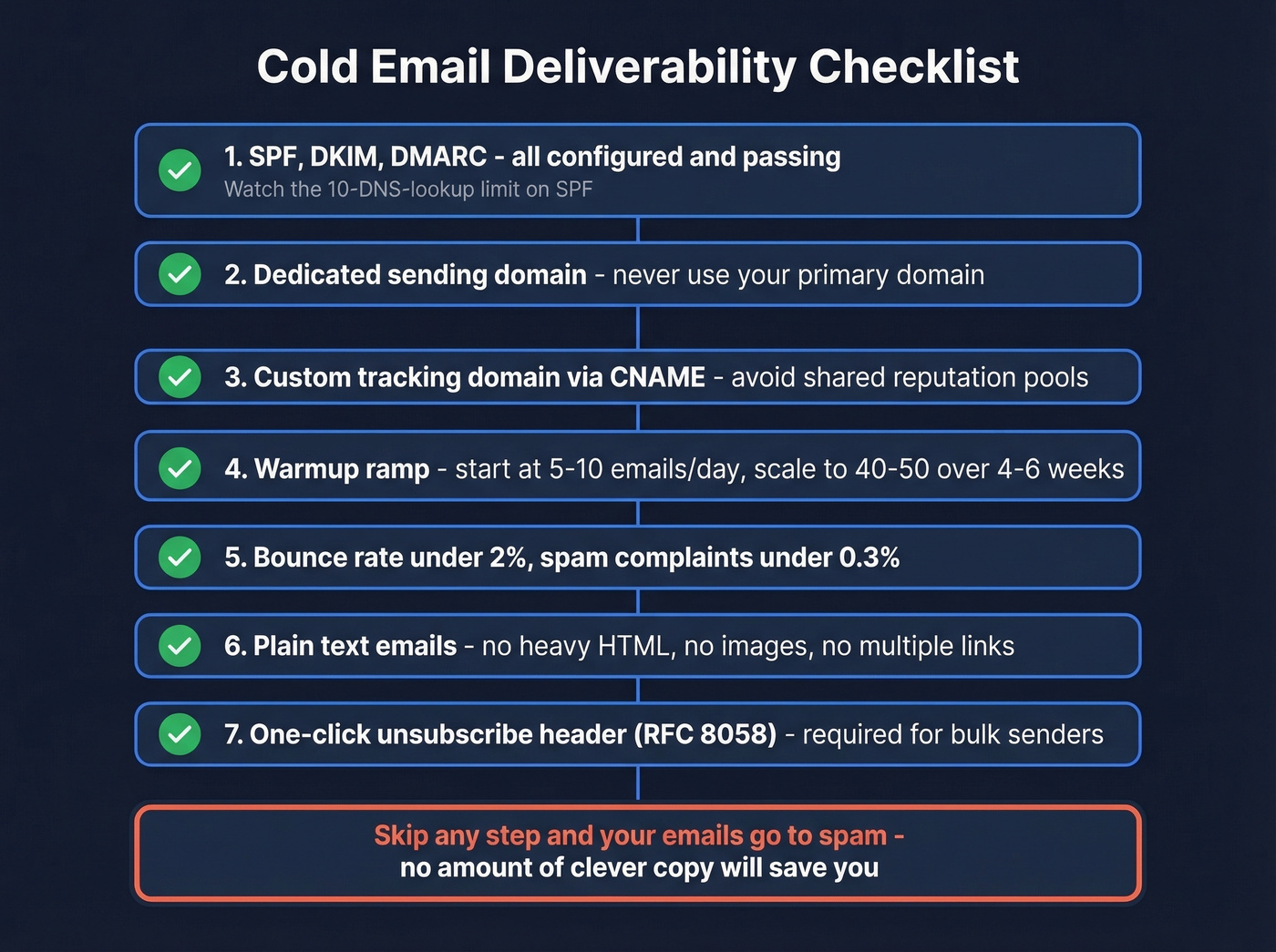
That story captures the whole problem. Microsoft started enforcing SPF/DKIM/DMARC for bulk senders in May 2025. If your authentication isn't locked down, your emails never reach the inbox - and no amount of clever writing will help.
The non-negotiable checklist:
- SPF, DKIM, DMARC configured and passing. Start DMARC at
p=none, move top=quarantine, thenp=reject. Watch the 10-DNS-lookup limit on SPF - exceeding it silently breaks authentication. - Dedicated sending domain - never cold email from your primary domain.
- Custom tracking domain via CNAME. Shared tracking domains pool your sender reputation with strangers. (If you’re setting this up, see what a tracking domain actually is.)
- Warmup ramp from 5-10 emails/day to 40-50/day over 4-6 weeks. (More on safe sending limits in email velocity.)
- Bounce rate under 2%, spam complaints under 0.3%. (Benchmarks + fixes: email bounce rate.)
- Plain text emails - no heavy HTML, no images, no multiple links.
- One-click unsubscribe header (RFC 8058) - required by bulk-sender rules.
Before you send a single email, verify your list. Prospeo's 5-step verification - catch-all handling, spam-trap removal, honeypot filtering - catches bad addresses at 98% accuracy with a 7-day refresh cycle. The free tier gives you 75 verified emails to test whether your list is the bottleneck. (If you need a broader framework, use this email deliverability guide.)

Target Fewer, Better Prospects
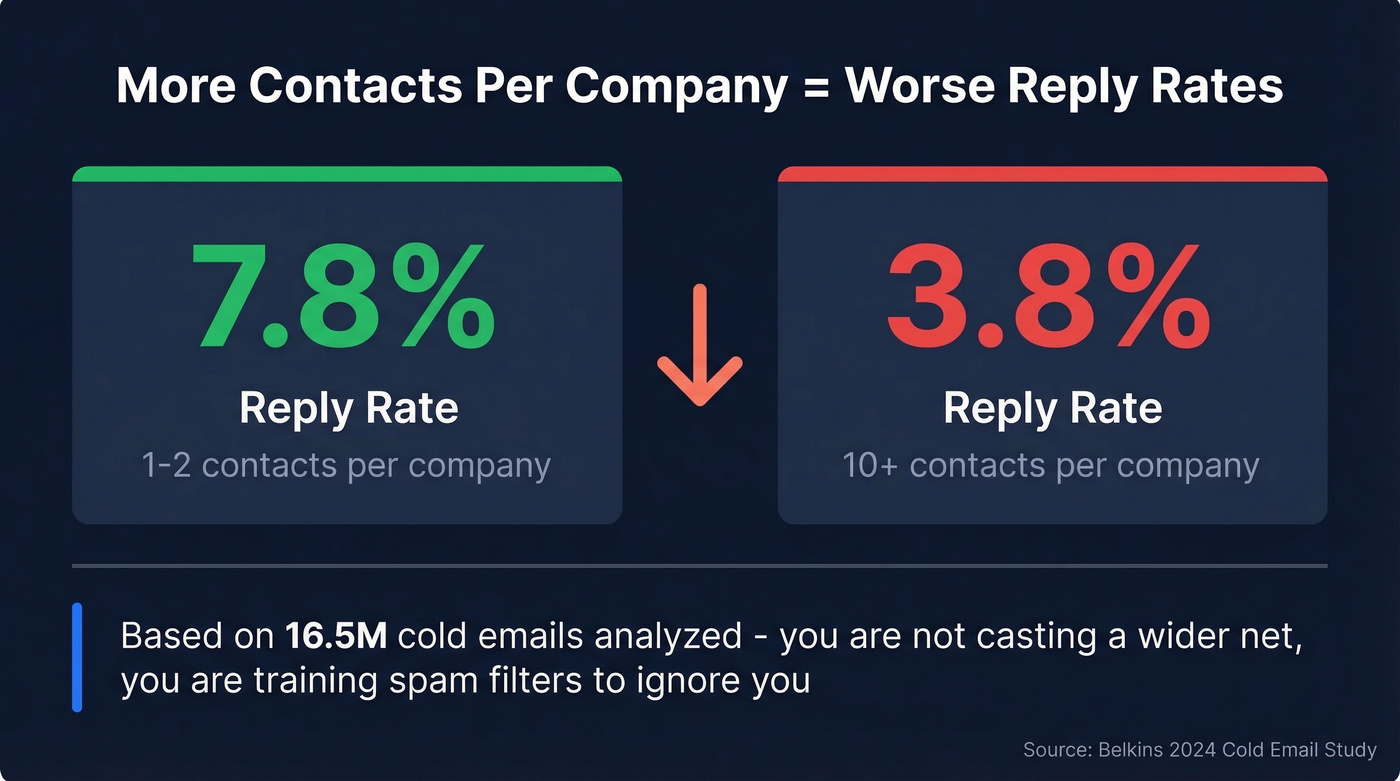
Volume is the enemy. The same 16.5M-email dataset shows that emailing 1-2 contacts per company produced a 7.8% reply rate. Emailing 10+ contacts at the same company? 3.8%. You're not casting a wider net - you're training spam filters to ignore you. (If you’re rebuilding your outbound motion, start with these sales prospecting techniques.)
One Reddit poster sent 147,000 cold emails in a year and got a 1.2% positive reply rate. Their takeaway was blunt: even with solid copy and inbox placement, they were "interrupting people" with zero intent.
The highest-leverage tactic we've seen is trigger-based targeting. Another practitioner tested 908 emails and booked 112 meetings - they attribute the lift to sending within 48 hours of a trigger event like a new hire, funding round, or job posting. Same email without a trigger? "Garbage results." The timing did the work, not the personalization tokens. Their total stack cost was ~$420/month, generating 16 qualified leads at roughly $26 per lead. This is the single fastest way to boost cold email response rates without changing a word of your copy. (To operationalize this, use a system for how to track sales triggers.)
Here's the thing: if you're spending hours perfecting email copy but sending to a stale list with no trigger, you're optimizing the wrong variable by an order of magnitude. A mediocre email sent to the right person at the right moment will outperform beautiful copy sent to a cold list every single time.
Write Emails Under 60 Words
The practitioner who improved their reply rate also cut email length from 141 words to under 56. Benchmark data supports the direction: shorter emails beat longer ones, and keeping it under 200 words is consistently safer than going long. In our testing, once you creep past ~100 words, response rates start sliding. (If you want a deeper framework, see email copywriting.)
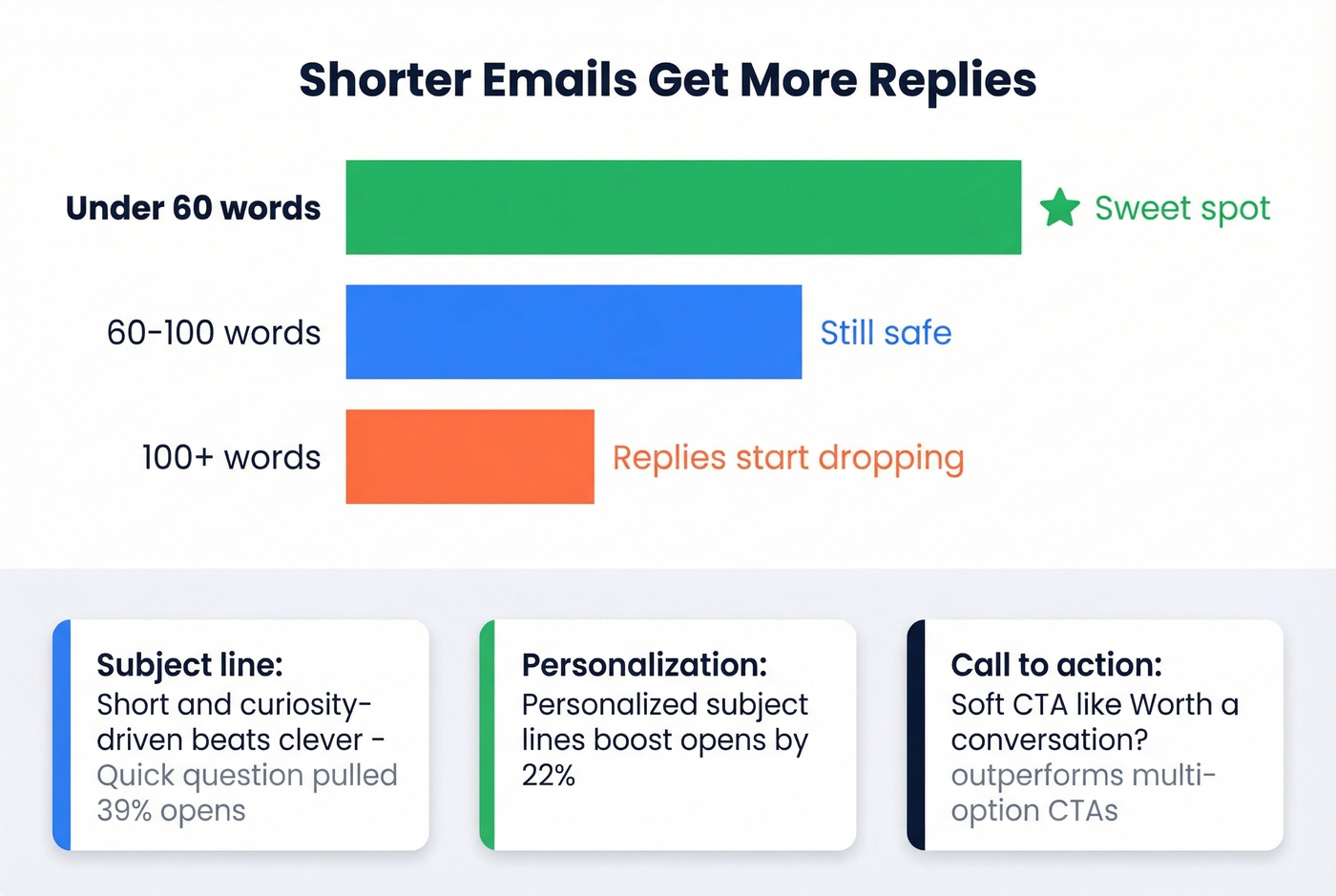
For subject lines, "Quick question" pulled 39% opens in one practitioner's test. Personalized subject lines boost opens by about 22% according to Woodpecker's cold email data. Don't overthink it - short and curiosity-driven beats clever. (If you need options, pull from these email subject line examples.)
An annotated example (~47 words) based on what's working in 2026:
Subject: Quick question
Hi Sarah,
Saw you just hired three SDRs - congrats. When teams scale outbound that fast, reply rates usually drop before they stabilize.
We helped [similar company] fix that in two weeks with a deliverability audit.
Worth a conversation?
Line 1 is a trigger-based opener (hiring signal) that proves you didn't batch-send this. Line 2 connects the trigger to a real problem. Line 3 is a specific offer with proof, not a generic pitch. The soft CTA - "Worth a conversation?" - outperforms multi-option CTAs.
With 5 trigger templates pre-built, each email takes under 3 minutes to personalize. Spend your energy finding the right trigger and crafting a specific, low-friction offer. The consensus on r/copywriting is clear: 40-60 words, a strong offer, and a soft close. That structure separates consistent replies from occasional lucky hits.

Bad data is the #1 reason cold emails get zero replies. Prospeo's 5-step verification catches spam traps, honeypots, and catch-all domains - delivering 98% email accuracy on a 7-day refresh cycle. Teams using Prospeo cut bounce rates from 35% to under 4%.
Stop emailing dead addresses. Start getting replies.
Follow Up Once or Twice, Then Stop
The first follow-up adds 40-50% more replies. Send it 3 days after your initial email. (If you want plug-and-play copy, use these cold email follow-up templates.)
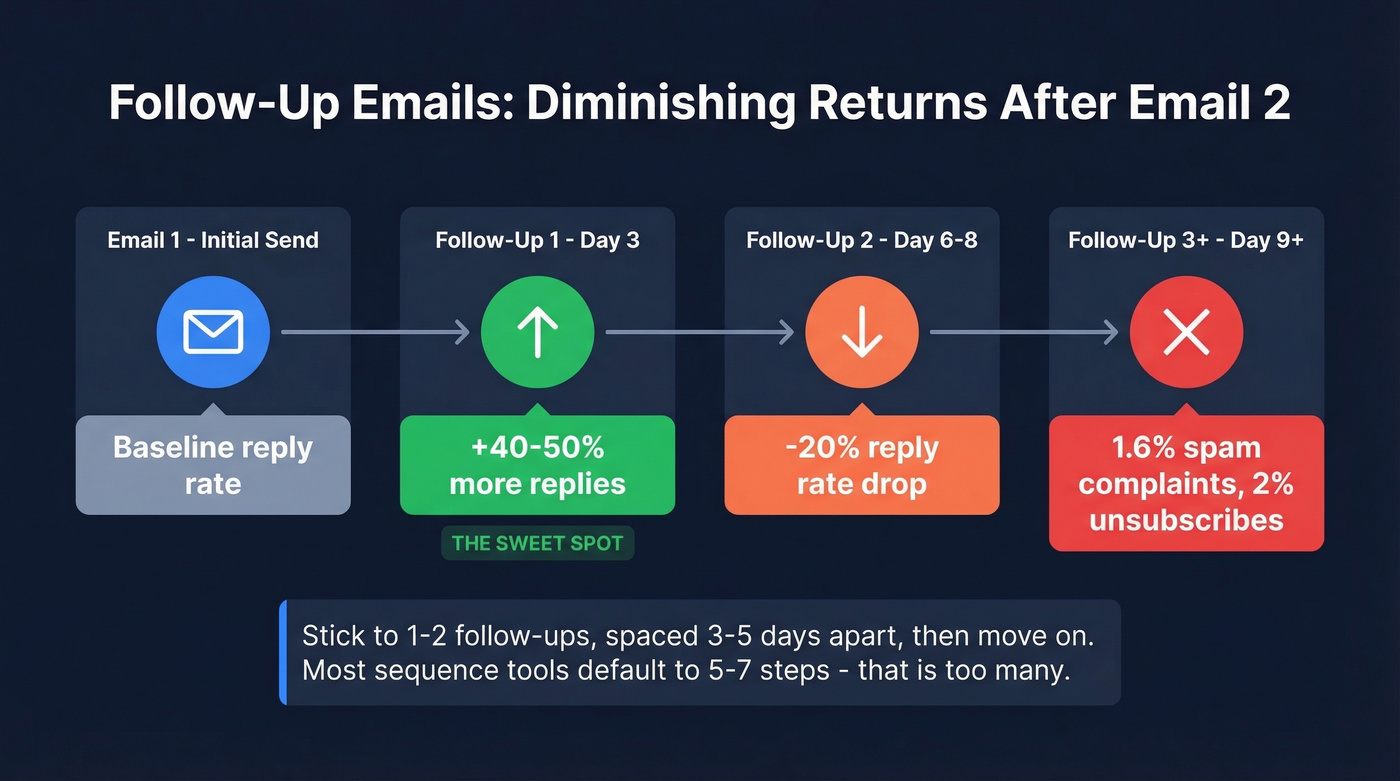
After that, returns collapse. A third email can drop reply rates by 20%. By the fourth follow-up, spam complaints hit 1.6% and unsubscribes reach 2%. Most sequence tools default to 5-7 steps - that's too many. Skip the long drip sequence. If someone didn't reply to two well-targeted, well-timed emails, a fifth one won't change their mind. It'll get you flagged.
Stick to 1-2 follow-ups, spaced 3-5 days apart, then move on.
When to Hit Send
Timing won't save a bad email, but it gives a good one an edge.
| Day | Reply Rate |
|---|---|
| Thursday | 6.87% |
| Tuesday | ~6.5% |
| Wednesday | ~6.3% |
| Monday | 5.29% |
The 8-11 PM window peaked at 6.52% replies - emails sent late land at the top of the inbox the next morning. Send Tuesday through Thursday, morning or late evening, in the recipient's timezone. (More data + a playbook: best time to send cold emails.)
Quick Diagnostic: Zero Replies?
Run through this in 30 seconds:
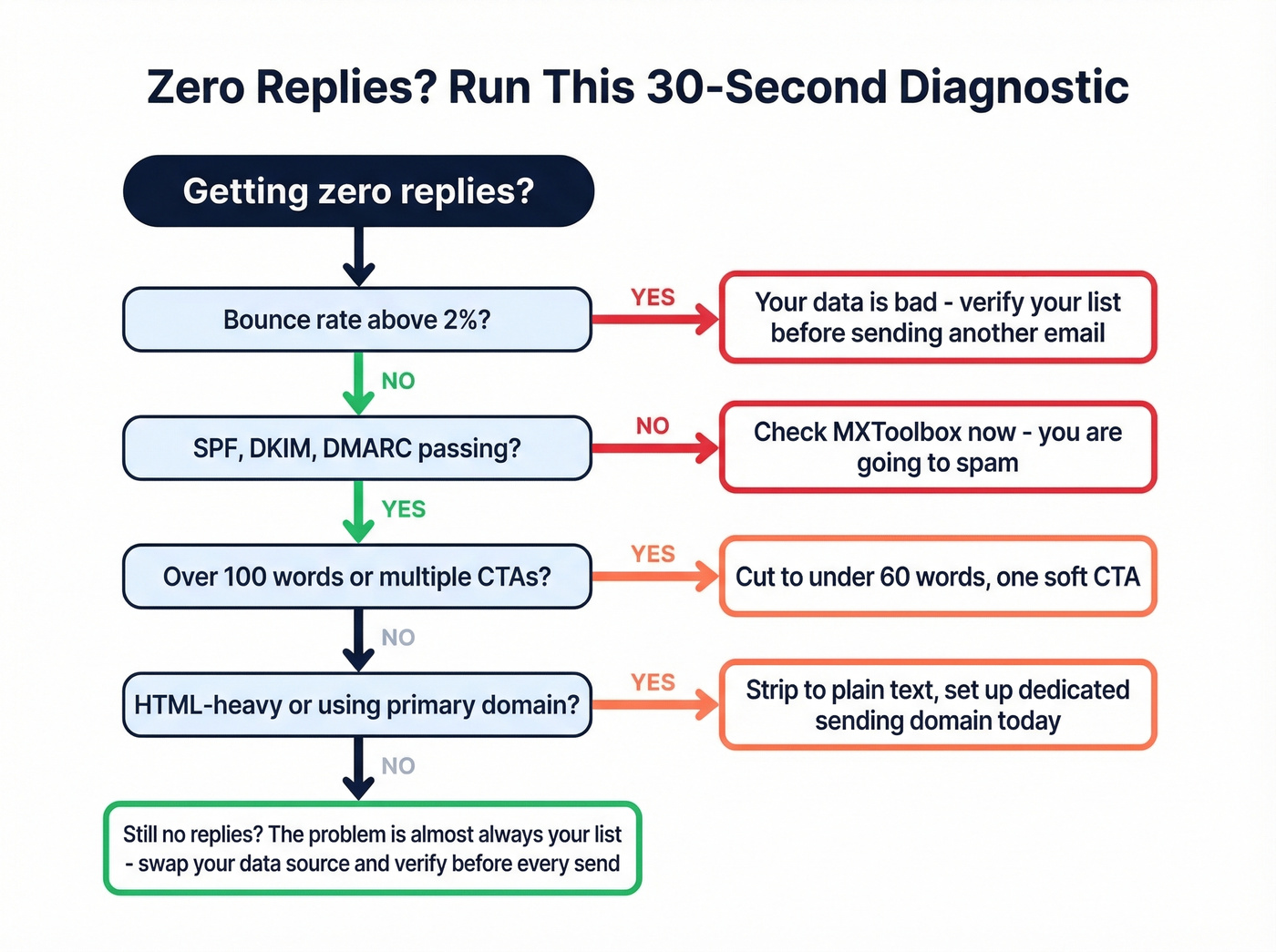
- Bounce rate above 2%? Your data is bad. Verify your list before sending another email.
- SPF/DKIM/DMARC passing? Check with MXToolbox. If any are failing, you're going to spam.
- More I's than you's? Rewrite it.
- Over 100 words? Cut ruthlessly.
- Multiple CTAs? Pick one. Make it low-friction.
- HTML-heavy? Strip it to plain text.
- Sending from your primary domain? Stop. Set up a dedicated sending domain today.
If you've checked every box and still aren't getting responses from cold emails, the problem is almost always your list - either bad data or wrong prospects. We've seen teams go from 1% to 8% reply rates just by swapping their data source and verifying before every send. (If you’re pressure-testing sources, compare options in best email list providers.)
Trigger-based targeting only works if you can find verified contact data fast. Prospeo tracks job changes, hiring surges, and funding rounds across 300M+ profiles - so you reach the right person within 48 hours of the signal, not weeks later with stale data.
Find trigger-ready prospects with emails that actually land.
FAQ
What's a good cold email reply rate in 2026?
5-10% is solid for B2B outbound. Above 15% is best-in-class, typically from trigger-based campaigns targeting job changes or funding events. The 2024 benchmark across 16.5M emails was 5.8%.
How many follow-ups should I send?
One or two, spaced 3-5 days apart. The first follow-up adds 40-50% more replies. Beyond that, spam complaints spike past 1.6% and returns collapse - more emails actively hurt your sender reputation.
How do I know if my cold emails are landing in spam?
Check your bounce rate (it should be under 2%) and verify SPF, DKIM, and DMARC are passing via MXToolbox. Run your list through email verification before every send. If your bounce rate is clean and authentication passes but you're still getting silence, try a seed test with a tool like GlockApps to see exactly where you're landing.
Does timing actually affect cold email response rates?
Thursday emails pull the highest reply rates at 6.87%, followed by Tuesday and Wednesday. The 8-11 PM send window peaks at 6.52% - late sends land at inbox-top the next morning. Always send in the recipient's local timezone.