

How to Give a Sales Pitch That Actually Closes Deals
84% of reps missed quota last year. Meanwhile, 79% of buyers say most sales presentations are ineffective. That's not a coaching gap - it's a preparation gap. Most pitches die before the first slide because the rep didn't research the buyer, didn't verify the contact data, and opened with a monologue instead of a question.
Here's the thing: 71% of prospects prefer independent research, so by the time they take your call, they already know your product. Your job isn't to introduce. It's to confirm, reframe, and close. Structure every pitch as Problem, Value, Proof, CTA. Ask more questions than you make statements. And fix your prospect data before you write a single word - 73% of B2B buyers actively avoid sellers who send irrelevant outreach.
Step Zero: Fix Your Data First
96% of prospects research your company before they'll talk to you. They're prepared. You need to be too - and that starts with knowing you're reaching the right person at a working email address.
We've seen this pattern over and over. A team builds a polished pitch deck, writes killer copy, then sends it to a list with a 35% bounce rate. Snyk's sales team lived this exact nightmare - 35-40% bounces - until they cleaned up their prospect data with Prospeo and dropped under 5%. Their AE-sourced pipeline jumped 180%.
If you're not sure whether data quality is your bottleneck, test it before you blame the pitch. Prospeo's email finder verifies addresses in real time with 98% accuracy on a 7-day refresh cycle, and the free tier gives you 75 verified emails per month to run that experiment. (If you want to compare options, see our guide to B2B email finders.)

The 5-Step Sales Pitch Structure
Stop memorizing scripts. Start memorizing this sequence.
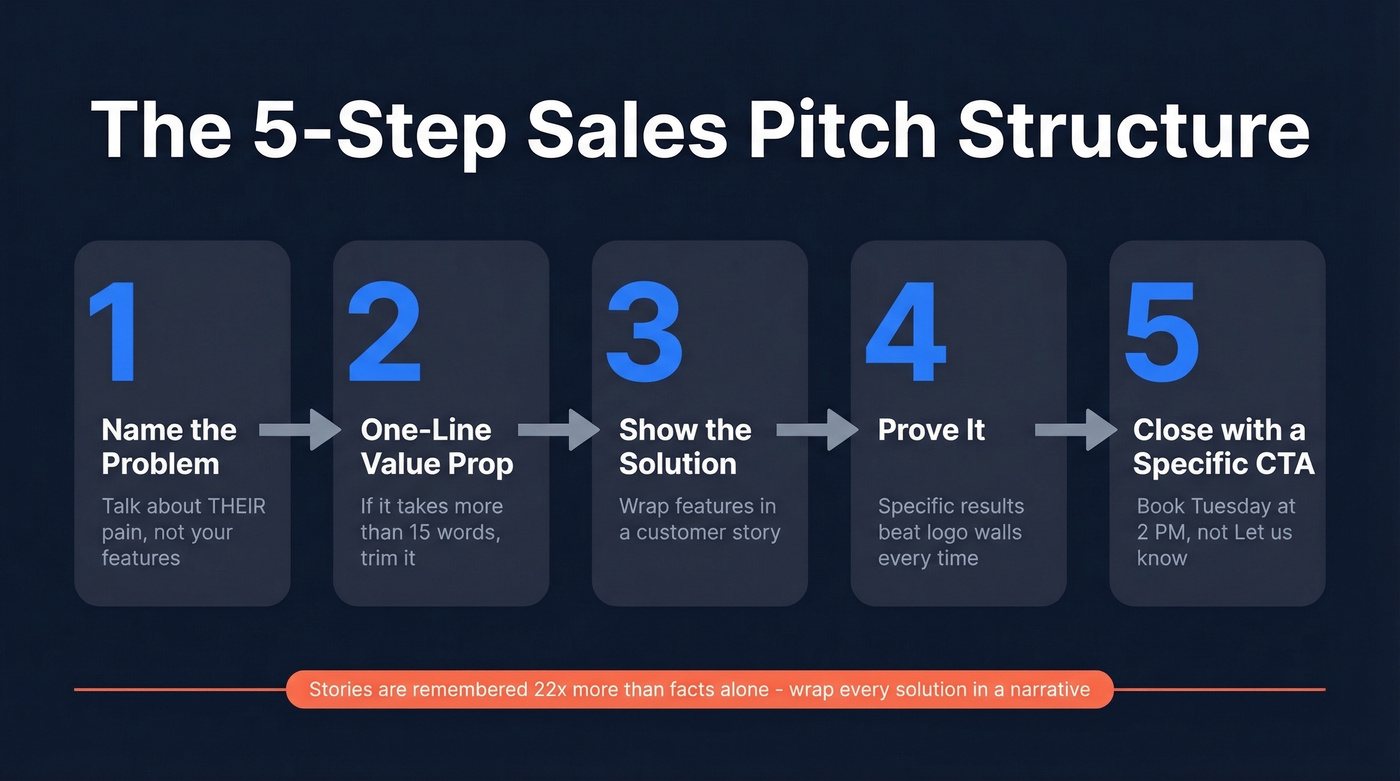
1. Name the problem. Not your product's features - the buyer's pain. "Your SDR team is spending 4 hours a day on manual research" hits harder than "We offer an AI-powered prospecting platform." One sentence about their world is worth ten about yours. (Need examples? Use these pain point examples to sharpen your opener.)
2. State your value prop in one sentence. If you can't explain the value in under 15 words, you don't understand it well enough. Trim until it hurts.
3. Show the solution. Now - and only now - talk about what you sell. Connect every feature back to the problem you named in step one. Stories are remembered up to 22 times more than facts alone, so wrap your solution in a customer narrative, not a feature list. "We helped GreyScout cut bounce rates from 38% to under 4% and grow pipeline 140%" beats a spec sheet every time. (If you want to tighten the walkthrough, borrow a sales demonstration example.)
4. Prove it with social proof. A specific result from a similar company beats a logo wall. "Company X cut their bounce rate from 38% to under 4% and grew pipeline 140%" is concrete. "Trusted by thousands of companies" is wallpaper.
5. Close with a specific CTA. "Let's book Tuesday at 2 PM to walk through a pilot" works. "Let us know what you think" doesn't. That's the difference between a deal that moves and one that stalls in someone's inbox forever. (For more options, see how to end a sales pitch.)
SPIN Selling: The Framework That Still Wins
Neil Rackham studied 35,000 sales calls over 12 years and found that top performers talked less and listened longer. SPIN Selling came out of that research, and it still outperforms script-based approaches in complex B2B sales. (Full breakdown here: SPIN Selling.)
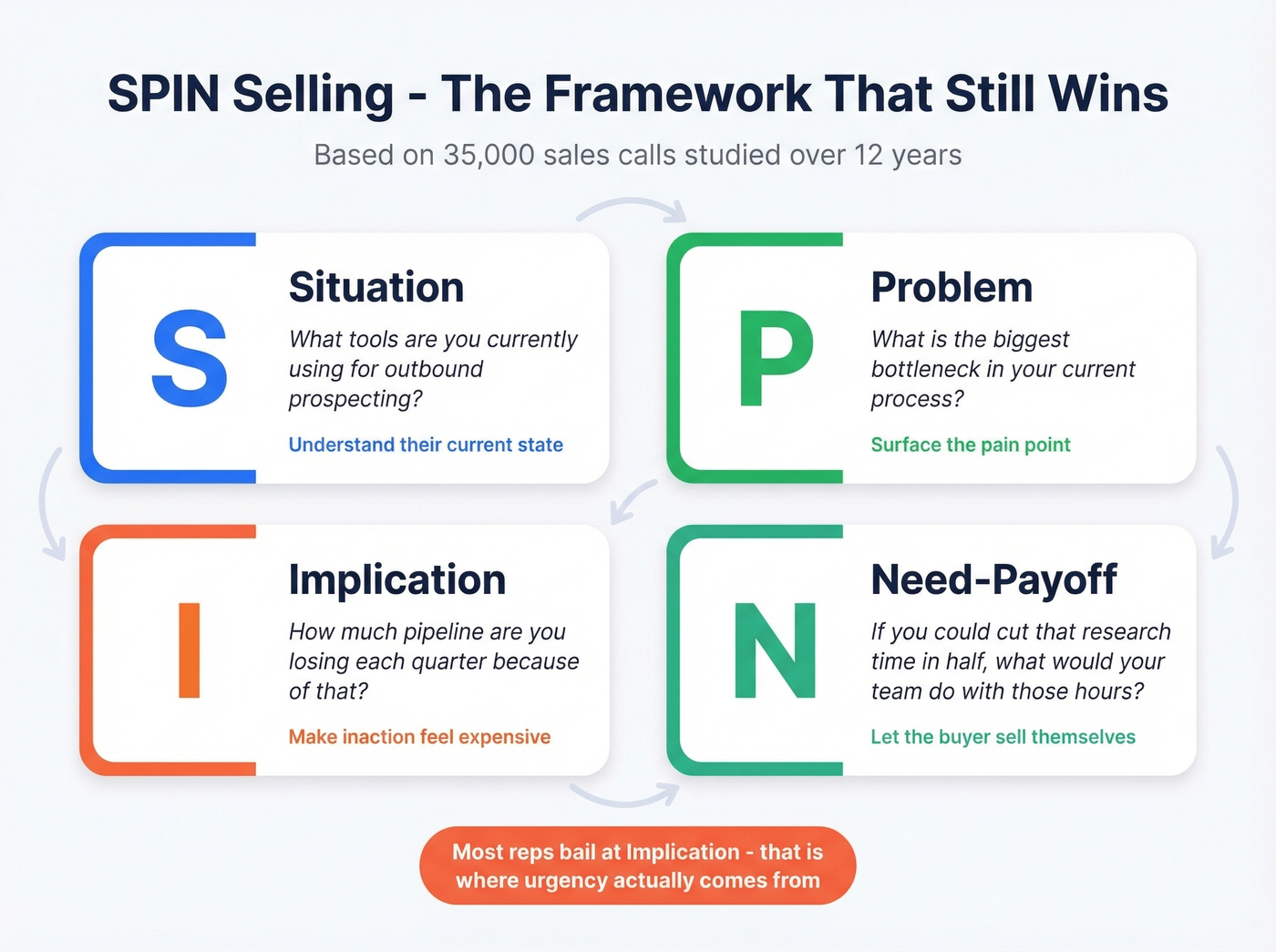
The four question types:
- Situation - "What tools are you currently using for outbound prospecting?"
- Problem - "What's the biggest bottleneck in your current process?"
- Implication - "How much pipeline are you losing each quarter because of that?"
- Need-Payoff - "If you could cut that research time in half, what would your team do with those hours?"
In our experience, the Implication stage is where most reps bail too early. They get uncomfortable with silence and jump straight to the demo. Don't. Let the buyer do the math on what inaction costs them - that's where urgency comes from, not fake countdown timers or "limited-time offers." Even 15 minutes of SPIN role-play before a call block trains you to sit in that discomfort instead of rushing past it. (If you want more prompts, use these open-ended questions for sales calls.)

The best sales pitch in the world fails when it hits a dead inbox. Snyk's 50 AEs dropped bounce rates from 35% to under 5% and grew AE-sourced pipeline 180% after switching to Prospeo's 98% accurate, 7-day-refreshed contact data. Fix your data before you fix your deck.
Start with 75 free verified emails and see the difference yourself.
How to Pitch by Channel
McKinsey's rule of thirds explains why multi-channel matters: at any buying stage, roughly a third of buyers prefer in-person, a third prefer remote, and a third prefer digital self-serve. And buyers spend only 17% of their buying time meeting suppliers, so every second of face time has to count.
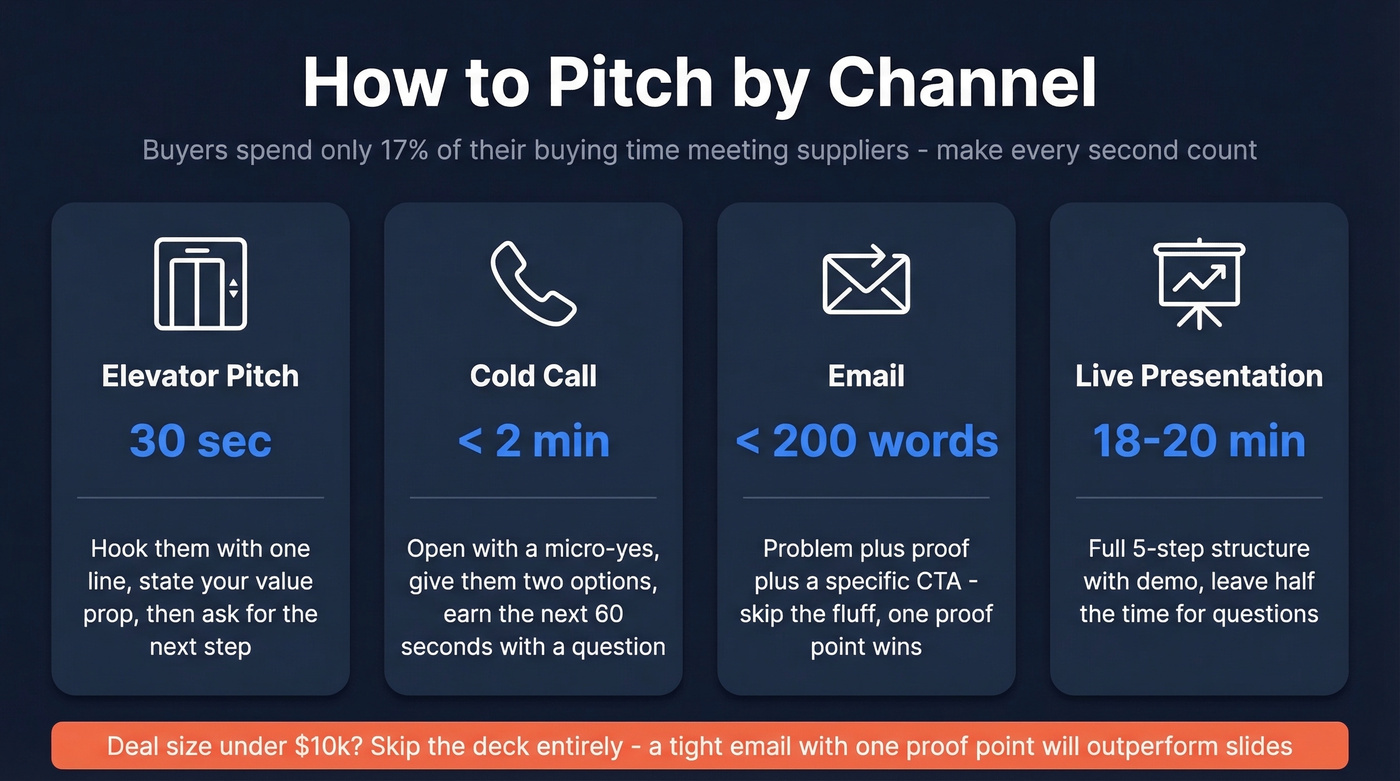
| Channel | Timing | Approach |
|---|---|---|
| Elevator | 30 sec | Hook + one-line value prop + ask |
| Cold call | Under 2 min | Micro-yes opener, then question |
| Under 200 words | Problem + proof + specific CTA | |
| Presentation | 18-20 min | Full 5-step structure with demo |
For cold calls, the "choose your own adventure" opener from Pipedrive's script library works well. Give the prospect two options early so they feel in control: "I can share how we helped [similar company] cut prospecting time by 60%, or I can ask a few questions about your current setup first - which sounds better?" That micro-yes keeps them on the line long enough to earn the next 60 seconds. (If you're building a full call flow, use these 10 steps to a sales call.)
Skip the 20-slide deck if your average deal size is under $10k. A tight email with one proof point and a specific CTA will outperform a presentation every time at that price point. The fastest way to improve close rates on smaller deals is to cut slides and add questions. (More ideas: sales prospecting techniques.)
Mistakes That Kill Pitches
Let's be honest - most pitch failures aren't about delivery. They're about preparation and framing.
Lead with the buyer's problem, not your process. The HBR beverage company case is the classic cautionary tale: they pitched manufacturing excellence while the retailer cared about high prices and low sales. The pitch was technically flawless and completely irrelevant.
Use data-backed proposals, not fake scarcity. Bryan Vasquez at LinkBuilder replaced urgency-based CTAs with tailored value maps and saw a 20% win-rate jump over two quarters. Real numbers beat manufactured pressure. (If you need a cleaner way to do this, use a sales proposal format.)
Listen for two minutes before pitching. If you're twenty minutes into a presentation before asking a single question, you've already lost. The best reps we've worked with spend the first third of any meeting asking and listening, then tailor the remaining time to what they heard.
Speed Wins - Follow Up or Lose
50% of deals go to the first vendor to respond. That stat alone should change how you prioritize your day.
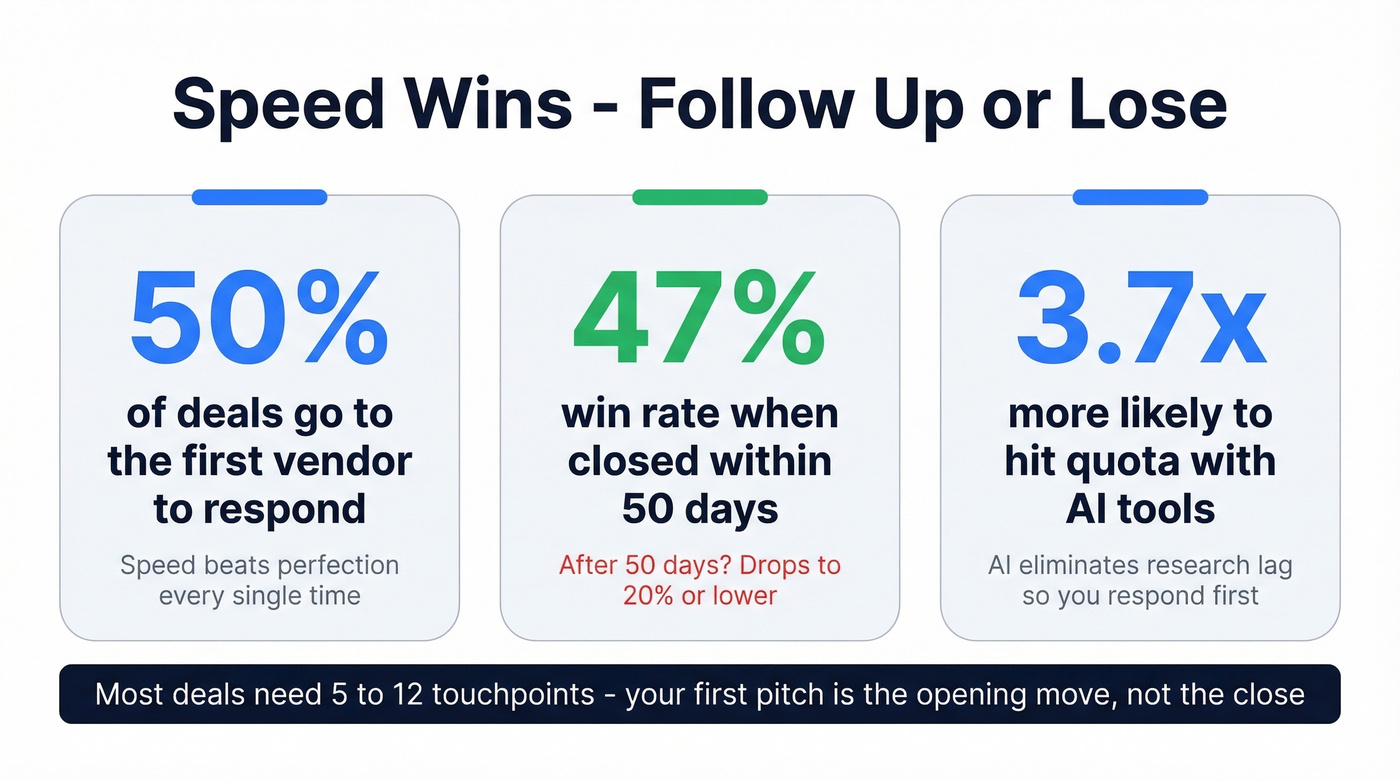
Opportunities closed within 50 days carry a 47% win rate; after that window, you're looking at 20% or lower. Most deals require 5-12 touchpoints, so your first pitch is the opening move, not the close. Sellers using AI tools are 3.7x more likely to meet quota - not because AI pitches better, but because it eliminates the research lag that kills speed. When you can verify a prospect's email, find their direct dial, and confirm their role in under a minute, you respond first. That matters more than having the perfect deck. (To improve the end-to-end motion, see how to shorten your sales cycle.)
You just learned the 5-step pitch structure - now make sure every pitch reaches the right decision-maker. Prospeo gives you 30+ filters to find buyers by intent, tech stack, and job changes, then delivers verified emails at $0.01 each. No more pitching into the void.
Stop perfecting pitches for prospects who never see them.
FAQ
How long should a sales pitch be?
Elevator pitch: 30 seconds. Cold call: under 2 minutes. Email: under 200 words. Live presentation: 18-20 minutes max, leaving half the time for questions. Shorter almost always wins.
What's the best framework for structuring a pitch?
SPIN Selling, developed from 35,000 sales calls over 12 years, replaces monologues with diagnostic questions - Situation, Problem, Implication, Need-Payoff - that let the buyer convince themselves. It consistently outperforms scripted approaches in complex B2B cycles.
How do I start without sounding scripted?
Open with a specific observation about the prospect's business - a recent hire, a tech stack change, a funding round - then ask a question. "I noticed you just expanded your SDR team - what's driving that?" feels human and earns the next 60 seconds.
How do I handle objections mid-pitch?
Acknowledge the concern, ask a follow-up, and reframe with proof. "That's fair - GreyScout had the same worry. After a 30-day pilot, they saw a 140% pipeline increase." Objections signal engagement, not rejection. Don't panic when you hear them.
What tools help improve pitch outcomes?
Start with data quality. Verified emails and direct dials ensure your pitch reaches the right person - everything else is downstream of that. Layer in AI role-play tools for practice and a CRM with activity tracking to measure which pitch variants convert best.