

How to Increase Email Open Rate in 2026
A RevOps lead we work with watched her newsletter open rate slide from 35% to 18% after July 2024. She hadn't changed her content, her list, or her send cadence. Her ESP's support team blamed "content quality." A Mailchimp user on r/MailChimp reported something worse - 31% down to 9% with zero explanation. Both were told to write better subject lines. Both had a deliverability problem, not a copywriting problem.
If you're trying to figure out how to increase email open rate, the answer almost never starts with your subject line.
The Three Layers
Email open rates break into three layers, and they have to be fixed in order:
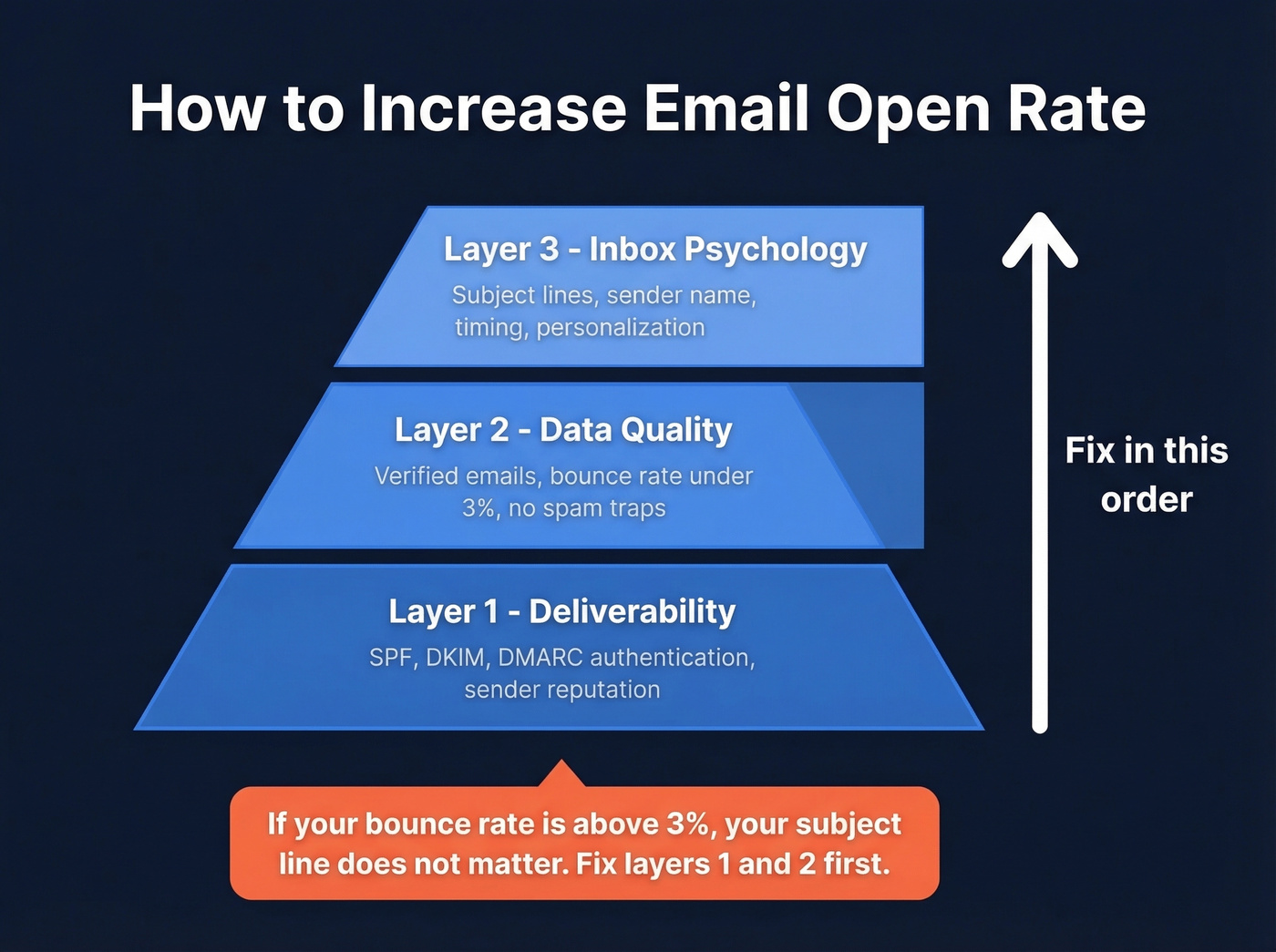
- Layer 1 - Deliverability. SPF, DKIM, DMARC properly configured. Sender reputation intact.
- Layer 2 - Data quality. Verified emails, bounce rate under 3%, no spam traps on your list.
- Layer 3 - Inbox psychology. Subject lines, sender name, timing, personalization - the stuff every other guide leads with.
Here's the thing: if your bounce rate is above 3%, your subject line doesn't matter. Fix layers 1 and 2 first.
What Is Email Open Rate?
Unique opens divided by delivered emails, times 100. Send 1,000 emails, 950 get delivered, 380 unique recipients open - that's a 40% open rate.
Tracking works via a tiny invisible pixel. When a recipient's email client loads that pixel, it registers an "open." The problem? Apple Mail Privacy Protection now preloads those pixels automatically via proxy - registering an "open" even when nobody reads the email. That single mechanism has made open rate one of the least reliable metrics in marketing.
2026 Benchmarks Worth Knowing
ActiveCampaign analyzed campaign data across their customer base. The results skew SMB, but they're the most comprehensive public dataset available.
Marketing Email Benchmarks by Industry
| Industry | Open Rate | Click Rate |
|---|---|---|
| Media/Publishing | 43.16% | 7.32% |
| Non-profit | 42.68% | 5.51% |
| Healthcare | 41.48% | - |
| Software | 36.20% | 6.67% |
| E-Commerce/Retail | 35.66% | 5.07% |
| All Industries | 39.26% | 6.21% |
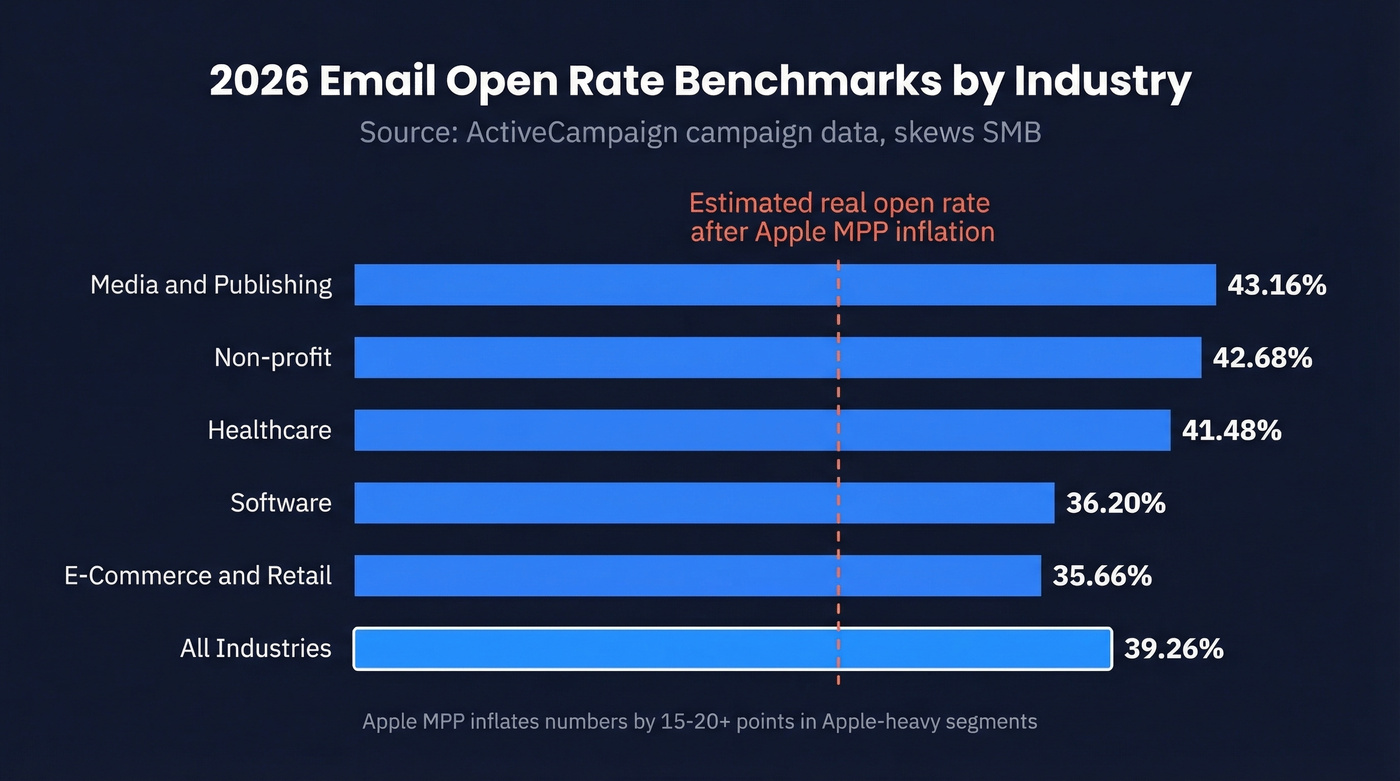
If your open rate sits above ~35% in an Apple-heavy audience, some of those opens are fake. Apple MPP inflates numbers by 15-20+ points in Apple-heavy segments. A "real" open rate for most marketing emails is probably closer to 20-30%.
Cold Email Benchmarks
Cold email lives in a different universe. Aggregated data from Smartlead's 14.3 billion sends shows a global average of ~42% open rate, ~3% reply rate, and ~7.5% bounce rate. Reply rate is the metric that actually matters here - opens are even less reliable in cold outbound.
Campaigns vs. Automated Flows
Here's a stat that should change how you think about email: Klaviyo's 2026 benchmarks show automated flows account for just 5.3% of total send volume but generate roughly 41% of email revenue. Flow click rates hit 5.58% versus 1.69% for broadcast campaigns. If you're sending mostly one-off blasts, you're leaving the highest-engagement channel on the table.

Bad email data is the silent killer of open rates. Every bounce chips away at your sender reputation, dragging inbox placement down for your entire list. Prospeo's 5-step verification eliminates invalid addresses, spam traps, and honeypots - delivering 98% email accuracy. Meritt cut their bounce rate from 35% to under 4%. Stack Optimize runs 94%+ deliverability with zero domain flags.
Fix Layer 2 before you rewrite a single subject line.
Why Your Open Rate Is Lying
Apple Mail Privacy Protection
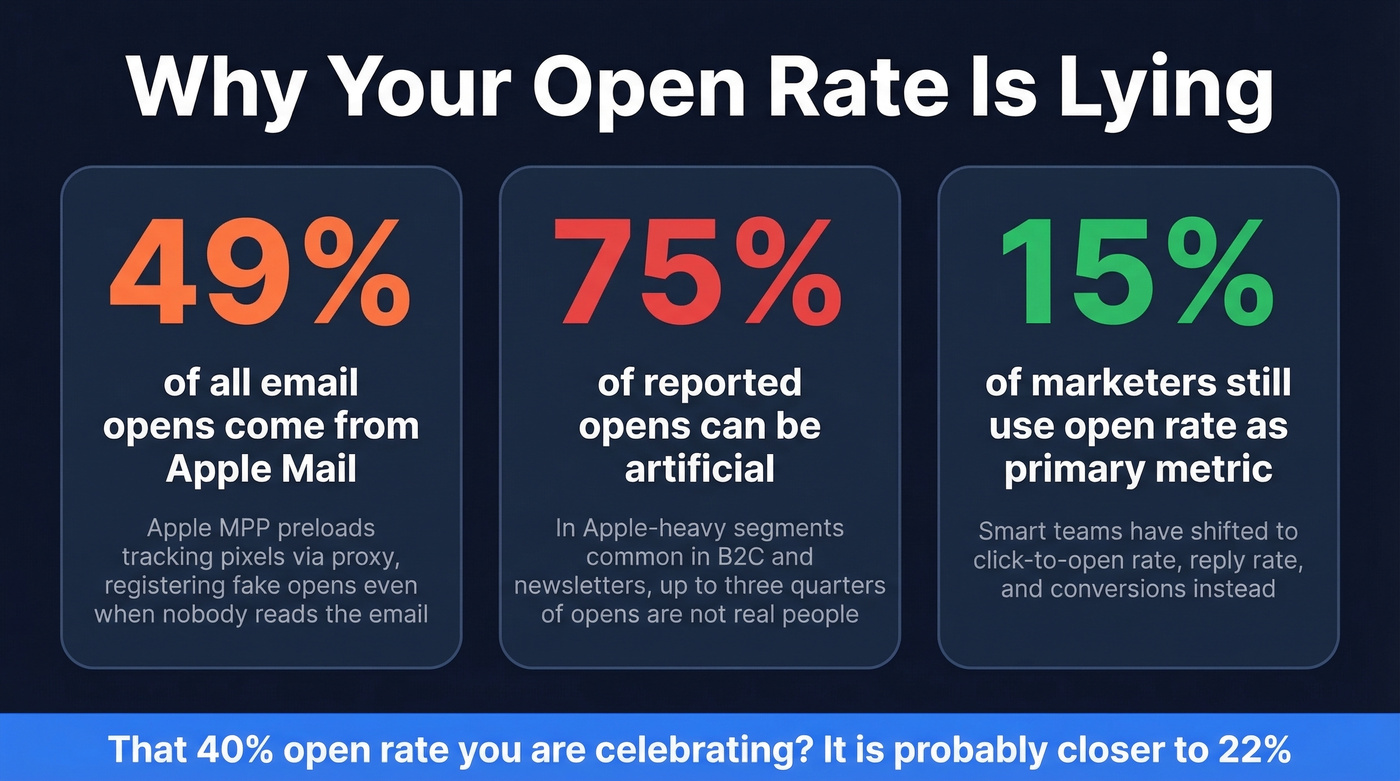
Apple MPP accounts for roughly 49% of email opens. Apple Mail preloads all images and tracking pixels via a proxy server, regardless of whether the recipient actually reads the email. In Apple-heavy segments - common in B2C and newsletter audiences - up to 75% of reported opens are artificial. That 40% open rate you're celebrating? It's probably 22%.
Bot Opens and Dark Clicks
Security scanners from Gmail, Outlook, and Yahoo pre-click links and pre-load images to check for malware. These "dark clicks" inflate both open rates and click-through rates, and they can trigger automations you didn't intend.
Flag any "open" that happens less than one second after delivery. Embed hidden honeypot links that only bots would click. Filter by user-agent strings associated with known scanners.
What to Track Instead
Only 15% of email marketers still treat open rate as a primary success metric. Smart move. Open rate works as a directional health signal - if it drops 50% overnight, something broke. But for performance measurement, shift to click-to-open rate, reply rate, and conversions.
Rough CTOR benchmarks by email type:
| Email Type | CTOR Range |
|---|---|
| Welcome emails | 20-30% |
| Newsletters | 10-15% |
| Promotional | 8-12% |
For cold email, reply rate is the only metric worth optimizing against. A strong campaign CTOR runs 10-20%.
Fix Deliverability First
Authentication Checklist
Three protocols you can't skip:
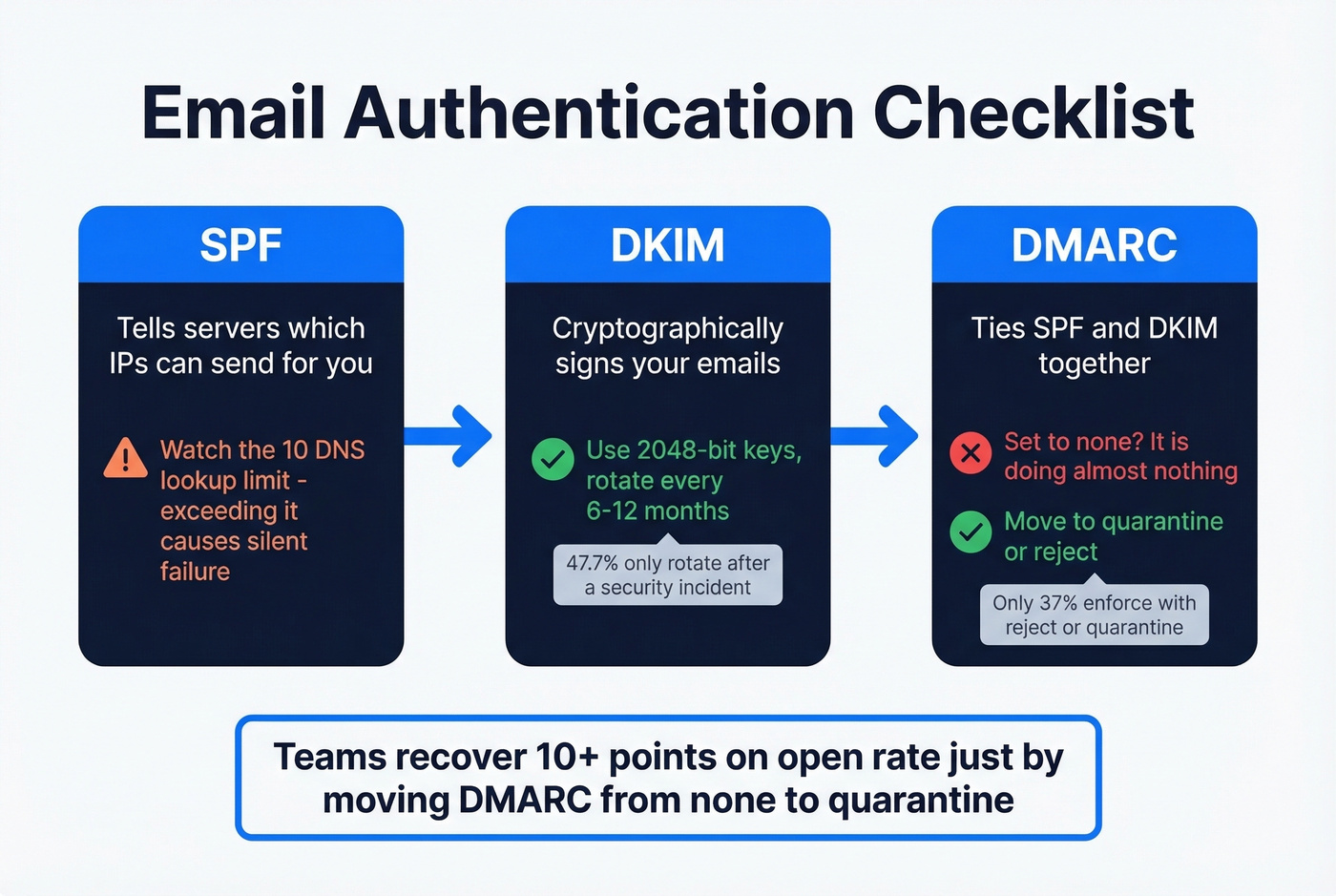
SPF tells receiving servers which IPs can send on your behalf. Watch the 10 DNS lookup limit - exceeding it causes SPF to silently fail, and you won't get an error message.
DKIM cryptographically signs your emails. Use 2048-bit keys. 47.7% of senders only rotate DKIM keys after a security incident - rotate every 6-12 months instead. If you want a quick sanity check, use this guide on verify DKIM is working.
DMARC ties SPF and DKIM together. Only 37% of DMARC users enforce with reject or quarantine policies. Among senders pushing 100k+ emails monthly, 20% still aren't sure whether they use DMARC at all. If yours is set to "none," it's doing almost nothing. If you’re troubleshooting policy behavior, start with DMARC alignment.
We've seen teams recover 10+ points on open rate just by moving DMARC from "none" to "quarantine." It's the single most underrated fix in email marketing.
Gmail and Yahoo Bulk Sender Rules
The enforcement timeline has been aggressive. February 2024 brought initial rejection of unauthenticated bulk senders. June 2024 made one-click unsubscribe mandatory. By October 2024, the spam complaint threshold tightened to 0.3%. December 2024 expanded enforcement to anyone sending 5,000+ daily messages.
If you haven't audited your authentication setup since early 2024, you're already losing inbox placement. (If you’re unsure where you stand, this email deliverability guide breaks down the audit.)
Data Quality: The Lever Nobody Talks About
Here's the causal chain most marketers miss: bad email addresses lead to bounces, bounces damage sender reputation, and damaged reputation reduces inbox placement for every subsequent send. You can have perfect authentication and flawless subject lines, and a ~7-8% bounce rate will still crush your deliverability. If you need bounce-specific thresholds and fixes, see bounce rate.

In our experience, lists that haven't been verified in 90 days are the most common cause of sudden open rate drops. Prospeo's 5-step verification catches the addresses that wreck your reputation - invalid mailboxes, catch-all domains, spam traps, and honeypots. If you’re actively cleaning traps, use this spam trap removal playbook. Meritt dropped their bounce rate from 35% to under 4% after switching, and Stack Optimize maintains 94%+ deliverability with zero domain flags across all their clients.
12 Tactics to Get Emails Opened
Sender Name and Subject Line
1. Use a human sender name. "Sarah from Acme" outperforms "Acme Marketing Team" almost every time. People open emails from people.
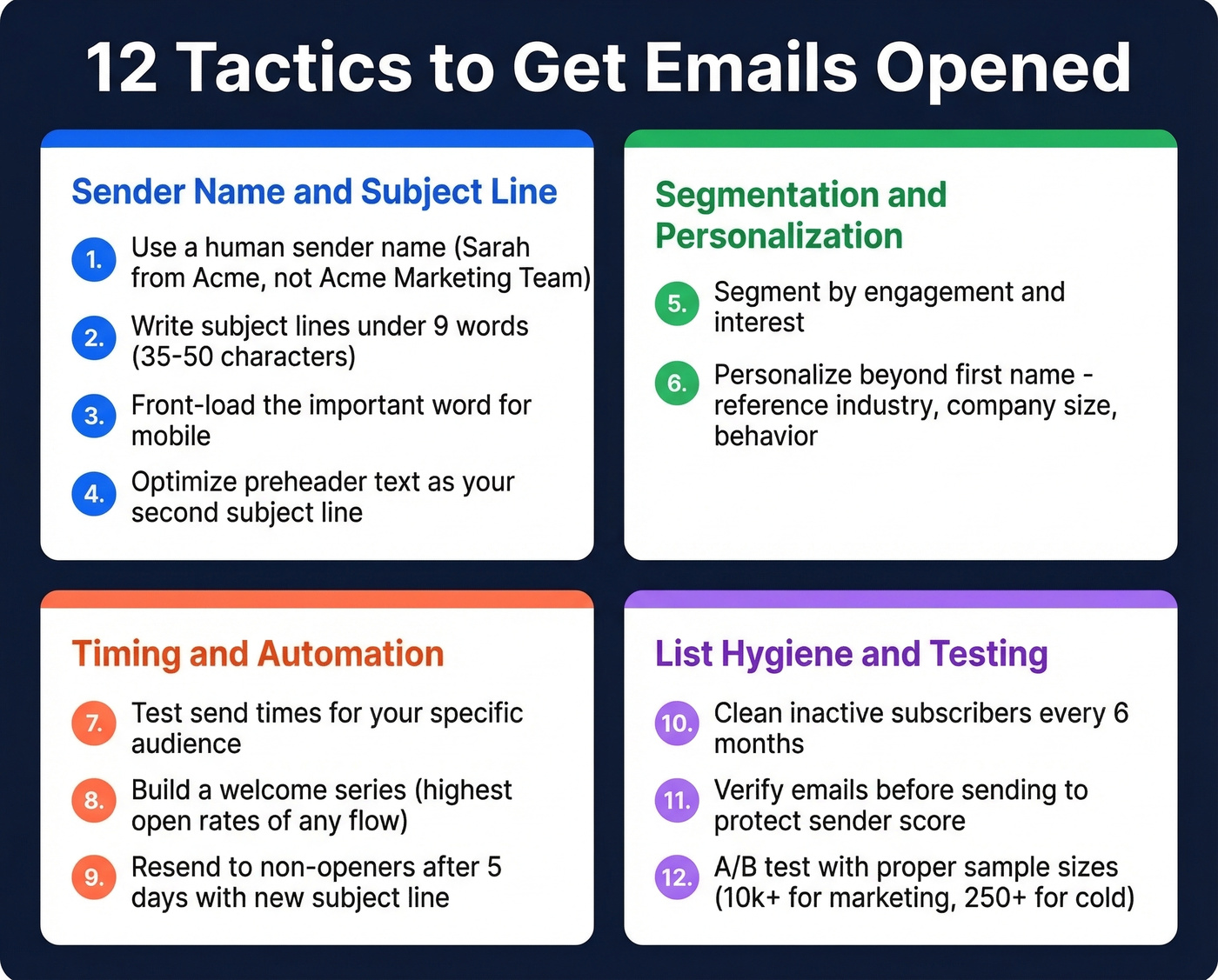
2. Write subject lines under 9 words. That's roughly 35-50 characters, which survives mobile truncation. Some data suggests 61-70 characters performs well on desktop - test both for your audience. If you want a swipe file, start with these subject line examples.
3. Front-load for mobile. Most emails are opened on phones. Put the most important word first, not last.
4. Optimize preheader text. The preheader is your second subject line. Don't waste it on "View this email in your browser." For a testing workflow, use preview text A/B testing.
Segmentation and Personalization
5. Segment by engagement and interest. Send your best content to your most engaged subscribers. Blasting the same email to your entire list is the fastest way to train spam filters against you. If you’re building segments from buying signals, intent based segmentation is a good starting point.
6. Personalize beyond first name. "Hi {{first_name}}" is the bare minimum. Reference their industry, company size, or recent behavior. Dynamic content blocks beat generic sends every time, and the performance gap widens the larger your list gets because you're sending more relevant content to more distinct segments simultaneously. For outbound, this personalized outreach guide pairs well with the approach.
Timing and Automation
7. Test send times for your audience. The "best time to send" data is wildly inconsistent across studies. Use these as starting points:
| Industry | Best Days | Best Times |
|---|---|---|
| Ecommerce | Tue/Thu | ~10am |
| SaaS | Tue/Thu | ~2-3pm |
| Professional services (B2B) | Mon/Tue | ~8-10am |
Some datasets show evening peaks around 8 PM outperforming business hours - another reason to test rather than follow generic advice. Run your own send-time tests for two weeks before committing.
8. Build a welcome series. Welcome emails get the highest open rates of any automated sequence and the highest CTOR at 20-30%. A 3-5 email welcome flow captures your highest-engagement window. Skip this if you're only doing cold outbound - it doesn't apply.
9. Resend to non-openers. Wait about five days, change the subject line, resend. This can increase total open and clickthrough rates by 15-30%. Don't do it every time or you'll accelerate list fatigue.
List Hygiene and Verification
10. Clean inactive subscribers every 6 months. Anyone who hasn't engaged in 180 days is dragging down your sender reputation. Sunset them or run a re-engagement campaign first. If you’re trying to fix the underlying issue, start with improve sender reputation.
11. Verify emails before sending. Every bounced email chips away at your sender score. Prospeo verifies in bulk - upload a CSV, get results in minutes, and strip out invalid addresses and spam traps before they hit your ESP. If you’re comparing tools, see Bouncer alternatives.
12. A/B test with proper sample sizes. For marketing emails, Litmus recommends 10,000 recipients per variant for meaningful results. For cold email, 250-500 contacts per variant works - but measure reply rate, not opens. Clickbait subject lines spike opens and kill replies.
Let's be honest: if your deal sizes are under five figures and your list is under 5,000 contacts, skip A/B testing entirely. You don't have the volume for statistical significance. Spend that energy on authentication and list hygiene instead - the ROI is 10x higher.
A/B Testing Framework
Isolate one variable per test. Subject line OR sender name OR send time - never all three. For cold outbound, Instantly's framework is solid: 250+ contacts per variant, positive reply rate as the success metric. If your open rate is below 15%, don't bother testing subject lines. That's an inbox placement problem, not a copy problem.
Cold Email: Different Rules
Reply rate is the real metric. A 3% reply rate is average; 5%+ is strong. One SaaS startup sent 400 targeted cold emails via Smartlead and booked 61 demos - roughly a 15% conversion rate - in eight weeks. That's proof that small, clean lists outperform massive spray-and-pray campaigns. If you’re building sequences, use this B2B cold email sequence framework.
The single biggest lever for cold email deliverability isn't your subject line. It's data quality. A 7.5% bounce rate - the Smartlead average - is way too high. That's domain reputation damage compounding with every campaign.
You just read that a ~7-8% bounce rate crushes deliverability regardless of authentication or copy. The fix isn't writing better subject lines - it's starting with verified contacts. Prospeo refreshes 300M+ profiles every 7 days, not every 6 weeks like competitors. At $0.01 per email, cleaning your list costs less than a single wasted send.
Stop optimizing subject lines on a list full of dead addresses.
FAQ
What's a good email open rate in 2026?
The all-industry average is 39.26%, but Apple MPP inflates that by 15-20+ points. A "real" open rate of 20-30% for marketing emails is solid; for cold email, 40-50% is strong. Focus on CTOR and reply rate for reliable measurement.
Why did my open rate drop suddenly?
Gmail and Yahoo enforced strict authentication requirements starting February 2024 - SPF, DKIM, DMARC, one-click unsubscribe, and a 0.3% spam complaint ceiling. Non-compliant senders saw 15-20 point drops overnight. Audit your DNS records and complaint rate first.
Are email open rates still accurate?
No. Apple MPP preloads tracking pixels via proxy, registering fake "opens" for roughly 49% of all email opens. Security bots add further inflation. Use click rate and reply rate as your primary performance metrics instead.
How does email verification improve open rates?
Invalid emails bounce, bounces damage sender reputation, and damaged reputation reduces inbox placement for every subsequent send. Verification breaks this chain by catching bad addresses, spam traps, and honeypots before they reach your ESP. Teams running consistent verification maintain sub-4% bounce rates and stable deliverability.
How do I calculate click-to-open rate?
Unique clicks divided by unique opens, times 100. If 400 people opened and 60 clicked, your CTOR is 15%. A strong marketing CTOR falls in the 10-20% range; welcome emails routinely hit 20-30%.