

How to Increase Revenue - Without the Generic Advice
The typical company grew 2.8% per year in the decade before COVID. Only 1 in 8 cracked 10% annual growth. Customer acquisition costs rose 60-75% between 2014 and 2019, and SaaS median growth just got cut nearly in half - from 47% down to 28%. Growth isn't just harder than it used to be. It's structurally more expensive.
The standard advice - "upsell more, get referrals, run ads" - ignores the math. We're going to walk through actual benchmarks, specific strategies to grow revenue in 2026, and the mistakes that quietly kill companies, with data from 5,000+ firms behind the claims.
The Short Version
Fix your pricing first. A 1% price increase drives an 11% profit increase, per McKinsey's research. That's the highest-leverage move you can make without acquiring a single new customer.
Plug the retention leak. CAC rose 60-75% between 2014 and 2019. If your SaaS revenue churn sits above ~12%, you're filling a leaky bucket with increasingly expensive water.
If you're in B2B, clean up your outbound data. Bad emails mean dead pipeline, which means lost revenue. Prospeo verifies emails at 98% accuracy and refreshes data every 7 days - that's the difference between a pipeline that converts and one that bounces.
The Revenue Equation
Every revenue strategy maps to one of two levers. Revenue equals the number of sales multiplied by the value per sale. Every tactic you'll ever hear about - upselling, referrals, pricing changes, new markets - is just pulling one of those two levers.
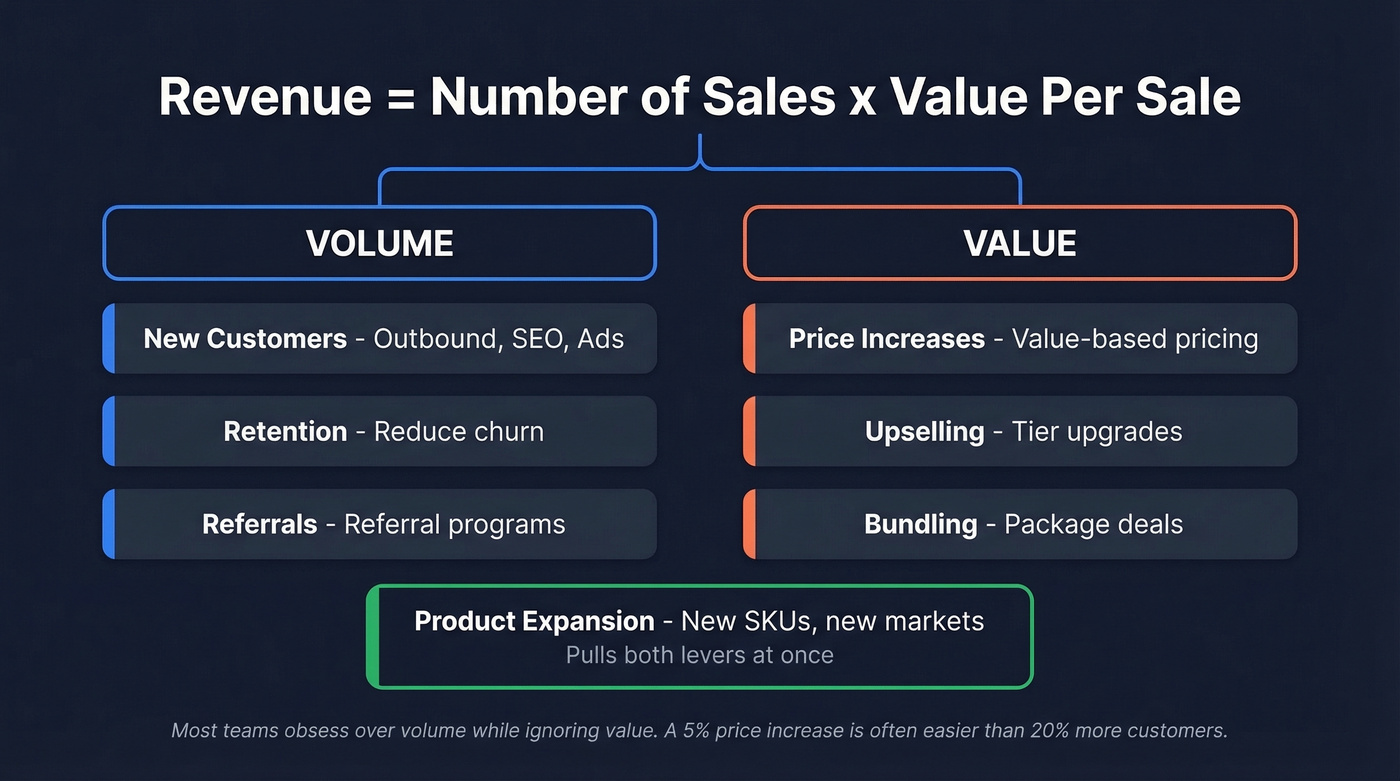
Here's how the major strategies map:
| Strategy | Lever | Example |
|---|---|---|
| New customers | Volume | Outbound, SEO, ads |
| Retention | Volume | Reduce churn |
| Referrals | Volume | Referral programs |
| Price increases | Value | Value-based pricing |
| Upselling | Value | Tier upgrades |
| Bundling | Value | Package deals |
| Product expansion | Both | New SKUs, markets |
The mistake most teams make is obsessing over volume while ignoring value. Getting 20% more customers is hard. Raising prices 5% is a Tuesday afternoon decision that'll likely have a bigger impact on your bottom line.
The stakes are higher than most leaders realize, too. McKinsey found that each additional 5 percentage points of annual revenue growth correlates with 3-4 extra points of total shareholder return - equivalent to 33-45% more market cap over a decade. Revenue growth isn't just an operating metric. It's the primary driver of long-term company value.
Revenue Growth Benchmarks
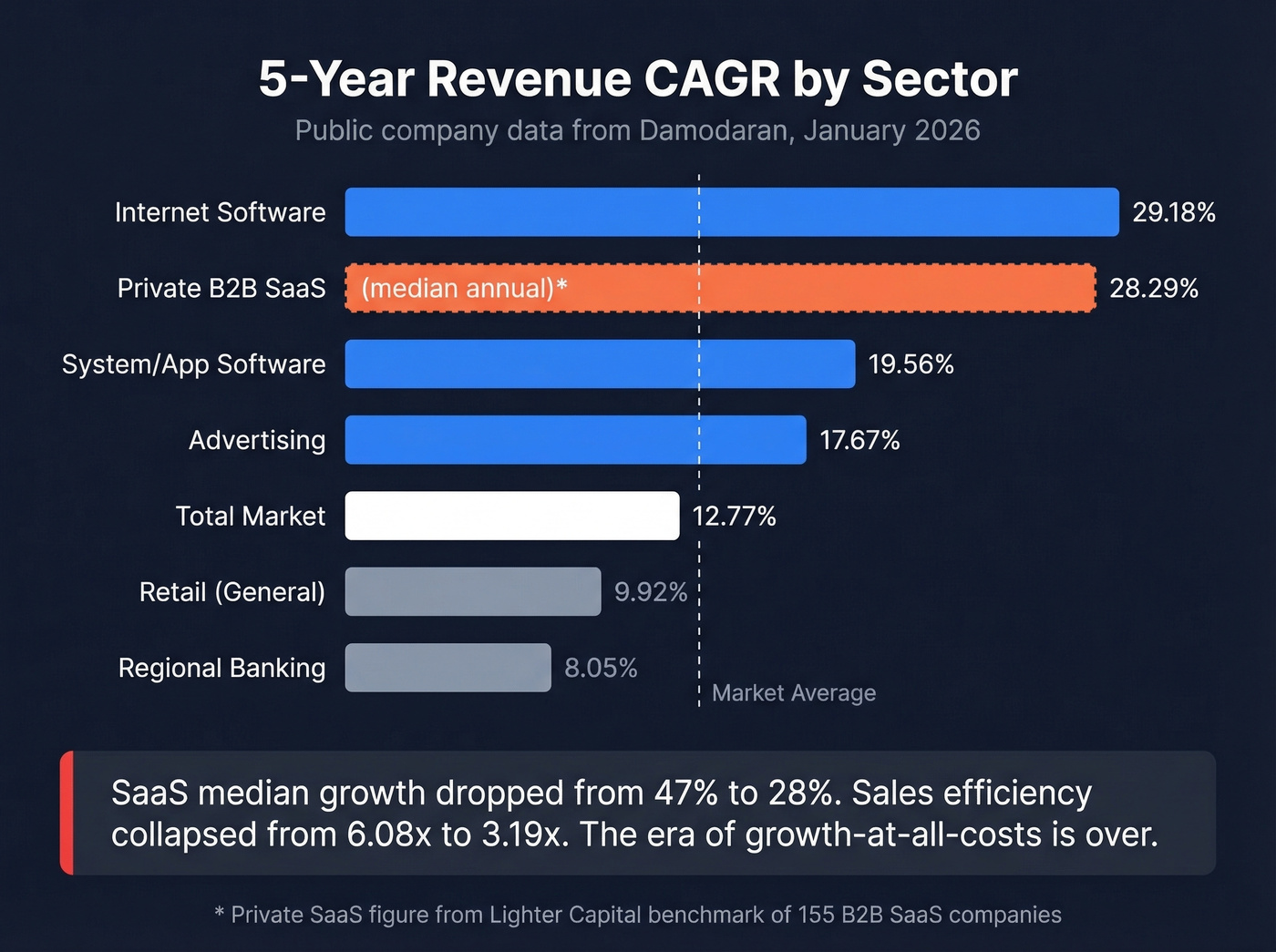
Before you set a growth target, you need to know what "good" looks like in your sector. These are 5-year compounded annual growth rates from Damodaran's January 2026 dataset covering public companies:
| Sector | 5-Year Revenue CAGR | Expected 5-Year CAGR |
|---|---|---|
| Internet Software | 29.18% | 14-18% |
| System/App Software | 19.56% | 12-16% |
| Advertising | 17.67% | 10-14% |
| Retail (General) | 9.92% | 6-9% |
| Regional Banking | 8.05% | 4-7% |
| Total Market | 12.77% | 8-11% |
| Private B2B SaaS* | 28.29% (median annual growth, 2026) | - |
*Private B2B SaaS figure from Lighter Capital's benchmark of 155 B2B SaaS companies.
In public software sectors, 5-year revenue CAGRs run roughly 19-29%. In retail, it's closer to 10%. Context matters enormously.
The SaaS-specific numbers tell a sharper story. Median growth dropped from 47% to 28% year-over-year, and the sales & marketing efficiency multiple collapsed from 6.08x to 3.19x. SaaS companies are spending more to grow less. Revenue churn ticked up to 12.50%. The era of growth-at-all-costs is definitively over - companies that grow sustainably now are the ones that survive.
Here's the uncomfortable truth: only 1 in 3 top-quartile growers maintained their position in subsequent periods. Among companies relying purely on organic growth, it was just 1 in 4. A single hot year means nothing if you can't sustain it.
How to Increase Sales Volume
Expand Your Customer Base
The customer acquisition playbook has shifted. Based on what founders are testing and sharing on r/ycombinator, the tactics actually showing results in the trenches look like narrow ABM lists with enrichment plus Loom mini-audits, founder-led content with fast DMs, programmatic SEO around templates and generators, micro-influencers paired with retargeting, and a small shareable utility inside the product.
None of these are revolutionary on their own. The pattern is specificity - targeting fewer, better-fit prospects with higher-effort touches instead of blasting thousands of cold contacts.
Fix Your Outbound Pipeline
Here's a revenue leak most teams don't even measure. When a big chunk of your outbound emails bounce, you're not just wasting rep time - you're burning your sending domain's reputation. Once that reputation tanks, even your good emails land in spam. The pipeline doesn't slow down. It dies.

Prospeo solves this at the source. Their database covers 300M+ professional profiles with 98% email accuracy and a 7-day data refresh cycle, compared to the industry average of six weeks. Meritt tripled their pipeline from $100K to $300K per week after switching, and their bounce rate dropped from 35% to under 4%. That's not an incremental improvement - it's a fundamentally different outbound operation.
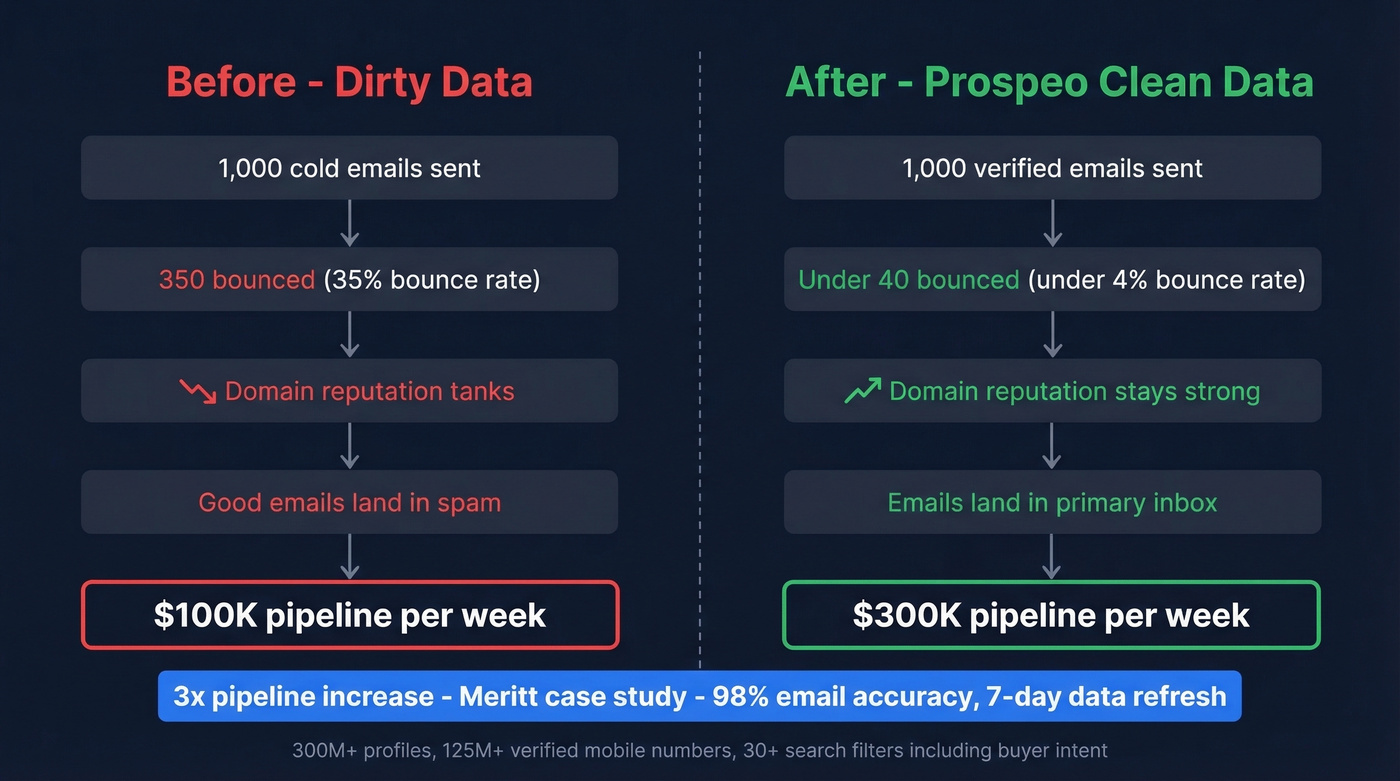
With 30+ search filters including buyer intent signals, technographics, job changes, and headcount growth, you can build precisely targeted lists instead of blasting thousands of unqualified contacts. The 125M+ verified mobile numbers with a 30% pickup rate mean your reps can actually get prospects on the phone.
If you're seeing bounces, start with email bounce rate benchmarks and fixes, then work backward into list quality and verification.
Improve Retention
Customer acquisition costs rose 60-75% between 2014 and 2019, and ecommerce CAC climbed another 60% through 2024. The average retention rate across industries sits around 75%. A quarter of your customers walk out the door every year.
The math is brutal. If you're spending $500 to acquire a customer and losing 25% annually, you need each customer to generate at least $2,000 in lifetime value just to break even on acquisition. Improving retention by even 5 percentage points dramatically shifts that equation.
Invest in onboarding, customer success, and proactive outreach before customers churn - not after. In our experience, the fastest-growing teams we've worked with treat retention as a revenue function, not a support function. For teams trying to grow on limited resources, retention is almost always the fastest path to more top-line dollars.
If you want to get more precise, run a proper churn analysis before you change anything.
Referrals and Partnerships
Referral programs remain one of the most capital-efficient volume levers available. A referred customer typically has higher lifetime value and lower acquisition cost than one sourced through paid channels. The key is making the referral mechanism dead simple - one click, clear incentive, immediate reward.
Strategic partnerships work similarly but at a larger scale. Find companies that sell to your ICP but don't compete with you, then build co-marketing or co-selling motions. Distribution through someone else's audience is cheaper than building your own from scratch.
If your partnership motion relies on outbound, tighten up your sales prospecting techniques so you’re not spraying and praying.

You just read that CAC rose 60-75% and SaaS growth got cut nearly in half. Every bounced email makes that math worse. Prospeo delivers 300M+ profiles at 98% email accuracy with a 7-day refresh cycle - so your pipeline actually converts instead of bouncing.
Stop paying more to grow less. Start with data that connects.
Increase Value Per Sale
Pricing Strategy
Look, pricing is the most underused lever in business, and I'll die on that hill. A McKinsey study of 5,000 companies found that a 1% price increase drives an 11% increase in profitability. No new customers. No new features. Just better pricing.
If you negotiate pricing a lot, learn how to use an anchor in negotiation so you don’t give margin away by default.
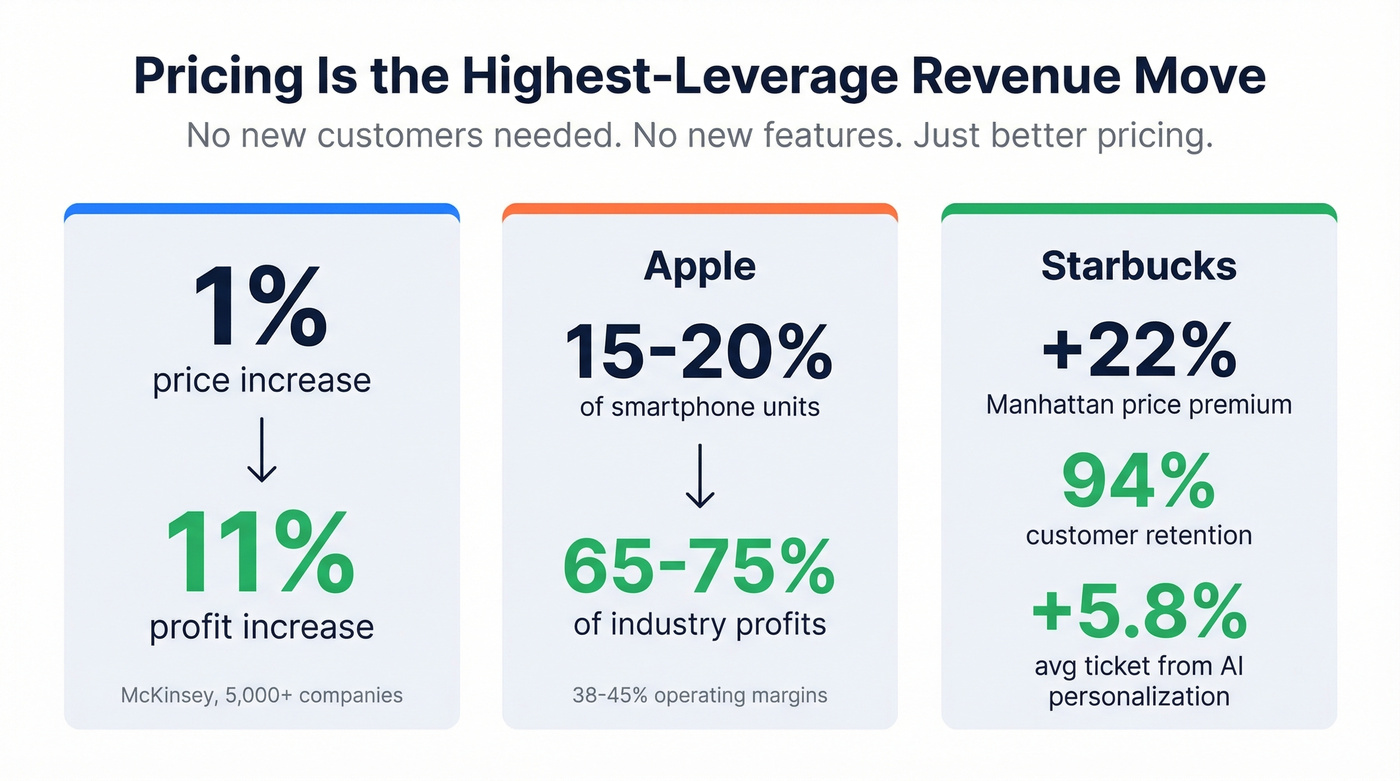
Apple is the textbook case. They hold 15-20% of smartphone unit share but capture 65-75% of the industry's profits, running 38-45% margins. Their Services division alone generates $85B+ annually - proof that value-based pricing creates entirely new revenue streams. That's not a volume play. It's a value play executed with discipline.
Starbucks does something similar with location-based pricing. Their Manhattan stores charge 22% more than suburban locations while retaining 94% of customer traffic. Their Deep Brew AI system pushes this further, driving a 5.8% increase in average ticket size and a 12-point jump in customer satisfaction through personalized recommendations in test markets. They're not guessing at what the market will bear. They're measuring it in real time.
The trend in SaaS is moving toward hybrid pricing models. Intercom's Fin AI charges a base subscription plus $0.99 per resolved customer conversation - aligning price with value delivered so customers pay more only when they get more. 2026 isn't the time for blunt price hikes. It's the time for smarter pricing architecture.
Hot take: If your average deal size is under $10K, you probably don't need to acquire more customers. You need to charge more for the ones you already have. Many companies undercharge by 20-40% because they're afraid of losing deals. The data says the opposite - disciplined pricing is the single strongest predictor of sustained profitable growth.
Upselling and Cross-Selling
44% of SaaS companies report getting roughly 10% of their revenue from upsells and cross-sells. In ecommerce, upsells drive 10-30% of average order value. These aren't marginal numbers.
If you want the clean definitions (and what to do with them), see Upsell vs Cross-Sell in SaaS.
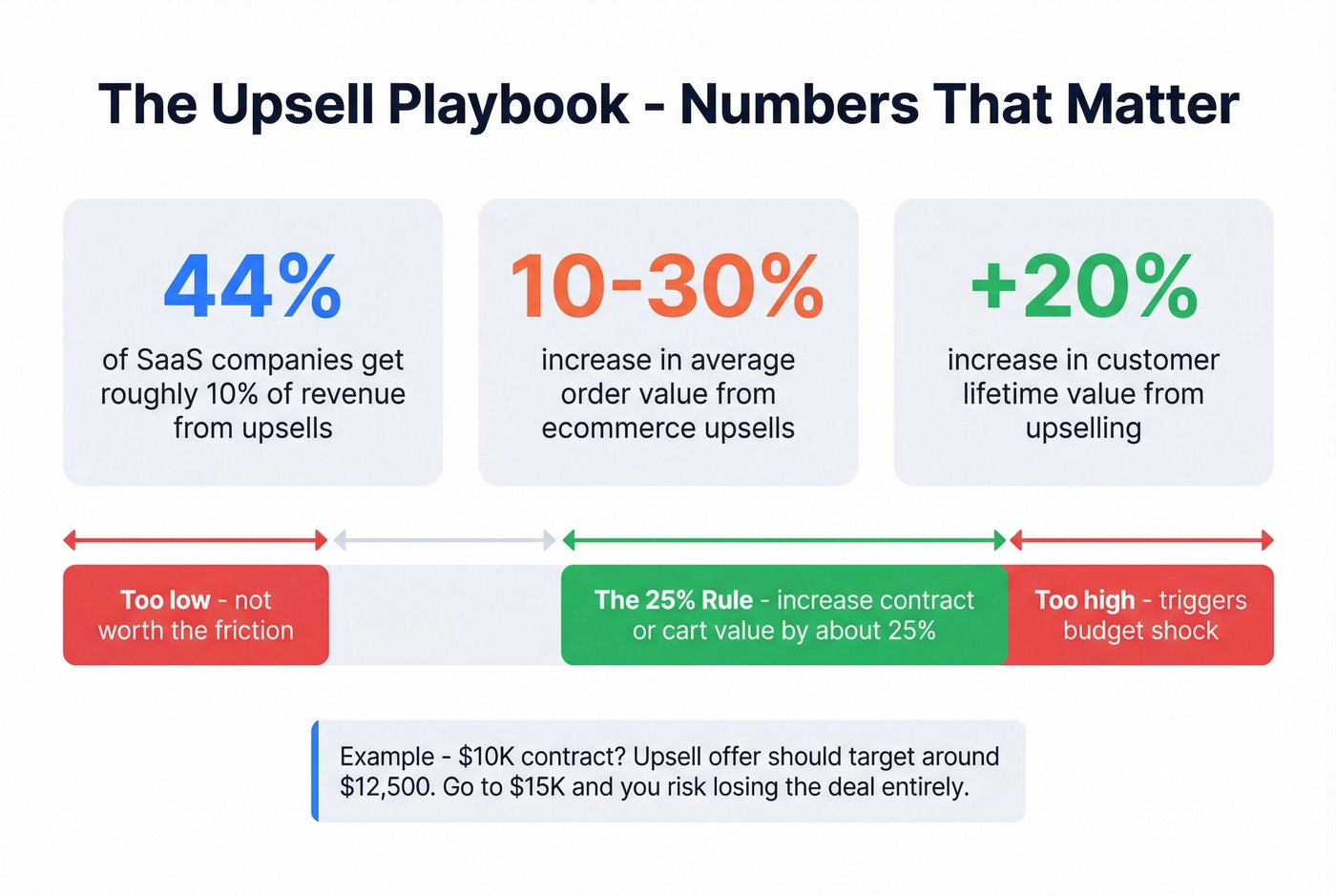
The practical heuristic is the 25% rule: your upsell offer should increase the cart or contract value by about 25%, not more. Go higher and you trigger budget shock. Go lower and it's not worth the friction. Upselling also drives roughly a 20% increase in customer lifetime value, which compounds over time - a fact that makes the initial effort of building upsell motions well worth the investment.
Bundling Over Discounting
When a customer asks for a discount, the instinct is to say yes. Don't.
A 20% discount on a product with a 25% markup doesn't just reduce your margin - it effectively wipes it out. You'd need to sell dramatically more units just to break even. Bundling is the smarter play: discount one item in a package but sell the others at full margin. The customer feels like they're getting a deal. You preserve your economics.
If you need a quick refresher on margin math, start with sales margin.
Expanding Your Product Range
Adjacent products and services capture more of the customer's workflow - and more of their budget. If you sell project management software, adding time tracking or invoicing is a natural expansion. Geographic expansion works the same way: your existing product, sold into a new market, increases both volume and often deal size. The key is sequencing. Nail one market before entering the next.
What's Working in 2026
Five tactics that founders and operators are actually running right now, not theorizing about:
Narrow ABM + enrichment + Loom mini-audits. Build a list of 100-200 target accounts, enrich with verified contacts and intent data, then send a 90-second Loom showing something specific about the prospect's business. We've seen teams using Prospeo's intent data filters to identify accounts actively researching their category, which cuts the list-building time from hours to minutes.
Founder-led content + fast DMs. Post twice a week on professional networks. When someone engages, DM them within the hour. It doesn't scale, but it builds pipeline that closes at a higher rate than any other channel.
Programmatic SEO around templates and generators. Build genuinely useful pages that target long-tail searches. When they work, they compound.
Micro-influencers + retargeting. Partner with niche creators for top-of-funnel awareness, then retarget engaged viewers with direct-response ads. The influencer alone won't convert - the retargeting does.
Shareable utility inside the product. Build a free tool or output that users naturally share. One founder on r/ycombinator described this as their best acquisition loop, period.
If you’re building outbound sequences to support these loops, use proven cold email follow-up templates instead of improvising.
Mistakes That Kill Revenue Growth
20.8% of businesses fail within their first year. 65.8% don't make it to year ten. The pattern isn't a lack of revenue - it's a lack of profitable revenue.
The most dangerous mistakes aren't dramatic. They're quiet.
Discounting without doing the math. A 20% discount on a 25% markup leaves you with almost nothing. Run the margin math before you agree to any discount. Every time.
Chasing wrong-fit customers. They demand the most support, churn the fastest, and drain resources from your best accounts. In our experience, teams that grow fastest aren't the ones with the biggest ad budgets - they're the ones ruthless about qualifying out bad-fit prospects early.
Ignoring cash flow. Revenue is an accounting concept. Cash is what pays your team. A company can be "growing" on paper while running out of money in practice. Review your cash position monthly, not quarterly.
Running outbound on bad data. This is the silent killer underneath it all. When a large share of your emails bounce, your sending domain gets flagged, your sequences land in spam, and your pipeline evaporates. By the time you notice, the damage is done. Clean data isn't a nice-to-have. It's infrastructure.
If you’re diagnosing why pipeline is stalling, start with the most common sales pipeline challenges.
Growing Revenue on a Constrained Budget
Not every team has the luxury of throwing money at growth. If you need to increase revenue on a flat budget, skip the acquisition-heavy tactics and maximize what you already have.
Start with pricing - it costs nothing to audit and adjust. Then focus on retention and upsells, which generate revenue from your existing customer base without additional CAC. Clean up your outbound data so every dollar spent on sales development actually reaches a real prospect. These three moves alone can meaningfully boost your top line without adding headcount or ad spend.
Meritt tripled their pipeline from $100K to $300K/week and cut bounce rates from 35% to under 4%. When revenue growth is structurally harder, the fastest lever is making sure your outbound emails actually reach real buyers - at $0.01 per verified email.
Increase revenue by fixing the leak no one measures: bad contact data.
FAQ
What's a good revenue growth rate?
The total public market's 5-year revenue CAGR is 12.77%, per Damodaran's January 2026 data. Only 1 in 8 companies exceed 10% sustained annual growth, according to McKinsey's study of 5,000 firms. Private B2B SaaS runs higher at a 28.29% median, though that's down sharply from 47% the prior year.
How do you grow revenue without new customers?
Start with pricing - a 1% price increase drives an 11% profitability gain. No new customers required, no additional marketing spend. After pricing, focus on upsells, which drive roughly 10% of SaaS revenue, and retention improvements. Audit pricing before investing in any other growth lever.
How do upsells impact revenue?
44% of SaaS companies generate roughly 10% of their revenue from upsells and cross-sells. Ecommerce sees 10-30% of average order value from upsells. Keep offers within 25% of the current cart or contract value to avoid triggering budget shock and maximize acceptance rates.
Why is revenue growing but profit isn't?
Three usual culprits: CAC inflation (up 60-75% between 2014 and 2019), discounting without margin math, and wrong-fit customers who consume disproportionate resources. Track both revenue and profit - or you'll grow yourself into a cash crisis.
How does outbound data quality affect revenue?
Bounced emails burn your sending domain's reputation and waste rep time on dead contacts. Once domain reputation drops, even valid emails land in spam. Clean, verified data with regular refresh cycles keeps bounce rates low and turns outbound from a cost center into a predictable pipeline engine.