

How to Introduce Your Company via Email: 8 Samples That Actually Get Replies
Your CEO forwards a template to the sales team. It starts with "Dear Sir/Madam, I am writing to introduce our company..." and runs 247 words before the CTA. Nobody replies. Nobody ever replies to that email.
We've seen this exact template forwarded across three different companies we've worked with. The problem is always the same: the email reads like a brochure, not a conversation. Every sample below is built on real performance data - not guesswork.
The Short Version
- Keep it under 80 words. Lead with an observation about their company, not a pitch about yours.
- Use a timeline hook ("Noticed [Company] just launched...") - timeline hooks get about 2.28x more replies than problem-based openers.
- Verify every email address before sending. One bad list tanks your domain reputation.
What the Data Says
A few numbers worth knowing, drawn from analyses of millions of cold emails:
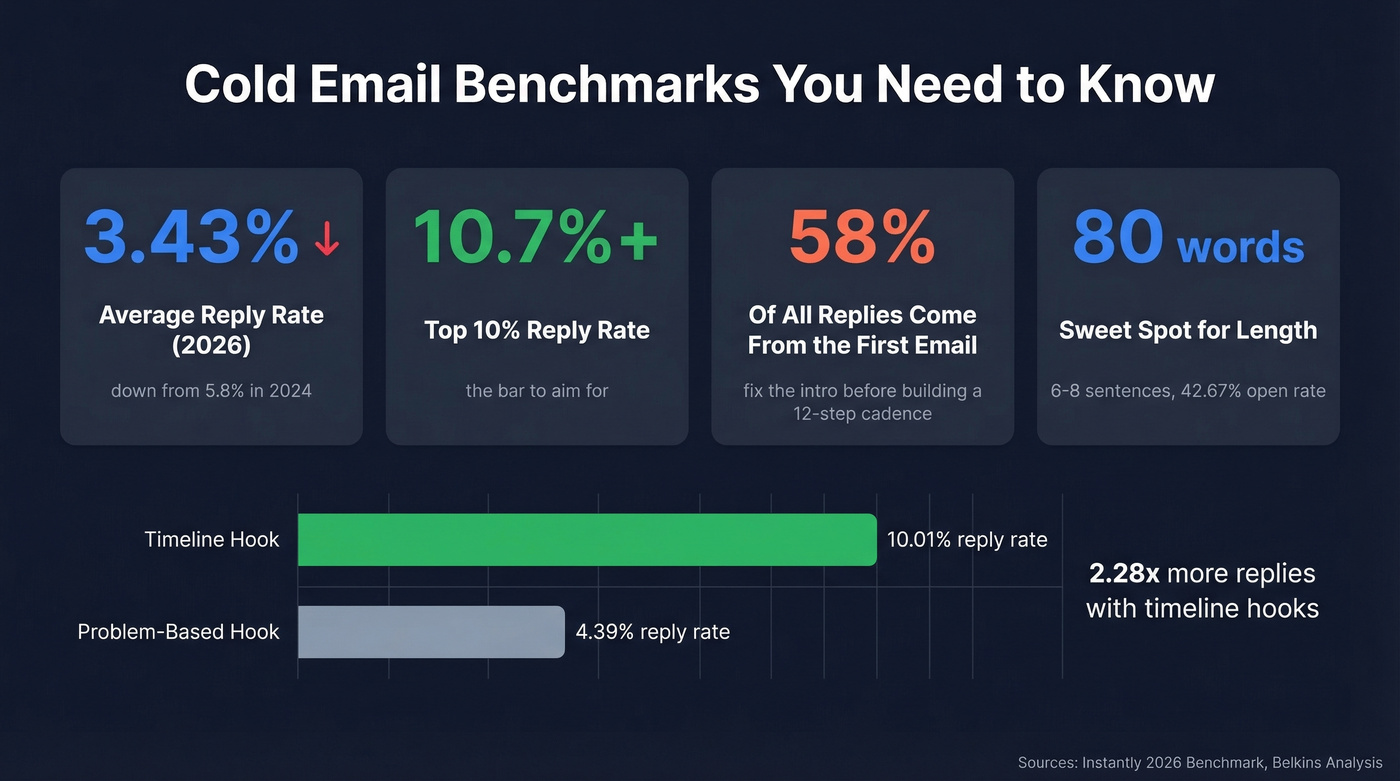
- Average reply rate (2024): 5.8%, down from 6.8% the year before, per Belkins' analysis of 16.5 million cold emails.
- 2026 benchmark: 3.43% average, with the top 10% hitting 10.7%+, according to Instantly's 2026 benchmark report.
- 58% of all replies come from the first email. Follow-ups help, but a weak first touch can't be saved by "just bumping this up."
- Sweet spot for length: 6-8 sentences pulled a 42.67% open rate and 6.9% reply rate. Best-performing campaigns stay under 80 words.
Here's the thing: most teams obsess over follow-up sequences when the first email is doing 58% of the work. Fix the intro email before you build a 12-step cadence.
Anatomy of an Intro Email That Gets Replies
Stop writing "introduction" emails. Write observation emails. Every component earns its place or gets cut - whether you're introducing a brand-new company or reaching out from an established one.
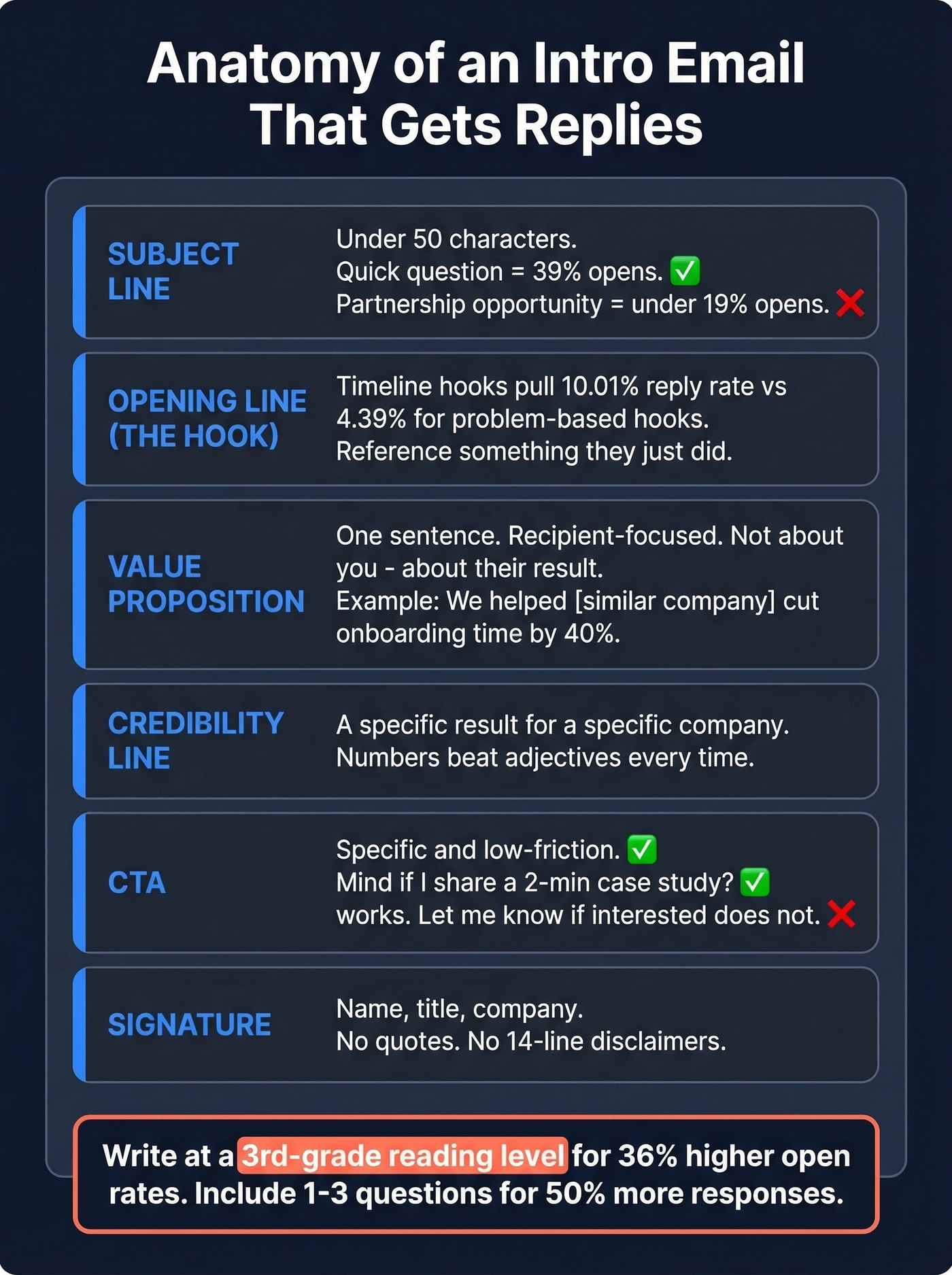
Subject line: Under 50 characters. "Quick question" pulls 39% opens; company-name subject lines hit 33%. Anything resembling "Partnership opportunity" drops below 19%. (If you want more options, borrow from these subject line examples.)
Opening line (the hook): Timeline hooks - referencing something the recipient's company just did - pull a 10.01% reply rate vs. 4.39% for problem-based hooks. "Noticed [Company] just expanded into APAC" beats "Struggling with international sales?" every time.
Value proposition: One sentence. Recipient-focused. Not "We're a leading provider of..." but "We helped [similar company] cut onboarding time by 40%."
Credibility line: A specific result for a specific company. Numbers beat adjectives.
CTA: Specific and low-friction. "Mind if I share a 2-minute case study?" works. "Let me know if you're interested" doesn't - it puts the cognitive load on them. (More patterns here: email call to action.)
Signature: Name, title, company. No inspirational quotes. No 14-line disclaimers.
Two more things: emails written at a third-grade reading level saw 36% higher open rates than college-level writing, and emails with 1-3 questions got 50% more responses than those without. When in doubt, write simpler than feels comfortable.
8 Company Introduction Email Samples
1. Cold Outreach to a Prospect
Subject: Noticed Relay's Series B
Hi Marcus,
Saw Relay just closed a $22M Series B - congrats. When Lattice was at the same stage, we helped their ops team cut reporting time by 60% in the first quarter.
Mind if I share a 2-minute case study?
Best, Sarah Chen, Datawise
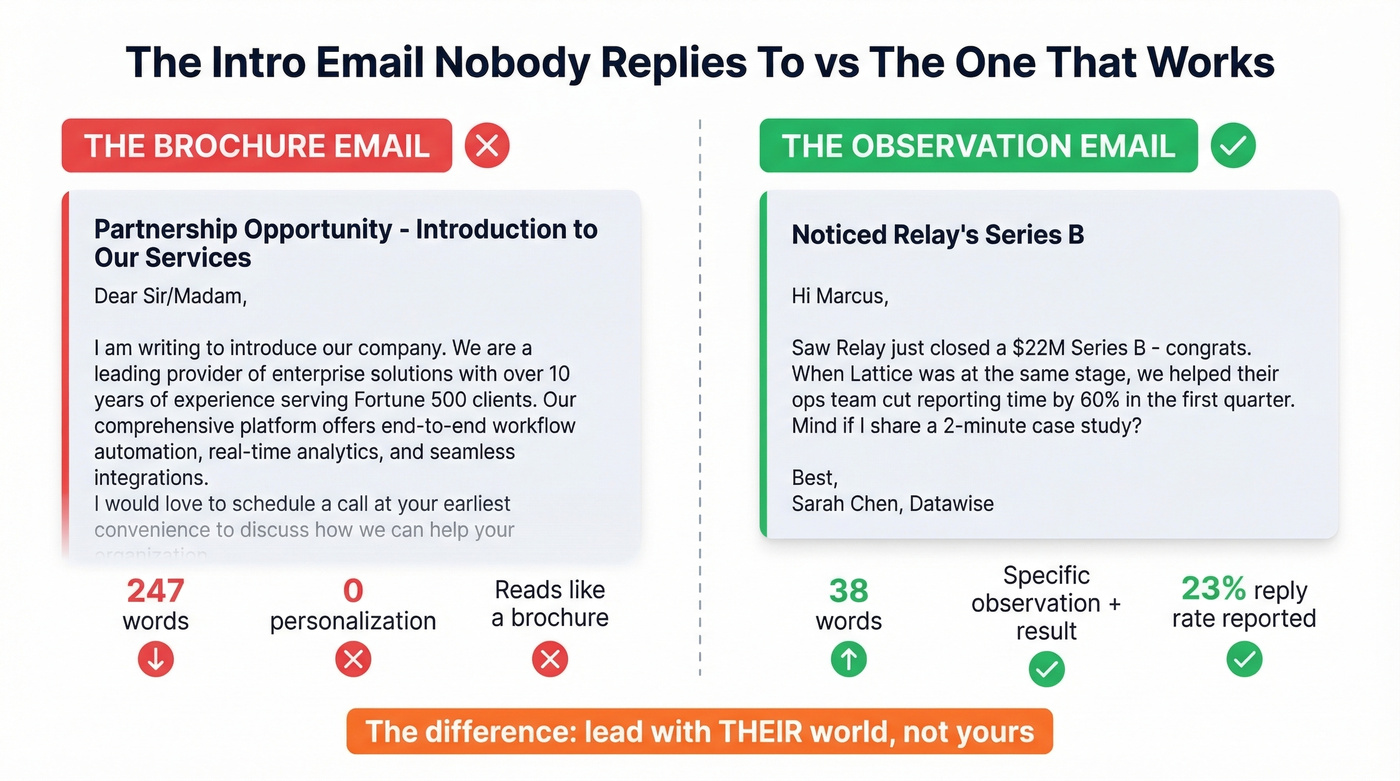
Why this works: Three sentences. Observation, credibility, small ask. One practitioner on r/indiehackers reported this framework pulling a 23% reply rate and $4,200 in revenue from 50 emails. If you need a sample for introducing your company to cold prospects, start here. (For more variations, see company introduction email examples.)
2. Post-Event Follow-Up
Use this within 24 hours of meeting someone at a conference, webinar, or meetup. The warm context window closes fast.
Subject: Quick follow-up from SaaStr
Hi Priya,
Great meeting you at the RevOps panel yesterday. You mentioned your team's spending too much time on manual lead routing - we built exactly that for Gong's SDR team last quarter.
Worth a 15-minute call this week?
Cheers, Tom Briggs, RouteFast
This isn't a cold email - it's a warm one disguised as an intro. The specific detail from the conversation ("manual lead routing") proves you were actually listening, not just collecting badges.
3. Partnership Proposal
Subject: Noticed Bloom's new API launch
Hi Jordan,
Saw Bloom just shipped a public API - nice move. We integrate with 40+ CRMs and our user base overlaps heavily with yours. A co-marketing push could put both products in front of 10K+ new accounts.
Open to a quick brainstorm?
Best, Ava Morales, SyncLayer
Why this works: Timeline hook plus mutual benefit framing. No vague "synergies" language. When you're proposing a partnership, lead with what's in it for them. (More on this style: cold email for business partnership.)
4. Investor Introduction
Subject: $1.2M ARR, 18% MoM growth
Hi David,
We're at $1.2M ARR growing 18% month-over-month with 94% net retention. We're building the compliance layer for fintech onboarding - a market that's tripled since 2023.
Would love 20 minutes to walk through the deck.
Best, Kai Nakamura, ComplianceOS
Most founder emails open with the origin story ("I was frustrated by..."). Investors scan for numbers first. Lead with traction - save the narrative for the meeting.
5. New Product Announcement
Subject: New feature - you asked for this
Hi Rachel,
We just shipped bulk CSV enrichment. Upload a list, get verified emails and direct dials back in minutes. Your team mentioned needing this last quarter.
Here's the 90-second walkthrough: [link]
Best, Nate Russo, DataStack
Existing relationship means you skip the intro entirely. Lead with value, single CTA.
6. CSM / Account Handoff
Before (the version everyone sends):
Hi - I'm your new CSM. I'm here to help with anything you need. Let's find time to connect!
After (the version that gets replies):
Subject: Picking up where Jess left off
Hi Lauren,
I'm taking over your account from Jess. She flagged that your team's been working on automating lead scoring - I helped two other accounts set that up last quarter and can share what worked.
Can I send over a quick recap before our first call?
Best, Derek Hale, Onboard.io
The original is about the CSM. The rewrite is about the customer's project. That's the entire difference. "Anything you need" signals a form letter; a specific reference to their project signals competence. (If you need more, use a handoff email template.)
7. Referral-Based Introduction
Subject: Lisa Park suggested I reach out
Hi Daniel,
Lisa Park mentioned you're rebuilding your outbound stack. We helped her team at Vanta cut list-building time from 12 hours to 2 hours a week.
Worth a quick call to see if it fits?
Best, Maya Lin, LeadForge
The mutual connection in sentence one bypasses cold resistance entirely. Referral emails aren't really cold outreach at all - they live in a different category.
8. Re-Engagement (Dormant Contact)
Subject: Closing the loop
Hi Sam,
I reached out a few months ago about your SDR team's data workflow. Clearly it wasn't the right time.
If anything's changed, I'm here. If not, no hard feelings - I'll stop filling your inbox.
Best, Elena Voss, Datawise
The "breakup" style is low-pressure and honest. The first follow-up lifts replies by up to 49%, but only if the tone respects the recipient's time. The 3-7-7 cadence (follow up on day 3, day 7, and day 14) captures 93% of replies that will ever come. After that, you're just annoying people. (Need more follow-ups? Use these sales follow-up templates.)

You just spent 20 minutes crafting the perfect company intro email. If it bounces, none of that matters. Prospeo's 98% email accuracy and 7-day data refresh mean your intro lands in real inboxes - not spam traps. At $0.01 per verified email, a bad list is no longer an excuse.
Stop perfecting emails that bounce. Start with verified data.
Deliverability Checklist Before You Send
Great copy means nothing if your emails land in spam. We've watched teams rebuild their entire outbound operation after ignoring these basics. Let's break it down.
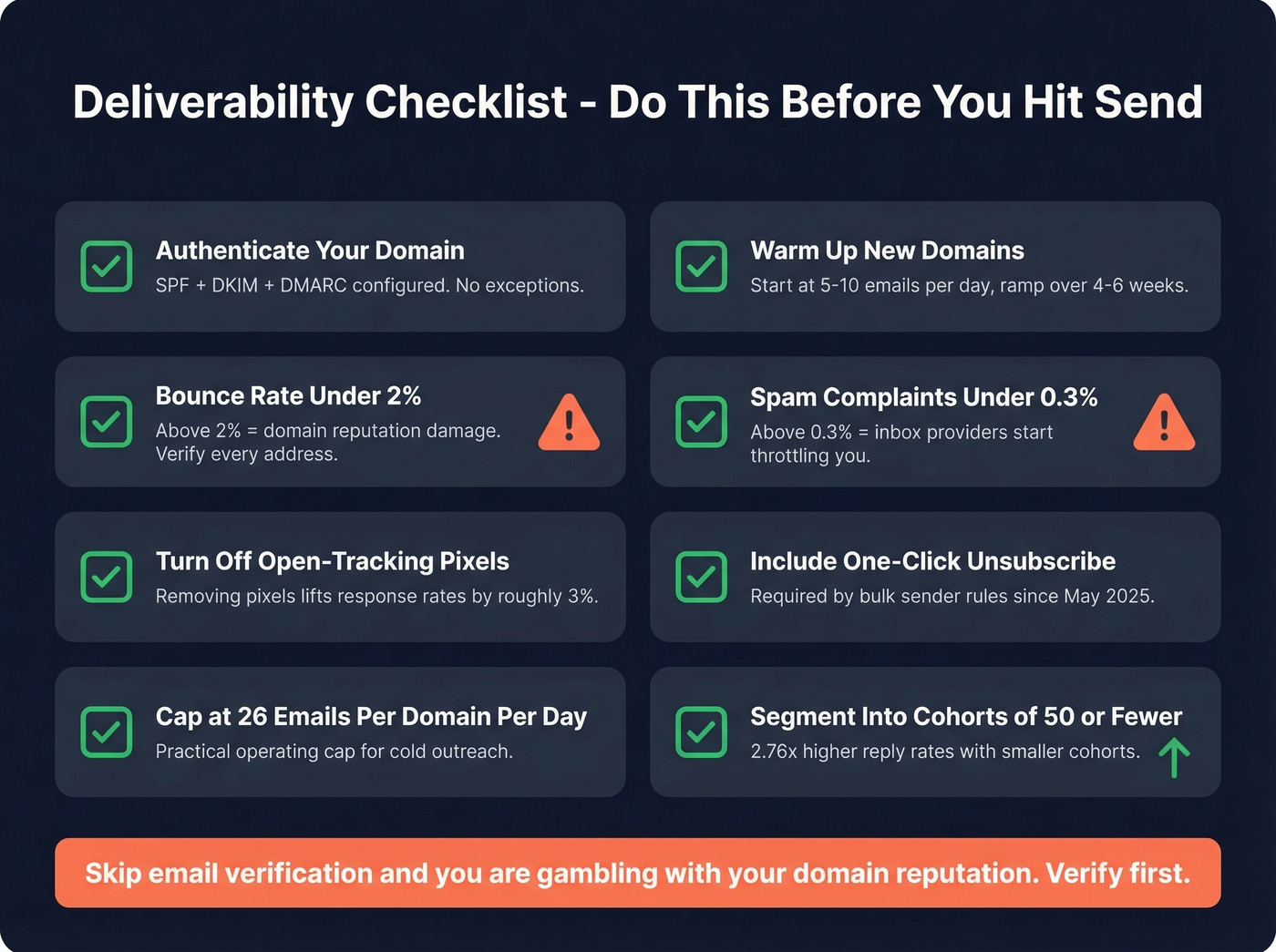
- Authenticate your domain. SPF, DKIM, and DMARC records must be configured. No exceptions. (If you want the deeper technical version, use this email deliverability guide.)
- Warm up new domains. Start at 5-10 emails per day, ramp over 4-6 weeks. Jumping straight to volume gets you flagged. (More on safe sending limits: email velocity.)
- Keep bounce rate under 2%. One practitioner on r/Entrepreneur rebuilt their outbound after hitting 11% - they got it under 2% and doubled their reply rate. (Benchmarks + fixes: email bounce rate.)
- Keep spam complaints under 0.3%. Above that threshold, inbox providers start throttling you.
- Turn off open-tracking pixels. Counterintuitive, but removing tracking pixels improves deliverability and lifts response rates by roughly 3%. Mailbox providers treat them as a spam signal. (Technical breakdown: email tracking pixels.)
- Include one-click unsubscribe. Required by bulk sender rules enforced since May 2025.
- Cap sending volume. 26 emails per domain per day is a practical operating cap many teams use for cold outreach.
- Segment lists into cohorts of 50 or fewer. Smaller cohorts lift reply rates by 2.76x and make it easier to run tighter targeting.
Skip the verification step and you're gambling with your domain reputation. Don't.
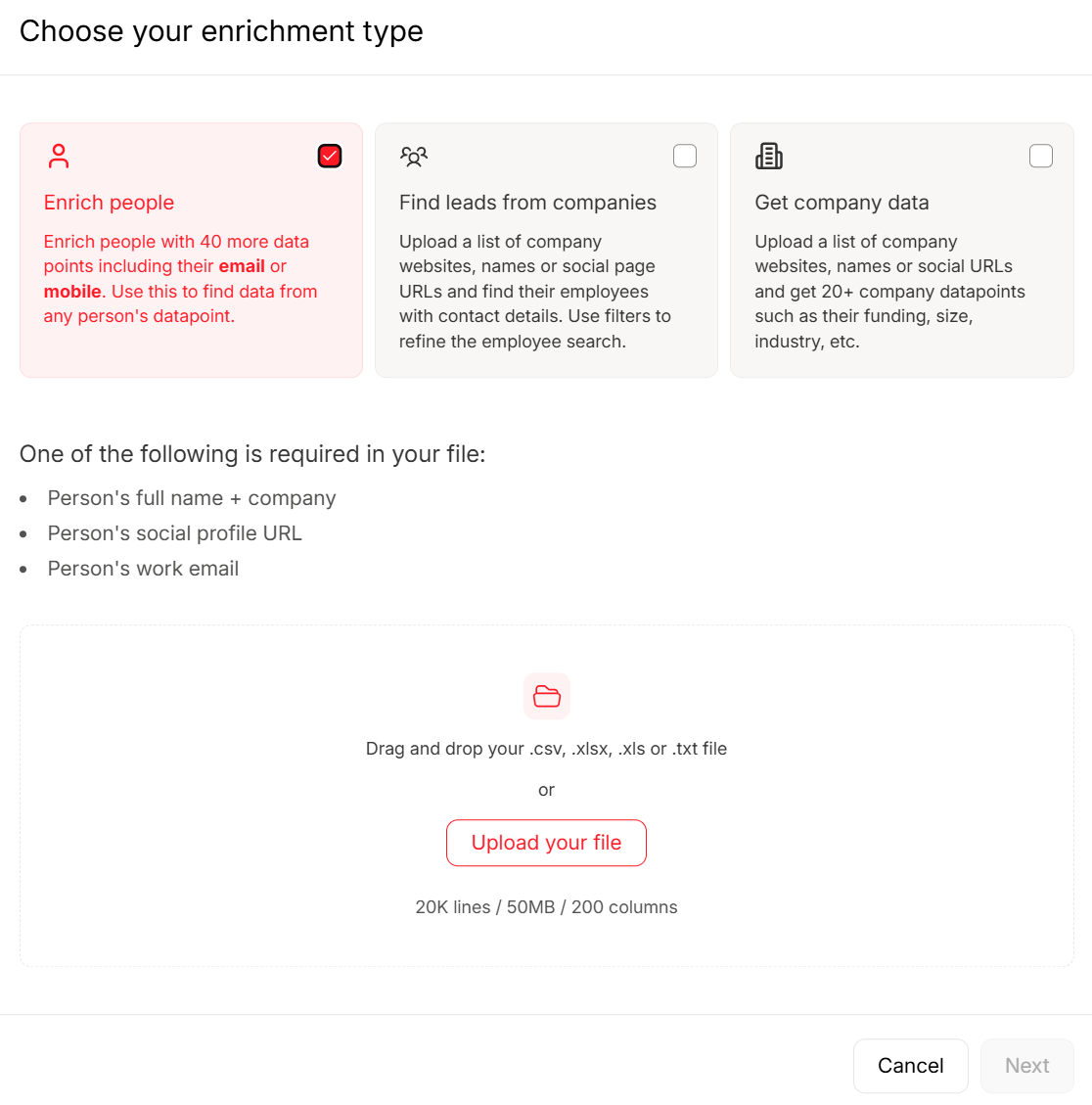
The samples above work - but only when you're emailing the right person at a verified address. Prospeo gives you 300M+ professional profiles with 30+ filters so you find the exact decision-maker, plus verified emails and direct dials to reach them. One bad list tanks your domain reputation. One good one builds pipeline.
Find the right contact, nail the intro, book the meeting.
CAN-SPAM & GDPR in 30 Seconds
US (CAN-SPAM): Include a valid physical postal address, use non-deceptive subject lines, provide a clear opt-out mechanism, and honor unsubscribes within 10 business days. You're responsible for third parties sending on your behalf.
EU (GDPR): Email addresses are personal data - GDPR applies even if you're outside the EU. B2B cold outreach typically relies on "legitimate interests" as a legal basis, meaning you need a genuine business reason and can't be intrusive about it. Cumulative GDPR fines have hit roughly EUR 5.88B across 2,245 enforcement actions. Maximum penalty: EUR 20M or 4% of global annual turnover.
Most small teams treat compliance as an afterthought. Before you write an email to introduce your company, make sure your legal foundations are solid.
Mistakes That Kill Reply Rates
Leading with "My name is... we are a leading..." Your name is in the sender line. "Leading" is meaningless. Cut both. (If you want a tighter framework, use this email copywriting guide.)
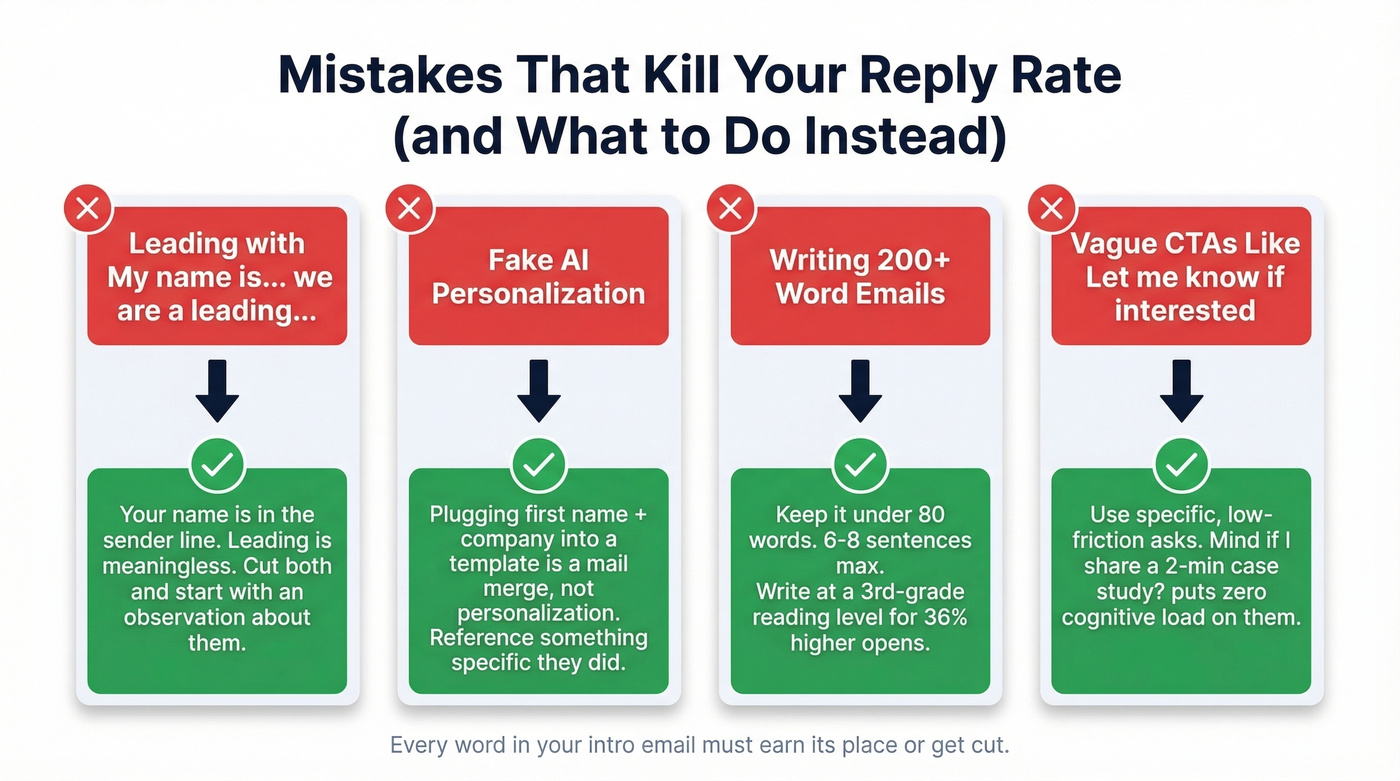
Fake AI personalization. Plugging a first name and company into a generic template isn't personalization - it's a mail merge. Recipients can tell. The consensus on r/sales is clear: over-reliance on automation without real personalization is the defining mistake of modern outbound. (See a better approach to personalized outreach.)
Emails over 200 words. If it scrolls on mobile, it's too long. Best-performing campaigns stay under 80 words.
Vague CTAs. "Let me know if you're interested" asks the prospect to do your job. "Can I send a 2-minute case study?" gives them a specific yes/no.
Sending without verifying contacts. A bounce rate above 2% damages your sender reputation. Verify before you send - skipping this step is how teams end up in spam folders permanently.
Writing a Formal Company Introduction Email
Not every introduction is casual. When you're reaching out to enterprise buyers, government agencies, or regulated industries, a formal email needs a slightly different tone - but the same structural principles apply. Keep it concise, lead with relevance to the recipient, and close with a specific ask. The only difference is register: replace "Hey" with "Dear," swap contractions for full forms, and maintain a professional sign-off. All eight samples above can be adapted to a formal register without changing their core framework.
FAQ
How long should a company introduction email be?
Between 50 and 125 words - three short paragraphs max. Data across millions of campaigns confirms that 6-8 sentences hit the sweet spot for both opens and replies. One practitioner cut their emails from 141 words to under 56 and doubled their reply rate.
What's a good reply rate for intro emails in 2026?
The average across cold email campaigns is 3.43%. Top 25% of campaigns hit 5.5%+, and the top 10% clear 10.7%. If you're consistently above 5%, you're outperforming most outbound teams.
When's the best day and time to send?
Thursday pulls the highest reply rate at 6.87%. Tuesday and Wednesday also perform well. Evening sends between 8-11 PM peak at 6.52% replies. Avoid Monday - it consistently underperforms.
What should a company introduction email include?
Five things: a subject line under 50 characters, an opening line referencing something specific about the recipient's company, a one-sentence value proposition with a concrete result, a credibility proof point, and a low-friction CTA. Skip the company history and mission statement.
How do I verify email addresses before sending company intros?
Use a dedicated verification tool before every campaign. Prospeo verifies emails in real-time with 98% accuracy and offers a free tier of 75 verifications per month - enough to validate early campaigns. Other options include NeverBounce and ZeroBounce, though accuracy and pricing vary.