

Most Intent Data Is Noise - Here's How to Use the 20% That Works
A sales leader with 20+ years of experience put it bluntly on r/sales: "90% of the intent triggers you're paying for are useless." Another practitioner on r/b2bmarketing called the whole category "80% smoke and mirrors."
And yet the intent data market hit roughly $4.49B in 2026, while only 25% of B2B companies actually use it - and of those, just 24% report exceptional ROI. Intent-driven campaigns show 220% higher click-through rates and up to 93% conversion improvements, but only when signals are filtered correctly. The gap between the winners and everyone else isn't the data. It's the framework.
What You Need Before Spending a Dollar
Here's the order of operations we recommend:
- Instrument your own website for first-party intent signals. Google Analytics, your MAP's page tracking, whatever you've got. This is free and produces the highest-quality signals you'll ever get.
- Add a contact data platform so you can actually reach accounts showing intent. You need verified emails and direct dials, not just account names. (If you’re evaluating options, start with a B2B database comparison.)
- Layer third-party intent from Bombora, G2, or 6sense only after you can consistently act on first-party signals.
The contrarian take: you don't need a $40K intent platform. You need to act on the signals you already have.
The Four-Tier Signal Hierarchy
Not all intent signals are created equal. Treating a pricing page visit the same as a generic blog read is how teams end up "chasing ghosts," as one Reddit practitioner described it. Clearbit's framework breaks intent into overt signals (form fills, demo requests) and covert signals (pricing page browsing, review-site research). That's useful, but it doesn't go far enough.
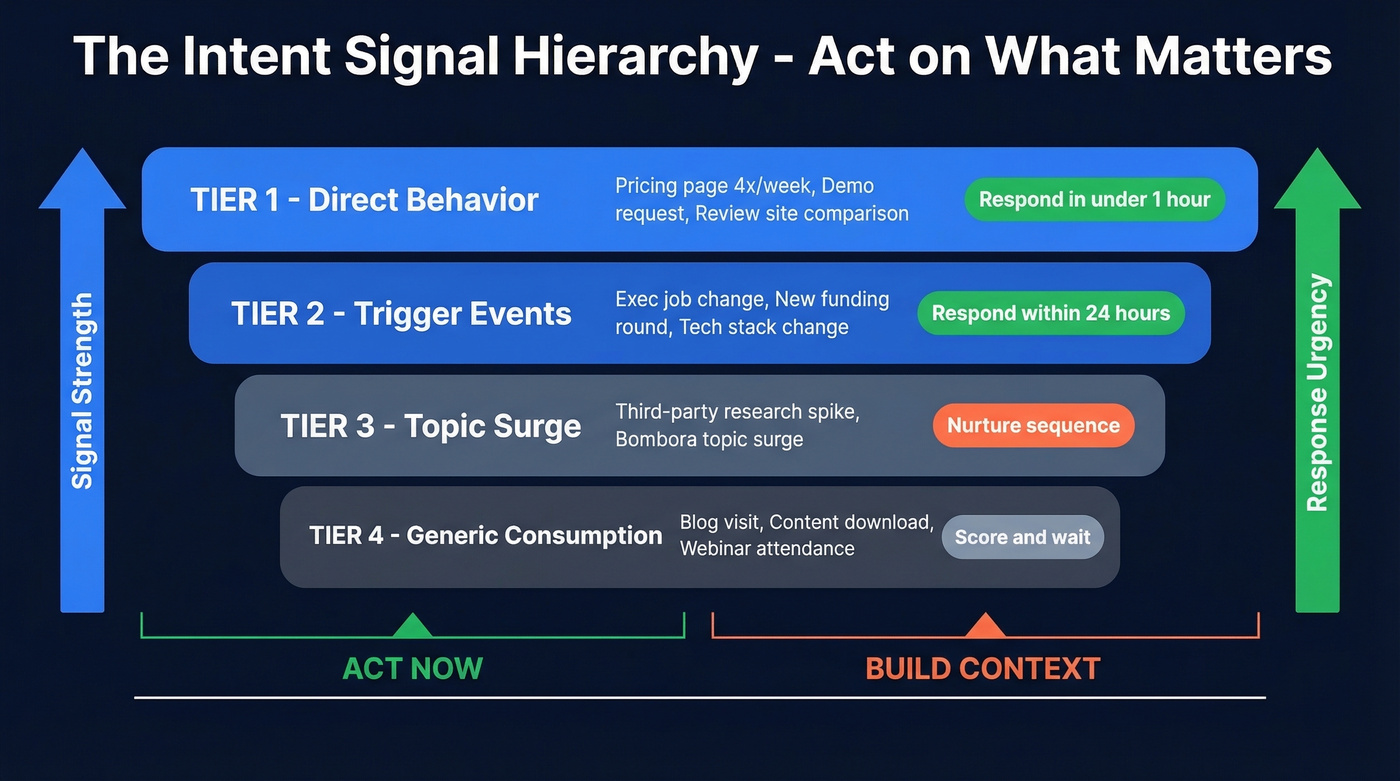
We use a four-tier hierarchy to prioritize response:
| Tier | Signal Type | Example | Strength | Response SLA |
|---|---|---|---|---|
| 1 | Direct behavior | Pricing page 4x/week | Strongest | Within 1 hour |
| 2 | Trigger events | Exec job change, funding | Strong | Within 24 hours |
| 3 | Topic surge | Third-party research spike | Moderate | Nurture sequence |
| 4 | Generic consumption | Blog visit, content download | Weak | Score and wait |
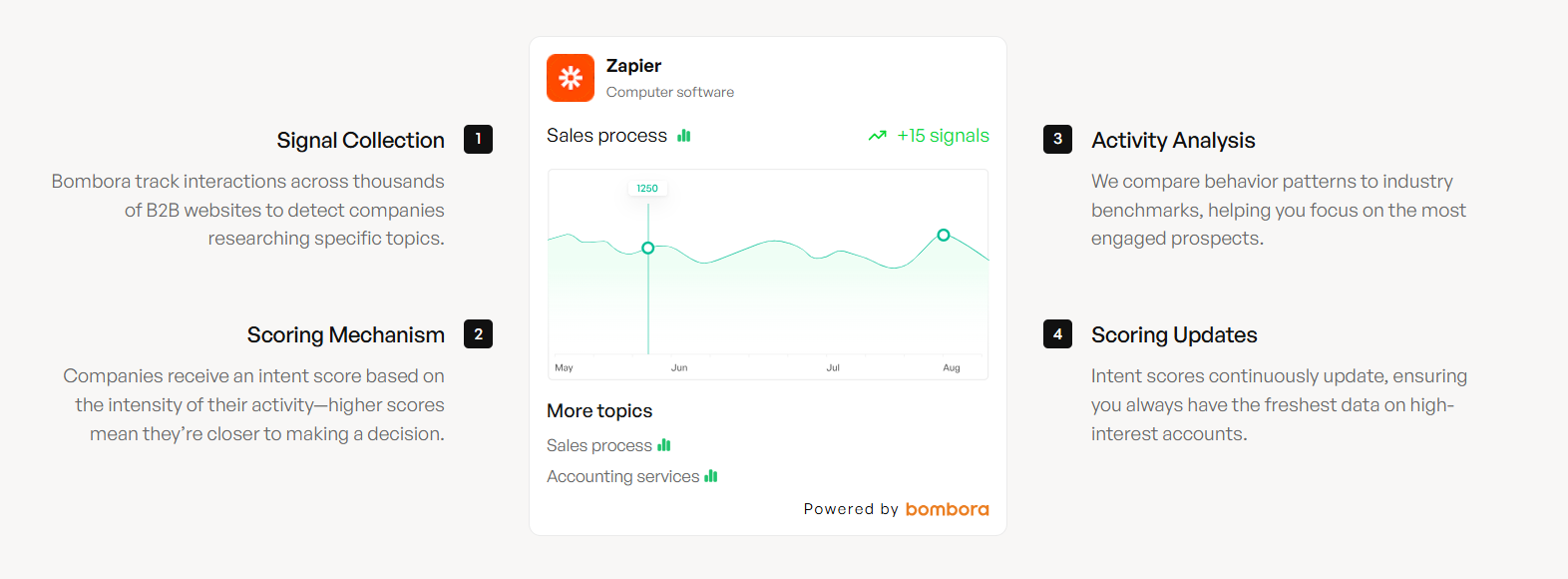
Here's the thing: if you've been wondering how buyer intent data works in practice, it's mostly this. Treat Tier 1 and Tier 2 as "act now" signals. Treat Tier 3 and Tier 4 as "build context" signals. That single distinction changes everything about how your SDRs spend their mornings.
This same hierarchy applies post-sale. A customer visiting your cancellation page is a Tier 1 churn signal that deserves the same urgency as a prospect hitting your pricing page. Other churn signals include decreased product usage, increased support tickets, billing disputes, and competitor searches. (If churn is a priority, see our guide on how to prevent churn.)
Review-site behavior - comparison research on G2 or TrustRadius - is a Tier 1 buying signal most teams underweight.
One negative-intent heuristic worth memorizing: if someone's only visiting your About and Careers pages, they're a job seeker, not a buyer. Filter them out before your SDRs waste time.
Turning Signals Into Outreach
The operational rule that separates teams who get ROI from intent data and teams who don't: filter by fit first, then prioritize by intent. An in-market account that doesn't match your ICP is still a bad account. Intent doesn't override fit - it accelerates it.
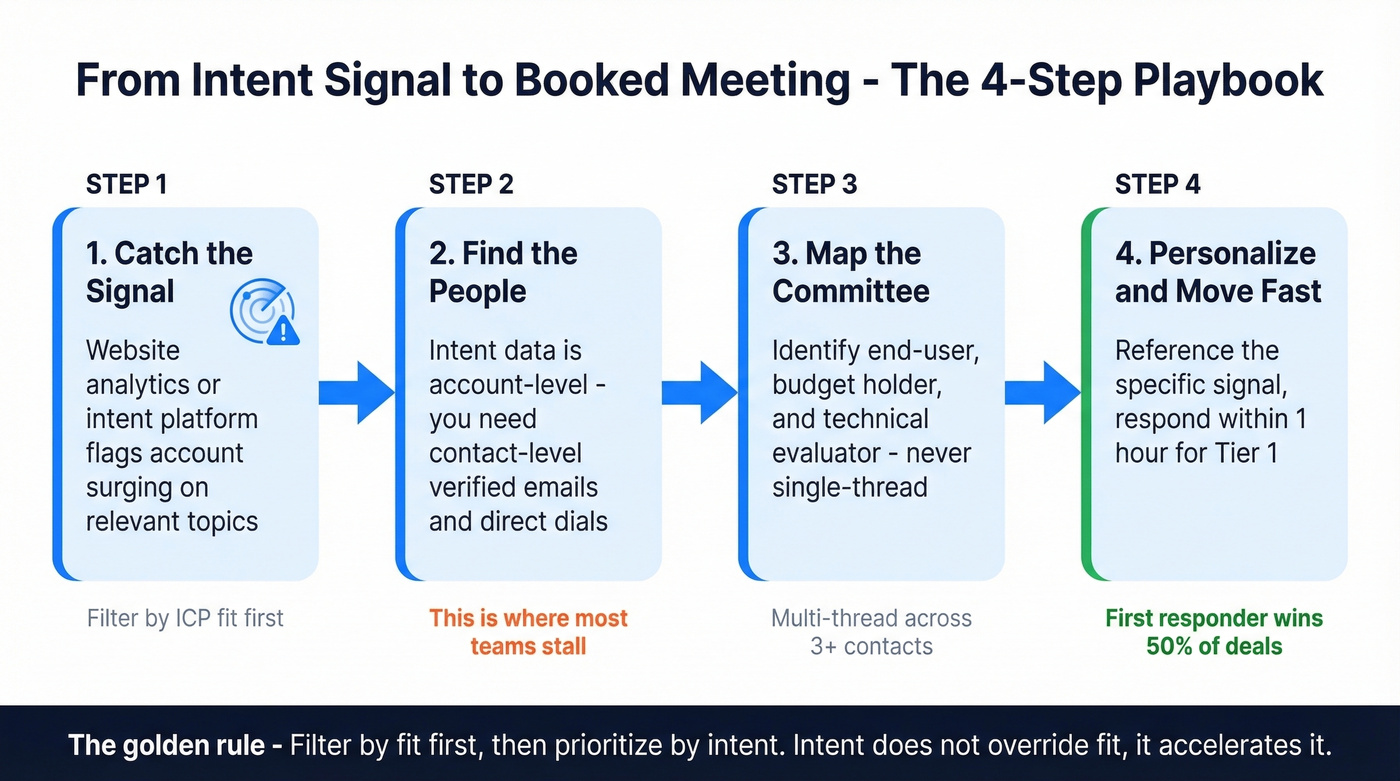
Say your website analytics show a 200-person fintech visited your pricing page three times this week. Once you've confirmed they match your ICP, the playbook looks like this:
- Catch the signal. Your website analytics or intent platform flags the account surging on relevant topics.
- Find the people. Intent data is account-level. You need contact-level data to do anything with it. This is where most teams stall - they know which company is in-market but can't reach the decision-makers. (More on this in our breakdown of contact-level intent data.)
- Map the committee. Don't single-thread. Identify the end-user, the budget holder, and the technical evaluator. Multi-thread your outreach across all three.
- Personalize and move fast. The vendor who responds first wins up to 50% of sales. One sales leader reported that spending just 5 minutes qualifying each intent-flagged account lifted reply rates from 2% to 8-12%.
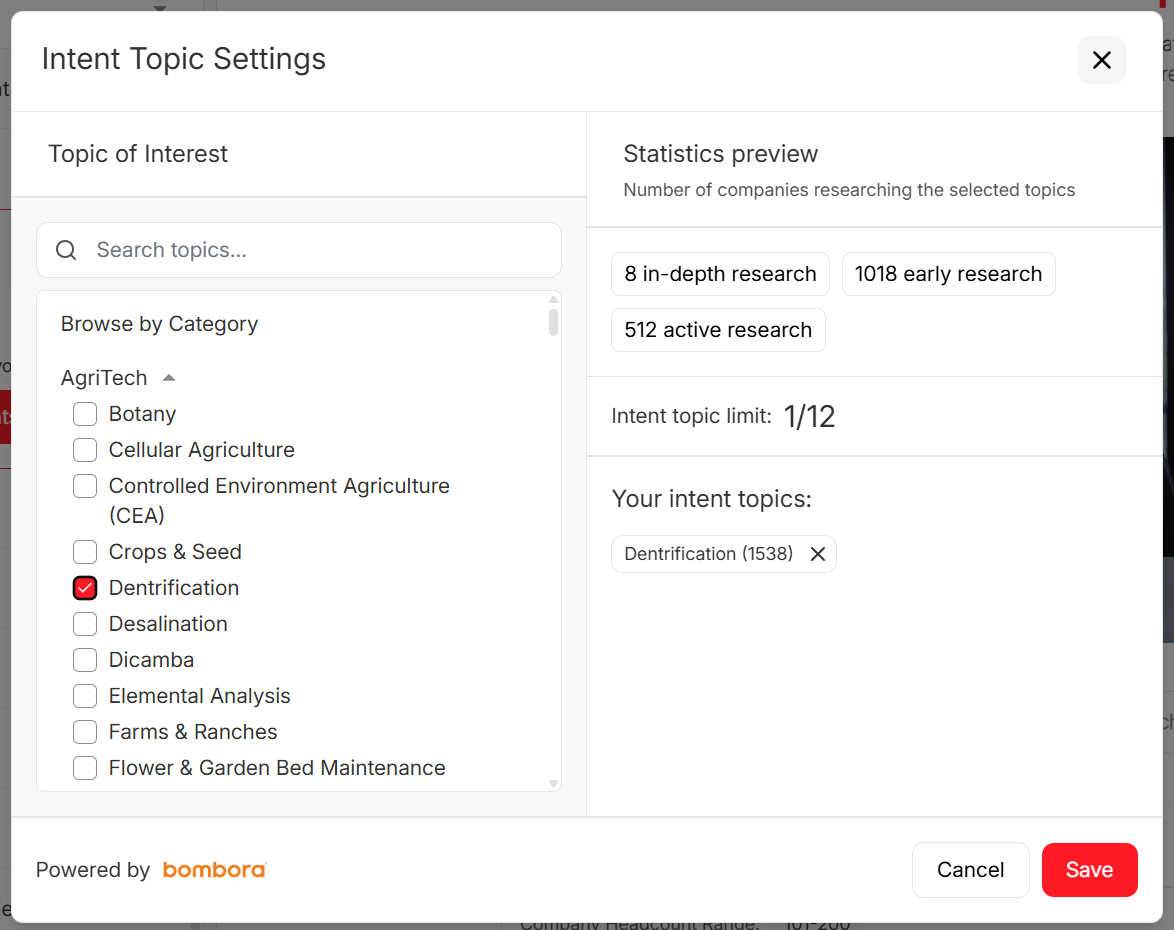
Step two is where we've seen the most teams stall out. You've got the signal. You know the account. But you can't find a verified email for the VP of Engineering who's actually making the decision. Prospeo's B2B database solves this by combining intent topic filters (15,000 Bombora topics) with job role, company size, technographics, and growth signals - then exporting verified emails at 98% accuracy and direct dials on a 7-day refresh cycle. Snyk's 50-person AE team used this kind of workflow to grow AE-sourced pipeline by 180%.
Contacting leads within 24 hours increases conversion by 5x. Nextiva's CMO reported closed-won rates jumping from 12% to 19% after shifting to insight-first prospecting supported by tools including 6sense. With Tier 1 signals, you want that window under an hour. (If you’re building the system end-to-end, use this blueprint to automate sales signals.)

Intent data tells you who's in-market. Prospeo tells you how to reach them. Combine 15,000 Bombora intent topics with verified emails (98% accuracy) and direct dials - all refreshed every 7 days. Snyk's 50 AEs grew pipeline 180% using this exact workflow.
Turn intent signals into booked meetings for $0.01 per verified email.
What Intent Data Costs in 2026
This is the section most intent data articles skip. Budget 15-25% above the license cost for implementation, integration, and optimization.
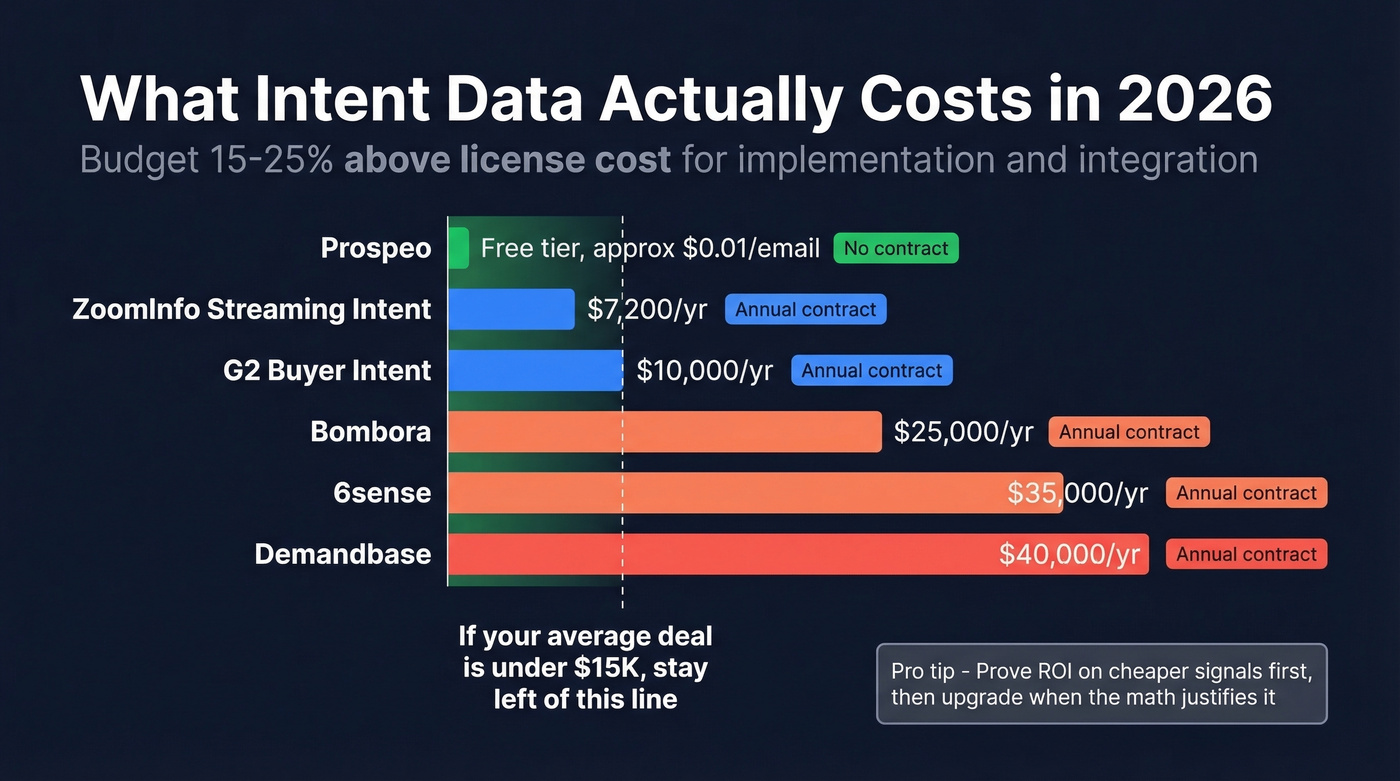
| Provider | Starting Price | Best For | Contract |
|---|---|---|---|
| Prospeo | Free tier; ~$0.01/email on paid | Intent + verified contacts | No contracts |
| ZoomInfo Streaming Intent | ~$7,200/yr | Teams already on ZoomInfo | Annual |
| G2 Buyer Intent | ~$10,000/yr | Review-site intent signals | Annual |
| Bombora | ~$25,000/yr | Pure intent data at scale | Annual |
| 6sense | ~$35,000/yr | Enterprise ABM orchestration | Annual |
| Demandbase | ~$40,000/yr | Full-stack ABM platform | Annual |
Let's be honest: if your average deal size sits below $15K, you probably don't need anything in the $25K+ tier. Those platforms pay for themselves when a single contract is worth six figures. For everyone else, prove you can act on cheaper signals first - then upgrade when the math justifies it. Skip the enterprise platforms entirely until you've exhausted what first-party data and a solid contact tool can do for you.
The article's math is clear: responding within an hour to Tier 1 signals wins deals. But speed means nothing if your emails bounce. Prospeo's 5-step verification and 7-day refresh cycle keep bounce rates under 4% - so when intent spikes, your outreach actually lands.
Stop chasing intent ghosts. Start reaching verified decision-makers.
Five Mistakes That Kill Intent Data ROI
Forrester's research on intent data mistakes is worth reading in full. These five kill the most deals:
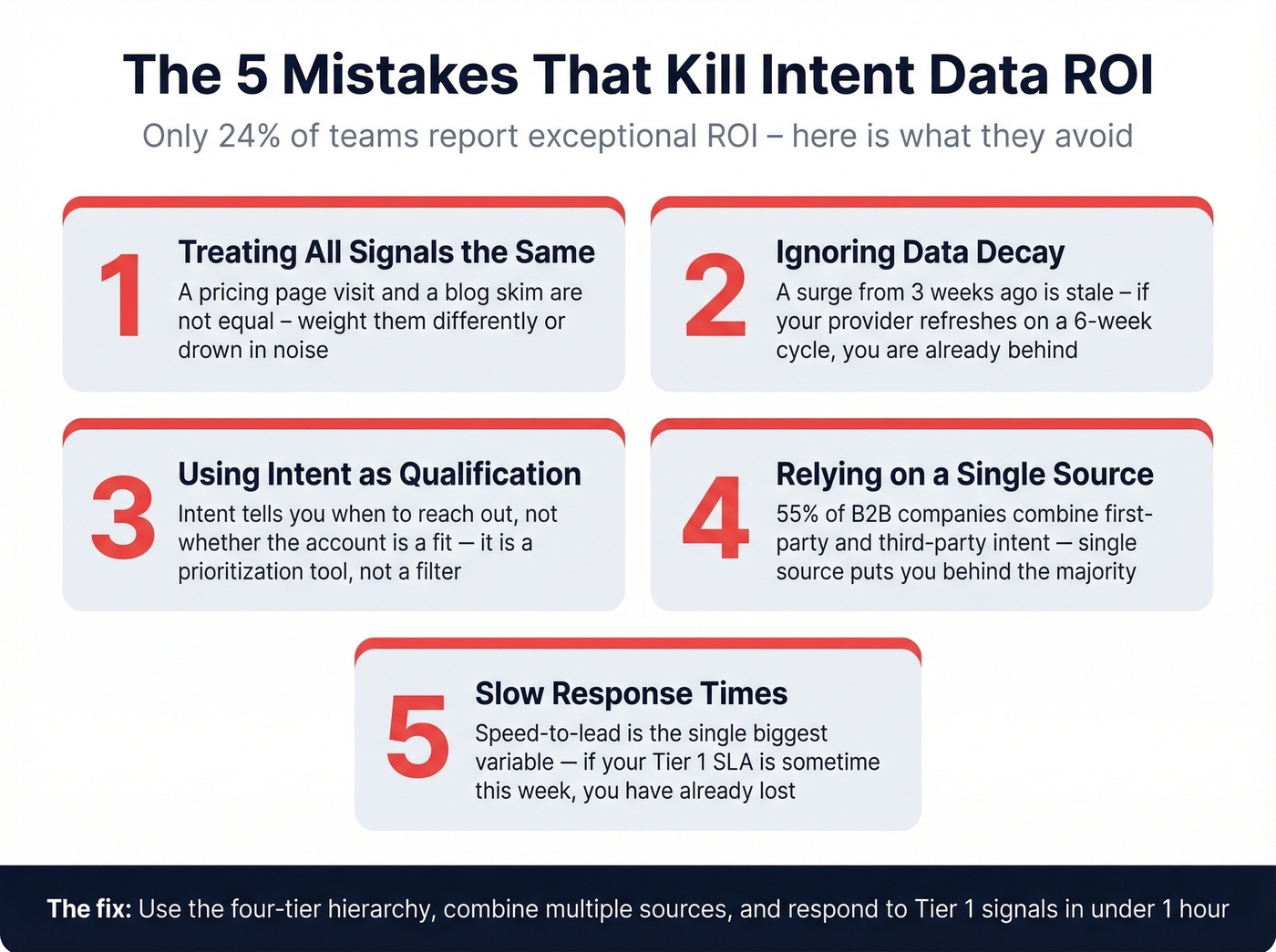
- Treating all intent sources the same. A pricing page visit and a blog skim aren't the same signal. Weight them differently or you'll drown in noise.
- Ignoring data decay. Intent is time-sensitive. A surge from three weeks ago is stale. If your data provider refreshes on a six-week cycle, you're already behind.
- Using intent as qualification. Intent tells you when to reach out, not whether the account is a fit. It's a prioritization tool, not a replacement for qualification. (If you need a tighter process, use a deal qualification framework.)
- Settling for a single source. Multi-source triangulation - first-party plus third-party plus trigger events - is more predictive than any one feed. 55% of B2B businesses already combine first- and third-party intent, so single-source reliance puts you behind the majority.
- Slow response times. Speed-to-lead is the single biggest variable. If your SLA for Tier 1 signals is "sometime this week," you've already lost the deal to whoever picked up the phone first. (Tighten the motion with a documented sales outreach strategy.)
Only 24% of teams report exceptional ROI from intent data. Avoiding these mistakes is how they got there.
Compliance in 60 Seconds
Intent data doesn't exempt you from privacy law. Four things to know:
- B2B contacts are personal data under both GDPR and CCPA. There's no blanket B2B exemption. (More detail: B2B compliance.)
- The CCPA B2B exemption expired January 1, 2023. California residents get full consumer rights regardless of business context.
- Legitimate interest works for most B2B outreach under GDPR, but you need to document your balancing test. "We bought a list" isn't documentation.
- Always provide an easy opt-out. Every email, every sequence. This protects your domain reputation as much as it satisfies regulators.
FAQ
What's the difference between first-party and third-party intent data?
First-party intent data comes from your own properties - website visits, product usage, email engagement - and it's free with the highest signal quality. Third-party intent data is aggregated browsing behavior across publisher networks; Bombora, for example, tracks 17B+ interactions monthly across 5,000+ sites. Best results come from combining first-party accuracy with third-party scale, which is why 55% of B2B companies now use both.
How fast should you act on intent signals?
Tier 1 signals demand response within one hour. Tier 2 within 24 hours. Tier 3 goes into nurture sequences. The vendor who responds first wins up to 50% of deals, making speed-to-lead the highest-leverage variable in any intent-driven outreach workflow - and the one most teams still get wrong.
Can you use intent data without an expensive platform?
Yes. Start with first-party signals from your website analytics, which are free and high-quality. Then add a contact data tool like Prospeo (free tier available, ~$0.01/email on paid plans) to find verified emails and direct dials at in-market accounts. You don't need a $25K+ platform to start acting on buyer intent signals today - in our experience, most teams should prove the workflow works at a lower price point before scaling up spend.