

How to Manage a Remote Sales Team Without Losing Your Mind - or Your Pipeline
It's 4 PM on a Tuesday. Your newest remote rep has logged two activities all day. You can't walk to their desk. You open Slack and type... what?
Figuring out how to manage a remote sales team isn't about more check-ins - it's about better systems. Only 43.5% of sales professionals hit quota in recent quarters, and 17% of reps generate 81% of revenue. That means most teams are carrying dead weight they can't even see. Remote makes both problems harder because there's no hallway correction, no shoulder tap, no "hey, how's that deal going" at the coffee machine.
You need three things: a scoreboard with real numbers, a coaching rhythm built on call reviews instead of surveillance, and clean data so reps stop wasting dials on dead numbers. Let's build each one.
Build the Scoreboard First
Activity metrics without conversion benchmarks are vanity metrics. "50 dials a day" means nothing if you don't know what good conversion looks like. Here's the benchmark table your dashboard should reflect:
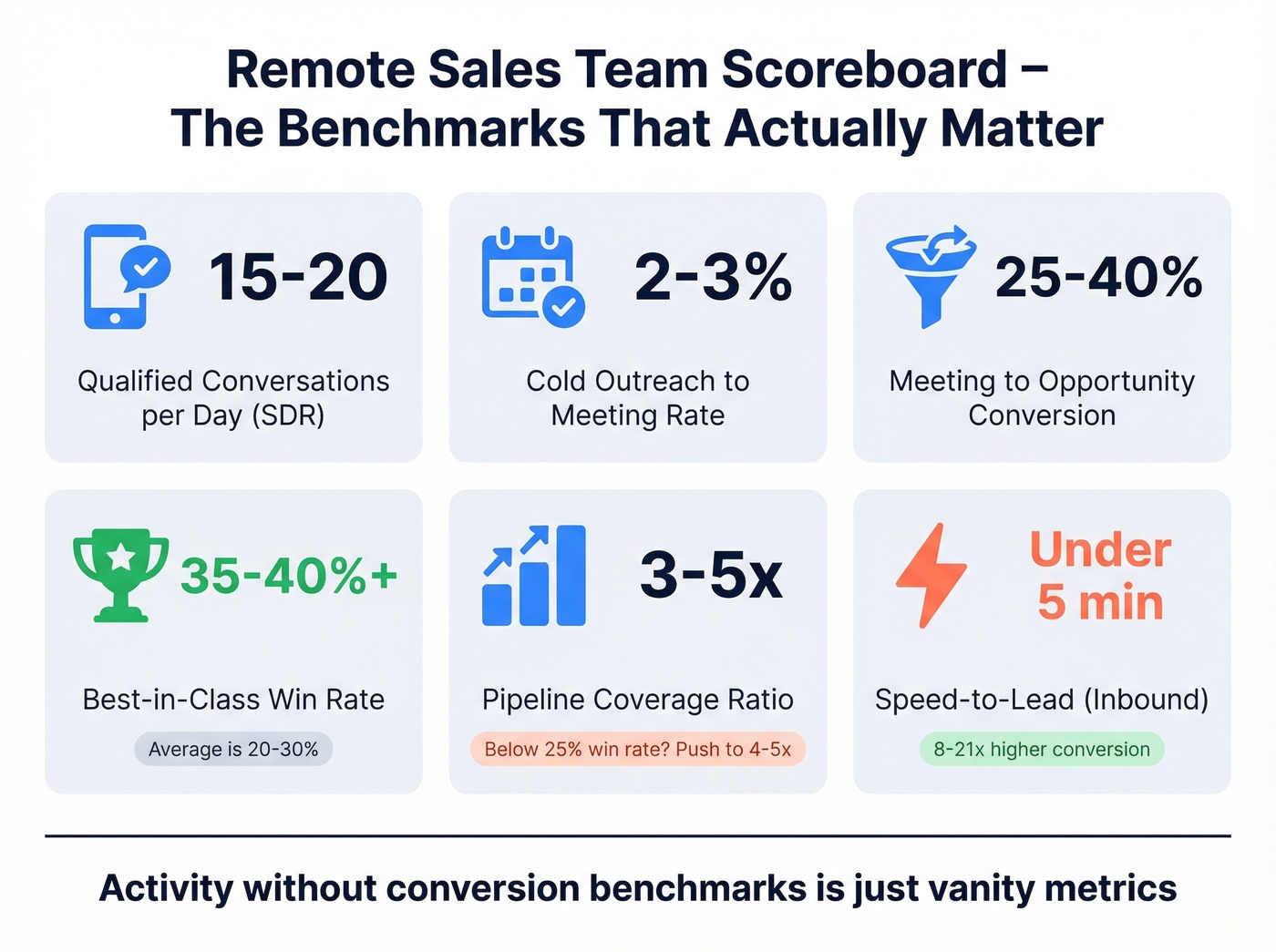
| Metric | SDR Benchmark | AE Benchmark |
|---|---|---|
| Qualified conversations/day | 15-20 | 8-12 |
| Cold outreach to meeting | 2-3% | - |
| Meeting to opportunity | 25-40% | 25-40% |
| Win rate | 20-30% avg | 35-40%+ best-in-class |
| Pipeline coverage | 3-5x | 3-5x |
| Speed-to-lead (inbound) | Under 5 min | Under 5 min |
Speed-to-lead is the sleeper metric. Responding in under five minutes yields 8-21x higher conversion. For remote teams with no manager hovering, this needs to be automated - not left to rep discipline.
Pipeline coverage at 3x is the floor. If your team's win rate runs below 25%, push that to 4-5x. We've watched managers obsess over activity volume while ignoring coverage ratios, and it always ends the same way: a pipeline that looks full but closes light. (If you want a deeper framework, use these pipeline health metrics.)
CRM as Command Center
One r/sales manager gave a new remote hire 12 accounts to call - expected it to take an hour. Three hours later, nothing was logged in Salesforce. The rep "acted like he understood." He didn't.
Here's the thing: if CRM adoption across your team is below 70%, you've got a design problem, not a rep problem. If logging a call takes six clicks, reps won't do it - especially when nobody's watching. Reduce required fields. Make the CRM the path of least resistance. This is one of the most overlooked remote sales management tips: simplify the system before blaming the people. (Need options? Here are examples of a CRM and a breakdown of contact management software.)
Communication Cadence That Actually Works
Remote teams don't need more meetings. They need the right three:
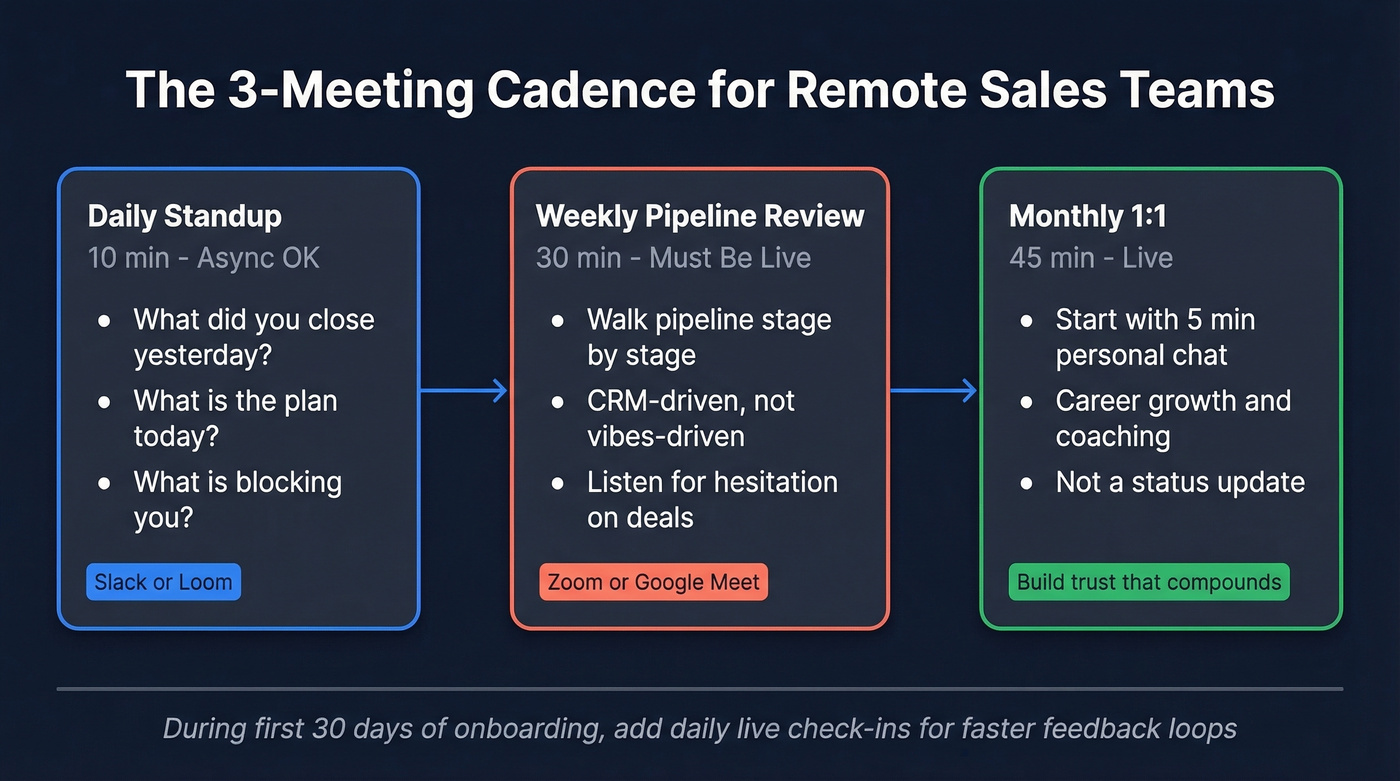
Daily standup (10 min, async-friendly). A Loom or Slack thread. What'd you close yesterday, what's the plan today, what's blocking you. No camera required.
Weekly pipeline review (30 min, live). CRM-driven, not vibes-driven. Walk the pipeline stage by stage. This is the one meeting that can't be async - tone of voice and hesitation tell you more about deal health than any CRM field ever will. (More scripts and structure in our remote sales meeting tips.)
Monthly 1:1 (45 min, live). Career and coaching, not a status update. Start with five minutes of non-work conversation. Skipping personal connection erodes trust fast, and trust is the only currency that compounds when you can't share a room.

Remote reps can't walk over and ask for a better lead list. Every bounced email and dead number kills momentum - and you can't see it happening. Prospeo's 7-day data refresh and 98% email accuracy mean your distributed team spends dials on real prospects, not ghosts.
Stop paying remote sellers to chase dead contacts.
Coach From Real Calls
Traditional QA reviews cover less than 2% of interactions. That means 98% of what your reps say to prospects is invisible to you.
The fix: conversation intelligence tools like Gong or Chorus, paired with a structured call-scoring rubric. Review 2-3 calls per rep per week - not to catch mistakes, but to find what's working. When reps know you're reviewing calls to help them win rather than to build a case against them, defensiveness disappears. Managing remote sales reps well means coaching from evidence, not assumptions. (This pairs well with a sales performance management approach.)
In our experience, the single highest-ROI coaching move is pulling a 30-second clip of a rep nailing an objection and sharing it in the team Slack channel. Public wins create private motivation.
Commission Design for Distributed Teams
Monthly commission payouts are a motivation killer for remote teams. A manager on r/sales put it bluntly - waiting 3-4 weeks after closing a deal "isn't hitting the same." When there's no office energy and no bell-ringing, the payout is the only dopamine hit left.
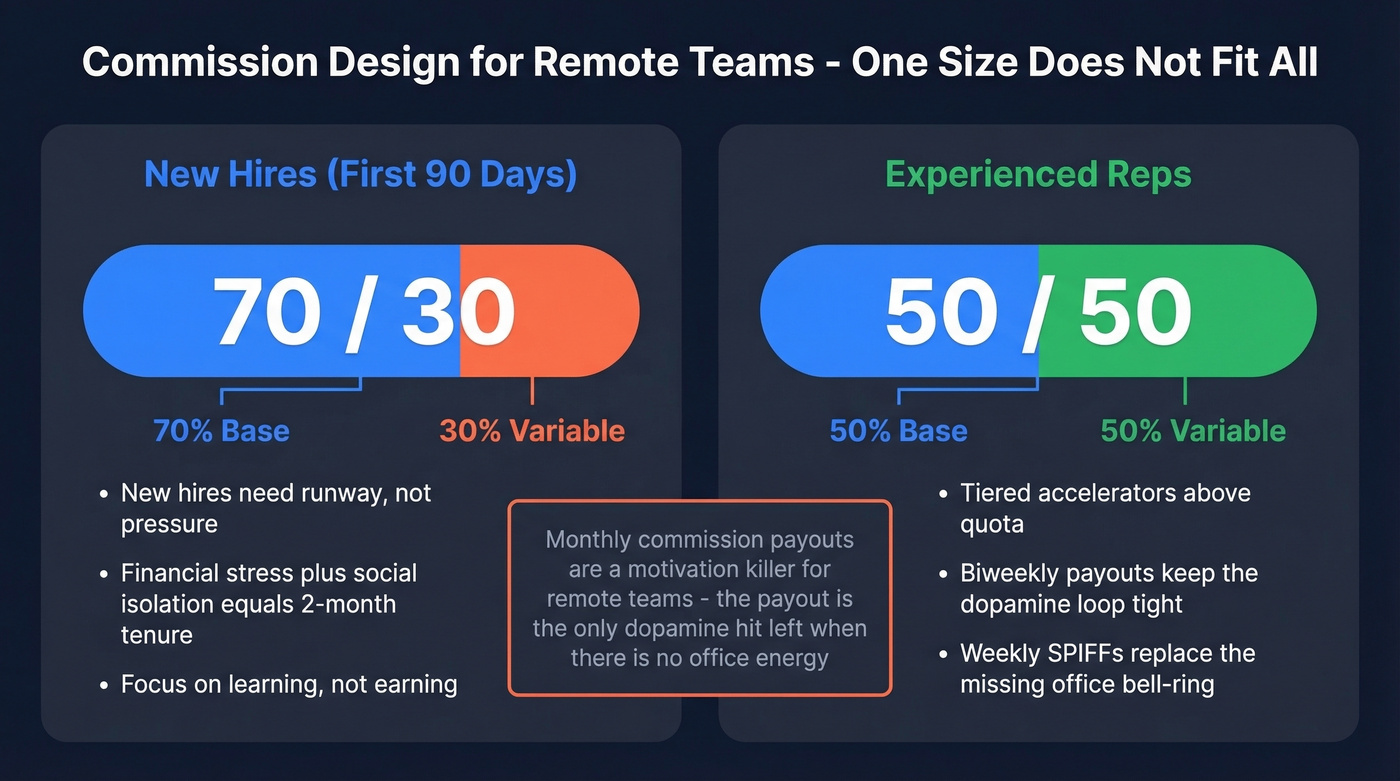
For experienced reps, run a 50/50 base-to-variable split with tiered accelerators. Biweekly payouts or weekly SPIFFs keep the feedback loop tight.
Skip this if you're onboarding new reps. Start them at 70/30 base-to-variable. New hires need runway, not pressure. Starving a new remote rep financially while they're also socially isolated is a recipe for a two-month tenure. (Use a structured 30-60-90 day plan for sales reps to reduce early churn.)
The Four-Layer Tech Stack
A Zoom workplace survey found 75% of organizations believe their remote work tools need upgrades. Most guides recommend ten tools. Your team needs four, configured correctly:
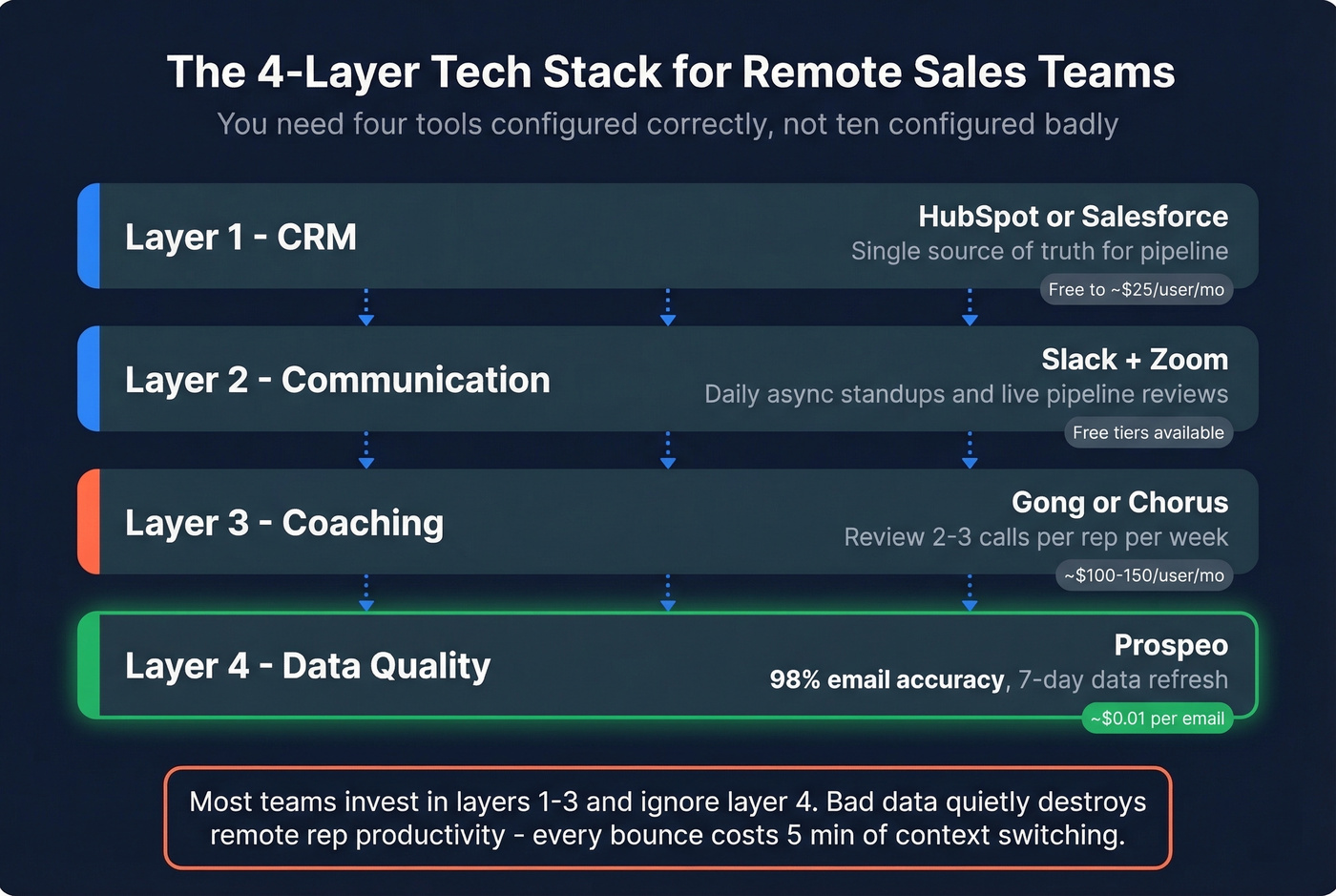
| Layer | Tool | Starting Price |
|---|---|---|
| CRM | HubSpot / Salesforce | HubSpot free CRM; Salesforce from ~$25/user/mo |
| Communication | Slack + Zoom | Free tiers available |
| Coaching | Gong / Chorus | ~$100-150/user/mo (typically billed annually) |
| Data Quality | Prospeo | Free tier; ~$0.01/email |
The first three layers get all the attention. The fourth - data quality - quietly destroys remote rep productivity. When a rep dials a disconnected number or sends an email that bounces, they lose confidence, momentum, and five minutes of context-switching. Multiply that across a team doing 50+ touches a day and you're hemorrhaging hours. (If you're evaluating vendors, start with these data enrichment services.)

GreyScout cut rep ramp time from 8-10 weeks to 4 after switching to Prospeo - new reps stopped burning their first month chasing bad contact data. With 98% email accuracy and a 7-day data refresh cycle, every outreach attempt actually reaches someone. (Related: how to reduce email bounce rate and improve email deliverability.)
If your deal sizes exceed $5k and your reps are still manually sourcing contact info, you're paying senior sellers to do intern work. Fix the data layer first. Everything else gets easier.
GreyScout cut remote rep ramp time in half after switching to Prospeo - from 8-10 weeks down to 4. New hires stopped burning their first month on bad data and started building pipeline immediately. At $0.01 per verified email, clean data costs less than a single wasted rep-hour.
Ramp remote reps in weeks, not months.
Avoid These Remote Management Mistakes
Micromanaging activity instead of outcomes. Set conversion benchmarks, not dial quotas. A rep who makes 30 calls and books 4 meetings is outperforming the one who logs 80 dials and books 1. (If you need a menu of what to track, see sales activities examples.)
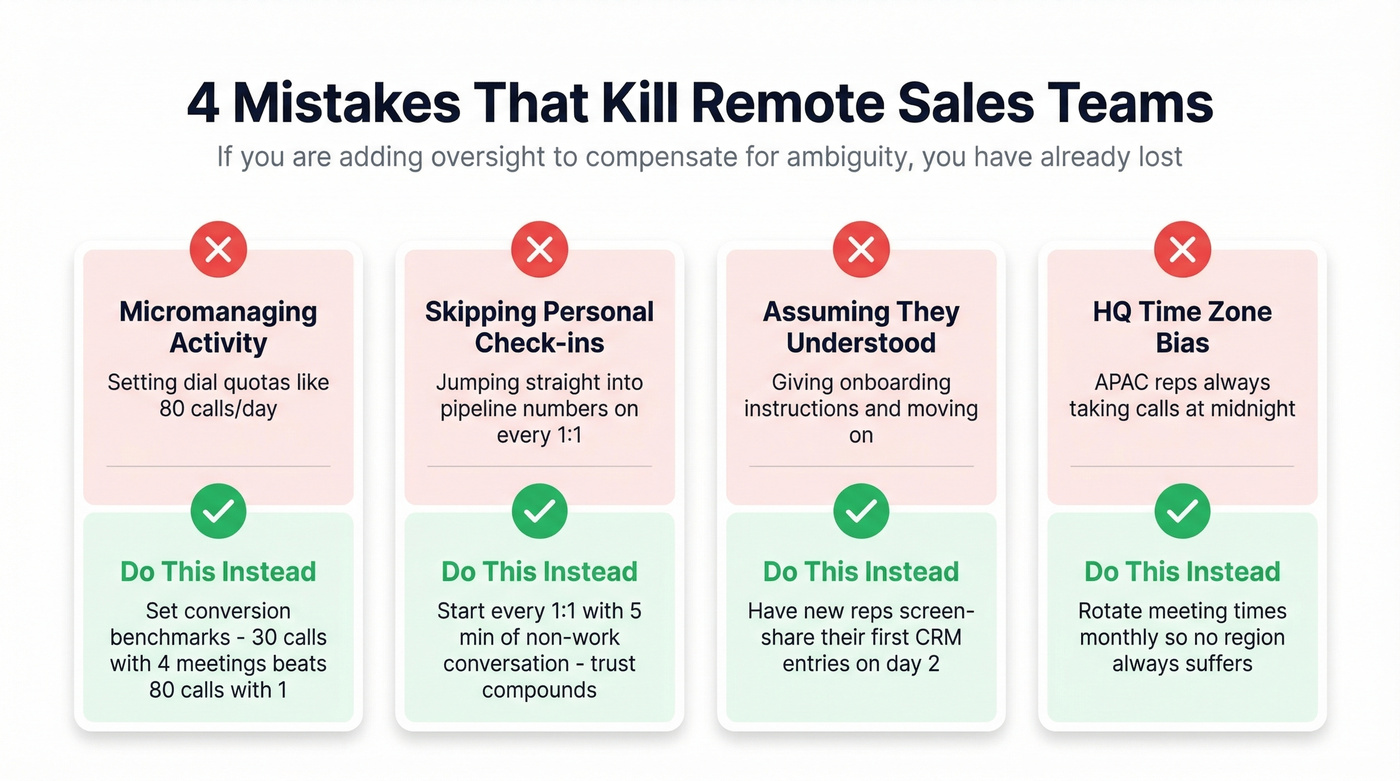
Skipping personal check-ins. Start every 1:1 with five minutes of non-work conversation. It feels like wasted time. It isn't.
Assuming "they understood" during onboarding. Have new reps screen-share their first CRM entries. You'll catch misunderstandings on day two instead of month two.
Running all meetings on HQ's time zone. Rotate meeting times monthly. If your APAC reps are always the ones taking calls at midnight, they'll leave.
The managers who get remote right consistently point to the same thing: fewer tools, configured better, with clear expectations from day one. Let's be honest - if you're adding oversight to compensate for ambiguity, you've already lost. Eliminate the ambiguity instead.
FAQ
How often should I check in with remote sales reps?
Daily async standup, weekly live pipeline review, monthly coaching 1:1. During the first 30 days of onboarding, add daily live check-ins - new reps need faster feedback loops before they build habits.
What KPIs matter most for remote sales teams?
Pipeline coverage (3-5x), meeting-to-opportunity conversion (25-40%), and speed-to-lead (under 5 minutes). These three metrics expose pipeline health faster than activity volume ever will.
How do I stop reps from wasting time on bad data?
Use a verification tool with a weekly data refresh cycle. GreyScout cut ramp time in half after switching to verified data - their bounce rate dropped from 38% to under 4%, and reps spent their first weeks selling instead of troubleshooting dead contacts.
What's the biggest mistake in remote sales team management?
Treating it like in-office management minus the office. The playbook needs to change: async communication, outcome-based KPIs, and tighter data hygiene replace the hallway conversations and visual accountability you lose when everyone's distributed.