

How to Qualify Sales Leads: The Operational Playbook for 2026
It's Thursday at 3 PM. Your SDR team has 200 "leads" from last week's webinar sitting in the CRM. Half are students. A quarter work at companies with six employees and no budget. Your reps are about to spend the next two days calling every single one because nobody built a system to qualify sales leads before reps start dialing.
That's not a pipeline. It's a lottery ticket.
67% of lost sales trace back to poor qualification - not bad closing skills, not weak demos, but bad qualification. And with 96% of buyers doing extensive research before they ever talk to your team, the leads that do raise their hand are either ready to buy or ready to waste your time. The difference is your qualification process.
What You Need (Quick Version)
Bookmark this. Send it to your team Monday.
- A scoring model with real numbers. Not "hot/warm/cold" - actual point values, thresholds, and decay rules. Copy-paste version below.
- Two frameworks, not six. One fast screen for inbound (BANT). One deep qualifier for deals that pass the screen (MEDDIC or SPICED).
- Clean, current data feeding both. Your scoring model is worthless if the contact records it's grading are weeks stale.
What Lead Qualification Actually Means
Lead qualification is the process of determining whether a prospect is worth your team's time and likely to become a customer. It's a sequence of decisions that starts with "does this person match our ICP?" and ends with "should we invest selling resources here?"
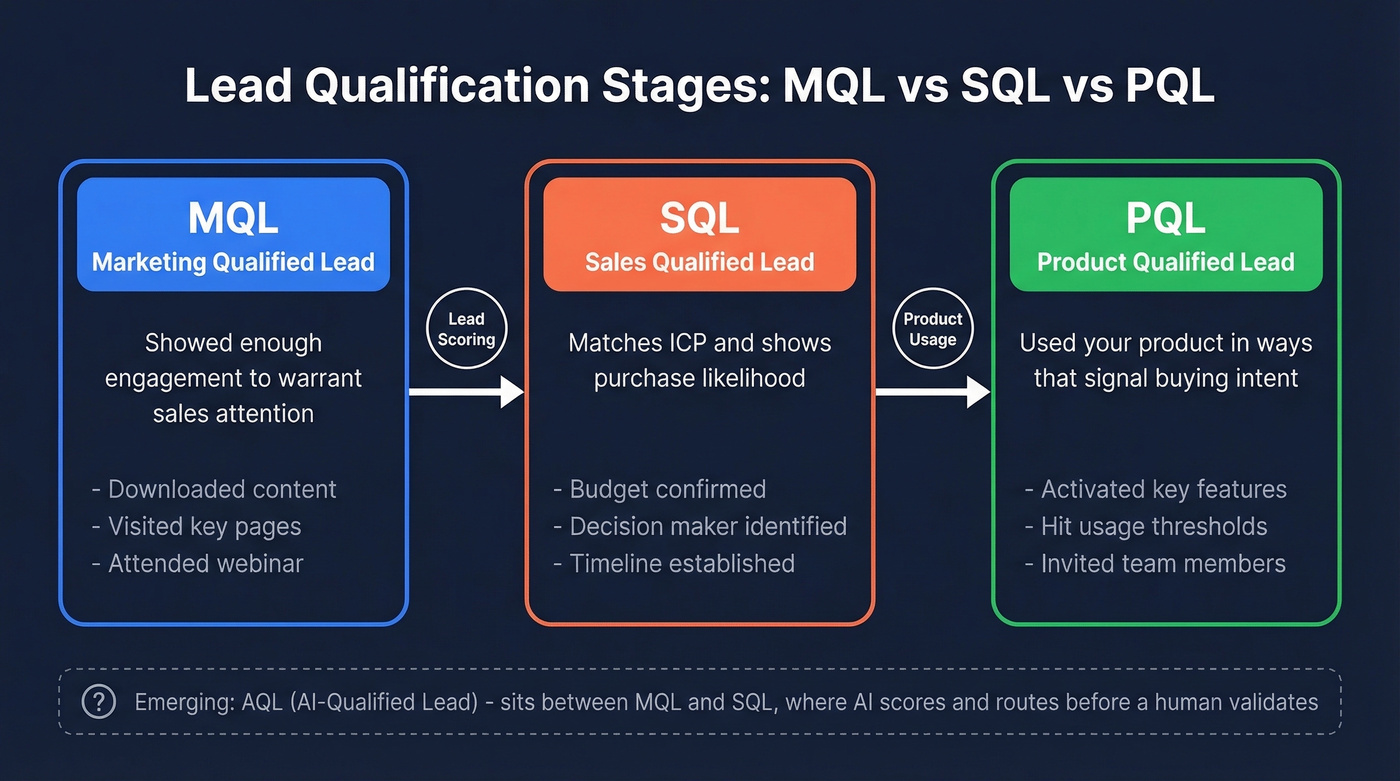
Three terms get confused constantly. An MQL (marketing qualified lead) has shown enough engagement to warrant sales attention. An SQL (sales qualified lead) matches your ICP and has demonstrated likelihood to purchase. A PQL (product qualified lead) has used your product in a way that signals buying intent - common in freemium models. Some teams are now experimenting with AQLs (AI-qualified leads) as a stage between MQL and SQL, where AI handles initial scoring and routing before a human validates. Worth watching, but don't skip human qualification for anything above $10k ACV.
One critical distinction: lead qualification isn't the same as lead scoring. Scoring assigns numerical values to attributes and behaviors. Qualification is the broader system that includes scoring, framework-based discovery, and human judgment. You need both.
Why Qualification Matters More in 2026
Each B2B deal now involves an average of five decision-makers, and complex enterprise deals routinely pull in 6-10+ stakeholders. You're not qualifying a person anymore - you're qualifying a buying committee. Miss one blocker and the deal stalls in week eight.
There's also a brutal alignment gap. 82% of C-suite executives think sales and marketing are aligned on lead quality. Only 65% of the people actually doing the work agree. That disconnect means marketing sends leads that sales doesn't trust, and sales ignores leads that marketing spent real money generating.
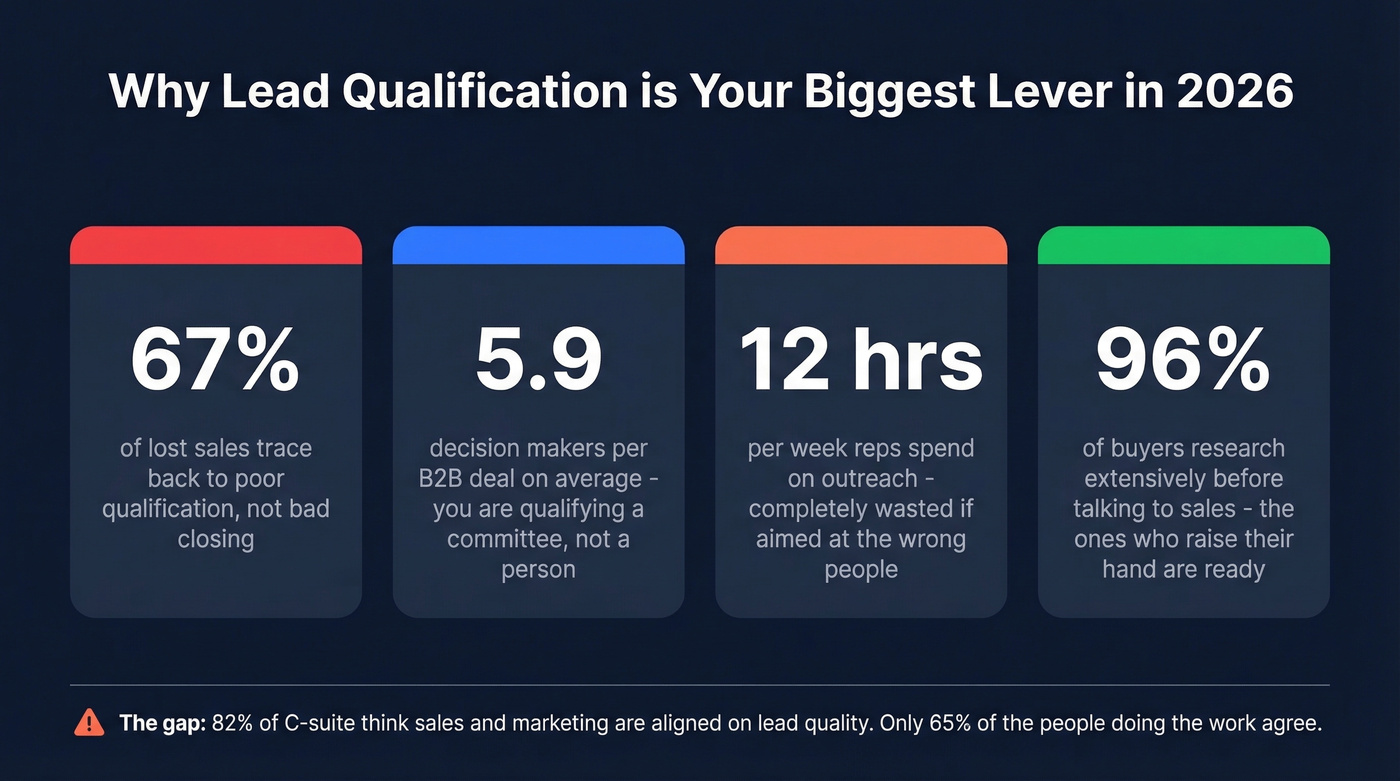
Sellers spend 5.9 hours per week personalizing pre-written content and another 6.2 hours creating outreach from scratch - 12 hours a week on outreach that's completely wasted if it's aimed at the wrong people. Proper lead qualification is the single best way to reclaim those hours.
The AI era has made this worse, not better. Every team can now generate more outreach, faster. More noise in every buyer's inbox means your qualification bar needs to be higher than ever. More leads doesn't mean better leads. It usually means the opposite.

Your lead scoring model is worthless if the contact data behind it is stale. Prospeo refreshes 300M+ profiles every 7 days - not the 6-week industry average - so your ICP filters, firmographic scores, and intent signals grade leads on reality, not outdated records. 98% email accuracy means reps dial into real conversations, not bounces.
Stop qualifying leads against last quarter's data. Start with records you can trust.
5 Steps to Qualify Sales Leads
Step 1: Define Your ICP With Qualifying Criteria
Your ICP shouldn't come from a whiteboard brainstorm. It should come from your closed-won data. Pull your last 50 wins and look for patterns:
- Firmographics: Company size, revenue range, industry, location, funding stage
- Technographics: Tech stack signals that indicate compatibility or need
- Growth signals: New leadership hires, product launches, active hiring in relevant departments
- Negative signals: Recent layoffs, lack of funding, hiring freezes
Growth signals matter more than most teams realize. A company that just hired a new VP of Sales is a fundamentally different prospect than one that laid off their sales team last quarter - even if they're the same size and industry.
Build your ICP criteria from wins, then use those criteria to filter before your reps ever touch a lead. Without this foundation, every downstream step is guesswork. If you need a starting point, use an Ideal Customer Profile Template and adapt it to your closed-won patterns.
Step 2: Build Your Lead Scoring Model
This is the centerpiece. A scoring model assigns numerical values to lead attributes (fit) and behaviors (intent), then uses thresholds to route leads appropriately.
Here's a concrete model you can implement this week:
| Signal | Points |
|---|---|
| Demo request | +40 |
| C-level decision maker | +30 |
| Target industry match | +25 |
| Pricing page visit | +20 |
| Case study download | +15 |
| Email open | +5 |
| Competitor employee | -50 |
| Email unsubscribe | -25 |
| Wrong company size | -20 |
| Personal email (B2B) | -15 |
| Single page bounce | -10 |
Set your MQL threshold to capture the top 20% of leads by score - typically 50-75 points on a 100-point scale. This range yields 15-25% conversion rates from qualified leads to closed deals.
Two operational rules most teams skip:
Score decay. Reduce scores by 25% per month without new activity. A lead who downloaded a whitepaper six months ago and went silent isn't an MQL - they're a ghost. Decay keeps your pipeline honest.
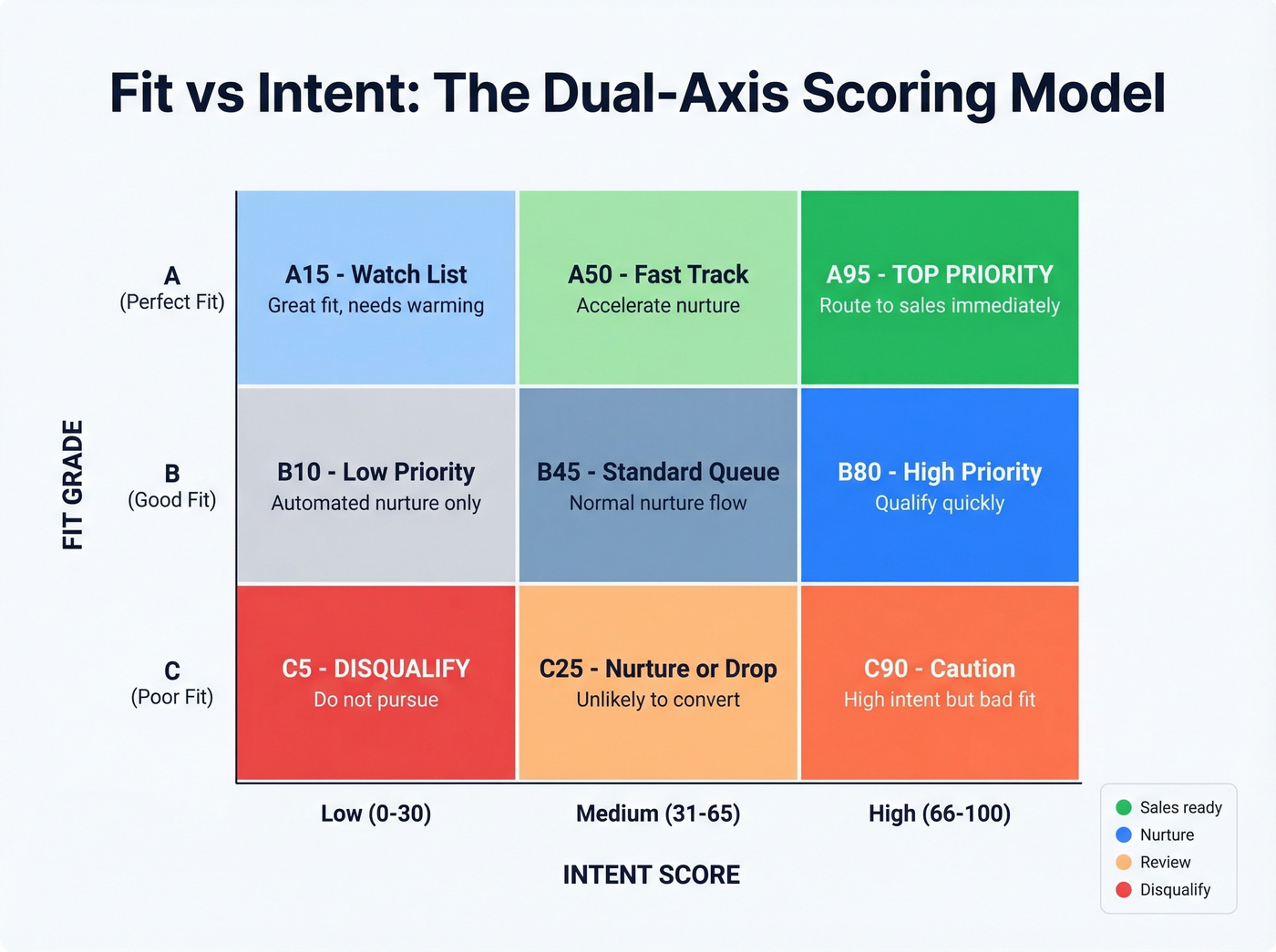
Fit vs. intent separation. The best models separate these into a grade (fit) and a score (intent). An A95 is a perfect-fit company showing high intent - top priority. A C25 is a poor-fit company with low engagement - that goes to nurture, not sales. This dual-axis approach prevents your team from chasing high-intent leads at companies that'll never buy.
One exception: "contact us," demo request, and trial signup leads should go to sales regardless of fit score. But they still need human qualification. A competitor's intern requesting a demo isn't an opportunity just because the form submission scored +40.
We've seen teams tighten their title and seniority filters, lower their activity threshold slightly, and get a 13% increase in MQL-to-meeting rate. Small scoring adjustments compound fast.
Step 3: Choose Your Qualification Framework
Stop collecting frameworks. Start implementing one.
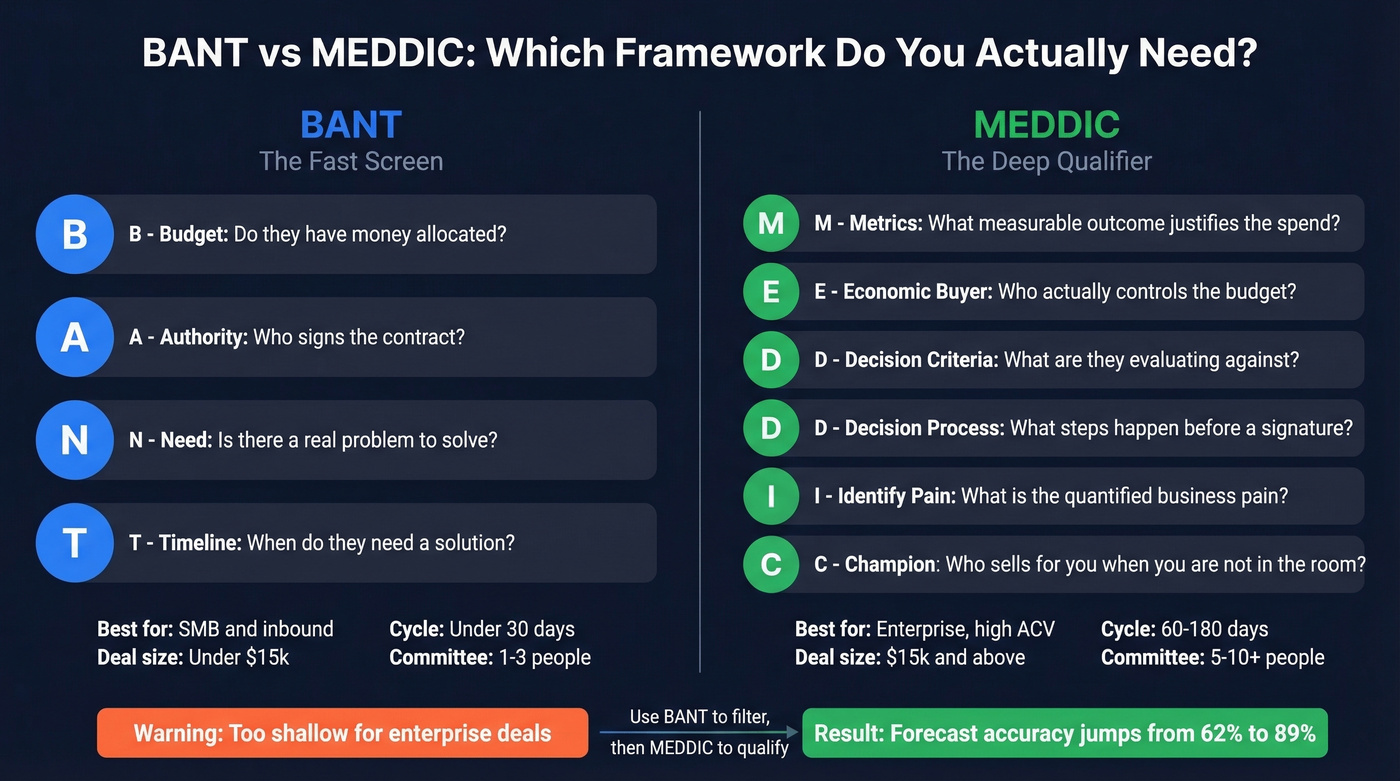
| Framework | Best For | Cycle Length | Buying Committee |
|---|---|---|---|
| BANT | High-velocity SMB/inbound | <30 days | 1-3 people |
| MEDDIC | Enterprise, high-ACV | 60-180 days | 5-10+ people |
| CHAMP | Mid-market consultative | 30-90 days | 3-5 people |
| SPICED | Change-heavy, consultative | 45-120 days | 4-8 people |
Most teams need exactly two: a fast screen (BANT) to filter inbound leads in under five minutes, and a deep qualifier (MEDDIC or SPICED) for deals that pass the screen. If you're standardizing MEDDIC, keep a shared bank of MEDDIC discovery questions so reps don't improvise.
Let's break this down with a real scenario. Imagine a $60k SaaS deal with stakeholders in IT, RevOps, and Finance, plus an ERP integration deadline in Q3.
BANT would ask: Do they have budget? Who decides? Do they need this? When? You'd get surface-level answers and move on. Fine for a $5k deal. Dangerously shallow for this one.
MEDDIC would map the Metrics (what measurable outcome justifies $60k?), the Economic Buyer (who signs?), the Decision criteria, the Decision process, the Pain, and the Champion who'll sell internally when you're not in the room. You'd surface the ERP deadline as a compelling event and identify that Finance has veto power.
Here's the thing: BANT is a pre-filter, not a qualification framework for anything above SMB. If your average deal exceeds $15k and you're still running BANT as your primary framework, you're flying blind on the variables that actually kill deals - internal politics, competing priorities, and unsigned procurement approvals. Teams that switched from BANT to MEDDIC saw forecast accuracy improve from 62% to 89%. That's not a marginal gain. That's the difference between a pipeline you can trust and one you can't.
Step 4: Ask the Right Discovery Questions
The framework tells you what to learn. The questions determine whether you actually learn it.
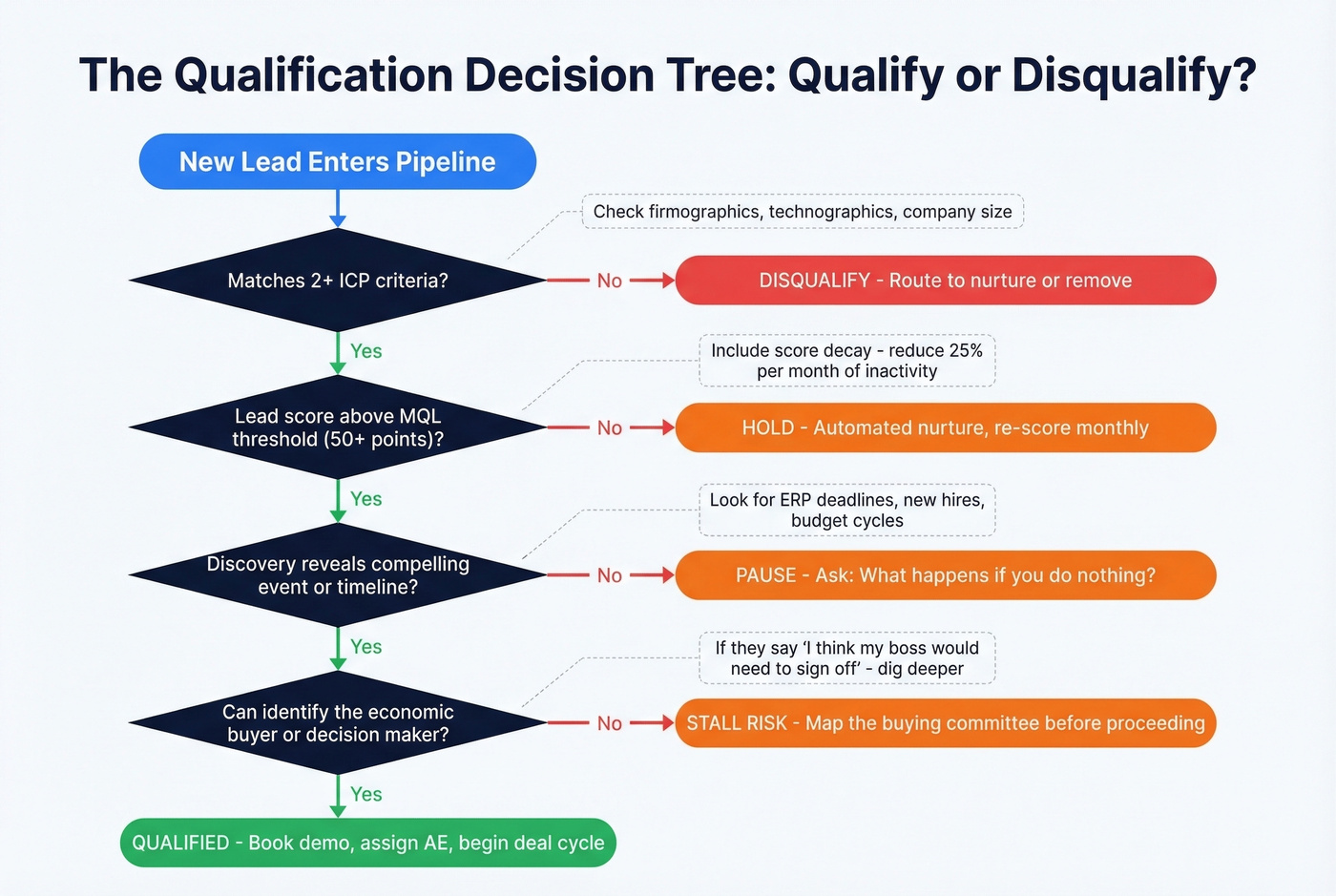
BANT warning signs to listen for: Unclear approvers ("I think my boss would need to sign off"), no concrete budget ("we'd need to figure that out"), vague timeline ("maybe this year"). Any of these should trigger deeper qualification, not a demo booking.
MEDDIC quantified metrics example: Don't accept "we want to reduce churn." Push for the number. "If we reduce churn by 2 points, that's $3.6M annually in retained revenue." Now you have a business case that sells internally.
Impact and urgency questions that actually work:
- "What happens if you do nothing to fix this?"
- "What metric is suffering right now?"
- "Who else in the organization is impacted by this problem?"
- "Are there any blockers that might stop us from getting this solution in place?"
One underused signal that keeps coming up in r/sales threads: check whether your prospect's team has recently connected with multiple employees at a competitor on professional networks. That pattern often indicates active evaluation - and a window to engage before they've made up their mind.
And here's the disqualification side, which is equally important. If you can't articulate your disqualification criteria as clearly as your qualification criteria, you don't have a process. You have a wish list.
Disqualify when the lead scores negative on two or more ICP criteria, when discovery reveals no compelling event or timeline, or when the prospect can't identify who makes the final decision. Walking away from bad-fit leads is the highest-leverage qualification skill your team can develop. Skip this if you enjoy burning 12 hours a week on outreach to people who were never going to buy.
Step 5: Qualify With Data, Not Gut Feel
Your rep is prepping for a qualification call. They pull up the CRM record. Half the phone numbers are disconnected. The email bounced last week. The company went through layoffs three months ago, but the data still shows "growing." Your rep is about to assess a lead based on information that's already wrong.
Most teams don't have a scoring problem. They have a data problem.
Intent signals, website behavior, and firmographic data are all qualification inputs - but only if they're current. A "pricing page visit" from four months ago doesn't mean what it meant four months ago. In our experience, the teams that struggle most with qualification aren't the ones using the wrong framework. They're the ones feeding good frameworks with bad data.

Your scoring model is only as good as the data feeding it. If your contact database refreshes every 4-6 weeks (the industry average), you're scoring leads with expired information. Prospeo refreshes every 7 days and verifies emails in real time at 98% accuracy - Snyk cut their bounce rate from 35-40% to under 5% and saw AE-sourced pipeline jump 180% after switching. That's not just a data quality improvement. It changed their pipeline math entirely. If you're evaluating vendors, start with a shortlist of data enrichment services.
Qualification Mistakes That Kill Your Pipeline
Five anti-patterns we see again and again:
1. Stale or missing data. Your scoring model assigns +25 for "target industry match," but the company pivoted six months ago and your CRM still shows the old classification. Every score built on bad data is a bad score. Run a quarterly data audit and use lead enrichment tools to refresh records automatically.
2. Volume over quality. Passing 500 MQLs to sales when only 80 are real creates distrust. Reps stop working MQLs. Marketing blames sales for not following up. Fix this by agreeing on a shared MQL definition with explicit criteria, then hold both teams to it.
3. Unclear or inconsistent criteria. If your SDRs can't explain what makes a lead qualified in one sentence, the criteria aren't clear enough. Write your qualification criteria on one slide. If it doesn't fit, simplify until it does.
4. Ignoring intent signals. A lead who visited your pricing page three times this week and downloaded a case study is telling you something. If your qualification process doesn't weight behavioral signals, you're ignoring the most predictive data in your funnel. Behavioral scoring boosts conversion rates by up to 40% - add it to your model.
5. Delaying follow-up on high-value leads. Follow up within one hour and you're looking at 53% conversion rates. Wait 24 hours and that drops to 17%. Build an alert that pings the assigned rep the moment a lead crosses your MQL threshold. If you need copy you can deploy fast, use these sales follow-up templates.
How Does Your Qualification Stack Up?
Here's where your team should land, broken down by industry:
| Industry | MQL-to-SQL Rate |
|---|---|
| Consumer Electronics | 21% |
| FinTech | 19% |
| Automotive | 18% |
| Healthcare | 13% |
| Oil & Gas | 12% |
These are cross-industry averages. Typical teams convert 25-35% of MQLs to SQLs overall, and high-alignment RevOps organizations push that to 40-50%. If you're below 20%, your qualification criteria are either too loose or your scoring model needs recalibration.
Win-rate benchmarks tell a similar story: a healthy overall win rate sits at 20-30%, but top-scored leads should convert at 30-45%. If your best leads aren't winning at meaningfully higher rates than your average, your scoring model isn't differentiating effectively.
For context, visitor-to-lead rates are much lower - B2B SaaS runs about 1.1%, Manufacturing 2.2%. Don't confuse the two when benchmarking.
Tools That Help You Qualify Leads
Three categories matter: CRM scoring, data quality, and intent.
For CRM scoring, use whatever your CRM offers natively. HubSpot's free CRM includes basic lead properties; Professional ($890/mo for 3 seats) adds manual scoring; Enterprise ($3,600/mo with a 10-seat minimum) unlocks predictive scoring plus $3,500 onboarding. HubSpot also offers Breeze Intelligence as an enrichment add-on starting at $45/mo for 100 credits - useful if you're already in the ecosystem, though the per-credit cost adds up fast at scale. Salesforce Sales Cloud starts at $165/user/mo, with Einstein AI scoring from $50/user/mo on top. Don't buy a separate scoring tool unless your CRM genuinely can't handle it. If you're still comparing options, here are examples of a CRM with real pricing.
For data quality and enrichment, this is the layer that makes scoring actually work. Prospeo's Chrome extension enriches contacts in real time during research, and CRM enrichment handles bulk data hygiene across your entire database. With 300M+ professional profiles, 98% email accuracy, and a 7-day refresh cycle, you're scoring leads against current information - not six-week-old snapshots.
For intent signals, 6sense is the enterprise standard ($60k-$300k/year). Bombora powers intent data across many platforms. For earlier-stage signals, website visitor identification tools like Lead Forensics or Clearbit Reveal can surface companies browsing your site before they fill out a form. If you're not ready for enterprise intent pricing, start with your CRM's built-in website tracking and work up from there. To operationalize this, build an intent based segmentation model that maps signals to routing rules.
Our recommendation: don't overthink the tool stack. Use your CRM for scoring. Use a dedicated enrichment layer for data quality. Layer in intent when your deal sizes justify the spend.
You just read that sellers waste 12 hours a week on outreach aimed at the wrong people. Prospeo's 30+ search filters - buyer intent, technographics, headcount growth, funding stage - let you pre-qualify before a rep ever touches the lead. Layer in Bombora intent data across 15,000 topics to know who's actually in-market.
Qualify leads before the first call, not during it.
FAQ
How do you qualify a lead quickly?
Use a two-stage approach: first, run every inbound lead through a scoring model with explicit point values and a clear MQL threshold - this takes seconds and happens automatically. Second, apply BANT for leads that cross the threshold, confirming budget, authority, need, and timeline in a five-minute call. Anything that passes both stages gets full discovery.
How many frameworks does my team need?
Two. A fast screen (BANT) to filter inbound leads in under five minutes, and a deep qualifier (MEDDIC or SPICED) for deals that pass the screen. Teams that "know" six frameworks but haven't standardized on any consistently underperform teams that execute one well.
When should I disqualify a lead?
Disqualify when a lead scores negative on two or more ICP criteria, goes 90+ days without engagement, or can't identify who makes the final decision. Knowing how to qualify sales leads means knowing when to walk away just as much as knowing when to pursue.
What tools improve lead qualification accuracy?
Start with your CRM's native scoring - HubSpot or Salesforce both work. Then layer in a data enrichment platform for verified, current contact data. Add intent data tools like Bombora or 6sense when deal sizes exceed $25k and justify the spend.