

How to Sell on the Phone: Scripts, Frameworks, and Data That Actually Work
It's 10:15 on a Tuesday morning. You've made 30 dials. Twenty-six went to voicemail. Two people hung up before you finished your name. One asked you to send an email. One said "not interested" so fast it felt rehearsed. You're staring at your screen wondering if the phone still works as a sales channel.
Here's the thing: what's broken probably isn't your pitch. It's everything that happens before you open your mouth.
What You Need (Quick Version)
- Fix your data first. Connect rates swing from 3% to 40% based on list quality alone.
- Memorize one opener and one objection framework. We give you both below.
- Follow up at least five times. 60% of people say no four times before buying.
- Practice daily. Reps who do see a +6.68% lift in conversion rates - that's the difference between struggling and hitting quota.
Phone Sales Benchmarks
Before you can improve, you need to know what "good" looks like. The average cold call conversion rate is 2.35% - roughly one sale per 43 calls. Your industry and deal size shift the math significantly.
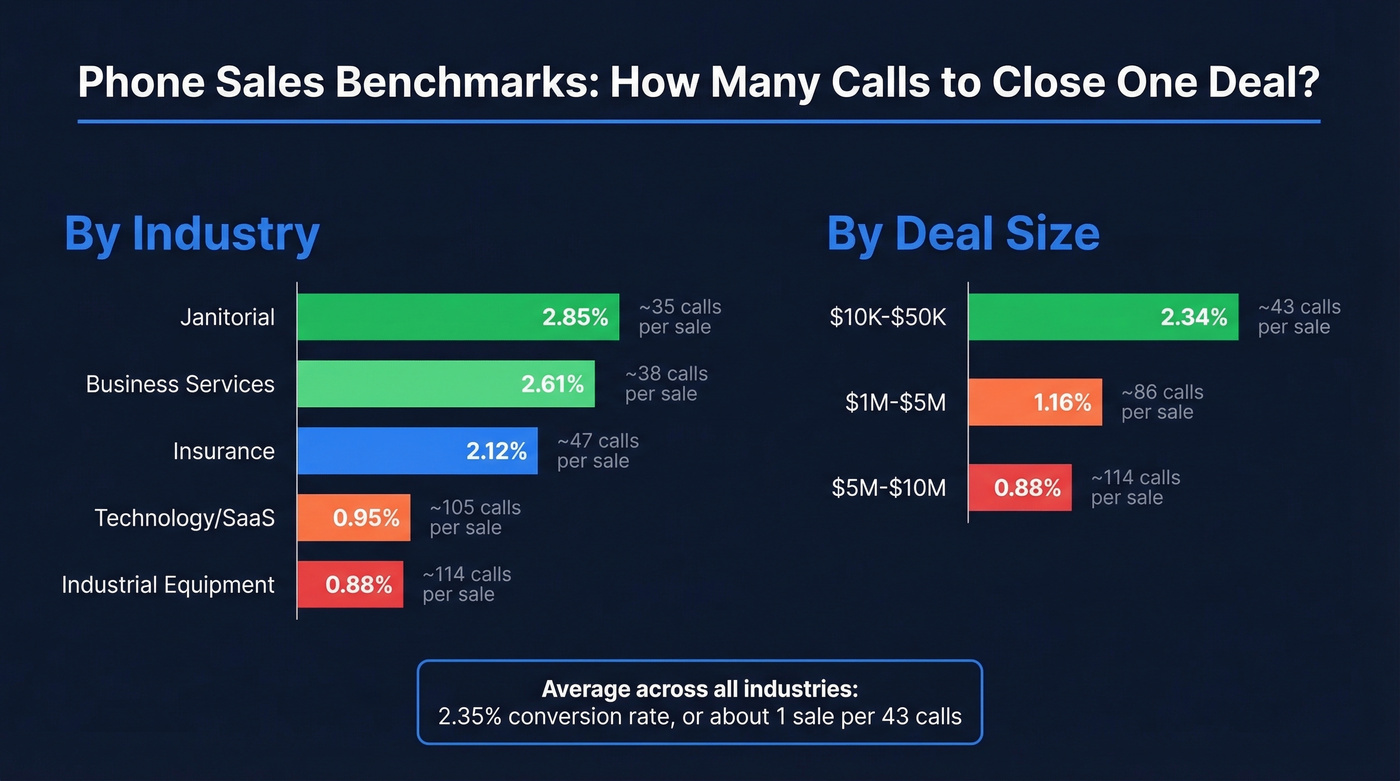
| Industry | Conversion Rate | Calls per Sale |
|---|---|---|
| Janitorial | 2.85% | ~35 |
| Business Services | 2.61% | ~38 |
| Insurance | 2.12% | ~47 |
| Technology / SaaS | 0.95% | ~105 |
| Industrial Equipment | 0.88% | ~114 |
Deal size matters too:
| Deal Size | Conversion Rate | Calls per Sale |
|---|---|---|
| $10K-$50K | 2.34% | ~43 |
| $1M-$5M | 1.16% | ~86 |
| $5M-$10M | 0.88% | ~114 |
Bigger tickets mean longer cycles and more stakeholders - no surprise there.
The cold-versus-warm gap is even more dramatic. Cold calls convert to meetings at roughly 2%. Warm calls - where the prospect has seen your name, opened an email, or engaged with content - hit around 20%. That's a 10x difference, and it's why the pre-call work matters so much.
Before You Dial
Every guide on selling over the phone jumps straight to scripts. That's like perfecting your golf swing without checking if you're on the right course. The foundation - your data, your research, your warming strategy - determines whether anyone picks up at all.
Connect rates swing from 3% to 40% based on data quality. Verified, fresh phone numbers convert up to 75% higher than stale CRM data. And multichannel cadences - call plus email plus social - produce 287% higher response rates than single-channel outreach. The phone works best when it isn't the first touch.
Spend 3-5 minutes researching each prospect before you dial. Check their recent job changes, company news, tech stack, or hiring patterns. That context turns a cold call into a warm one. Check your prospect's competitors' reviews on G2 or Capterra - unmet needs in those reviews become your talking points.
Then send a short email or engage on social the day before you call. When they see your name on caller ID, you're not a stranger - you're someone they vaguely recognize.
This is where your data platform earns its keep. We've seen teams using Prospeo's mobile finder triple their connect rate to 20-25% after switching from stale data, thanks to 125M+ verified mobile numbers on a 7-day refresh cycle. When your numbers are fresh, more people actually pick up.

You just read that connect rates swing from 3% to 40% based on data quality. Prospeo's 125M+ verified mobile numbers refresh every 7 days - not every 6 weeks. Teams using Prospeo triple their connect rate to 20-25%. At $0.01 per lead, bad data costs more.
Fix your phone list before you fix your pitch.
When to Call
Timing isn't everything, but it isn't nothing. ZoomInfo analyzed [1.4 million outbound calls](https://pipeline.zoominfo.com/sales/best-days-to-cold-call) and the patterns are clear.
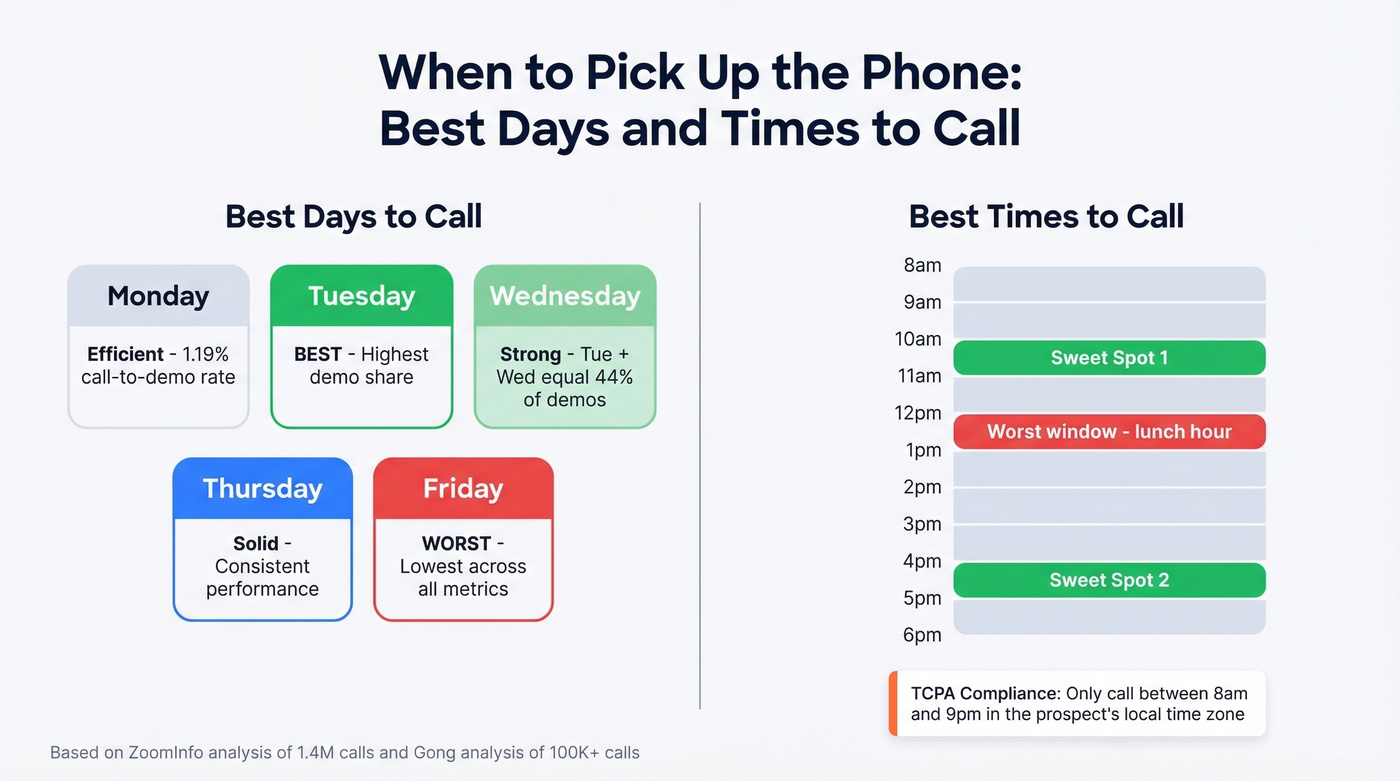
| Day | Demo Share | Notes |
|---|---|---|
| Tuesday | Highest | Tue + Wed = 44% of demos |
| Wednesday | High | Strong connect rates |
| Thursday | Solid | Consistent performance |
| Monday | Efficient | 1.19% call-to-demo rate |
| Friday | Worst | Lowest across all metrics |
For time of day, Gong's analysis of 100,000+ connected B2B calls found two sweet spots: 10-11am and 4-5pm local time. The worst window is 12-1pm - people are eating lunch, not taking cold calls.
One compliance note: TCPA rules restrict calls to between 8am and 9pm in the prospect's local time zone. If you're dialing across time zones, build that into your cadence logic or you're asking for trouble. (If you want the full breakdown, see TCPA rules before you scale dialing.)
The practical takeaway: stack your heaviest dial blocks on Tuesday through Thursday, late morning or late afternoon. We've seen teams double their connect rates just by shifting dials from Monday morning to Tuesday at 10am. Save Friday for follow-up emails and admin.
Winning the First 7 Seconds
You're not selling your product in the opener. You're selling the next 30 seconds. That's it.
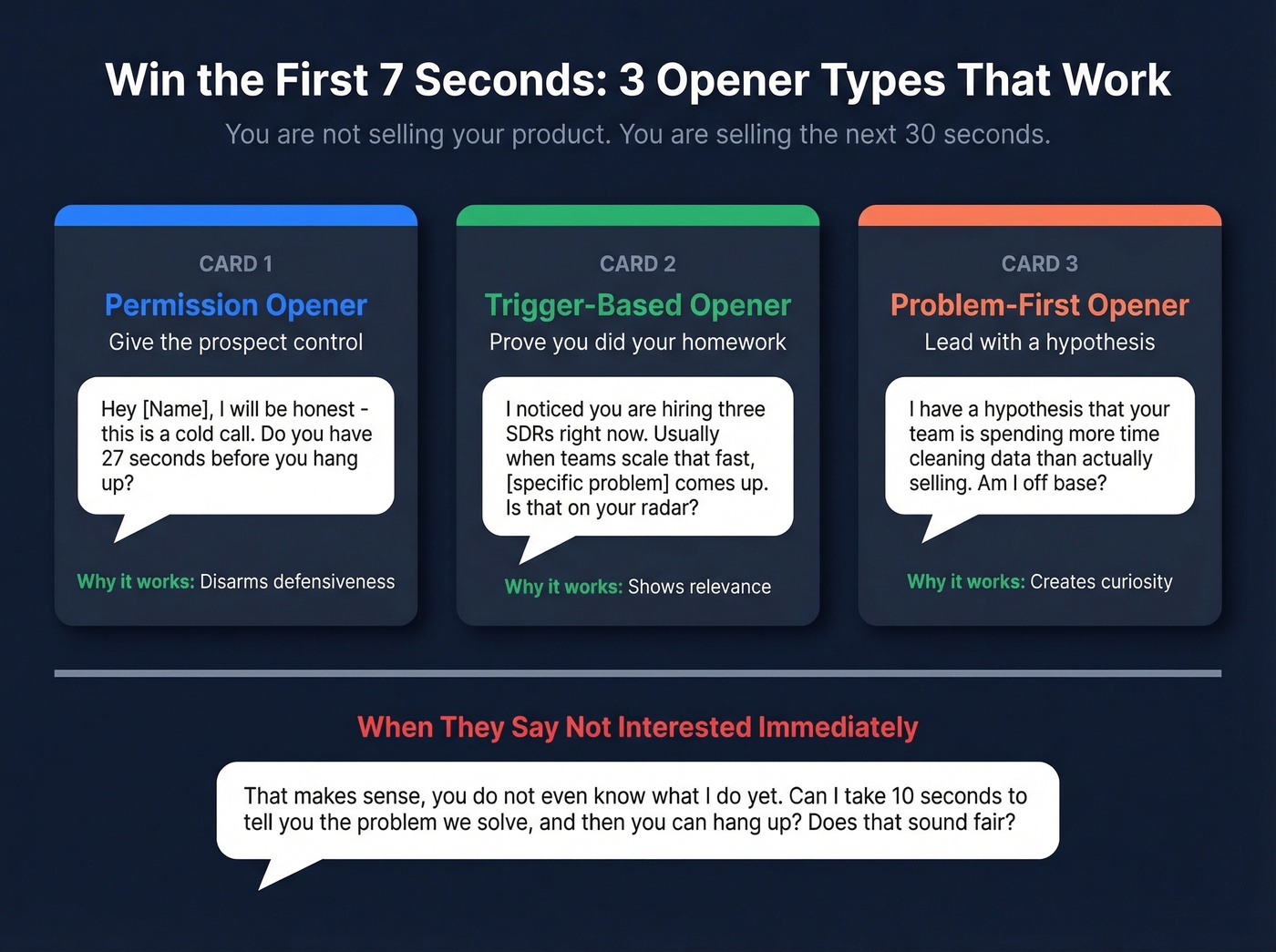
The goal is a pattern interrupt - something that doesn't sound like every other cold call they've gotten this week. (For more options, steal a few from these cold calling script examples.)
Permission openers work because they give the prospect control:
"Hey [Name], I'll be honest - this is a cold call. Do you have 27 seconds before you hang up?"
"Hi [Name], we haven't spoken before. Do you have a quick minute, or should I call back?"
Trigger-based openers work because they prove you did your homework:
"I noticed you're hiring three SDRs right now. Usually when teams scale that fast, [specific problem] comes up. Is that on your radar?"
"Saw the Series B announcement - congrats. Most teams at your stage start running into [problem]. Quick question about that."
Problem-first openers lead with a hypothesis:
"I have a hypothesis that your team is spending more time cleaning data than actually selling. Am I off base?"
And when you hear "not interested" within the first three seconds - and you will - try this:
"That makes sense, you don't even know what I do yet. Can I take 10 seconds to tell you the problem we solve, and then you can hang up? Does that sound fair?"
It reframes the reflex into a conversation. The "does that sound fair?" close is a micro-commitment that works because it's almost impossible to say no to. If you want more variations, use this not interested objection handling playbook.
Tone Matters More Than Words
A USC study on telephone communication found that 84% of the message is conveyed by tone, not words. Your script is 16% of the equation.
Top-performing reps speak at 110-125 words per minute - conversational, not rushed. A positive, enthusiastic tone increases sales by 37% compared to neutral or flat delivery. That doesn't mean fake energy. It means genuine interest in the person on the other end.
Smile while you talk. It changes your vocal quality more than you'd expect. Mirror the prospect's pace and energy level, and use intentional pauses after key questions. Silence gives the prospect space to think - and talk. (If you want to train this specifically, start with cold call tonality.)
The biggest tone killers are monotone delivery, rushing through your script like you're reading a teleprompter, and filler words. Every "um" and "like" erodes credibility. Replace them with a pause. Silence sounds confident; filler sounds nervous.
Hot take: If your average deal is under $15k, tone and energy matter more than any framework in this article. At lower deal sizes, people buy from people they like talking to. Period.
Swap your language too. Small word changes shift how prospects feel about the conversation:
| Instead of... | Say... |
|---|---|
| Cost / Price | Investment |
| Contract | Agreement |
| Problem | Challenge |
| Buy | Get started |
| Cheaper | More efficient |
These aren't tricks. They're reframes that remove friction.
Multichannel cadences produce 287% higher response rates than calls alone. Prospeo gives you verified emails (98% accuracy), direct dials (30% pickup rate), and intent data across 15,000 topics - so your call is never the first touch.
Warm every call with the right data before you dial.
Discovery and Call Control
Once you're past the opener, the instinct is to pitch. Resist it. The best phone sellers spend 70% of the call listening and 30% talking - that's the 70/30 rule, backed by call analysis data from Gong and Chorus.
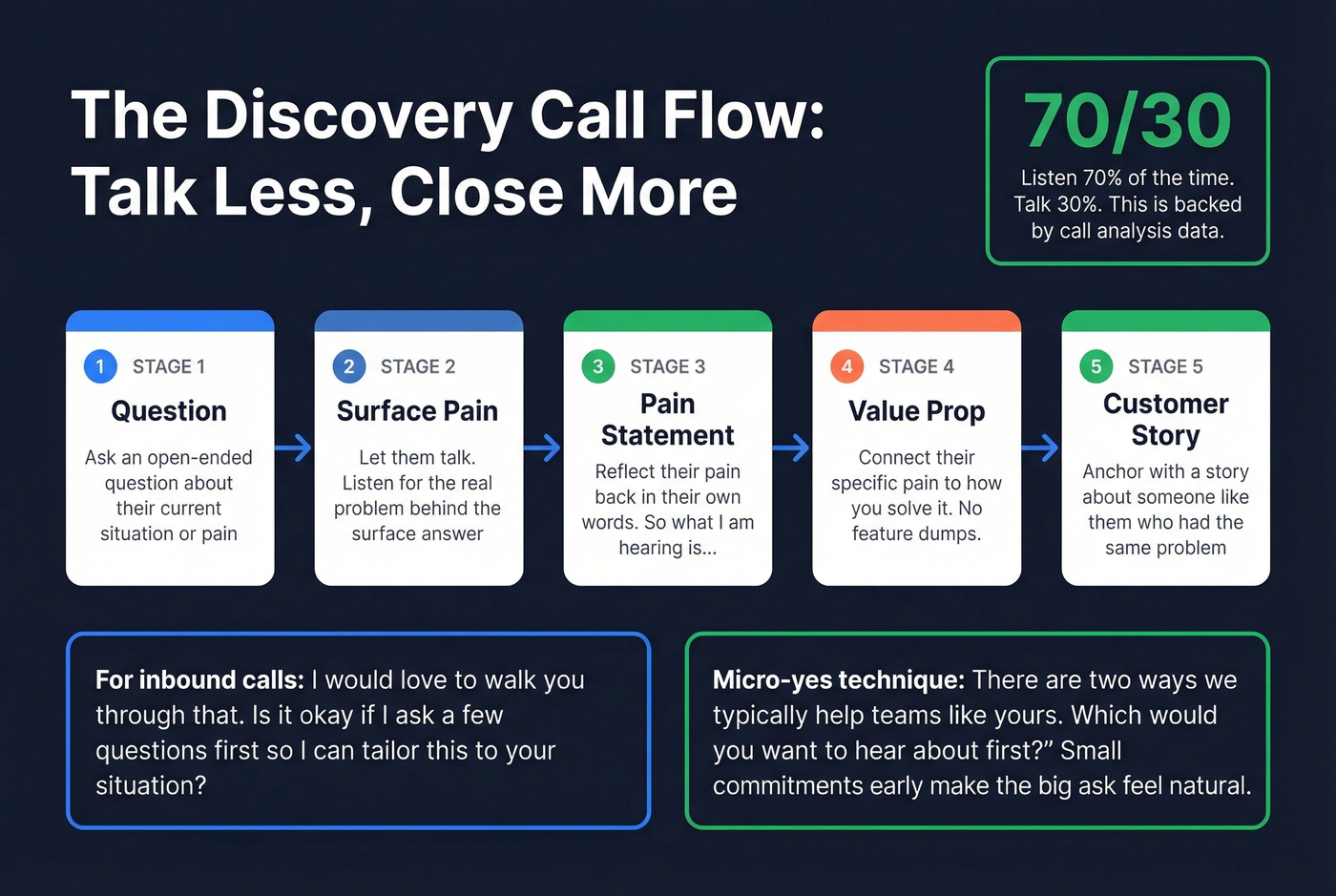
The discovery flow moves through five stages: Question, Surface Pain, Pain Statement, Value Prop, Customer Story. Each step builds on the last. You ask a question, the prospect reveals a pain point, you reflect it back in their language, connect it to your value prop, and anchor it with a story about someone like them. (If you want a tighter set of prompts, use these discovery call tips.)
For inbound calls where the prospect reached out first, you still need to control the conversation. Try: "I'd love to walk you through that. Is it okay if I ask you a few questions first so I can tailor this to your situation?" That one sentence prevents you from giving away pricing and features before you understand what they actually need.
The micro-yes technique keeps momentum going. Instead of a long monologue, offer a choice: "There are two ways we typically help teams like yours. Which would you want to hear about first?" Small commitments early make the big commitment later feel natural.
Selling a Product Over the Phone
Selling a product over the phone differs from selling a service in one critical way: the prospect needs to visualize the outcome without seeing or touching anything. Your job is to paint a picture with specifics - numbers, timelines, and results from similar customers - rather than listing features.
Lead with the problem your product solves, not the product itself. A rep who says "We help sales teams cut data cleanup time by 60%" will always outperform one who says "We have a B2B data platform with 300 million profiles." The first statement creates curiosity. The second invites a "send me an email" brush-off. (If that’s your most common stall, keep a dedicated send me an email objection script ready.)
Objection Handling Frameworks
Objections happen on 60%+ of calls. They're not rejection - they're the prospect telling you what they need to hear before they can say yes. In our experience, three frameworks cover virtually every scenario you'll face. (For more real-world lines, pull from these objection handling examples.)
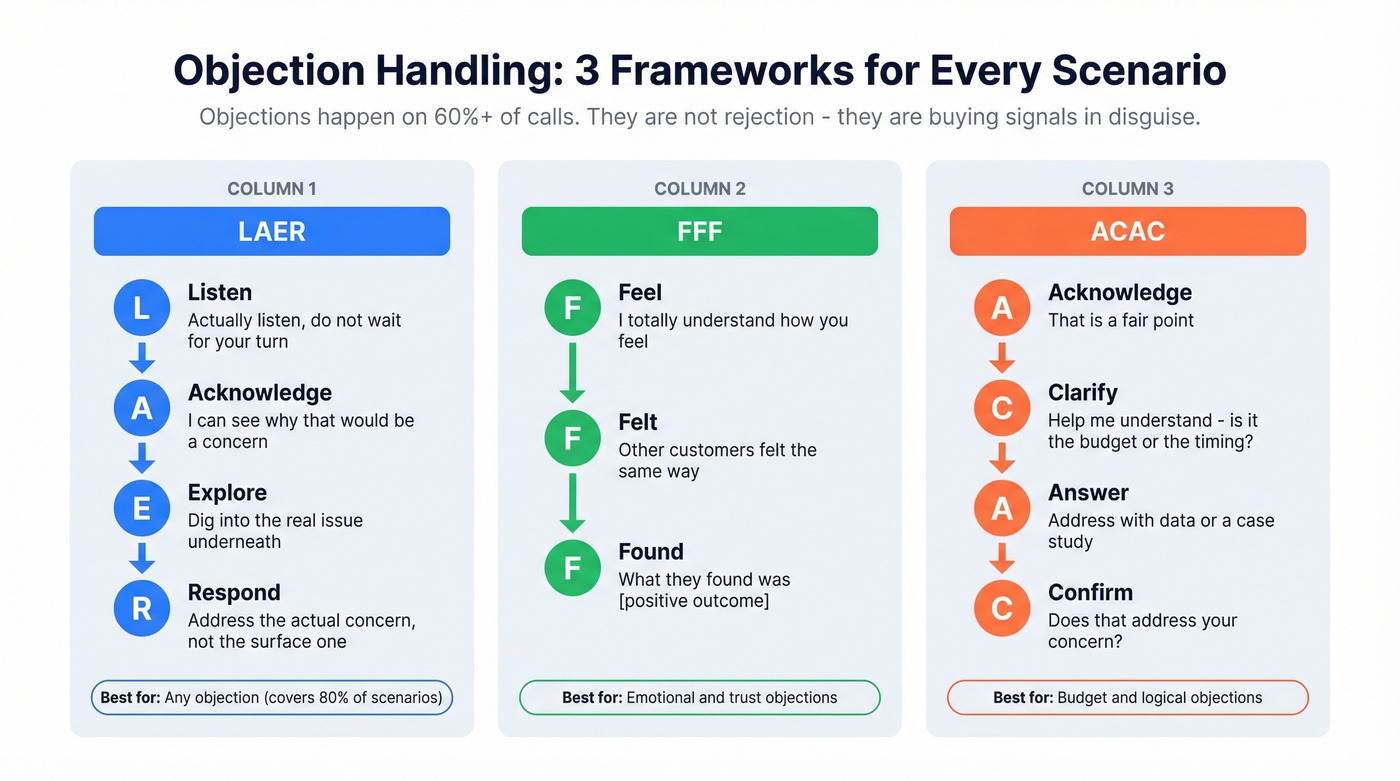
| Framework | Steps | Best For |
|---|---|---|
| LAER | Listen, Acknowledge, Explore, Respond | Any objection |
| FFF | Feel, Felt, Found | Emotional / trust |
| ACAC | Acknowledge, Clarify, Answer, Confirm | Budget / logical |
LAER: The All-Purpose Framework
LAER works for everything because it starts with listening - actually listening, not waiting for your turn to talk. The acknowledge step is where most reps fail. Phrases like "I can see why that would be a concern" or "That makes a lot of sense" disarm defensiveness before you explore the real issue underneath. We've found LAER handles about 80% of what you'll encounter on any given day.
FFF: Feel, Felt, Found
FFF is best when the objection is emotional - trust, risk, or skepticism. It normalizes the concern and provides social proof in one breath:
"I totally understand how you feel. A lot of our customers felt the same way before they started. What they found was that [specific outcome] happened within the first 30 days."
ACAC: For Budget and Logic
When someone says "it's too expensive" or "we don't have budget," ACAC keeps you from getting defensive:
Acknowledge: "I appreciate you being upfront about that."
Clarify: "Can I ask - is it the total cost, or the timing of the spend?"
Answer: "Most teams at your stage offset the cost by [specific ROI mechanism] within 60 days."
Confirm: "Does that change the math for you?"
Skip ACAC if the prospect sounds emotionally charged - switch to FFF instead. Logic doesn't land when someone's frustrated.
Common rebuttals you'll need:
- "Not interested": "Totally fair - you don't even know what I do yet. Can I take 10 seconds?"
- "I don't have time": Ask for 30 seconds, explain what you do, then let them decide. End with "Does that sound fair?" (If you need a clean response set, use how to respond to 'I don't have time'.)
- "Send me an email": "Happy to. So I send the right thing - what's the biggest challenge you're dealing with on [topic] right now?"
- "Need to think about it": "Of course. What specifically do you want to think through? I might be able to answer it right now." (Here are more options for the I need to think about it objection.)
Gatekeepers and Voicemail
Gatekeepers aren't obstacles - they're people doing their job. The rapport-first approach works better than trying to sound important. Ask for their name, thank them, then: "What's the best way to make reaching [decision-maker] happen?" Treating them as an ally instead of a barrier changes the dynamic completely. (If you want a full set of lines, use this cold calling gatekeeper guide.)
If you're consistently getting blocked, try calling before 8:30am or after 5:30pm. Decision-makers often answer their own phones outside business hours.
Voicemail is the most common call outcome, so don't treat it as a throwaway. Keep it under 30 seconds, state your name and reason clearly, and repeat your callback number twice. A good voicemail script: "Hi [Name], it's [Your Name] from [Company]. I'm calling about [one specific thing]. My number is [number] - that's [number]. I'll try you again [day]." Short, directive, easy to act on.
Follow-Up Cadence
Here's where most reps lose. 60% of people say no four times before buying. But only 12% of reps make three or more follow-up attempts. The math is brutal - most salespeople quit right before the prospect was ready to say yes.
Most sales happen after 5-7 touchpoints. Build a 10-14 day multi-touch cadence that mixes calls, emails, and social touches. The call alone won't close the deal. The call inside a sequence will. (If you want a ready-made system, use this call follow up guide.)
Real talk: persistence isn't pestering. Each follow-up should add value - a relevant case study, a new angle on their problem, a piece of industry data. If every touchpoint says "just checking in," you're not following up. You're annoying people.
Mistakes That Kill Your Numbers
A thread on r/CarSalesTraining nailed four common phone mistakes: answering the prospect's question right away instead of asking one back, narrowing the inventory too fast, failing to build rapport, and not asking for the appointment. That tracks with what we see across B2B too.
| Mistake | Fix |
|---|---|
| Dialing unverified numbers | Verify with a data platform before you dial |
| No pre-call research | Spend 3-5 minutes per prospect |
| Talking too much | Follow the 70/30 rule |
| Answering questions instead of asking them | Respond with a question that deepens the conversation |
| Sounding robotic | Use bullet frameworks, not rigid scripts |
| Weak first 10 seconds | Lead with relevance, not your name |
| Bad timing | Tue-Thu, 10-11am or 4-5pm |
| Giving up after one "no" | Commit to 5-7 touchpoints minimum |
The reps who consistently hit quota aren't the ones with the best scripts. They're the ones who actually pick up the phone 50+ times a day with verified numbers and a plan for each call.
FAQ
Is cold calling dead in 2026?
No - 69% of buyers accepted cold calls from new providers in the past year. The channel isn't dead; lazy execution is. Pair verified mobile numbers with multichannel warming and a strong opener, and cold calling remains one of the fastest paths to pipeline.
How many cold calls should I make per day?
Most SDRs target 50-80 dials per day, but connect rate matters more than volume. Fifty calls to verified mobiles outperform 200 calls to stale data every time. Optimize for conversations, not dial count.
What's a good cold call conversion rate?
The average is 2.35% - roughly one sale per 43 calls. Tech/SaaS runs lower at ~0.95%; business services higher at ~2.6%. Daily practice can lift your rate by nearly 7%, which compounds fast over a quarter.
What's the best time to cold call?
Tuesday through Thursday, between 10-11am or 4-5pm in the prospect's local time zone. Avoid Friday afternoons and the lunch hour. Monday's 1.19% call-to-demo rate makes it worth dialing too.
How do I get accurate phone numbers for prospects?
Use a B2B data platform that verifies mobile numbers and refreshes records frequently. Stale CRM data is the top reason connect rates stay below 5%. Prospeo's free tier gives you 75 emails and 100 Chrome extension credits per month, so you can test before committing a dollar.