

How to Write a Cold Pitch Email That Actually Gets Replies
The average cold email reply rate in 2026 is 3.43%. Top-quartile senders hit 5.5%+, and the top 10% break 10.7%. If you're learning how to write a cold pitch email that lands in that top tier, the gap isn't copywriting talent - it's infrastructure, list quality, and discipline.
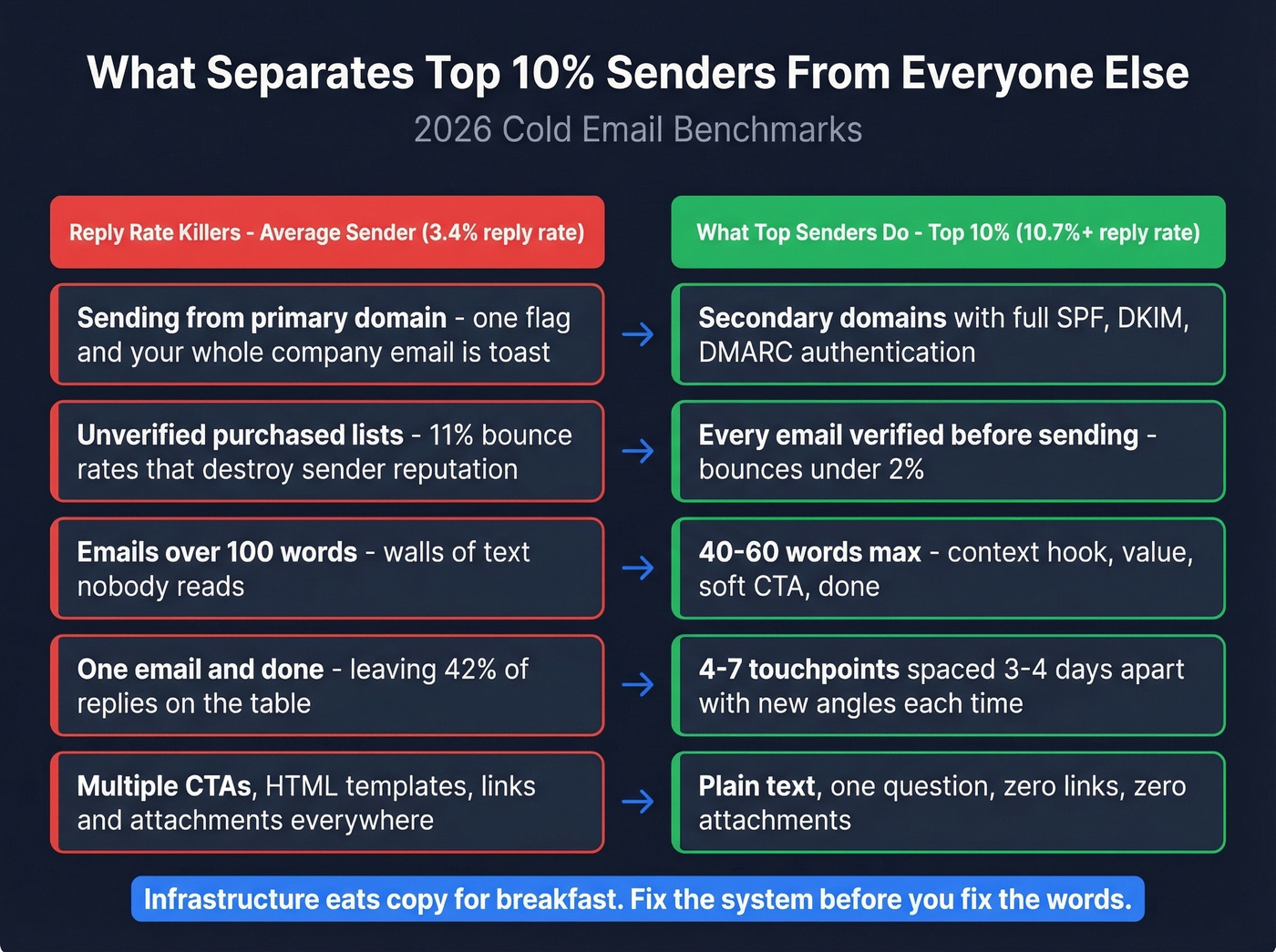
We call this the infrastructure-first method, and it flips the usual advice on its head. Fix deliverability first (domains, warmup, authentication). Verify every email before sending. Keep emails under 80 words. Follow up 3-6 times, because 42% of replies come from follow-ups.
Most guides skip straight to templates. That's backwards. Whether you're sending a cold email business proposal to a Fortune 500 or pitching a startup founder, results start with what's behind the scenes.
Set Up Your Infrastructure First
Your sending infrastructure determines whether emails reach inboxes or spam. One practitioner on r/Entrepreneur documented their reply rate collapsing from 8% to 3% over 18 months - entirely because they neglected infrastructure while obsessing over copy.
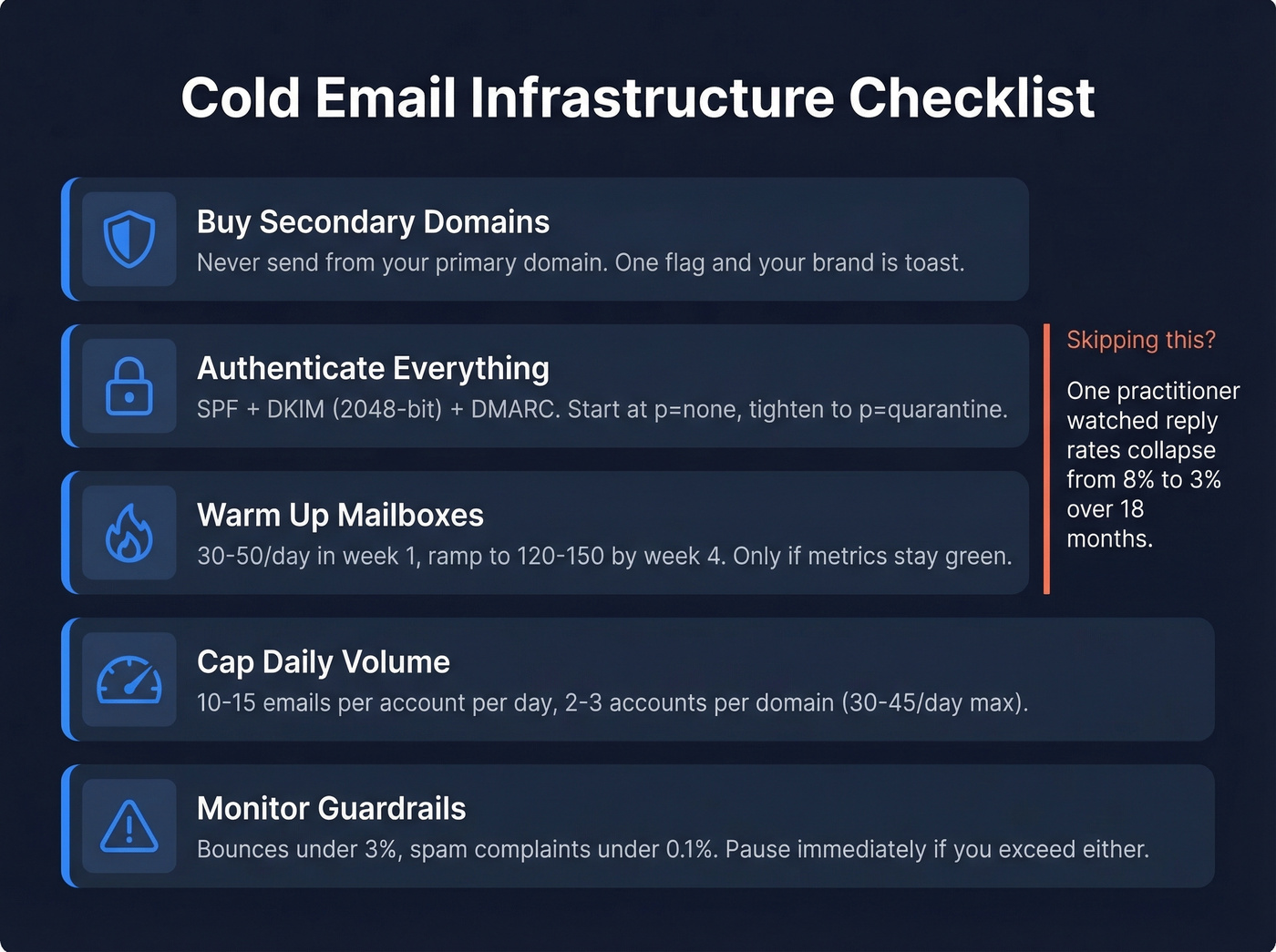
Here's the thing: none of the fancy subject line tricks matter if you're landing in spam. The baseline checklist:
- Never send from your primary domain. Buy secondary/variant domains. If one gets flagged, your main brand stays clean.
- Authenticate everything. SPF, DKIM (2048-bit keys), and DMARC. Start DMARC at
p=none, then tighten top=quarantine. - Warm up before you send. Ramp per mailbox: 30-50/day in week one, up to 120-150 by week four - only if metrics stay green. (More on safe sending limits in our email velocity guide.)
- Cap volume. 10-15 emails per account per day, 2-3 accounts per domain (so ~30-45/day per domain).
- Monitor guardrails. Bounces under 3%, spam complaints under 0.1%. Pause immediately if you exceed either. (Benchmarks and remediation: email bounce rate and email spam checker.)
This isn't optional. It's the foundation everything else sits on. If you want the full technical checklist, see our email deliverability guide and how to improve sender reputation.
Build a Clean, Verified List
The same r/Entrepreneur case study saw bounce rates drop from 11% to under 2% after switching from purchased lists to verified contacts. That single change was the biggest contributor to doubling their reply rate. We've seen the same pattern across dozens of campaigns - list quality beats clever copy every time.
Before you load a single contact into your sending platform, run the list through an email verification tool. Prospeo's email verification uses a 5-step process - catch-all handling, spam-trap removal, honeypot filtering - and delivers 98% email accuracy. The free tier gives you 75 emails/month to test with zero risk. Bad data doesn't just waste sends; it torches your domain reputation. (If you're comparing tools, start with our AI email checker and Bouncer alternatives.)

Write a Subject Line That Earns the Open
A Belkins study analyzing 5.5 million emails gives us hard numbers. The winners are short, personalized, and curious:
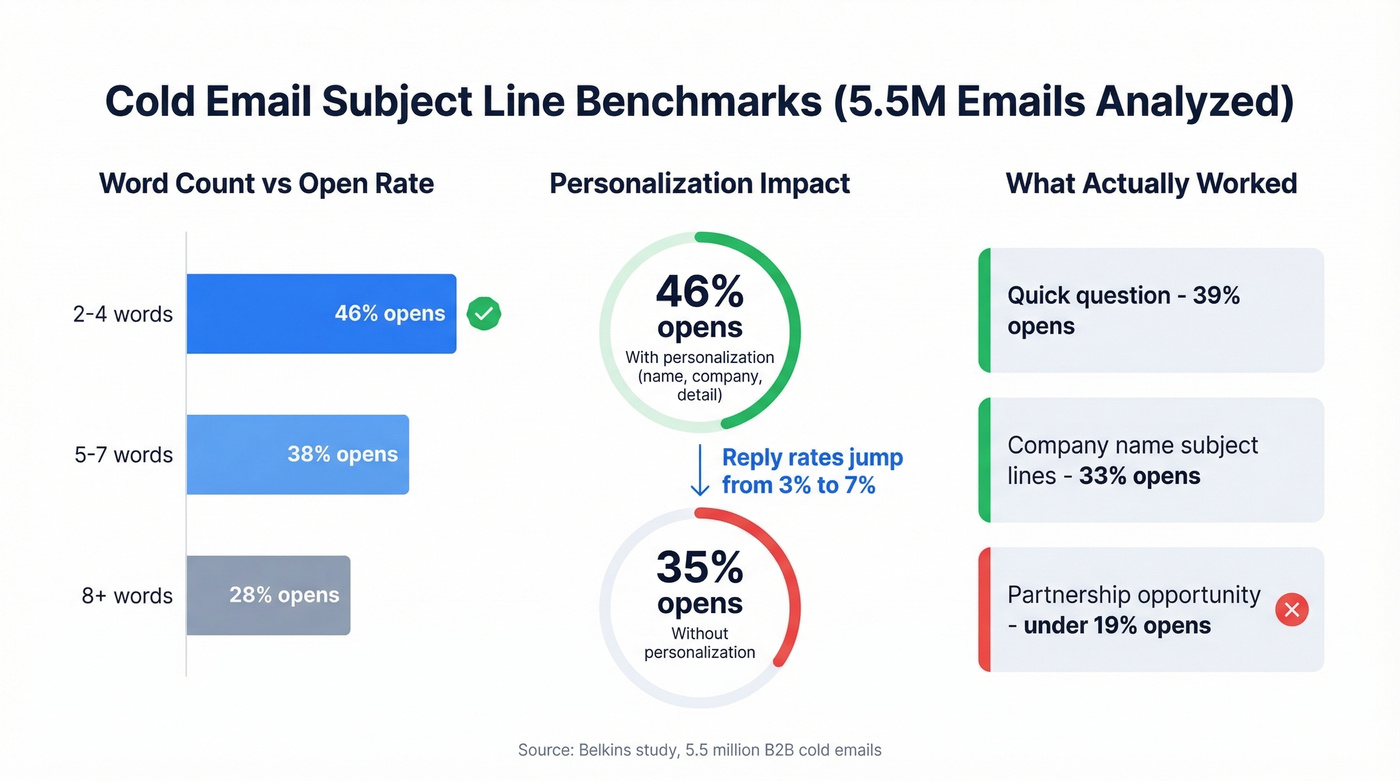
- 2-4 words hit 46% open rates. Opens drop steadily past 7 words.
- Personalized subject lines (company name, role, or specific detail) averaged 46% opens vs. 35% without - and reply rates jumped from 3% to 7%. (More ideas: cold email subject line examples and subject lines that get opened.)
- Question formats matched that 46% open rate, making them the most reliable structure.
From the case study: "Quick question" pulled 39% opens. Company-name subject lines hit 33%. "Partnership opportunity" cratered below 19%.
Short, specific, and genuinely curious beats clever or urgent every time.

The article you just read proves it: list quality beats clever copy every time. Prospeo's 5-step email verification - catch-all handling, spam-trap removal, honeypot filtering - delivers 98% accuracy so your cold pitch emails actually reach inboxes. At $0.01 per email, keeping bounces under 3% costs less than a single wasted send.
Stop burning domains. Start with verified data.
Craft Your Cold Pitch Email (Under 80 Words)
The best-performing cold emails in 2026 run 40-80 words, with practitioners on r/copywriting reporting the sweet spot around 40-60. The case study we've been tracking saw reply rates double after cutting emails from 141 words to under 56. Every extra sentence is a reason to delete. (For a deeper framework, see email copywriting and emails that get responses.)
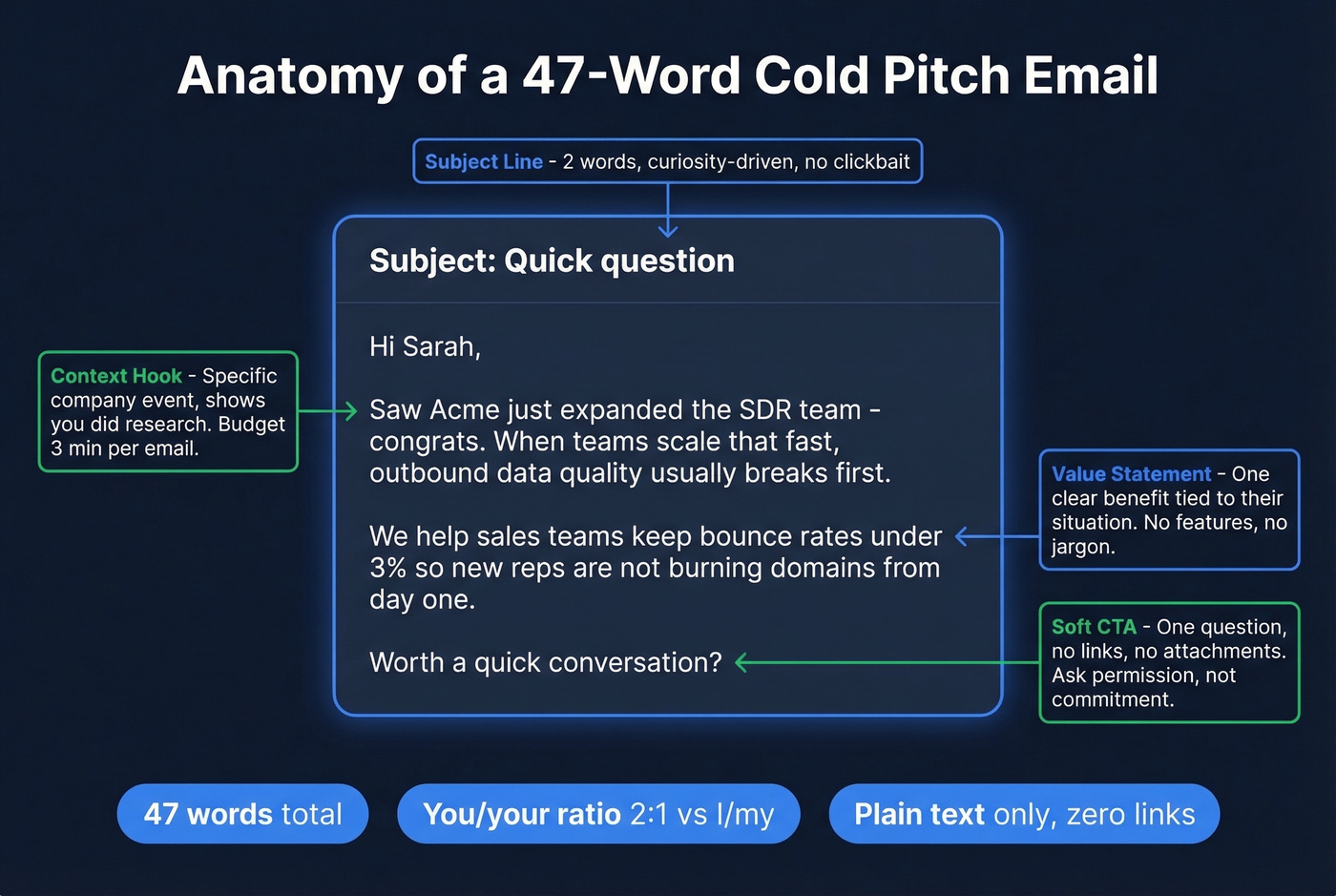
The structure is simple: context hook, value/relevance, soft CTA.
Subject: Quick question
Hi {{firstName}},
Saw {{company}} just expanded the SDR team - congrats. When teams scale that fast, outbound data quality usually breaks first.
We help sales teams keep bounce rates under 3% so new reps aren't burning domains from day one.
Worth a quick conversation?
That's 47 words. Two-sentence paragraphs. One question. No links, no attachments, no multiple CTAs. Study the cold pitch examples that actually convert and you'll notice they all share this same stripped-down structure.
Two quick rules of thumb: keep your "I/my" to "you/your" pronoun ratio at roughly 1:2, and budget about 3 minutes per email on first-line personalization - enough to reference a specific company announcement, not enough to overthink it. A genuinely relevant offer with a soft CTA ("Interested?" / "Worth a conversation?") outperforms a heavily personalized email pitching something the prospect doesn't need.
Let's be honest: if your deal sizes are under five figures, you probably don't need hyper-personalized outreach. A tight, relevant offer sent to a verified list will outperform an AI-personalized masterpiece sent to garbage data. Infrastructure eats copy for breakfast.
Follow Up (42% of Replies Live Here)
Instantly's 2026 benchmark shows 58% of replies come from the first email - and 42% from follow-ups. Stopping after one send leaves almost half your results on the table.
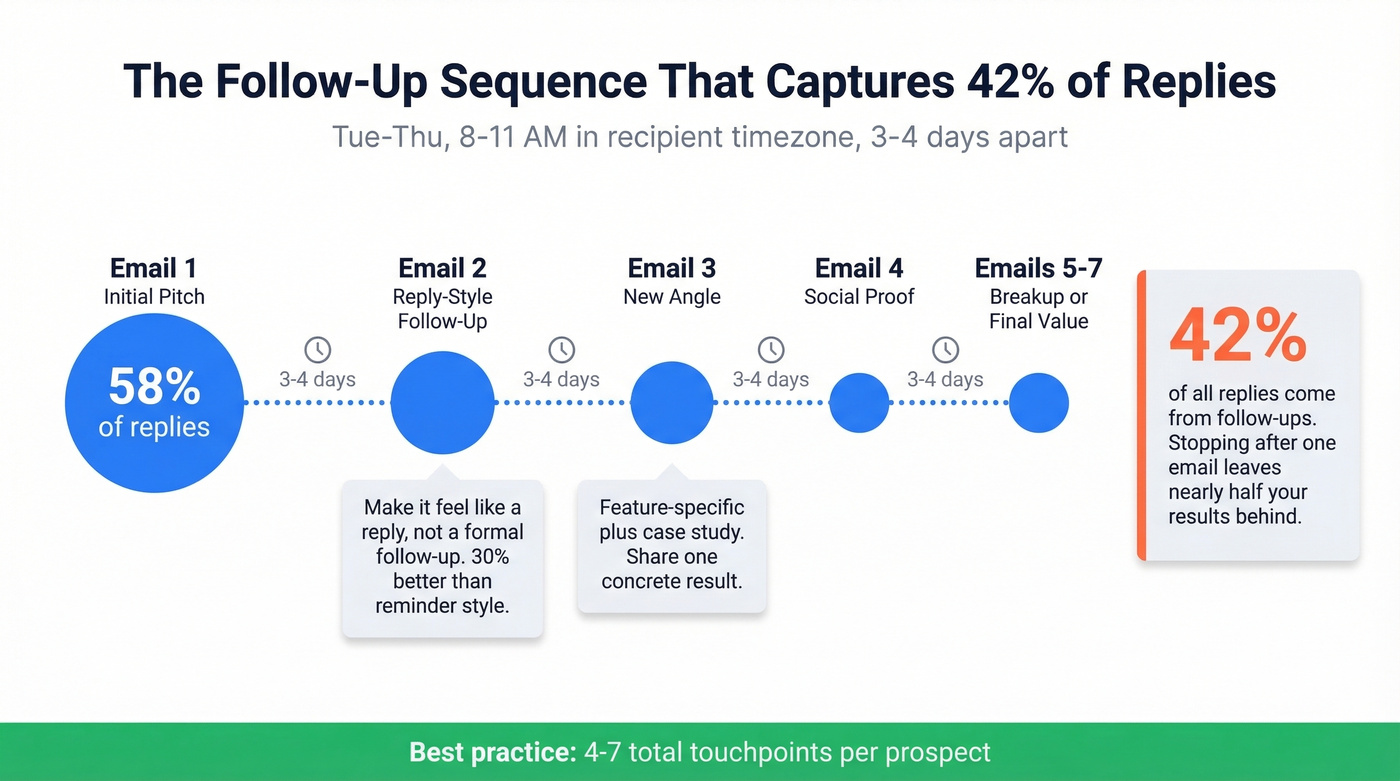
Aim for 4-7 total touchpoints, spaced 3-4 days apart. Send Tuesday through Thursday, 8-11 AM in the recipient's timezone - the case study reported a 16% open rate improvement from timing alone. Make step 2 feel like a reply, not a formal follow-up; that approach outperforms traditional reminder-style messages by roughly 30%. (If you want plug-and-play sequences, use these cold email follow-up templates.)
One tactic worth stealing: a "feature-specific + case study" follow-up where you share one concrete result. In one r/sales thread, this approach nearly doubled reply rates versus the initial email, with the poster claiming 12 meetings booked in a single day. The best cold pitch sequences treat each follow-up as a new angle, not a rehash of the original message.
Stay Legal
Cold email is legal. Sloppy cold email isn't.
CAN-SPAM (US): Include a valid physical address, a clear unsubscribe link, and accurate From/Reply-To fields. No deceptive subject lines. Honor opt-outs within 10 business days. (FTC CAN-SPAM guide)
GDPR (EU/UK): B2B outreach can use legitimate interest (Article 6(1)(f)) as your legal basis. Disclose how you found their info, provide an easy opt-out, and keep outreach relevant to the recipient's role. (Woodpecker's breakdown)
Skip the legal paranoia - just don't be shady. Relevant outreach to business contacts with a clear opt-out is fine in both frameworks.
Mistakes That Kill Reply Rates
- Not verifying your list. One bad batch can tank your domain for weeks. We've watched agencies lose months of warmup progress from a single unverified import.
- Sending from your primary domain. When it gets flagged, your entire company's email reputation suffers.
- Writing emails over 80 words. The data is unambiguous. Shorter wins.
- No follow-up plan. You're leaving 42% of your replies behind.
- Multiple CTAs or HTML-heavy formatting. Ask one question. Plain text, one link max.
You've got the 47-word template, the follow-up cadence, and the infrastructure checklist. Now you need contacts worth emailing. Prospeo gives you 300M+ profiles with 30+ filters - job changes, headcount growth, buyer intent - so every cold pitch lands with a relevant context hook built in.
Find the right prospects before you write a single word.
FAQ
How long should a cold pitch email be?
Under 80 words. The best 2026 campaigns cluster around 40-60 words. One case study saw reply rates double after cutting from 141 to under 56 words - every extra sentence gives the reader a reason to delete.
How many follow-ups should I send?
Four to seven total touchpoints. Instantly's 2026 benchmark shows 42% of replies come from follow-ups, so stopping after one email leaves nearly half your results behind. Space messages 3-4 days apart.
How do I keep cold emails out of spam?
Set up SPF, DKIM, and DMARC on secondary domains. Warm up 2-3 weeks before sending. Verify your list to keep bounces under 3%, and cap volume at 10-15 emails per account per day.
What's the best free tool for verifying email lists?
Prospeo's free tier includes 75 verified emails per month with its full 5-step verification process - catch-all handling, spam-trap removal, and honeypot filtering included. Hunter offers 25 free searches monthly but caps enrichment features, making Prospeo the stronger option for teams running real outbound campaigns.