

How to Write a Follow-Up Email Subject Line That Actually Gets Opened
42% of all campaign replies come from follow-ups, yet 48% of reps never send a second email. The ones who do? Most blow it with "Just checking in" - a subject line that says nothing and earns nothing.
Your subject line is the entire pitch for whether someone opens or ignores you. 69% of recipients report spam based on the subject line alone. With the average cold email open rate sitting at 27.7%, you can't afford a lazy follow-up competing against 120+ daily emails in a B2B decision-maker's inbox. That's a brutal filter, and "Touching base" doesn't survive it.
Here's the short version: front-load your message in the first 33 characters, use the PIQUE framework, never write "Just checking in," and verify the email address is real before you worry about the subject line - 17% of cold emails never reach the inbox in the first place.
The 33-Character Rule
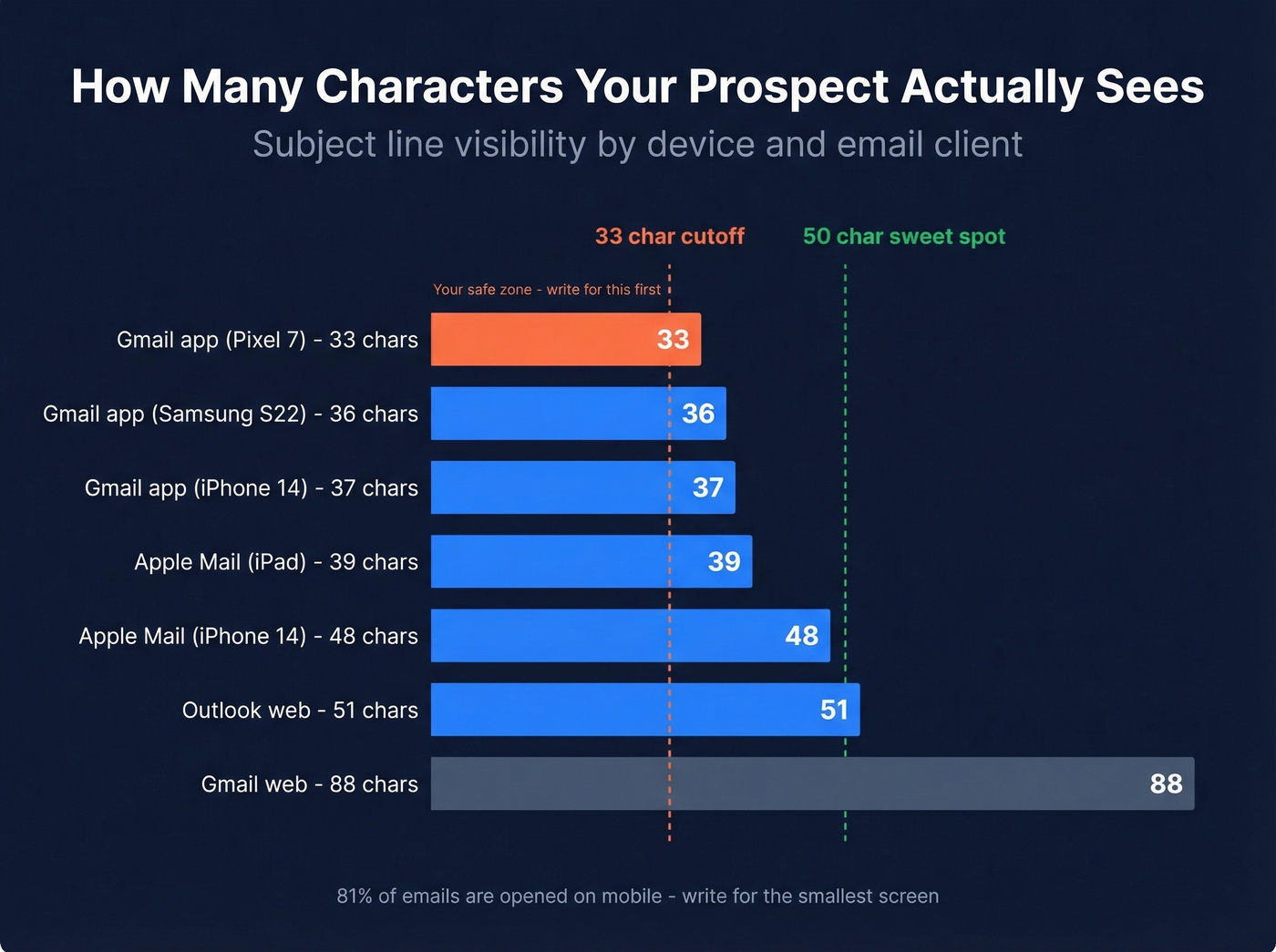
81% of emails are opened on mobile. That makes mobile the only screen that matters when you're writing subject lines. Here's what actually happens on real devices, per EmailToolTester's device-by-device breakdown:
| Device / Client | Max Visible Characters |
|---|---|
| Gmail app (Pixel 7) | 33 |
| Gmail app (Samsung S22) | 36 |
| Gmail app (iPhone 14) | 37 |
| Apple Mail (iPad 10th gen) | 39 |
| Apple Mail (iPhone 14) | 48 |
| Outlook web | 51 |
| Gmail web | 88 |
The tightest screen - Gmail on a Pixel - cuts you off at 33 characters. That's roughly six words. Your key message needs to land in those first 33 characters, even if the full subject line runs longer. Everything after character 33 is bonus context that many recipients won't see.
Keep total length under 50 characters, but write the first 33 as if they're the only ones that exist. Subject lines in the 36-50 character range consistently produce the best response rates.
Don't forget the preheader. That gray preview text after the subject line is free real estate. An EmailOpShop case study that boosted revenue 9% changed both the subject line and preheader together. Treat the preheader as your subject line's second sentence: use it to complete the thought, not repeat it. (If you want to go deeper, see preview text A/B testing.)
The PIQUE Framework
We've tested dozens of follow-up subject lines across outbound campaigns, and the ones that consistently earn opens share the same five traits. PIQUE gives you a mental checklist before you hit send:
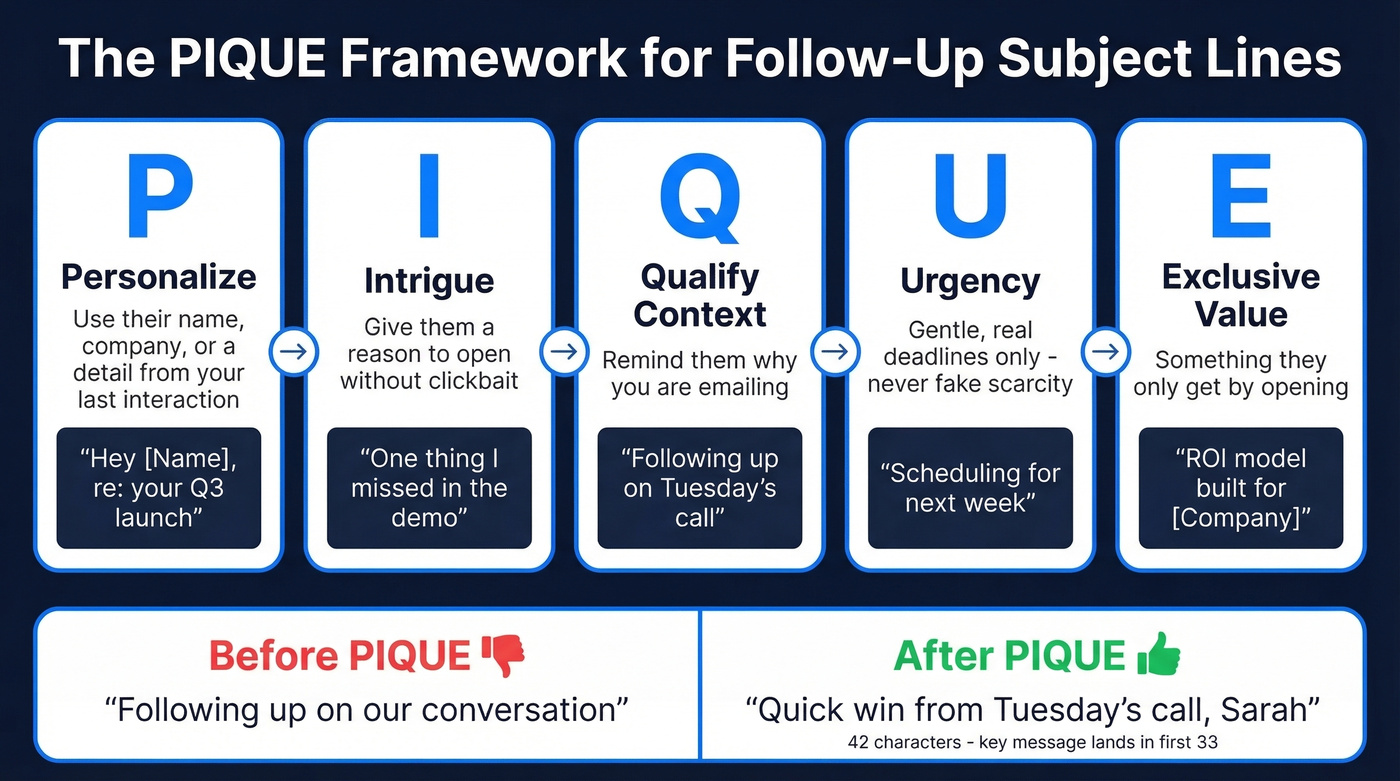
- Personalize - name, company, or a specific detail from your last interaction
- Intrigue - create a reason to open without resorting to clickbait
- Qualify context - remind them why you're emailing (the meeting, the proposal, the intro)
- Urgency - gentle, real deadlines only ("scheduling for next week" beats "ACT NOW")
- Exclusive value - something they can't get by ignoring you
Personalization is one of the most reliable levers you can pull. One benchmark from an Adestra study found emails addressing the recipient by name had a 22.2% higher chance of being read.
Let's see it in action. Generic subject line: "Following up on our conversation." After PIQUE: "Quick win from Tuesday's call, [Name]" - personalized, intriguing, context-qualified, with implied exclusivity. That's 42 characters, and the key message lands in the first 33.
Same thread or new thread? If your original email was relevant and recent (under a week), reply in the same thread - the RE: prefix is earned and provides instant context. If more than a week has passed or you're changing the topic, start a new thread with a fresh subject line. Fake RE: prefixes on cold emails are a different story - more on that below. (For more subject line patterns, see prospecting email subject lines.)
Subject Line Examples by Scenario
After a Meeting or Call
These work because they reference something specific. The recipient immediately remembers the conversation.
- "Next steps on [project name]"
- "The ROI model we discussed Tuesday"
- "3 takeaways from our call - plus one idea"
- "[Name], the [specific topic] follow-up"
If you need full follow-up sequences (not just subject lines), pull from these sales follow-up templates.
Cold Outreach Follow-Up
You're fighting for attention against 120+ daily emails. Lead with value, not guilt.
A tip from r/sales that works well in practice: use a calendar-based nudge. "Trying to finalize my schedule for next week - does [date] work?" reframes the follow-up as logistics, not desperation. It's a subtle shift, but it removes the needy energy that kills reply rates.
Launch your initial sequence on Monday - that's when B2B engagement peaks for first touches. Follow-ups land best on Wednesday. Here are subject lines B2B reps are using to earn opens:
- "[Competitor] solved this in 3 weeks"
- "Quick question about [specific initiative]"
- "30-sec read: [relevant metric] for [company]"
Test two variants per follow-up step. Run enough volume to avoid noise - 100+ sends per variant is a solid baseline before judging a winner. (More on building the full flow: B2B cold email sequence.)
After a Proposal or Demo
The goal here isn't pressure. It's making the next step feel easy. The best post-demo subject lines give the recipient a reason to re-engage that isn't "please buy."
"One thing I forgot to mention in the demo" works because it creates genuine curiosity. "Pricing valid through [date] - wanted to flag" works because it's a real deadline, not a manufactured one. And sometimes the simplest approach wins: "Any questions on the proposal?" removes friction by making the reply a one-word answer. (If you're tightening the whole demo-to-close motion, use this product demo checklist.)
After Being Ghosted
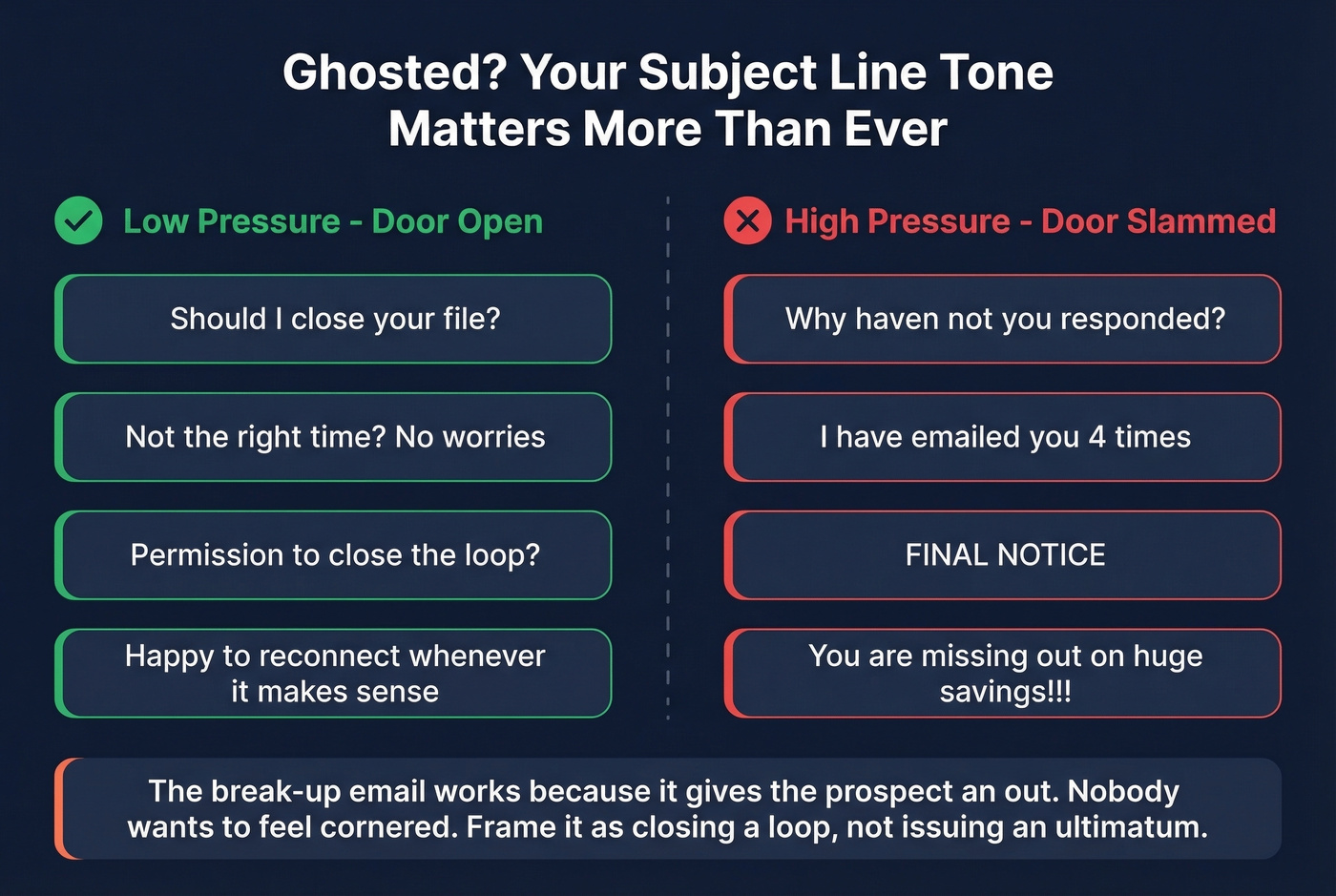
Low-pressure, door-open. These perform well because they remove obligation. The break-up email often becomes one of the highest-reply steps in a sequence, and getting the subject line right at this stage is critical.
| Do this | Not this |
|---|---|
| "Should I close your file?" | "Why haven't you responded?" |
| "Not the right time? No worries" | "I've emailed you 4 times" |
| "Permission to close the loop?" | "FINAL NOTICE" |
Here's the thing: the break-up email works precisely because it gives the prospect an out. Nobody wants to feel cornered. Frame it as closing a loop, not issuing an ultimatum. (More ideas: polite chaser email.)
Job Interview Follow-Up
Keep it professional and specific: "Thank you for the [role] conversation" or "Excited about [specific project discussed]." Reference something concrete from the interview - it proves you were listening and separates you from every other "Thank you for your time" in the hiring manager's inbox.
Skip this section if you're purely doing sales outreach - the tone rules are different enough that mixing interview etiquette with cold email tactics will hurt both.

You just spent time crafting the perfect follow-up subject line. Don't waste it on a dead email address. 17% of cold emails never reach the inbox - and bad data is the #1 reason. Prospeo's 5-step verification delivers 98% email accuracy, so your carefully written subject lines actually get seen.
Fix the data before you fix the subject line.
Words That Send You to Spam
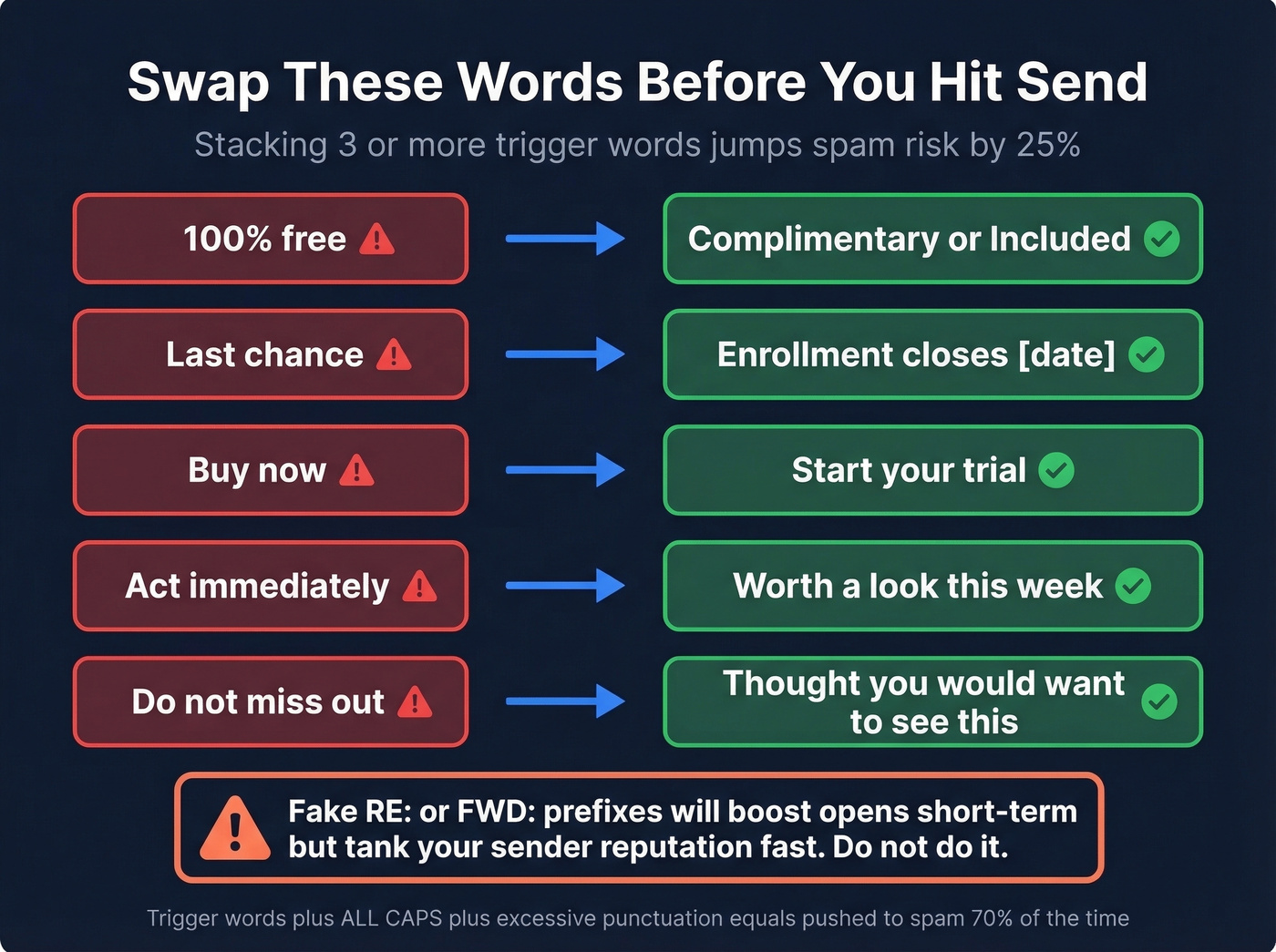
Single trigger words rarely kill deliverability on their own. But stack three or more together, and spam risk jumps 25%. Combine those with ALL CAPS or excessive punctuation, and trigger-word subject lines get pushed into spam territory 70% of the time.
| Instead of... | Say this... |
|---|---|
| "100% free" | "Complimentary" or "Included" |
| "Last chance" | "Enrollment closes [date]" |
| "Buy now" | "Start your trial" |
| "Act immediately" | "Worth a look this week" |
| "Don't miss out" | "Thought you'd want to see this" |
Fake RE: or FWD: prefixes deserve special mention. They'll boost opens short-term, but they're deceptive under CAN-SPAM and they'll tank your sender reputation fast. Don't do it. (If you're troubleshooting deliverability, start with this email deliverability guide and a quick email spam checker.)
Stop Measuring Opens
Open rates are broken. Apple Mail Privacy Protection inflates opens by 18 points across 80,000+ email accounts studied, and Apple Mail represents 46% of email clients. Your "45% open rate" might really be 27%.
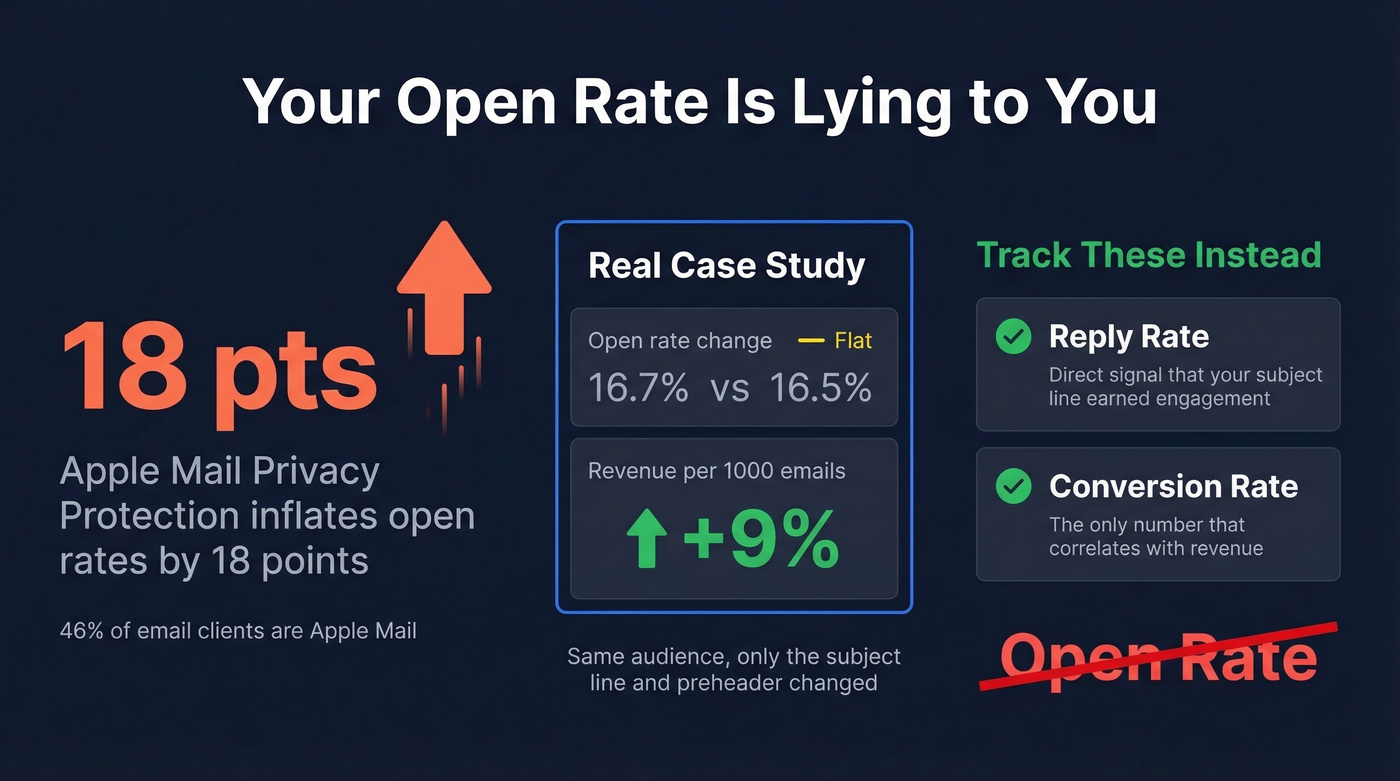
Open rate is one of the most misleading metrics on your dashboard. It feels good and often means nothing.
The proof? That same EmailOpShop case study changed only the subject line and preheader. Revenue per thousand emails jumped 9%. Open rate? Flat - 16.7% vs 16.5%. Track reply rate and conversion rate instead. Those are the numbers that correlate with revenue, and the real test of whether your subject lines earn replies, not just opens. (Benchmarks here: follow-up email reply rate.)
Subject Lines Don't Fix Bounces
You can nail every principle above and still get zero replies if 17% of your emails never reach the inbox. That's the cold email average for bounces and spam filtering. All that subject line craft? Wasted on dead addresses.
In our experience, the teams that see the biggest jump in reply rates aren't the ones obsessing over word choice - they're the ones who cleaned their list first. Prospeo's 5-step email verification handles catch-all domains, spam-trap removal, and honeypot filtering, delivering 98% email accuracy across 143M+ verified addresses. Upload a CSV, get results in minutes, and push clean contacts straight to your sequencer. (If you're diagnosing list quality, start with email bounce rate and spam trap removal.)

Testing two subject line variants per step means nothing if you're emailing outdated contacts. Prospeo refreshes 300M+ profiles every 7 days - not every 6 weeks like competitors. Your A/B tests run on real, reachable inboxes, giving you clean data on what subject lines actually win.
Start every follow-up sequence with emails that actually exist.
FAQ
How long should a follow-up email subject line be?
Under 50 characters total, with the key message in the first 33. Gmail on Android - the tightest major client - cuts off at 33 characters. Write those first six words as if they're the only ones your recipient will see, then use the remaining space for supporting context.
What's a good subject line for a follow-up email?
A good subject line is specific, concise, and gives the recipient a reason to open. Reference something concrete - a date, a project name, a metric - rather than defaulting to vague phrases like "Touching base." Lead with value or context in the first 33 characters, and make the next step obvious.
How many follow-ups should you send before stopping?
Three to five, spaced a few business days apart. 42% of all campaign replies come from follow-up messages, so stopping after one email leaves nearly half your potential responses on the table. The break-up email often drives the most replies because it removes pressure.
How do I keep follow-up subject lines out of spam?
Avoid stacking trigger words like "free," "act now," or "last chance." Skip ALL CAPS and excessive punctuation. Use the swap table above to replace high-risk phrases with natural alternatives. Most importantly, verify every address before sending - bounces wreck sender reputation faster than any trigger word.
How do I make sure my follow-up emails don't bounce?
Verify every email address before sending. A 5-step verification process that includes catch-all handling and spam-trap removal can keep bounce rates under 2%. Clean data protects your sender reputation so future emails actually land in the inbox instead of getting filtered.